
Uniform Market Size and Share
Market Overview
| Study Period | 2021 - 2031 |
|---|---|
| Market Size (2026) | USD 63.48 Billion |
| Market Size (2031) | USD 85.13 Billion |
| Growth Rate (2026 - 2031) | 6.05 % |
| Fastest Growing Market | Middle East and Africa |
| Largest Market | Asia-Pacific |
| Market Concentration | Low |
Major Players
*Disclaimer: Major Players sorted in no particular order Image © Mordor Intelligence. Reuse requires attribution under CC BY 4.0. |
|
Uniform Market Analysis by Mordor Intelligence
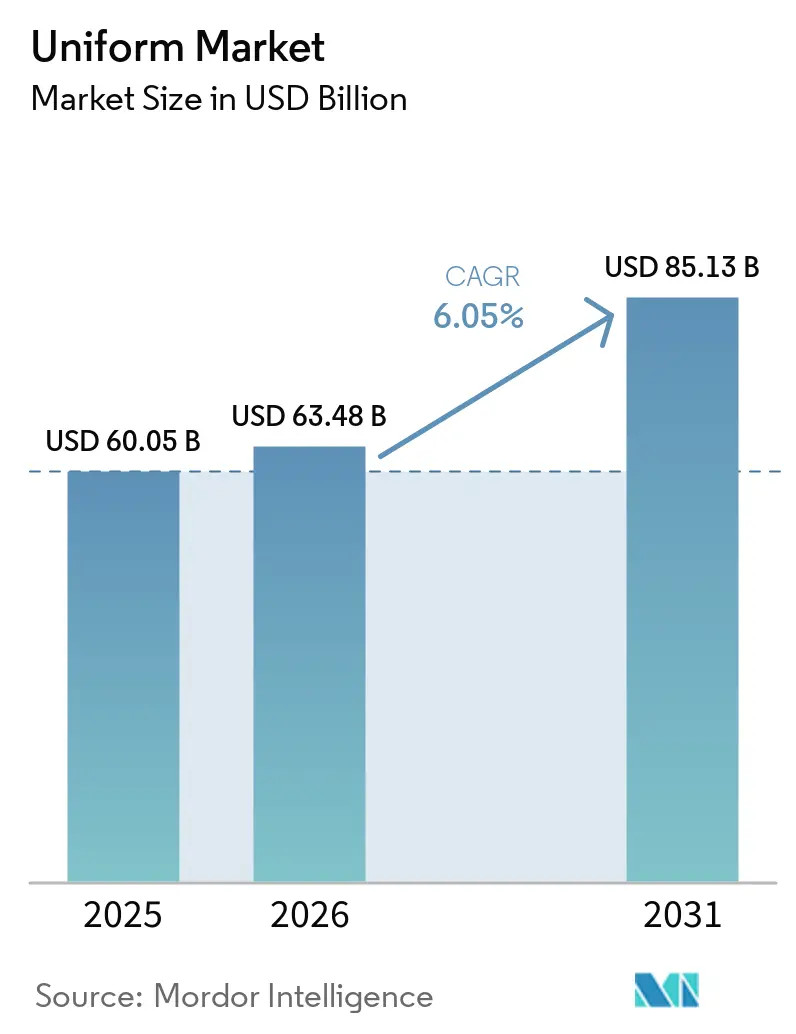
The uniform market size is expected to grow from USD 60.05 billion in 2025 to USD 63.48 billion in 2026 and is forecast to reach USD 85.13 billion by 2031 at a 6.05% CAGR over 2026-2031. The uniform market is experiencing steady growth, driven by expanding employment across healthcare, manufacturing, hospitality, logistics, and other service industries, along with increasing emphasis on workplace safety, regulatory compliance, and corporate branding. Organizations are adopting standardized uniforms to strengthen brand identity, improve employee safety, and maintain a consistent professional appearance. Demand is also shifting toward durable, functional, and sustainable fabrics that improve wearer comfort and reduce lifecycle costs. Digital procurement platforms and managed uniform service models are streamlining purchasing, inventory management, and replacement processes, improving program efficiency for businesses across various end-use sectors.
Key Report Takeaways
- By product type, corporate uniforms held 28.74% of the 2025 Uniform market share, while industrial uniforms are projected to grow at a 7.05% CAGR from 2026 to 2031.
- By fabric type, polyester accounted for 41.23% share of the Uniform market size in 2025, while blended fabrics are forecast to expand at a 7.53% CAGR through 2031.
- By distribution channel, offline sales captured 66.13% share in 2025, while online channels are expected to record the fastest growth at an 8.13% CAGR through 2031.
- By geography, Asia-Pacific held 39.11% share in 2025, while the Middle East and Africa is projected to advance at a 6.95% CAGR from 2026 to 2031.
Note: Market size and forecast figures in this report are generated using Mordor Intelligence’s proprietary estimation framework, updated with the latest available data and insights as of January 2026.
Global Uniform Market Trends and Insights
Drivers Impact Analysis*
| Driver | (~) % Impact on CAGR Forecast | Geographic Relevance | Impact Timeline |
|---|---|---|---|
| Increasing emphasis on workplace safety and regulatory compliance | +1.8% | Global, with concentrated impact in North America and Europe | Short term (≤ 2 years) |
| Growing demand for corporate branding and employee identity programs | +1.2% | Global; strongest in North America, Europe, and Asia-Pacific service sectors | Medium term (2–4 years) |
| Rising participation in organized sports and team-based activities | +0.7% | North America, Asia-Pacific core, spill-over to Middle East and Africa | Medium term (2–4 years) |
| Rising employment across healthcare, hospitality, manufacturing, and logistics | +1.5% | Global; Asia-Pacific core and Middle East and Africa fastest-accelerating | Long term (≥ 4 years) |
| Growing preference for sustainable and durable uniform solutions | +0.6% | Europe (regulatory lead), North America, Asia-Pacific spill-over | Medium term (2–4 years) |
| Advancements in high-performance and functional uniform fabrics | +0.8% | Global, with Research and Development concentration in Europe and East Asia | Long term (≥ 4 years) |
| Source: Mordor Intelligence | |||
Increasing Emphasis on Workplace Safety and Regulatory Compliance
Governments and regulatory authorities worldwide are strengthening workplace safety requirements, encouraging employers to invest in standardized uniforms and protective workwear that comply with occupational health regulations. Industries such as manufacturing, construction, healthcare, food processing, and utilities increasingly require role-specific garments to improve worker safety, hygiene, and operational compliance. The International Labour Organization (ILO) continues to monitor global occupational safety indicators, reinforcing the importance of preventive safety measures and compliance across workplaces. This sustained regulatory focus is supporting long-term demand for compliant occupational apparel. The growing emphasis on compliance is further reinforced by enforcement initiatives from agencies such as the Occupational Safety and Health Administration (OSHA) in the United States. OSHA requires establishments in covered industries to electronically submit workplace injury and illness data through its Injury Tracking Application, strengthening oversight of workplace safety practices. As employers continue investing in measures that reduce occupational risks and comply with evolving regulations, demand for certified uniforms and protective workwear is expected to remain a key driver of the global uniform market.
Growing Demand for Corporate Branding and Employee Identity Programs
Organizations across retail, hospitality, healthcare, aviation, logistics, and other customer-facing industries are increasingly adopting standardized uniforms to strengthen corporate identity and maintain a consistent brand image. Uniforms make employees easily recognizable while reinforcing professionalism, trust, and service quality during customer interactions. As businesses expand across multiple locations and franchise networks, maintaining a unified visual identity through branded apparel has become an important component of corporate branding strategies. The growing focus on employee identity and brand consistency is encouraging organizations to invest in customized uniform programs that incorporate company logos, colors, and role-specific designs. Beyond enhancing brand visibility, standardized uniforms support team cohesion, simplify employee identification, and contribute to a more organized workplace environment. These factors are driving continued demand for uniforms across both private and public sector organizations, supporting long-term market growth.
Rising Participation in Organized Sports and Team-Based Activities
Growing participation in organized sports, school athletics, amateur leagues, and recreational clubs is driving demand for team uniforms across educational institutions, sports organizations, and community programs. Uniforms support team identity, improve player recognition, and create a professional appearance during competitions and training. As investments in grassroots sports and organized athletic programs continue to expand, demand for customized sports apparel and team uniforms is expected to grow across both youth and adult segments. Recent participation trends reflect the strength of this demand. According to the Sports & Fitness Industry Association (SFIA), a record 250 million Americans participated in at least one sport, fitness, or outdoor activity in 2025, the highest level since the association began tracking participation[1]Source: Sport & Fitness Industry Association, "Participation Hits New High, but Majority of Americans Not Yet Meeting Recommended Guidelines of Weekly Activity, SFIA’s 2026 Topline Report Finds", sfia.org. The SFIA also reported that team sports exceeded 90 million participants for the first time in 2025, reflecting continued growth in organized and recreational athletic activities[2]Source: Sport & Fitness Industry Association, "Participation Hits New High, but Majority of Americans Not Yet Meeting Recommended Guidelines of Weekly Activity, SFIA’s 2026 Topline Report Finds", sfia.org. Separately, the National Federation of State High School Associations (NFHS) reported an all-time high of 8,062,302 participants in U.S. high school sports during the 2023–24 school year, an increase of 210,469 participants over the previous year[3]Source: National Federation of State High School Associations, "Participation in High School Sports Tops Eight Million for First Time in 2023-24", nfhs.org. This growing participation expected to sustain demand for team apparel and uniforms across schools, clubs, and recreational leagues.
Rising Employment Across Healthcare, Hospitality, Manufacturing, and Logistics
Growing employment across healthcare, hospitality, manufacturing, logistics, and other labor-intensive industries is creating sustained demand for uniforms as organizations expand their workforce and onboard new employees. These sectors require standardized apparel to enhance workplace safety, maintain hygiene standards, ensure regulatory compliance, and promote a professional corporate image. As businesses increase staffing levels to support operational growth, uniform procurement remains an essential component of workforce management. The expansion of service-oriented industries and industrial operations is further reinforcing the need for role-specific uniforms designed to meet functional and operational requirements. Employers are increasingly investing in durable, comfortable, and purpose-built workwear that improves employee performance while supporting consistent brand identity across multiple locations. Beyond new employee onboarding, recurring replacement cycles driven by garment wear and changing workforce requirements continue to generate steady demand for uniforms across a wide range of end-use industries.
Restraints Impact Analysis*
| Restraint | (~) % Impact on CAGR Forecast | Geographic Relevance | Impact Timeline |
|---|---|---|---|
| Volatility in raw material and textile input costs | -1.2% | Global; concentrated impact in Asia-Pacific manufacturing hubs | Short term (≤ 2 years) |
| Environmental concerns associated with textile waste and frequent uniform replacement | -0.5% | Europe (regulatory pressure), North America and Asia-Pacific spill-over | Medium term (2–4 years) |
| Customization and sizing complexities across diverse workforce requirements | -0.5% | Global; concentrated in fragmented markets across South Asia, Middle East and Africa, and South America | Medium term (2–4 years) |
| Counterfeit and unauthorized uniform production creating security and brand integrity risks | -0.3% | Global; heightened risk in Asia-Pacific manufacturing hubs and North America event merchandise markets | Short term (≤ 2 years) |
| Source: Mordor Intelligence | |||
Volatility in Raw Material and Textile Input Costs
Fluctuations in the prices of key raw materials, including cotton, polyester, specialty fibers, dyes, and textile chemicals, pose a significant challenge for uniform manufacturers. Changes in commodity prices, energy costs, and transportation expenses can increase production costs and create uncertainty in procurement and pricing strategies. As uniforms are often supplied under long-term contracts with fixed pricing, manufacturers may face margin pressure when input costs rise unexpectedly. Supply chain disruptions and fluctuations in the availability of textile inputs add to sourcing complexities, particularly for manufacturers serving multiple regions. Rising costs of fabrics, trims, and finishing materials can also affect production timelines and inventory planning, making it more difficult to maintain competitive pricing. These factors encourage manufacturers to diversify sourcing strategies and optimize material utilization, but continued volatility in textile input costs remains a key restraint on the growth of the global uniform market.
Environmental Concerns Associated with Textile Waste and Frequent Uniform Replacement
Growing environmental concerns are increasing scrutiny of textile waste generated through frequent uniform replacement and disposal. Uniforms used in industries such as healthcare, hospitality, manufacturing, and corporate services are often replaced due to wear, branding updates, or changing workplace requirements, resulting in substantial volumes of discarded garments. This has raised concerns about landfill waste, resource consumption, and the environmental impact of textile production and disposal. In response, organizations are placing greater emphasis on extending garment lifecycles, improving textile recyclability, and adopting more sustainable procurement practices. However, transitioning to recycled fibers, circular textile programs, and environmentally responsible manufacturing processes often involves higher material and operational costs. Balancing sustainability objectives with durability, performance, and cost-effectiveness remains a challenge for both uniform manufacturers and end users, restraining broader market growth.
*Our forecasts treat driver/restraint impacts as directional, not additive. The impact forecasts reflect baseline growth, mix effects, and variable interactions.
Segment Analysis
By Product Type: Industrial Surge Reframes Sector Mix
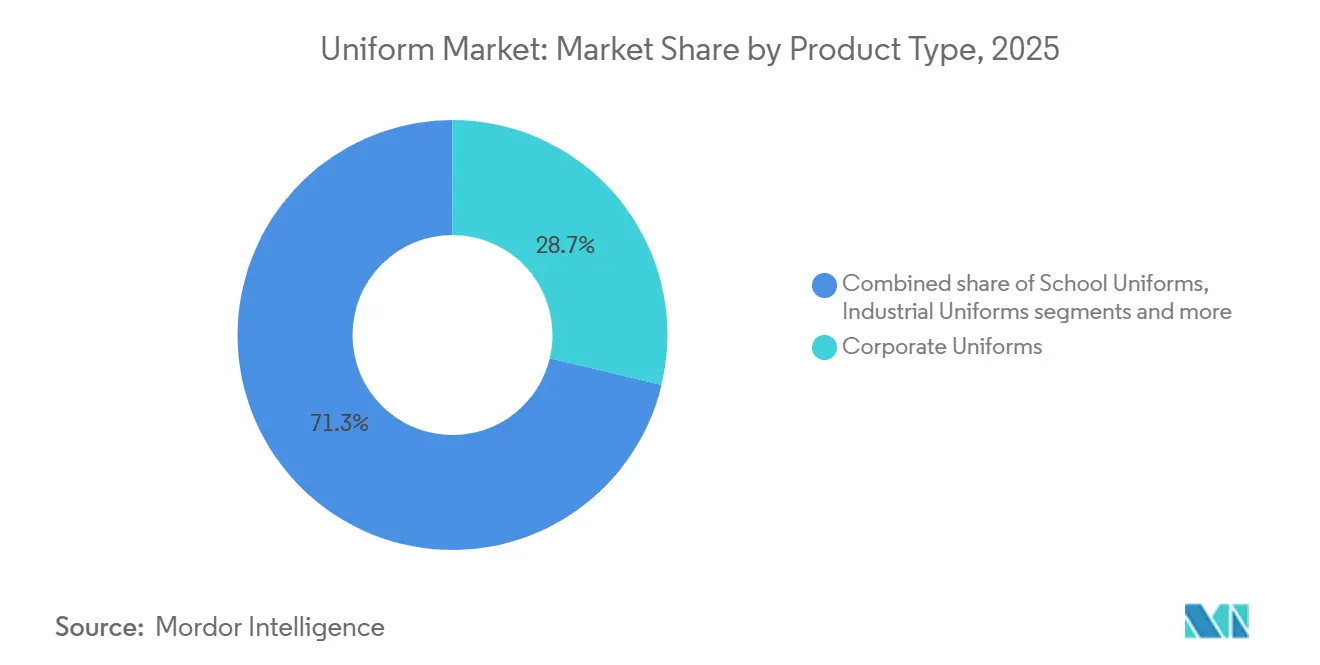
Corporate uniforms accounted for the largest share of 28.74% in 2025, driven by widespread adoption across banking, hospitality, retail, aviation, healthcare, and other customer-facing industries. Organizations increasingly use standardized uniforms to reinforce corporate identity, maintain a professional appearance, and improve employee recognition while ensuring consistency across multiple business locations. Regular workforce expansion, employee replacement cycles, and periodic branding updates further support steady procurement of corporate uniforms, contributing to the segment's market leadership.
Industrial uniforms are projected to register the fastest CAGR of 7.05% during 2026–2031, supported by growing employment in manufacturing, construction, logistics, utilities, and energy sectors. Rising emphasis on workplace safety, regulatory compliance, and employee protection is driving demand for durable, high-performance garments designed for hazardous and physically demanding work environments. School uniforms continue to benefit from mandatory dress policies in many educational institutions, while sports, military, hospitality, and specialty uniforms maintain stable demand driven by institutional procurement, organized sporting activities, and expanding service-sector employment.



By Fabric Type: Blended Constructions Disrupt Polyester's Share
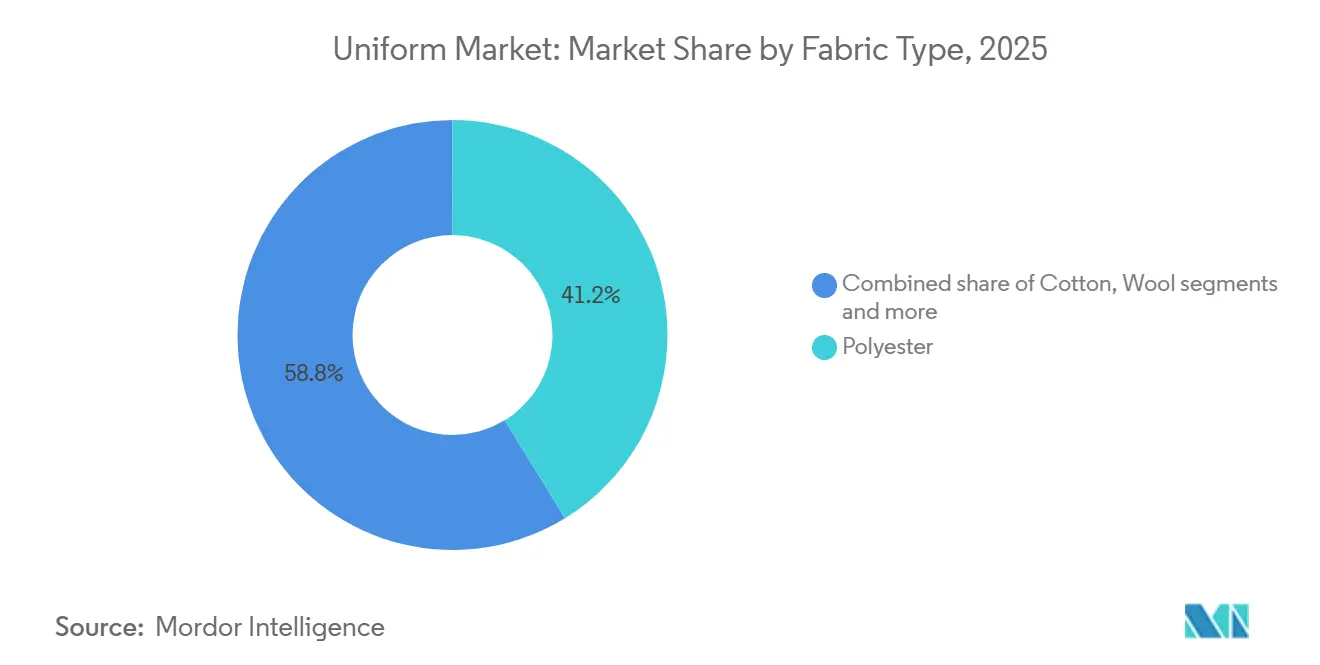
Polyester accounted for the largest market share of 41.23% in 2025, driven by its cost-effectiveness, durability, and suitability for large-scale uniform production across industrial, corporate, healthcare, hospitality, and educational applications. Its wrinkle resistance, color retention, moisture management properties, and ease of maintenance make it a preferred choice for organizations seeking long-lasting uniforms with lower lifecycle costs. The widespread availability of polyester fabrics and established manufacturing capabilities further support its dominant position in the market.
Blended fabrics are projected to register the fastest CAGR of 7.53% during 2026–2031, driven by increasing demand for uniforms that offer an optimal balance of durability, comfort, flexibility, and functional performance. By combining the strengths of multiple fibers, blended fabrics improve wearer comfort while meeting the performance requirements of diverse workplace environments. Cotton continues to be preferred for applications prioritizing breathability and comfort, while wool, flame-resistant fabrics, and other specialized textiles maintain steady demand in formal, hazardous, and high-performance occupational settings where specific functional properties are required.
By Distribution Channel: Online Platforms Narrow the Offline Lead
Offline channels accounted for the largest market share of 66.13% in 2025, driven by the complex procurement requirements of institutional buyers across corporate, healthcare, industrial, hospitality, and public-sector organizations. Many businesses prefer direct engagement with suppliers for product evaluation, size fitting, customization, bulk order management, and after-sales support. Long-term supply contracts, managed uniform programs, and rental services also contribute to the continued dominance of offline distribution, particularly for organizations with large and geographically dispersed workforces.
Online channels are projected to register the fastest CAGR of 8.13% during 2026–2031, supported by the rapid adoption of digital procurement platforms and B2B e-commerce solutions. Organizations are increasingly using online portals for bulk ordering, employee-specific catalog access, inventory tracking, and order replenishment, improving procurement efficiency and reducing administrative effort. The growing availability of customization tools, integrated procurement systems, and digital order management capabilities is enabling businesses of all sizes to streamline uniform purchasing, supporting the continued expansion of online distribution channels.
Geography Analysis
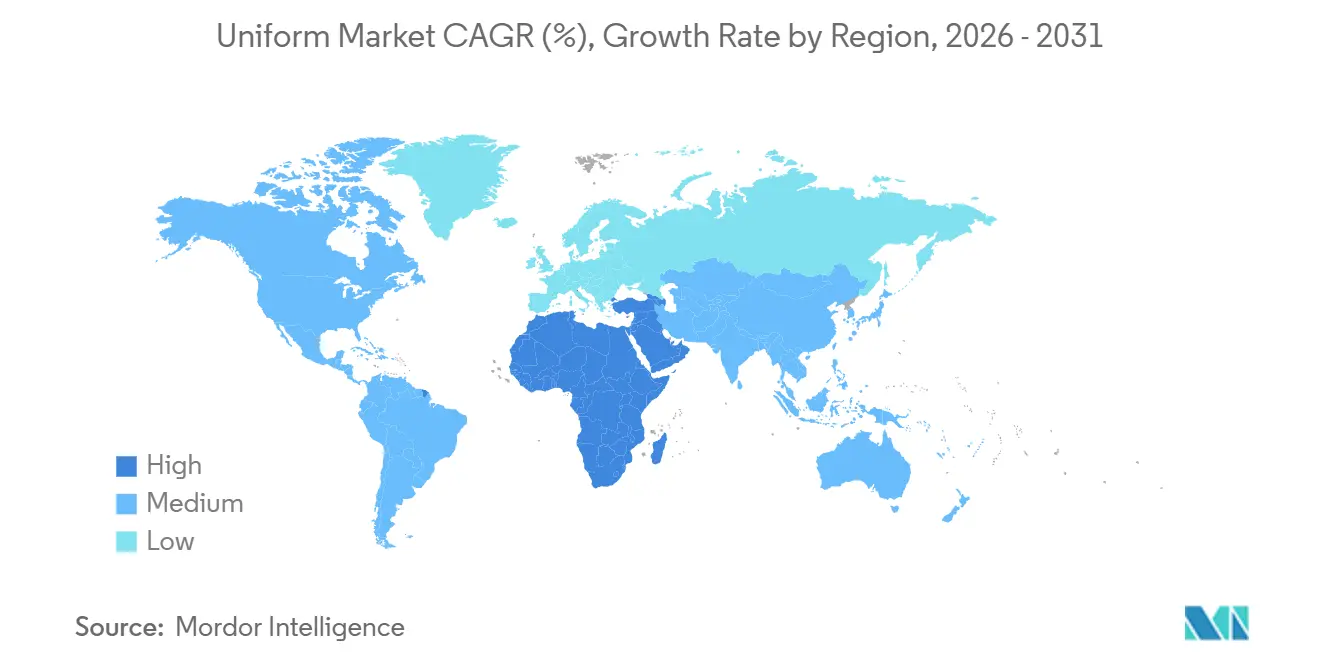
Asia-Pacific accounted for the largest share of 39.11% of the global uniform market in 2025, supported by its large manufacturing workforce, expanding healthcare and hospitality sectors, and increasing adoption of standardized uniforms across industrial and service industries. The region benefits from a strong textile manufacturing base, enabling cost-effective production and a wide range of fabric options. Rising formal employment, urbanization, and growing investments in workplace safety and corporate branding continue to support uniform demand across countries such as China, India, Japan, and Southeast Asian economies.
The Middle East and Africa is projected to register the fastest CAGR of 6.95% during 2026–2031, driven by expanding infrastructure projects, industrial diversification, and workforce growth across construction, manufacturing, healthcare, and hospitality sectors. Governments and private organizations are increasing investments in workplace safety, while the expansion of tourism, logistics, and public services is creating additional demand for occupational and service uniforms. Growing industrialization and rising institutional procurement across several countries are expected to further accelerate market growth throughout the forecast period.
North America and Europe represent mature markets characterized by well-established workplace safety regulations, high levels of workforce formalization, and widespread adoption of managed uniform programs across commercial and industrial sectors. Demand in these regions is primarily supported by replacement cycles, regulatory compliance, and ongoing investments in employee safety and corporate identity initiatives. Meanwhile, South America is witnessing steady growth as manufacturing, mining, food processing, and service industries continue to expand, creating new opportunities for uniform adoption across both industrial and customer-facing occupations.

Competitive Landscape
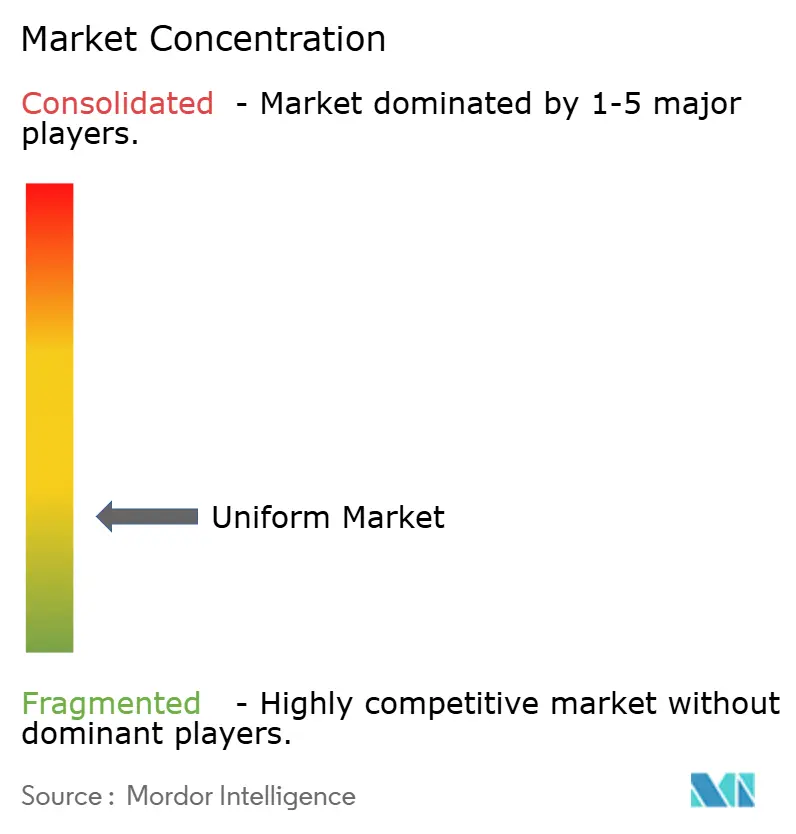
The global uniform market is fragmented, with competition shaped by multinational manufacturers, managed uniform service providers, and regional suppliers serving specific industries and institutional buyers. Market participants compete across a broad range of product categories, including corporate, industrial, healthcare, hospitality, educational, and specialty uniforms. Long-term supply contracts, customization capabilities, product quality, and service reliability are key competitive differentiators, while regional manufacturers maintain a strong presence in local procurement markets.
Leading companies such as Cintas Corporation, Vestis Corporation, UniFirst Corporation, VF Corporation, and Alsico Group compete by expanding their product portfolios, strengthening managed uniform service offerings, investing in digital procurement capabilities, and enhancing customization solutions for enterprise customers. Strategic acquisitions, manufacturing expansion, and sustainability initiatives have become increasingly important as companies seek to broaden their geographic reach and improve operational efficiency while addressing evolving customer requirements across multiple end-use industries.
Regional manufacturers and niche uniform suppliers continue to play an important role by offering industry-specific products, flexible order volumes, faster delivery, and tailored customization services for local customers. Many smaller companies are also adopting sustainable materials, digital ordering platforms, and value-added services such as inventory management and garment maintenance to differentiate themselves from larger competitors. As customer expectations continue to evolve, competition is expected to remain centered on product innovation, service quality, operational flexibility, and long-term client relationships.
Uniform Industry Leaders
-
Cintas Corporation
-
Vestis Corporation
-
UniFirst Corporation
-
VF Corporation
-
Alsico Group
- *Disclaimer: Major Players sorted in no particular order

Recent Industry Developments
- June 2026: Engelbert Strauss GmbH & Co. KG announced the go-live of its integrated logistics partnership with DHL Supply Chain in Columbus, Ohio. The new facility combines warehousing, fulfillment, and in-house embroidery and print customization, strengthening the company's B2B workwear operations and supporting its continued expansion in the North American uniform market.
- March 2026: Cintas Corporation announced a definitive agreement to acquire UniFirst Corporation in a transaction valued at approximately USD 5.5 billion. The acquisition is expected to strengthen the combined company's uniform rental, facility services, and workplace solutions capabilities across North America, while expanding operational capacity and service offerings, subject to customary regulatory and shareholder approvals.
- November 2025: VF Corporation completed the sale of the Dickies brand to Bluestar Alliance for USD 600 million, transferring ownership of the global workwear brand to support its continued expansion under Bluestar Alliance while enabling VF Corporation to streamline its brand portfolio.
- October 2025: Delta Plus Group acquired Gevanta, a Lithuania-based manufacturer specializing in premium workwear, to strengthen its presence in the Baltic region and expand its high-end workwear portfolio. The acquisition supports the company's strategy to enhance its premium product offerings and broaden its geographic footprint across Northern and Eastern Europe.


Global Uniform Market Report Scope
Uniforms are standardized garments designed for use across workplaces, educational institutions, sports, military, and other professional environments, providing a consistent appearance while meeting functional and safety requirements. The uniform market is segmented by product type, fabric type, distribution channel, and geography. Based on product type, the market is segmented into corporate uniforms, school uniforms, industrial uniforms, sports uniforms, hospitality uniforms, military uniforms, workwear uniforms, and specialty uniforms. By fabric type, the market is segmented into cotton, polyester, wool, blended fabrics, fire-resistant fabrics, and other performance fabrics. Based on distribution channel, the market is segmented into online stores and offline stores. Geographically, the market covers North America, Europe, Asia-Pacific, South America, and the Middle East and Africa. For each segment, the market sizing and forecasting have been done in value terms (USD billion).
| Corporate Uniforms |
| School Uniforms |
| Industrial Uniforms |
| Sports Uniforms |
| Hospitality Uniforms |
| Military Uniforms |
| Workwear Uniforms |
| Specialty Uniforms |
| Cotton |
| Polyester |
| Wool |
| Blended Fabrics |
| Fire-Resistant Fabrics |
| Other Performance Fabrics |
| Online Stores |
| Offline Stores |
| North America | United States |
| Canada | |
| Mexico | |
| Rest of North America | |
| Europe | Germany |
| United Kingdom | |
| Italy | |
| France | |
| Spain | |
| Netherlands | |
| Poland | |
| Belgium | |
| Sweden | |
| Rest of Europe | |
| Asia-Pacific | China |
| India | |
| Japan | |
| Australia | |
| Indonesia | |
| South Korea | |
| Thailand | |
| Singapore | |
| Rest of Asia-Pacific | |
| South America | Brazil |
| Argentina | |
| Colombia | |
| Chile | |
| Peru | |
| Rest of South America | |
| Middle East and Africa | South Africa |
| Saudi Arabia | |
| United Arab Emirates | |
| Nigeria | |
| Egypt | |
| Morocco | |
| Turkey | |
| Rest of Middle East and Africa |
| By Product Type | Corporate Uniforms | |
| School Uniforms | ||
| Industrial Uniforms | ||
| Sports Uniforms | ||
| Hospitality Uniforms | ||
| Military Uniforms | ||
| Workwear Uniforms | ||
| Specialty Uniforms | ||
| By Fabric Type | Cotton | |
| Polyester | ||
| Wool | ||
| Blended Fabrics | ||
| Fire-Resistant Fabrics | ||
| Other Performance Fabrics | ||
| By Distribution Channel | Online Stores | |
| Offline Stores | ||
| By Geography | North America | United States |
| Canada | ||
| Mexico | ||
| Rest of North America | ||
| Europe | Germany | |
| United Kingdom | ||
| Italy | ||
| France | ||
| Spain | ||
| Netherlands | ||
| Poland | ||
| Belgium | ||
| Sweden | ||
| Rest of Europe | ||
| Asia-Pacific | China | |
| India | ||
| Japan | ||
| Australia | ||
| Indonesia | ||
| South Korea | ||
| Thailand | ||
| Singapore | ||
| Rest of Asia-Pacific | ||
| South America | Brazil | |
| Argentina | ||
| Colombia | ||
| Chile | ||
| Peru | ||
| Rest of South America | ||
| Middle East and Africa | South Africa | |
| Saudi Arabia | ||
| United Arab Emirates | ||
| Nigeria | ||
| Egypt | ||
| Morocco | ||
| Turkey | ||
| Rest of Middle East and Africa | ||


Key Questions Answered in the Report
What is the current size of the Uniform market?
The Uniform market was valued at USD 60.05 billion in 2025 and is estimated at USD 63.48 billion in 2026, before reaching USD 85.13 billion by 2031.
How fast is demand expected to grow through 2031?
The Uniform market is projected to expand at a 6.05% CAGR from 2026 to 2031, supported by employment growth, safety compliance, and stronger branded uniform programs.
Which product category leads global demand?
Corporate uniforms held the largest 2025 share at 28.74%, showing the importance of branded employee programs in service-heavy sectors.
Which region leads the global landscape?
Asia-Pacific led with 39.11% share in 2025, supported by industrial scale in China, organized employment growth in India, and mature procurement systems in Japan.
Page last updated on:


 Your data is secure and never sold or shared.


