
Market Overview
| Study Period | 2020 - 2031 |
|---|---|
| Forecast Data Period | 2026 - 2031 |
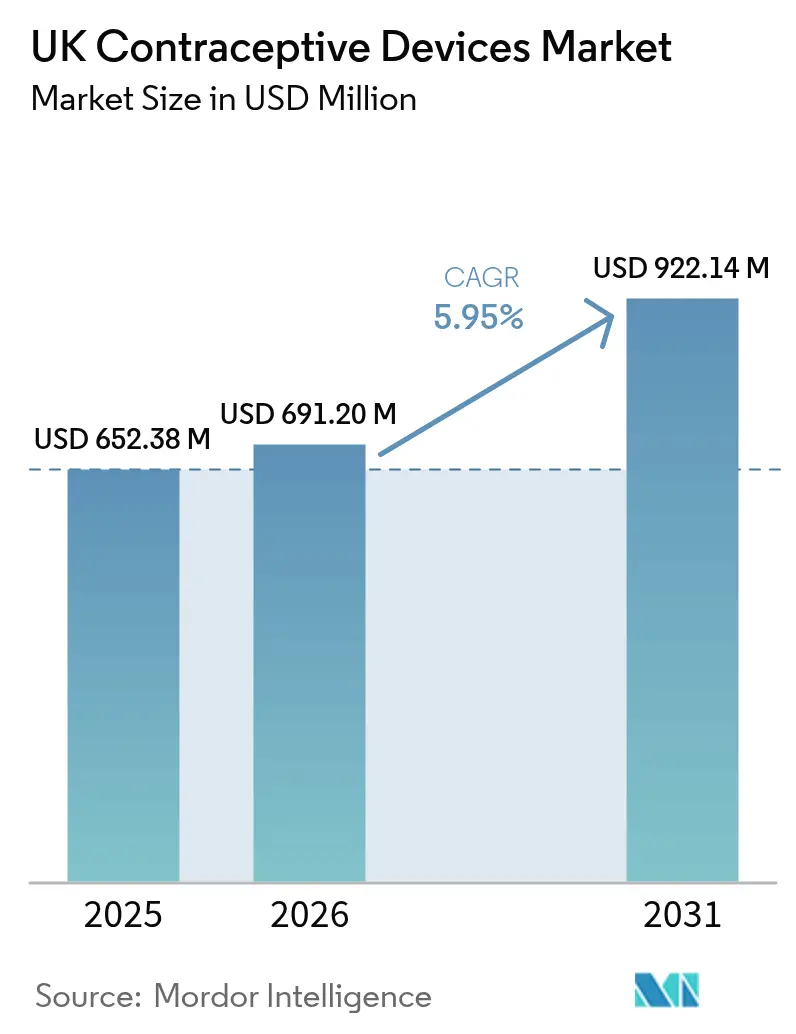
| Base Year Market Size (2025) | USD 652.38 Million |
| Market Size (2026) | USD 691.2 Million |
| Market Size (2031) | USD 922.14 Million |
| Growth Rate (2026 - 2031) | 5.95 % |
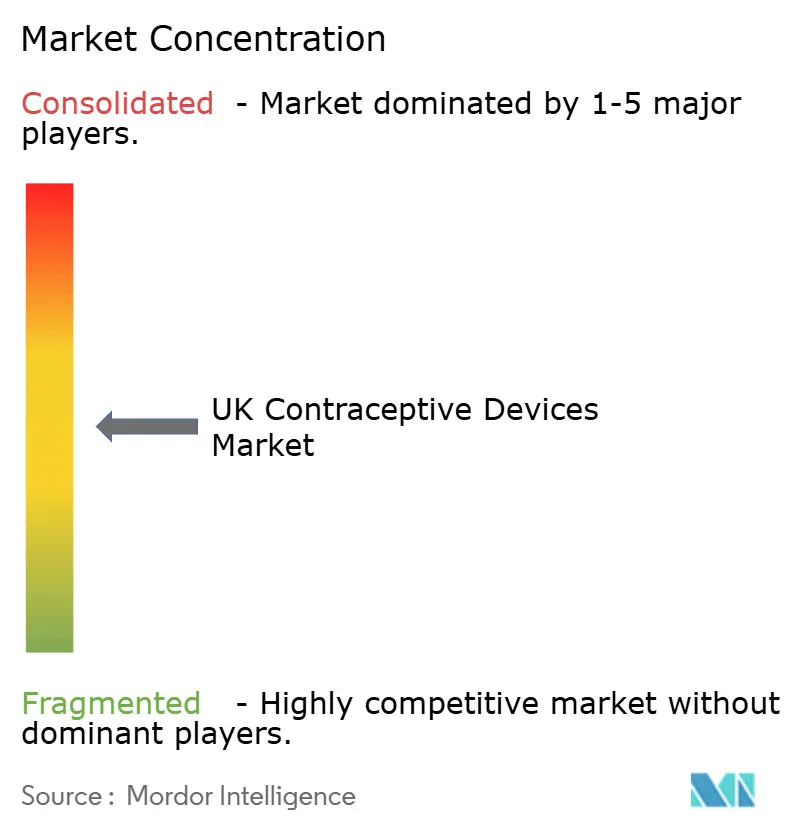
| Market Concentration | Medium |
Major Players *Disclaimer: Major Players sorted in no particular order Image © Mordor Intelligence. Reuse requires attribution under CC BY 4.0. | |
UK Contraceptive Devices Market Analysis by Mordor Intelligence
UK contraceptive devices market size in 2026 is estimated at USD 691.2 million, growing from 2025 value of USD 652.38 million with 2031 projections showing USD 922.14 million, growing at 5.95% CAGR over 2026-2031. This expansion reflects the National Health Service’s (NHS) preventive-care emphasis, a regulatory climate that rewards product safety, and persistent demographic trends that sustain demand for reliable birth-control technologies. Rising sexually transmitted infection (STI) rates, notably the 85,223 gonorrhoea diagnoses recorded in 2023, keep dual-protection methods such as condoms squarely in focus.[1]The Medicines and Healthcare products Regulatory Agency (MHRA) intensified post-market surveillance rules in 2024, raising entry barriers yet reinforcing end-user confidence in device quality. Meanwhile, the January 2024 policy that allows pharmacists to dispense oral contraceptives without a general-practitioner consultation has accelerated over-the-counter (OTC) and online sales channels. Together, these forces position the UK contraceptive devices market for steady medium-term growth despite public-sector budget constraints and periodic supply bottlenecks.
Key Report Takeaways
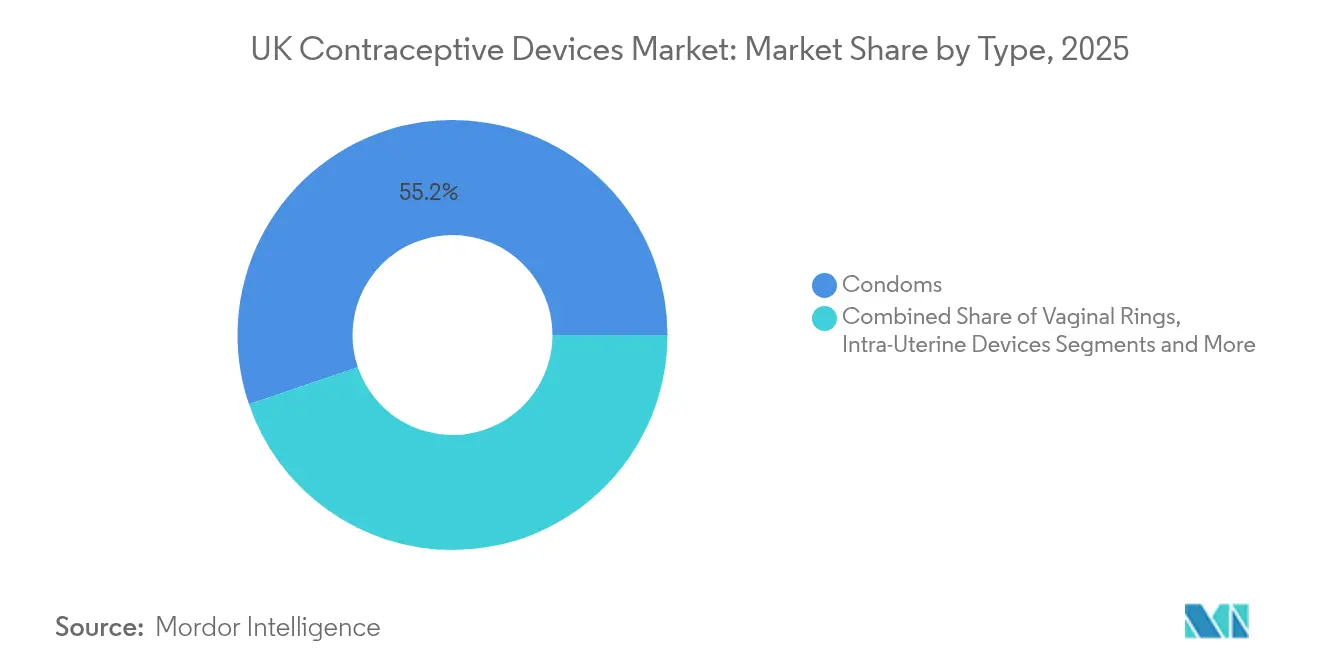
- By product type, condoms led with 55.22% revenue share in 2025; intrauterine devices are forecast to expand at a 8.67% CAGR through 2031.
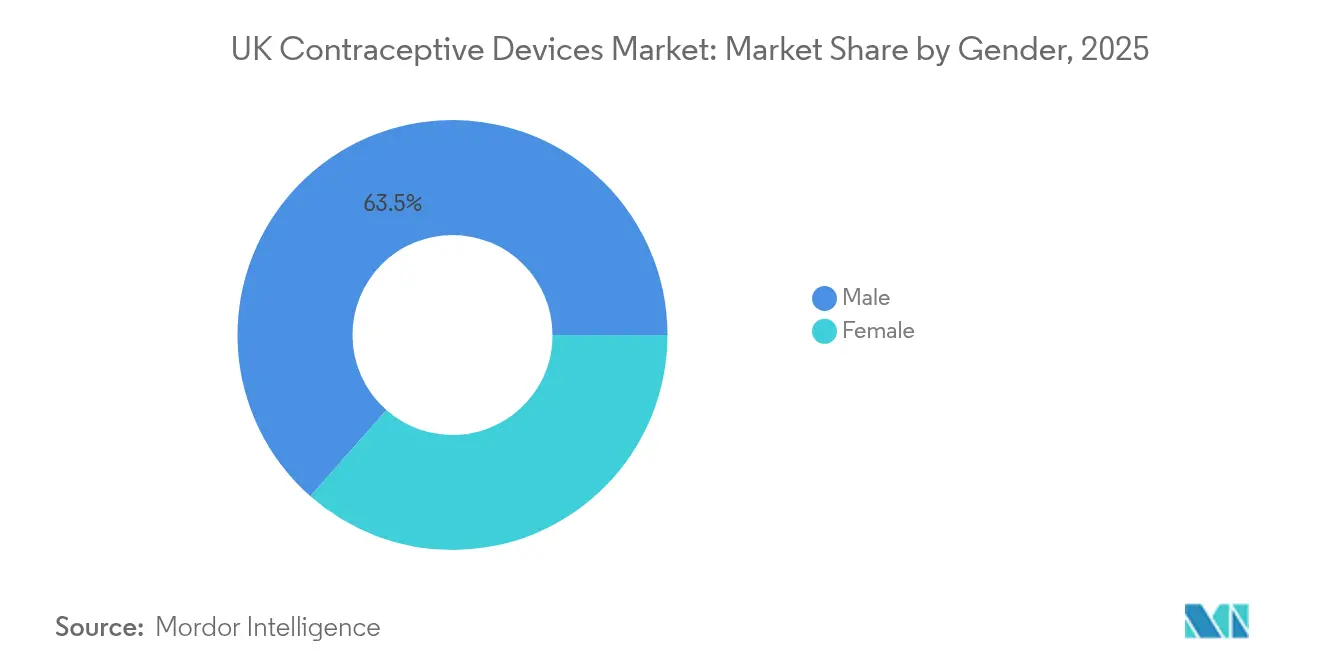
- By gender, male-targeted products held 63.51% of the UK contraceptive devices market share in 2025, while female-focused devices are set to grow at an 8.31% CAGR to 2031.
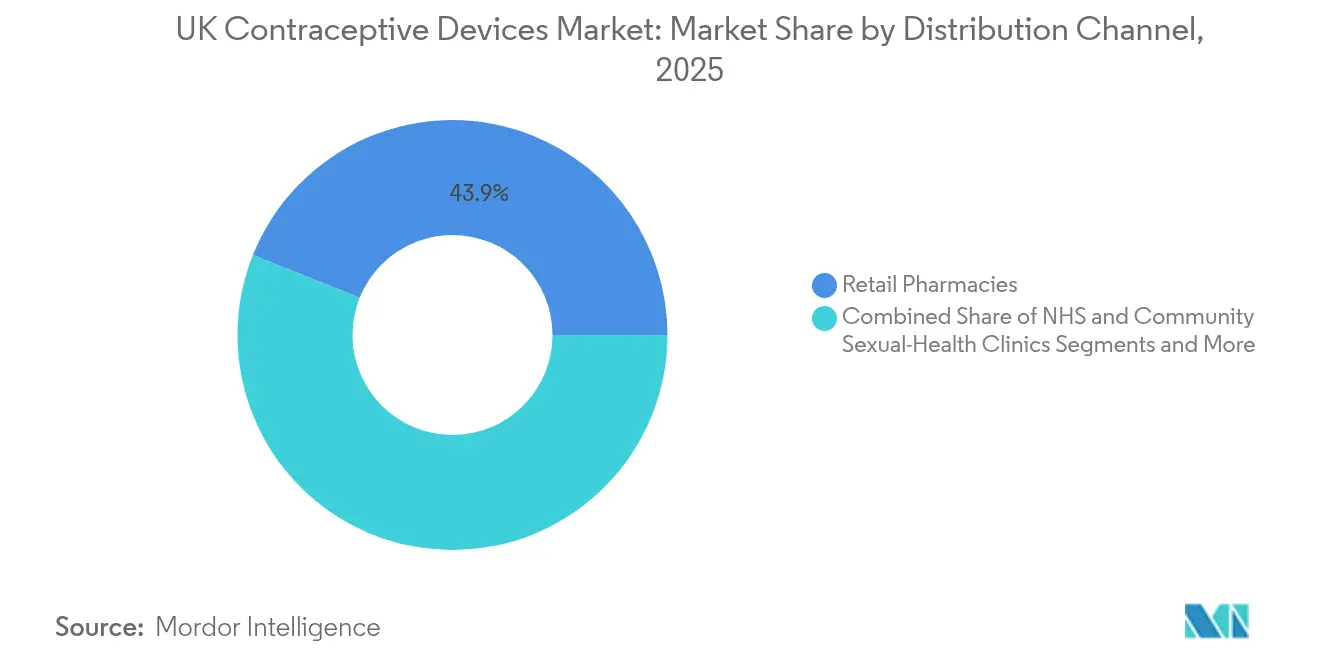
- By distribution channel, retail pharmacies captured 43.94% of the UK contraceptive devices market size in 2025 and are advancing at a 9.97% CAGR through 2031.
Note: Market size and forecast figures in this report are generated using Mordor Intelligence’s proprietary estimation framework, updated with the latest available data and insights as of 2026.
Market Trends and Insights
Drivers Impact Analysis of UK Contraceptive Devices Market*
| Driver | (~) % Impact on CAGR Forecast | Geographic Relevance | Impact Timeline |
|---|---|---|---|
| High prevalence of STDs & rising awareness | +1.2% | England-focused, spillover to Wales and Scotland | Medium term (2-4 years) |
| Increasing unintended pregnancies & UK-wide public-health drives | +0.9% | UK-wide with regional variations | Short term (≤ 2 years) |
| Government support for Reproductive and Family Planning services | +0.8% | England and Wales primary, Scotland secondary | Long term (≥ 4 years) |
| Consumer shift toward OTC & e-pharmacy fulfilment | +1.1% | Urban centers across UK, rural expansion | Medium term (2-4 years) |
| Growth Demand for LARCs and Innovative Devices | +0.7% | NHS-covered regions, private healthcare supplements | Long term (≥ 4 years) |
| Integration of Contraception with Digital Health Platforms | +0.6% | Tech-savvy demographics, urban concentration | Medium term (2-4 years) |
| Source: Mordor Intelligence | |||
High Prevalence of STIs & Rising Awareness
England alone logged 401,800 STI cases in 2023, a 4.7% year-on-year increase, keeping barrier methods at the centre of preventive policy.[2] Gonorrhoea cases have reached their highest level since 1918, while 52 antibiotic-resistant strains had been identified by mid-2025. Public-health messaging now frames condoms as dual-function tools that curb both pregnancies and infections, boosting unit volumes in the UK contraceptive devices market. National surveillance also shows that 46% of new STI cases occur in the 15-24 age bracket, prompting age-specific outreach campaigns.[1]Local authorities, citing resource strain, increasingly promote self-care and home-delivery condom programmes, reinforcing a preventive mindset.
Increasing Unintended Pregnancies & UK-Wide Public-Health Drives
UK reproductive-health profiles show long-acting reversible contraception (LARC) uptake among women under 25 rising from 27.6% in 2019 to 36.2% in 2023, yet overall utilisation remains below pre-pandemic levels. Scotland’s bridging-contraception initiative delivers three-month supplies of progestogen-only pills through pharmacies, eliminating appointment delays and widening access. Parallel educational reforms mandate comprehensive relationships and sex education in schools, ensuring that the emerging adult cohort enters the UK contraceptive devices market with higher baseline awareness parliament.uk. Together, these programmes create latent demand for a diverse product mix that extends beyond condoms to LARCs, rings, and diaphragms.
Government Support for Reproductive and Family-Planning Services
NHS England’s 2025/26 operational guidance ranks sexual and reproductive health integration among top five priorities, reinforcing multi-year funding streams for device procurement england.nhs.uk. The Department of Health channelled more than GBP 3.5 billion (USD 4.36 billion) to local public-health budgets in 2024, underpinning subsidised access programmes that drive volume growth in the UK contraceptive devices market. From a regulatory standpoint, the MHRA now requires evidence-based post-market surveillance plans, rewarding firms that maintain robust quality systems.[3]Contraceptive caps and intra-uterine systems listed in the NHS Drug Tariff are supplied without patient co-payments, removing price barriers and guaranteeing predictable reimbursement for pharmacies.
Consumer Shift Toward OTC & E-Pharmacy Fulfilment
The January 2024 pharmacy-dispensing policy created a structural push toward walk-in and online channels, evidenced by 10% year-on-year pharmacy revenue growth at Boots in Q4 2024. SH:24, an NHS-supported telehealth portal, ships free contraceptives nationwide under clinician oversight, demonstrating the scalability of digital models. The NHS Pharmacy First service further extends pharmacist prescribing, converting community outlets into hybrid clinical hubs that lift unit throughput in the UK contraceptive devices market. Younger, tech-savvy consumers transact seamlessly on mobile interfaces, valuing discreet delivery and shorter wait times over legacy in-store consultations.
Restraints Impact Analysis of UK Contraceptive Devices Market*
| Restraint | (~) % Impact on CAGR Forecast | Geographic Relevance | Impact Timeline |
|---|---|---|---|
| Device-related adverse effects & discontinuation | -0.8% | UK-wide with regional reporting variations | Short term (≤ 2 years) |
| Sociocultural resistance among specific faith & ethnic groups | -0.4% | Urban centers with diverse populations | Long term (≥ 4 years) |
| NHS funding pressure causing supply bottlenecks | -1.1% | England primary, Scotland and Wales secondary | Medium term (2-4 years) |
| Regulatory and Privacy Challenges Amid Digital Contraceptive Solutions | -0.3% | Tech-enabled services, urban concentration | Short term (≤ 2 years) |
| Source: Mordor Intelligence | |||
Device-Related Adverse Effects & Discontinuation
Heightened media attention on safety concerns, such as the meningioma risk linked to prolonged use of certain injectable progestogens, has raised discontinuation rates for some methods. The MHRA now obliges manufacturers to submit granular adverse-event reports within strict timelines, elevating compliance costs but also improving post-market data transparency. Professional societies such as the British Society of Urogynaecology actively encourage clinicians to report device complications, further sensitising the public to possible side effects. While long-acting progestogen therapies can reduce repeat interventions, risk-benefit calculations have become more nuanced, leading some women to revert to condoms or non-hormonal methods.
NHS Funding Pressure Causing Supply Bottlenecks
Brexit-related trade friction and global manufacturing disruptions have triggered intermittent shortages of contraceptive pills and barrier devices, forcing NHS regional procurement teams to issue guidance on therapeutic alternatives. A National Audit Office review found that central purchasing targets were missed in 2024, limiting economies of scale that might otherwise lower unit costs. While emergency sourcing frameworks exist, they can delay deliveries by weeks, creating temporary gaps in retail-pharmacy inventories and dampening short-term growth in the UK contraceptive devices market.
*Our forecasts treat driver/restraint impacts as directional, not additive. The impact forecasts reflect baseline growth, mix effects, and variable interactions.
UK Contraceptive Devices Market Segment Analysis
By Type:
Condoms Retain Scale as IUDs Accelerate Upgrade CyclesThe segment generated 55.22% of UK contraceptive devices market revenue in 2025, underscoring condoms’ strong dual-protection value proposition and extensive retail availability. The UK contraceptive devices market size for condoms amounted to USD 360.87 million in 2025, and volumes stay resilient as STI control remains a public-health priority. Intra-uterine devices (IUDs) are the fastest-growing line, advancing at a 8.67% CAGR to 2031, bolstered by extended wear times and favourable cost-utility ratios. Bayer’s Mirena and Kyleena systems now carry eight-year licences, a milestone that reduces replacement frequency and elevates lifetime adherence. Regulatory confidence also surfaced in 2024 when the Levosert hormonal IUS secured its own eight-year extension, signalling a high safety-efficacy threshold for hormonal platforms.
Innovations in non-hormonal technology add breadth to the category. The contoured Caya diaphragm, already registered in nearly 40 countries, demonstrates high acceptability in pilot studies and offers a silicone-free alternative for latex-sensitive users. Research published in Advanced Materials shows promise for stimuli-responsive hydrogels that produce reversible fallopian-tube occlusion, hinting at future patient-controlled sterilisation modalities. Vaginal rings are evolving beyond hormone-delivery systems; Bayer is co-developing a ferrous-gluconate-based ring that impedes sperm motility without altering hormonal balance. These R&D pipelines widen the technology mix, enabling manufacturers to address both safety concerns and emerging lifestyle preferences.

By Gender:
Male Dominance but Strong Female UpsideMale-oriented products accounted for 63.51% of 2025 revenue, reflecting cultural acceptance of condom use and expanded free-distribution programmes such as the NHS Greater Glasgow and Clyde postal service. The UK contraceptive devices market size attached to male methods reached USD 414.43 million in 2025, but future growth moderates as female autonomy rises. Women increasingly opt for LARCs; the proportion of under-25 females selecting these devices rose to 36.2% in 2023. Digital health channels amplify this shift by supplying remote consultations and discreet deliveries that resonate with privacy-conscious users.
Academic investment is also accelerating female-controlled innovation. The University of Birmingham, backed by Gates Foundation funding, leads a multi-country study on sperm functionality aimed at developing novel, non-hormonal contraceptive frameworks. The MHRA’s guidance that women using GLP-1 weight-management drugs must adopt effective contraceptive measures opens an ancillary growth corridor among users of those therapies. Overall, female-focused devices carry an 8.31% compound pace, gradually balancing gender contributions within the UK contraceptive devices market.
By Distribution Channel:
Retail Pharmacies Evolve into Omnichannel HubsRetail outlets controlled 43.94% revenue in 2025, equivalent to USD 286.66 million. This dominance stems from policy-enabled pharmacist prescribing, real-time inventory management, and click-and-collect services that compress delivery lead times. The UK contraceptive devices market share attributable to retail pharmacies is reinforced by NHS funding that reimburses pill supplies under the Pharmacy Contraception Service. Community sexual-health clinics retain a crucial role in complex procedures such as IUD insertion, yet their growth is capped by staffing and estate constraints.
Online pharmacies and e-commerce maintain the swiftest expansion at 9.97% CAGR through 2031. NHS-aligned telehealth portals register the sharpest relative expansion, leveraging algorithm-driven triage to channel patients toward the most suitable method while ensuring regulatory compliance. SH:24’s nationwide plain-package delivery model embodies this scalability, serving both urban and rural postcodes with equivalent efficiency. Supermarket chains lobby for over-the-counter status for emergency contraception, a move that would further democratise access but awaits regulatory clearance. Charities and youth centres cover demand peaks during festival seasons and university enrolment periods, supplying free condoms financed through local-authority grants.
Geography Analysis
England commands the largest slice of the UK contraceptive devices market, driven by population density and NHS England’s centralised purchasing frameworks that smooth procurement across 42 Integrated Care Boards. The region’s policy outreach includes the 2025 commitment to supply free morning-after pills at community pharmacies, ending postcode disparities and reinforcing condom and pill unit volumes. London and the West Midlands record the highest per-capita STI notifications, further elevating prophylactic demand.
Scotland contributes a smaller but influential share, using progressive initiatives such as bridging contraception to plug access gaps during appointment backlogs. Free-condom postal services complement the policy suite, and local Health Boards actively pilot telehealth models for LARC counselling. Wales benefits from regulatory harmonisation with England; its rural health boards rely heavily on e-pharmacy networks to ensure continuity of supply, particularly during tourist-season surges along the Pembrokeshire coast. Northern Ireland’s compliance with the European Union Medical Device Regulation adds an additional layer of certification but secures alignment with continental supply chains. The province’s younger demographic profile, coupled with targeted educational outreach, sustains condom volume growth despite a historically conservative cultural backdrop. Across all regions, digital platforms mitigate geographic inequities by centralising triage and logistics, ensuring that even remote islands receive deliveries within 48 hours.
Regulatory Landscape
Contraceptive devices placed on the Great Britain market are governed by the UK Medical Devices Regulations 2002 (UK MDR 2002) as amended, with the Medicines and Healthcare products Regulatory Agency (MHRA) acting as the competent authority for device registration and post-market oversight. Manufacturers must register devices with the MHRA before placement, and they operate under transitional arrangements that continue to accept CE-marked devices for defined periods (including timelines extending to 30 June 2028 for certain EU MDD/AIMDD certificates, and to 30 June 2030 for EU MDR/IVDR-compliant devices). This supports continuity of supply while UK requirements evolve.
Regulatory tightening has increased compliance and surveillance obligations for higher-risk and implantable products used in contraception. Post-market surveillance requirements introduced in mid-2025 strengthened incident traceability and risk management expectations, and in May 2026 the MHRA published draft Medical Devices (Amendment) Regulations 2026 for consultation, including an International Reliance pathway and closer alignment with IMDRF principles. Alongside updated MHRA guidance in March 2026 on when clinical investigations are required, these changes raise the importance of technical documentation quality, vigilance systems, and clear intended-purpose labeling for suppliers serving NHS and retail channels.
Value Chain Analysis
The UK contraceptive devices value chain starts with raw materials and component suppliers (for example, polymers and packaging for condoms and diaphragms, and metals plus inserter components for IUDs), then moves through manufacturing, quality management, and conformity assessment and registration steps governed by the MHRA under the UK MDR 2002. Product classification can influence the pathway: many barrier devices and non-hormonal IUDs fall under medical device rules, while hormone-acting intrauterine systems are commonly handled under medicinal-product requirements. This shapes how manufacturers plan evidence, labeling, and pharmacovigilance interfaces.
Downstream, public-sector procurement and reimbursement determine scale and access. NHS Supply Chain (Supply Chain Coordination Ltd) aggregates demand across obstetrics, gynaecology, and sexual health categories and in May 2025 launched a framework for Maternity, Obstetrics, Gynaecology and Sexual Health Products with 54 suppliers (including 11 new suppliers), widening the eligible supplier base while standardising contracting routes. Dispensing and service delivery occur through NHS and community sexual-health clinics (notably for insertion procedures), retail pharmacies, and growing digital channels; in England, NHSBSA administration via the Manage Your Service (MYS) portal supports pharmacy contraception services under formal directions. This makes community pharmacy a key operational link between prescribing pathways, inventory availability, and patient access.
Competitive Landscape
The UK contraceptive devices market hosts a moderately fragmented field where no single player exceeds one-third of revenue. Bayer leads the hormonal IUS category: Mirena, Kyleena, and the recently extended Levosert collectively shape clinical guidelines and influence formulary decisions. Cooper Surgical has refreshed its copper IUD offering with a single-hand inserter, a feature that trims clinic chair time and widens practitioner adoption. Reckitt-Benckiser’s Durex enjoys brand primacy in condoms, leveraging sustained investment in quality-control labs and marketing campaigns centred on STI prevention.
Digital disruptors increase competitive intensity. Community-pharmacy chains such as Boots blend e-commerce and clinical-service modules, capturing share from smaller independents and converting footfall into subscription repeats. NHS-approved portals like SH:24 position themselves as cost-avoidance tools for the public sector, compressing administrative overhead while meeting confidentiality expectations. Academic-industry collaborations, notably the University of Birmingham’s sperm-functionality study, create intellectual-property pipelines that established manufacturers may licence, accelerating product-portfolio renewal cycles.
Compliance capabilities serve as a growing differentiator under the MHRA’s strengthened surveillance regime. Firms with integrated pharmacovigilance systems respond faster to safety alerts, a feature that payers reward through preferred-supplier listings. Non-hormonal technologies represent white-space potential; early movers could insulate market positions by offering alternatives that sidestep hormone-related contraindications
UK Contraceptive Devices Industry Leaders
-
CooperSurgical, Inc.
-
Bayer AG
-
Gedeon Richter Plc
-
Organon & Co.
-
Reckitt Benckiser Group plc
- *Disclaimer: Major Players sorted in no particular order
UK Contraceptive Devices Market Companies Covered in this Report
- Bayer
- The Cooper Companies
- Pfizer
- Organon
- Gedeon Richter Plc.
- Reckitt Benckiser Group plc (Durex)
- Pregna International Ltd.
- Karex Berhad
- Okamoto Industries Inc.
- Femcap Inc
- Lifestyle Healthcare Pte Ltd
- Pasante Healthcare Ltd
- Relarc BV
- LTC Healthcare
- Skins Sexual Health
- KESSEL medintim GmbH
Market Opportunities and Future Outlook
Community pharmacy service expansion is creating practical whitespace for contraceptive-device suppliers to support primary-care workflows, training, and supply reliability. The Pharmacy Contraception Service in England was revised on 29 October 2025 to include oral emergency contraception and enable broader participation in delivery. The programme direction to add independent prescribing from autumn 2026 creates an operating model in which pharmacies manage more end-to-end contraceptive pathways. This shift reinforces demand for products and packaging formats that simplify selection, counselling, and handoff to clinics for procedures, and it raises the importance of dependable wholesaler and NHS-aligned distribution to prevent gaps linked to local inventory constraints.
Regulatory change also opens an access and portfolio opportunity for manufacturers with differentiated long-acting and non-hormonal options. The MHRA draft Medical Devices (Amendment) Regulations 2026 introduces an International Reliance concept and signals continued modernisation of routes to market, while the ongoing CE acceptance timelines (to 2028/2030 depending on device compliance basis) provide a transition window for suppliers managing dual UKCA/CE strategies. At the product level, longer-duration LARC use and hormone-free device innovation are still visible through recent MHRA actions and licensing activity, encouraging companies to pair post-market surveillance capabilities with product claims that address safety concerns and patient preference for non-hormonal choices.
Recent Industry Developments in UK Contraceptive Devices Market
- June 2026: Organon completed a global licensing agreement with Sebela Pharmaceuticals for exclusive rights to MIUDELLA, a hormone-free copper intrauterine device. The deal expands Organon's non-hormonal contraception footprint and adds a differentiated IUD platform that can sit alongside existing LARC offerings as patient preference shifts toward hormone-free options.
- May 2026: The MHRA approved an extension of use for Organon's NEXPLANON (etonogestrel) implant from three years to five years and updated labeling to reflect BMI-related efficacy information. A longer approved duration strengthens the value proposition of implantable contraception in NHS and clinic settings by reducing replacement frequency and raising the bar for competing LARC products on evidence and lifecycle performance.
- October 2024: Boots rolled out the NHS Pharmacy Contraception Service to more than 1,250 stores across England. The scale-up increased community-pharmacy touchpoints for contraception access and reinforced retail pharmacies as a high-throughput channel that blends in-person supply with omnichannel fulfilment.
UK Contraceptive Devices Market Report Scope and Research Methodology
Market Definition and Coverage
This market covers the value of contraceptive devices sold in the United Kingdom to prevent pregnancy through barrier or long acting device use, measured in USD at manufacturer or landed pricing levels. It is aligned to how products are procured through public and private channels.
Scope exclusions: Excludes contraceptive drugs, permanent surgical sterilization procedures, and digital fertility or cycle tracking tools.
Segments Covered in This Report
- By Type
- Condoms
- Diaphragms & Cervical caps
- Vaginal Rings
- Intra-Uterine Devices
- Implants & Injectables
- Spermicidal Devices
- Other Types
- By Gender
- Male
- Female
- By Distribution Channel
- NHS & Community Sexual-Health Clinics
- Retail Pharmacies
- Online Pharmacies & e-commerce
- Supermarkets & Convenience Stores
- Others (Charities, Youth Centres)
Data Sources, Market Sizing, and Validation
Desk Research
Desk work starts with building a clean fact base on contraceptive use and service delivery across the UK, then mapping it to device demand. Public sources, including NHS Sexual and Reproductive Health service publications, Office for National Statistics population by age and sex, UKHSA sexual health datasets, and MHRA safety and regulatory updates, help set the real world context for utilization and access.
We also review supporting signals like trade statistics for relevant product groups, peer-reviewed clinical literature on method mix and replacement cycles, and company annual reports plus investor presentations for product focus and channel exposure. Where needed, we supplement with paid subscriptions for company financials and intelligence, patent databases, and shipment-level import and export data to sanity-check trends. The specific sources listed here are illustrative and not exhaustive, and other references were also used to collect data, validate inputs, and resolve research questions.
Primary Interviews and Surveys
Primary work is used to confirm how volumes move between NHS tenders, sexual health clinics, retail pharmacy, and online channels, and to understand ASP patterns after procurement discounts. We speak with manufacturers, distributors, procurement focused stakeholders, clinicians, and channel experts across the UK to test assumptions on adoption, replacement timing, and product mix shifts.
Distribution of primary research fieldwork respondents
| Company type | Respondent position |
|---|---|
| Top tier: 33% | CXOs: 16% |
| Mid tier: 47% | Functional/Unit leaders: 26% |
| Smaller Players: 20% | Managers: 58% |
Market-Sizing & Forecasting
Sizing is built from a top-down demand pool view where UK contraception prevalence, method mix, and device replacement cycles are translated into yearly unit needs, followed by pricing to reach value. To keep the model grounded, we track inputs such as women of reproductive age, uptake of long acting reversible contraception, clinic and pharmacy dispensing patterns, tender and procurement timing, and the share of self purchased devices in private channels.
Those totals are then cross-checked through selective bottom-up approximations, such as rolling up supplier presence in key channels, sampling price bands by device type, and using import and domestic supply signals where they are meaningful. When a data gap shows up, for example limited visibility on private channel splits, assumptions are tightened through interviews and then tested with sensitivity checks rather than being filled with aggressive growth.
For forecasting, we rely on scenario analysis supported by simple trend models (including exponential smoothing where the history is stable). The forward view is adjusted based on expected policy or access changes, procurement cadence, and expert consensus on method switching.
Data Validation & Update Cycle
Before results are finalized, outputs are compared against independent indicators, such as changes in service utilization, contraceptive uptake signals, and pricing movement seen in procurement cycles. If the model shows a step-change that does not match these outside signals, the drivers are rechecked, and respondents may be re-contacted to confirm whether a real market shift occurred.
Each dataset and assumption is reviewed in multiple analyst passes, and the market math is re-run after every material scope or pricing update. The report is refreshed annually, and interim updates are triggered when major regulatory, reimbursement, or supply events can move demand or ASPs. Right before delivery, a final pass is done so clients receive the most current view we can support.
Mordor Intelligence's UK Contraceptive Devices Market Size Compared Against Other Published Estimates
Published market numbers for UK contraceptive devices can look far apart, even when everyone is discussing the same country, because the counting rules are not always the same. Differences usually come from what gets included as a device, what price level is used, and whether public procurement is treated as a separate layer or is blended into retail values.
The spread is mainly driven by scope choices (device-only versus drugs plus devices), pricing treatment (manufacturer or landed values versus end-user spend that includes channel margins), and the base year used for normalization. Another common driver is how replacement cycles and method switching are applied, because small changes there can shift units noticeably, and then value follows.
Benchmark comparison
| Source | Market Size | Gaps in Research Methodology |
|---|---|---|
| Mordor Intelligence | USD 652.38 M (2025) | |
| Regional Consultancy A | USD 395.62 M (2023) | Uses an earlier base year and may not fully reflect recent shifts in method mix and procurement volumes, and it is not always clear whether NHS purchasing and private retail are treated at the same price level. |
| Industry Publisher B | USD 450.00 M (2026) | Shows a forward-year point and may embed faster ASP escalation or different currency timing, which can move the 2026 value without being anchored to a reconstructed unit demand pool from prevalence and replacement behavior. |
Taken together, the comparison suggests that year selection and price-level choices explain most of the gap, with device scope and replacement timing adding a second layer of variation. Keeping contraceptive drugs and surgical sterilization outside scope, and sizing from UK method mix with replacement-cycle checks, is what keeps the value tied to the device-only demand pool, with the annual refresh applied by Mordor Intelligence.
Key Questions Answered in the Report
What is the 2026 value of the UK contraceptive devices market?
The market stands at USD 691.2 million in 2026
Which product type is growing fastest through 2031?
Intra-uterine devices are projected to expand at a 8.67% CAGR.
How have policy changes influenced pharmacy sales?
The January 2024 rule allowing pharmacist dispensing of oral contraception contributed to a 10% revenue increase at leading chains in 2024.
Why are condoms still the largest segment?
High STI prevalence makes dual-protection methods indispensable, keeping condoms at 55.22% revenue share in 2025.
Which channel shows the highest growth potential?
Online pharmacies and e-commerce, boosted by digital integration, are advancing at a 9.97% CAGR through 2031.
What regulatory trends affect market entry?
The MHRA’s 2024 post-market surveillance rules tighten safety reporting, raising compliance costs but strengthening user confidence.