
Market Overview
| Study Period | 2020 - 2031 |
|---|---|
| Forecast Data Period | 2026 - 2031 |
| Base Year Market Size (2025) | USD 1.43 Billion |
| Market Size (2026) | USD 1.48 Billion |
| Market Size (2031) | USD 1.73 Billion |
| Growth Rate (2026 - 2031) | 3.18 % |
| Market Concentration | Low |
Major Players *Disclaimer: Major Players sorted in no particular order Image © Mordor Intelligence. Reuse requires attribution under CC BY 4.0. | |
United Arab Emirates Corrugated Board Packaging Market Analysis by Mordor Intelligence
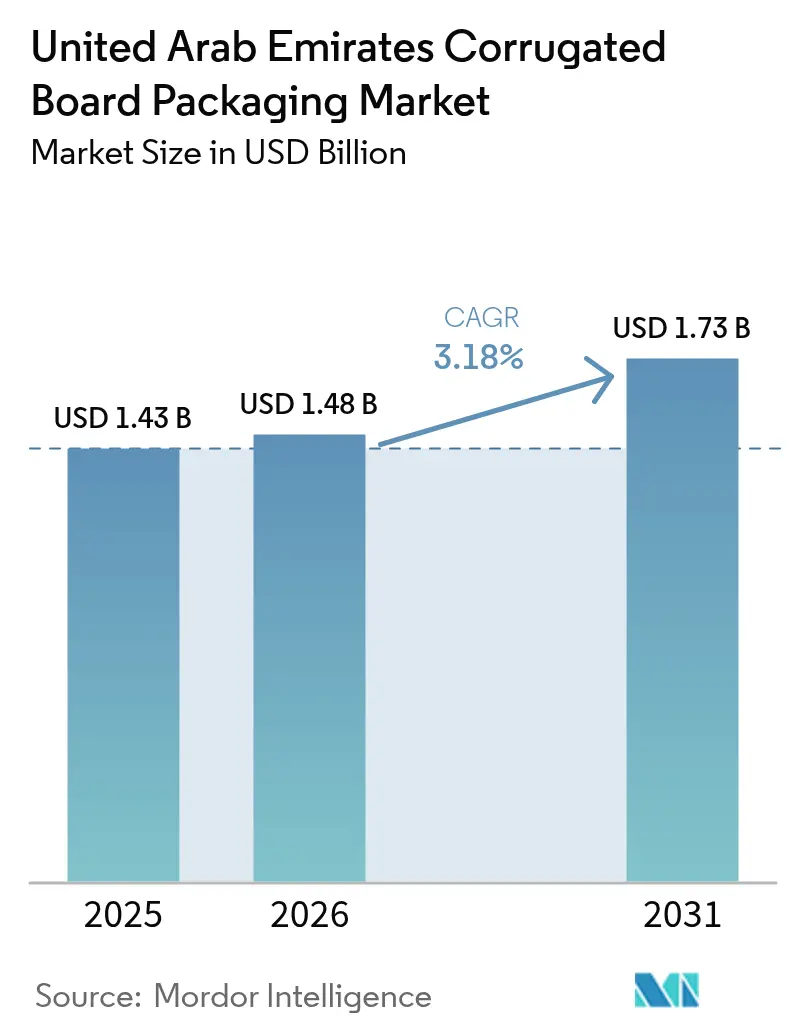
The United Arab Emirates corrugated board packaging market size was valued at USD 1.43 billion in 2025 and estimated to grow from USD 1.48 billion in 2026 to reach USD 1.73 billion by 2031, at a CAGR of 3.18% during the forecast period (2026-2031). Strategic economic diversification, a USD 8.6 billion manufacturing sector, and a national ambition to lift non-oil exports by 50% collectively underpin stable demand for transit, retail, and premium corrugated solutions. Dubai’s transshipment role, handling 75% of national maritime traffic, multiplies packaging volumes as goods flow through re-export channels. In tandem, food processing output of 5.96 million t and rapid e-commerce expansion intensify the need for durable, high-graphics boxes. Brand owners further accelerate the adoption of digital printing and lightweight substrates to cut freight costs and elevate shelf appeal. Government customs exemptions on machinery and raw materials and competitive energy tariffs attract regional and global converters to scale local capacity.
Key Report Takeaways
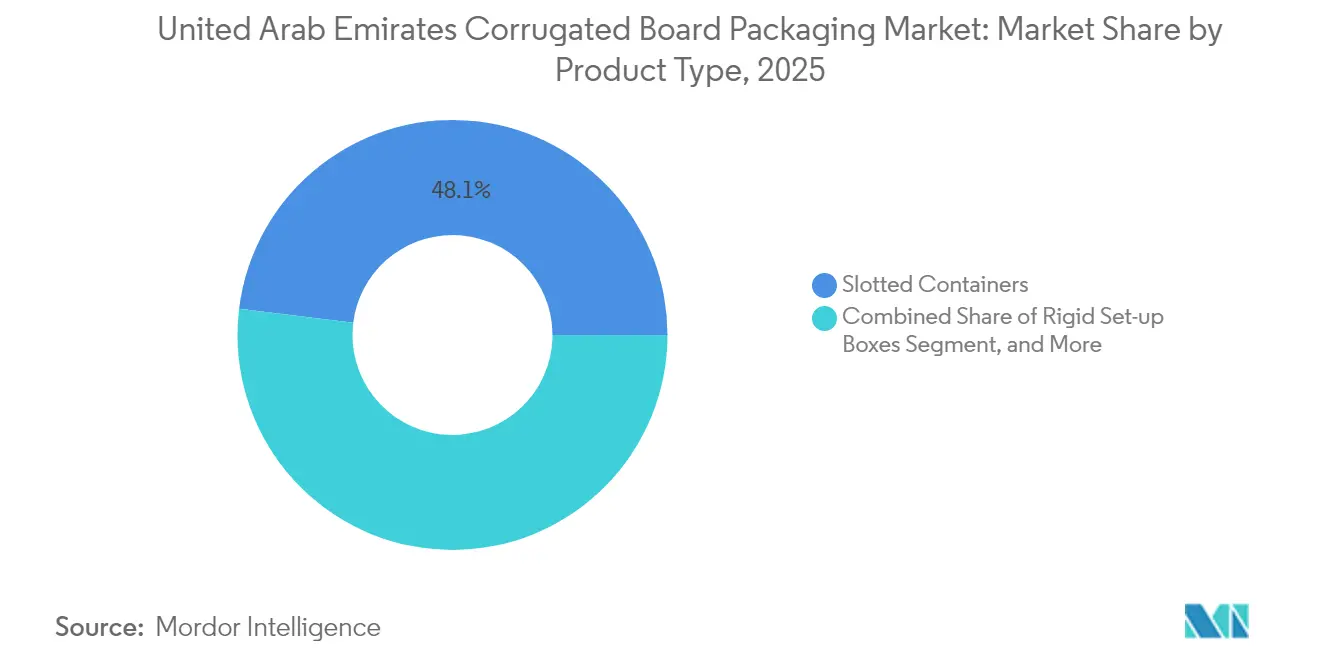
- By product type, slotted containers led with 48.05% of the United Arab Emirates corrugated board packaging market share in 2025; rigid set-up boxes will advance at a 5.34% CAGR to 2031.
- By end-user, food accounted for 32.20% of the United Arab Emirates corrugated board packaging market size in 2025, while e-commerce is forecast to expand at a 4.78% CAGR through 2031.
- By board construction, single-wall commanded 58.00% share of the United Arab Emirates corrugated board packaging market size in 2025, and triple-wall is projected to grow at 4.32% CAGR to 2031.
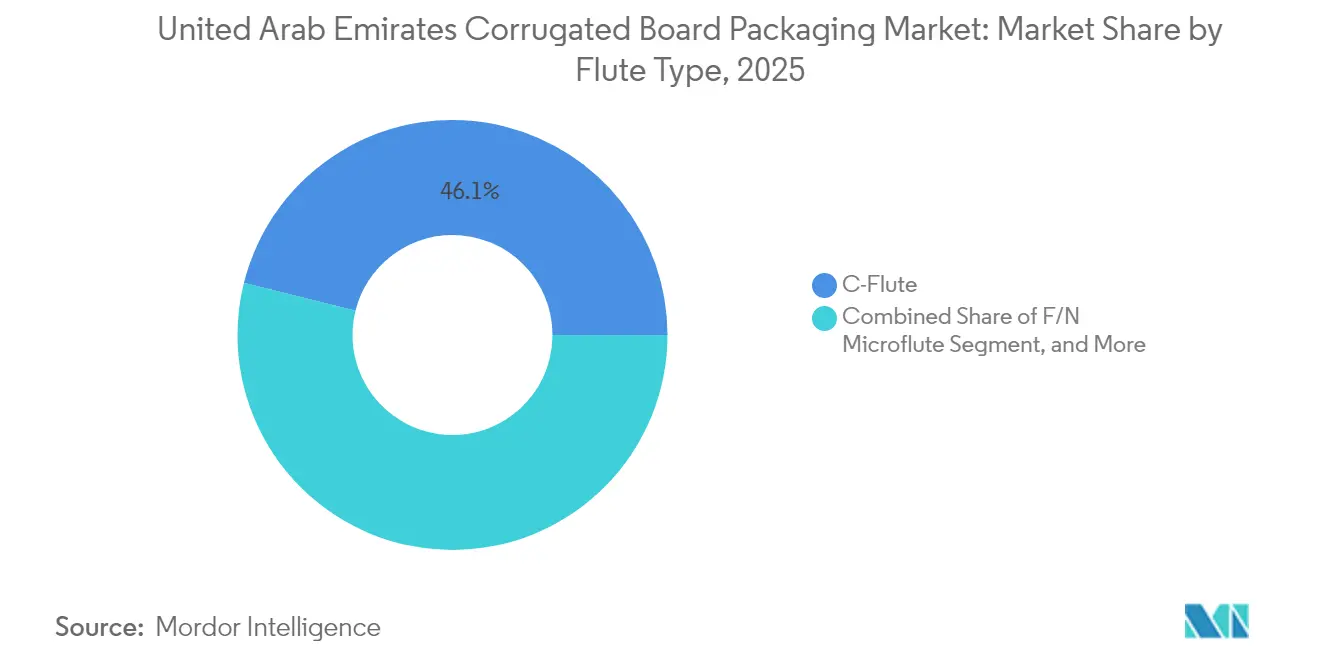
- By flute type, C-flute captured 46.10% of the United Arab Emirates corrugated board packaging market share in 2025; F/N microflute is poised for 4.74% CAGR through 2031.
- By printing technology, flexography held 38.10% share of the United Arab Emirates corrugated board packaging market size in 2025, whereas digital printing is rising at a 4.96% CAGR during the same period.
Note: Market size and forecast figures in this report are generated using Mordor Intelligence’s proprietary estimation framework, updated with the latest available data and insights as of 2026.
United Arab Emirates Corrugated Board Packaging Market Trends and Insights
Drivers Impact Analysis*
| Driver | (~) % Impact on CAGR Forecast | Geographic Relevance | Impact Timeline |
|---|---|---|---|
| E-commerce boom driving high-volume transit packaging | +0.8% | National (Dubai & Abu Dhabi focus) | Short term (≤ 2 years) |
| Light-weighting and high-graphics printing in FMCG and electronics | +0.6% | National; GCC spillover | Medium term (2-4 years) |
| Regulatory push for plastic substitution with recyclable board | +0.5% | National; GCC alignment | Long term (≥ 4 years) |
| Logistics corridor expansion around Jebel Ali Port | +0.4% | Dubai-centric; Northern Emirates | Medium term (2-4 years) |
| Mars Mission and aerospace supply chains needing high-strength boxes | +0.2% | National; advanced zones | Long term (≥ 4 years) |
| Rapid growth of dark-store grocery start-ups | +0.3% | Urban centers | Short term (≤ 2 years) |
| Source: Mordor Intelligence | |||
E-commerce Boom Driving High-Volume Transit Packaging
Online retail has re-shaped order fulfillment, with food e-commerce sales climbing to USD 1.07 billion in 2023 and grocery turnover reaching USD 36.5 billion in 2022. [1] International Paper’s USD 40 million investment to upgrade European e-commerce lines signals global recognition of transport-intensive parcel formats. Because Dubai handles roughly 61% of GCC-bound cargo, corrugated demand multiplies as shipments are repacked for regional delivery. Dark-store grocery chains favor right-sized, rapid-assembly boxes that protect chilled items during last-mile runs. The United Arab Emirates corrugated board packaging market, therefore, benefits from higher unit counts per order and from value-added design services that enhance unboxing experiences.
Light-weighting and High-Graphics Printing in FMCG and Electronics
Digital presses now permit personalized graphics with run lengths tailored to promotion cycles, pushing digital printing to a 5.21% CAGR. [2] Brands in the electronics and FMCG sectors leverage lighter microflute boards to lessen freight expense while preserving structural integrity. Automated warehouses and smart recycling lines financed under the USD 8.6 billion manufacturing agenda favor thinner substrates that run efficiently through high-speed conveyors. Packaging thus evolves from commodity containers to marketing assets that reinforce premium positioning at the point of delivery. The United Arab Emirates corrugated board packaging market increasingly revolves around collaborative structural design and variable data printing expertise.
Regulatory Push for Plastic Substitution with Recyclable Board
Government climate objectives, including a 2050 circular manufacturing roadmap, incentivize the adoption of fiber-based packaging. Alpha Emirates processes 84,000 t of recovered paper yearly, supporting recycled-content corrugated capacity. Anti-dumping duties on select paperboard imports demonstrate policymakers’ readiness to shield local mills from injurious pricing. Food processors, totaling about 2,000 firms, shift toward corrugated formats that satisfy GCC traceability and environmental labeling rules. As regulatory traction converges with recycling infrastructure, fiber-based formats gain share at the expense of single-use plastic crates.
Logistics Corridor Expansion Around Jebel Ali Port
Ongoing port deepening and free-zone warehousing upgrades sustain demand for heavy-duty bulk shippers and high-stacking strength boxes. Gulf Paper Manufacturing Company’s forthcoming 70,000 t capacity addition inside Jebel Ali Free Zone underscores the pull of proximity to export lanes. Large multinationals such as Smurfit Westrock, which booked USD 9.577 billion from its Europe-MEA-APAC division in 2024, align capacity planning to tap surging containerboard flows through Dubai. Efficient customs clearance and bonded logistics clusters further cement the United Arab Emirates’ role as a packaging gateway for the wider Middle East.
Restraints Impact Analysis*
| Restraint | (~) % Impact on CAGR Forecast | Geographic Relevance | Impact Timeline |
|---|---|---|---|
| Volatile kraftliner import prices and freight surcharges | -0.7% | National | Short term (≤ 2 years) |
| Fibre-quality inconsistency in domestic recycling streams | -0.4% | Industrial zones | Medium term (2-4 years) |
| Competition from returnable plastic crates in fresh produce | -0.3% | Food distribution centers | Medium term (2-4 years) |
| Aseptic-grade demands in pharma limit corrugated uptake | -0.2% | Pharma clusters | Long term (≥ 4 years) |
| Source: Mordor Intelligence | |||
Volatile Kraftliner Import Prices and Freight Surcharges
The United Arab Emirates relies heavily on imported kraftliner, exposing converters to global price spikes that erode margins. Graphic Packaging’s 2024 sales slide to USD 8.807 billion, blamed partly on pulp and freight swings, mirrors pressure felt by local sheet feeders. [3] Smurfit Westrock likewise flagged higher recovered fiber and energy costs, with delayed pass-through to box pricing. Customs exemptions help, yet cannot neutralize currency and bunker fuel volatility. Converters hedge through dual-sourcing and lightweighting, but price turbulence still clips the United Arab Emirates corrugated board packaging market growth rate.
Fibre-Quality Inconsistency in Domestic Recycling Streams
Although recycling capacity expands, variability in collected grades forces expensive cleaning and blending steps. Alpha Emirates’ 84,000 t mill illustrates commendable scale but still struggles with mixed-paper contamination. Gulf Paper’s 50,000 t annual waste-paper recovery runs into similar purity gaps, affecting runnability and box strength. Investment in optical sorters and AI-enabled inspection is underway, yet full standardization remains several years out. Until then, mill gate rejects and imported semi-chemical fluting fill supply gaps, trimming sustainable content targets for the United Arab Emirates corrugated board packaging market.
*Our forecasts treat driver/restraint impacts as directional, not additive. The impact forecasts reflect baseline growth, mix effects, and variable interactions.
Segment Analysis
By Product Type: Premium Packaging Drives Innovation
Rigid set-up boxes, though niche, are predicted to register the fastest 5.34% CAGR, reflecting rising demand for luxury electronics, confectionery, and gifting formats. Slotted containers preserved a 48.05% share of the United Arab Emirates corrugated board packaging market size in 2025, largely because they remain the universal choice for bulk shipping. Rigid set-up designs capitalize on high-graphics wraps and tactile finishes that command shelf premiums, enabled by digital print workflows and short fabrication cycles. Emirates Printing Press demonstrates local proficiency in folding carton and rigid set-up conversion, allowing brand owners to localize premium packs without long lead times.
Volume-driven die-cut containers and five-panel folders cater to e-commerce and electronics fulfillment, where easy assembly and precise fit reduce cushioning expense. Product innovation also extends to heavy-duty tray-lid formats for aerospace parts tied to the Mars program. As national export ambitions accelerate, specifications increasingly favor performance-engineered corrugated over generic brown boxes, ensuring the United Arab Emirates corrugated board packaging market maintains a balanced mix of mass and premium SKUs.

By End-User Industry: E-Commerce Reshapes Demand Patterns
Food processors consumed 32.20% of all corrugated in 2025, buoyed by 5.96 million t of domestic output spanning bakery, dairy, and savory snacks. E-commerce, however, will outpace every other vertical with a 4.78% CAGR as online grocery, fashion, and electronics retailers switch from plastic mailers to right-sized fiber boxes. Platform operators demand rapid art changes, serialized barcodes, and ship-ready tear strips, which favor digitally printed microflute. Beverage, personal care, and electrical goods, meanwhile, exploit high-strength double-wall cases to minimize damage claims during regional re-export runs.
Industrial, pharmaceutical, and petrochemical users add steady volume through anti-static liners, humidity shields, and tamper-evident tapes. Taken together, these mixed use-cases anchor steady base demand while permitting converters to diversify revenue. The United Arab Emirates corrugated board packaging market, therefore, exhibits both scale and specialization, hedging economic swings in any single vertical.
By Board Construction: Structural Innovation Meets Performance Demands
Single-wall maintained a 58.00% share of the United Arab Emirates corrugated board packaging market size in 2025, thanks to cost efficiency and adequate stacking strength for most FMCG cases. Triple wall is forecast to record a 4.32% CAGR, driven by aerospace payload, heavy machinery spares, and bulk chemical bag-in-box shipments that need compressive strength without weight penalties. Double wall satisfies intermediate loads for electronics and auto parts, offering a compromise between board weight and crush resistance.
Gulf Paper Manufacturing Company’s investment plan targets multi-wall capacity, betting on regional infrastructure and construction exports that require heavier grades. Logistics customers increasingly map board design to pallet patterns and container heights, engaging converters in value engineering to lower total landed cost. In sum, board construction choice is becoming a strategic lever for shippers, reinforcing demand for diversified sheet-feeding in the United Arab Emirates corrugated board packaging market.
By Flute Type: Microflute Technology Gains Traction
C-flute dominated with 46.10% share in 2025, prized for cushioning and stacking across food staples. F/N microflute is projected to advance at 4.74% CAGR as shelf-ready packs, gift boxes, and subscription parcels prioritize surface print quality and slim profiles. B-flute stays popular for wine, beverages, and mid-range appliances, where the balance between print area and rigidity is key. E-flute carves a niche in cosmetics and OTC pharma where point-of-sale display and tactile finishes matter.
Digital presses from Billerud show optimal results on microflute, aligning visual storytelling and inventory reduction. Recycled fiber input from Alpha Emirates, once refined, meets caliper needs for all flute combinations, strengthening domestic supply security. Consequently, flute selection is no longer a one-size gamble; it is data-driven, enabling converters in the United Arab Emirates corrugated board packaging market to tailor SKU-specific performance.
By Printing Technology: Digital Revolution Transforms Capabilities
Flexography retained 38.10% market share in 2025 on the back of long runs for beverages and staples. Digital printing, though, is rising at a 4.96% CAGR as SKU proliferation and seasonal campaigns require agile artwork swaps. Hybrid presses combining inkjet heads with inline die-cutting shrink order-to-delivery windows to as little as 24 hours, critical for flash promotions and influencer-driven product drops. Screen and offset methods survive for specialty gift attire and low-porosity coated liners.
Emirates Printing Press deploys both conventional and digital units, giving customers a continuum of cost-to-volume options. Variable QR codes, anti-counterfeit inks, and augmented-reality triggers are increasingly printed on high-touch packs in e-commerce, giving digital an edge. Investment payback is improved by reduced plate charges and minimized waste, catalyzing broader digital penetration in the United Arab Emirates corrugated board packaging market.
Geography Analysis
Dubai anchors demand by channeling 75% of the nation’s maritime traffic through Jebel Ali, translating to high throughput for export cartons, pallet bins, and reefer liners. The emirate also re-exports 61% of GCC-bound cargo, creating double-handling opportunities for value-added repacking. Abu Dhabi complements with aerospace clusters and state-backed manufacturing zones that stipulate advanced multi-wall grades for defense, aviation, and Mars-mission payload kits. Incentive programs granting duty-free machinery import and subsidized utilities lure global sheet integrators to both emirates, cementing their lead within the United Arab Emirates corrugated board packaging market.
Sharjah and Ajman leverage proximity to Dubai but differentiate through SME-oriented industrial estates offering quick-turn sheet-plant services for local confectionery, printing, and personal-care producers. Ras Al Khaimah adds mineral and cement exports, driving bulk bag-in-box and high-burst corrugated pallet surrounds. Government anti-injury duties on under-priced imports protect mills in all emirates, encouraging capex in recycling sortation and energy-efficient pulping.
Nationally, the USD 1 trillion transport infrastructure plan underscores packaging’s role in safeguarding value during multimodal transfers. Harmonized GCC labeling codes further integrate United Arab Emirates output into neighboring markets. As a result, regional converters position facilities within one-day truck distance of both seaport and desert hinterland to optimize freight and service lead times. Geography thus amplifies the resilience and growth prospects of the United Arab Emirates corrugated board packaging market.
Regulatory Landscape
The United Arab Emirates corrugated board packaging market operates under a framework of federal waste-management and product-safety rules that shape sourcing, design, and end-of-life handling. Federal Law No. (12) of 2018 on Integrated Waste Management sets requirements around waste reduction, segregation, and processing, supporting higher recovered-fiber utilization and recycling-oriented packaging specifications.
At the emirate level, Dubai Executive Council Resolution No. (124) of 2023 regulating the use of single-use products, with implementation actions effective from June 2024, adds momentum to material substitution discussions and pushes brand owners and retailers to document compliance pathways. Industrial establishments, including packaging converters, align with federal industrial regulation and product-safety requirements covering conformity, safe use, and market entry controls, with oversight linked to industrial licensing authorities and the Ministry of Industry and Advanced Technology (MoIAT).
Value Chain Analysis
The value chain begins with recovered paper collection and imported containerboard (kraftliner and fluting), followed by pulping or sheet supply into corrugators and sheet plants across key industrial zones, with Dubai-centric logistics supported by Jebel Ali connectivity. Converting stages include corrugation, die-cutting, flexo or digital printing, and finishing (tapes, coatings, and specialty liners), then distribution through direct sales to large FMCG, food processors, e-commerce fulfillment operators, and via packaging-material distributors serving SMEs.
Downstream, brand owners and logistics providers influence specifications for stacking strength, light-weighting, barcoding, and high-graphics capability, while recyclers close the loop by returning OCC back into the fiber stream. Within local manufacturing, companies such as Universal Carton Industries LLC highlight food-grade production practices and automation, while Arabian Packaging Industries positions across manufacturing and packaging-material distribution. Compliance and operating permissions across the chain are shaped by industrial licensing and MoIAT-linked safety, health, and environmental requirements, affecting supplier qualification, plant audits, and process controls for food-contact and retail packaging programs.
Competitive Landscape
International groups dominate scale-driven containerboard but partner with regional players for market intimacy. Smurfit Westrock’s USD 9.577 billion Europe-MEA-APAC earnings equip it with procurement clout and R&D funding to push high-performance liners into the United Arab Emirates. Middle East Paper Company and Gulf Paper Manufacturing Company counter with responsive lead times, Arabic labeling fluency, and relationships inside free zones. Strategic thrusts focus on lightweighting, recycled content, and digital front-end services.
Technology is the new battleground. Billerud licenses modular inkjet engines to converters seeking personalized campaigns, while Alpha Emirates back-integrates into recovered-fiber sorting for circular credentials. E-commerce specialists experiment with glue-free crash-lock bases that cut pack time by 30%. Sustainability seals, carbon-footprint calculators, and blockchain traceability emerge as service differentiators beyond board price. The result is a moderately concentrated yet innovation-intensive United Arab Emirates corrugated board packaging market where collaboration often trumps outright rivalry.
M&A activity remains selective after Smurfit WestRock’s 2024 mega-deal, with local sheet-plants instead favoring JV structures inside free zones to scale without heavy balance-sheet stretch. Investors monitor freight cost volatility and fiber supply as key risk determinants. Overall, competitive dynamics balance scale efficiency with agile customization, aligning with the diversified demand base of the United Arab Emirates corrugated board packaging market.
United Arab Emirates Corrugated Board Packaging Industry Leaders
-
Arabian Packaging Co. LLC
-
World Pack Industries LLC
-
Universal Carton Industries LLC
-
Queenex Corrugated Carton Factory LLC
-
Falcon Pack Industries LLC
- *Disclaimer: Major Players sorted in no particular order

Market Opportunities and Future Outlook
Policy-driven substitution and circularity programs create whitespace for fiber-based designs that replace single-use formats in retail and foodservice, especially in Dubai where Executive Council Resolution No. (124) of 2023 regulates single-use products with implementation actions effective from June 2024. This has increased the need for converters to supply performance-engineered corrugated alternatives, including shelf-ready packs and e-commerce shippers that meet handling durability while supporting recyclability and traceability requirements.
An additional opportunity sits in recycling-linked supply security and certified sustainable manufacturing. The UAE Circular Economy Policy 2021-2031 names material efficiency and recycling improvements across manufacturing, reinforcing demand for higher recovered-fiber utilization, better sorting, and consistent liner quality, supported by domestic recovered-paper processing capacity referenced in the market context (for example, Alpha Emirates processing 84,000 t annually). Converters that combine recycled-content quality control with short-run digital printing and rapid design iteration support premiumization in FMCG, electronics, and gifting, while aligning with government support mechanisms for sustainable manufacturing practices.
Recent Industry Developments
- July 2026: Universal Carton Industries LLC reconfirmed manufacturing capability for diversified sectors including food, retail, and industrial packaging within the UAE and GCC. This strengthens local supply security and regional export potential in UAE corrugated packaging market. The move underscores ongoing commitment to expand domestic capacity and service levels.
- June 2026: A commercial production and scale availability launched for a new corrugated box format, developed by Arabian Packaging Co. LLC, expanding local capacity for premium packaging. The packaging format addresses demand for differentiated, high-value packing solutions in the UAE. It signals a shift toward premium, design-led packaging in the market.
- May 2025: Middle East Paper Company posted Q1 2025 financial results, reinforcing its trajectory in regional corrugated capacity scaling. The update reflects continued capacity expansion and footprint widening in the UAE. It highlights competitive dynamics among regional players and the importance of scale in supply chain resilience.
Research Methodology Framework and Report Scope
Market Definition and Coverage
For this study, the market covers the value of corrugated board packaging sold and used within the United Arab Emirates across common box formats and board constructions, counted at prevailing selling prices in USD.
Scope exclusions: Excludes non-corrugated paper packaging formats (such as folding cartons) and non-paper rigid packaging materials.
Segmentation Overview
- By Product Type
- Slotted Containers
- Die-cut Containers
- Five-Panel Folder Boxes
- Rigid Set-up Boxes
- Other Product Types
- By End-User Industry
- Food
- Beverage
- Electrical and Electronics
- Personal and Home Care
- E-commerce
- Other End-user Industries
- By Board Construction
- Single Face
- Single Wall
- Double Wall
- Triple Wall
- By Flute Type
- C-Flute
- B-Flute
- E-Flute
- F/N Microflute
- Other Flute Types
- By Printing Technology
- Flexography
- Digital
- Other Printing Technologies
Data Sources, Market Sizing, and Validation
Desk Research
Desk work started by mapping the UAE packaging demand pool using public statistics and industry signals, then narrowing it to corrugated use cases. We leaned on sources such as UAE Federal Competitiveness and Statistics Center releases, UN Comtrade trade statistics for paper and paperboard items, World Bank macro indicators, and UNIDO industrial structure indicators to understand baseline activity and the direction of change.
To keep inputs practical, we also reviewed listed company annual reports and investor presentations, association and event materials tied to packaging and logistics in the UAE, and reputable news coverage for capacity moves and price signals. Where available, we referenced paid subscriptions for company financials and intelligence, plus an import and export shipment level database to sanity check trade direction and product mix. These desk sources are illustrative only, and other public and proprietary references were also used during data collection, cross-checking, and clarification.
Primary Interviews and Surveys
Primary work focused on filling gaps that public data does not cleanly show, such as typical conversion margins, corrugator utilization, and how fast printing technology is changing in mainstream box orders. We spoke with packaging producers, distributors, and large end users, and we checked views from logistics and retail linked buyers, so pricing, volume, and mix assumptions stayed realistic across the UAE.
Distribution of primary research fieldwork respondents
| Company type | Respondent position |
|---|---|
| Top tier: 33% | CXOs: 13% |
| Mid tier: 52% | Functional/Unit leaders: 35% |
| Smaller Players: 15% | Managers: 52% |
Market-Sizing & Forecasting
Sizing begins with a top-down build where UAE packaging demand is reconstructed from industrial output, trade flows for relevant paper and paperboard items, and sector activity that typically drives corrugated usage. Once that demand pool is formed, it is split into corrugated board packaging using mix assumptions that reflect common box formats and use cases in the country.
To keep the estimate grounded, we corroborated totals with selective bottom-up checks such as sampled average selling price times shipment volumes for key box types, plus channel checks on conversion and printing pass-through. Inputs that materially move the model include manufacturing and re-export intensity, e-commerce parcel volumes and retail replenishment needs, board construction mix (single wall versus double wall), flute preferences for strength and cost, and pricing movements linked to containerboard and recycled fiber availability.
For forecasting, scenario analysis was used so near-term demand shifts from trade, consumer spending, and industrial activity could be reflected without overfitting the history. Assumptions were then adjusted based on expert views on utilization, lead times, and how fast price changes are passed through to box buyers. Where direct volume indicators were missing for smaller product pockets, gaps were handled through proportional allocation using end user activity and validated ranges from interviews.
Data Validation & Update Cycle
Validation is done in layers so that no single data point drives the result. We compare model outputs against independent signals, like trade direction for paperboard inputs, reported capacity changes, and plausible price bands seen in channel checks, and then review any large variances before sign-off.
If an anomaly appears, we revisit assumptions, re-check arithmetic, and re-contact selected interviewees to confirm whether the change is structural or a one-off timing effect. Reports are refreshed annually, and interim updates are made when material events occur, such as a major capacity addition, trade disruption, or sharp raw material price movement. Before delivery, a final pass is completed so clients receive the latest updated view.
Mordor Intelligence's UAE Corrugated Board Packaging Market Size Versus Other Published Estimates
Published market values can differ even for the same country because the counted products, pricing points, and the year used for currency conversion are not always aligned. Differences also show up when one estimate relies more on capacity commentary, while another relies more on demand indicators tied to end use.
Folding carton and paper bags sit outside Mordor Intelligence's scope here, which is one practical reason some broader paper packaging totals look higher than the figure shown in the table. The spread can also come from how average selling prices are progressed year to year, and whether re-exports and local consumption are separated using trade and end market checks.
Benchmark comparison
| Source | Market Size | Gaps in Research Methodology |
|---|---|---|
| Mordor Intelligence | USD 1.43 B (2025) | |
| Industry Association A | USD 1.65 B (2025) | Often reported as a wider paper-based packaging spend that can include adjacent formats and more packaging services, which inflates totals versus a corrugated-only view. |
| Trade Journal B | USD 1.20 B (2025) | Commonly built from selective producer capacity and utilization commentary without fully reconciling pricing ranges and the pull from end-user demand, which can understate value in years with price pass-through. |
The comparison mainly points to scope and pricing logic as the key drivers of variance, rather than a disagreement on the direction of growth. By keeping counted products specific and then cross-checking totals with trade signals and realistic price bands, the estimate stays traceable to repeatable steps.
Key Questions Answered in the Report
How large is corrugated packaging demand in the United Arab Emirates today?
The United Arab Emirates corrugated board packaging market size is USD 1.48 billion in 2026 and is projected to reach USD 1.73 billion by 2031.
Which segment is growing fastest through 2031?
E-commerce packaging is forecast to post a 4.78% CAGR, outpacing every other end-user segment.
What board construction is most common for everyday shipping cartons?
Single wall accounts for 58.00% of current volume due to its balance of cost and performance.
How are sustainability policies influencing material choices?
Government targets for a circular economy and anti-plastic measures are shifting demand toward recycled-content corrugated solutions.
Which technology is disrupting traditional flexography?
Digital inkjet printing is rising at a 4.96% CAGR, enabling personalized graphics and fast turnaround times.
Why are kraftliner prices a critical issue for converters?
The nation relies on imported kraftliner, so freight surcharges and global pulp swings directly hit input costs, trimming margins and elevating price volatility.