
Market Overview
| Study Period | 2020 - 2031 |
|---|---|
| Forecast Data Period | 2026 - 2031 |
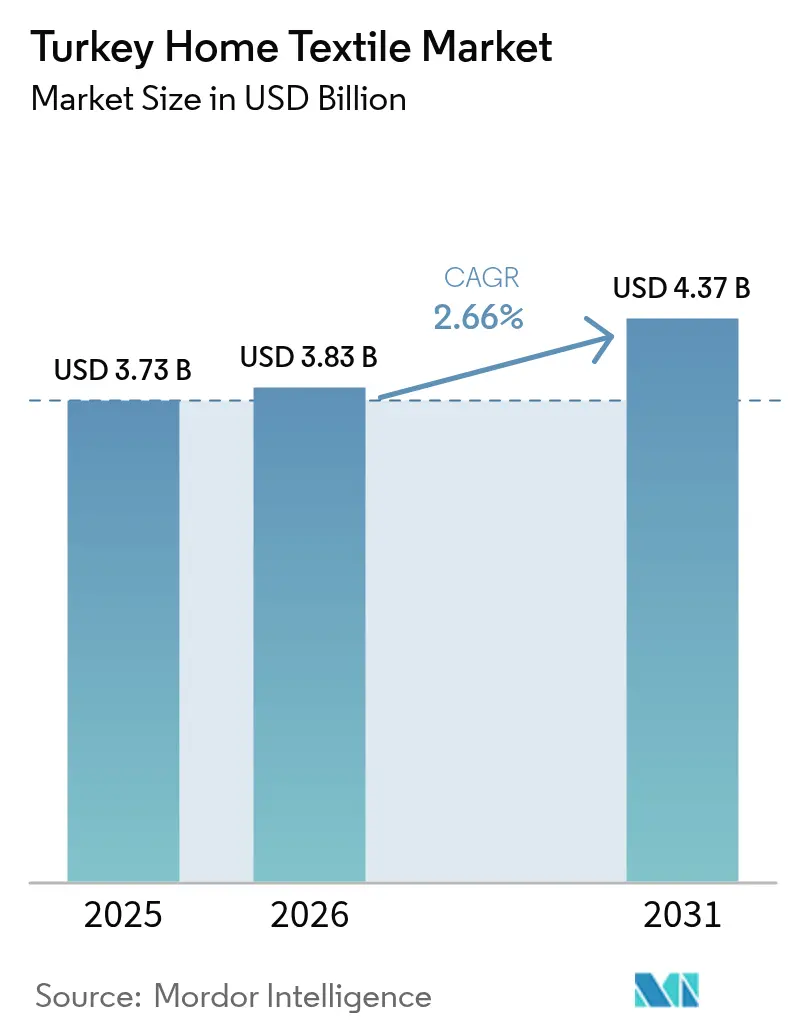
| Base Year Market Size (2025) | USD 3.73 Billion |
| Market Size (2026) | USD 3.83 Billion |
| Market Size (2031) | USD 4.37 Billion |
| Growth Rate (2026 - 2031) | 2.66 % |
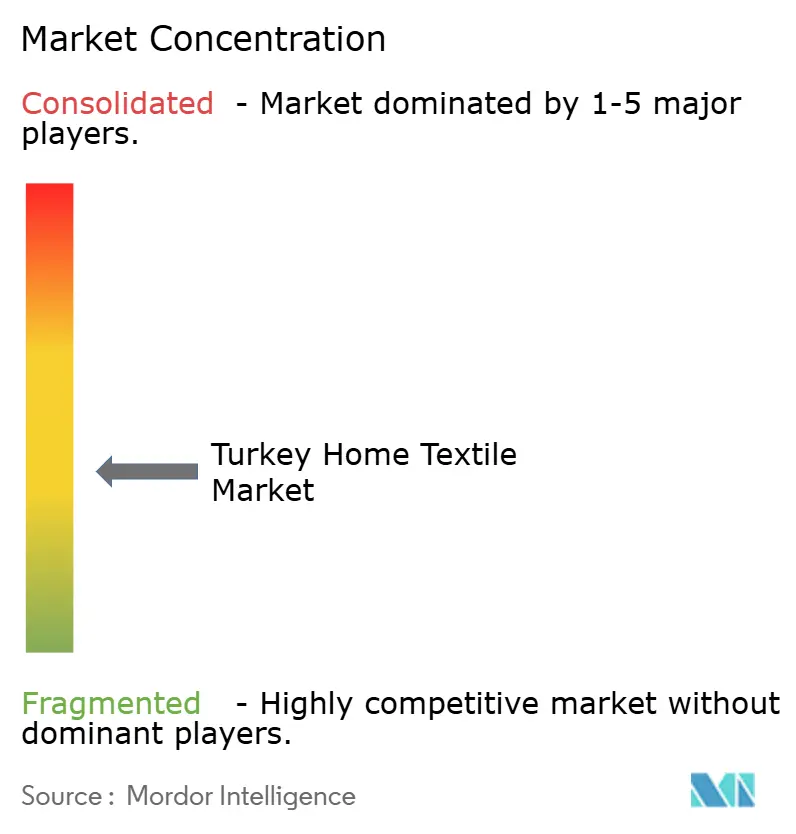
| Market Concentration | Medium |
Major Players *Disclaimer: Major Players sorted in no particular order Image © Mordor Intelligence. Reuse requires attribution under CC BY 4.0. | |
Turkey Home Textile Market Analysis by Mordor Intelligence
The Turkey home textile market size is expected to grow from USD 3.73 billion in 2025 to USD 3.83 billion in 2026 and is forecast to reach USD 4.37 billion by 2031 at 2.66% CAGR over 2026-2031. The steady trajectory stems from Turkey’s role as a near-shore production hub for European buyers seeking short lead times, its long-standing cotton heritage, and an accelerated shift toward value-added technical fabrics. Over 2024–2025, sector players adopted vertical integration and digitalization to counter inflation, currency volatility, and rising energy costs, helping safeguard margins while deepening export relationships with the EU. Functional and performance textiles now feature prominently in product pipelines, reflecting rising demand from hospitality, e-commerce, and wellness-focused consumers. Regional specialization, most notably Denizli for terry towels and Gaziantep for machine-made carpets, contributes to scale economies, while government incentives for high-value technical production bolster long-term competitiveness.
Key Report Takeaways
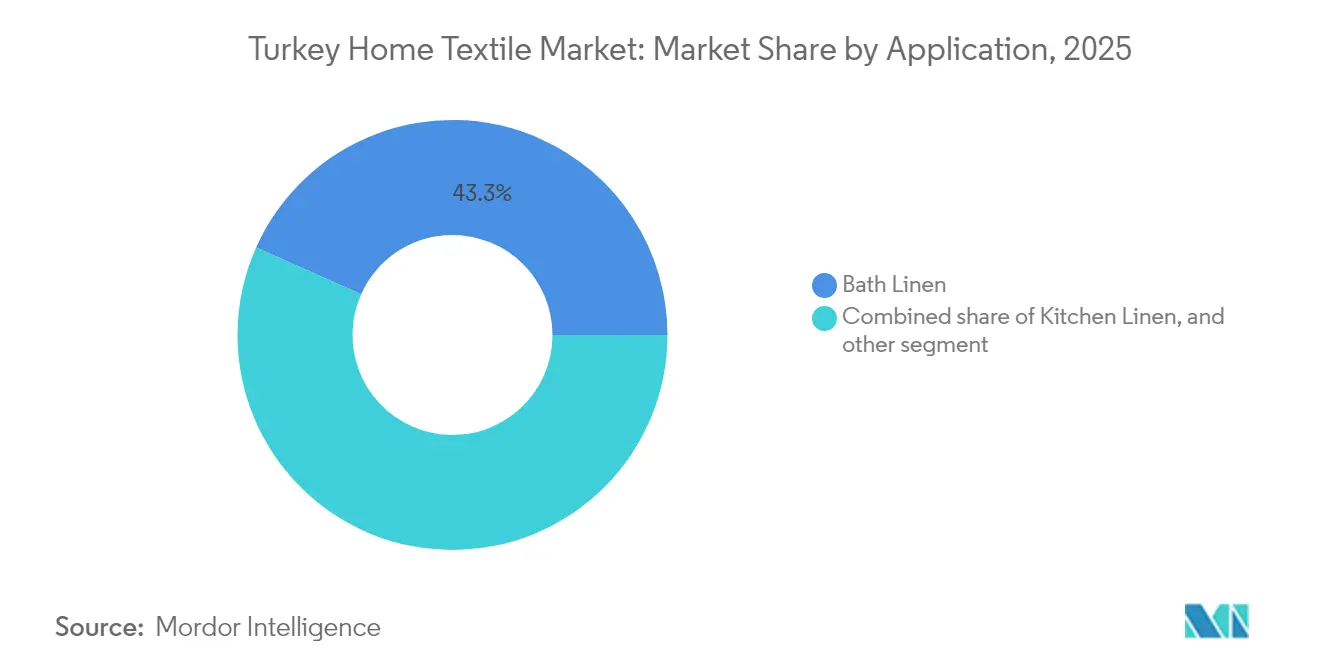
- By application, bath linen led with 43.32% of the Turkey home textile market share in 2025; kitchen linen is projected to post an 8.70% CAGR to 2031.
- By material, cotton accounted for a 73.65% share of the Turkey home textile market size in 2025, whereas synthetic fibers are set to expand at a 10.28% CAGR through 2031.
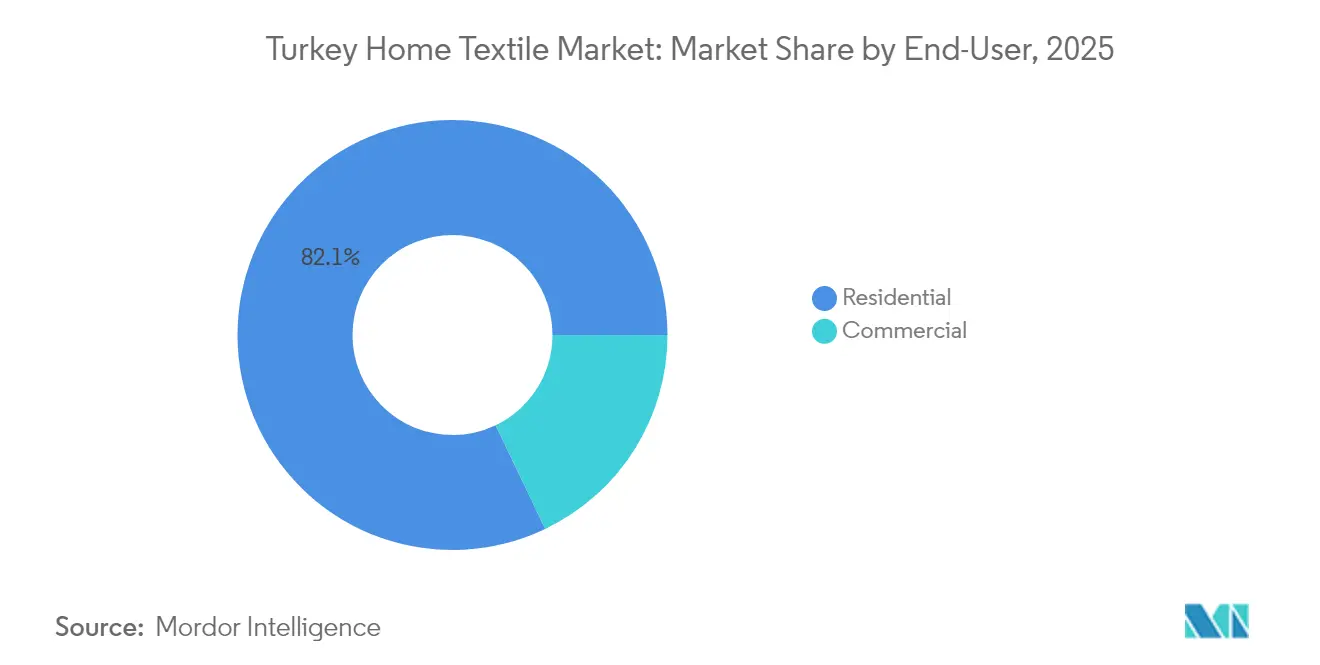
- By end-user, the residential segment held 82.10% share of the Turkey home textile market size in 2025, while commercial hospitality textiles are advancing at a 7.22% CAGR to 2031.
- By distribution channel, offline retail captured 78.60% share of the Turkey home textile market size in 2025, yet online sales are climbing at a 16.42% CAGR through 2031.
- By geography, the Aegean region commanded a 36.15% share of the Turkey home textile market size in 2025, and Southeastern Anatolia is forecast to grow at a 8.98% CAGR between 2026-2031.
Note: Market size and forecast figures in this report are generated using Mordor Intelligence’s proprietary estimation framework, updated with the latest available data and insights as of 2026.
Turkey Home Textile Market Trends and Insights
Drivers Impact Analysis*
| Driver | (~) % Impact on CAGR Forecast | Geographic Relevance | Impact Timeline |
|---|---|---|---|
| Cotton-cost advantage versus Asian peers | +0.8% | Aegean region, Southeastern Anatolia | Medium term (2-4 years) |
| Domestic e-commerce & marketplace growth | +0.6% | Nationwide: Istanbul, Ankara, Izmir | Short term (≤ 2 years) |
| Tourism rebound boosts hospitality linens | +0.5% | Mediterranean and Aegean coasts | Short term (≤ 2 years) |
| EU near-shoring preference | +0.7% | Nationwide, Marmara logistics hubs | Medium term (2-4 years) |
| Government incentives for technical textiles | +0.4% | Bursa, Central Anatolia industrial zones | Long term (≥ 4 years) |
| Demand for wellness-oriented fabrics | +0.3% | R&D centers in Istanbul, Bursa | Long term (≥ 4 years) |
| Source: Mordor Intelligence | |||
Cotton-cost advantage versus Asian peers
Turkey ranks seventh globally in cotton output, supplying domestic mills with competitively priced fiber while global cotton prices softened 3.65% year-over-year to USD 2.08 per kg in 2025. Vertically integrated firms, such as Zorlu, run contiguous polyester and cotton operations that lower procurement costs and shorten production cycles. Cotton lint by-products add roughly 60,000 tonnes of revenue-earning mass annually, giving producers additional margin levers. As Asian competitors contend with wage inflation and longer transit times, Turkish suppliers leverage raw-material proximity to secure contracts from European brands seeking high-quality cotton towels and bedding. This advantage strengthens whenever maritime disruptions elevate freight costs, underscoring the resilience of the Turkey home textile market.
Proliferation of domestic e-commerce & marketplace ecosystems
Turkey’s e-commerce sales have grown around 30% annually, yet penetration remains only 3.5% of total retail, far below the 8.5% global norm [1]. Mobile commerce drives this surge; more than half of online orders already originate on smartphones. International labels notice the opportunity: Mango Home entered Turkey in July 2024 exclusively online, signaling confidence in local digital maturity. Domestic brands increasingly pair Instagram campaigns with direct-to-consumer stores, enabling rapid feedback loops for new functional bedding and kitchen textiles. Higher return rates in digital channels pose a margin risk, but advanced sizing tools and easy pick-up points are gradually mitigating logistics costs, keeping the Turkey home textile market on a digital-first growth path.
Tourism rebound driving hospitality linen demand
Tourism receipts hit USD 61.1 billion in 2024, an 8.3% jump that coincided with 62 million international visitors [2]. Pipeline data show 130 hotels and 19,038 rooms under construction, placing Turkey behind only the UK and Germany in European hotel development. International chains such as IHG and Accor intend to open roughly 20 new properties each by 2030, raising demand for high-turnover linens, bathrobes, and table coverings. Antalya alone welcomed 16.6 million foreign tourists in 2024, lifting occupancy rates and accelerating textile replacement cycles. Suppliers skilled in quick-response production and OEKO-TEX compliance are ideally positioned to capture this high-margin segment within the Turkey home textile market.
EU near-shoring preference for short lead-time suppliers
Turkey’s customs union with the EU and its trucking corridors permit one-week delivery into continental distribution centers, compared with four to six weeks from Asia. German machinery exports worth EUR 350 million (USD 410 million) reached Turkish mills in 2023, reaffirming Europe’s commitment to localizing fine fabric production. Mid-sized mills such as Barutçu Tekstil supply Louis Vuitton and Hugo Boss at average fabric prices of EUR 5.5-6 per meter (USD 6.5-7 per meter), showing that premium buyers value speed and quality over marginal cost savings. When EU rules demanding traceability tighten, short regional supply chains become even more attractive, sustaining the export-oriented thrust of the Turkey home textile market.
Restraints Impact Analysis*
| Restraint | (~) % Impact on CAGR Forecast | Geographic Relevance | Impact Timeline |
|---|---|---|---|
| Volatile TRY inflation | −1.2% | Nationwide, particularly in urban centers | Short term (≤ 2 years) |
| Rising energy prices | −0.8% | Bursa, Denizli, and Gaziantep industrial corridors | Medium term (2-4 years) |
| Imported long-staple cotton dependency | −0.4% | Nationwide premium segments | Medium term (2-4 years) |
| High online return rates | −0.3% | Nationwide e-commerce channels | Short term (≤ 2 years) |
| Source: Mordor Intelligence | |||
Volatile TRY inflation is eroding consumer purchasing power
The consumer price index rose 38.10% year-over-year in March 2025, eroding disposable incomes and prompting households to postpone non-essential textile upgrades. Central Bank policy lifted reference rates to 46% in April 2025, raising working-capital costs for mills [3]. A 30% hike in the minimum wage to TRY 22,104 per month expanded wage bills for about 1.5 million sector employees, squeezing margins even as the weaker lira made exports more attractive. Retailers responded with promotional bundles and private-label lines to retain price-sensitive shoppers, yet volume softness remains a near-term drag on the Turkey home textile market.
Rising energy prices are increasing processing costs
Turkey’s energy trade deficit topped USD 80 billion in 2022, and elevated gas and electricity tariffs have persisted through 2025. Dyeing and finishing plants consume intensive heat loads; resource audits show 39-71% electricity-saving potential via equipment upgrades[4]. Several producers installed rooftop solar arrays covering 18-20% of consumption, but capital constraints limit widespread replication. The Black Sea gas project that came online in 2023 promises eventual relief, yet mills remain exposed to short-term volatility, constraining investment bandwidth across the Turkey home textile market.
*Our forecasts treat driver/restraint impacts as directional, not additive. The impact forecasts reflect baseline growth, mix effects, and variable interactions.
Segment Analysis
By Application: Bath linen anchor with kitchen linen breakout
Bath linen accounted for 43.32% of the Turkey home textile market size in 2025, owing to Denizli’s dense terry-towel ecosystem and consistent hotel restocking cycles. High-absorbency cotton loops and double-stitched hems differentiate local towels, allowing price premiums in EU retail. Kitchen linen, though smaller in absolute value, is set to deliver an 8.70% CAGR to 2031 as stain-resistant and antimicrobial coatings gain household traction. Functional aesthetics—coordinated aprons, table runners, and oven mitts—resonate with social-media-driven décor trends, giving SMEs a platform to experiment through online marketplaces.
Exports of machine-made carpets under the “Others” category reached USD 2.8 billion in 2024, led by Gaziantep’s high-speed looms that target Saudi and U.S. buyers. Upholstery fabrics benefit from Turkey’s strong furniture cluster, while bed linen remains a volume staple for European brands. Smart-textile add-ons, such as Zorlu’s self-cleaning blinds and LED-integrated drapes, illustrate how application boundaries blur as connectivity enters the home. Continued R&D investments foster additional crossover between traditional linens and emerging technical functions, helping sustain the Turkey home textile market.

By Material: Cotton core, synthetic edge
Cotton retained a dominant 73.65% share of the Turkey home textile market in 2025, boosted by domestic cultivation and spinning infrastructure. However, synthetic fibers will likely post a 10.28% CAGR to 2031 as polyester blends deliver durability, moisture management, and circularity via recycled feedstocks. Korteks’s 200,000-tonne polyester complex already earmarks 20% of throughput for technical yarns that command higher margins. Recycled inputs convert roughly 110,000 plastic bottles into one ton of digital-print fabric, meeting EU sustainability mandates.
Linen and specialty cellulosic serve luxury bedding and boutique hospitality, while wool, hemp, and bamboo cater to smaller eco-conscious niches. University labs have created temperature-adaptive finishes for regenerated cellulose fabrics, hinting at broader adoption once commercialization costs fall. The material mix shift is set to diversify supplier capabilities and reduce reliance on imported long-staple cotton in the Turkey home textile market.
By End-User: Residential bedrock, commercial surge
Residential buyers contributed 82.10% of 2025 revenues, supported by an 86.3-million-strong population and omnipresent mall networks. Yet hospitality linens will climb at a 7.22% CAGR as hotel projects open across Antalya, Istanbul, and Izmir. Institutional demand favors standardized product lines with industrial wash durability at 90 °C, creating scale opportunities for mills equipped with piece-dyed sheeting and high-GSM bath robes.
Households increasingly order coordinated bed-in-a-bag sets online, lured by free returns and influencer collaborations. Hospitals and elder-care facilities constitute a stable, recurring-replacement channel, demanding antibacterial and flame-retardant properties. This diversification cushions revenue against retail cyclicality and amplifies export credentials, consolidating growth prospects for the Turkey home textile market.
By Distribution Channel: Showroom heritage meets digital future
Brick-and-mortar outlets absorbed 78.60% of sales in 2025, underscoring the cultural preference to touch and feel textiles before purchase. Department stores and brand showrooms showcase full room sets, a tactic that drives higher average order sizes. Meanwhile, online revenue will advance at a 16.42% CAGR as payment gateways improve and last-mile networks widen. Domestic platforms blend social commerce with installment plans, attracting millennials to furnish their first homes.
Retailers adopt hybrid models—click-and-collect, virtual reality room planners, and AI-based size guides—to shrink return ratios that currently erode margins. Import duties on e-commerce parcels exceeding USD 25 shield local producers, giving them space to refine omnichannel strategies without overwhelming foreign competition. As digital literacy rises further, site analytics will inform SKU rationalization, narrow stock-outs, and enhance capital efficiency in the Turkey home textile market.
Geography Analysis
The Aegean region—anchored by Denizli—held 36.15% of 2025 revenue due to its centuries-old weaving heritage, proximity to cotton farms, and efficient access to Izmir port for EU exports. Clusters of small and mid-sized mills share dyeing houses, logistics services, and skilled labor, lowering unit costs and enabling rapid sampling cycles. The Marmara region hosts Istanbul-based design studios and distribution hubs, strengthening the regional supply chain with fashion insights and export documentation expertise.
Southeastern Anatolia is projected to log a 8.98% CAGR by 2031, propelled by Gaziantep’s carpet mega cluster and state incentives that offset higher transport costs. Lower wage levels and proximity to Middle Eastern markets encourage multinational brands to place incremental orders there, though geopolitical uncertainties occasionally disrupt overland routes. Central Anatolia and Bursa contribute technical-textile breakthroughs through collaborations between the Bursa Chamber of Commerce and R&D center BUTEKOM, anchoring future-oriented capacity.
The Mediterranean coastline benefits from hospitality-driven procurement, with Antalya hotels sourcing high-thread-count sheeting locally to minimize reorder lead times. Rest-of-Turkey provinces, although smaller in volume, experience spillover effects from national e-commerce adoption and cross-regional trucking corridors. Collectively, diversified geographic strengths fortify the Turkey home textile market against localized shocks and broaden its export footprint into adjacent regions.
Regulatory Landscape
Turkey home textiles operate under the Law on Product Safety and Technical Legislation No. 7223 (effective 2021), which aligns national technical regulation and market surveillance with EU-style frameworks. Import and export product-safety controls are administered by the Ministry of Trade through the TAREKS system and related Product Safety and Inspection Communiques, while textile labeling follows the Regulation on the Naming and Labeling of Textile Products (Official Gazette 08.06.2017/30090).
Trade and standards compliance continue to shift with tariff and flammability requirements. The 2026 Import Regime, published in the Official Gazette on December 31, 2025, sets the tariff schedule and additional duties, and Decision No. 11002 (Official Gazette No. 33189, March 7, 2026) introduced further changes to the Import Regime Decree for specific GTIP positions. On the technical side, the Turkish Standards Institution (TSE) issued Technical Notice No. TSE/TEK/2026/089 to transition to TS EN ISO 11925-2:2025 for flame-resistance testing of decorative fabrics (including drapery), effective July 1, 2026, creating a compliance checkpoint for suppliers serving hospitality and institutional channels.
Value Chain Analysis
Turkey's home textile value chain starts with upstream cotton and fiber sourcing, followed by spinning, weaving/knitting, dyeing and finishing, and conversion into finished goods such as bed linen, bath linen, curtains, and carpets. The chain also reflects a high degree of vertical integration, with many manufacturers running multiple stages in-house to control quality, manage compliance (OEKO-TEX STANDARD 100, GOTS, GRS, Sedex SMETA), and shorten lead times for EU buyers.
Regional clusters shape specialization and throughput. Denizli is a core hub for towels, bathrobes, and bedding, while Bursa and Istanbul support bedding, curtains, and jacquard production, and Gaziantep anchors machine-made carpets. Evidence of export-oriented scale shows up in Denizli Exporters Association (DENIB) reporting for the first 11 months of 2025: USD 410 million in towels, USD 130 million in bathrobes, and USD 250 million in bedding shipments from the Denizli cluster. Downstream, products move through brand showrooms and department stores (the dominant offline channel), alongside fast-growing e-commerce and marketplace models, with logistics and finishing capacity acting as common constraints during peak seasonal demand when dyeing, sewing, or weaving lines approach utilization limits.
Competitive Landscape
The market remains moderately fragmented, with the leading companies controlling a significant value yet exhibiting strong vertical integration. Zorlu Tekstil runs the polyester-to-retail chain encompassing TAC and Linens stores, allowing price discipline and quick design renewals. Korteks leverages a 200,000-tonne yarn base to supply both internal and external clients, channeling 20% of production into high-margin technical lines. Sanko’s Re&Up platform targets 1 million tonnes of recycling capacity by 2030, positioning the group for future circular-economy mandates.
Innovative efforts cluster around digital printing, moisture management, and circularity. Optimum Digital’s pigment-printing systems reduce water use, recently producing a commemorative carpet for the Turkish Republic’s centenary. METAMORPHOSIS and other EU-backed programs accelerate SME digital readiness, introducing cloud-based inventory and predictive maintenance tools across 100+ factories. Brands emphasize OEKO-TEX and GOTS certifications to comply with EU inbound requirements, effectively raising market entry barriers for newcomers.
Growth strategies increasingly pivot toward technical collaborations with universities, licensing of in-house patents, and joint ventures with European design houses. As price-only competition wanes, differentiation via sustainability and functional performance gains prominence. Collectively, these dynamics underpin a stable yet competitive Turkey home textile market that rewards scale, agility, and technology adoption.
Turkey Home Textile Industry Leaders
-
Zorlu Tekstil
-
Sanko Tekstil
-
Menderes Tekstil
-
Ozanteks
-
Küçükçalık Textile
- *Disclaimer: Major Players sorted in no particular order
Market Opportunities and Future Outlook
Opportunities cluster around compliance-led differentiation and export diversification, as buyers seek faster traceability and lower-impact manufacturing. Industry roadmapping around carbon measurement and Digital Product Passport readiness (TGSD 2026-2027 roadmap) creates space for mills that can provide audited data, standardized labeling, and certified materials across cotton and recycled synthetics, especially for hospitality and private-label programs that need repeatable specifications and documentation.
Export momentum and platform-led market access also support product and channel opportunities. At HOMETEX 2026 (33rd edition), nearly 600 companies exhibited to business representatives from 45 countries across 200,000 square meters, which highlights the role of trade platforms in connecting Turkish suppliers with new buyers and higher-value programs. In 2026, ITHIB reported Turkish home textile exports of USD 767 million in the first four months of 2026, and Turkish textile exports to the Americas rose 232% year-on-year in the same period, giving suppliers room to tailor assortments (performance bedding, easy-care kitchen textiles, and circular yarn-based collections) for non-EU destinations while keeping EU-aligned compliance for core markets.
Recent Industry Developments
- June 2026: Sanko Textile received TRUECYCLED certification from Trutzschler for converting post-consumer textile waste into ring-spun yarns at industrial scale. The certification formalizes recycled-yarn capability for home textile inputs, supporting circular product lines and compliance-driven sourcing requirements from international buyers.
- March 2026: Zorluteks was accepted into the EU-supported Horizon Europe Program for the third time with the ORBIT project, focused on building an AI-supported infrastructure for supply chain traceability. This reinforces digital compliance readiness and can shorten onboarding cycles with buyers requiring documented chain-of-custody and product data.
- August 2024: Proparco announced a significant investment in Sanko groups RE&UP platform focused on textile-to-textile recycling. The financing supports scale-up of circular feedstock availability, improving access to recycled fibers for Turkish home textile producers targeting sustainability-led contracts.
Research Methodology Framework and Report Scope
Market Definition and Coverage
For this report, the Turkey home textile market is defined as the value of finished textile products used for home furnishing and household comfort that are sold within Turkey through offline and online channels.
Scope exclusions: We exclude apparel textiles and industrial or medical technical textiles that are not bought as home furnishing items.
Segmentation Overview
- By Application
- Bed Linen
- Bath Linen
- Kitchen Linen
- Upholstery
- Others (Carpets and Area Rugs)
- By Material
- Cotton
- Linen
- Synthetic Fibers
- Other Materials (Wool, Hemp, Silk, Jute, Bamboo etc.)
- By End-User
- Residential
- Commercial
- By Distribution Channel
- Offline
- Online
- By Region
- Marmara
- Aegean
- Central Anatolia
- Mediterranean
- Rest of Turkey
Data Sources, Market Sizing, and Validation
Desk Research
Desk work starts by mapping what is produced and traded, then narrowing it down to home-focused textile categories sold in Turkey. We lean on public trade and industry signals such as TurkStat production and price series, Turkish Ministry of Trade releases, UN Comtrade trade data, and World Bank macro indicators, which help explain demand cycles and currency effects.
We also review materials and cotton related references (such as ICAC publications), customs and tariff category notes, and updates from textile and fashion associations that discuss export orders and capacity trends. For company context, annual reports, investor decks, and reputable press coverage are used to understand product mix and channel exposure, and then key numbers are cross-checked using paid subscriptions for company financials and intelligence, patent databases, and shipment-level import or export records where available. This desk source list is not exhaustive, and we used additional public and paid references for data collection, validation, and clarification.
Primary Interviews and Surveys
Primary inputs come from interviews and short surveys with manufacturers, exporters, distributors, retailers, and large institutional buyers (such as hospitality procurement teams) across Turkey. We use these discussions to confirm product mix, typical pricing logic, channel margins, and how demand shifts between domestic consumption and export-led production, then we re-check assumptions when responses diverge by region or product group.
Distribution of primary research fieldwork respondents
| Company type | Respondent position |
|---|---|
| Top tier: 29% | CXOs: 17% |
| Mid tier: 51% | Functional/Unit leaders: 23% |
| Smaller Players: 20% | Managers: 60% |
Market-Sizing & Forecasting
Sizing starts from a top-down build where production and trade data are used to reconstruct the Turkey demand pool for home textile goods, after adjusting for re-exports and category overlaps. The totals are then corroborated with selective bottom-up checks, such as sampled average selling prices times estimated volumes in a few core categories, followed by channel checks with wholesalers and retailers to keep price ladders realistic.
Key inputs used in the model include home textile export and import trends, cotton and synthetic fiber cost movement, consumer price inflation and household spending direction, e-commerce penetration for home goods, and tourism and hospitality activity that influences commercial buying. When gaps show up, we handle them through proxy splits discussed with respondents, for example using regional production hubs and product specialization to allocate missing volumes.
For forecasting, scenario analysis is used so growth stays anchored to what stakeholders expect for demand, input costs, and currency effects, and then the final path is smoothed using recent historical behavior so one-off spikes do not drive the full outlook. When a variable shifts sharply, we re-run sensitivities to see how much the market total moves before locking the forecast.
Data Validation & Update Cycle
All estimates are triangulated across independent signals, including trade values, domestic price indices, and channel feedback on volumes and margins. Outliers are flagged, reviewed by a second analyst, and then reconciled through follow-up calls when the difference is material.
The model is reviewed in steps, starting with scope checks, then data sanity checks, and finally assumption testing before sign-off. Reports are refreshed annually, with interim updates when major events change costs, demand, or trade flows. Before delivery, we complete a fresh review pass so clients receive the latest updated view.
Mordor Intelligence's Turkey Home Textile Market Size Measured Against Other Published Estimates
Published numbers for this market often differ because each publisher draws the market boundary in a slightly different place, then applies different price and channel assumptions. Differences also come from which year is treated as the base, how currency conversion is timed, and how export-heavy categories are handled in domestic market totals.
Carpets and area rugs are kept outside Mordor Intelligence's scope in this report, which reduces the total versus estimates that blend floor coverings into home textiles using broader HS groupings. Other gaps usually come from mixing manufacturer revenue with retail sales value, applying aggressive price inflation to all categories, or not validating category splits with stakeholders who see real order books and channel discounting.
Benchmark comparison
| Source | Market Size | Gaps in Research Methodology |
|---|---|---|
| Mordor Intelligence | USD 3.73 B (2025) | |
| Trade Journal A | USD 3.20 B (2025) | Often proxied from export-only signals and headline industry commentary, which can undercount domestic sales and omit offline retail turnover not visible in trade data. |
| Industry Association B | USD 4.10 B (2025) | Typically closer to sector revenue totals and may include adjacent floor-covering textiles or broader household textile groups, and it can blend producer value with downstream selling value. |
The spread across the three figures is mainly explained by what gets included as home textile, plus whether the value is captured at producer or selling stage. By keeping inputs tied to observable trade, pricing, and channel checks, the estimate stays easier to trace back to clear variables and repeatable steps.
Key Questions Answered in the Report
What is the current value of the Turkey home textile market?
The sector reached USD 3.83 billion in 2026 and is forecast to hit USD 4.37 billion by 2031.
How fast will hospitality demand grow for Turkish home textiles?
Commercial hospitality textiles are expected to register a 7.22% CAGR through 2031, outpacing residential demand.
Which region holds the largest share of Turkish home textile output?
The Aegean region, led by Denizli, controls 36.15% of national revenue thanks to its terry-towel ecosystem.
What material trend is shaping future product development?
Synthetic fibers, especially recycled polyester with moisture-management functions, are projected to expand at a 10.28% CAGR.
How big is e-commerce’s role in Turkish home textiles?
Online channels currently account for just over 20% of sales but are growing at a 16.42% CAGR, supported by high mobile penetration.
Which companies are leading sustainability initiatives?
Korteks, Zorlu, and Sanko’s Re&Up are investing in recycled yarns, circular platforms, and low-impact dyeing technologies.