
Transradial Access Market Size and Share
Market Overview
| Study Period | 2022 - 2031 |
|---|---|
| Forecast Data Period | 2026 - 2031 |
| Historical Data Period | 2022 - 2024 |
| Growth Rate | 7.41 % |
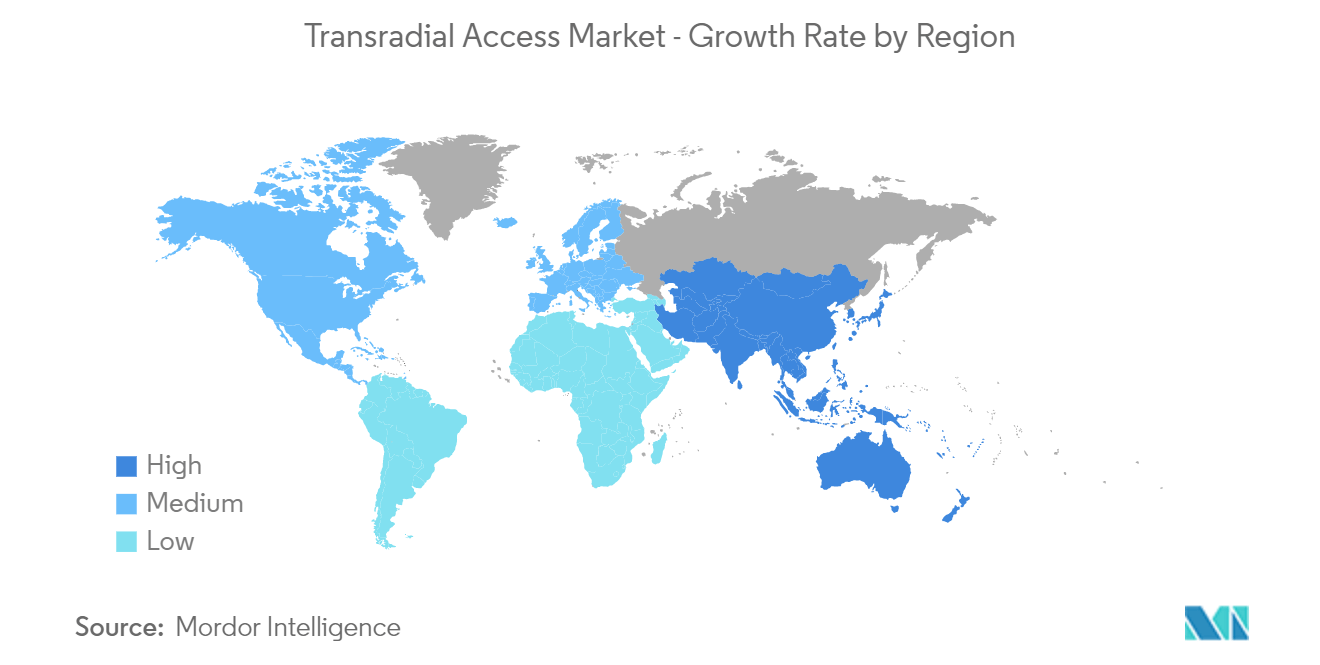
| Fastest Growing Market | Asia Pacific |
| Largest Market | North America |
| Market Concentration | High |
Major Players *Disclaimer: Major Players sorted in no particular order Image © Mordor Intelligence. Reuse requires attribution under CC BY 4.0. | |
Transradial Access Market Analysis by Mordor Intelligence
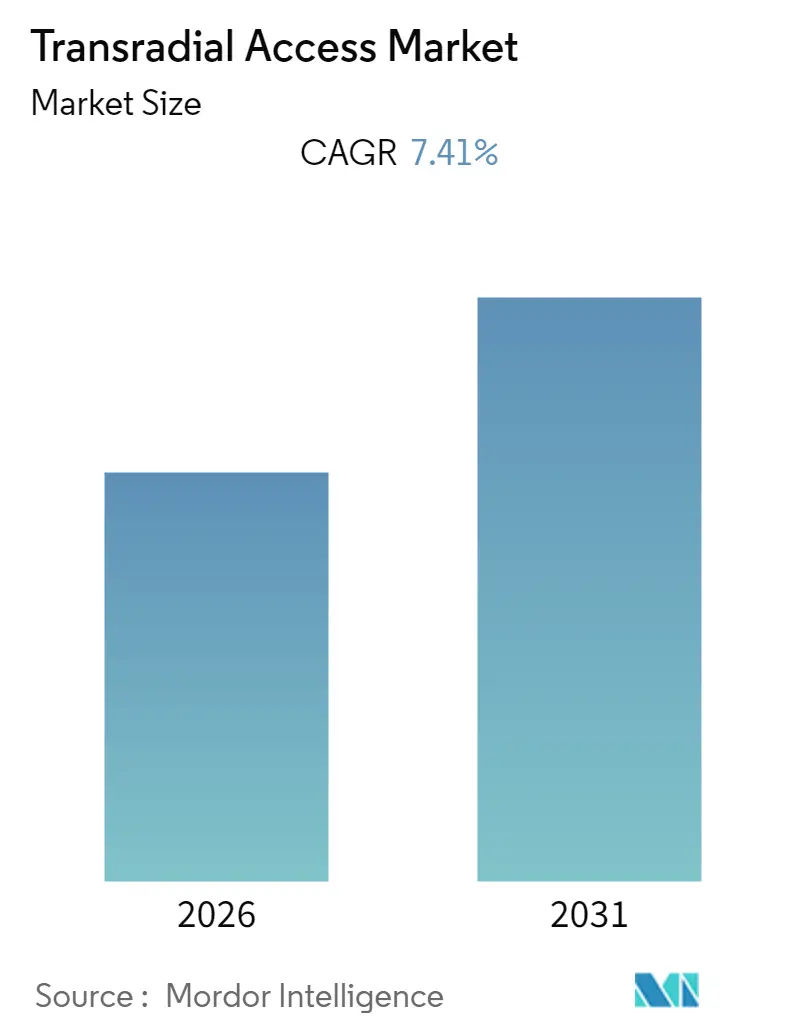
The Transradial Access Market size is expected to register a CAGR of 7.41% during the forecast period (2026-2031).
The COVID-19 pandemic significantly impacted the treatment and diagnostic procedures for cardiac practices, resulting in delayed diagnoses and multiple postponed appointments, which in turn affected the growth of the studied market for transradial access devices. Furthermore, many studies suggested that people with cardiac diseases were particularly vulnerable to COVID-19, which led to a decrease in footfalls in hospitals and diagnostic centers. For instance, according to a research study published by the NCBI in May 2021, during the COVID-19 pandemic, cardiac procedural activity in England decreased dramatically, resulting in a deficit of approximately 45,000 procedures. Moreover, a study published in Frontiers in Family Medicine and Primary Care in December 2021 stated that in Germany, despite having symptoms of coronary artery disease (CAD), 9.1% of patients did not consult a medical practitioner due to a fear of contracting COVID-19. However, the study's findings also detailed that most patients received adequate medical care during the COVID-19 pandemic for CAD. As a result of the growing availability of cardiac diagnosis and treatments, the market is expected to be favorably influenced in the latter phase, as per the analysis.
The transradial access market is growing due to the increasing preference for interventional procedures using radial artery access, the growing prevalence of cardiovascular diseases due to lifestyle disorders, and the increasing use of radial access devices in pediatric patients.
According to the WHO data updated in June 2021, nearly 33.5 million people globally are suffering from atrial fibrillation (AFib), which is the most common type of serious arrhythmia. Moreover, the British Heart Foundation's report published in July 2021 reported that 7.6 million people in the United Kingdom live with heart and circulatory diseases. Further, according to the 2022 AHA report, approximately 244.1 million people were living with IHD around the world. North Africa, the Middle East, Central, and South Asia, and Eastern Europe had the highest prevalence rates of IHD in the world in 2020. With the rise in the aging population worldwide, the number of patients suffering from heart rhythm disorders is likely to increase. This will lead to increased adoption of transradial access, which is expected to drive the growth of the studied market.
A scientific study published by the AHA in August 2021 stated that lower extremity peripheral artery disease (PAD) affects more than 230 million people worldwide and is linked to an elevated risk of several unfavorable clinical outcomes (including cardiovascular diseases like coronary heart disease and stroke and limb outcomes like amputee status). The increased incidence of PAD ultimately boosts the demand for interventional procedures requiring transradial access, augmenting the market's growth over the forecast period.
However, the major restraining factor for the market's growth is the high costs involved in the placement and maintenance of vascular access devices and the lack of trained professionals, which poses significant challenges.
Note: Market size and forecast figures in this report are generated using Mordor Intelligence’s proprietary estimation framework, updated with the latest available data and insights as of 2026.
Global Transradial Access Market Trends and Insights
Catheters Segment is Expected to Witness Growth Over the Forecast Period
The catheter segment is expected to witness growth over the forecast period. Transradial access (TRA) via the left radial artery is an alternative to traditional transfemoral access for catheter-based procedures that are becoming increasingly relevant in all types of arterial vascular interventions. Cardiac catheterization is a common procedure that can help diagnose heart disease. In some cases, catheterization is also used to treat heart disease by opening blocked arteries with balloon angioplasty and stent placement.
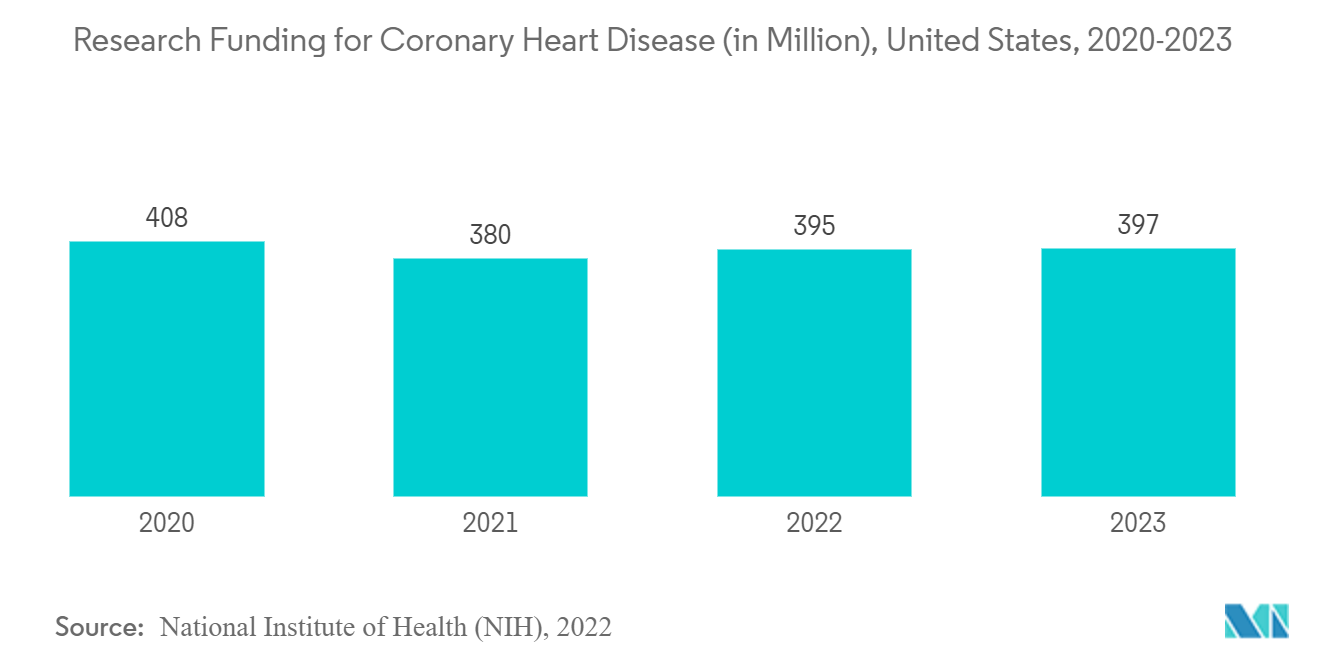
Cardiac catheterization helps in the diagnosis of multiple heart diseases, including atherosclerosis, cardiomyopathy, congenital heart disease, heart failure, and heart valve disease. With the growing burden of cardiovascular diseases all over the world, the catheter segment is expected to witness significant growth. As per a February 2022 published update by the CDC, in 2020, the percentage of adults diagnosed with coronary heart disease was 4.6% in the United States. In addition, as of February 2021, approximately 1.5 million heart attacks and strokes occur every year in the United States. Moreover, as per the 2021 PAHO, cardiovascular diseases account for 40.8 million disability-adjusted life years (DALYs) in the Americas. In addition, according to the National Center for Chronic Disease Prevention and Health Promotion data updated in July 2022, coronary heart disease is the most common type of heart disease. Moreover, about 805,000 people in the United States have a heart attack every year. This concerning situation is raising public awareness about disease management and the importance of diagnostics.
Thus, the abovementioned factors are expected to drive catheter segment growth over the forecast period.


North America Dominates the Market and is Expected to Follow the Same Trend for Few More Years
The North American market is likely to grow with the highest growth rate, owing to factors such as the growing prevalence of CVDs, a rising number of conferences and workshops, and an increase in research and clinical trials for vascular access devices.
According to an article published by the CDC in September 2020, heart disease is the leading cause of death in the United States. The same source also reports that every year about 805,000 Americans have a heart attack. As the number of deaths due to heart diseases is increasing, there is a continuous need for the proper treatment and diagnosis of cardiac diseases, since transradial access devices help in the diagnosis and are hence expected to show growth over the forecast period.
According to the CDC updates from February 2022, about 2.1% of children in the United States are in fair or poor health conditions in 2020, and about 3.3% of children aged 5 to 11 in 2020 missed 11 or more days of school in the last 12 months due to some form of illness or injury. Also, as per the above-mentioned source, in the United States, approximately 20.3% of children aged 6 to 11 have obesity, and as obesity is one of the major risk factors for different diseases, the burden of pediatric disease is expected to increase in the country, which would drive growth in the market studied.
The region's transradial access market is expected to benefit from the well-established healthcare industry and rising healthcare expenditure. For instance, according to NHEA data released in December 2021, the United States spent USD 440,000 million on healthcare in 2020. Thus, rising healthcare costs are expected to spur the development of new products such as transradial access devices, which are expected to drive market growth over the forecast period.
Thus, the market is expected to witness a high growth rate over the forecast period due to the factors mentioned above in the North American region.

Competitive Landscape
The transradial access market is competitive and fragmented and is inclusive of the big players along with some of the local players in the market. Some of the key players in the market include Becton, Dickinson and Company, Boston Scientific Corporation, Edward Lifesciences Corporation, Medtronic plc, and Terumo Corporation.
Transradial Access Industry Leaders
Becton, Dickinson and Company
Boston Scientific Corporation
Edward Lifesciences Corporation
Terumo Corporation
Medtronic plc
- *Disclaimer: Major Players sorted in no particular order


Market Opportunities and Future Outlook
Opportunities are expanding around distal radial access (dTRA) enablement across coronary, neurovascular, and other arterial interventions, supported by regulatory clearances and evolving clinical workflows. Adoption of thin-walled 7-French sheath technology that keeps an outer diameter similar to traditional 6-French forearm sheaths supports larger-bore use cases via radial routes, and it also creates room for accessories such as dedicated hemostasis and closure solutions tailored to distal radial anatomy.
A May 2026 FDA 510(k) clearance for the SAYA 86 Radial Access Guide Catheter by Asahi Intecc reinforces roadmaps that extend radial platforms into neurointerventional procedures. Clinical programs and 2025-2026 publications also provide procedural evidence for ultrasound-guided dTRA and radial strategies in complex structural interventions, and this is helping vendors broaden radial-specific catheter options beyond coronary procedures.
Recent Industry Developments
- July 2026: Results from the SAFER-TAVI trial show that using radial access for secondary access during TAVI reduces complications at the secondary access site. The findings support the expansion of radial access in structural heart procedures and align with demand for integrated radial workflows.
- May 2026: Asahi Intecc received FDA 510(k) clearance for the SAYA 86 Radial Access Guide Catheter for neurovascular diagnostic and interventional access. The clearance adds to the device portfolio for radial navigation in neurointerventions and supports broader adoption of distal radial strategies.
- March 2025: A randomized controlled trial, RAPID III, published in BMC Medicine found that distal radial access for primary PCI in STEMI resulted in a lower incidence of radial artery occlusion compared with conventional transradial access. The outcomes back procedural adoption of distal radial techniques and broaden pull-through for devices optimized for distal radial anatomy.


Research Methodology Framework and Report Scope
Market Definition and Coverage
For this study, the transradial access market is defined as the revenue from devices used to obtain and maintain access through the radial artery for diagnostic and interventional catheterization procedures, including related access components sold for use in hospitals and cath labs.
Scope exclusions: This sizing excludes procedure service revenue, physician fees, and general cardiovascular devices that are not specifically used for radial artery access.
Segmentation Overview
- By Product
- Catheters
- Guidewires
- Sheaths and Sheath Introducers
- Accessories
- By Application
- Drug Administration
- Fluid and Nutrition Administration
- Blood Transfusion
- Diagnostics and Testing
- By End User
- Hospitals
- Clinics and Ambulatory Care Centers
- Others
- Geography
- North America
- United States
- Canada
- Mexico
- Europe
- Germany
- United Kingdom
- France
- Italy
- Spain
- Rest of Europe
- Asia Pacific
- China
- Japan
- India
- Australia
- South Korea
- Rest of Asia-Pacific
- Middle East and Africa
- GCC
- South Africa
- Rest of Middle East and Africa
- South America
- Brazil
- Argentina
- Rest of South America
- North America
Data Sources, Market Sizing, and Validation
Desk Research
Desk research was used to build the initial view of demand, clinical adoption, and regulatory context for radial-first access. We reviewed public sources such as the US FDA device databases and safety communications, the US CDC healthcare utilization statistics, OECD health indicators, and the World Bank population and health expenditure series, which help anchor the procedure and patient pool directionally.
To link the clinical side to market math, we also used peer reviewed cardiology and interventional journals, customs and trade statistics where relevant for medical devices, and company filings and investor presentations for product portfolio and geographic revenue cues. In a few cases, paid subscriptions that support company financials and patent landscaping were used to cross-check product activity and commercialization signals. These sources are illustrative only, and many other public references were used during data collection, validation, and clarification.
Primary Interviews and Surveys
Primary work focused on validating what is actually stocked in the lab and how purchasing decisions are made for radial access consumables. We spoke with a mix of clinical users, procurement teams, and distribution side experts across APAC, EMEA, and the Americas, and then used their inputs to confirm adoption rates, typical usage per procedure, and pricing changes by region and care setting.
Distribution of primary research fieldwork respondents
| Company type | Respondent position | Region |
|---|---|---|
| Top tier: 28% | CXOs: 14% | APAC: 40% |
| Mid tier: 57% | Functional/Unit leaders: 40% | EMEA: 36% |
| Smaller Players: 15% | Managers: 46% | Americas: 24% |
Market-Sizing & Forecasting
Sizing starts with a top-down build where catheterization procedure volumes and the share of radial access are used to reconstruct the addressable demand pool by region, then converted into value using typical device sets per case and average selling prices. Because coverage differs by hospital type and clinical protocol, the model also accounts for factors such as elective versus emergency mix, radial-to-femoral conversion rates, and the shift toward outpatient cath lab settings.
To keep totals realistic, selective bottom-up checks were run using supplier and channel feedback on shipped volumes, sampled price bands for sheaths, guidewires, and catheters, and sanity checks against reported regional sales exposure in public financial disclosures. Forecasting used scenario analysis supported by expert consensus on key drivers, including coronary artery disease and peripheral artery disease procedure trends, guideline-driven radial-first adoption, reimbursement stability, and inflation effects on device ASPs. Where volume or price gaps existed for smaller countries, we used proxy indicators like procedure intensity per million population and nearby country pricing to avoid overstating precision.
Data Validation & Update Cycle
Outputs were validated through multiple passes that compare modeled results with independent signals, including procedure growth patterns, import and export directionality for relevant device categories, and interview feedback on price moves and utilization. When a large variance shows up, the assumptions are reopened, and the relevant experts are re-contacted to confirm whether a true market shift occurred or the input was misread.
Before sign-off, another analyst reviews the logic, unit conversions, and regional splits, and checks that implied volumes and prices stay within plausible clinical ranges. Reports are refreshed annually, and interim updates are made when material events occur, such as regulatory actions, major product changes, or meaningful shifts in cath lab practice. Right before delivery, a final pass is completed so clients receive the most current view available.
Mordor Intelligence's Transradial Access Market Size Compared Against Other Published Estimates
Different published market values for transradial access can vary even when the topic name looks the same, because each study draws the line differently on what counts as access, how prices are normalized, and which year is treated as the anchor for growth.
In practice, the biggest gaps usually come from whether only radial access consumables are counted or whether adjacent cath lab disposables get folded in, along with differences in how procedure volumes are translated into device sets per case and how currency timing is handled for multi-region totals. Update cadence also matters, since clinical adoption can shift quickly after guideline updates and hospital protocol changes.
Benchmark comparison
| Source | Market Size | Gaps in Research Methodology |
|---|---|---|
| Mordor Intelligence | USD 2.39 B (2025) | |
| Global Research Publisher A | USD 2.27 B (2024) | Uses an earlier base year and a broader procedure-type framing, and the public summary does not clearly show how device set assumptions and currency timing were normalized across regions. |
| Industry Research Publisher B | USD 2.50 B (2025) | Public figures appear to include a wider device basket around transradial workflows and apply a different ASP progression path, which can lift the near-term value versus a strict access-only count. |
The table indicates that most of the spread is driven by what is included around the access step, and by how price and currency assumptions are carried through the model. In this comparison, the access-only device scope is the key reason the 2025 total aligns with Mordor Intelligence.


Key Questions Answered in the Report
What is the current Transradial Access Market size?
The Transradial Access Market is projected to register a CAGR of 7.41% during the forecast period (2026-2031)
Who are the key players in Transradial Access Market?
Becton, Dickinson and Company, Boston Scientific Corporation, Edward Lifesciences Corporation, Terumo Corporation and Medtronic plc are the major companies operating in the Transradial Access Market.
Which is the fastest growing region in Transradial Access Market?
Asia Pacific is estimated to grow at the highest CAGR over the forecast period (2026-2031).
Which region has the biggest share in Transradial Access Market?
In 2025, the North America accounts for the largest market share in Transradial Access Market.
What years does this Transradial Access Market cover?
The report covers the Transradial Access Market historical market size for years: 2022, 2023, 2024 and 2025. The report also forecasts the Transradial Access Market size for years: 2026, 2027, 2028, 2029, 2030 and 2031.
Page last updated on:





