
Thermoelectric Coolers Market Size and Share
Market Overview
| Study Period | 2022 - 2032 |
|---|---|
| Market Size (2027) | USD 0.92 Billion |
| Market Size (2032) | USD 1.52 Billion |
| Growth Rate (2027 - 2032) | 10.66 % |
| Fastest Growing Market | Asia-Pacific |
| Largest Market | Asia-Pacific |
| Market Concentration | Medium |
Major Players *Disclaimer: Major Players sorted in no particular order Image © Mordor Intelligence. Reuse requires attribution under CC BY 4.0. | |
Thermoelectric Coolers Market Analysis by Mordor Intelligence
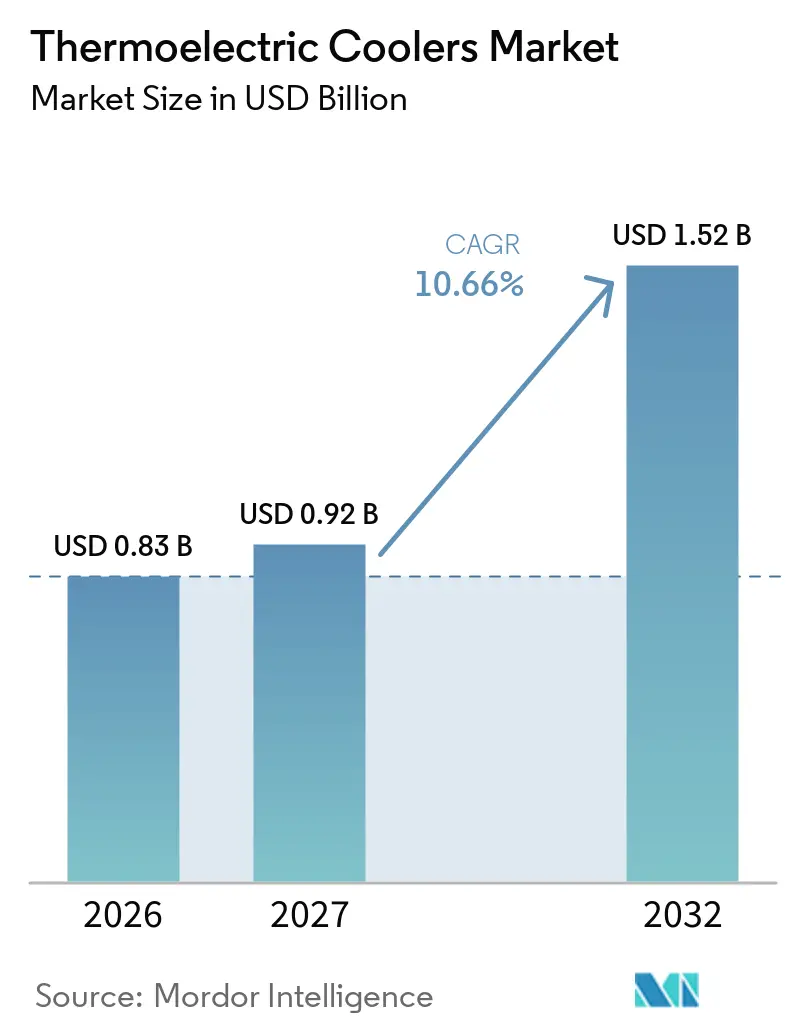
The Thermoelectric Coolers Market size is expected to grow from USD 0.83 billion in 2026 to USD 0.92 billion in 2027 and is forecast to reach USD 1.52 billion by 2032 at 10.66% CAGR over 2027-2032. The thermoelectric coolers market benefits from demand for precise, compact, refrigerant-free cooling in AI infrastructure, electric vehicles, optical networks, and diagnostic equipment. Thermoelectric devices use the Peltier effect to move heat across a semiconductor junction when supplied with direct current. Their vibration-free operation and bidirectional control suit equipment that cannot tolerate temperature variation. Small production micro-thermoelectric cooler (micro-TEC) products now have footprints below 2 mm², which supports use in tightly packed photonics and sensor packages. The thermoelectric coolers market is also moving toward custom modules because advanced applications require cooling systems that fit the component, rather than a standard component fitted into the system.
Key Report Takeaways
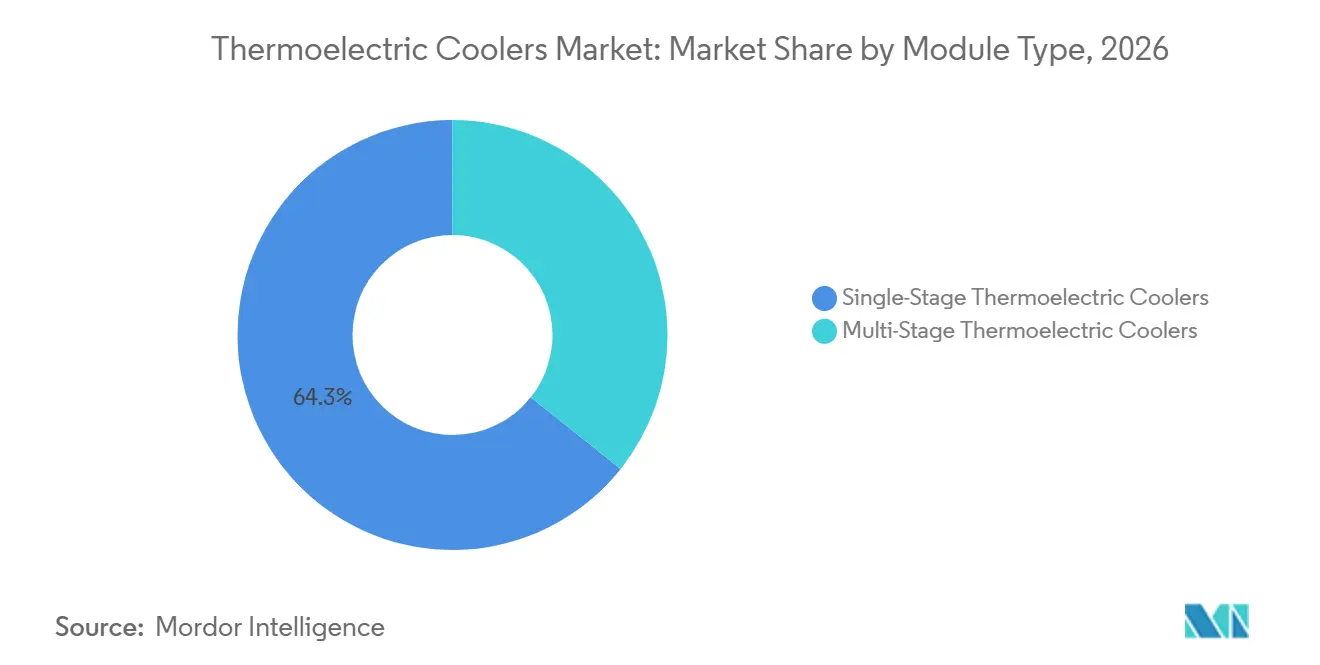
- By module type, single-stage coolers held 64.3% of revenue in 2026, while multi-stage coolers are forecast to grow at a CAGR of 10.8% through 2032.
- By design, standard coolers accounted for 59.4% of revenue in 2026, while custom-designed coolers are projected to grow at a CAGR of 10.9% through 2032.
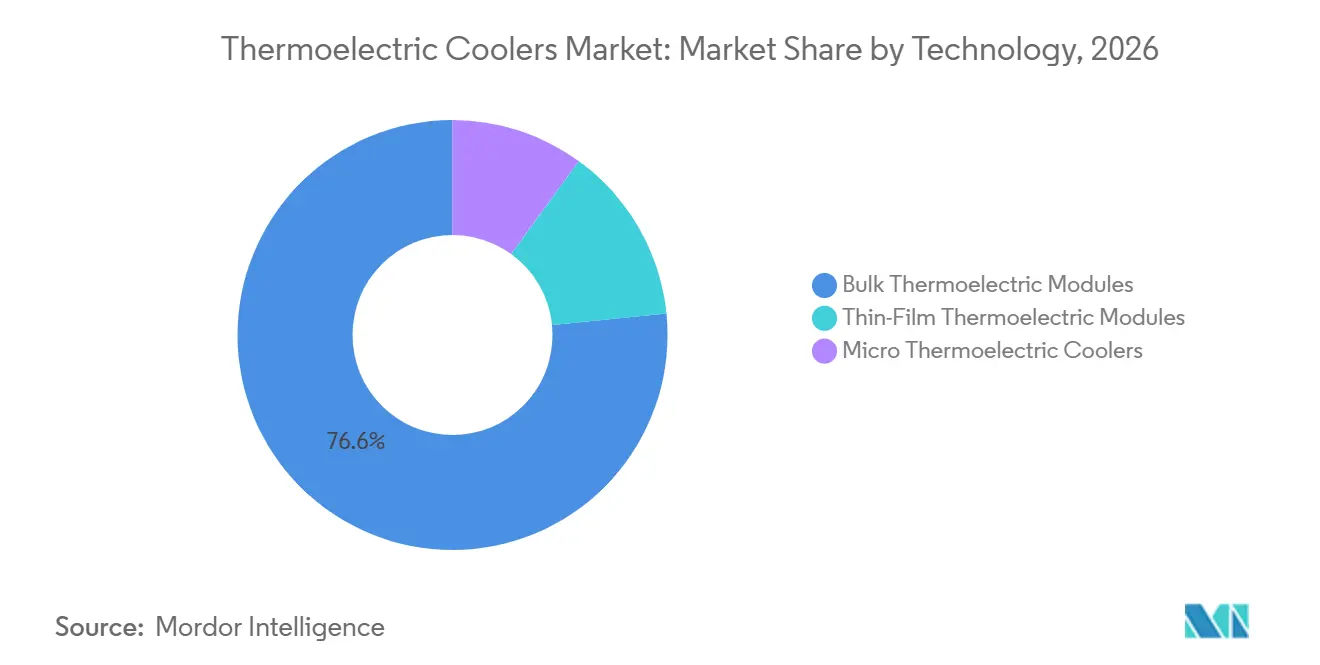
- By technology, bulk modules held 76.6% of revenue in 2026, while thin-film modules are forecast to expand at a CAGR of 11.3% through 2032.
- By temperature range, medium-temperature coolers accounted for 49.2% of revenue in 2026, while low-temperature coolers are projected to grow at a CAGR of 11.7% through 2032.
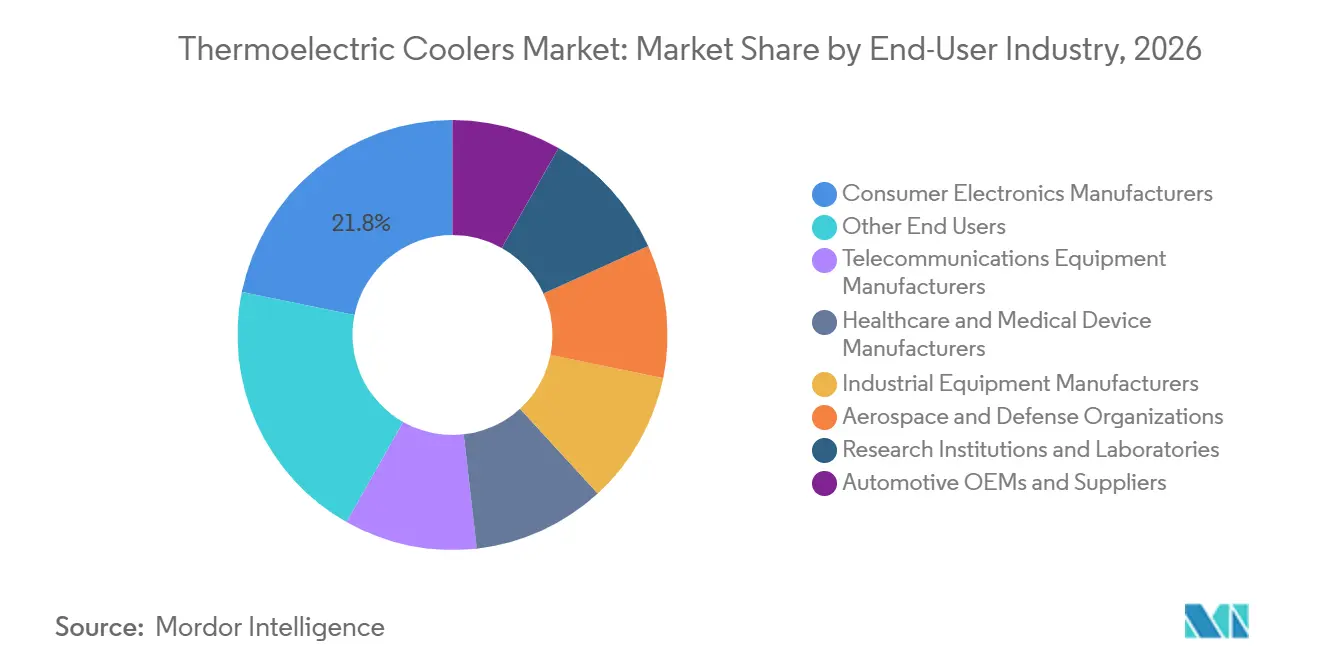
- By end-user industry, consumer electronics held 21.8% of revenue in 2026, while telecommunications equipment is projected to grow at a CAGR of 11.8% through 2032.
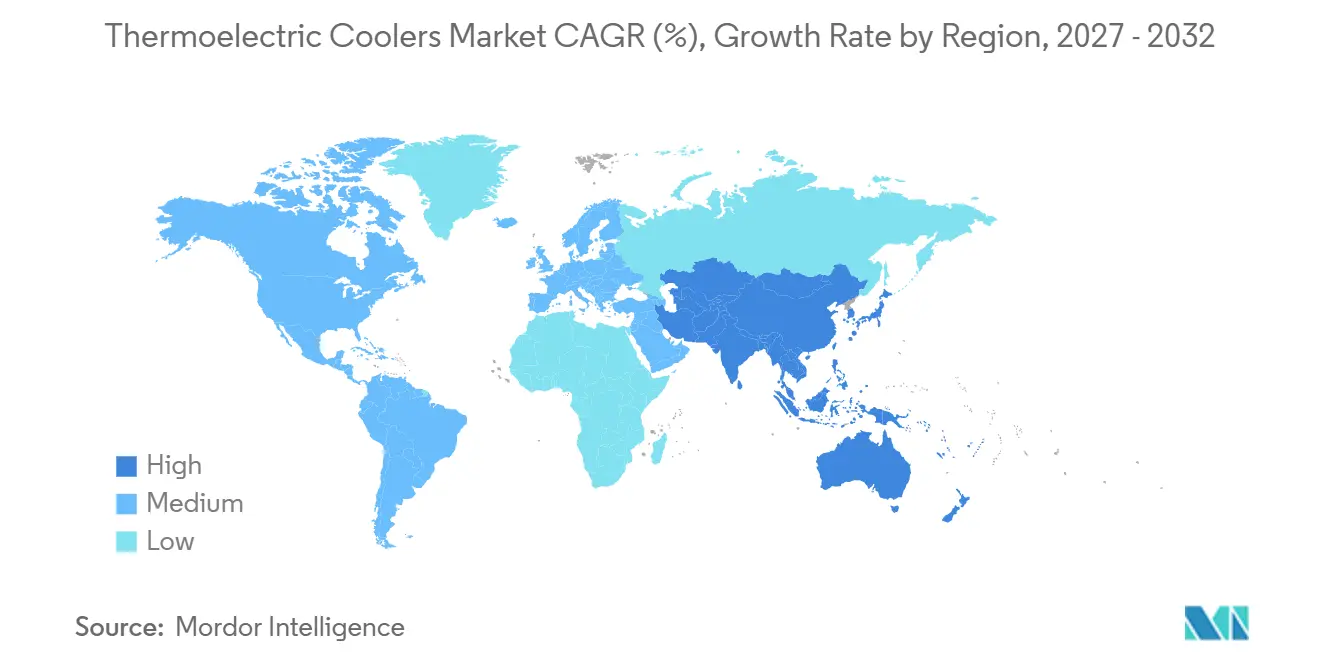
- By geography, Asia-Pacific held 41.3% of revenue in 2026 and is forecast to grow at a CAGR of 11.1% through 2032.
Note: Market numbers in this report are based on Mordor Intelligence's proprietary estimation framework, which combines nine months of actuals with Q4 projections for base year 2026.
Market Trends and Insights
Drivers Impact Analysis of Thermoelectric Coolers Market*
| Driver | (~) % Impact on CAGR Forecast | Geographic Relevance | Impact Timeline |
|---|---|---|---|
| AI-Server and Co-Packaged Optics Heat Density | +3.1% | Global, with concentration in North America and Asia-Pacific | Short term (≤ 2 years) |
| EV Battery, Cabin, and Sensor Thermal Management | +2.0% | Global, with early gains in China, Europe, and North America | Medium term (2-4 years) |
| 5G Optical-Module and Edge-Network Deployment | +1.7% | Asia-Pacific core, with spillover to Middle East and Africa and South America | Short term (≤ 2 years) |
| Precision Temperature Control in Diagnostics and Laboratory Instruments | +1.1% | North America and Europe, with accelerating Asia-Pacific demand | Medium term (2-4 years) |
| Miniaturization of Photonics, LiDAR, and Wearable Electronics | +0.9% | Global, with innovation concentration in North America, Japan, and South Korea | Medium term (2-4 years) |
| Refrigerant-Free Cooling and Solid-State Reliability Requirements | +0.7% | Global, with North American and European regulatory influence | Long term (≥ 4 years) |
| Source: Mordor Intelligence | |||
AI-Server and Co-Packaged Optics Heat Density
The transition to co-packaged optics is increasing demand in the thermoelectric coolers market because temperature control must sit close to the compute die and laser source. AI accelerators draw 400 W to 1,000 W per chip, while localized hot spots can exceed 100 W/cm², which air cooling cannot resolve at the component level.[1] Co-packaged optical systems need laser temperature stability within ±0.5°C to preserve signal integrity at 800G and 1.6T speeds. Tark introduced its OptoTEC MBX Series in September 2025 with footprints as small as 1.5 mm × 1.1 mm and heat-pumping density of 43 W/cm² for high-speed optical pluggables. The move toward smaller optical packages also extends demand to LiDAR and wearable electronics, where small devices need close-range thermal control. Phononic reports that it has deployed more than 25 million TECs for optical applications and is extending solid-state cooling into data center architectures.
EV Battery, Cabin, and Sensor Thermal Management
Electric vehicle applications are expanding the thermoelectric coolers market because battery cells, cabins, and driver-assistance sensors require controlled temperatures. Research on light electric vehicle battery systems found that an optimized TEC reduced energy use by 5.89% against standard catalog modules.[2] A 2025 hybrid phase-change material, TEC, and liquid cooling study found that activating the TEC above 303.15 K and at discharge rates above 5C held the maximum battery temperature at 321.07 K with minimum energy use of 1,439 J.[3] A 12-module air-to-liquid TEC system delivered 1,000 W of refrigerant-free cabin cooling with a validated coefficient of performance of 1.09. Higher-resolution LiDAR and radar systems add a separate source of demand because avalanche photodiode receivers are temperature sensitive. Refrigerant-free operation and solid-state reliability also strengthen the case for TECs where vibration, maintenance, or refrigerant handling limit conventional cooling options.
5G Optical-Module and Edge-Network Deployment
The thermoelectric coolers market gains from 5G and future 6G networks because higher data rates concentrate heat in smaller optical modules. Research published in 2025 showed that leg width, height, and packing density determine micro-TEC cooling capacity, coefficient of performance, and power use in optical modules.[4] Guangdong Fuxin disclosed in July 2025 that its Micro TEC for 400G and 800G optical modules had completed validation with a Chinese telecommunications company and entered batch supply. Higher carrier frequencies and output power in 6G systems will require tighter laser temperature control across outdoor conditions. This requirement makes TECs part of the transceiver architecture rather than an optional add-on. Telcordia GR-468 reliability requirements also favor suppliers with validated telecom qualification histories over new suppliers competing mainly on price.
Precision Temperature Control in Diagnostics and Laboratory Instruments
Precision diagnostics support the thermoelectric coolers market because molecular tests require repeatable temperature cycling in compact instruments. Polymerase chain reaction systems require transitions around 55°C, 72°C, and 95°C, with cell-to-cell uniformity within ±0.5°C. Coherent launched its CT-Series in January 2025 for medical laser stabilization, sensor cooling, incubation, and wearable thermal management, with maximum temperature difference above 70°C at 27°C ambient and rated life of 100,000 cycles. Tark introduced its PCX Series in December 2025 for PCR applications, specifying more than 200,000 power cycles, ±0.5°C uniformity, and 215 W heat-pumping capacity. Point-of-care instruments broaden demand beyond central laboratories because they need laboratory-grade temperature control in smaller, lower-power equipment. ISO 13485 validation requirements favor pre-qualified assemblies with documented cycle-life data, which reinforces demand for custom products.
Restraints Impact Analysis of Thermoelectric Coolers Market*
| Restraint | (~) % Impact on CAGR Forecast | Geographic Relevance | Impact Timeline |
|---|---|---|---|
| Lower Coefficient of Performance Versus Vapor-Compression Cooling | -1.7% | Global | Long term (≥ 4 years) |
| Tellurium and Bismuth Supply Concentration | -1.3% | Global, acute in North America and Europe | Short term (≤ 2 years) |
| Heat Rejection and System-Integration Complexity | -0.9% | Global, most acute where thermal engineering expertise is limited | Medium term (2-4 years) |
| Qualification Cost for Automotive, Medical, and Aerospace Applications | -0.7% | North America and Europe | Medium term (2-4 years) |
| Source: Mordor Intelligence | |||
Lower Coefficient of Performance Versus Vapor-Compression Cooling
Lower energy efficiency limits the thermoelectric coolers market in high-load cooling applications. A thermoelectric cooler (TEC) that extracts 100 W of heat can consume 150 W of electricity, leaving the hot-side system to reject 250 W in total. Vapor-compression systems can operate with coefficients of performance from 3 to 5, which makes them more suitable for large-format refrigeration. A 2025 review found that hybrid battery systems can improve cell-level thermal performance, but TEC energy use limits deployment to conditions that need active precision. SolidT reports modeled coefficients of performance above 2.5 at temperature differences of 7 °C to 10 °C, but efficiency falls sharply when the temperature difference exceeds 15 °C. Heat rejection needs, integration complexity, and the need for engineers with thermal-system expertise add cost where these narrow operating conditions cannot be met.
Tellurium and Bismuth Supply Concentration
Bismuth and tellurium supply concentration remains a direct risk for the thermoelectric coolers market. China supplied 80% of global bismuth, and U.S. import reliance exceeded 95% of consumption, with no domestic primary refined bismuth production since 1997. Chinese export license requirements contributed to bismuth prices reaching USD 38.50 per pound in early 2025, compared with USD 3.58 per pound at the start of the year, before prices partially corrected after the May trade truce. The International Energy Agency identifies tellurium as a high-risk strategic mineral because its supply depends on copper refining rather than its own output cycle. A 2025 study identified tellurium as the highest supply-risk input for European thermoelectric applications and reported that European dependence on Chinese sources for tellurium and bismuth exceeded 80%. Automotive, medical, and aerospace qualification costs add a further barrier, so suppliers increasingly use long-term material agreements rather than spot sourcing, as shown by PyroDelta, First Tellurium, and Fenix Advanced Materials in October 2025.
*Our forecasts treat driver/restraint impacts as directional, not additive. The impact forecasts reflect baseline growth, mix effects, and variable interactions.
Thermoelectric Coolers Market Segment Analysis
By Module Type:
Multi-Stage Growth Accelerates as Single-Stage Anchors VolumeSingle-stage coolers held 64.3% of thermoelectric coolers market share in 2026. Their lower cost and simpler drive electronics support use in consumer electronics, standard telecom transceivers, portable medical devices, and controlled enclosures. These applications usually need moderate temperature differences that one Peltier junction can provide. China produced 137 million TEC units in 2024, with most production focused on single-stage modules. Larger output has intensified price competition in standard products. The segment remains important because consumer electronics applications require large volumes. Its margins face pressure as lower-cost Asian capacity grows. Producers are responding by shifting attention toward custom and multi-stage products.
Multi-stage coolers are projected to grow at a CAGR of 10.8% from 2027 to 2032. The technology serves InGaAs infrared detectors, quantum-cascade lasers, LiDAR receiver arrays, and spectroscopy tools that require deeper cooling. Stacked junctions enable colder operating points than single-stage designs. Tark presented its OptoTEC MSX Series in August 2025 for high-performance imaging sensors in autonomous systems and machine vision. Coherent's CT-Series also supports high-differential cooling, with a maximum temperature difference above 70°C at 27°C ambient. The thermoelectric coolers market is therefore extending multi-stage demand from aerospace and defense into commercial photonics and robotics. Qualification history remains important in applications where performance failure is costly.

By Design:
Custom Solutions Gaining Ground Amid Qualification-Driven PurchasingStandard designs are estimated to account for 59.4% of revenue in 2026. Catalog availability, established supply chains, and high-volume demand support their position. Consumer electronics and industrial customers can often use common footprints and rated performance. Global distributors also make standard modules easy to source for prototypes and short development programs. This availability keeps standard designs economically attractive for many OEMs. High-volume manufacturing lowers unit costs. The thermoelectric coolers industry still depends on these designs for broad-based volume. Standard modules also remain useful when system requirements do not justify a customized thermal interface.
Custom-designed coolers are projected to grow at a CAGR of 10.9% from 2027 to 2032. OEMs need products optimized for form factor, drive current, material selection, and the thermal interface. Medical and automotive requirements make a qualified custom design more useful over a long production run. Optical form-factor standards, including Octal Small Form-factor Pluggable (OSFP) and Quad Small Form-factor Pluggable Double Density (QSFP-DD), create tight dimensions that generic modules cannot meet. Tark's MBX Series was designed with a 1.5 mm × 1.1 mm footprint for these package constraints. Established engineering capability and qualified supply chains give suppliers an advantage in higher-value applications. This part of the thermoelectric coolers market rewards vendors that can jointly design the cooling module and the end product. It also reduces the scope for commodity-only competition.
By Technology:
Bulk Modules Lead on Volume, Thin-Film Unlocks High-Density ApplicationsBulk modules held 76.6% of revenue in 2026. Long-running bismuth telluride manufacturing in China, Japan, and Europe supports low unit costs. Integrated supply chains provide pellets, ceramic substrates, and copper interconnects at scale. Ferrotec, Thermonamic Electronics, and Guangdong Fuxin operate in high-volume bulk manufacturing. Bulk products remain suited to ambient temperature uses with moderate cooling needs. Micro-TECs remain part of the bulk technology family but use more precise assembly processes. Their small footprints below 5 mm² support optical transceivers and polymerase chain reaction thermocyclers. The thermoelectric coolers market, therefore, retains bulk modules as its main volume technology.
Thin-film modules are forecast to grow at a CAGR of 11.3% from 2027 to 2032. They serve packages where bulk modules cannot meet space and form-factor limits. SolidT reports heat-pumping density above 100 W/cm² and modeled coefficient of performance above 2.5 at a 7°C to 10°C temperature difference. A 2025 study demonstrated 10 µm Sb₂Te₃ thick films with a room-temperature power factor of 25.0 µW cm⁻¹ K⁻² for flexible planar devices. Separate research validated flexible thermoelectric fabrics with 0.02 K temperature-detection accuracy across more than 10,000 compression cycles. These results support future uses in wearables and close-range cooling of skin-contact electronics. The remaining issue is whether wafer-level manufacturing can lower costs enough for thin film products to move beyond premium applications.
By Temperature Range:
Low-Temperature Segment Leads Forecast Growth as Deep-Cooling Demand ExpandsMedium-temperature coolers held 49.2% of revenue in 2026. They are used in consumer electronics, telecom modules, portable cooling, and laboratory instruments. These applications require temperatures between ambient conditions and around −40°C. Single-stage bismuth telluride modules can usually provide that range without the complexity of a multi-stage product. High-temperature-differential systems serve smaller aerospace, defense, and industrial laser applications. Their unit value is higher even though their production volume is lower. Specialist suppliers accept their higher qualification requirements because these products can support stronger margins. Medium-temperature products remain central to the thermoelectric coolers market because of their broad application base.
Low-temperature coolers are projected to grow at a CAGR of 11.7% from 2027 to 2032. Photon-counting detectors, InGaAs and Mercury Cadmium Telluride (MCT) imaging, molecular biology equipment, and satellite sensors require colder operating conditions. Multi-stage TEC assemblies can provide deep cooling while tolerating vibration and thermal shock. That gives them an advantage over cooling systems that need cryogenic service or more maintenance. Coherent documents thermal shock, power cycling, vibration, insulation resistance, and burn-in testing for space-qualified TEC assemblies. Point-of-care molecular diagnostics also require cooling below ambient during temperature cycling. These demanding conditions create barriers that support premium pricing for qualified suppliers. Demand from commercial diagnostic instruments adds to established aerospace and defense demand.
By End-User Industry:
Telecom Leads Forecast Growth as AI Cluster Demand Reshapes End-Use PrioritiesConsumer electronics held 21.8% of revenue in 2026. Personal computing, imaging devices, portable audio equipment, and premium portable coolers use TECs for quiet and vibration-free spot cooling. The segment remains price sensitive, but compressor noise is not acceptable in several portable product categories. Automotive manufacturers are another major source of future demand because battery thermal management is becoming a design requirement. Research on hybrid TEC battery systems supports the use of active precision cooling in demanding conditions. Healthcare customers use higher-value assemblies in PCR equipment, immunoassay analyzers, centrifuges, and incubators. Industrial equipment, aerospace, defense, and research institutions support stable specialist demand. These applications diversify the thermoelectric coolers market beyond consumer devices.
Telecommunications equipment is forecast to grow at a CAGR of 11.8% from 2027 to 2032. The segment uses thermoelectric coolers (TECs) in 800G and 1.6T transceivers for AI data centers and 5G base stations. Each 800G transceiver can use a micro-TEC, while AI clusters deploy large numbers of transceivers. The resulting cooling content per rack is higher than in earlier network designs. Initial telecom design wins can lead to supply commitments lasting 5 to 8 years. This favors suppliers that enter a transceiver platform early in its development cycle. The thermoelectric coolers market also benefits from early platform selection because suppliers can secure multiyear commitments. Food cold-chain and consumer portable-cooling uses add a more diffuse source of demand. Phononic's 2025 licensing agreement for its ACS platform targets e-commerce fulfillment, grocery refrigeration, and last-mile delivery.
Geography Analysis
Asia-Pacific held 41.3% of thermoelectric coolers market share in 2026 and is projected to grow at a CAGR of 11.1% through 2032. China combines bismuth telluride material supply, pellet fabrication, ceramic production, module assembly, consumer electronics, and telecom manufacturing. Chinese TEC production reached 137 million units in 2024, supported by consumer electronics, telecom, and automotive demand. The country is moving from lower-cost commodity modules toward more precise products. Guangdong Fuxin began batch supply of a validated Micro TEC for 400G and 800G optical modules in July 2025. Japan contributes precision engineering through KELK, Ferrotec, and Z-MAX. South Korea benefits from its connection to the Samsung semiconductor ecosystem. India and Southeast Asia provide thermoelectric coolers market opportunities as electronics and medical-device production expand.
North America and Europe provide major thermoelectric coolers market demand in aerospace, defense, precision medical equipment, industrial lasers, and AI data center infrastructure. North America supports major demand for 800G and 1.6T optical hardware, with Coherent, Phononic, TE Technology, and Sheetak positioned in the regional supply base. U.S. bismuth import dependence above 95% of consumption remains a material security risk. This exposure encourages alternative feedstock agreements and material-substitution research. European demand is centered in Germany, the United Kingdom, France, and Nordic countries. Automotive development, scientific equipment, and semiconductor capital equipment support premium demand. The European Critical Raw Materials Act adds pressure for supply-chain diversification, which supports recycling and non-Chinese material sources. TEC Microsystems and European Thermodynamics serve specialized customers where qualification history and local engineering support matter more than component cost.
South America, the Middle East, and Africa remain smaller parts of the thermoelectric coolers market. Brazil and Argentina lead demand in South America through telecom equipment, agricultural biotechnology, clinical diagnostics, and portable cooling. Colombia is a secondary market tied to telecom and healthcare investment. Saudi Arabia and the UAE are increasing data center and industrial automation investment under economic diversification programs. They import TEC-equipped transceivers and sensors from Asia-Pacific and European suppliers. South Africa, Egypt, and Nigeria support demand for laboratory and point-of-care diagnostic equipment. Thermoelectric coolers market growth depends on electronics investment, healthcare funding, and the pace of 5G deployment. These factors make regional demand less predictable than the growth drivers in Asia-Pacific and North America.
Competitive Landscape
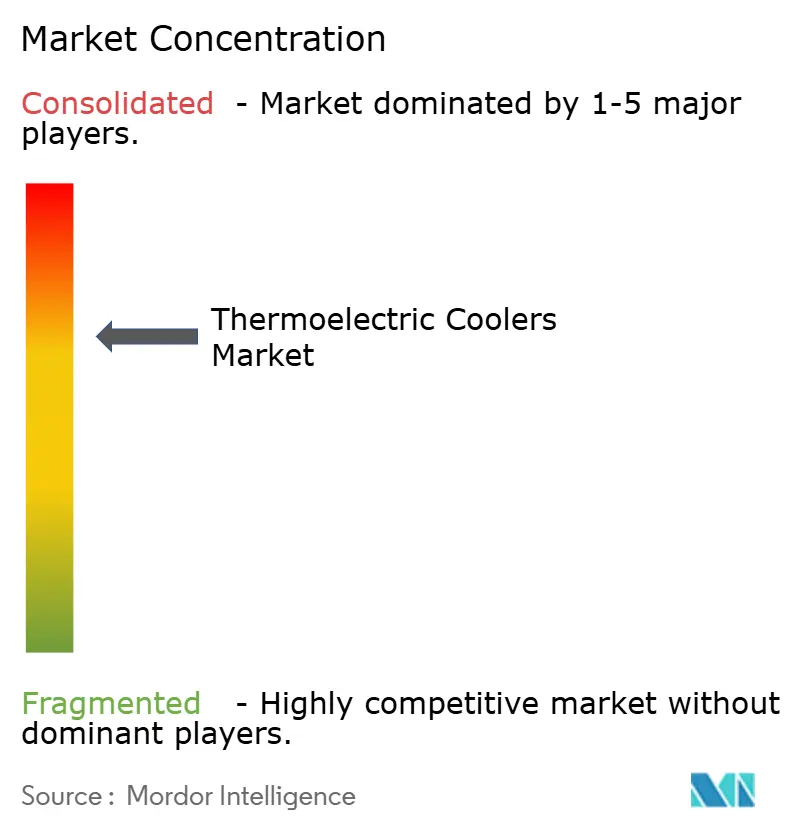
The thermoelectric coolers market is moderately concentrated, with Ferrotec Holdings, Coherent Corp., and Tark Thermal Solutions together holding a major share of revenue in 2026. Within the thermoelectric coolers market, Ferrotec has broad vertical integration across materials processing, module fabrication, and system assembly in Japan and China. It supplies semiconductor capital equipment, automotive radar, and precision photonics to customers. Ferrotec opened its Total Thermal Solutions Open Lab in Japan in November 2025 to offer module characterization, system modeling, and integrated design support. This move shifts the company toward system-level thermal support. Coherent serves aerospace, life science, and optical communications customers where reliability and qualification history matter. Its January 2025 CT-Series launch expanded its offer for medical and sensor uses. Tark develops integrated assemblies with controllers for PCR instruments, transceivers, and autonomous-system sensors.
The competitive structure has two distinct levels. Chinese, Russian, and Eastern European producers compete strongly on price in commodity single-stage modules. Japanese and U.S. specialists retain stronger positions in precision applications because automotive, aerospace, and medical qualification processes are costly. Guangdong Fuxin's telecom validation shows that Chinese producers are moving into higher-end optical cooling. Supply security is becoming part of the competitive offer because bismuth and tellurium availability can affect production and margins. The First Tellurium, PyroDelta, and Fenix agreement is an example of companies using contracted supply to lower this exposure. Suppliers with material access, validated processes, and application engineering capability can defend positions beyond price. This makes it difficult for a commodity producer to enter regulated and high-reliability accounts.
Phononic took a different route in September 2025 through an exclusive licensing agreement with Peltier Technology for its Active Cooling Solutions platform. White-space opportunities in the thermoelectric coolers market remain in automotive-grade Micro thermoelectric cooler (TEC) supply for Western electric vehicle (EV) and driver-assistance customers. There is also an opportunity to integrate closed-loop control into the module package. Low-bismuth and bismuth-free alternatives could gain value where supply security or reformulation is important. Research activity in nanostructured materials and alternative thermoelectric systems is advancing across the United States, Germany, Japan, and China. Future performance gains are more likely to come from materials advances than from changes to basic module architecture.
Thermoelectric Coolers Industry Leaders
-
Ferrotec Holdings Corporation
-
Laird Thermal Systems
-
Coherent Corp.
-
KELK Ltd. (Komatsu Ltd.)
-
Phononic, Inc.
- *Disclaimer: Major Players sorted in no particular order
Thermoelectric Coolers Market Companies Covered in this Report
- Coherent Corp.
- Crystal Ltd.
- CUI Devices
- European Thermodynamics Ltd.
- Ferrotec Holdings Corporation
- Guangdong Fuxin Technology Co., Ltd.
- KELK Ltd. (Komatsu Ltd.)
- KJLP Electronics Co., Ltd.
- Kryotherm Industries
- KYOCERA Corporation
- Laird Thermal Systems
- Merit Technology Group
- P&N Technology (Xiamen) Co., Ltd.
- Phononic, Inc.
- RMT Ltd.
- TE Technology, Inc.
- TEC Microsystems GmbH
- Thermonamic Electronics (Jiangxi) Corp., Ltd.
- Zhejiang Wangu Semiconductor Technology Co., Ltd.
- Z-MAX Co., Ltd.
Recent Industry Developments in Thermoelectric Coolers Market
- October 2025: First Tellurium Corp. and its subsidiary PyroDelta Energy Inc. signed a critical minerals supply agreement with Fenix Advanced Materials in Trail, British Columbia, to secure high-purity refined tellurium with 99.9999% purity for thermoelectric generator production. The agreement secures a North American alternative feedstock source with long-standing domestic smelter agreements.
- September 2025: Tark Thermal Solutions introduced custom configurations of its OptoTEC MBX Series micro thermoelectric coolers for 800G, 1.6T, and 3.2T optical pluggables in AI data centers and 5G infrastructure. Modules measure as small as 1.5 mm × 1.1 mm × 0.65 mm and achieve heat-pumping density of 43 W/cm²
- September 2025: Phononic and Peltier Technology Inc. entered an exclusive cold-chain licensing agreement for Phononic's Active Cooling Solutions platform. Peltier Technology will commercialize the platform across e-commerce fulfillment, retail grocery refrigeration, and last-mile delivery.
- August 2025: Tark Thermal Solutions presented next-generation active cooling products at CIOE 2025 in Shenzhen, including the OptoTEC MSX Series of multi-stage micro-TECs for deep cooling of imaging sensors and the Hi-Temp ETX Series for autonomous vehicles and machine vision.
Global Thermoelectric Coolers Market Report Scope
A thermoelectric cooler (TEC), also known as a Peltier cooler or Peltier chip, is a solid-state active heat pump that transfers heat from one side of the device to the other using direct electric current.
The global thermoelectric coolers market is segmented by module type, design, technology, temperature range, end-user industry, and geography. By module type, the market is segmented into single-stage and multi-stage thermoelectric coolers. By design, the market is segmented into standard and custom-designed thermoelectric coolers. By technology, the market is segmented into bulk thermoelectric modules, thin-film thermoelectric modules, and micro thermoelectric coolers. By temperature range, the market is segmented into low-temperature, medium-temperature, and high-temperature differential coolers. By end-user industry, the market is segmented into consumer electronics manufacturers, automotive OEMs and suppliers, telecommunications equipment manufacturers, healthcare and medical device manufacturers, industrial equipment manufacturers, aerospace and defense organizations, research institutions and laboratories, and other end users. The report also covers the market size and forecasts for the global thermoelectric coolers market across 28 countries in key regions. For each segment, the market sizing and forecasts have been provided on the basis of value (USD).
Segmentation Overview
| Single-Stage Thermoelectric Coolers |
| Multi-Stage Thermoelectric Coolers |
| Standard Thermoelectric Coolers |
| Custom-Designed Thermoelectric Coolers |
| Bulk Thermoelectric Modules |
| Thin-Film Thermoelectric Modules |
| Micro Thermoelectric Coolers |
| Low-Temperature Coolers |
| Medium-Temperature Coolers |
| High-Temperature-Differential Coolers |
| Consumer Electronics Manufacturers |
| Automotive OEMs and Suppliers |
| Telecommunications Equipment Manufacturers |
| Healthcare and Medical Device Manufacturers |
| Industrial Equipment Manufacturers |
| Aerospace and Defense Organizations |
| Research Institutions and Laboratories |
| Other End Users |
| North America | United States |
| Canada | |
| Mexico | |
| Europe | Germany |
| France | |
| Italy | |
| Spain | |
| United Kingdom | |
| Poland | |
| Netherlands | |
| Russia | |
| Rest of Europe | |
| Asia-Pacific | China |
| India | |
| Japan | |
| South Korea | |
| Australia | |
| Indonesia | |
| Malaysia | |
| Thailand | |
| Philippines | |
| Rest of Asia-Pacific | |
| South America | Brazil |
| Argentina | |
| Colombia | |
| Rest of South America | |
| Middle East and Africa | Saudi Arabia |
| United Arab Emirates | |
| South Africa | |
| Egypt | |
| Nigeria | |
| Rest of Middle East and Africa |
| By Module Type | Single-Stage Thermoelectric Coolers | |
| Multi-Stage Thermoelectric Coolers | ||
| By Design | Standard Thermoelectric Coolers | |
| Custom-Designed Thermoelectric Coolers | ||
| By Technology | Bulk Thermoelectric Modules | |
| Thin-Film Thermoelectric Modules | ||
| Micro Thermoelectric Coolers | ||
| By Temperature Range | Low-Temperature Coolers | |
| Medium-Temperature Coolers | ||
| High-Temperature-Differential Coolers | ||
| By End-User Industry | Consumer Electronics Manufacturers | |
| Automotive OEMs and Suppliers | ||
| Telecommunications Equipment Manufacturers | ||
| Healthcare and Medical Device Manufacturers | ||
| Industrial Equipment Manufacturers | ||
| Aerospace and Defense Organizations | ||
| Research Institutions and Laboratories | ||
| Other End Users | ||
| By Geography | North America | United States |
| Canada | ||
| Mexico | ||
| Europe | Germany | |
| France | ||
| Italy | ||
| Spain | ||
| United Kingdom | ||
| Poland | ||
| Netherlands | ||
| Russia | ||
| Rest of Europe | ||
| Asia-Pacific | China | |
| India | ||
| Japan | ||
| South Korea | ||
| Australia | ||
| Indonesia | ||
| Malaysia | ||
| Thailand | ||
| Philippines | ||
| Rest of Asia-Pacific | ||
| South America | Brazil | |
| Argentina | ||
| Colombia | ||
| Rest of South America | ||
| Middle East and Africa | Saudi Arabia | |
| United Arab Emirates | ||
| South Africa | ||
| Egypt | ||
| Nigeria | ||
| Rest of Middle East and Africa | ||
Key Questions Answered in the Report
How large is the thermoelectric coolers market in 2026?
The thermoelectric coolers market size is USD 0.83 billion in 2026 and is forecast to reach USD 1.52 billion by 2032 at a 10.66% CAGR.
Why are thermoelectric coolers used in AI data centers?
They provide compact, localized cooling for optical components that need temperature stability within ±0.5°C at high transmission speeds. This supports co-packaged optics and dense transceiver designs near high-heat compute components. Their vibration-free operation is also useful for sensitive optical hardware.
Which thermoelectric cooler technology is growing fastest?
Thin-film modules are forecast to grow at a CAGR of 11.3% through 2032 because they fit space-constrained optical and wearable applications. Their small form factor can support high-density thermal management where conventional modules are too large. Bulk modules remain the principal volume technology.
What limits wider use of thermoelectric cooling?
Lower energy efficiency than vapor-compression cooling limits use in high-load applications. Bismuth and tellurium supply concentration can also affect cost, availability, and manufacturers' material procurement plans. These limits make TECs most suited to targeted precision applications.
Which region leads demand for thermoelectric coolers?
Asia-Pacific held 41.3% of revenue in 2026 and is projected to grow at a CAGR of 11.1% through 2032. Its electronics manufacturing base combines component supply with large downstream demand. China remains the key production and consumption center.
How concentrated is the supplier landscape?
Ferrotec, Coherent, and Tark are among the major suppliers in the thermoelectric coolers market, while many regional suppliers continue to compete in standard single-stage modules. Qualification history differentiates suppliers in regulated and high-reliability applications.