
Terpene Resins Market Size and Share
Market Overview
| Study Period | 2022 - 2032 |
|---|---|
| Market Size (2027) | USD 1.07 Billion |
| Market Size (2032) | USD 1.51 Billion |
| Growth Rate (2027 - 2032) | 7.18 % |
| Fastest Growing Market | Asia-Pacific |
| Largest Market | Asia-Pacific |
| Market Concentration | Medium |
Major Players *Disclaimer: Major Players sorted in no particular order Image © Mordor Intelligence. Reuse requires attribution under CC BY 4.0. | |
Terpene Resins Market Analysis by Mordor Intelligence
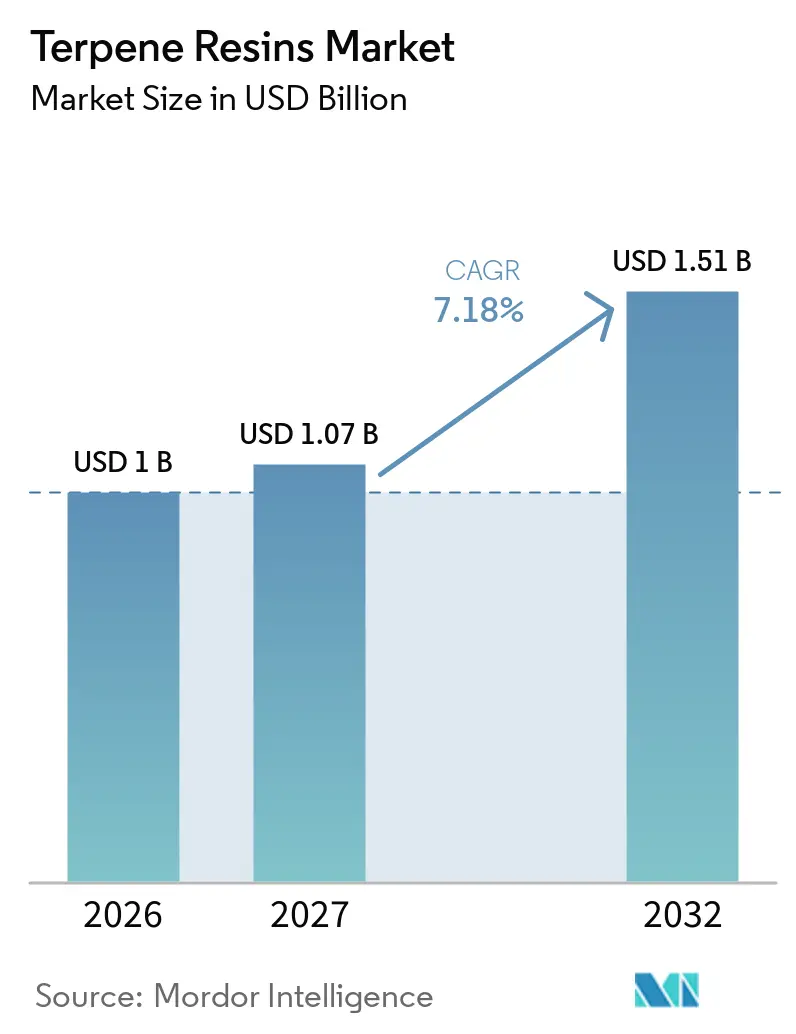
The terpene resins market size was valued at USD 1.00 billion in 2026 and is estimated to grow from USD 1.07 billion in 2027 to USD 1.51 billion by 2032, at a CAGR of 7.18% during the forecast period (2027-2032). Demand is shifting toward renewable tackifiers as adhesive buyers require lower volatile organic compound (VOC) formulations and clearer documentation of renewable content. Hydrogenated terpene grades support tighter softening-point control, lower odor, and improved color stability in applications such as medical tapes, hygiene adhesives, and food-contact packaging. These product requirements are reducing the terpene resins market's dependence on standard hydrocarbon resin specifications for higher-value uses. Producers with secure pine feedstock, hydrogenation capability, and recognized sustainability credentials are better positioned to manage input volatility and meet customer qualification requirements. Capacity planning is increasingly centered on Asia-Pacific, where resin supply, adhesive conversion, rubber processing, and packaging manufacturing are closely connected.
Key Report Takeaways
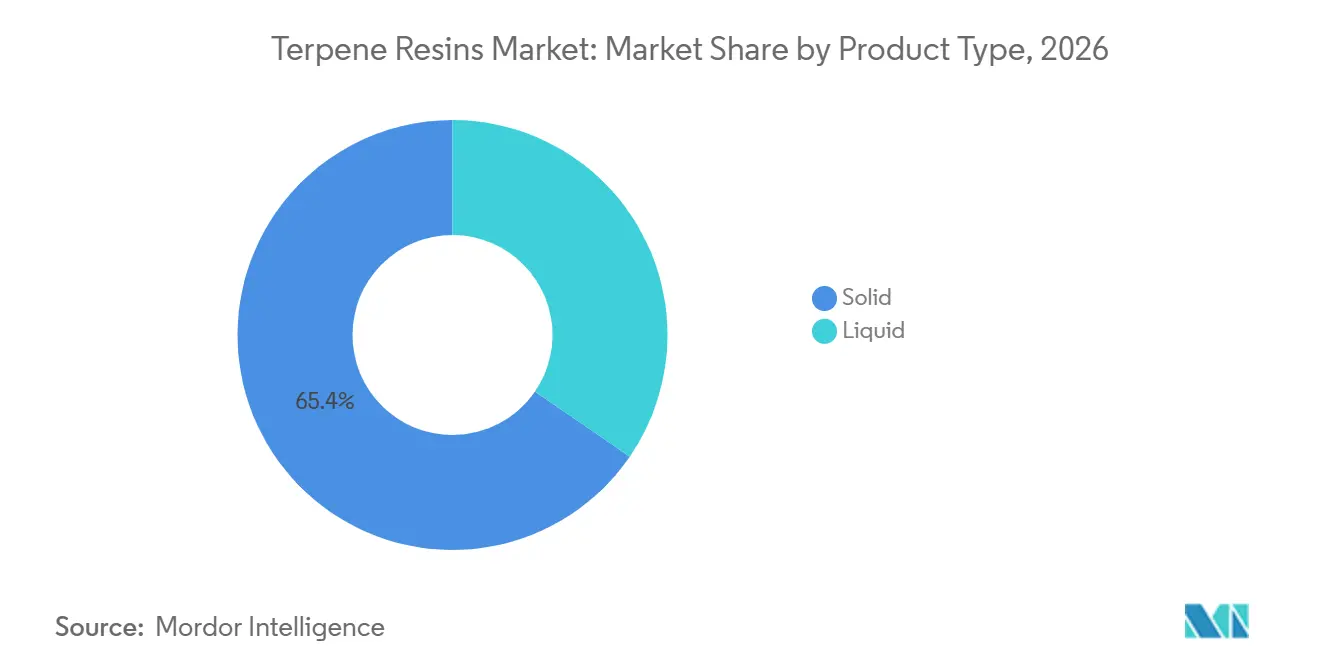
- By product type, solid resins held 65.43% of the terpene resins market share in 2026, while liquid resins are forecast to expand at a 7.67% CAGR through 2032.
- By grade, industrial grade accounted for 31.67% of the terpene resins market share in 2026, while pharmaceutical and food-contact grades are projected to grow at an 8.12% CAGR through 2032.
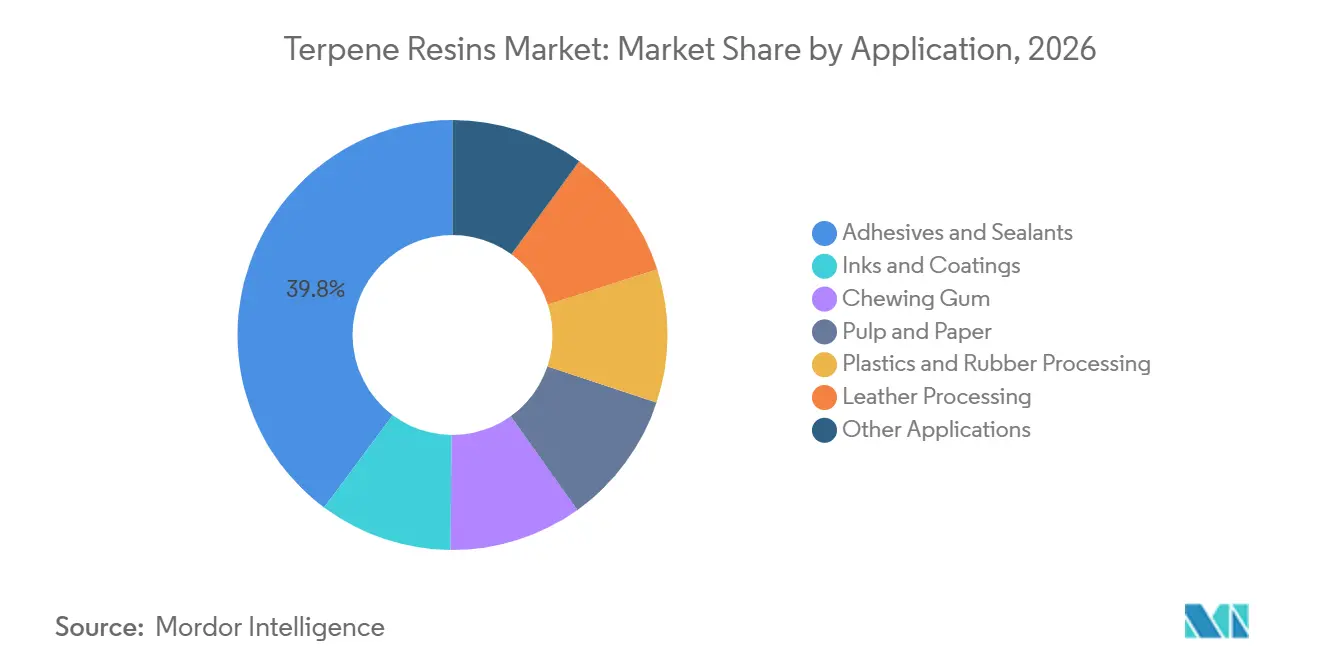
- By application, adhesives and sealants captured 39.81% of the terpene resins market share in 2026, while plastics and rubber processing is forecast to advance at an 8.44% CAGR through 2032.
- By geography, Asia-Pacific accounted for 36.52% of the terpene resins market share in 2026 and is expected to grow at an 8.31% CAGR through 2032.
Note: Market numbers in this report are based on Mordor Intelligence's proprietary estimation framework, which combines nine months of actuals with Q4 projections for base year 2026.
Market Trends and Insights
Drivers Impact Analysis of Terpene Resins Market*
| Drivers | (~) % Impact on CAGR Forecast | Geographic Relevance | Impact Timeline |
|---|---|---|---|
| Demand for Bio-Based Tackifiers in Adhesives | +2.1% | Global, concentrated in North America, EU, and Japan | Medium term (2-4 years) |
| Growth in Packaging, Automotive, and Construction Applications | +1.8% | Asia-Pacific core, with spillover to North America and EU | Medium term (2-4 years) |
| Expansion of Inks and Coatings, Rubber, and Paper Processing | +1.2% | Global, with Asia-Pacific and EU as primary demand centers | Long term (≥ 4 years) |
| Asia-Pacific Industrialization and Manufacturing Relocation | +1.5% | China, India, and ASEAN countries | Long term (≥ 4 years) |
| Renewable-Diesel Competition Driving Feedstock Reallocation | +0.6% | North America and EU | Short term (≤ 2 years) |
| Source: Mordor Intelligence | |||
Demand for Bio-Based Tackifiers in Adhesives
Regulation of volatile organic compounds is driving a shift from synthetic hydrocarbon tackifiers toward terpene-based alternatives in adhesive formulations across the terpene resins market. The U.S. Environmental Protection Agency approved Connecticut's revisions to its adhesive and sealant regulation in November 2025 under the Clean Air Act. Kraton states that its SYLVALITE 2200 tackifier contains 97% USDA Certified Biobased content, and Henkel has incorporated it into the Technomelt SUPRA packaging adhesive line. The company reports a 25% lower cradle-to-gate carbon footprint for the resulting formulation compared to its legacy formulation. The 2024 Henkel-Kraton supply partnership indicates that qualified renewable inputs can move from spot purchasing toward longer-term supply arrangements. This underscores the importance of consistent quality and supply reliability in the terpene resins market, particularly for customers who use approved formulations in packaging and hygiene products.
Growth in Packaging, Automotive, and Construction Applications
Hot-melt adhesives used in e-commerce packaging and hygiene products remain a major outlet for the terpene resins market. Automotive applications are also expanding, as battery assembly, vibration-damping materials, and interior trim adhesives require controlled color and odor. Yasuhara Chemical identified resin demand for automotive parts as a contributing business area in its 2025 financial reporting. Hydrogenated grades can meet the tighter performance requirements that distinguish these applications from standard adhesive uses. Construction products provide an additional outlet where high softening points and humidity resistance are important in panel and flooring adhesives. The terpene resins market therefore benefits from demand across several converted-material applications rather than depending on a single adhesive category.
Expansion of Inks and Coatings, Rubber, and Paper Processing
Terpene resins support controlled tack, formulation stability, and low-migration performance in packaging printing inks. Paper-processing applications can also use resin-based materials in sizing agents and surface coatings. A 2025 peer-reviewed study found that terpene-phenol and terpene-phenol-styrene resins produced from crude sulfate turpentine matched commercial analogs in softening temperature and acid number while remaining compatible with conventional vulcanization systems. This supports their use as additives in rubber compounds and reduces the reformulation barrier for compounders. Research published in 2025 also described terpene-maleate photopolymers for stereolithography, indicating a potential specialized application for terpene-derived materials. These applications broaden the demand base for the terpene resins market beyond adhesive production.
Asia-Pacific Industrialization and Manufacturing Relocation
Asia-Pacific combines pine chemical supply with large downstream manufacturing centers for packaging, automotive parts, footwear, textiles, and electronics. Manufacturing relocation from China to Vietnam, India, and Indonesia is expanding demand for adhesives and coatings across a broader regional footprint in the terpene resins market. Mangalam Organics reported FY2026 revenue of INR 622.57 crore (USD 74 million), representing a 17.46% year-over-year increase. Its EBITDA nearly doubled to INR 87.82 crore (USD 10 million) during the same period. China's emissions targets and chemical management requirements are also pushing producers to strengthen process and compliance documentation[1]. This favors established operators that can supply qualified products to premium customers in Japan, South Korea, and Europe.
Restraints Impact Analysis of Terpene Resins Market*
| Restraints | (~) % Impact on CAGR Forecast | Geographic Relevance | Impact Timeline |
|---|---|---|---|
| Limited Natural Feedstock and Price Volatility | -1.0% | Global, most acute in North America and China | Short term (≤ 2 years) |
| High Extraction, Purification, and Energy Costs | -0.7% | EU, Japan, and China | Medium term (2-4 years) |
| Seasonal and Weather-Sensitive Gum-Resin Supply | -0.5% | Southern China, Southeast Asia, and South America | Short term (≤ 2 years) |
| Source: Mordor Intelligence | |||
Limited Natural Feedstock and Price Volatility
Pine harvesting and gum-resin tapping are labor-intensive processes that follow forest-management cycles, which means supply cannot respond quickly to rising demand. Production is concentrated in China, Brazil, and Southeast Asia, leaving resin manufacturers exposed to weather, agricultural, and policy-related disruptions. In early 2025, the South Korean government imposed provisional anti-dumping duties of 4.45% to 7.55% on petroleum resins from China and Taiwan[2]. Although this measure covered petroleum resins rather than terpene resins, it influenced pricing and supplier options for adhesive and rubber customers that purchased both material types. Renewable diesel demand also competes for biomass-derived feedstocks, which can tighten availability for chemical uses. Large buyers can manage this risk through dual sourcing and forward supply agreements, while smaller buyers often have less protection against sudden price movements.
High Extraction, Purification, and Energy Costs
Premium resin grades require purification and, in many cases, hydrogenation to achieve the color, odor, and thermal stability required for pharmaceutical and food-contact applications. These operations are energy-intensive and require greater capital investment than standard-grade production. European suppliers also operate under Registration, Evaluation, Authorisation and Restriction of Chemicals (REACH) requirements, which mandate chemical safety documentation for products placed on the EU market. Producers may reduce operating costs through continuous-flow hydrogenation and waste-heat recovery, but these systems can be difficult for regional firms to finance. The resulting cost burden can limit investment in premium capacity when selling prices do not fully reflect higher feedstock and energy costs. Seasonal and weather-sensitive gum-resin supply compounds this issue, as interruptions in feedstock collection can disrupt production plans before processing begins.
*Our forecasts treat driver/restraint impacts as directional, not additive. The impact forecasts reflect baseline growth, mix effects, and variable interactions.
Terpene Resins Market Segment Analysis
By Product Type:
Solid Resins Lead While Liquid Grades Gain in Waterborne SystemsSolid resins held 65.43% of the terpene resins market share in 2026. Their position reflects their suitability for hot-melt adhesive and rubber-compounding lines, where bead and flake forms can be incorporated into polymer matrices without handling solvents. These resins offer stable processing behavior at 130-160 degrees Celsius. They are compatible with Styrene-Isoprene-Styrene (SIS), Styrene-Butadiene-Styrene (SBS), and Styrene-Ethylene-Butylene-Styrene (SEBS) block copolymers used in pressure-sensitive labels and tapes. Yasuhara Chemical lists its YS Resin products for adhesive, ink, coating, rubber, and related uses. This breadth of applications supports steady demand for solid grades across the terpene resins market.
Liquid resins are forecast to grow at a 7.67% CAGR from 2027 to 2032. Their growth is linked to waterborne and low-volatile organic compound (VOC) systems used in packaging and construction applications. A World Intellectual Property Organization (WIPO) publication from 2025 describes a water-dispersible composition comprising terpene resin, rosin resin, petroleum resin, and a copolymer emulsifier, reflecting ongoing efforts to improve dispersion stability in waterborne adhesive systems. Liquid grades also suit inks and coatings, where solution handling is preferred over the thermal processing required for solid resins. Their smaller base limits current output, but their role in formulation provides a clear growth path.

By Grade:
Industrial Grade Leads by Share While Pharma Grade Records Faster GrowthIndustrial grade accounted for 31.67% of the terpene resins market share in 2026. It serves general-purpose adhesives, printing inks, rubber compounding, and paper sizing applications where qualification requirements are well established. These applications remain price-sensitive, so suppliers compete on consistent performance and dependable delivery. Technical grade occupies an intermediate position between industrial and high-purity products, supporting adhesive and coating formulations that require stronger color and odor control without the full documentation burden associated with pharmaceutical applications. The broad industrial customer base keeps this grade central to the terpene resins market.
Pharmaceutical and food-contact grade is expected to grow at an 8.12% CAGR from 2027 to 2032. Growth is driven by demand for medical pressure-sensitive adhesives and by stricter controls on materials used in food packaging. Yasuhara Chemical identifies YS Resin PXN1150N as a material registered in a US FDA Drug Master File for use in medical pressure-sensitive adhesives. EU Regulation 10/2011 establishes requirements for plastic materials and articles intended to come into contact with food. These regulatory requirements favor suppliers with analytical capability, complete dossiers, and consistent traceability, making this segment a higher-value opportunity for producers able to maintain documented compliance.
By Application:
Adhesives Lead While Plastics and Rubber Processing AccelerateAdhesives and sealants accounted for 39.81% of the terpene resins market in 2026, supported by demand from pressure-sensitive labels, packaging tapes, hygiene products, and electronics assembly tapes. Inks and coatings are other significant application areas where terpene resins serve as film-forming materials and viscosity modifiers. Chewing gum, pulp and paper, and leather processing provide smaller but stable demand streams, while construction sealants and agrochemical dispersants add further uses outside the main categories of converted materials. This broad application mix makes adhesives and sealants the primary driver of current demand in the terpene resins market.
Plastics and rubber processing is projected to grow at an 8.44% CAGR from 2027 to 2032. Terpene-phenol resins are used as reinforcing agents in tire tread compounds and as compatibilizers in polymer blends. A 2025 study in Petroleum Chemistry confirmed that terpene-phenol-styrene materials derived from crude sulfate turpentine can match commercial softening-point and acid-number profiles, reducing the technical risk for compounders considering bio-based inputs. Fuel-efficient tire development also depends on precise resin combinations that meet wet-grip and rolling-resistance targets. Premium terpene phenolics can therefore retain a useful role in applications where standard hydrocarbon alternatives do not meet the same performance requirements.
Geography Analysis
Asia-Pacific: Scale and Speed Support Regional Leadership
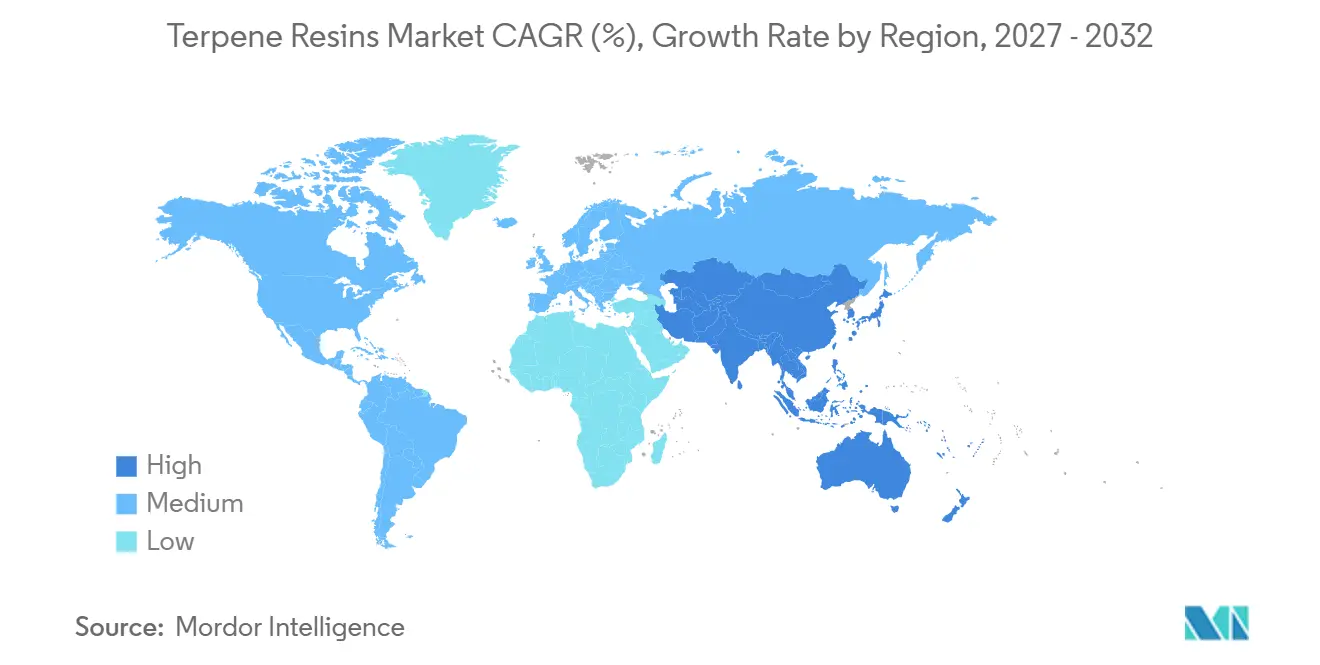
Asia-Pacific accounted for 36.52% of the terpene resins market share in 2026 and is forecast to grow at an 8.31% CAGR through 2032. China benefits from gum-turpentine harvesting in Guangdong, Guangxi, and Yunnan, as well as an established downstream base for adhesives and rubber processing. In June 2025, the Maoming Municipal Government approved an environmental impact assessment for a Maoming Fengyuan Forest Products facility with an annual capacity of 10,000 tons of rosin and modified resin. The approval indicates continued investment in regional pine-chemical processing. India and ASEAN countries are adding demand as production of footwear, textiles, electronics, and related goods becomes more geographically distributed. Japan and South Korea remain important markets for higher-grade resins used in automotive, electronics, and medical-device adhesives. These applications favor producers that can provide consistent quality and regulatory documentation.
North America: Feedstock Competition and Portfolio Changes Influence Supply
North America is an important producer and consumer of terpene resins. Ingevity completed the sale of its North Charleston crude tall oil refinery and most of its Industrial Specialties product line in January 2026. The transaction altered the local supply landscape for rosin-based tackifier resins and crude tall oil. Kraton announced a global price increase for terpene- and limonene-based products in February 2025, effective from April 2025. Demand from biomass-based diesel can increase competition for turpentine and tall-oil feedstocks. As a result, producers and adhesive formulators are placing greater weight on imports, forward procurement, and qualified alternative supply sources. Trade policy affecting resin intermediates can add further cost pressure for importers.
Europe, South America, Middle East, and Africa: Distinct Demand and Supply Roles
Europe has demand from industrial adhesives and printing inks, particularly in Germany, France, and Nordic countries. EU REACH requirements make chemical safety records and compliance data important commercial considerations for resin suppliers. Kraton's Niort manufacturing facility in France received ISCC PLUS certification in March 2025, allowing the company to offer certified AMS and AMS phenolic resins through mass-balance attribution. South America has pine forest assets, including Brazilian Pinus elliottii plantations, which support its role as a feedstock supplier. Demand in the Middle East and Africa is still developing and is linked to construction activity in the Gulf states and packaging growth in South Africa and Nigeria. Imports from Asia-Pacific supply much of this demand. Local petrochemical development may create future partnership opportunities where resin processing and adhesive conversion grow together.
Competitive Landscape
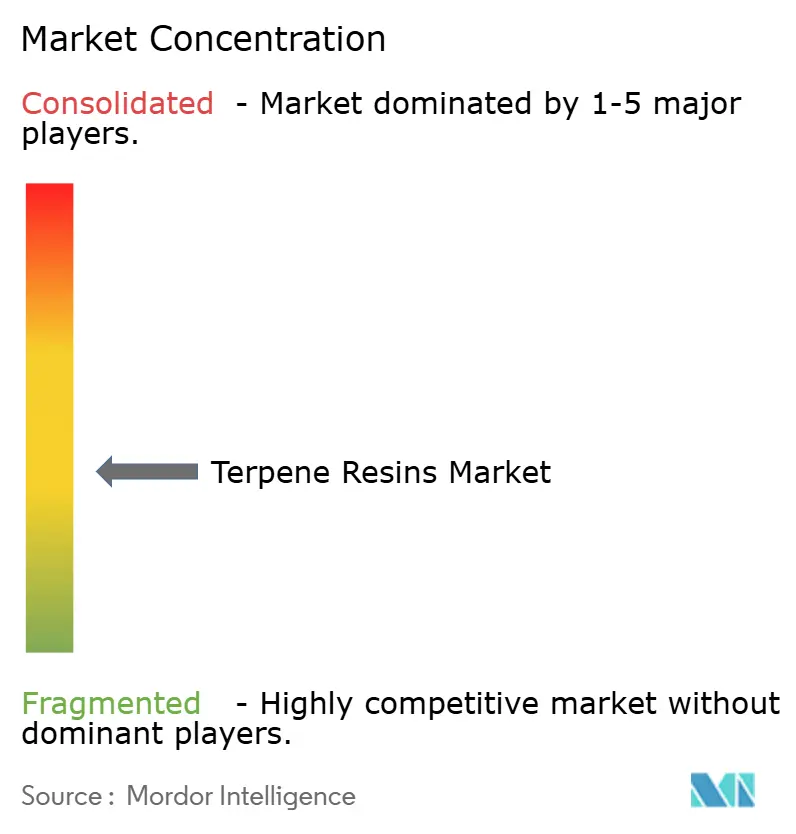
The terpene resins market is moderately fragmented, with global specialty chemical companies competing alongside a growing number of Chinese suppliers. Arakawa Chemical Industries, Yasuhara Chemical, and the DRT business within dsm-firmenich are associated with higher-specification resin applications in Asia and Europe. Kraton maintains a sustainability-focused supply position through ISCC PLUS certifications in France, Sweden, and Taiwan. Suppliers are investing in hydrogenation, mass-balance certification, and customer supply arrangements to serve adhesive formulators that require performance data, product consistency, and renewable-content information. The competitive balance varies by application, as standard industrial grades face more direct price competition than pharmaceutical and food-contact grades.
Kraton's March 2025 patent application covers a polymer composition that combines styrenic block copolymers with decarboxylated rosin as a co-solvent, reflecting an effort to extend product development beyond the resin itself into adhesive-system formulation. In the same month, Kraton obtained ISCC PLUS certification for its AMS and AMS phenolic resins at its Niort facility. Yasuhara Chemical offers specialized resin grades for adhesives, rubber, inks, coatings, and medical pressure-sensitive adhesive applications. Such application-specific positioning is relevant in the terpene resins market, where technical approvals tend to be more durable than price advantages and give established suppliers a means to protect margins in grades that require extensive documentation.
Chinese producers, including Foshan Baolin Chemical, Xinyi Sonyuan Chemical, and Qingdao Hwalong Chemical, compete actively in general-purpose adhesive and ink applications, increasing price pressure in standard industrial grades. Established suppliers are responding by prioritizing pharmaceutical, food-contact, waterborne, and other documentation-intensive applications. Waterborne emulsion resins represent an area in which formulation stability and regulatory requirements pose entry barriers. Customers may also value suppliers that provide lifecycle assessment materials alongside technical data sheets. As no combined market share figure for major companies is available, the evidence points to a fragmented rather than concentrated competitive structure.
Terpene Resins Industry Leaders
-
YASUHARA CHEMICAL CO., LTD.
-
Kraton Corporation
-
dsm-firmenich
-
Arakawa Chemical Industries, Ltd.
-
MANGALAM ORGANICS
- *Disclaimer: Major Players sorted in no particular order
Terpene Resins Market Companies Covered in this Report
- 3M
- DELO Industrial Adhesives
- Denka Company Limited
- DIC Corporation
- Dow
- Dymax
- H.B. Fuller Company
- Henkel AG & Co. KGaA
- Master Bond
- Momentive
- Nitto Denko Corporation
- NORLAND PRODUCTS INCORPORATED
- Panacol-Elosol GmbH
- Permabond
- Shin-Etsu Chemical Co., Ltd.
- Sika AG
Recent Industry Developments in Terpene Resins Market
- April 2026: dsm-firmenich signed a definitive agreement to sell its Action Pin pine-derivatives business to AP Marensin, a French private equity-backed consortium. The Action Pin business reported approximately EUR 50 million in 2025 revenue and produces over 250 plant extracts and pine derivatives for fragrance, cosmetics, adhesives, and rubber applications. The divestiture allows dsm-firmenich to focus on nutrition, health, and beauty, while retaining its core DRT terpene and rosin resin portfolio, including the DERCOLYTE, DERTOPHENE, and HYDROGRAL ranges.
- March 2025: Kraton Corporation's manufacturing facility in Niort, France, received ISCC PLUS certification, enabling the company to offer 100% ISCC PLUS-certified AMS and AMS Phenolics terpene resins through mass-balance attribution. The certification covers specialty adhesive and tire-application resin grades and represents Kraton's third ISCC PLUS-certified site globally.
Global Terpene Resins Market Report Scope
Terpene resins are pale, transparent, thermoplastic polymers produced by polymerizing terpene hydrocarbons or oils (such as turpentine derived from pine trees) using a catalyst. These resins are derived from naturally occurring terpene compounds, which are found in a variety of plant sources, most commonly in coniferous trees.
The terpene resin market is segmented by product type, grade, application, and geography. By product type, the market is segmented into solid and liquid. By grade, the market is segmented into industrial grade, technical grade, and pharmaceutical and food-contact grade. By application, the market is segmented into adhesives and sealants, inks and coatings, chewing gum, pulp and paper, plastics and rubber processing, leather processing, and other applications. The report also covers market sizes and forecasts for terpene resin across 15 countries in major regions. The market sizes and forecasts are provided in terms of value (USD).
Segmentation Overview
| Epoxy |
| Acrylic |
| Cyanoacrylate |
| Silicone |
| Other Resins |
| Optical Bonding and Assembly |
| Lens Bonding Cement |
| Fiber Optics |
| Other Applications |
| Electrical and Electronics |
| Automotive |
| Telecommunications |
| Medical |
| Other End-User Industries |
| Asia-Pacific | China |
| India | |
| Japan | |
| South Korea | |
| ASEAN Countries | |
| Rest of Asia-Pacific | |
| North America | United States |
| Canada | |
| Mexico | |
| Europe | Germany |
| United Kingdom | |
| France | |
| Italy | |
| NORDIC Countries | |
| Rest of Europe | |
| South America | Brazil |
| Argentina | |
| Rest of South America | |
| Middle East and Africa | Saudi Arabia |
| South Africa | |
| Rest of Middle East and Africa |
| By Resin Type | Epoxy | |
| Acrylic | ||
| Cyanoacrylate | ||
| Silicone | ||
| Other Resins | ||
| By Application | Optical Bonding and Assembly | |
| Lens Bonding Cement | ||
| Fiber Optics | ||
| Other Applications | ||
| By End-User Industry | Electrical and Electronics | |
| Automotive | ||
| Telecommunications | ||
| Medical | ||
| Other End-User Industries | ||
| By Geography | Asia-Pacific | China |
| India | ||
| Japan | ||
| South Korea | ||
| ASEAN Countries | ||
| Rest of Asia-Pacific | ||
| North America | United States | |
| Canada | ||
| Mexico | ||
| Europe | Germany | |
| United Kingdom | ||
| France | ||
| Italy | ||
| NORDIC Countries | ||
| Rest of Europe | ||
| South America | Brazil | |
| Argentina | ||
| Rest of South America | ||
| Middle East and Africa | Saudi Arabia | |
| South Africa | ||
| Rest of Middle East and Africa | ||
Key Questions Answered in the Report
What is current market size of Terpene Resins Market?
The terpene resins market size was valued at USD 1.00 billion in 2026 and is estimated to grow from USD 1.07 billion in 2027 to USD 1.51 billion by 2032, at a CAGR of 7.18% during the forecast period (2027-2032).
Which product type drives demand for terpene resin?
Solid resins lead demand, with a 65.43% share in 2026, due to their widespread use in hot-melt adhesives and rubber compounding.
Which terpene resin application is growing the fastest?
Plastics and rubber processing is forecast to grow at an 8.44% CAGR through 2032, supported by tire compounds and polymer blends.
Which region has the strongest growth outlook for terpene resins?
Asia-Pacific holds a 36.52% share in 2026 and is expected to grow at an 8.31% CAGR through 2032.