
Size and Share of Taiwan Sapphire Crystal Growth Equipment Market for LED Substrates
Market Overview
| Study Period | 2020 - 2031 |
|---|---|
| Forecast Data Period | 2026 - 2031 |
| Base Year Market Size (2025) | USD 30.79 Million |
| Market Size (2026) | USD 32.87 Million |
| Market Size (2031) | USD 43.91 Million |
| Growth Rate (2026 - 2031) | 5.96 % |
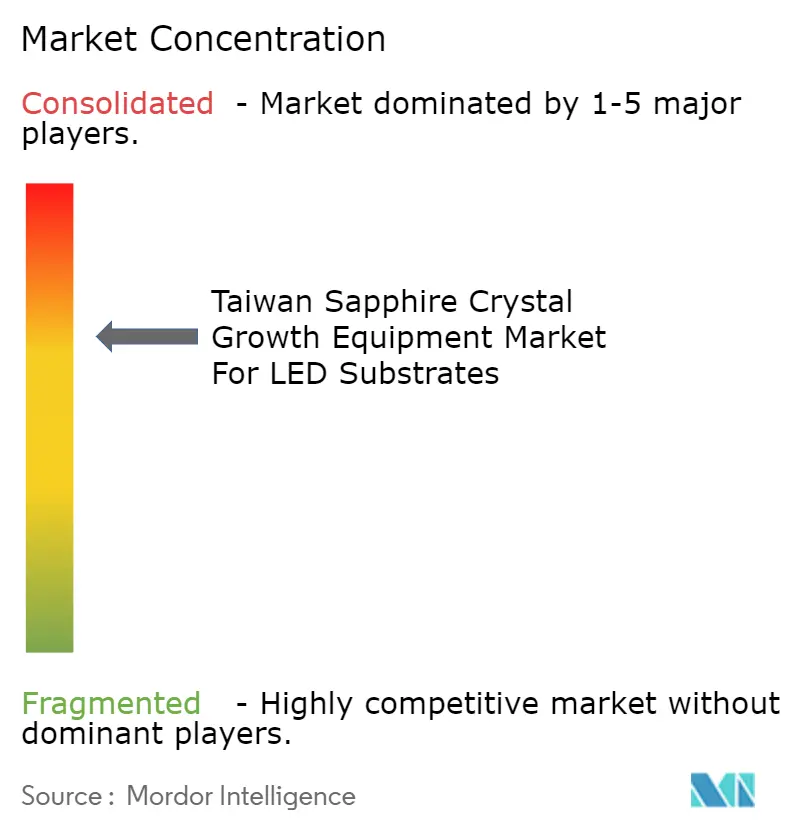
| Market Concentration | Medium |
Major Players *Disclaimer: Major Players sorted in no particular order Image © Mordor Intelligence. Reuse requires attribution under CC BY 4.0. | |
Analysis of Taiwan Sapphire Crystal Growth Equipment Market for LED Substrates by Mordor Intelligence
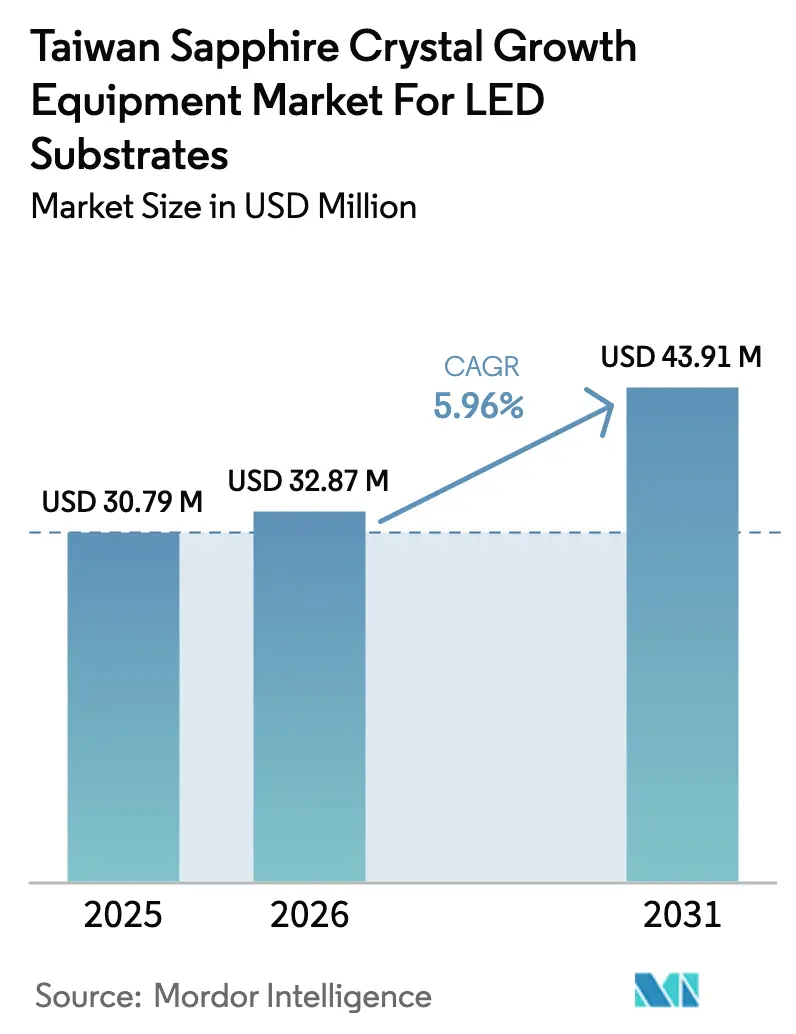
The Taiwan sapphire crystal growth equipment market for LED substrates industry size was valued at USD 30.79 million in 2025 and is estimated to grow from USD 32.87 million in 2026 to reach USD 43.91 million by 2031, at a CAGR of 5.96% during the forecast period (2026-2031). Rising demand for micro-LED and mini-LED backlights, a steady flow of government incentives for energy-efficient manufacturing, and a pivot toward 300 millimeter-plus wafer diameters position the Taiwan sapphire crystal growth equipment market for durable expansion. Domestic panel makers have already redirected capital toward higher-margin micro-LED programs, supporting a procurement cycle that favors next-generation crystal growth furnaces and AI-enhanced process controls. At the same time, tighter energy-efficiency mandates for commercial buildings and displays are lifting the baseline volume of solid-state lighting, widening the customer base for local substrate suppliers. Equipment orders are therefore tracking a balanced mix of replacement demand and brownfield expansion as Taiwanese manufacturers optimize yield and throughput in response to a persistent skilled-labor shortage.
Key Report Takeaways
- By equipment type, crystal growth furnaces led with 69.42% revenue share of Taiwan sapphire crystal growth equipment market for LED substrates industry in 2025, while growth automation and process control systems are forecast to expand at a 6.23% CAGR through 2031.
- By growth technology, the Kyropoulos method accounted for 60.47% share of the Taiwan sapphire crystal growth equipment market for LED substrates industry in 2025, whereas the Czochralski method is projected to advance at a 6.54% CAGR during 2026-2031.
- By sapphire diameter capability, 150-300 millimeter tools held 50.61% of the Taiwan sapphire crystal growth equipment market for LED substrates industry share in 2025, and equipment supporting diameters above 300 millimeters is expected to register a 6.78% CAGR to 2031.
Note: Market size and forecast figures in this report are generated using Mordor Intelligence’s proprietary estimation framework, updated with the latest available data and insights as of January 2026.
Global valuation is built by aggregating outputs from multiple countries and regions, with Taiwan being one of the contributors. Our global sapphire crystal growth equipment for led substrates market size represents that cumulative total.
Insights and Trends of Taiwan Sapphire Crystal Growth Equipment Market for LED Substrates
Drivers Impact Analysis*
| Driver | (~) % Impact on CAGR Forecast | Geographic Relevance | Impact Timeline |
|---|---|---|---|
| Proliferation of Mini-LED Backlighting in Consumer Electronics | +1.2% | Taiwan, spillover to South Korea and China | Short term (≤ 2 years) |
| Government Incentives for Energy-Efficient LED Manufacturing in Taiwan | +0.9% | Taiwan national | Medium term (2-4 years) |
| Growing Adoption of Solid-State Lighting in Commercial Buildings | +0.7% | Taiwan, broader APAC | Medium term (2-4 years) |
| Transition to Larger Wafer Diameters for Cost Reduction | +1.0% | Taiwan and South Korea | Medium term (2-4 years) |
| Surge in Domestic Demand from Emerging Micro-LED Start-ups | +0.6% | Hsinchu and Tainan clusters | Long term (≥ 4 years) |
| Integration of AI-Driven Furnace Controls Improving Yield Margins | +0.8% | Global, early use in Taiwan and EU | Long term (≥ 4 years) |
| Source: Mordor Intelligence | |||
Proliferation of Mini-LED Backlighting in Consumer Electronics
Mini-LED televisions and monitors are capturing premium display share because they deliver higher peak brightness and longer lifetimes than OLED at a lower unit cost. Shipments of mini-LED LCD sets surpassed OLED volumes in 2025, reaching 13.5 million versus 7.1 million units.[1] Each large-screen mini-LED panel integrates tens of thousands of chips, multiplying sapphire substrate demand and driving equipment investment among Taiwanese furnace buyers. AUO and Innolux have committed 4.5- and 3.5-generation production lines, respectively, locking in multiyear purchase agreements for high-throughput Kyropoulos and Czochralski systems.[2] The associated substrate pull-through underpins a sizable portion of near-term revenue in the Taiwan sapphire crystal growth equipment market for LED substrates industry.
Government Incentives for Energy-Efficient LED Manufacturing in Taiwan
Taiwan’s net-zero plan mandates full LED penetration in retail by 2025 and in commercial buildings by 2030, backed by direct equipment subsidies and tax breaks. Funding of NTD 1.3 billion (USD 42 million) flowed to 28 IC design and compound-semiconductor projects in 2025, with allocations rising to NTD 2 billion (USD 62 million) in 2026.[3] These measures cut the effective payback of new crystal growth furnaces while promoting local sourcing, a policy mix that strengthens procurement pipelines for domestic tool vendors and favors sustained growth of the Taiwan sapphire crystal growth equipment market for LED substrates industry.
Growing Adoption of Solid-State Lighting in Commercial Buildings
Escalating electricity tariffs and carbon-reduction mandates have made LED retrofits the default upgrade path for property owners. Taiwan aims for 100% LED lighting across commercial premises by 2030. Advanced modules require premium GaN-on-sapphire chips with strict lumen-maintenance targets, creating pull-through demand for boules with lower threading-dislocation densities. As retrofit momentum builds, furnace utilization rates climb, reinforcing volume visibility for the Taiwan sapphire crystal growth equipment market for LED substrates industry.
Transition to Larger Wafer Diameters for Cost Reduction
Yield-per-boule economics favor 6- and 8-inch wafers, prompting furnace upgrades capable of handling heavier melts and longer thermal cycles. Panel makers in Korea and Taiwan have already converted to ≥4-inch formats, and development-stage projects are qualifying 12-inch boules. Alpha HPA’s plan for 8-inch sapphire feedstock at 10,000 metric tons per year underscores confidence in scale-up economics.[4] Bigger diameters unlock die-cost savings that resonate with LED and power-device manufacturers, sustaining a technical rationale for capital spending across the Taiwan sapphire crystal growth equipment market for LED substrates industry.
Restraints Impact Analysis*
| Restraint | (~) % Impact on CAGR Forecast | Geographic Relevance | Impact Timeline |
|---|---|---|---|
| High Capital Expenditure for Crystal Growth Furnaces | -0.8% | Taiwan, broader APAC | Short term (≤ 2 years) |
| Volatile Prices of High-Purity Aluminum Oxide Feedstock | -0.6% | Global, acute in Taiwan and China | Short term (≤ 2 years) |
| Intense Competition from Chinese Equipment Suppliers | -0.5% | Taiwan and Southeast Asia | Medium term (2-4 years) |
| Skilled Operator Shortage for High-Temperature Growth Processes | -0.7% | Taiwan national | Long term (≥ 4 years) |
| Source: Mordor Intelligence | |||
High Capital Expenditure for Crystal Growth Furnaces
A single 200 millimeter Kyropoulos unit costs upward of USD 1 million, and 400 millimeter models approach USD 2 million, excluding installation and customization.[5] Long growth cycles stretch payback periods, compelling mid-tier producers to stagger capacity additions. Despite rising order intake, PVA TePla noted customer deferrals aimed at cash-flow preservation. Elevated upfront costs thus temper annual shipment momentum within the Taiwan sapphire crystal growth equipment market for LED substrates industry.
Volatile Prices of High-Purity Aluminum Oxide Feedstock
Shanghai Metals Market recorded an 80.66% price spike for 4N alumina during 2024, squeezing margins for wafer producers.[6] Feedstock swings encourage cautious inventory management and can trigger short-term pauses in furnace procurement. Long-term offtake agreements partly mitigate risk, yet volatility remains a headwind that subtracts nearly 0.6 percentage points from the forecast CAGR of the Taiwan sapphire crystal growth equipment market for LED substrates industry.
*Our forecasts treat driver/restraint impacts as directional, not additive. The impact forecasts reflect baseline growth, mix effects, and variable interactions.
Segment Analysis
By Equipment Type: Automation Systems Gain Share as Yield Pressures Mount
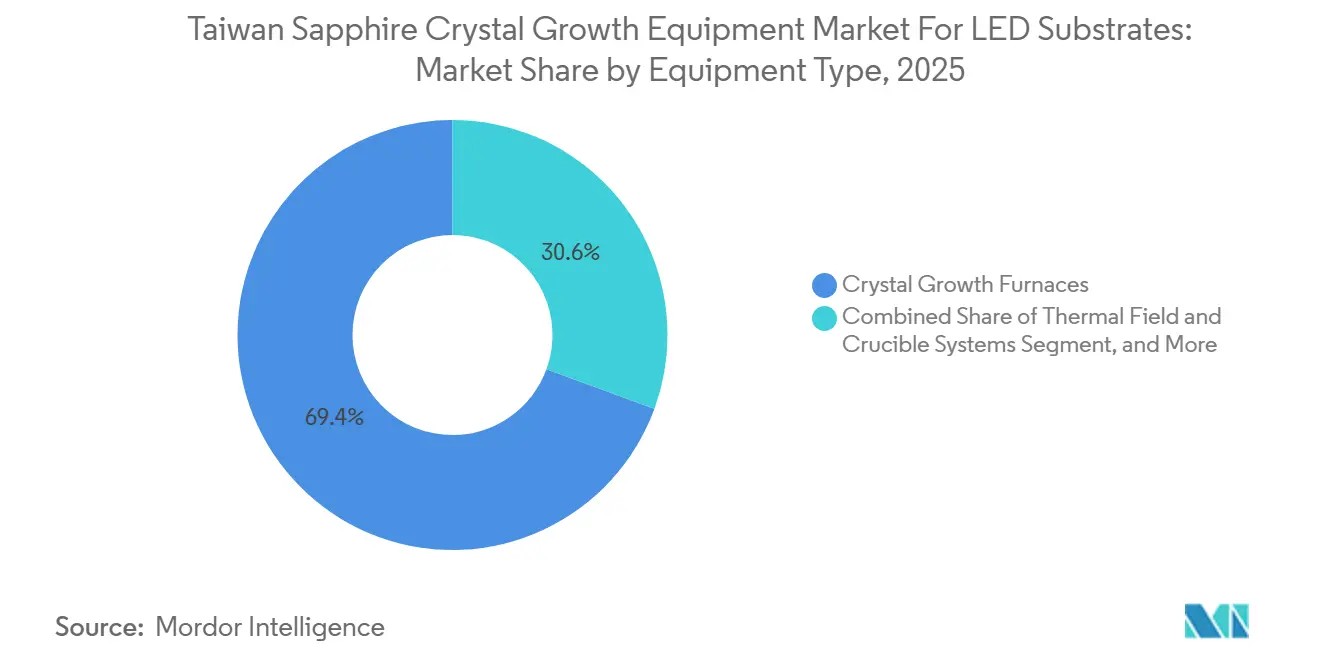
Crystal growth furnaces represented the core of capital spending, capturing 69.42% of 2025 revenue in the Taiwan sapphire crystal growth equipment market for LED substrates industry. Rising micro-LED adoption, however, has exposed defect tolerances that standard manual controls struggle to meet. AI-enabled automation platforms introduced by Linton Crystal Technologies reduce pull-rate variability and enhance facet stability, delivering up to 30% yield gains.[7] Over 2026-2031, automation and process-control subsystems are forecast to log the fastest segment growth at 6.23% CAGR, a trajectory that raises their revenue contribution within the Taiwan sapphire crystal growth equipment market for LED substrates industry market size.
Thermal-field kits and crucible assemblies represent a steady aftermarket because each boule pull degrades liners and shields, forcing periodic swaps to hold defect counts low. As furnaces migrate to 8-inch and larger loads, users are choosing iridium-lined crucibles for purity even though their price can be triple that of molybdenum alternatives, a premium justified by higher downstream micro-LED yields. Vendors now bundle motorized lift-rotate mechanisms that let two operators service a 150 kg crucible safely, trimming change-over time by roughly 20% and freeing scarce technicians for higher-value tasks. Because these consumables refresh every six to 12 months, they smooth revenue swings when large furnace orders pause, supplying a resilient contribution to the Taiwan sapphire crystal growth equipment market for LED substrates industry market size.

By Growth Technology: Czochralski Gains as Micro-LED Demands Tighter Tolerances
The Kyropoulos method held 60.47% market share in 2025, favored for bulk substrate output. Yet micro-LED fabs increasingly specify Czochralski boules for their lower dislocation density and real-time diameter control. European Union funding under the SMART GROWTH program accelerates zero-defect loop development, shortening the qualification timeline for Czochralski upgrades.[8] Consequently, Czochralski equipment is projected to grow 6.54% annually, steadily expanding its slice of the Taiwan sapphire crystal growth equipment market for LED substrates industry market share.
Edge-defined film-fed and heat-exchanger growth tools remain niche, yet process tweaks pioneered there, such as dual-zone heaters that suppress radial stress, are being retrofitted to mainstream Kyropoulos and Czochralski chambers to cut crack rates. Leading micro-LED producers have begun co-engineering pull profiles with furnace OEMs, accelerating knowledge spillover and reinforcing a feedback loop that favors suppliers able to cross-license patents quickly As a result, the Taiwan sapphire crystal growth equipment market for LED substrates industry market share of Czochralski systems is expected to edge higher without displacing Kyropoulos entirely, keeping both platforms commercially relevant through 2031.
By Sapphire Diameter Capability: Above-300 Millimeter Systems Lead Growth as Economics Favor Scale
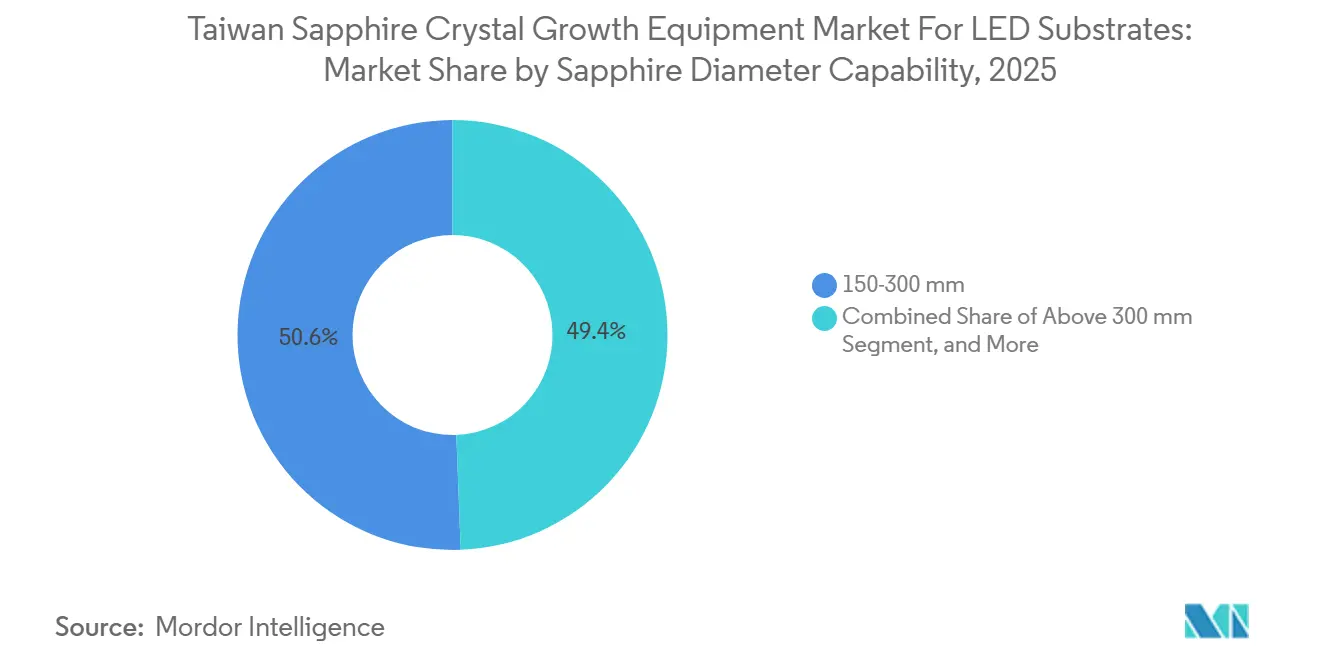
Systems designed for 150-300 millimeter boules contributed 50.61% of 2025 turnover, reflecting the legacy 4- and 6-inch wafer predominance. However, supplier roadmaps now prioritize 300-millimeter-plus chambers, with forecast unit demand climbing at a 6.78% CAGR. A 12-inch wafer offers roughly 2.25 times the area of an 8-inch wafer, enabling sharper die-cost reductions if yields hold. Alpha HPA’s capacity bookings, covering more than 60% of its planned 10,000 metric-ton output, confirm downstream appetite for larger sheets. The shift underpins a multi-year capex wave that inflates the high-end of the Taiwan sapphire crystal growth equipment market for LED substrates industry market size.
Demand for sub-150 mm tools now centers on ultraviolet curing, medical phototherapy, and pilot-line prototyping, areas where quick recipe changes outweigh die-cost arithmetic. SemiLEDs reduces fresh alumina use by reclaiming sapphire through laser lift-off, a workflow that shields it from feedstock spikes yet caps volume. These specialty runs keep a modest but recurring stream of replacement orders flowing to small-chamber OEMs, while training lines at local universities also refresh legacy inventory. Together, they anchor a baseline of low-volume sales that helps stabilize supplier margins when macro cycles turn against big-diameter investments in the broader Taiwan sapphire crystal growth equipment market for LED substrates industry.
Geography Analysis
Taiwan’s Hsinchu and Tainan science parks anchor more than three-quarters of furnace installations and spare-parts depots, reinforcing cluster economics for the Taiwan sapphire crystal growth equipment market for LED substrates industry. PlayNitride’s pilot lines in Hsinchu and Ennostar’s merged epilayer and packaging campuses create localized pull for equipment, engineering services, and consumables. Suppliers benefit from just-in-time logistics, which compress qualification cycles and enable rapid iteration on thermal-field designs.
Government co-investment continues to funnel capital into compound-semiconductor initiatives despite headline budget constraints. NTD 1.3 billion (USD 42 million) flowed to advanced IC and GaN projects in 2025, and allocations rise to NTD 2 billion (USD 62 million) in 2026, safeguarding substrate demand pipelines. Yet fiscal volatility remains a watch item after the Ministry of Economic Affairs faced a potential NTD 29.7 billion (USD 93 million) reduction for 2025, a scenario that would erode subsidy pools promised to large foreign investors.
Labor scarcity casts a long shadow. Vacancies in production, quality, and maintenance climbed 67% between 2023 and 2025, reaching 7,240 open positions. A former TSMC executive warned that the talent gap could widen fifteen-fold without systemic fixes. The shortage inflates operator wages and extends training cycles, mildly reducing the speed at which the Taiwan sapphire crystal growth equipment market for LED substrates industry can absorb next-generation high-temperature furnaces.
Coverage of the sapphire crystal growth equipment market for led substrates by Mordor Intelligence spans a wide geographic footprint, with regional analysis available for Asia, alongside detailed country-level intelligence for China and Japan, each shaped by local operating conditions.
Competitive Landscape
Competition splits into premium Western vendors and price-focused Chinese suppliers. PVA TePla, Linton Crystal Technologies, and GT Advanced Technologies compete on process precision and support packages, securing orders from micro-LED fabs that prize low dislocation density. PVA TePla logged EUR 268 million (USD 302 million) in 2025 order intake, surpassing revenue and keeping its book-to-bill above 1.0. Linton’s AI-enabled Kayex control suite further differentiates its Czochralski line.
Chinese manufacturers Zhejiang Jingsheng Mechanical and Electrical and Beijing Naura Technology Group rely on aggressive pricing and state support. Naura rose to sixth place globally by equipment revenue in 2024, targeting 40% sales growth that year. Jingsheng reported 2024 revenue of CNY 17.58 billion (USD 2.4 billion) but booked a net loss after sizeable impairment charges. Taiwanese buyers weigh lower acquisition costs against potential yield risk, especially as defect tolerances narrow in micro-LED programs, shaping purchase decisions in Taiwan's sapphire crystal growth equipment market.
Strategic whitespace lies in 400 millimeter-plus furnace design and embedded AI control. The European SMART GROWTH consortium and Linton’s 600 millimeter KX320/600 prototype signal early-stage movement, yet no player dominates, suggesting room for share realignment as commercialization approaches. This landscape implies moderate concentration, with Western and Chinese leaders collectively controlling under 70% of installed base value.
Leaders of Taiwan Sapphire Crystal Growth Equipment Market for LED Substrates
-
Zhejiang Jingsheng Mechanical & Electrical Co., Ltd.
-
PVA TePla AG
-
Beijing Naura Technology Group Co., Ltd.
-
GT Advanced Technologies Inc.
-
Linton Crystal Technologies, Ltd.
- *Disclaimer: Major Players sorted in no particular order
Recent Industry Developments
- February 2026: AU Optronics unveiled Virtual Sky Canopy micro-LED cockpit displays at CES 2026 through its new AUO Mobility Solutions subsidiary, signaling automotive pull-through for sapphire substrates.
- October 2025: Ennostar completed the merger of Epistar and Lextar, consolidating 12.5% of global LED chip capacity under one roof.
- April 2025: PlayNitride recorded its first quarterly profit and doubled equipment orders to support forthcoming mass-production ramps.
- February 2025: AUO’s 4.5-generation and Innolux’s 3.5-generation micro-LED lines moved into mass-production qualification.
Scope of Report on Taiwan Sapphire Crystal Growth Equipment Market for LED Substrates
The Taiwan Sapphire Crystal Growth Equipment Market for LED Substrates Report is Segmented by Equipment Type (Crystal Growth Furnaces, Thermal Field and Crucible Systems, and Growth Automation and Process Control Systems), Growth Technology (Kyropoulos Method, Edge-Defined Film-Fed Growth, Heat Exchanger Method, and Czochralski Method), and Sapphire Diameter Capability (Up to 150 mm, 150-300 mm, and Above 300 mm). The Market Forecasts are Provided in Terms of Value (USD).
| Crystal Growth Furnaces |
| Thermal Field and Crucible Systems |
| Growth Automation and Process Control Systems |
| Kyropoulos Method |
| Edge-Defined Film-Fed Growth (EFG) |
| Heat Exchanger Method |
| Czochralski Method |
| Up to 150 mm |
| 150-300 mm |
| Above 300 mm |
| By Equipment Type | Crystal Growth Furnaces |
| Thermal Field and Crucible Systems | |
| Growth Automation and Process Control Systems | |
| By Growth Technology | Kyropoulos Method |
| Edge-Defined Film-Fed Growth (EFG) | |
| Heat Exchanger Method | |
| Czochralski Method | |
| By Sapphire Diameter Capability | Up to 150 mm |
| 150-300 mm | |
| Above 300 mm |
Key Questions Answered in the Report
How fast is demand for larger-diameter sapphire boules growing in Taiwan?
Equipment supporting diameters above 300 millimeters is projected to register a 6.78% CAGR between 2026 and 2031, the quickest pace among diameter segments in the Taiwan sapphire crystal growth equipment market.
Which equipment sub-category is expected to gain the most revenue share through 2031?
Growth automation and process-control systems are forecast to expand at a 6.23% CAGR, outpacing other equipment types as manufacturers seek AI-driven yield improvements.
What is the main government policy supporting sapphire equipment investment?
Taiwan's net-zero roadmap mandates full LED lighting in commercial buildings by 2030 and delivers targeted subsidies that lower the capital burden of new crystal growth furnaces.
Why are Czochralski tools gaining traction over Kyropoulos systems?
Micro-LED fabs favor Czochralski boules for their lower dislocation density and real-time diameter control, attributes that support higher optical efficiency and tighter color uniformity.
How does labor scarcity influence furnace procurement?
A shortage of roughly 34,000 semiconductor workers raises operator costs and training timelines, prompting fabs to adopt automation platforms that reduce manual intervention.
What level of market concentration characterizes Taiwan's supplier landscape?
With leading Western and Chinese vendors controlling just under 70% of installed base value, the market earns a concentration score of 6, indicating moderate consolidation.