
Sweet Spread Market Size and Share
Market Overview
| Study Period | 2021 - 2031 |
|---|---|
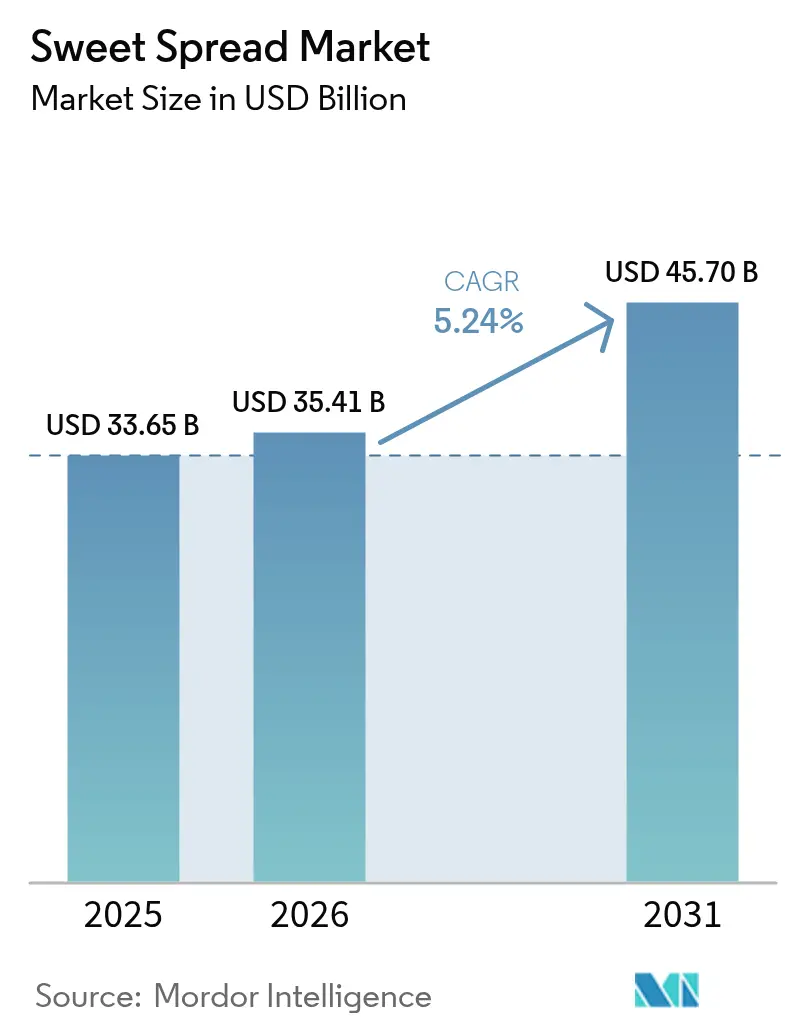
| Market Size (2026) | USD 35.41 Billion |
| Market Size (2031) | USD 45.7 Billion |
| Growth Rate (2026 - 2031) | 5.24 % |
| Fastest Growing Market | Asia-Pacific |
| Largest Market | Europe |
| Market Concentration | Medium |
Major Players
*Disclaimer: Major Players sorted in no particular order Image © Mordor Intelligence. Reuse requires attribution under CC BY 4.0. |
|
Sweet Spread Market Analysis by Mordor Intelligence
The sweet spreads market size was valued at USD 33.65 billion in 2025 and estimated to grow from USD 35.41 billion in 2026 to reach USD 45.7 billion by 2031, at a CAGR of 5.24% during the forecast period (2026-2031). The rising demand for products that combine indulgence with nutritional benefits is driving the popularity of honey-based, nut-based, and fruit-derived formulations. The Asia-Pacific region has the fastest market growth, fueled by increasing urbanization, the growing adoption of Western-style breakfast habits, and the rapid expansion of e-commerce platforms. In contrast, Europe, while being a mature market, remains the largest regional consumer. The region is witnessing a shift toward premium offerings and lower-sugar alternatives, reflecting changing consumer preferences. On a global scale, supermarkets continue to dominate in terms of volume; however, the rapid growth of online retail, with its double-digit CAGR, is significantly influencing merchandising strategies, packaging innovations, and channel dynamics within the sweet spreads market.
Key Report Takeaways
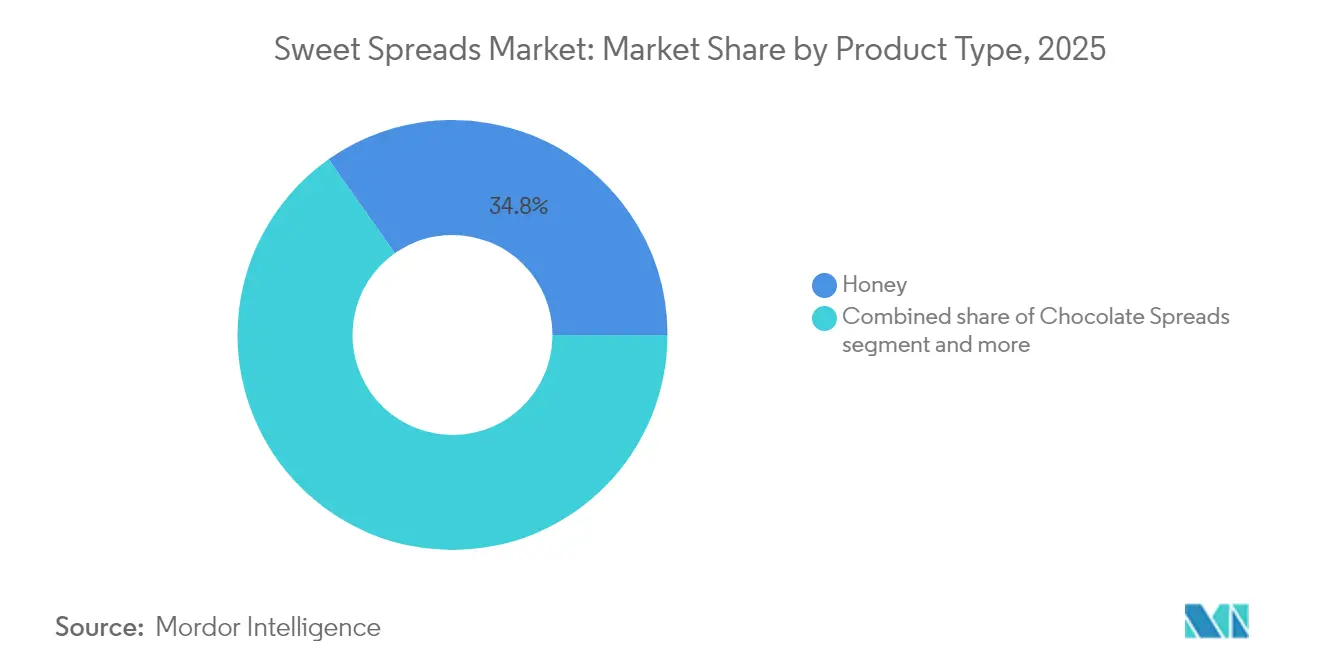
- By product type, honey held 34.78% of the sweet spreads market share in 2025 and is projected to expand at a 7.01% CAGR through 2031.
- By nature, conventional products accounted for 70.52% of the sweet spreads market size in 2025, whereas organic variants are forecast to grow at an 7.88% CAGR to 2031.
- By packaging type, jars captured 61.33% of revenue in 2025, while sachets and pouches are set to post a 6.66% CAGR from 2026-2031.
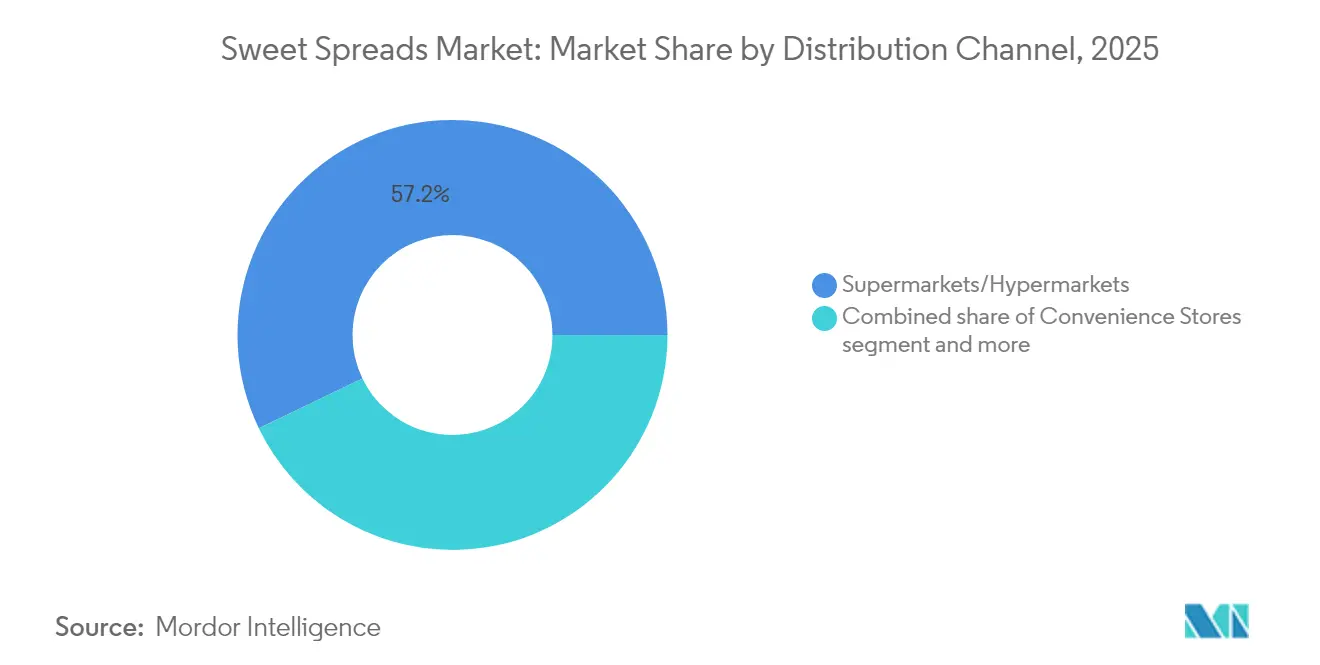
- By distribution channel, supermarkets and hypermarkets commanded 57.15% of sales in 2025, yet online retail is on course for an 11.32% CAGR through 2031.
- By region, Europe led with 31.68% of the sweet spreads market share in 2025; Asia-Pacific will outpace all regions at a 7.08% CAGR to 2031.
Note: Market size and forecast figures in this report are generated using Mordor Intelligence’s proprietary estimation framework, updated with the latest available data and insights as of 2026.
Global Sweet Spread Market Trends and Insights
Drivers Impact Analysis*
| Driver | (~) % Impact on CAGR Forecast | Geographic Relevance | Impact Timeline |
|---|---|---|---|
| Rising demand for convenient breakfast options | +1.2% | Global, with stronger impact in Asia-Pacific | Medium term (2-4 years) |
| Product innovations such as new flavors and health-focused variants attract diverse demographics | +1.1% | Global | Long term (≥ 4 years) |
| Growth of retail stores and online distribution channels improves spreads availability to consumers | +1.0% | Global, with stronger impact in Asia-Pacific | Medium term (2-4 years) |
| Increasing consumer preference for natural and organic ingredients | +0.9% | North America and Europe | Medium term (2-4 years) |
| Branding and marketing campaigns by companies | +0.6% | Global | Short term (≤ 2 years) |
| Adoption of western breakfast habits in developing countries | +0.8% | Asia-Pacific, Middle East and Africa | Long term (≥ 4 years) |
| Source: Mordor Intelligence | |||
Rising demand for convenient breakfast options
Modern lifestyles have turned breakfast into a quick, functional routine, driving growth in the sweet spreads market as consumers seek convenient, flavorful options. In urban areas, where time is limited, demand for ready-to-eat and easy-to-prepare solutions has surged. Sweet spreads appeal to singles and families due to their versatility and ease of use, extending beyond breakfast to snacking, baking, and desserts. Manufacturers have introduced innovations like portion-controlled packs, squeezable bottles, and single-serve sachets, supporting on-the-go consumption and reducing food waste. Healthier variants, such as low-sugar and organic options, have expanded the consumer base, meeting the demand for convenience, portability, and sustainability, and solidifying sweet spreads as a staple in today’s health-focused food industry.
Increasing consumer preference for natural and organic ingredients
Growing consumer skepticism toward artificial ingredients has driven a significant market shift toward natural and organic sweet spreads. This transition has given rise to a premium segment that achieves higher profit margins, even in a price-sensitive market. However, this trend extends beyond mere ingredient substitution, it reflects a broader reevaluation of consumer food values. Transparency in sourcing and minimal processing have emerged as critical factors influencing purchasing decisions. This shift is particularly prominent in honey and nut-based spreads, where consumers are increasingly attentive to sourcing practices and production methods. Brands that can substantiate their natural claims through transparent supply chains and credible third-party certifications are well-positioned to capitalize on this evolving demand, creating a competitive edge in the market.
Product innovations such as new flavors and health-focused variants attract diverse demographics
In the sweet spreads market, product innovation has shifted from simply adding new flavors to incorporating functional benefits that cater to specific nutritional needs. This shift has expanded the market's appeal to a wider demographic. By integrating superfoods, enhancing protein content, and formulating with less sugar, sweet spreads have transitioned from being seen solely as indulgent treats to being recognized as functional foods with tangible health benefits. This transformation is not only creating new occasions for use but also attracting consumer segments that traditional sweet spread marketing overlooked. Responding to the rising consumer demand for artisanal and small-batch products with unique flavors, the New York State Department of Agriculture and Markets has set forth guidelines for home processing of fruit jams and jellies [1]Source: Department of Agriculture and Markets, "Home Processing", agriculture.ny.gov. Furthermore, the "swicy" trend, melding sweet and spicy flavors, has gained momentum, with companies delving into bold innovations that fuse sweetness with heat for unique taste experiences.
Branding and marketing campaigns by companies
In the sweet spreads market, companies are adopting advanced branding strategies to gain a competitive edge. Emotional connections and lifestyle positioning now shape consumer preferences, often outweighing price-value considerations. Campaigns increasingly use "newstalgia," blending nostalgic comfort with modern innovation to meet consumer desires for familiarity and novelty. Digital platforms, especially social media, amplify these efforts by enabling immersive experiences, direct consumer engagement, and community building, extending brand influence beyond retail shelves. Additionally, brands focus on authentic storytelling and transparency to align with health-conscious consumers, building trust and meeting evolving demands.
Restraints Impact Analysis*
| Restraint | (~) % Impact on CAGR Forecast | Geographic Relevance | Impact Timeline |
|---|---|---|---|
| Rising concerns over sugar content and obesity discourage frequent consumption | -0.8% | Global, with stronger impact in North America and Europe | Long term (≥ 4 years) |
| Increasing raw material costs (e.g., nuts, cocoa) impact pricing and profit margins | -0.6% | Global | Medium term (2-4 years) |
| Growing competition from healthier alternatives like yogurt spreads restrains category | -0.5% | North America and Europe | Medium term (2-4 years) |
| Shorter shelf-life for natural and preservative-free products challenges supply chains | -0.4% | Global, with stronger impact in developing markets | Short term (≤ 2 years) |
| Source: Mordor Intelligence | |||
Rising concerns over sugar content and obesity discourage frequent consumption
Rising consumer awareness of sugar's health risks is challenging the traditional sweet spreads market. Manufacturers must balance taste with nutritional standards, while regulatory actions add pressure. For instance, Peru's front-of-package warning labels have driven reformulations, and Chile's Food Labelling Law cut 'high in' sugar sweet spreads from 58.0% to 13.7%, as per a BMC Medicine study. Adding to this momentum, the FDA's updated definition of "healthy" as a nutrient content claim, which will take effect in February 2025, introduces stricter criteria for products making health claims [2]Source: Food and Drug Administration, "Food Labeling: Nutrient Content Claims; Definition of Term 'Healthy'", federalregister.gov. This regulatory landscape is pushing manufacturers to adopt innovative sugar reduction strategies, such as incorporating natural sweeteners and reformulating products to retain their taste profiles while addressing growing health concerns.
Increasing raw material costs (e.g., nuts, cocoa) impact pricing and profit margins
Key sweet spread ingredients have seen volatile price swings, squeezing margins across the board. In response, manufacturers are turning to advanced procurement strategies and reformulating products to stay profitable. This challenge hits hardest for premium and organic variants. Here, consumer demand for authentic, high-quality formulations leaves little room for ingredient substitutions. Beyond just costs, these hurdles are steering innovation. Research and development are now more focused on crafting formulations that lean less on these volatile ingredients. For instance, Lindt & Sprüngli's 2024 annual report underscored the pinch of rising cocoa prices on its bottom line. In response, the company made strategic tweaks to safeguard its margins, all while keeping an eye on product development. Compounding these challenges are supply chain disruptions and climate impacts on agriculture, making raw material availability and pricing even more unstable for manufacturers.
*Our forecasts treat driver/restraint impacts as directional, not additive. The impact forecasts reflect baseline growth, mix effects, and variable interactions.
Segment Analysis
By Product Type: Honey Dominance and Growth Leadership
In 2025, the honey market held the largest share at 34.78% and was the fastest-growing segment, with a projected CAGR of 7.01% from 2026 to 2031. This growth reflects honey's role in meeting demand for natural sweeteners and functional foods. Its dominance stems from being a natural, minimally processed sweetener with health benefits, aligning with the clean-label trend. Honey's uses in cooking, baking, and remedies expand its market reach. Regulatory support, such as guidelines from the New York State Department of Agriculture and Markets, highlights the rising importance of natural sweeteners. Innovations like 'hot honey' further drive consumer interest and market growth.
The segment's growth is driven by awareness of honey's antioxidant and immune-supporting benefits. Innovations combining honey with natural ingredients create premium options for health-conscious consumers. Regulatory changes, like the FDA's focus on 'added sugars,' strengthen honey's position. Honey's role as a market leader and growth driver solidifies its importance in the natural sweetener market.



By Nature: Conventional Dominance Versus Organic Growth
In 2025, conventional sweet spreads dominate the market with a 70.52% share, driven by affordability and consumer familiarity. Competitive pricing and the reach of traditional retail channels make them the preferred choice for mainstream buyers. Manufacturers leverage economies of scale to keep prices low while investing in product innovations and marketing. Although the USDA highlights growing interest in organic products, conventional spreads remain dominant due to price sensitivity and established habits. They also serve as a platform for testing new flavors and formulations, aiding the development of premium variants.
The organic segment, however, is growing rapidly, with a projected CAGR of 7.88% from 2026 to 2031, outpacing conventional spreads. This growth is fueled by consumer demand for healthier, sustainable, and high-quality products. Adhering to strict production standards, organic spreads appeal to health-conscious buyers who value transparency. The USDA notes that despite economic challenges, a loyal consumer base supports organic products, driving demand. Expanding retail channels and increased awareness of organic benefits further bolster this growth.
By Distribution Channel: Supermarket Dominance Meets Digital Disruption
In 2025, supermarkets and hypermarkets dominate the distribution landscape, capturing a 57.15% share. Their success lies in showcasing diverse products and enticing impulse buys through savvy merchandising. With established ties to major manufacturers, supermarkets negotiate terms that ensure competitive pricing. Furthermore, they leverage prime shelf space for heightened product visibility and promotional activities, fueling category growth. Food Export USA's assessment underscores the pivotal role of supermarkets in Chile's retail food sector, emphasizing their market dominance and influence in product introductions .
Online retail is set to outpace all other distribution channels, boasting a projected CAGR of 11.32% from 2026 to 2031. This surge is attributed to the convenience, broader selections, and tailored shopping experiences it offers. The channel's ascent mirrors a shift in consumer habits, a trend hastened by the pandemic, as shoppers grow increasingly at ease with online food purchases. Online platforms excel in product discovery, owing to recommendation engines, and they provide access to specialty and premium items often absent from local shelves. Moreover, these platforms foster direct relationships with consumers, yielding invaluable data for refining products and marketing strategies.
By Packaging Type: Traditional Jars Lead While Convenience Formats Accelerate
In 2025, jars dominate the packaging market with a 61.33% share, driven by consumer familiarity and perceived value. Glass packaging protects products and allows visual quality assessment, while jars also aid in storage and portion control, making them a household staple. Established supply chains and cost-efficient production enable competitive pricing. As sustainability gains focus, manufacturers are adopting recyclable glass and reducing materials while maintaining product integrity.
Sachets and pouches are set to be the fastest-growing packaging format, with a projected CAGR of 6.66% from 2026 to 2031. This growth reflects a shift toward convenience and portion control, appealing to on-the-go and health-conscious consumers, especially younger demographics. Advances in flexible packaging technology enhance product protection and reduce material use, addressing functionality and sustainability. A report from the Australian Food and Beverage Accelerator highlights the importance of circular design and waste reduction, aligning with the efficiency of sachets and pouches.
Geography Analysis
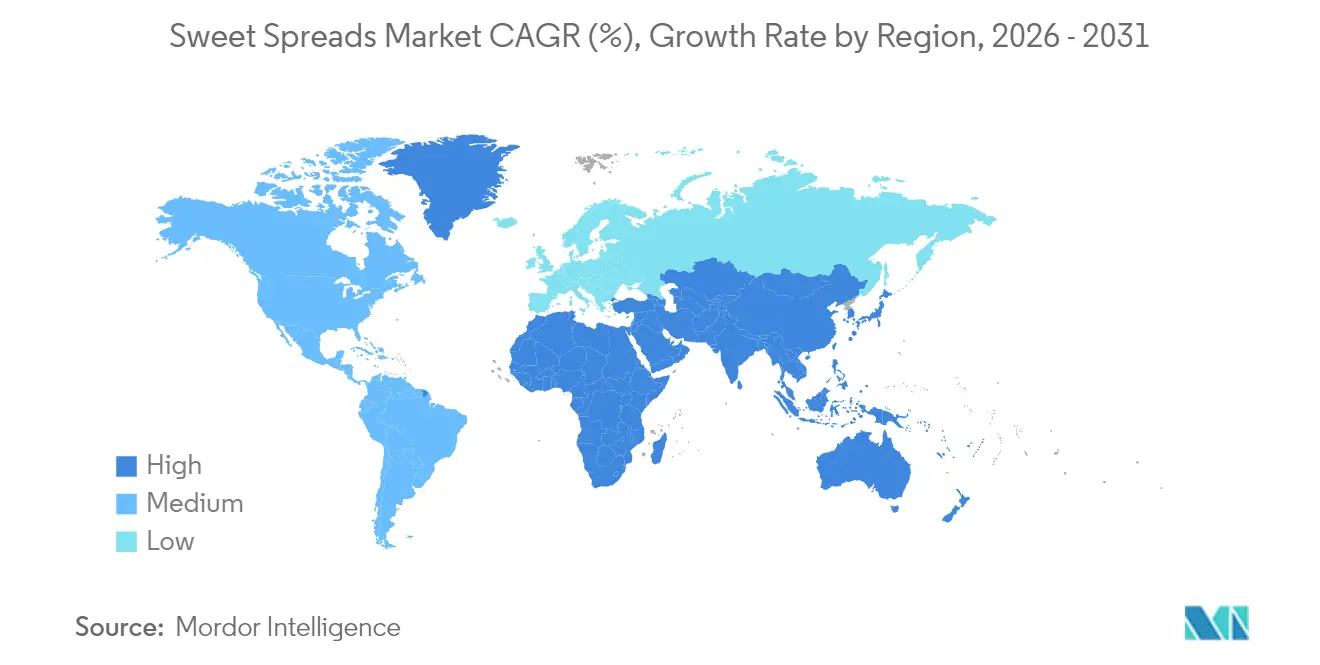
In 2025, Europe leads the sweet spreads market with a 31.68% share, driven by established consumption habits and a refined retail network. Western Europe emphasizes quality and authenticity, supporting premium pricing. Despite market maturity, Europe is shifting towards premiumization and functional, plant-based variants. USDA data highlights strong demand for premium products, with Germany and France leading the organic market. Regulatory changes, including sugar content and nutritional labeling, are driving product reformulations, with front-of-package warning labels prompting significant adjustments. The region fosters innovation by blending traditional appeal with health and sustainability trends.
Asia-Pacific is set to drive the sweet spreads market growth, with a projected CAGR of 7.08% from 2026 to 2031, surpassing global rates. Growth is fueled by rising incomes, urbanization, and western breakfast trends in China and India. Diverse consumer preferences and market maturity require balancing affordability with premiumization. USDA forecasts India’s food processing sector to grow at a 15% CAGR, reaching USD 535 billion by 2025/26, driven by Tier-II and III cities. The Asian Development Bank's report on e-commerce in Asia-Pacific underscores the sustained momentum in online retail, offering digital opportunities for manufacturers.
North America remains a key market but faces maturity challenges. High per-capita consumption drives intense competition between established and emerging brands. Consumer preferences split between indulgent and health-focused options, creating diversification opportunities. In the U.S., nut-based spreads like peanut butter hold cultural significance, while health-centric alternatives gain traction. Regulatory changes, such as the FDA’s 'added sugars' label, push for transparency, influencing formulations and marketing. Trade agreements like the United States-Chile Free Trade Agreement, removing tariffs on agricultural goods, create export opportunities for U.S. manufacturers.

Regulatory Landscape
Regulatory requirements for sweet spreads continue to tighten labeling, nutrient claims, and additive approvals across major markets, increasing compliance complexity for global portfolios that span jams and preserves, honey, and nut or seed-based spreads. The FDA sets a uniform compliance window for food labeling regulations published from January 1, 2025 through December 31, 2026, and the updated definition of the nutrient content claim healthy takes effect in February 2025, prompting brands to review sugar-related messaging and front-of-pack communication alongside ingredient and nutrition panels.
Competitive Landscape
The global sweet spreads market is moderately fragmented, featuring a diverse range of products such as jams, nut butters, honey, and chocolate spreads offered by both multinational giants and regional players. While companies like The Kraft Heinz Company, Ferrero International S.A., The J.M. Smucker Company, Mondelez International, Inc., and Andros Group lead in distribution and innovation, smaller niche and artisanal brands hold strong positions in local markets.
The growing demand for natural, low-sugar, and high-protein options is fueling product innovation, with low entry barriers allowing startups to meet evolving consumer needs, especially in health-focused, premium segments. In line with this trend, GOOD GOOD, a leader in no-added-sugar jams and spreads, entered the United Kingdom retail market for the first time in October 2024. Its Strawberry, Raspberry, Apricot, and Blackcurrant jams were launched at Holland & Barrett, offering wellness-conscious shoppers fruit-forward, naturally sweetened options with great taste and nutrition.
Digital technologies are reshaping competitive dynamics by enhancing consumer engagement, illustrated by Lindt & Sprüngli's 2024 launch of a generative AI chatbot for personalized shopping experiences. Emerging disruptors like MeliBio are challenging category conventions with plant-based honey alternatives, exemplified by its Spicy Habanero Plant-Based Hot Honey launch, which addresses growing consumer interest in vegan options.
Sweet Spread Industry Leaders
-
The Kraft Heinz Company
-
Ferrero International S.A.
-
The J.M. Smucker Company
-
Mondelez International, Inc.
-
Andros Group
- *Disclaimer: Major Players sorted in no particular order


Market Opportunities and Future Outlook
Sugar-reduction and clean-label reformulation remain primary whitespace across sweet spreads as brands adapt to health positioning rules while preserving texture, sweetness profile, and shelf life. Ingredient and technology suppliers are expanding the toolbox for reduced-sugar spreads, as shown by industry demonstrations at IFT First 2026 in Chicago where Samyang Corporation debuted Fibernova crystalline prebiotic fiber designed for low-sugar applications and HTBA showcased Citrose, an upcycled high-intensity sweetener complex derived from citrus flavonoids. In parallel, Nambawan Spain commercialized Thauma (thaumatin II sweetener protein) in June 2026, giving manufacturers additional non-traditional sweetness solutions that can be positioned away from conventional high-intensity synthetic sweeteners.
Recent Industry Developments
- July 2026: The J.M. Smucker Company rolled out refrigerator-friendly positioning for Uncrustables, allowing the product to be stored in a refrigerator for up to five days after purchase. The move broadens placement options and shopping occasions by shifting the brand further into convenience-led, ready-to-eat usage. It also supports distribution strategies that emphasize grab-and-go merchandising and higher purchase frequency.
- May 2025: Ferrero launched Nutella Peanut, combining Nutella’s hazelnut cocoa profile with roasted peanuts, marking a major flavor extension for the brand. The product targets US taste preferences for peanut-based spreads while expanding Nutella’s usage occasions beyond traditional hazelnut-cocoa positioning. It also reinforces competitive pressure in nut-based spreads where lower-sugar and differentiated flavor propositions are increasing.
- October 2024: GOOD GOOD entered the United Kingdom retail market with its no-added-sugar jams and spreads range at Holland & Barrett. The launch broadened access to reduced-sugar fruit spreads in a health and wellness-focused retail chain, strengthening visibility for better-for-you positioning in a mature European market. This retail entry also highlights how specialty chains can accelerate distribution for premium, functional, and reformulated spreads.


Research Methodology Framework and Report Scope
Market Definition and Coverage
The sweet spread market covers packaged sweet spreads used as toppings or fillings and sold mainly through retail channels. We size it on a value basis at the manufacturer selling price level and include products that function as sweet spreads.
Scope exclusions: Savory sandwich spreads, dairy cheese spreads, margarine, frosting, and small artisan batches sold only through food service are excluded.
Segmentation Overview
-
By Product Type
- Chocolate Spreads
- Honey
- Jam and Fruit Preserves
- Nut and Seed Based Spreads
- Malt and Syrup-based Spreads
- Others
-
By Nature
- Conventional
- Organic
-
By Packaging Type
- Jars
- Tubs
- Sachets/Pouches
- Others
-
By Distribution Channel
- Supermarkets/Hypermarkets
- Convenience Stores
- Online Retail Stores
- Other Distribution Channels
-
By Geography
-
North America
- United States
- Canada
- Mexico
- Rest of North America
-
Europe
- Germany
- United Kingdom
- Italy
- France
- Spain
- Netherlands
- Poland
- Belgium
- Sweden
- Rest of Europe
-
Asia-Pacific
- China
- India
- Japan
- Australia
- Indonesia
- South Korea
- Thailand
- Singapore
- Rest of Asia-Pacific
-
South America
- Brazil
- Argentina
- Colombia
- Chile
- Peru
- Rest of South America
-
Middle East and Africa
- South Africa
- Saudi Arabia
- United Arab Emirates
- Nigeria
- Egypt
- Morocco
- Turkey
- Rest of Middle East and Africa
-
North America
Data Sources, Market Sizing, and Validation
Desk Research
Desk research starts by building a simple fact base that can be checked year to year for demand and supply signals. We use public sources such as FAOSTAT for crop and sweetener context, UN Comtrade for trade flows of relevant processed foods, and USDA and Eurostat releases for food consumption and price indicators.
To align the model with how products are sold, we also refer to company annual reports, investor presentations, trade association websites, and reputable press coverage on labeling and product launches. Select paid subscriptions are used for company financials and intelligence, plus an import and export shipment-level database when trade classification needs extra clarity. These examples are not exhaustive, and many other public sources were also checked for data collection, validation, and research clarification.
Primary Interviews and Surveys
Primary interviews and surveys are used to pressure-test the desk model and close gaps around pricing, channel mix, and private label intensity. We speak with manufacturers, ingredient suppliers, distributors, and retail category stakeholders across major regions so the assumptions reflect how products behave on-shelf and how purchasing patterns show up at retailer level.
Distribution of primary research fieldwork respondents
| Company type | Respondent position | Region |
|---|---|---|
| Top tier: 30% | CXOs: 15% | APAC: 49% |
| Mid tier: 55% | Functional/Unit leaders: 28% | EMEA: 31% |
| Smaller Players: 15% | Managers: 57% | Americas: 20% |
Market-Sizing & Forecasting
Sizing is built using a mix of top-down demand pool reconstruction and selective bottom-up checks. We start from regional packaged food consumption signals, then apply category penetration and typical usage occasions for spreads, and then translate that into value using observed price bands by product family.
Key inputs tracked in the model include sugar and cocoa price direction that affects shelf pricing, honey and fruit availability signals, import dependence in key consuming countries, shifts between glass jars and flexible packs, and the channel split between modern grocery and online. Where smaller countries have thin public data, gaps are handled using proxy indicators like GDP per capita, urbanization, and packaged food share, followed by a re-check against nearby markets with similar diets.
For forecasting, scenario analysis is used around a base case anchored in expected raw material cost pass-through, private label expansion, and clean-label reformulation pace. Those scenarios are reviewed with primary respondents so the growth curve stays practical, and the final outlook is kept consistent with observed category elasticity and trade patterns.
Data Validation & Update Cycle
Validation happens in a few layers so outliers are caught early. We compare outputs against independent signals like trade movement, raw material price cycles, and broad packaged food growth, and then investigate large variances at the country and region level before sign-off.
A second analyst reviews the calculations, unit conversions, and currency handling, followed by a final consistency pass across historical years and the forecast curve. The report is refreshed annually, with interim updates triggered by material events such as major pricing shocks, policy changes affecting sugar, or meaningful shifts in supply. Before delivery, we do a fresh review so clients receive the latest updated view rather than an older snapshot.
Mordor Intelligence's Sweet Spread Market Size Measured Against Other Published Estimates
Published numbers for sweet spreads can look far apart even when they cover the same space on paper, and the gaps usually come from scope, pricing level, and the base year selected. Differences also show up when one estimate blends retail value with manufacturer value, or when coverage is limited to only a few spread types.
In this market, the biggest drivers are whether nut and seed butters and malt or syrup spreads are included, whether food service only volumes are mixed in, and how currency conversion timing is handled when inflation is moving. The spread is also widened when one publisher anchors on 2024 and another uses 2026, and when price lift is applied broadly instead of being checked by product family and region, which is why the scope rules and manufacturer-level pricing checks are explicitly documented in Mordor Intelligence.
Benchmark comparison
| Source | Market Size | Gaps in Research Methodology |
|---|---|---|
| Mordor Intelligence | USD 35.41 B (2026) | |
| Global Research Firm A | USD 30.13 B (2024) | Uses an earlier base year and does not clearly confirm inclusion of nut and seed butters and malt or syrup spreads, which can lower totals versus a broader sweet spread definition. |
| Global Research Firm B | USD 30.13 B (2024) | Anchors on 2024 and provides limited clarity on whether values are kept at manufacturer selling price versus retail value in all regions, which can shift totals when markups and inflation vary. |
Taken together, the table suggests that the main spread is explained by base-year choice, included product families, and consistent price level treatment across countries. We keep each assumption tied to checkable indicators so the total can be repeated and updated without introducing hidden scope expansion or double counting.


Key Questions Answered in the Report
What is the current value of the sweet spreads market?
The sweet spreads market stands at USD 35.41 billion in 2026 and is projected to hit USD 45.7 billion by 2031.
How important is online retail to category growth?
Online retail is the fastest-expanding channel with an 11.32% CAGR outlook, reshaping assortment and marketing strategies.
What is driving premiumization in sweet spreads?
Rising demand for organic, clean-label, and functional formulations is steering consumers toward higher-priced, value-added spreads.
How are manufacturers addressing sugar-reduction pressures?
Companies use natural sweeteners, reformulate recipes, and adopt portion-controlled packaging to align with health regulations and consumer expectations.
Page last updated on:


 Your data is secure and never sold or shared.


