
Sub-Saharan Africa Containerized Shipping Market Size and Share
| Study Period | 2019 - 2030 |
| Forecast Data Period | 2025 - 2030 |
| Historical Data Period | 2019 - 2023 |
| Market Size (2025) | USD 7.46 Billion |
| Market Size (2030) | USD 9.79 Billion |
| CAGR (2025 - 2030) | 5.50% |
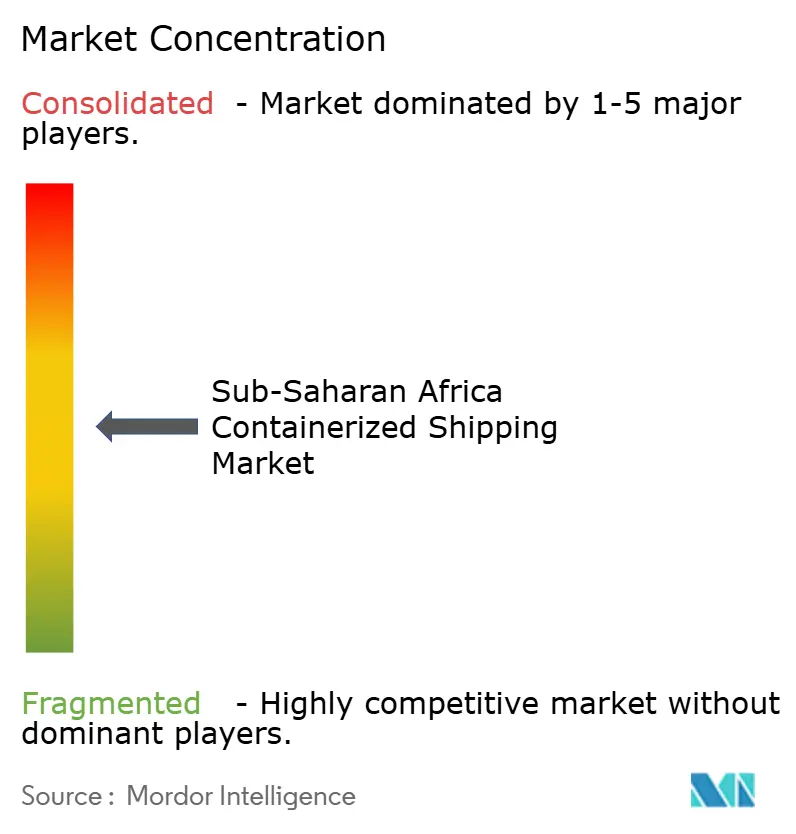
| Market Concentration | Medium |
Major Players *Disclaimer: Major Players sorted in no particular order |
Sub-Saharan Africa Containerized Shipping Market Analysis by Mordor Intelligence
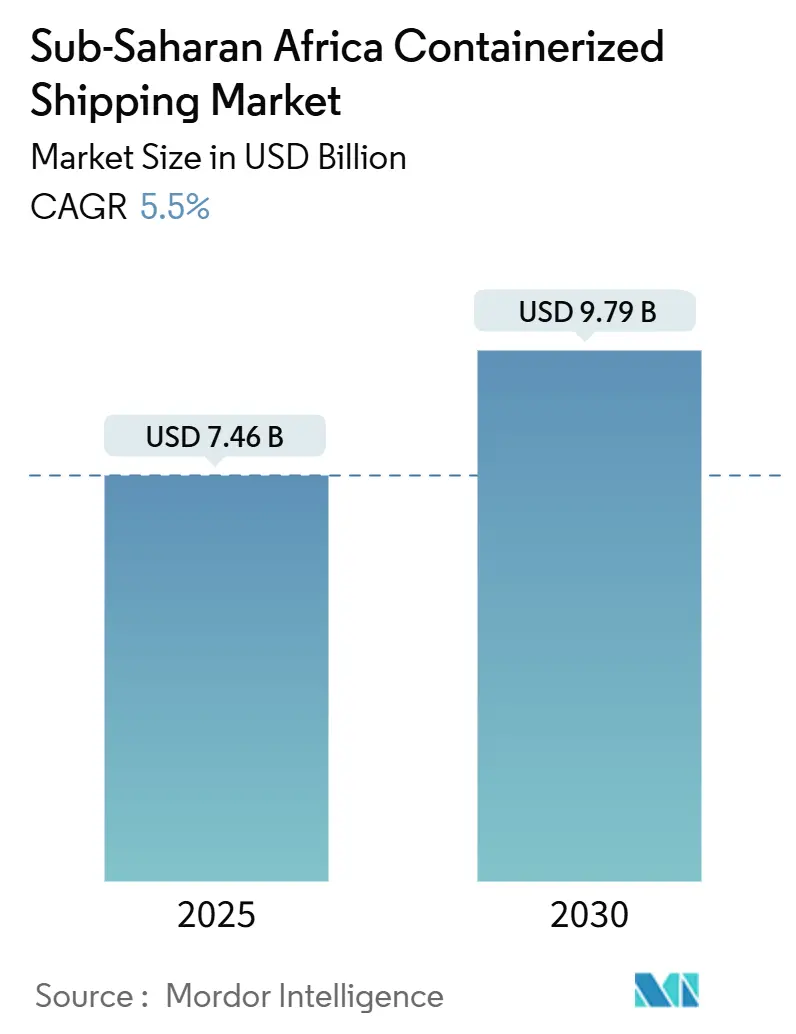
The Sub-Saharan Africa Containerized Shipping Market size is estimated at USD 7.46 billion in 2025, and is expected to reach USD 9.79 billion by 2030, at a CAGR of 5.5% during the forecast period (2025-2030).
- The containerized shipping market in Sub-Saharan Africa is reportedly evolving due to increasing trade volumes, rising consumer demand, and infrastructural advancements. The region is said to benefit from growing exports of raw materials, such as minerals, oil, and agricultural products, alongside rising imports of consumer goods and machinery.
- Government-led initiatives and policy measures are believed to be enhancing the market. Compliance with the International Maritime Organization's (IMO) amendments to the Facilitation (FAL) Convention, effective January 1, 2024, is expected to drive the adoption of electronic platforms for mandatory data exchanges at ports. South Africa is reportedly working on its MSW system to streamline ship clearance and improve port efficiency.
- Reports suggest that the IMO, in collaboration with the African Alliance for Electronic Commerce (AACE), has been supporting African nations in adopting digital tools to facilitate trade. Workshops conducted in December 2024 are said to promote Single Window systems, aiming to reduce time and costs associated with port operations.
- Technological advancements are also shaping the market. The Port of Mombasa, Kenya's largest seaport, is noted for its role in regional trade, handling over 1.4 million TEUs annually and serving neighboring landlocked countries. In 2024, the port reportedly launched a smart port system integrating IoT sensors, predictive analytics, and real-time container tracking to enhance operational efficiency and logistics, particularly for temperature-sensitive goods.
- Additionally, MSC Mediterranean Shipping Company is reported to have introduced the Thermal Blanket in October 2024, a thermal protection system designed to regulate container temperatures during transit. This innovation is said to benefit temperature-sensitive goods like cocoa, ensuring optimal conditions for international markets. Combined with MSC's Smart Containers and storage facilities, it is expected to improve product quality and profitability for local producers.
- In conclusion, the containerized shipping market in Sub-Saharan Africa is evolving through policy reforms, technological integration, and innovative solutions, collectively driving efficiency, trade facilitation, and economic growth in the region.
Sub-Saharan Africa Containerized Shipping Market Trends and Insights
Energy Sector Growth Drives the Market
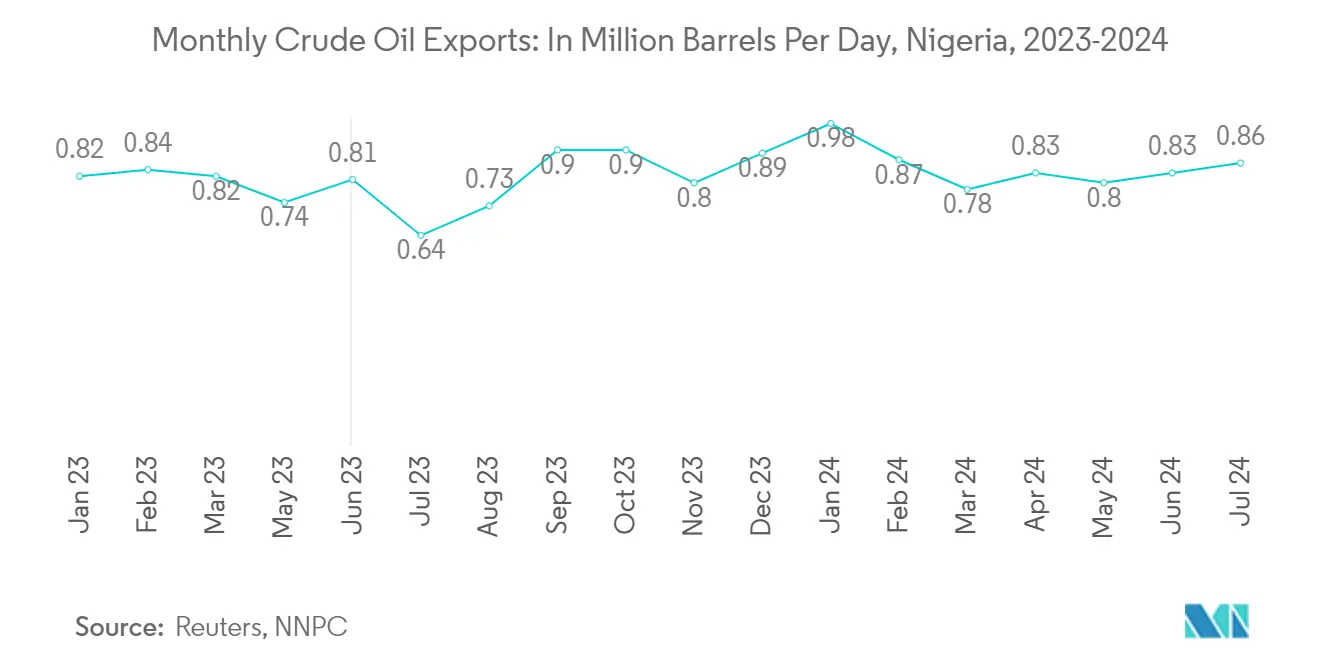
The dry bulk trucking market in Sub-Saharan Africa has been witnessing positive developments, particularly in the energy sector, with significant progress in the transportation of dry bulk products such as coal, crude oil, refined oil, and liquefied natural gas (LNG).
Reports from January 2025 highlighted that coal exports from South Africa's Richards Bay Coal Terminal (RBCT) grew by 10% in 2024, reaching 52.08 million metric tons, marking the highest level in three years. This growth was attributed to improvements in freight rail performance, which positively impacted the trucking sector by enhancing the overall supply chain efficiency. While coal shipments had previously declined due to capacity constraints faced by Transnet, the state-owned freight rail and port operator, the recent increase in exports signals a recovery in the market. The 2024 figures represent a significant improvement from the 47.21 million tons recorded in 2023, which was the lowest since 1992.
In 2023, Nigeria was identified as Africa's leading importer of petroleum products, with an import volume of 476,000 barrels per day. Furthermore, Asia's share of South Africa's coal exports expanded in 2024, reaching 43.99 million tons, or 84.5% of the total, compared to 37.1 million tons in the previous year. This growth in exports has positively influenced the dry bulk trucking market by increasing demand for transportation services. Additionally, the export volumes of crude palm oil (CPO) experienced a notable surge in 2024, driven by rising demand in various countries. Ghana recorded a 32% increase in exports, while Nigeria's imports rose by an impressive 450%, as reported in the Oilseeds and Products Report.
These developments reflect a positive trajectory for the dry bulk trucking market in Sub-Saharan Africa, with improving infrastructure, growing trade volumes, and increasing demand driving the sector's growth.
South Africa Strengthens Its Dominance in Sub-Saharan Containerized Shipping
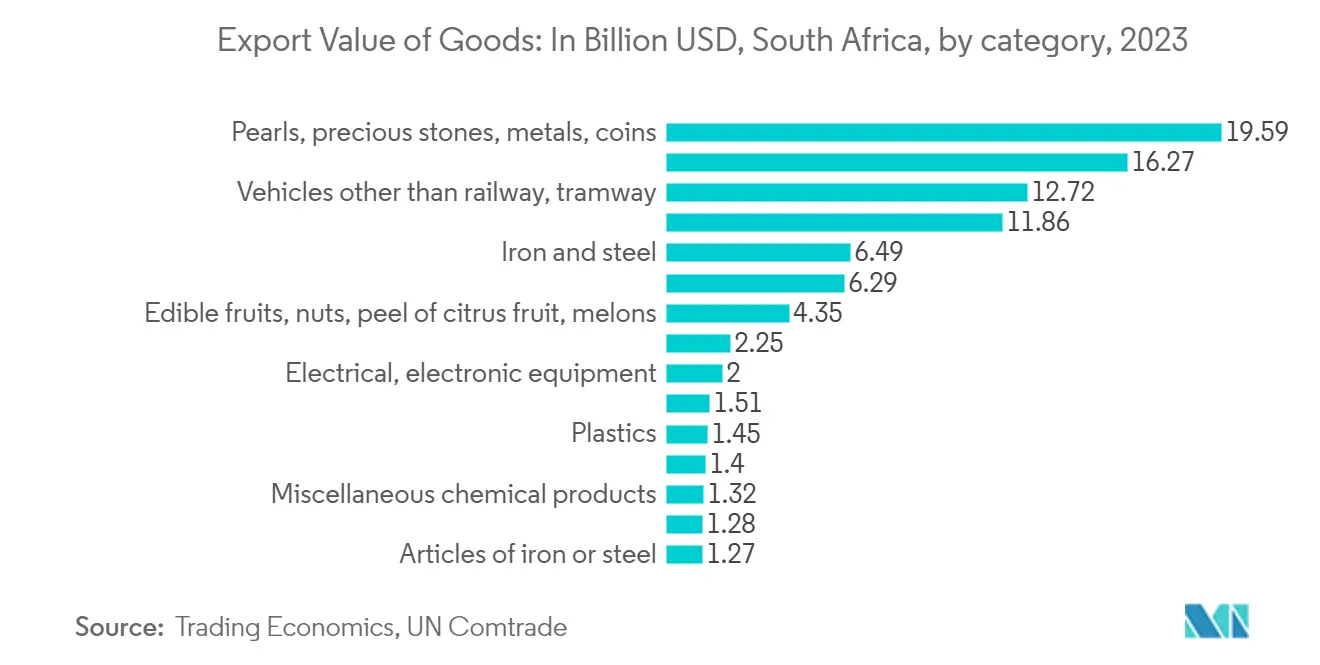
South Africa has reportedly reinforced its leadership in Sub-Saharan Africa's containerized shipping market through strategic investments in port infrastructure, increased commodity exports, and the adoption of advanced technologies.
Reports from January 2025 suggested that Transnet National Ports Authority had outlined capital expenditure plans for the Port of Durban. These plans were said to include expanding the container terminal, deepening the entrance channel, improving Maydon Wharf's channel depth, broadening automotive terminals, upgrading Bayhead and Langeberg Roads, and implementing water and energy sustainability projects. These developments were noted to enhance South Africa's role as a hub for regional and international containerized trade, facilitating the export of commodities such as coal, minerals, and manufactured goods.
According to INON Africa IOA in April 2024, Africa's maritime sector was reportedly adapting to challenges posed by evolving ship technology and competition from other transport modes by focusing on efficiency, speed, and environmental sustainability. The adoption of digital solutions was highlighted as a significant factor in this transformation. In 2025, Transnet, South Africa's state-owned logistics company, was said to have introduced digital port operation systems in Durban and Cape Town to improve port efficiency and reduce dwell times. These advancements in digital infrastructure were noted to have attracted more shipping lines, strengthening South Africa's position as a key trade gateway in the region.
In conclusion, South Africa's strategic initiatives in infrastructure development and digital transformation have positioned it as a critical player in Sub-Saharan Africa's containerized shipping market, driving regional trade growth and enhancing its competitiveness on the global stage.
Competitive Landscape
Sub-Saharan Africa's containerized shipping market boasts a semi-consolidated structure. Dominating the scene are global shipping titans such as Maersk Line, MSC Shipping, and CMA-CGM. Yet, these giants contend with competition from both regional players and smaller operators. The latter often carve out niches, focusing on specialized markets and regional routes, enriching the market's diversity and competitiveness. Key players in this arena encompass MSC Shipping, Maersk Line, CMA CGM, COSCO Shipping Lines, and Hapag-Lloyd.
For insatnce, in June 2024, DP World announced plans to invest USD 3 billion in Africa over the next three to five years, focusing on new port and logistics infrastructure. The investment, aimed at addressing long-term growth and increasing demand for critical mineral exports, was expected to impact the Sub-Saharan Africa Containerized Shipping Market. Of the total investment, USD 2 billion was allocated to port developments, while USD 1 billion was designated for logistics operations. Such investments bolster the market landscape.
Sub-Saharan Africa Containerized Shipping Industry Leaders
-
MSC Shipping
-
Maersk Line
-
CMA CGM
-
COSCO Shipping
-
Hapag-Lloyd
- *Disclaimer: Major Players sorted in no particular order
Recent Industry Developments
- June 2024: MSC reportedly completed its acquisition of Bolloré Africa Logistics, as confirmed by SC Group. The acquisition, involving Bolloré Africa Logistics SAS and its affiliates, was seen as a significant step in MSC's strategy to strengthen supply chains and infrastructure in Sub-Saharan Africa, which could have implications for the Sub-Saharan Africa Containerized Shipping Market.
- June 2024: Mitsui O.S.K. Lines (MOL) was reported to have made a strategic investment in Alistair Group, a Tanzania-based logistics company operating in Sub-Saharan Africa. The deal, which granted MOL a 25% stake in Alistair, was expected to expand MOL's presence in the region. Alistair Group's operations, including customs clearance, warehousing, port cargo handling, and digital transformation logistics, were considered relevant to the Sub-Saharan Africa Containerized Shipping Market.
Sub-Saharan Africa Containerized Shipping Market Report Scope
Container shipping involves transporting goods in standardized containers. This method, distinct from traditional shipping, uses containers of various standard sizes, ensuring compatibility across different modes of transport. It enables efficient movement of goods via trains, ships, and trucks, simplifying the loading, transport, and unloading processes.
Sub-Saharan Africa containerized shipping market report is segmented by size (small, large, high cube containers), by type (general container, temperature-controlled container, non-temperature-controlled container), by end user (agriculture, manufacturing, construction, energy, retail, healthcare and pharma, other industries), by country (South Africa, Kenya, Nigeria, Tanzania, Ghana). The report offers market size and market forecasts for Sub-Saharan Africa containerized shipping market in value (USD).
| Small |
| Large |
| High Cube Containers |
| General Container |
| Temperature Controlled Container |
| Non-Temperature Controlled Container |
| Agriculture |
| Manufacturing |
| Construction |
| Energy |
| Retail |
| Healthcare and Pharma |
| Other Industries |
| South Africa |
| Kenya |
| Nigeria |
| Tanzania |
| Ghana |
| By Size | Small |
| Large | |
| High Cube Containers | |
| By type | General Container |
| Temperature Controlled Container | |
| Non-Temperature Controlled Container | |
| By End-User | Agriculture |
| Manufacturing | |
| Construction | |
| Energy | |
| Retail | |
| Healthcare and Pharma | |
| Other Industries | |
| By Country | South Africa |
| Kenya | |
| Nigeria | |
| Tanzania | |
| Ghana |
Key Questions Answered in the Report
How big is the Sub-Saharan Africa Containerized Shipping Market?
The Sub-Saharan Africa Containerized Shipping Market size is expected to reach USD 7.46 billion in 2025 and grow at a CAGR of 5.5% to reach USD 9.79 billion by 2030.
What is the current Sub-Saharan Africa Containerized Shipping Market size?
In 2025, the Sub-Saharan Africa Containerized Shipping Market size is expected to reach USD 7.46 billion.
Who are the key players in Sub-Saharan Africa Containerized Shipping Market?
MSC Shipping, Maersk Line, CMA CGM, COSCO Shipping and Hapag-Lloyd are the major companies operating in the Sub-Saharan Africa Containerized Shipping Market.
What years does this Sub-Saharan Africa Containerized Shipping Market cover, and what was the market size in 2024?
In 2024, the Sub-Saharan Africa Containerized Shipping Market size was estimated at USD 7.05 billion. The report covers the Sub-Saharan Africa Containerized Shipping Market historical market size for years: 2019, 2020, 2021, 2022, 2023 and 2024. The report also forecasts the Sub-Saharan Africa Containerized Shipping Market size for years: 2025, 2026, 2027, 2028, 2029 and 2030.
Sub-Saharan Africa Containerized Shipping Market Report
Statistics for the 2025 Sub-Saharan Africa Containerized Shipping market share, size and revenue growth rate, created by Mordor Intelligence™ Industry Reports. Sub-Saharan Africa Containerized Shipping analysis includes a market forecast outlook for 2025 to 2030 and historical overview. Get a sample of this industry analysis as a free report PDF download.