
Specialty Pulp and Paper Chemical Market Size and Share
Market Overview
| Study Period | 2021 - 2031 |
|---|---|
| Market Size (2026) | USD 26.66 Billion |
| Market Size (2031) | USD 34.54 Billion |
| Growth Rate (2026 - 2031) | 5.32 % |
| Fastest Growing Market | Asia-Pacific |
| Largest Market | Asia-Pacific |
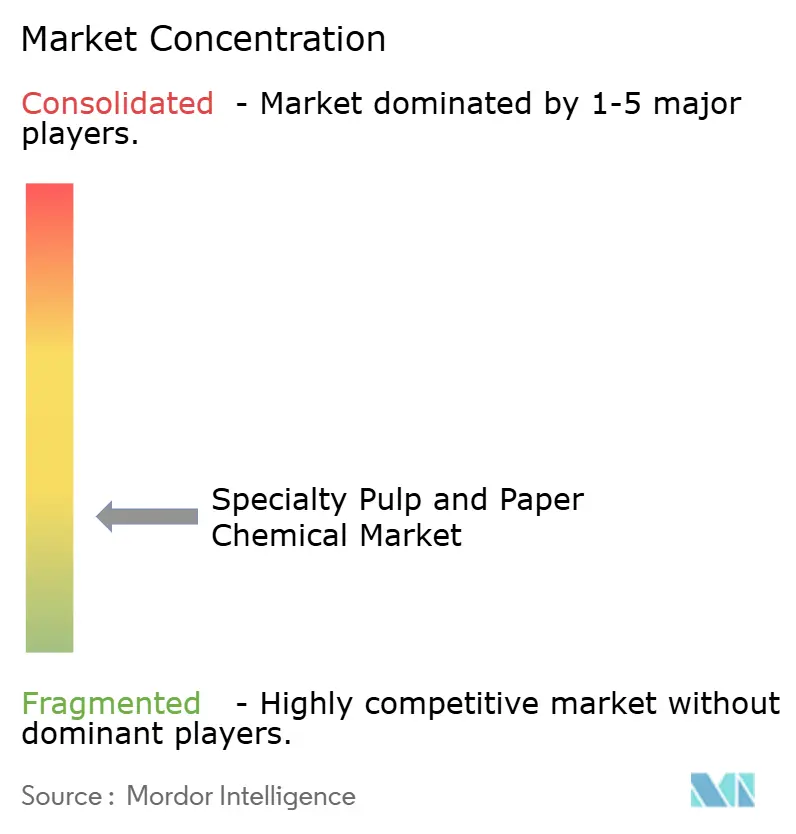
| Market Concentration | Low |
Major Players *Disclaimer: Major Players sorted in no particular order Image © Mordor Intelligence. Reuse requires attribution under CC BY 4.0. | |
Specialty Pulp and Paper Chemical Market Analysis by Mordor Intelligence
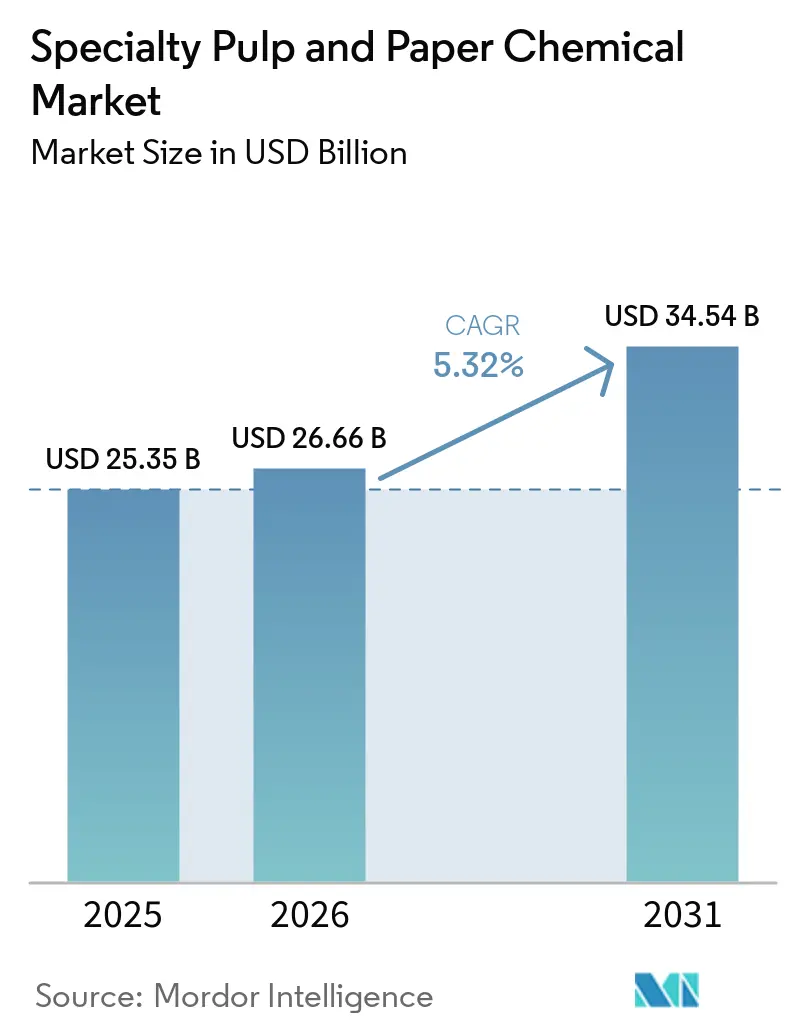
The Specialty Pulp and Paper Chemical market size was valued at USD 25.35 billion in 2025 and is estimated to grow from USD 26.66 billion in 2026 to reach USD 34.54 billion by 2031, at a CAGR of 5.32% during the forecast period (2026-2031). The specialty pulp and paper chemical market is supported by the shift from plastic packaging to fiber-based consumer and food packaging, as well as the requirement for durable corrugated packaging in e-commerce logistics and consumer goods distribution. These trends increase demand for retention aids, wet-strength resins, starches, drainage aids, and sizing chemicals that enable mills to produce packaging grades with consistent formation, strength, and resistance to handling conditions. Restrictions on per- and polyfluoroalkyl substances (PFAS) prompt paper converters to reformulate barrier coatings using alternatives that meet food-contact requirements while maintaining grease resistance, production efficiency, and compatibility with existing converting processes. Increased use of recycled fiber also drives demand for dry-strength additives, drainage aids, fixatives, enzymes, and other functional chemicals, as recycled furnish has weaker fiber bonding and more variable surface chemistry than virgin kraft fiber. Water reuse and zero-liquid-discharge systems increase demand for scale inhibitors, biocides, dispersants, coagulants, and cleaning chemicals. These requirements expand the specialty pulp and paper chemical market beyond growth in paper production and link demand to process control, environmental compliance, and water quality. However, input-cost volatility remains a risk for polyacrylamide, hydrogen peroxide, chlorine dioxide, and other energy-linked chemical inputs. The competitive landscape includes global suppliers with application science capabilities and co-located production facilities. Regional mills without advanced monitoring systems also create opportunities for suppliers offering localized formulations and technical support.
Key Report Takeaways
- By product type, polymers held 27.45% of the specialty pulp and paper chemical market share in 2025, while the same category is forecast to expand at a 5.84% CAGR through 2031.
- By application, papermaking accounted for 34.56% of the specialty pulp and paper chemical market share in 2025, while paper coating is forecast to grow at a 6.13% CAGR through 2031.
- By end-user industry, packaging paper and board captured 43.78% of the specialty pulp and paper chemical market share in 2025 and is forecast to record a 6.47% CAGR through 2031.
- By geography, Asia-Pacific held 40.11% of the specialty pulp and paper chemical market share in 2025 and is forecast to expand at a 6.31% CAGR through 2031.
Note: Market size and forecast figures in this report are generated using Mordor Intelligence’s proprietary estimation framework, updated with the latest available data and insights as of January 2026.
Global Specialty Pulp and Paper Chemical Market Trends and Insights
Drivers Impact Analysis*
| Drivers | (~) % Impact on CAGR Forecast | Geographic Relevance | Impact Timeline |
|---|---|---|---|
| Packaging Substitution and E-Commerce Corrugated Demand | +1.8% | Global, with the highest intensity in Asia-Pacific and North America | Short term (≤ 2 years) |
| Recycled-Fiber Furnish Increasing Functional-Chemical Intensity | +1.2% | Global, with Asia-Pacific and Europe at the forefront | Medium term (2-4 years) |
| Water Reuse and Closed-Loop Mill Treatment | +0.9% | Asia-Pacific core, including China and India, with spillover to the Middle East and Africa | Medium term (2-4 years) |
| Per- and Polyfluoroalkyl Substances (PFAS)-Free and Repulpable Barrier Reformulation | +1.1% | North America and the EU primarily, with Asia-Pacific emerging | Short term (≤ 2 years) |
| Enzymatic Bleaching, Deinking, and Fiber-Yield Optimization | +0.7% | Asia-Pacific and South America, including Brazil | Long term (≥ 4 years) |
| Source: Mordor Intelligence | |||
Packaging Substitution and E-Commerce Corrugated Demand
The specialty pulp and paper chemical market is affected by the shift toward fiber-based consumer and food packaging, particularly as brand owners seek recyclable alternatives to plastic formats. Corrugated board requires wet-strength resins, starches, retention aids, and surface-sizing agents to protect boxes from moisture exposure during storage and handling. E-commerce fulfillment increases demand for individual shipping formats rather than shared retail packaging, increasing the need for reliable outer packaging across varied shipping conditions.
This trend increases demand for lighter corrugated constructions that maintain strength, stiffness, and print quality without adding unnecessary fiber weight. These grades require more specialized additive systems than standard containerboard because mills must balance drainage, formation, dry strength, and moisture resistance. Packaging growth increases chemical use in board formation, surface performance, converting, and repulpability. It also requires close control of fiber usage, basis weight, moisture behavior, and finished-box performance across varied transportation, storage, humidity, and handling conditions.
Recycled-Fiber Furnish Increasing Functional-Chemical Intensity
Higher recycled-fiber content weakens fiber-surface chemistry and increases chemical dosage requirements in paper production, particularly when mills use recovered fiber for packaging grades. Previous drying cycles block part of the cellulose surface through hornification, reducing hydrogen bonding, fiber flexibility, and cationic additive adsorption. As recycled content increases, mills often need to adjust their retention, drainage, fixation, and dry-strength programs.
A 2025 study found that a combination of laccase, xylanase, and mannanase improved pulp brightness by 5.37% ISO and reduced chlorine dioxide consumption by 13.26% in recycled-furnish sequences. In May 2025, ANDRITZ started a recycled-fiber line at Heinzelpaper Laakirchen in Austria, with a capacity of 1,600 tons per day of high-quality fiber[1]ANDRITZ AG, “ANDRITZ Successfully Starts Up New Recycled Fiber Line at Heinzelpaper Laakirchen, Austria,” ANDRITZ, andritz.com.. Enzymatic bleaching, deinking, and fiber-yield optimization help mills manage recycled-fiber quality, while specialty chemical programs help stabilize production quality. The specialty pulp and paper chemical market is affected as mills increase recycled-fiber content while maintaining product performance, machine efficiency, fiber recovery, and the quality consistency required for high-volume packaging, tissue, and specialty paper production. These requirements are particularly relevant because recovered-fiber quality can vary by collection source and processing history.
Water Reuse and Closed-Loop Mill Treatment
Water scarcity is an operating challenge for pulp and paper facilities in India, China, and the Gulf, where mill operators face pressure to reduce freshwater withdrawals. Closed-loop and zero-liquid-discharge systems require chemical treatment because recycled water accumulates dissolved solids, microbiological loads, organic residues, and scale-forming ions through repeated recirculation. These systems increase the use of scale inhibitors, biocides, dispersants, coagulants, and cleaning chemicals, independent of paper output growth.
Chemical control is required because unstable water quality can affect sheet formation, deposit formation, equipment reliability, and finished-paper consistency. Voith states that its AquaLine Zero system can reduce freshwater consumption to a maximum of 1.5 liters per kilogram of paper and lower effluent discharge to 0 liters per kilogram. The company also states that biogas generation can reduce CO₂ emissions by 10%. This operating model creates recurring demand for water-treatment chemicals across the specialty pulp and paper chemical market, even when underlying mill output does not increase at the same pace. Water recirculation requires treatment at every stage of reuse, including stages where deposits and biological growth can disrupt stable machine operations.
Per- and Polyfluoroalkyl Substances (PFAS)-Free and Repulpable Barrier Reformulation
PFAS-free barrier reformulation is changing the chemistry used in food-contact paper and paperboard as converters replace fluorinated grease-resistant treatments. A 2025 academic assessment reported PFAS treatment costs of USD 0.00012 per m², compared with USD 0.015 to USD 0.98 per m² for bio-based alternative coatings. The same assessment estimated that the aggregate transition cost could reach USD 12,500 million above the PFAS baseline.
In January 2025, the FDA invalidated 35 related food-contact notifications after PFAS-containing grease-proofing substances were no longer sold for food-contact use in the United States. Regulation (EU) 2025/40 has applied since August 2026 and sets PFAS limits for food-contact packaging at 25 parts per billion (ppb) for an individual substance and 250 ppb in total. Water-based polymer coatings, dispersion-coated boards, and enzymatic surface-sizing systems provide replacement pathways. However, producers must evaluate barrier performance, repulpability, processing compatibility, food-contact suitability, the ability to scale new formulations across existing production lines, and the cost and availability of alternative coating ingredients. These requirements place reformulation within the specialty pulp and paper chemical market at the center of the broader packaging transition.
Restraints Impact Analysis*
| Restraints | (~) % Impact on CAGR Forecast | Geographic Relevance | Impact Timeline |
|---|---|---|---|
| Raw-Material and Energy-Cost Volatility | -1.8% | Global, with Europe and South Asia most exposed | Short term (≤ 2 years) |
| Effluent, Adsorbable Organic Halogens (AOX), Chemical Oxygen Demand (COD), and Chemical-Substance Compliance Costs | -0.9% | Global, with heightened pressure in the EU and Asia-Pacific | Medium term (2-4 years) |
| Closed-Loop and Zero-Liquid-Discharge Fouling Risk | -0.4% | Asia-Pacific core and the Middle East and Africa | Long term (≥ 4 years) |
| Source: Mordor Intelligence | |||
Raw-Material and Energy-Cost Volatility
Raw material and energy cost volatility limits purchasing flexibility for mills and chemical suppliers, particularly for products that rely on energy-intensive feedstocks. The production of polyacrylamide monomers, hydrogen peroxide, and chlorine dioxide requires significant energy inputs and remains exposed to changes in energy and petrochemical markets. Cost pressures can reduce mill budgets for additive upgrades, especially for enzymatic and bio-based products that carry a cost premium. These pressures can also lead mills to evaluate lower-cost commodity alternatives when specialty products rely on energy-linked feedstocks and mills face immediate budget constraints. Acrylamide price resets in 2025 and 2026 led some Asian mills to evaluate oxidized-starch dry-strength systems. This risk can reduce value per ton even when chemical demand remains stable, as customers may select less specialized formulations or defer nonessential process upgrades.
Effluent, Adsorbable Organic Halogens (AOX), Chemical Oxygen Demand (COD), and Chemical-Substance Compliance Costs
Stricter effluent discharge and chemical substance requirements increase operating and capital costs for pulp and paper facilities, particularly when older mills need to upgrade their existing treatment systems. China’s GB3544-2024 standard requires white-water recycling rates above 95% and solids-loss rates below 3%, increasing the need for treatment equipment, monitoring, and dosing systems. The standard also regulates adsorbable organic halogens (AOX), which are associated with chlorine-based bleaching sequences and require process management. The Registration, Evaluation, Authorization and Restriction of Chemicals (REACH) framework progressively restricts formaldehyde-releasing wet-strength resins, requiring suppliers and mills to reformulate products and qualify alternatives. These compliance requirements support demand for low-AOX and bio-based chemical systems, but can delay purchasing decisions during the transition. Fouling in closed-loop and zero-liquid-discharge systems remains a long-term constraint, as it can increase treatment complexity, the risk of downtime, and water-reuse operating costs.
*Our forecasts treat driver/restraint impacts as directional, not additive. The impact forecasts reflect baseline growth, mix effects, and variable interactions.
Segment Analysis
By Product Type: Polymers Lead as Recycled-Fiber Adoption Intensifies
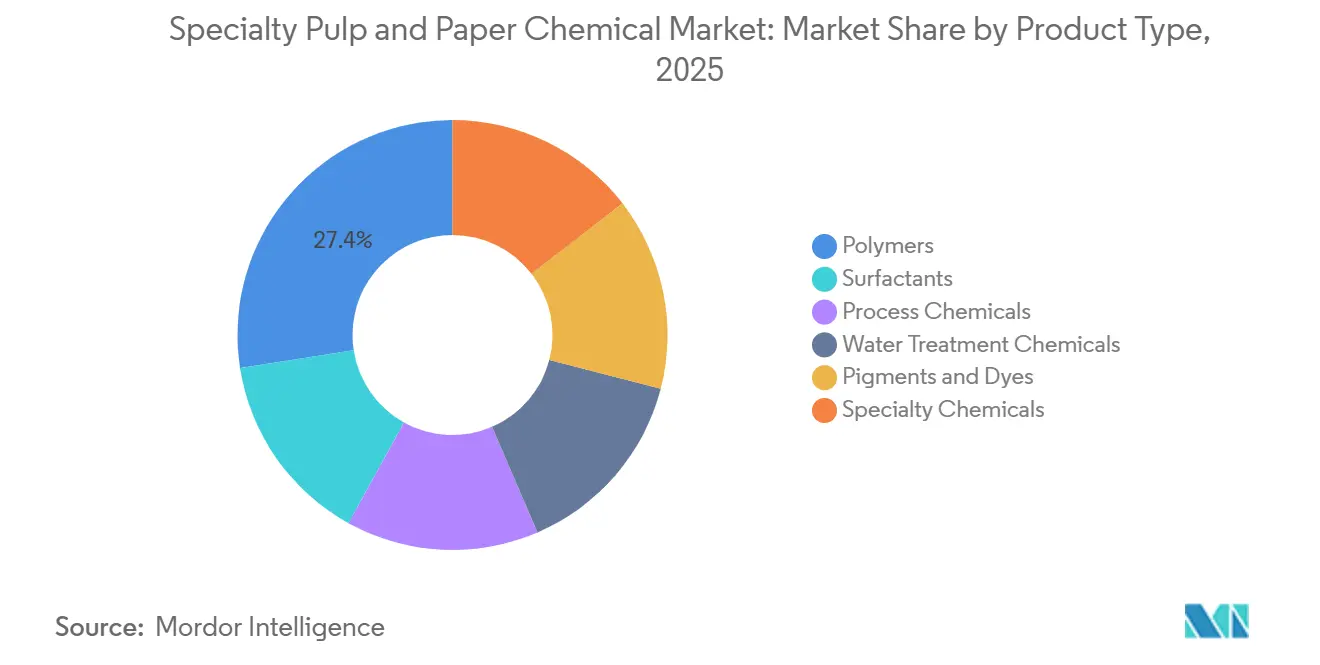
Polymers accounted for 27.45% of the specialty pulp and paper chemical market by product type in 2025. The polymers segment is forecast to expand at a CAGR of 5.84% through 2031. Polyacrylamide, polyvinylamine, and polyamidoamine-epichlorohydrin chemistries support retention, drainage, wet strength, and the retention of fines and fillers during papermaking. Their importance increases as containerboard producers raise recycled-furnish content while maintaining machine runnability under demanding operating conditions. Recycled fibers create a cationic-demand deficit, which can increase polymer dosage per ton and complicate the balance among retention, drainage, and formation. Consequently, polymers support mill efforts to preserve strength and drainage performance, reduce virgin-fiber use, and meet quality specifications for packaging grades.
Nouryon commercially introduced Expancel 081 microspheres in April 2026. According to the company, adding up to 1% of the product can increase paperboard bulk and thickness by 15-25%, enabling mills to reduce fiber consumption while maintaining stiffness. Surfactants function as defoamers and wetting agents in wet-end operations, where foam control and uniform liquid coverage can affect manufacturing stability. Process chemicals support pulping and cooking stages, while water-treatment chemicals support closed-loop systems that require control of deposits, biological activity, and dissolved solids. Pigments and dyes provide optical brightening and color, while specialty chemicals, including enzymatic and barrier-coating products, are receiving attention in reformulation.



By Application: Paper Coating Outpaces Traditional Wet-End Chemistry
Papermaking accounted for a 34.56% share of the specialty pulp and paper chemical market by application in 2025. Chemical use in wet-end operations includes retention aids, starches, fillers, biocides, drainage agents, and additives that manage water removal and sheet formation. Mills use these products across each ton of output and across multiple paper grades, providing the application with a stable demand base. Pulp bleaching is another application in which enzyme-assisted sequences are gradually reshaping chemical procurement and creating opportunities to reduce chlorine dioxide use. Paper converting and specialty paper serve narrower applications, including self-adhesive laminates, release liners, medical-grade substrates, and grades requiring controlled surface properties. Paper coating is forecast to expand at a CAGR of 6.13% through 2031.
The paper-coating segment is supported by regulatory deadlines to replace per- and polyfluoroalkyl substances (PFAS). The U.S. phase-out and Regulation (EU) 2025/40 are driving paper producers toward water-based polymer dispersions, silica-based barriers, and thermally cross-linked bio-coating systems. These solutions can reduce AOX-generating bleaching loads within existing capital cycles, and help mills improve bleaching performance without requiring separate equipment investments. The application mix is shifting toward products that address performance, compliance, operational continuity, and lower-impact paper production.
By End-User Industry: Packaging Paper and Board Commands Nearly Half the Market
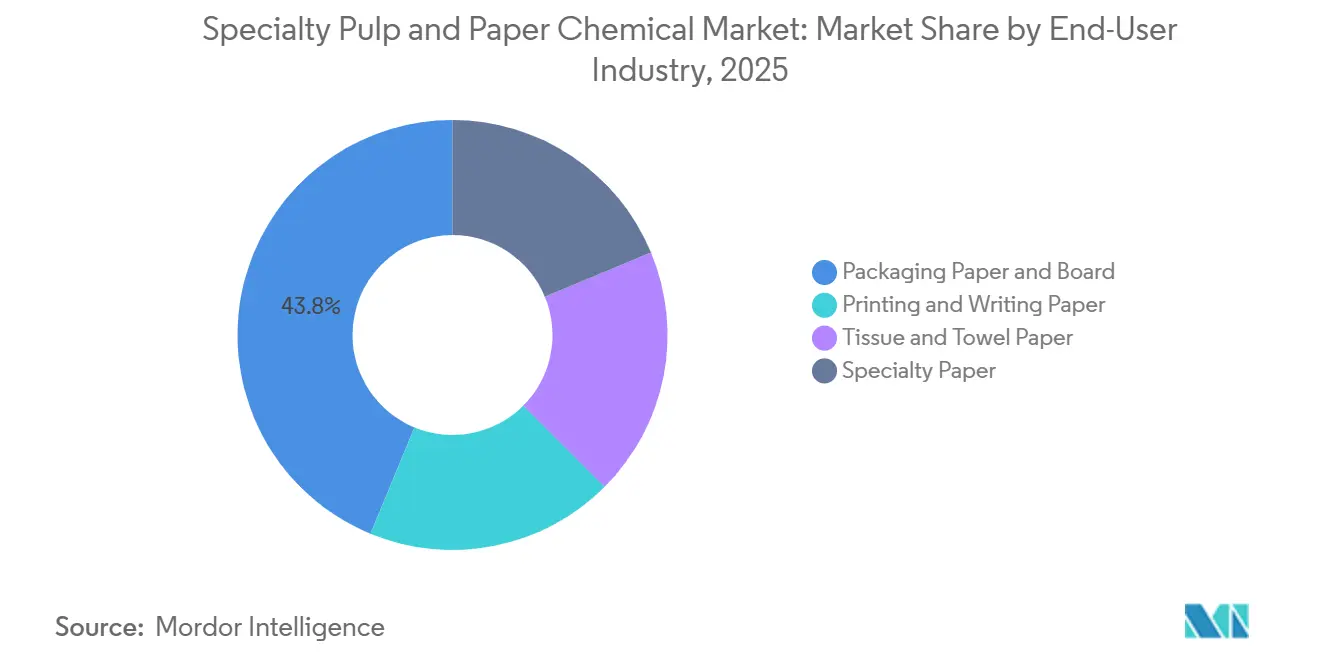
Packaging paper and board accounted for 43.78% of the specialty pulp and paper chemical market by end-user industry in 2025. The segment is forecast to grow at a CAGR of 6.47% through 2031. Containerboard and corrugated medium require additives that provide dry strength, wet strength, repulpability, moisture resistance, and reliable performance during shipping and storage. Growth in packaging demand increases chemical requirements for each additional ton of board capacity and heightens the importance of chemicals that support lightweight construction. Demand applies to grades used in e-commerce, consumer-goods distribution, food-service packaging, and other applications in which the board must balance product protection with efficient fiber use. These factors support the packaging paper and board end-user category.
Solenis began construction of a new 60,000-ton production facility in Beihai, Guangxi, in April 2026, with production planned for the second quarter of 2027. The facility reflects investment in packaging-board supply chains in China, where chemical suppliers require regional production capacity and application support near paper mills. Printing and writing paper faces pressure from digital substitution but continues to require premium chemicals for high-brightness, surface-treated, office, security, and other specialized grades. Tissue and towel applications maintain chemical intensity because softness, absorbency, and wet strength remain important to product quality. Specialty paper includes food-service substrates, label stocks, and filtration papers, where functional requirements can exceed those of standard commodity grades. Although these applications are smaller, they can require barrier and functional chemical formulations, particularly where product safety and surface performance are requirements.
Geography Analysis
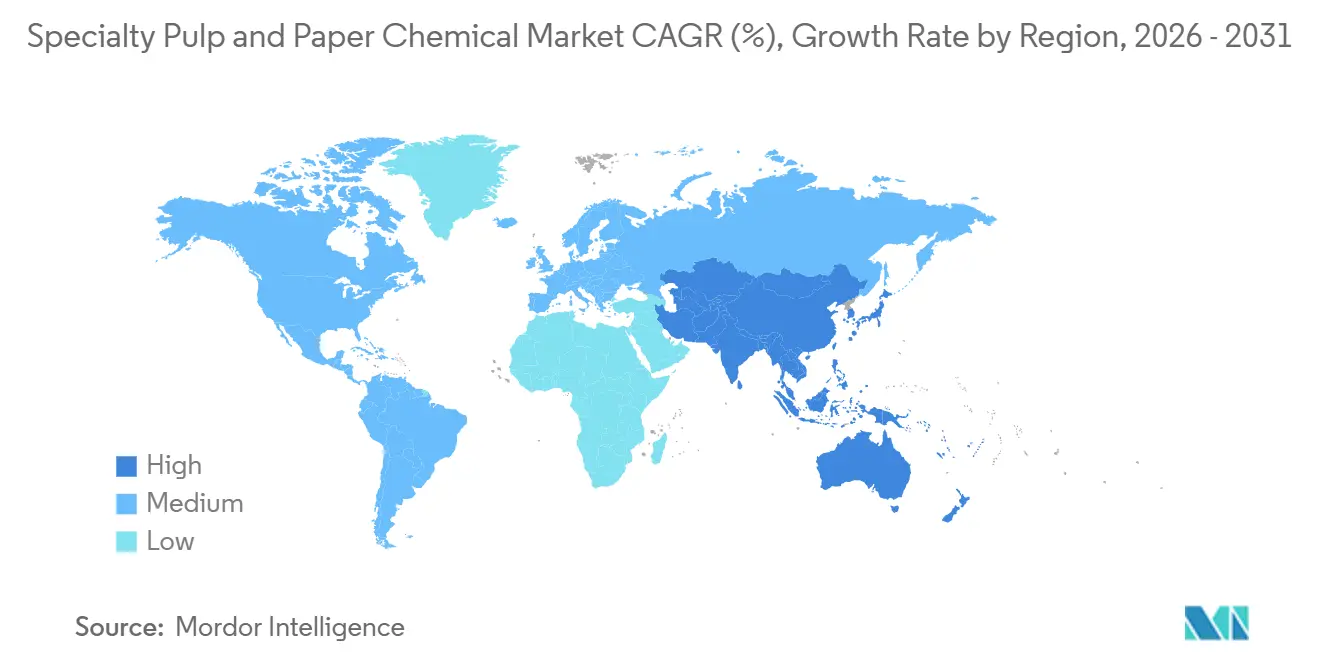
Asia-Pacific accounted for 40.11% of the specialty pulp and paper chemicals market in 2025 and is projected to grow at a CAGR of 6.31% through 2031. China is a source of regional demand, as provinces such as Shandong, Zhejiang, and Guangxi are adding integrated pulp and paper assets that require functional, bleaching, water-treatment, and process chemicals. India is gaining importance as government incentive programs reduce financing barriers for packaging mills and shorten chemical procurement cycles for new capacity. Kemira’s Wellgrow facility in Thailand became operational in August 2026, with an annual capacity of 100,000 tons of strength chemicals[2]Kemira Oyj, “Kemira Invests in the Expansion of Paper and Board Chemical Capacity in Thailand to Serve the Growing APAC Market,” Kemira, kemira.com.. The facility meets the demand for paper, board, and tissue in Southeast Asia and India. Japan and South Korea generate demand for enzyme-based bleaching agents and high-purity functional additives used in premium packaging and specialty grades. These factors create a regional demand base that includes expanding packaging capacity and specialty paper production.
North America is the second-largest regional specialty pulp and paper chemicals market, supported by an established mill base with technical capabilities. Regional demand is growing through process intensification, chemical efficiency, and regulatory-driven reformulation rather than additions of basic paper production capacity. The FDA’s January 2025 action on 35 PFAS food-contact notifications accelerated conversion schedules for paper packaging, which had previously been voluntary for some converters. Canada supports demand through its Kraft pulp sector and interest in enzymatic and bio-based bleaching additives associated with corporate Scope 3 emissions commitments. Mexico is expanding from a lower base through consumer goods and food-service packaging activity linked to the nearshoring manufacturing corridor. New production and distribution activity in this corridor is increasing demand for packaging board, functional coatings, and wet-end chemical programs.
Germany, France, and the Nordic countries operate mills with established elemental chlorine-free and totally chlorine-free bleaching systems. This infrastructure supports enzyme integration and the adoption of low-AOX chemicals. In South America, the market remains concentrated in Brazil, where cellulose production reached 29.4 million tons in 2025, up 6.9% from 2024, while exports reached 20.7 million tons, up 11.6%. Brazil’s environmental licensing framework supports the procurement of biodegradable retention aids and bio-based alternatives for mill chemical applications. The Middle East and Africa remain smaller markets; however, greenfield mills in Saudi Arabia, Egypt, and South Africa are adopting advanced delignification and peroxide bleaching technologies from inception, without legacy capital constraints that can delay technology adoption in other regions. This enables the selection of chemical programs during initial mill design and startup.

Competitive Landscape
The specialty pulp and paper chemical market is fragmented. Kemira, Solenis, Ecolab, and BASF operate in the wet-end functional chemicals segment, where application expertise and mill-level performance optimization are relevant. Co-located production facilities, technical service capabilities, and established customer relationships can support supplier relationships with larger mills. Global suppliers are shifting from product supply toward digital service programs that incorporate real-time soft-sensor dosing, predictive quality control, and data-driven chemical optimization. Regional mid-sized mills that are expanding but lack advanced monitoring infrastructure may not be fully served by standardized global formulations. This creates opportunities for localized service and application support tailored to regional fiber mixes, machine conditions, water quality, and mill operating priorities.
In 2026, Solenis agreed with Moleaer to expand the use of nanobubble technology for polymer activation through its Novera program. The agreement focused on process performance and polymer activation in addition to chemical supply. In April 2026, Nouryon introduced Expancel 081 to help paperboard producers increase recycled fiber use while maintaining board properties. Kemira’s capacity expansion in Thailand provides a regional production footprint to meet demand for packaging, board, and tissue across Southeast Asia and India. The specialty pulp and paper chemical market favors suppliers that combine application support, local availability, performance validation, and measurable cost-in-use benefits, particularly where mills seek to improve strength, runnability, water efficiency, or barrier performance without disrupting established production processes.
Bio-based materials are creating a distinct competitive avenue for smaller suppliers, including lignosulfonate-based strength additives, rosin-based sizing systems, and bio-based flocculants. Smaller formulators in Brazil and Southeast Asia are tailoring enzymatic deinking and water-treatment products to local recycled-furnish conditions that may not align with standard global formulations. Their competitive position depends on application-specific support and local responsiveness rather than a broad global product portfolio. ISO 14001 environmental management requirements can also influence mill procurement governance, resulting in a competitive structure in which global suppliers operate in established functional chemical categories. At the same time, specialized regional formulators address local and bio-based applications.
Specialty Pulp and Paper Chemical Industry Leaders
Kemira Oyj
Solenis
BASF
Ecolab Inc.
Buckman
- *Disclaimer: Major Players sorted in no particular order

Recent Industry Developments
- April 2026: Nouryon commercially introduced Expancel 081 microspheres at the Pulp and Beyond 2026 event in Helsinki. When used at up to 1% in paperboard, the product increases bulk and thickness by 15–25%, enabling mills to meet performance targets with higher recycled-fiber content without increasing basis weight.
- March 2025: Kemira’s expanded Wellgrow facility in Thailand reached full operational status, with an annual capacity of approximately 100,000 tons of strength chemical agents. The facility serves the Specialty Pulp and Paper Chemical market in Southeast Asia and India across paper, board, and tissue applications. The multi-million-euro expansion included multiple production lines and represented Kemira’s largest Asia-Pacific capacity commitment to date.


Global Specialty Pulp and Paper Chemical Market Report Scope
Specialty pulp and paper chemicals are formulations used in pulp and paper manufacturing to improve production efficiency, manage mill processes, and provide specific performance characteristics to final products.
The specialty pulp and paper chemical market is segmented by product type, application, end-user industry, and geography. By product type, the market is segmented into surfactants, polymers, process chemicals, water treatment chemicals, pigments and dyes, and specialty chemicals. By application, the market is segmented into papermaking, paper coating, pulp bleaching, paper converting, and specialty paper production. By end-user industry, the market is segmented into printing and writing paper, packaging paper and board, tissue and towel paper, and specialty paper. The report also covers market size and forecasts for specialty pulp and paper chemicals across 15 countries in major regions. The market sizes and forecasts are provided in terms of value (USD).
| Surfactants |
| Polymers |
| Process Chemicals |
| Water Treatment Chemicals |
| Pigments and Dyes |
| Specialty Chemicals |
| Papermaking |
| Paper Coating |
| Pulp Bleaching |
| Paper Converting |
| Specialty Paper Production |
| Printing and Writing Paper |
| Packaging Paper and Board |
| Tissue and Towel Paper |
| Specialty Paper |
| Asia-Pacific | China |
| India | |
| Japan | |
| South Korea | |
| ASEAN Countries | |
| Rest of Asia-Pacific | |
| North America | United States |
| Canada | |
| Mexico | |
| Europe | Germany |
| United Kingdom | |
| France | |
| Italy | |
| NORDIC Countries | |
| Rest of Europe | |
| South America | Brazil |
| Argentina | |
| Rest of South America | |
| Middle East and Africa | Saudi Arabia |
| South Africa | |
| Rest of Middle East and Africa |
| By Product Type | Surfactants | |
| Polymers | ||
| Process Chemicals | ||
| Water Treatment Chemicals | ||
| Pigments and Dyes | ||
| Specialty Chemicals | ||
| By Application | Papermaking | |
| Paper Coating | ||
| Pulp Bleaching | ||
| Paper Converting | ||
| Specialty Paper Production | ||
| By End-User Industry | Printing and Writing Paper | |
| Packaging Paper and Board | ||
| Tissue and Towel Paper | ||
| Specialty Paper | ||
| By Geography | Asia-Pacific | China |
| India | ||
| Japan | ||
| South Korea | ||
| ASEAN Countries | ||
| Rest of Asia-Pacific | ||
| North America | United States | |
| Canada | ||
| Mexico | ||
| Europe | Germany | |
| United Kingdom | ||
| France | ||
| Italy | ||
| NORDIC Countries | ||
| Rest of Europe | ||
| South America | Brazil | |
| Argentina | ||
| Rest of South America | ||
| Middle East and Africa | Saudi Arabia | |
| South Africa | ||
| Rest of Middle East and Africa | ||


Key Questions Answered in the Report
What is current market size of Specialty Pulp and Paper Chemical Market?
The Specialty Pulp and Paper Chemical market size was valued at USD 25.35 billion in 2025 and is estimated to grow from USD 26.66 billion in 2026 to reach USD 34.54 billion by 2031, at a CAGR of 5.32% during the forecast period (2026-2031).
Which product category leads specialty pulp and paper chemicals?
Polymers led with a 27.45% share in 2025 and are projected to grow at a 5.84% CAGR through 2031, reflecting their role in retention, drainage, and wet-strength applications.
What application is growing fastest in specialty pulp and paper chemicals?
Paper coating is the fastest-growing application, with a projected 6.13% CAGR through 2031, supported by PFAS-free barrier reformulation and demand for water-based and repulpable coating systems.
Why are recycled fibers increasing the demand for specialty chemicals?
Recycled furnish has weaker fiber bonding and lower available surface area, which increases the need for strength additives, drainage aids, fixatives, and enzyme programs that help mills maintain paper quality.
Page last updated on:


 Your data is secure and never sold or shared.


