
Market Overview
| Study Period | 2020 - 2031 |
|---|---|
| Forecast Data Period | 2026 - 2031 |
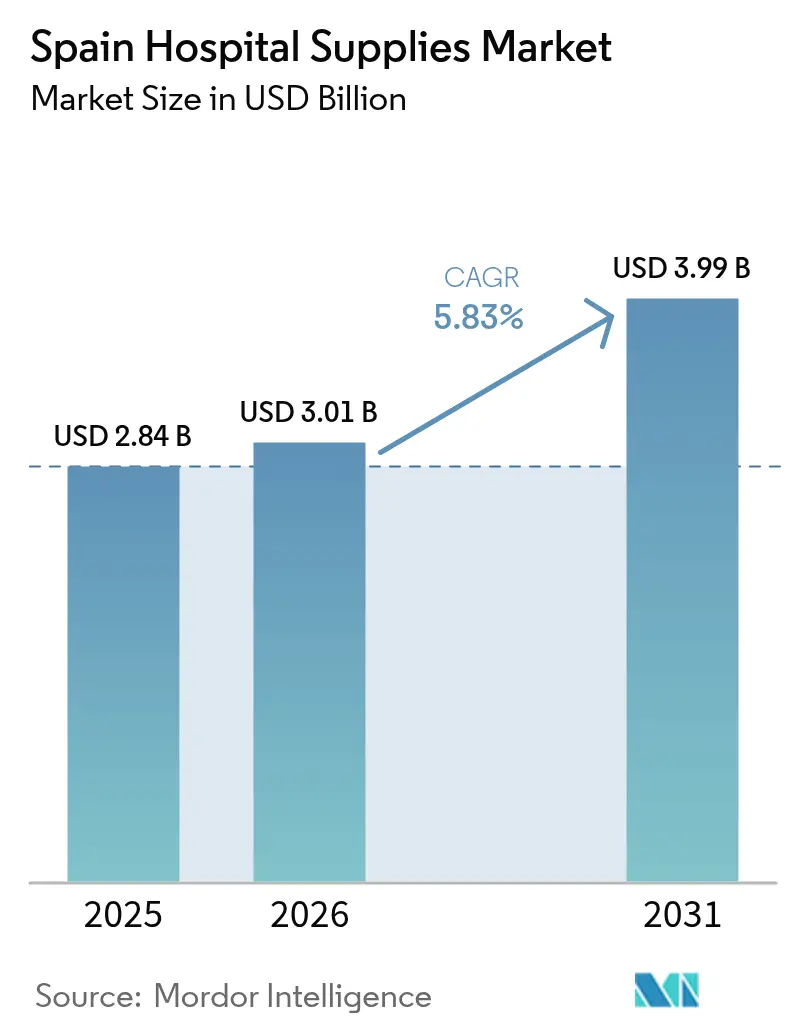
| Base Year Market Size (2025) | USD 2.84 Billion |
| Market Size (2026) | USD 3.01 Billion |
| Market Size (2031) | USD 3.99 Billion |
| Growth Rate (2026 - 2031) | 5.83 % |
| Market Concentration | Medium |
Major Players *Disclaimer: Major Players sorted in no particular order Image © Mordor Intelligence. Reuse requires attribution under CC BY 4.0. | |
Spain Hospital Supplies Market Analysis by Mordor Intelligence
The Spain hospital supplies market size is expected to grow from USD 2.84 billion in 2025 to USD 3.01 billion in 2026 and is forecast to reach USD 3.99 billion by 2031 at 5.83% CAGR over 2026-2031. Spain’s solid public-sector foundation, together with targeted Recovery and Resilience Facility investments, underpins this consistent trajectory even as other European healthcare systems show greater volatility. Rising life expectancy, a sharply expanding population segment aged 90 years and above, and stricter infection-prevention standards reinforce equipment renewal cycles, while digital procurement mandates accelerate order fulfilment. Global multinationals and domestic specialists compete on value, compliance support and rapid logistics, creating a balanced yet dynamic competitive field. Continued EU harmonisation through the Medical Device Regulation (MDR) and the European Health Data Space is driving both standardisation benefits and added compliance costs.
Key Report Takeaways
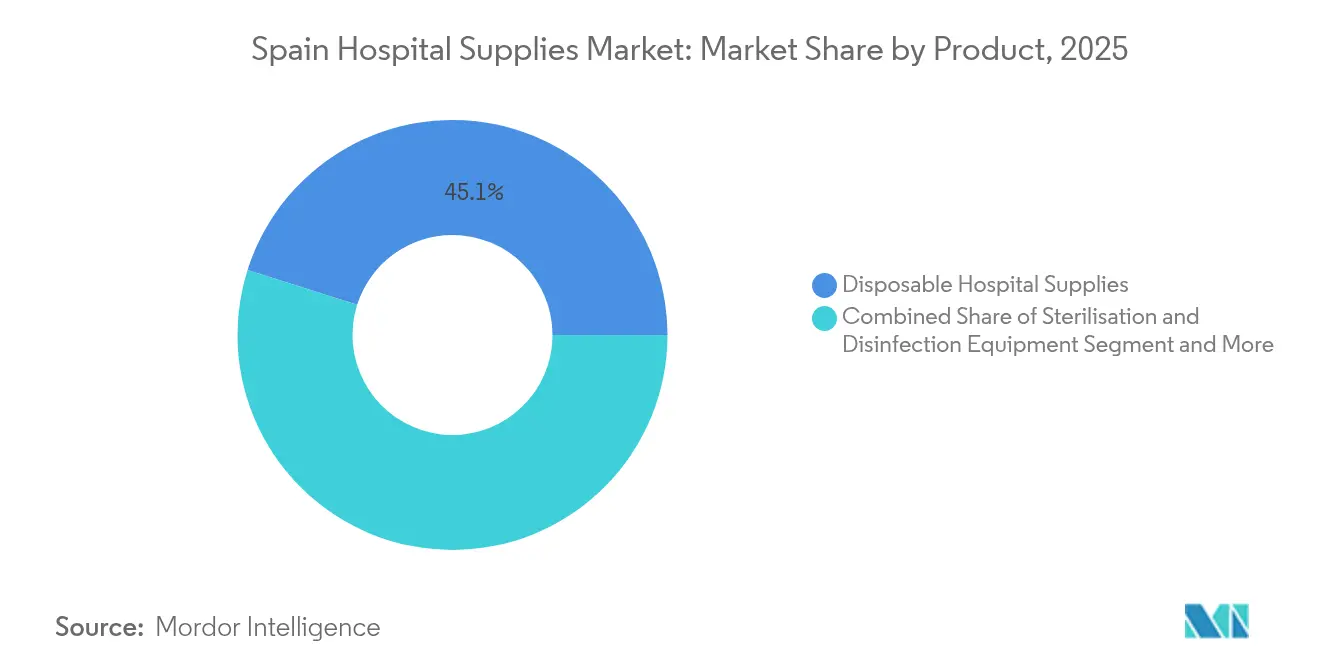
- By product, disposable hospital supplies held 45.12% of Spain hospital supplies market share in 2025; sterilisation and disinfection equipment is projected to register the fastest 7.56% CAGR to 2031.
- By end-user facility, public hospitals commanded 62.10% of the Spain hospital supplies market size in 2025, while private hospitals are expanding the quickest at a 6.76% CAGR through 2031.
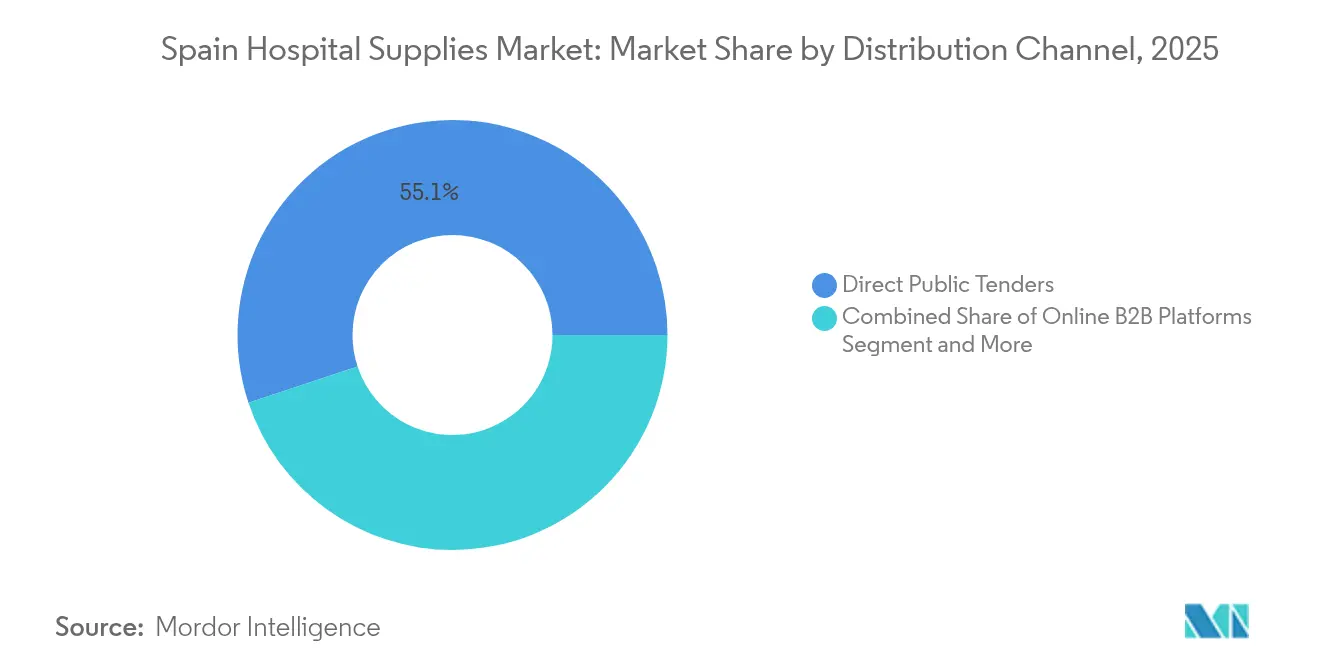
- By distribution channel, direct public tenders retained 55.10% share in 2025; online B2B platforms are set to grow at a 9.69% CAGR on the back of mandatory e-invoicing legislation.
Note: Market size and forecast figures in this report are generated using Mordor Intelligence’s proprietary estimation framework, updated with the latest available data and insights as of 2026.
Spain Hospital Supplies Market Trends and Insights
Drivers Impact Analysis*
| Driver | (~) % Impact on CAGR Forecast | Geographic Relevance | Impact Timeline |
|---|---|---|---|
| Rising incidence of infectious & chronic diseases | +1.2% | National, urban centres | Medium term (2-4 years) |
| Growing awareness of hospital-acquired infections | +0.8% | National, acute-care facilities | Short term (≤ 2 years) |
| Rapidly ageing Spanish population | +1.5% | National, rural weight | Long term (≥ 4 years) |
| Digitalised public procurement accelerating fulfilment | +0.6% | National, regional governments | Medium term (2-4 years) |
| EU RRF funds modernising hospital infrastructure | +0.9% | National, underserved areas | Short term (≤ 2 years) |
| Domestic single-use plastics capacity expansions | +0.4% | Catalonia & Valencia | Medium term (2-4 years) |
| Source: Mordor Intelligence | |||
Rising Incidence of Infectious & Chronic Diseases
Surveillance data show that 7.1% of EU hospital patients experience healthcare-associated infections, with respiratory conditions at the forefront[1]. Spain’s universal health system guarantees treatment for those cases, translating into predictable bulk procurement of diagnostic kits, sterile consumables and respiratory support devices. The 2024 Universal Health-Care Bill extended coverage to temporary residents and asylum seekers, widening the beneficiary pool. As hospitals integrate chronic-care and infection-control pathways, suppliers benefit from bundled tenders that combine disposables with automated sterilisation units, while analytics-enabled devices support longitudinal disease management across inpatient and outpatient settings.
Growing Awareness of Hospital-Acquired Infections
An estimated 3.5 million HAI cases and more than 90,000 related deaths occur annually across the EU, up to half of which are preventable through stronger infection-control practices. Spanish hospitals respond by favouring CE-marked single-use devices and traceable sterilisation systems that comply with MDR post-market surveillance rules. Tender specifications increasingly reference antimicrobial surfaces and closed-system drug-transfer solutions, rewarding vendors that certify ISO-compliant clean-room manufacturing. As procurement teams quantify the cost of outbreak containment versus up-front product premiums, infection-control portfolios gain strategic weight.
Rapidly Ageing Spanish Population
Citizens over 90 years old reached 608,321 by 2023, a 58.29% jump in a decade. Ageing prompts steady demand for wound-management dressings, mobility aids and implantable devices. The European Central Bank projects ageing-related fiscal costs in Spain to rise by 7 percentage points of GDP by 2070, the highest in the euro area. Hospitals must therefore retrofit wards for geriatric care, install low-height beds and adopt remote monitoring to reduce readmissions, creating multi-year equipment replacement cycles that favour suppliers with modular, upgrade-ready systems.
Digitalised Public Procurement Accelerating Fulfilment
Spain’s FACe e-invoicing hub now processes more than 12 million invoices per year, while Law 18/2022 obliges companies above EUR 8 million revenue to issue electronic bills within one year of regulatory approval. The Plataforma de Contratación del Sector Público provides real-time tender notices, shrinking quotation lead times. This digitisation accelerates replenishment of frequently-used disposables, encourages smaller firms to bid nationwide, and underpins the 9.85% CAGR forecast for online B2B platforms.
Restraints Impact Analysis*
| Restraint | (~) % Impact on CAGR Forecast | Geographic Relevance | Impact Timeline |
|---|---|---|---|
| Stringent regulatory framework | –0.7% | Nationwide, EU compliance | Long term (≥ 4 years) |
| Shift toward home-care services | –0.5% | Urban hubs | Medium term (2-4 years) |
| EU plastic-tax driven input-cost volatility | –0.3% | National, packaging items | Short term (≤ 2 years) |
| Fragmented regional-budget procurement cycles | –0.4% | 17 autonomous communities | Medium term (2-4 years) |
| Source: Mordor Intelligence | |||
Stringent Regulatory Framework
The MDR requires legacy devices to align with updated quality-management standards by May 2024, while transitional grace periods run no later than December 2028. Spain’s AEMPS further obliges in-country registration of all medical devices and mandates supply-interruption notifications under Regulation (EU) 2024/1860. Smaller manufacturers face high compliance costs for risk-based classification, unique-device identification labelling and periodic safety-update reports. Consequently, distributors consolidate their portfolios around MDR-approved products, potentially narrowing brand choice and lengthening market-entry timelines for innovative SMEs.
Shift Toward Home-Care Services
Policy makers and patients increasingly favour home-based chronic-disease management to alleviate hospital bed shortages. The InCARE study shows Spain’s long-term-care model emphasises personal autonomy, with family caregivers playing a critical role[2]. Funds earmarked for telehealth and remote-monitoring pilots reduce certain procedure volumes within hospitals, dampening demand for selected inpatient consumables. Suppliers aiming to offset this trend tailor kits for domiciliary infusion, wound care and portable diagnostics.
*Our forecasts treat driver/restraint impacts as directional, not additive. The impact forecasts reflect baseline growth, mix effects, and variable interactions.
Segment Analysis
By Product: Disposables Drive Infection-Control Priorities
Disposable hospital supplies accounted for 45.12% of Spain hospital supplies market share in 2025, reflecting persistent emphasis on single-use safety protocols. Sterilisation and disinfection equipment, posting a 7.56% CAGR to 2031, benefits from rising HAI awareness and MDR traceability rules. The Spain hospital supplies market size for sterilisation systems is projected to expand steadily as hospitals upgrade to low-temperature and hydrogen-peroxide units that protect heat-sensitive devices.
Operating-room equipment and diagnostic instruments continue to receive budget allocations tied to Recovery Plan grants, while syringe and needle specifications evolve following ophthalmology safety alerts on silicone-oil droplets. Suppliers of CE-marked micro-volume syringes with zero residual volume capture niche but high-value orders.

By End-User Facility: Public Hospitals Anchor Demand
Public facilities represented 62.10% of Spain hospital supplies market size in 2025, mirroring the tax-funded Sistema Nacional de Salud’s nationwide reach. Procurement frameworks stipulate open, competitive tenders with multi-year supply contracts, providing volume stability but lower margin.
Private hospitals, though smaller, are forecast to grow 6.76% annually as investors target specialist care and medical tourism. Technology-heavy private clinics favour premium imaging, robotic-surgery and point-of-care testing devices to differentiate services, expanding addressable revenue pools for high-capability vendors.
By Distribution Channel: Digital Transformation Accelerates
Direct public tenders controlled 55.10% of 2025 purchases, underpinned by obligatory use of the FACe and PLACE portals for invoice routing and contract publishing. Nonetheless, the Spain hospital supplies market is rapidly pivoting toward electronic catalogues, and online B2B platforms will post a 9.69% CAGR to 2031 as e-invoicing enforcement spreads to firms below the EUR 8 million threshold.
Group purchasing organisations pool demand for smaller clinics, while retail and community pharmacies fill urgent gaps for ambulatory care. Multinationals increasingly integrate ERP systems with public portals to automate order confirmation and shipment tracking, cutting average lead times from days to hours.
Geography Analysis
Spain is the EU’s fourth-largest public healthcare spender, committing USD 99 billion of public funds in 2025—7.4% of GDP—and a further USD 35 billion from private sources. Madrid, Catalonia and Valencia host the densest hospital networks and the majority of high-complexity referral centres. Urban hubs capture early deployments of AI-enabled endoscopy towers, closed-loop sterilisation and automated drug compounding, raising per-bed expenditure above the national average.
Rural regions face physician shortages and longer logistics chains, prompting a shift to mobile diagnostics and modular treatment units. Recovery Plan grants target these underserved areas with digital radiology vans, negative-pressure tent systems and tele-ICU platforms, expanding the Spain hospital supplies market while easing urban congestion.
Manufacturing clusters along the Mediterranean corridor enhance supply security. Facilities such as Essity’s Tarragona plant and QIAGEN’s QIAstat-Dx site in Barcelona shorten lead times for critical consumables and diagnostics. Port infrastructure in Valencia and Barcelona facilitates raw-material imports and finished-goods exports, positioning Spain as a potential distribution hub for southern Europe and northern Africa.
Regulatory Landscape
Spain regulates hospital supplies under the EU Medical Device Regulation (MDR 2017/745) and its national implementation through Real Decreto 192/2023, with AEMPS as the primary authority for medical devices and in vitro diagnostics (including registration, inspections, and post-market requirements). MDR transition milestones affect tender eligibility, labeling and UDI readiness, and ongoing technical documentation maintenance for legacy portfolios.
Regulatory attention has also turned toward supply security and more digital, standardized market administration. AEMPS launched RECOPS on June 15, 2026 as the application for registering commercialization of medical devices and IVDs, replacing prior communication systems and clarifying how manufacturers and distributors interact with the authority. In parallel, AEMPS published a 2025-2030 Supply Guarantee Plan to identify vulnerabilities and dependencies for strategic health products, while Real Decreto 664/2025 created an Interministerial Committee (2024-2028) linked to the Pharmaceutical Industry Strategy. Together with public procurement reform discussions, including the April 2026 draft modification of Order SND 682/2021 to expand centralized procurement mechanisms, these steps reinforce supply-chain resilience.
Competitive Landscape
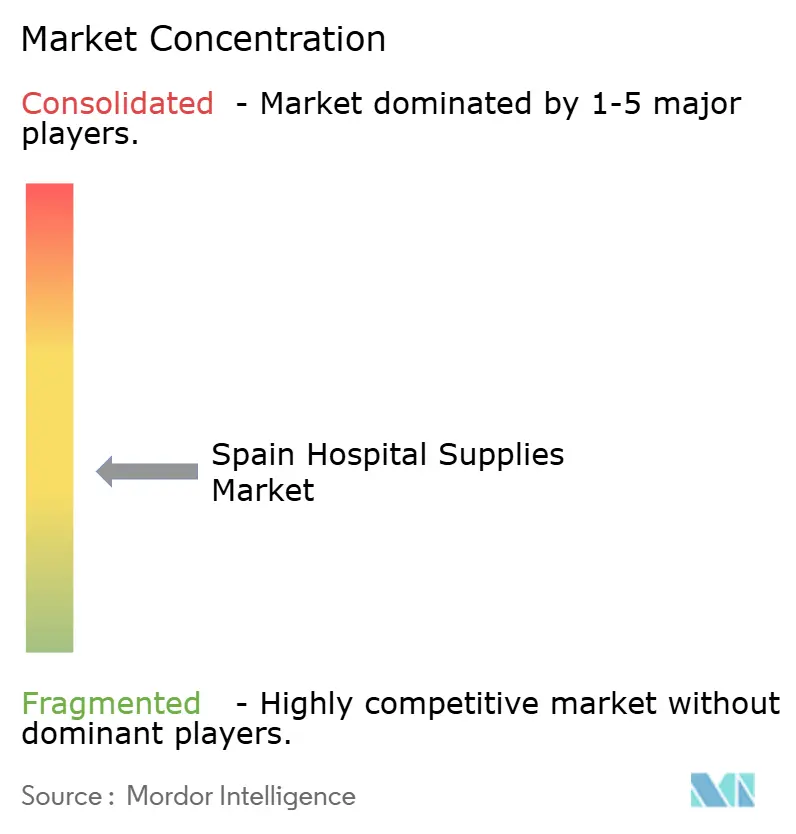
The Spain hospital supplies industry is moderately fragmented. Global groups—Solventum, B. Braun, Medtronic—leverage broad portfolios and MDR-compliant quality systems, securing framework agreements with regional health ministries. Domestic champions Grifols, Werfen and ROVI exploit deep clinician relationships and rapid service response; Grifols recorded EUR 7.212 billion revenue in 2024 and continues to expand immunoglobulin production capacity[3].
Recent strategies centre on digital supply-chain visibility and in-house sustainability programmes. Werfen’s EUR 20 million venture fund targets start-ups in rapid sepsis diagnosis, reinforcing its critical-care franchise. Essity deploys real-time OEE dashboards across its Spanish plants to cut downtime and plastic waste. Competitors are also tailoring product lines for home-care settings—portable suction units, wearable infusion pumps—to counter volume shifts away from inpatient wards.
Cross-border M&A remains active as MDR compliance expenses rise: private-equity interest in medium-sized Spanish manufacturers is growing, exemplified by ongoing speculation over a potential Brookfield offer for Grifols. Larger acquirers gain immediate CE-mark portfolios and established e-tendering credentials, while sellers gain the capital to fund next-generation R&D.
Spain Hospital Supplies Industry Leaders
-
Cardinal Health Inc.
-
Medtronic plc
-
B. Braun SE
-
GE HealthCare Technologies Inc.
-
Solventum Corporation
- *Disclaimer: Major Players sorted in no particular order
Market Opportunities and Future Outlook
Spain is creating new demand pockets for higher-spec hospital supplies through facility modernization, digital health infrastructure, and clearer market access rules for technology. Hospital Ascires Valencia opening in May 2026 after a EUR 125 million investment (with EUR 40 million allocated to advanced technology, including a hybrid OR with high-end imaging) and Hospiten announcing a 10-year partnership with Siemens Healthineers in April 2026 for Hospiten Madrid Boadilla, supported by a EUR 22 million investment for more than 25 diagnostic and therapy devices, point to where procurement budgets are moving. On the public side, the European Investment Bank approved a EUR 500 million loan in June 2026 to support modernization and expansion of the Basque Country hospital and primary care network, strengthening procurement pipelines for imaging, operating-room integration, sterilization, and digitally connected equipment.
Regulatory and data initiatives are also widening the compliance-enabled opportunity for suppliers focused on traceability, evidence generation, and interoperability. From May 28, 2026, Spain moved into mandatory use of the first four EUDAMED modules for medical devices, increasing the importance of UDI-ready labeling, master data quality, and distributor and manufacturer processes that support registrations and vigilance. In May 2026, Royal Decree 415/2026 established a national Health Technology Assessment framework covering medical devices, diagnostics, and digital health tools, and Royal Decree 90/2026 (effective July 1, 2026) introduced a new selective financing regime for medical devices within the National Health System, updating reimbursement mechanics that had been largely unchanged since 2006. Alongside the National Health Data Space launched in January 2026 with an initial EUR 70 million allocation, these changes increase demand for data-generating devices, connected consumables logistics, and vendors able to submit clinical-economic dossiers and post-market evidence aligned to Spanish HTA and EU MDR requirements.
Recent Industry Developments
- July 2026: Introduced Omnipod 5 automated insulin delivery system in Spain, expanding access for type 1 diabetes patients aged 2 and older. The rollout broadens hospital-linked diabetes education channels and influences starter kits and consumables supply chains tied to endocrinology and pediatric pathways.
- June 2026: Introduced Integrated Solutions in Spain by B. Braun to support hospital ecosystem management, data integration, and cybersecurity. The program signals a move toward digitally integrated procurement and operations, aligning suppliers with hospital priorities around interoperability and workflow efficiency.
- October 2025: Expanded capacity at the Rubi production center for surgical sutures to scale output and deepen manufacturing capabilities in Spain. Added local capacity strengthens supply continuity for high-volume consumables frequently purchased through public tenders and multi-year framework agreements.
Research Methodology Framework and Report Scope
Market Definition and Coverage
This market covers the value of products that hospitals in Spain procure and use to examine, treat, move, and protect patients, along with items used by clinical staff during routine care and procedures.
Scope exclusions: Home-use medical products and most outpatient-only clinic supplies are excluded unless the same items are routinely purchased for hospital wards and operating rooms.
Segmentation Overview
- By Product
- Patient Examination Devices
- Operating-Room Equipment
- Mobility Aids & Transport Equipment
- Sterilisation & Disinfection Equipment
- Disposable Hospital Supplies
- Syringes & Needles
- Other Products
- By End-User Facility
- Public Hospitals
- Private Hospitals
- Specialised Clinics
- Diagnostic & Imaging Centres
- By Distribution Channel
- Direct Public Tenders
- Group-Purchasing Organisations (GPOs)
- Online B2B Platforms
- Retail & Community Pharmacies
Data Sources, Market Sizing, and Validation
Desk Research
Desk research was used to pin down the demand pool in Spain and to avoid mixing hospital procurement with retail healthcare spending. We leaned on public sources such as Spain Ministry of Health publications, Instituto Nacional de Estadistica healthcare and population tables, Eurostat health expenditure series, and OECD health statistics to understand activity levels that drive supply consumption.
To keep the supply side grounded, we reviewed sources such as the Spanish public procurement portal and EU tender databases for purchasing patterns, along with customs and trade statistics for import intensity of key categories. Company annual reports, investor presentations, association websites, and reputable press were also used to sense-check product mix changes and pricing direction. In a few places, we used paid subscriptions for company financial intelligence and for shipment and tender tracking where public records were not detailed enough. These desk sources are illustrative rather than exhaustive, since we reviewed many other public documents for data collection, validation, and clarification.
Primary Interviews and Surveys
Primary work centered on interviews and structured surveys with procurement, nursing, infection control, and operations contacts, plus distributors and product specialists who support hospital buying decisions. For a Spain-specific market, we ensured coverage across public and private settings, then used respondent input to fill pricing gaps, confirm replacement cycles, and validate category splits that were only partly visible in desk sources.
Distribution of primary research fieldwork respondents
| Company type | Respondent position |
|---|---|
| Top tier: 32% | CXOs: 19% |
| Mid tier: 49% | Functional/Unit leaders: 28% |
| Smaller Players: 19% | Managers: 53% |
Market-Sizing & Forecasting
Sizing started with a top-down build that reconstructs hospital supplies demand from Spain healthcare activity and procurement signals, and then maps that demand into product categories that are routinely bought by hospitals. Inputs that were tracked include hospital admissions and inpatient days, surgical procedure volumes, infection prevention intensity (which shifts sterilization and disposable usage), bed capacity changes, and public tender award patterns that indicate mix and purchasing cadence.
Once the demand pool was shaped, results were corroborated with selective bottom-up approximations, such as sampled unit pricing times estimated volumes for high-usage consumables, plus channel checks with distributors to validate typical annual purchasing for major hospital groups. Where unit data was missing for smaller categories, gaps were handled by using proportional shares from similar hospitals, then tightening the shares through primary feedback. For forecasting, scenario analysis was applied around elective procedure recovery, inflation in medical consumables, and procurement cycles, and the assumptions were cross-checked with what respondents expected for ordering frequency and budget pressure.
Data Validation & Update Cycle
Validation was done by triangulating the modeled totals against independent signals, including healthcare activity trends, tender intensity, and import dependence for categories that are largely sourced from outside Spain. Large variances were flagged, and then assumptions were rechecked at the input level before moving to a second analyst review and final sign-off.
The report is refreshed annually, and interim updates are made when there are material events such as policy changes, procurement shocks, or sharp price movements in high-share consumables. Before delivery, we run a final update pass so the numbers reflect the latest available public data and the most recent primary feedback.
Mordor Intelligence's Spain Hospital Supplies Market Size Measured Against Other Published Estimates
Published market sizes for Spain hospital supplies often vary because sources do not always count the same buying channels, product families, and care settings, and they also pick different base years. In practice, the split between hospital-only purchasing and broader healthcare spending is the point where many totals start to drift.
Retail and community pharmacy sales of consumer health items are the most common add-on, and those items sit outside Mordor Intelligence's scope even if they look similar to hospital consumables in name. Differences can also come from whether public tenders are treated as the anchor for volumes, how price inflation is applied across disposable supplies versus durable equipment, and how currency timing is handled when imports are used as a proxy. Update cadence matters too, because a model that does not refresh procedure and procurement signals can keep older mix assumptions for longer than it should.
Benchmark comparison
| Source | Market Size | Gaps in Research Methodology |
|---|---|---|
| Mordor Intelligence | USD 2.84 B (2025) | |
| Global Consultancy A | USD 2.68 B (2024) | Uses an earlier base year and mixes historical and forecast windows differently, which can shift implied pricing and procedure normalization after the base year. |
| Industry Publisher B | USD 4.80 B (2026) | Leans toward a narrower public-hospital procurement lens for selected consumables and then reports a later-year point estimate, which can inflate the apparent level when compared to a base-year view. |
The spread across sources is mainly explained by what gets counted as hospital purchasing versus broader healthcare retail, plus the year used for the headline figure. When the scope is kept tied to hospital procurement signals and then cross-checked with activity and tender indicators, the market total stays easier to reproduce and to monitor over time.
Key Questions Answered in the Report
What is the current value of Spain hospital supplies and how fast is it growing?
Spending reached USD 3.01 billion in 2026 and is projected to advance to USD 3.99 billion by 2031 at a 5.83% CAGR over 2026-2031.
Which product segment generates the most revenue in Spain hospital supplies?
Disposable hospital supplies lead with 45.12% share, driven by strict infection-control protocols in public and private facilities.
How large is the role of Spain's public hospitals in overall purchasing?
Public facilities account for 62.10% of national procurement, ensuring steady tender volumes through the tax-funded Sistema Nacional de Salud.
Why are online B2B platforms expanding so quickly in Spain hospital supplies?
Mandatory e-invoicing and centralized portals such as FACe simplify bidding and payment, supporting a 9.69% CAGR for digital channels through 2031.
What impact does the EU plastic tax have on Spain hospital supplies?
The EUR 0.45/kg levy increases packaging costs, but medical-device exemptions soften the blow for single-use items while spurring eco-design shifts.
Which regional investments are shaping future supply capacity?
Projects like Essity's EUR 24 million Tarragona line and QIAGEN's new Barcelona diagnostics site boost domestic output and shorten delivery times.