
Market Overview
| Study Period | 2021 - 2031 |
|---|---|
| Forecast Data Period | 2026 - 2031 |
| Base Year Market Size (2025) | 37.21 gigawatt |
| Market Volume (2026) | 42.84 gigawatt |
| Market Volume (2031) | 86.63 gigawatt |
| Growth Rate (2026 - 2031) | 15.12 % |
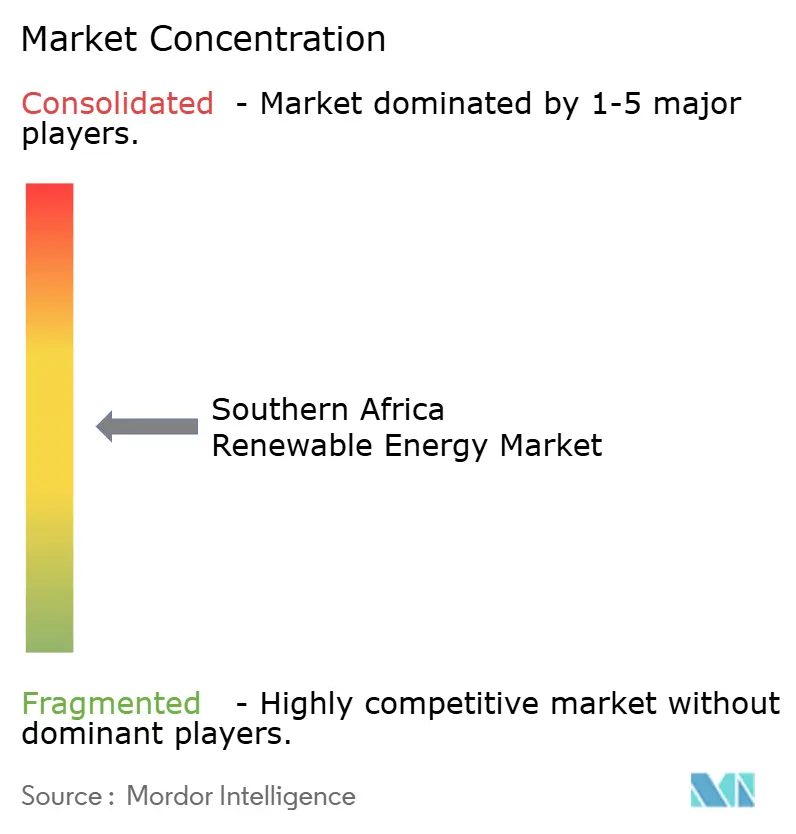
| Market Concentration | Medium |
Major Players *Disclaimer: Major Players sorted in no particular order Image © Mordor Intelligence. Reuse requires attribution under CC BY 4.0. | |
Southern Africa Renewable Energy Market Analysis by Mordor Intelligence
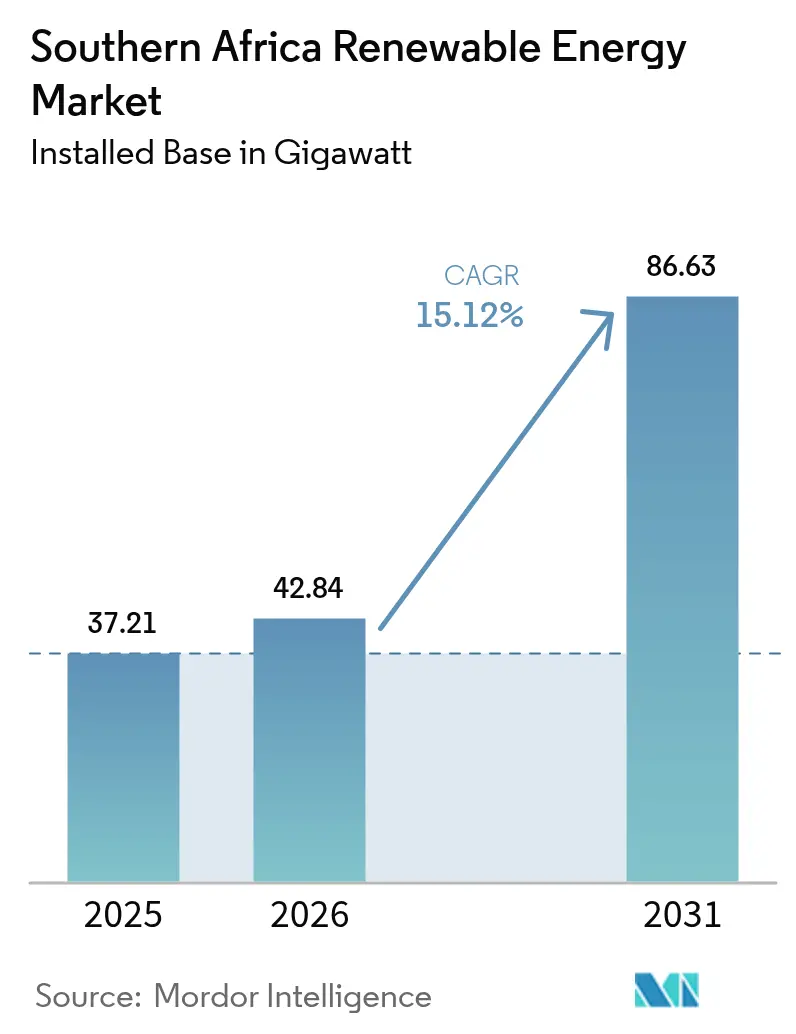
The Southern Africa Renewable Energy Market size was valued at 37.21 gigawatt in 2025 and estimated to grow from 42.84 gigawatt in 2026 to reach 86.63 gigawatt by 2031, at a CAGR of 15.12% during the forecast period (2026-2031).
Falling levelized costs for solar photovoltaic and onshore wind, combined with Eskom’s 36% tariff increase for 2025/26, are making self-generation projects economically viable for mines, manufacturers, and commercial property owners. The Electricity Regulation Amendment Act, signed in August 2024, unbundled Eskom’s transmission arm and authorized third-party wheeling, opening the grid to competitive procurement.[1] Bid Window 7 of the Renewable Energy Independent Power Producer Procurement Program (REIPPPP) awarded 1,760 MW of utility-scale solar at a record ZAR 0.47 per kWh, while Battery Energy Storage IPP Procurement Program (BESIPPPP) Bid Window 2 allocated 615 MW of four-hour systems to firm evening peaks. Angola, Zambia, and the Democratic Republic of Congo are scaling hydropower, and Namibia’s USD 10 billion Hyphen green-hydrogen project is catalyzing a second wave of gigawatt-scale renewables.
Key Report Takeaways
- By technology, hydropower held 61.25% of the Southern Africa renewable energy market share in 2025, whereas wind is forecast to record a 24.35% CAGR to 2031
- By end-user, utilities commanded 51.62% of deployment in 2025; commercial and industrial installations are projected to expand at a 20.15% CAGR through 2031
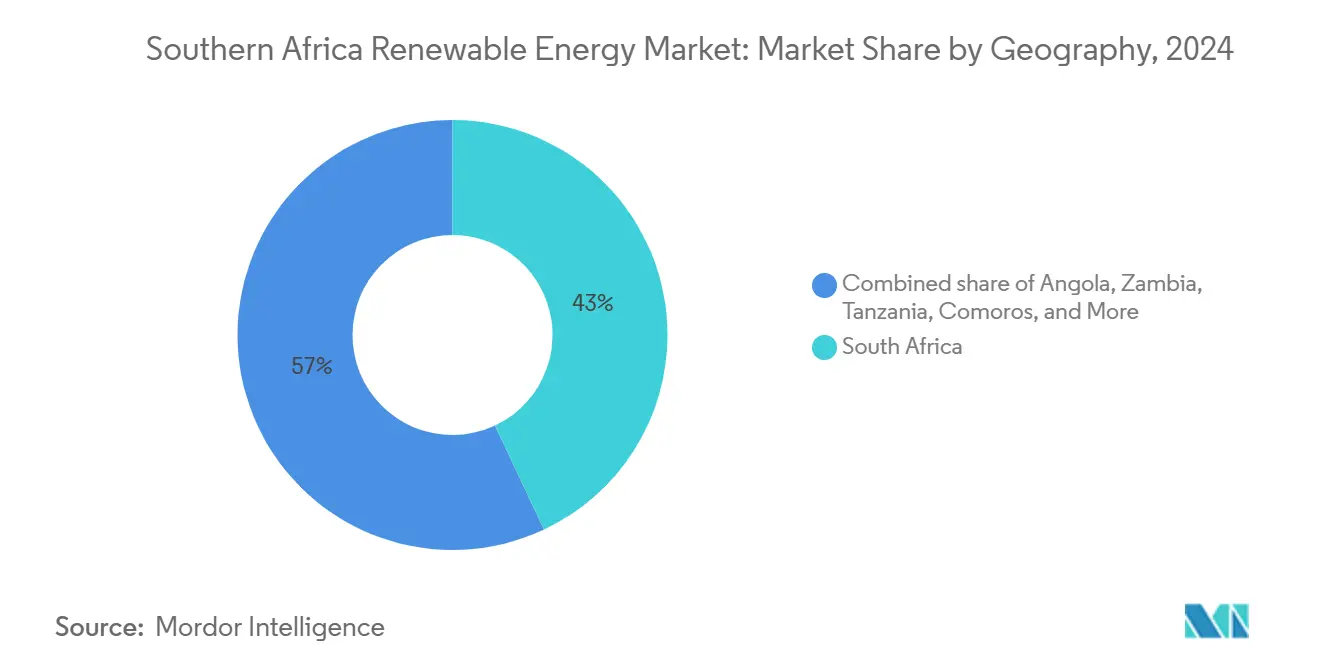
- By geography, South Africa captured 42.35% of capacity in 2025, while Comoros is expected to post a 51.02% CAGR during 2026-2031.
Note: Market size and forecast figures in this report are generated using Mordor Intelligence’s proprietary estimation framework, updated with the latest available data and insights as of 2026.
Market Trends and Insights
Drivers Impact Analysis of Southern Africa Renewable Energy Market*
| Driver | (~) % Impact on CAGR Forecast | Geographic Relevance | Impact Timeline |
|---|---|---|---|
| Declining LCOE for solar & wind | +3.2% | South Africa, Namibia, Botswana | Medium term (2-4 years) |
| Escalating Eskom tariffs & load-shedding risk | +4.1% | South Africa, regional SAPP members | Short term (≤ 2 years) |
| REIPPPP & new Renewable Energy Masterplan (SAREM) | +2.8% | South Africa | Medium term (2-4 years) |
| Surge in corporate PPAs & wheeling frameworks | +2.6% | South Africa, Zimbabwe, Zambia | Short term (≤ 2 years) |
| Green-hydrogen export corridors (Namibia, SA Northern Cape) | +1.9% | Namibia, South Africa (Northern Cape) | Long term (≥ 4 years) |
| Monetisation of carbon markets & EU-CBAM avoidance | +1.7% | South Africa, Mozambique (aluminum exports) | Medium term (2-4 years) |
| Source: Mordor Intelligence | |||
Declining LCOE for Solar & Wind
Module oversupply from Asian manufacturers lowered utility-scale solar tariffs below USD 0.03 per kWh in the Northern Cape by late 2024, well under Eskom’s average generation cost of ZAR 1.48 per kWh.[2] JinkoSolar and First Solar supplied Bid Window 7 projects at prices 22% below 2022 benchmarks, enabling sub-ZAR 0.50 per kWh twenty-year power purchase agreements. Onshore wind LCOE in the Eastern Cape approached USD 0.04 per kWh, yet logistics bottlenecks and grid delays left wind bids 18% costlier than solar, resulting in zero wind allocations in Bid Window 7. Namibia’s Hyphen project secured a blended renewables tariff of USD 0.025 per kWh for its 7 GW portfolio, establishing a regional floor and signaling future price compression. Coupling four-hour batteries with solar now provides dispatchable capacity at roughly USD 0.06 per kWh, eroding the economics of coal peakers and supporting Eskom’s just-transition schedule.
Escalating Eskom Tariffs & Load-Shedding Risk
NERSA’s 36% tariff hike raises the average industrial power cost above ZAR 2.20 per kWh in 2025/26, reducing the payback period for rooftop solar arrays larger than 500 kW to below four years.[3] Stage 6 load-shedding persisted for 78 days in 2024, prompting mining majors to contract more than 200 MW of captive solar-plus-storage systems. The Electricity Regulation Amendment Act allows private transmission investment and wheeling, enabling corporate buyers in Gauteng to source Northern Cape renewables without Eskom as an intermediary. This reform is expected to reduce Eskom’s generation share below 60% by 2030, transitioning the utility toward a pure transmission-system-operator role. Multilateral lenders are linking concessional finance to accelerated grid upgrades, tying future disbursements to measurable reductions in unserved energy.
REIPPPP & South African Renewable Energy Masterplan
Bid Window 7 attracted ZAR 31.4 billion in solar investment and achieved a 12% tariff reduction compared to the previous round. The 2024 master plan targets 20 GW of new renewables by 2030; however, transmission planning lags behind procurement by up to two years, resulting in 1.2 GW of capacity being stranded in the Northern Cape. BESIPPPP Bid Window 2 added 615 MW of storage with a mandatory four-hour duration to firm evening peaks at a combined capital cost of ZAR 12.8 billion. Local-content rules, which require 40% for solar modules and 45% for wind towers, favor vertically integrated developers such as BioTherm and Distributed Power Africa, although compliance increases capex by 8-12%. Achieving the master plan’s 2.5 GW annual procurement goal will stretch NERSA’s approval capacity and Eskom’s grid integration resources.
Surge in Corporate PPAs & Wheeling Frameworks
Finalized in May 2025, NERSA’s wheeling tariff of ZAR 0.12 per kWh enables third-party use of Eskom’s network and underpins over 800 MW of corporate PPAs signed in 2024. Mining, manufacturing, and data-center operators led adoption as bilateral PPA prices settled around ZAR 0.45 per kWh—below prevailing industrial tariffs. Virtual wheeling platforms aggregate surplus rooftop solar and transfer certificates to industrial off-takers, cutting renewable-energy certificate costs by 15%. Zambia and Zimbabwe are drafting similar frameworks; Zambia’s regulator expects implementation by Q3 2025 to unlock cross-border trade within the Southern African Power Pool. Lenders remain cautious and often require standby letters of credit, adding 50-75 basis points to financing spreads.
Restraints Impact Analysis of Southern Africa Renewable Energy Market*
| Restraint | (~) % Impact on CAGR Forecast | Geographic Relevance | Impact Timeline |
|---|---|---|---|
| Transmission bottlenecks in Cape & Namibia corridors | -2.4% | South Africa (Northern, Western, Eastern Cape), Namibia | Short term (≤ 2 years) |
| Wind-specific site scarcity & auction failures | -1.3% | South Africa (Eastern Cape, Western Cape) | Medium term (2-4 years) |
| Currency & sovereign-credit risk deterring project finance | -1.8% | South Africa, Angola, Zambia | Medium term (2-4 years) |
| Skills gap for utility-scale BESS & O&M | -0.9% | Regional, concentrated in South Africa | Short term (≤ 2 years) |
| Source: Mordor Intelligence | |||
Transmission Bottlenecks in Cape & Namibia Corridors
Northern Cape lines operate at 92% utilization, curtailing 180 gigawatt-hours (GWh) per year and delaying grid connections by up to 18 months. Eskom deferred the ZAR 4.5 billion Aries–Kronos upgrade due to liquidity constraints, leaving 1.2 GW of awarded projects stranded. NamPower’s Kokerboom–Gerus backbone can absorb only 800 MW of additional injections, yet Hyphen alone needs 2.5 GW of export capacity.[4] Private-sector interest exists, but cost-recovery and wheeling-tariff pass-through remain unclear, stalling financial close on the first independent transmission projects. Developers are co-locating batteries to shift output into off-peak transmission windows, adding USD 150-200 per kW to capital expenditures (capex) and trimming equity returns by up to 2 percentage points.
Wind-Specific Site Scarcity & Auction Failures
Bid Window 7 received no wind bids owing to port logistics, limited high-wind sites near grid access, and elevated turbine transport costs. Environmental assessments for wind projects now average 24 months, due to stricter avian-collision studies, which is double the timeline for solar projects. Offshore wind remains in early study phases; 17 GW of technical potential along the Western Cape lacks seabed lease rules or port infrastructure, pushing the first commercial units beyond 2030. Developers are pivoting toward hybrid solar-wind-storage schemes that improve bankability but dilute the wind’s share. Bid Window 8 may introduce wind-specific carve-outs at higher tariff caps; however, any perceived subsidy could trigger a political backlash.
*Our forecasts treat driver/restraint impacts as directional, not additive. The impact forecasts reflect baseline growth, mix effects, and variable interactions.
Southern Africa Renewable Energy Market Segment Analysis
By Technology:
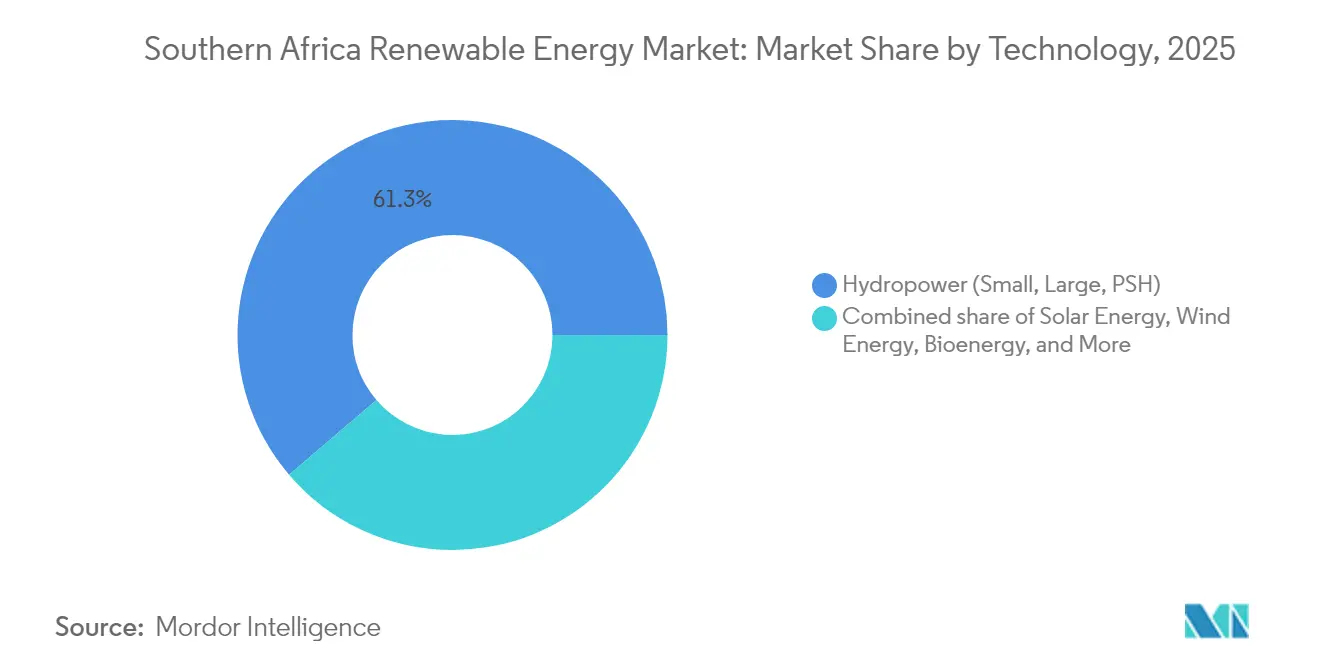
Hydropower Anchors, Wind SurgesHydropower dominated the Southern African renewable energy market, accounting for a 61.25% share in 2025, as legacy assets, such as Zambia’s Kariba and the Democratic Republic of Congo’s Inga complexes, continue to supply bulk power. Wind capacity is expected to post a 24.35% CAGR to 2031, the fastest among all technologies, supported by forthcoming REIPPPP carve-outs and expanding corporate PPAs. Solar, including photovoltaic and concentrated solar power, accounted for 28.60% of capacity in 2025; ACWA Power’s 420 MW Redstone plant with 12-hour molten-salt storage demonstrated solar’s dispatchable potential, a feature utilities favor for evening peaks. Bioenergy remains a niche market, accounting for less than 2% of capacity, primarily concentrated in South Africa’s sugarcane belt, where mills co-generate power from bagasse. Geothermal and ocean energy are still in the exploratory stage; Tanzania’s Rift Valley sites offer up to 5 GW of potential, but drilling costs of nearly USD 5 million per well dampen near-term prospects.
Developers anticipate that pumped-storage projects at Eskom’s Ingula and Drakensberg sites will contribute 1.4 GW to grid balancing by 2030, despite capital costs exceeding USD 2,000 per kW. Small hydropower projects under 10 MW are proliferating in Angola and Mozambique through donor finance, aiming to reach 300 MW by 2030. Wind’s upswing hinges on logistics solutions at Port Elizabeth and expedited environmental permits; hybrid solar-wind-storage plants are expected to win contracts as they diversify revenue streams. Ocean-energy pilot programs in Algoa Bay currently remain below commercial readiness levels, making material additions unlikely this decade. Overall, technology diversification is narrowing hydropower’s dominance and steering the Southern Africa renewable energy market toward a more balanced mix.

By End-User:
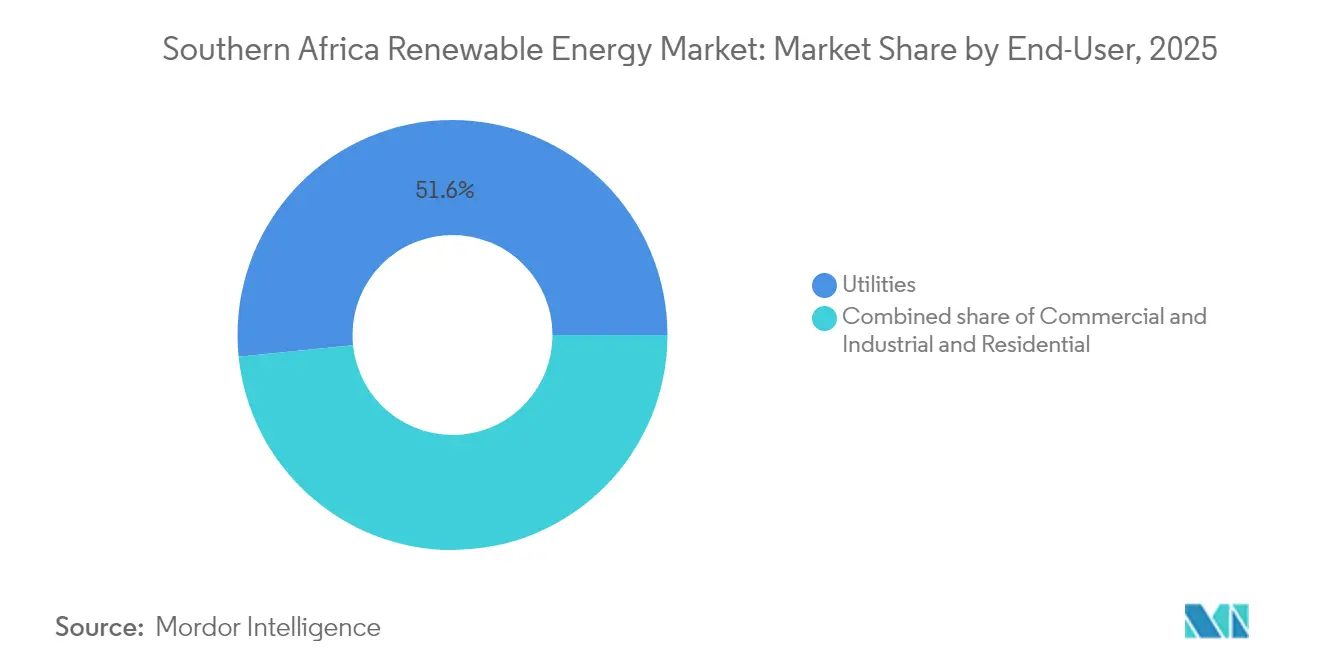
Utilities Anchor Capacity While C&I Demand SurgesUtilities accounted for 51.62% of capacity in 2025, reflecting the long-standing dominance of REIPPPP and BESIPPPP contracts feeding Eskom’s grid. Commercial and industrial (C&I) buyers are projected to log a 20.15% CAGR through 2031 as wheeling rules slash transaction costs and renewables hedge tariff volatility. Mining houses such as Anglo American and Sibanye-Stillwater have each signed PPAs exceeding 100 MW to secure power at a rate of under ZAR 0.50 per kWh. Retail chains Shoprite and Woolworths are rolling out more than 50 MW of rooftop solar, advancing toward their goal of 100% renewable electricity by 2028. Residential rooftop solar surpassed 1.5 GW in 2024, with battery attachment rates close to 40% in metropolitan areas.
C&I growth is concentrated in manufacturing, data centers, and retail centers that seek Scope 2 decarbonization under the Science-Based Targets initiative commitments. Virtual wheeling creates geographic arbitrage between high-irradiance generation zones and load centers, trimming delivered costs by 10-15%. M-Pesa-enabled pay-as-you-go solar continues to expand in lower-income urban and peri-urban households, though individual systems remain under 1 kW. Utilities’ market share is projected to slip below 45% by 2031 as distributed resources erode centralized dispatch models. The Southern African renewable energy market size for distributed generation is forecast to grow sixfold between 2026 and 2031 as regulatory barriers are removed.
Geography Analysis
Northern Cape and South Africa Renewable Energy Market
South Africa controlled 42.35% of capacity in 2025, underpinned by 7.2 GW procured through REIPPPP and a regulatory overhaul that enables third-party wheeling. The Northern Cape hosts 60% of South Africa’s utility-scale solar installations, thanks to irradiance levels above 2,200 kWh/m². However, grid connections now face an average wait of 18 months due to delayed transmission upgrades. Corporate PPAs totaling 800 MW were signed in 2024 at tariffs of nearly ZAR 0.45 per kWh, which is significantly lower than Eskom’s industrial rates. Green-hydrogen ambitions at Boegoebaai could absorb 3.5 GW of renewables and tighten module supplies for domestic markets. NERSA’s ZAR 0.12 per kWh wheeling tariff is expected to unlock 1.5 GW of rooftop solar by 2028.
Central, East and Southern Africa Renewable Energy Market
Angola, Zambia, and the Democratic Republic of Congo jointly hold roughly 35% of capacity, driven by hydropower in the Congo River basin. Angola’s Laúca expansion and Caculo Cabaça plant added 558 MW in 2024, boosting firm supply to the Southern African Power Pool. Zambia secured USD 150 million from the IFC to finance 500 MW of solar and small hydro projects, aimed at reducing its dependence on the drought-prone Kariba reservoir. Inga 3, a 4.8 GW extension in the Democratic Republic of the Congo, remains in a feasibility study, with the final investment decision pushed beyond 2026. Tanzania’s 300 MW Mwenga hydro and Mozambique’s 120 MW Mocuba solar asset advanced to construction in 2024 with AfDB and EIB backing.
Comoros Renewable Energy Market
Comoros, although accounting for less than 1% of the volume, is poised for a 51.02% CAGR as donor-funded mini-grids replace diesel at current costs of USD 0.40 per kWh. Botswana and Namibia are expanding utility-scale solar. Namibia’s Hyphen project alone will install 7 GW by 2030, potentially redirecting equipment away from South African demand. Zimbabwe’s 600 MW pipeline is hindered by foreign-exchange shortages and debt arrears, limiting near-term projects to sub-10 MW plants that sidestep multilateral guarantees. Cross-border trade via the Southern African Power Pool is rising as Mozambique’s Cahora Bassa exports 1.5 GW to South Africa under long-term contracts.
Regulatory Landscape
South Africa’s electricity-market reforms and regional trading rules are increasingly shaping renewable project development across Southern Africa. The Electricity Regulation Amendment Act (Act 38 of 2024) took effect from 1 January 2025 and establishes the operating framework for an open-market platform through a Transmission System Operator SOC Ltd, supporting third-party trading and wheeling alongside Eskom’s unbundled transmission function. Alongside this, the Integrated Resource Plan 2025 (gazetted in October 2025) lays out the strategic procurement framework for new generation capacity, linking utility-scale competitive procurement with industrial policy priorities.
Implementation details have also expanded for both utility-scale and distributed generation. In June 2025, South Africa introduced net-billing rules for prosumers, allowing export of surplus electricity based on NERSA-guided avoided energy cost valuations, which improves revenue visibility for embedded generation. In December 2025, grid capacity allocation rules were issued to manage scarcity and construction-start delays, which directly affects queue discipline for solar and wind projects in congested corridors. On trade and standards, SAPP has published new-entrant guidance and opened consultation on a generation and transmission master plan update. Separately, South Africa’s ITAC issued a July 2026 notice for public comment on preliminary designations for local procurement of solar panels, inverters, and trackers under the Public Procurement Act (Act 28 of 2024), which increases compliance expectations for EPC and equipment sourcing strategies.
Competitive Landscape
The Southern Africa renewable energy market is moderately fragmented; the top five developers, Scatec, EDF Renewables, Enel Green Power, ACWA Power, and BioTherm, control close to 40% of operating capacity. Vertical integration grants cost advantages; BioTherm and Distributed Power Africa qualify under 40% local-content mandates by sourcing towers and control panels from domestic suppliers, trimming import lead times by up to twelve weeks. Long-term supply agreements, such as Scatec’s module off-take with JinkoSolar and EDF’s turbine framework with Vestas, reduce exposure to component price swings.
White-space is growing in distributed generation and virtual wheeling, segments where Sola Group and Distributed Power Africa have aggregated portfolios exceeding 200 MW across 150 rooftops.[7] Battery integrators Pylontech South Africa and Freedom Won are capturing margin by bundling software that extends cell life beyond 6,000 cycles, a feature prized for long-duration contracts. Offshore wind remains a greenfield opportunity; more than 17 GW of Western Cape potential awaits seabed-lease and port-infrastructure frameworks, offering European turbine makers an opportunity to replicate the North Sea business model.
Regulatory compliance has become an entry barrier. Projects must meet the ISO 9001 quality management standard and the IEC 61215 photovoltaic standard to qualify for REIPPPP. Smaller independent developers lacking in-house certification often rely on third-party labs, which adds 3% to soft costs and extends the financial close by up to six weeks. As competition intensifies, long-tenor PPAs with investment-grade off-takers and blended-finance structures are key differentiators in securing capital at competitive rates.
Southern Africa Renewable Energy Industry Leaders
-
Scatec ASA
-
EDF Renewables
-
Enel Green Power SA
-
BTE Renewables
-
ACWA Power
- *Disclaimer: Major Players sorted in no particular order
Southern Africa Renewable Energy Market Companies Covered in this Report
- Scatec ASA
- EDF Renewables
- Enel Green Power South Africa
- BTE Renewables (BioTherm)
- ACWA Power
- JinkoSolar Holding Co. Ltd
- Vestas Wind Systems A/S
- Siemens Gamesa Renewable Energy SA
- Nordex SE
- First Solar Inc.
- Juwi AG
- Sola Group
- ABO Energy South Africa
- ACED ( African Clean Energy Developments)
- Pylontech South Africa
- Distributed Power Africa
- Freedom Won
- Eskom Renewable IPP Office
Market Opportunities and Future Outlook
Dispatchable renewables and hybridization are emerging as a specific whitespace as utilities and large off-takers look for firm evening capacity without adding fossil peakers. In July 2026, TotalEnergies inaugurated the Hydra project in South Africa’s Northern Cape, combining a 216 MW solar PV plant with a 500 MWh battery energy storage system, illustrating how solar-plus-storage is being positioned as firm capacity rather than only energy. This same configuration supports utility procurement and corporate PPAs where four-hour storage requirements are already present in South Africa’s BESS procurement, and where grid congestion in the Cape and Namibia corridors increases the value of co-located storage and more flexible delivery profiles.
Public programs and industrial corridors are also broadening demand beyond traditional IPP auctions. In July 2026, Zambia signed contracts with five consortiums to build 312 MW of solar across 156 constituencies under the Presidential Constituency Energy Initiative, expanding the addressable market for standardized multi-site delivery and O&M models. Namibia’s green-hydrogen industrialization push provides another pull factor for renewables, with the Namibian President holding high-level discussions with China National Chemical Engineering & Construction Corporation Seven (CC7) in July 2026 on a 3 GW green ammonia facility, reinforcing the scale of dedicated renewables required for export-oriented molecules. Regionally, SAPP continues to highlight cross-border coordination and transmission financing, with ministers meeting in Harare in July 2025 to discuss regional transmission infrastructure financing and renewable energy promotion, supporting opportunities connected to wheeling-compatible PPAs, grid services, and interconnector-ready project design.
Recent Industry Developments in Southern Africa Renewable Energy Market
- July 2026: TotalEnergies inaugurated the Hydra hybrid project in South Africa’s Northern Cape, combining a 216 MW solar PV plant with a 500 MWh battery energy storage system. The project configuration highlights the shift from energy-only renewables toward dispatchable supply profiles that can better match peak demand and procurement requirements. It also raises the bar for EPC capability and battery integration in utility-scale projects.
- June 2026: Enel Green Power South Africa brought the 330 MW Impofu wind farm cluster in the Eastern Cape into commercial operation. The assets supply power to Sasol and Air Liquide under long-term power purchase agreements, reinforcing the role of large corporate off-takers in underwriting new-build wind. The commissioning adds reference scale for bankable private PPAs in a market increasingly shaped by wheeling and bilateral contracting.
- May 2025: NERSA published final wheeling rules that set a ZAR 0.12 per kWh tariff for third-party use of Eskom’s network. This clarified a key cost component for corporate PPAs and virtual wheeling structures, improving transaction standardization for buyers sourcing renewables across provinces. The change supports broader participation by C&I off-takers that previously faced bespoke, higher-friction network access arrangements.
Southern Africa Renewable Energy Market Report Scope and Research Methodology
Market Definition and Coverage
This market is defined as renewable power generation capacity that is installed and connected across Southern Africa, measured in gigawatts, and covering solar, wind, hydropower, bioenergy, geothermal, and ocean energy.
Scope exclusions: We exclude fossil based generation and nuclear capacity, and we do not count projects that are only announced or planned until commissioning is evidenced.
Segments Covered in This Report
- By Technology
- Solar Energy (PV and CSP)
- Wind Energy (Onshore and Offshore)
- Hydropower (Small, Large, PSH)
- Bioenergy
- Geothermal
- Ocean Energy (Tidal and Wave)
- By End-User
- Utilities
- Commercial and Industrial
- Residential
- By Geography
- South Africa
- Namibia
- Zambia
- Mozambique
- Botswana
- Angola
- Zimbabwe
- Rest of Southern Africa
Data Sources, Market Sizing, and Validation
Desk Research
Desk research starts by building a clean view of how much renewable capacity exists today and what is officially expected to be added. We typically use public sources such as IRENA capacity statistics, IEA regional electricity datasets, World Bank energy indicators, and country energy regulator releases, which are then checked against utility planning documents.
To keep the model grounded in what can be built and connected, we also review sources such as national integrated resource plans, renewable procurement round announcements, grid connection updates, and tender portals. Company filings, investor presentations, and reputable regional press are used to confirm commissioning timelines and technology splits. Where available, we also use paid subscriptions for company financials and intelligence, news and financials, and global contracts and tenders to cross-check project pipelines and ownership changes. These desk research sources are illustrative, and many other public documents were also referred to for data collection, validation, and clarification.
Primary Interviews and Surveys
Primary work is used to test the desk view of what is operating versus what is delayed, and to confirm the practical drivers of new builds across the region. We speak with developers, utilities, EPC and O&M participants, grid and policy stakeholders, and large electricity users across key markets in Southern Africa so assumptions can be adjusted before totals are finalized.
Distribution of primary research fieldwork respondents
| Company type | Respondent position |
|---|---|
| Top tier: 37% | CXOs: 13% |
| Mid tier: 42% | Functional/Unit leaders: 40% |
| Smaller Players: 21% | Managers: 47% |
Market-Sizing & Forecasting
Our sizing is built from a top-down reconstruction of installed renewable capacity by country and technology, where public capacity series and official commissioning records are stitched together and then aligned to the study definition in gigawatts. Once totals are built, they are cross-checked using selective bottom-up approximations, such as sampled project capacity roll ups by technology, procurement award lists, and channel checks on typical commissioning lag.
Key inputs used to shape the model include announced versus awarded capacity in procurement rounds, grid connection readiness and curtailment signals, utility and regulator targets, technology specific utilization patterns, and the split between utility and behind-the-meter additions. Forecasting is done using scenario analysis, since policy cadence, permitting, and grid availability can shift timelines, and then expert feedback is used to set realistic buildout paths. Where bottom-up visibility is incomplete for smaller markets, gaps are handled through conservative pipeline conversion rates and then revalidated against country totals and target pathways.
Data Validation & Update Cycle
Validation happens in several passes so that obvious overcounts and timing errors are removed early. We compare outputs with independent signals like national capacity statements, procurement award volumes, and grid connection progress, and then outliers are investigated before sign-off.
A second analyst review is completed to check calculations, unit consistency, and whether assumptions stay consistent across countries and technologies. Reports are refreshed annually, with interim updates when major auctions, policy shifts, or commissioning waves materially change the outlook. Before delivery, a final pass is completed so clients receive an updated view that matches the latest public releases and interview learnings.
Mordor Intelligence's Southern Africa Renewable Energy Market Size Compared Against Other Published Estimates
Published estimates for Southern Africa renewable energy often differ because some sources size the market as revenue or investment, while others, like this study, size it as installed capacity, and these are not interchangeable. Differences also come from which countries are counted as Southern Africa and whether the count is limited to commissioned capacity or includes projects still in development.
The key gap drivers usually sit in treatment of pumped storage within hydropower, whether off-grid and behind-the-meter solar is counted consistently, and how delays are handled when procurement awards slip past the expected commissioning year. Currency conversion is not relevant when the unit is gigawatts, but refresh timing still matters because recent grid connections can change the current-year base quickly.
Benchmark comparison
| Source | Market Size | Gaps in Research Methodology |
|---|---|---|
| Mordor Intelligence | USD 37.21 B (2025) | |
| Industry Association A | USD 34.90 B (2025) | Often reported as a narrower installed-capacity count that excludes smaller behind-the-meter solar additions and may treat pumped storage separately, which lowers the total versus a full technology and end-user roll-up. |
| Global Consultancy B | USD 40.60 B (2025) | Frequently reflects an expanded definition that includes late-stage projects under construction or uses nameplate pipeline additions as if they are already commissioned, which pushes the current-year figure higher. |
The spread in the table is mainly explained by what gets counted as operating today, and by whether distributed solar and pumped storage are folded into the same total. When commissioning evidence and grid-connection status are used as the deciding tests, and when country coverage is kept consistent across the region, the current-year number becomes easier to reproduce, which is the approach applied by Mordor Intelligence.
Key Questions Answered in the Report
How fast is capacity in Southern Africa expected to grow through 2031?
Installed renewables should climb from 37.21 GW in 2025 to 86.63 GW in 2031, implying a 15.12% annual growth rate during the forecast period (2026-2031).
Which technology will add the most new capacity?
Onshore wind is projected to record the fastest expansion, rising at a 24.35% CAGR as corporate PPAs and future REIPPPP carve-outs unlock projects in the Eastern Cape and Namibia.
What role will green hydrogen play in future demand?
Namibia’s 7 GW Hyphen project and South Africa’s Boegoebaai corridor could absorb 12 GW of renewables by 2030, tightening supply of modules and turbines for domestic utility and C&I developers.
How do new wheeling rules change corporate procurement?
NERSA’s ZAR 0.12 per kWh wheeling tariff allows third-party use of Eskom lines, enabling firms in Gauteng and elsewhere to contract remote solar and wind power at prices about 15% below grid tariffs.
What is the main bottleneck limiting near-term additions?
Transmission congestion in the Northern Cape and Namibia corridors is curtailing output and delaying grid connections; upgrades worth more than ZAR 4.5 billion are still awaiting financial close.
Are currency risks manageable for foreign investors?
Partial-risk guarantees from IFC and AfDB cover up to 40% of exposure, but residual FX risk and sub-investment-grade sovereign ratings still push loan margins to SOFR + 450-550 bps.