
Market Overview
| Study Period | 2020 - 2031 |
|---|---|
| Forecast Data Period | 2026 - 2031 |
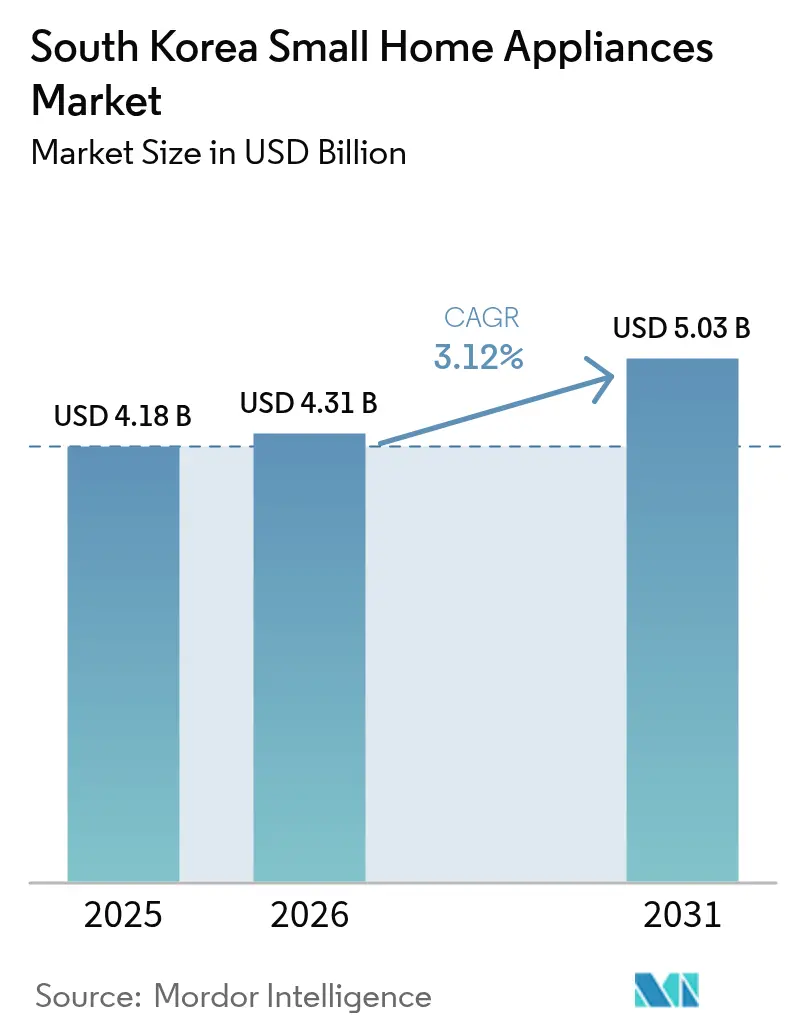
| Base Year Market Size (2025) | USD 4.18 Billion |
| Market Size (2026) | USD 4.31 Billion |
| Market Size (2031) | USD 5.03 Billion |
| Growth Rate (2026 - 2031) | 3.12 % |
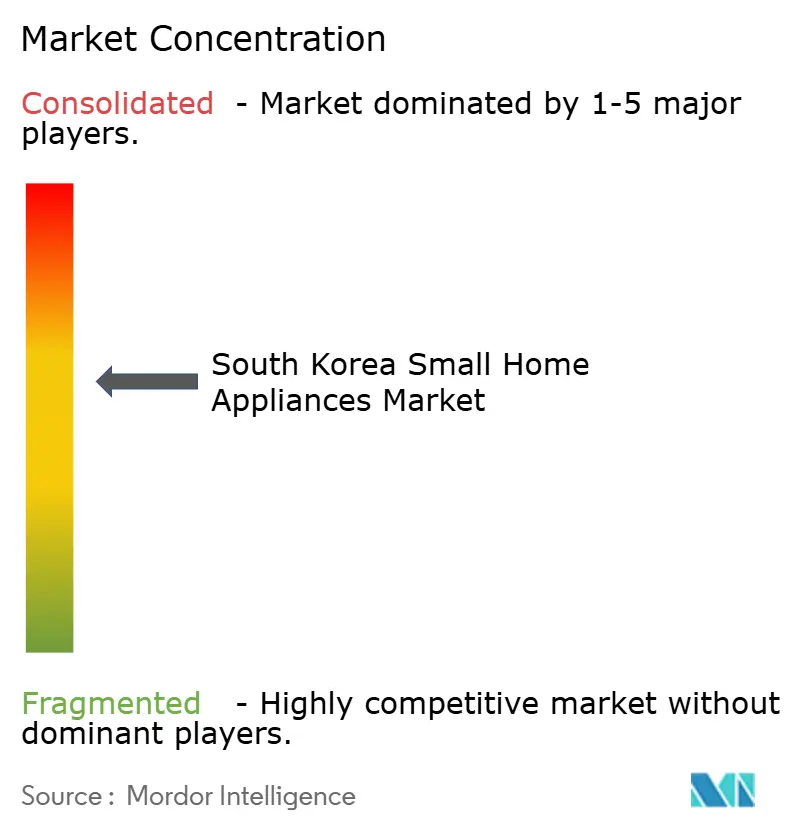
| Market Concentration | Medium |
Major Players *Disclaimer: Major Players sorted in no particular order Image © Mordor Intelligence. Reuse requires attribution under CC BY 4.0. | |
South Korea Small Home Appliances Market Analysis by Mordor Intelligence
South Korea small home appliance market size in 2026 is estimated at USD 4.31 billion, growing from 2025 value of USD 4.18 billion with 2031 projections showing USD 5.03 billion, growing at 3.12% CAGR over 2026-2031. Current growth is underpinned by rapid single-person household formation, premium appliance adoption, and accelerating smart-home integration, while economic headwinds and supply chain risks temper the overall trajectory. Robust government incentives for energy-efficient designs, surging demand for premium coffee equipment, and widening e-commerce penetration collectively foster healthy revenue expansion. At the same time, semiconductor supply volatility, household debt constraints, and fragmented rural service networks introduce structural challenges that manufacturers must navigate. Increasing ESG scrutiny and the rollout of standardized IoT protocols further compel brands to prioritize energy footprints and interoperability in future product roadmaps.
Key Report Takeaways
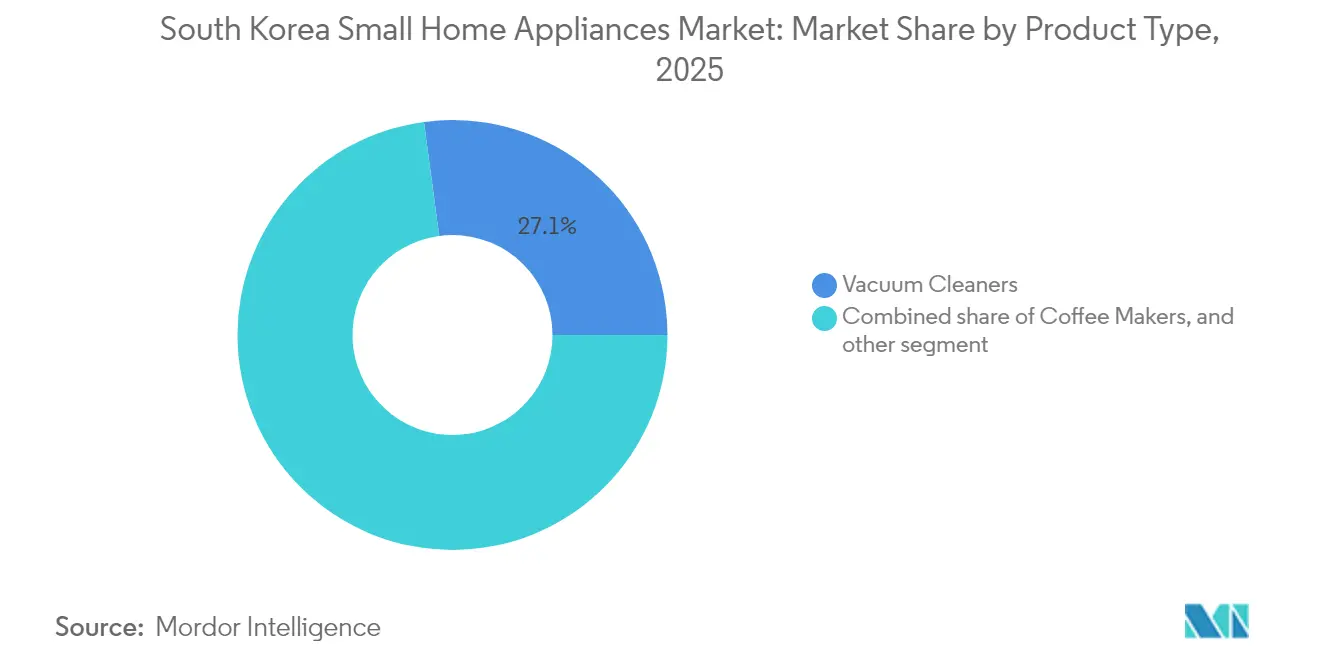
- By product type, vacuum cleaners led with 27.12% of the South Korea small home appliance market share in 2025; smart robotic models are forecast to advance at a 13.95% CAGR through 2031.
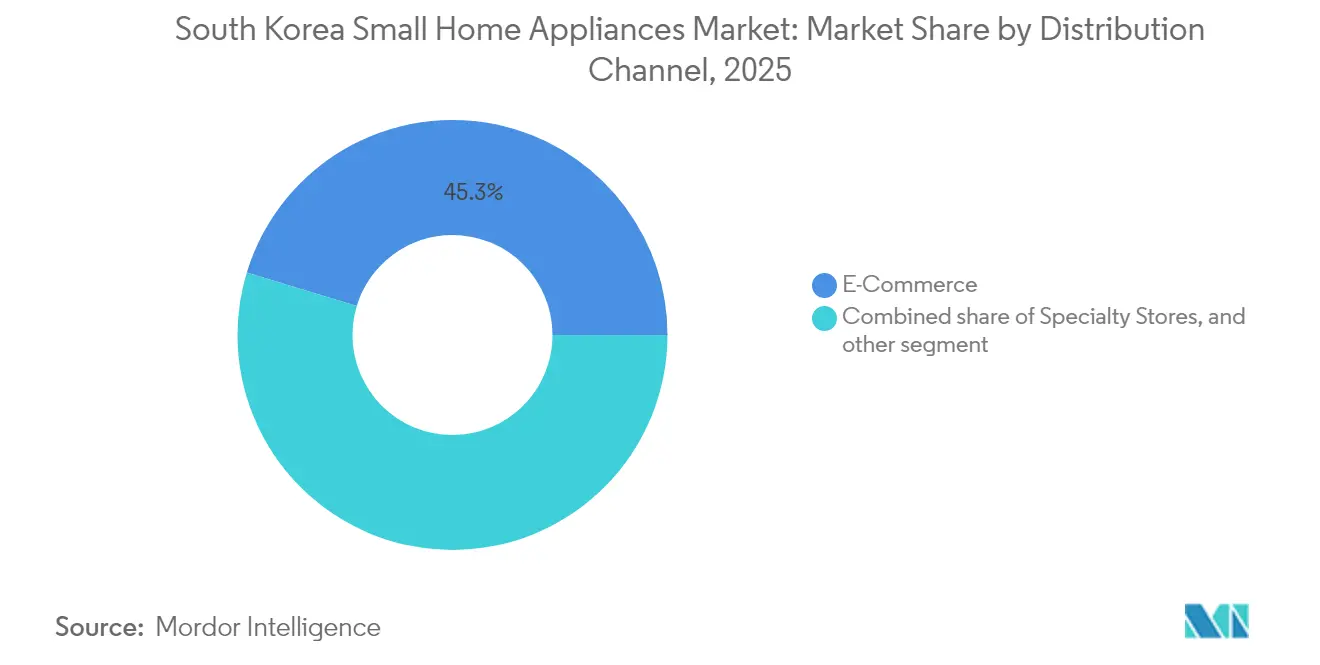
- By distribution channel, e-commerce accounted for 45.30% of the South Korea small home appliance market size in 2025 and is growing at a 15.05% CAGR toward 2031.
- By technology, energy-efficient appliances captured 46.70% of the South Korea small home appliance market size in 2025, while smart-connected units are expanding at a 15.60% CAGR to 2031.
- By geography, the Seoul Capital Area commanded 52.10% revenue share of the South Korea small home appliance market in 2025, whereas Jeju Province is projected to post an 11.05% CAGR between 2026-2031.
Note: Market size and forecast figures in this report are generated using Mordor Intelligence’s proprietary estimation framework, updated with the latest available data and insights as of 2026.
South Korea Small Home Appliances Market Trends and Insights
Drivers Impact Analysis*
| Driver | (~) % Impact on CAGR Forecast | Geographic Relevance | Impact Timeline |
|---|---|---|---|
| Proliferation of single-person households | +0.8% | Seoul Capital Area, major urban centres | Medium term (2-4 years) |
| Rising demand for premium coffee culture equipment | +0.5% | Seoul Capital Area, affluent urban areas | Short term (≤ 2 years) |
| Government subsidies for high-efficiency motors & inverters | +0.4% | National, metro focus | Medium term (2-4 years) |
| Growth of quick-commerce grocery platforms bundling appliances | +0.3% | Seoul Capital Area, secondary cities | Short term (≤ 2 years) |
| ESG-driven investor pressure on appliance energy footprints | +0.2% | National, early in Seoul & Busan | Long term (≥ 4 years) |
| Emergence of Korean smart-home ecosystems (Matter, Zigbee) | +0.3% | Seoul Capital Area, tech-forward homes | Medium term (2-4 years) |
| Source: Mordor Intelligence | |||
Proliferation of Single-Person Households
Single-person households reached 42% of all Korean households in 2024, totalling 9.93 million units, and this demographic now decisively shapes appliance demand[1]Min-sik Yoon, “Solo Living: A New Norm in Seoul,” The Korea Herald, koreaherald.com . Compact, multi-purpose designs gain traction because urban dwellers value space savings, illustrated by Samsung’s Bespoke AI Laundry Combo that combines wash-and-dry functions and cuts footprint. Elevated willingness to pay for automation fosters rapid uptake of smart vacuums and subscription-based services. Mobile-first shopping habits, over 60% of e-commerce transactions occur via phone, further streamline digital discovery, and reinforce e-commerce dominance[2]Bank of Korea, “Economic Outlook (May 2025),” bok.or.kr . As single residents often inhabit premium micro-apartments, they increasingly favour AI-enabled, energy-efficient appliances that integrate seamlessly into smart-home ecosystems.
Rising Demand for Premium Coffee Culture Equipment
The increasing annual coffee consumption among adults is driving significant investments in premium home-brewing equipment, reflecting a shift toward enhanced at-home coffee experiences. De’Longhi's Household division reported a 6.9% increase in revenue during Q2 2024, attributed primarily to the strong performance of its coffee device segment. This growth highlights the division's ability to capitalize on consumer demand within the coffee appliance market. Korean consumers exhibit notable price elasticity when quality enhancements are clear, gravitating to machines that automate grind sizing, pressure, and temperature. Connectivity remains pivotal because AI algorithms can replicate barista preferences, further elevating premium positioning.
Government Subsidies for High-Efficiency Motors & Inverters
In Q1 2024, Samsung's energy-efficient air conditioners achieved significant market penetration, supported by the Korea Energy Agency's regulatory and financial initiatives. The agency's mandatory 1-5 efficiency labeling system effectively removed low-performing models from the market, ensuring only high-efficiency products remain competitive. Simultaneously, the High-Efficiency Appliance Rebate program reduced acquisition costs, making energy-efficient appliances more accessible to consumers. Foreign manufacturers have also been encouraged to invest in local production facilities for inverter motors, driven by attractive incentives such as cash subsidies and seven-year tax exemptions. This strategic policy framework has reshaped consumer behavior, with energy efficiency ratings now serving as a critical determinant of product quality. As a result, brands dependent on conventional motor technologies are experiencing increased competitive pressure to innovate. This shift in market dynamics has led to heightened investments in research and development, particularly in advanced technologies like inverter compressors and BLDC motors, which are being integrated across diverse product portfolios to meet evolving consumer expectations and regulatory standards.
Growth of Quick-Commerce Grocery Platforms Bundling Appliances
Coupang's dominance in South Korea's e-commerce market enables the company to strategically cross-sell products such as mixers, kettles, and vacuums by integrating them into the purchasing process for everyday food items. This approach leverages consumer buying patterns to enhance product visibility and drive additional sales. Kurly likewise now stocks small appliances to elevate basket size and retention. Bundling thrives in a mobile-centric ecosystem, pairing impulse buys with one-hour grocery delivery and shrinking the path to purchase. Data-driven algorithms recommend appliances that mirror household grocery patterns, improving conversion and enabling smaller challenger brands to gain visibility. Quick-commerce’s speed and convenience, therefore, intensify price competition for brick-and-mortar electronics retailers.
Restraints Impact Analysis*
| Restraint | (~) % Impact on CAGR Forecast | Geographic Relevance | Impact Timeline |
|---|---|---|---|
| Economic slowdown is impacting discretionary spend | -0.7% | National, stronger in rural areas | Short term (≤ 2 years) |
| High household debt levels are limiting credit-based purchases | -0.5% | National, urban focus | Medium term (2-4 years) |
| Fragmented after-sales service outside metro areas | -0.3% | Rural regions, secondary cities | Long term (≥ 4 years) |
| Semiconductor supply volatility for IoT chipsets | -0.2% | National, smart segments | Medium term (2-4 years) |
| Source: Mordor Intelligence | |||
Economic Slowdown Impacting Discretionary Spend
GDP growth was revised to just 0.8% for 2025, dragging consumer sentiment to its weakest since 2008 and depressing retail volumes[3]Chae-Yeon Kim, “Samsung's AI-Powered Robot Vacuum…,” kedglobal.com . Consumers with high price sensitivity are prioritizing essential replacements or repairs over investing in premium upgrades. The decline in housing values is diminishing wealth effects, with a more pronounced impact observed in regions outside Seoul. Ongoing political gridlock is delaying the implementation of fiscal stimulus measures, thereby extending the timeline for demand recovery in the market for high-value smart appliances. Although projected interest rate cuts in late 2025 may alleviate credit costs, this potential benefit is unlikely to fully mitigate the risks posed by global trade uncertainties, which continue to jeopardize employment in export-driven industries.
High Household Debt Levels Limiting Credit-Based Purchases
Korea’s household debt-to-GDP ratio remains among the OECD’s highest, constraining disposable income and curbing installment purchases for appliances. Lenders have tightened underwriting standards, making zero-interest plans rarer for mid-range models. Subscription services offer a workaround; LG projects KRW 2 trillion (USD 1.4 billion) in subscription appliance revenue for 2024[4]U.S. Department of Agriculture, “South Korea Food Ecommerce Market,” usda.gov . Consumers burdened by servicing costs may choose to terminate agreements prematurely, posing significant challenges in accurately projecting customer lifetime value. This scenario necessitates that manufacturers adopt a data-driven approach to balance the pursuit of aggressive customer acquisition strategies with the effective management of credit-risk exposure. By leveraging analytical tools and predictive modeling, manufacturers can better assess risk profiles and optimize acquisition efforts to ensure sustainable growth.
*Our forecasts treat driver/restraint impacts as directional, not additive. The impact forecasts reflect baseline growth, mix effects, and variable interactions.
Segment Analysis
By Product Type: Robotic Leadership in Vacuum Cleaners
Vacuum cleaners held 27.12% of the South Korea small home appliance market share in 2025, while robotic variants are projected to grow at a 13.95% CAGR to 2031. The South Korean small home appliance market size for robotic vacuums will therefore expand rapidly as AI navigation, self-empty docks, and voice control become standard. By August 2024, Samsung's Bespoke AI Steam model had achieved significant market penetration, reflecting how local manufacturers strategically capitalized on enhanced security features and ecosystem integration to disrupt the dominance of Chinese competitors. Coffee makers form the next growth hotspot, propelled by premiumization and rising café culture. Specialized cooking gadgets like air fryers and waffle makers diversify revenue streams and cater to niche culinary trends among single-person households. Regulatory efficiency mandates spur R&D investment in inverter motors across product lines, ensuring future models blend performance with lower power consumption.
Sustained health consciousness sustains demand for juicers and blenders, while grills and toasters benefit from compact kitchen layouts in studio apartments. Manufacturers embed IoT chips even in smaller categories, unlocking app-based recipes and predictive maintenance alerts. Subscription or lease-to-own schemes emerge for higher-priced robotic vacuums, smoothing affordability against economic uncertainty. Cross-category brand ecosystems foster customer stickiness as consumers prefer uniform interfaces across multiple appliances. Consequently, product innovation centres on multi-functionality, smart-home compatibility, and ESG-aligned materials to capture premium margins in a maturing landscape.



By Distribution Channel: E-Commerce Dominance Reshapes Retail
E-commerce platforms commanded 45.30% of the South Korea small home appliance market size in 2025 and are slated to rise at a 15.05% CAGR, cementing digital leadership. The South Korean small home appliance market thrives on mobile shopping habits that account for a significant share of online transactions, allowing impulse purchases triggered by flash deals and influencer reviews. Quick-commerce services shorten delivery windows to hours, further eroding the relevance of physical showrooms for entry-level goods. Yet, tactile evaluation remains vital for high-end devices; thus, multi-brand stores adopt hybrid models offering on-site demos with online price matching. Specialty outlets pivot toward curated premium assortments and after-sales consultancy to safeguard share.
Cross-border e-commerce now contributes 6.3% of foreign platform sales in home appliances, introducing global competition and broader brand variety. Social-commerce livestreams gain prominence as micro-influencers demo real-time product performance, driving conversion through time-bound coupons. Brands optimize last-mile logistics via dark stores and pick-up lockers, enhancing convenience while cutting costs. Data-rich platforms like Coupang analyse grocery baskets to recommend complementary appliances, elevating average order value. Traditional retailers embracing omnichannel capacity can still prosper, though failure to digitize risks accelerated decline amid relentless online expansion.
By Technology: Smart Connectivity Accelerates Despite Efficiency Leadership
In 2025, energy-efficient units accounted for 46.70% of the South Korea small home appliance market, driven by the implementation of rebate programs and mandatory labelling requirements. However, despite their significant market share, smart-connected appliances are projected to grow at a robust CAGR of 15.60% during the forecast period, reflecting the market's transition toward AI-enabled solutions. Increasing consumer demand for features such as Wi-Fi connectivity, app-based controls, and voice integration has redefined these functionalities as standard expectations, relegating traditional models to lower-priced segments. Furthermore, the introduction of Matter 1.3 has enhanced interoperability across devices, effectively addressing prior compatibility challenges that impeded the adoption of smart appliances.
Samsung and LG synchronize efficiency and intelligence, touting 45% energy savings alongside personalized automation. Firmware-based updates extend product lifecycles and unlock recurring revenue via premium cloud services. Conventional appliances remain relevant for budget-constrained rural buyers but steadily cede urban shelf space to connected variants. As electricity tariffs rise, efficiency and smart management together define purchase criteria, encouraging R&D convergence of inverter tech, BLDC motors, and on-device machine learning. Over time, industry margins will hinge more on software subscriptions than hardware alone, reshaping competitive dynamics.
Geography Analysis
The Seoul Capital Area held 52.10% revenue share in 2025, a concentration reflecting higher disposable incomes, dense single-person living, and superior after-sales infrastructure. Affluent tech-savvy consumers here quickly adopt AI-enabled solutions and influence nationwide trends through social media. Chungcheong benefits from spillover demand owing to its proximity to Seoul and expanding industrial bases, though price sensitivity remains greater than in the capital. Yeongnam, anchored by Busan and Daegu, forms the second-largest regional market but faces export-linked economic volatility that mildly restrains premium purchases.
Honam and Gangwon exhibit slower uptake owing to rural demographics, aging populations, and service limitations. Government rural revitalization campaigns may stimulate future demand, yet near-term growth centres on urban agglomerations. Jeju Province stands out with an 11.05% CAGR forecast through 2031, driven by luxury residential developments appealing to retirees and remote workers seeking resort lifestyles. Tourism infrastructure upgrades spur sales of compact, energy-efficient appliances for rental apartments and boutique hotels. E-commerce mitigates geographic service gaps by providing direct transport to islands, but installation services still lag, presenting white space for specialized logistics firms.
Regional disparities drive manufacturers to tailor portfolios: Seoul receives cutting-edge smart-home-ready SKUs, while rural outlets emphasize durability and value. Marketing communications likewise diverge, highlighting convenience and automation in metros versus reliability and energy savings in countryside messaging. In sum, expansion beyond Seoul requires localized after-sales partnerships, modular self-service designs, and digital channels that bypass traditional retail bottlenecks.
Regulatory Landscape
Small home appliances sold in South Korea fall under the Electrical Appliances and Consumer Products Safety Control Act, administered through the KC mark framework by the Korea Agency for Technology and Standards (KATS). The framework categorizes products by risk levels (Safety Certification, Safety Confirmation, and Supplier's Declaration of Conformity), which influences the depth of testing and factory-audit requirements and affects time-to-market for categories including vacuum cleaners and microwave ovens.
Recent adjustments have aimed at streamlining compliance while raising or clarifying performance expectations. In October 2025, KATS Notice No. 2025-402 revised safety standards across 34 electrical appliance types to refine terminology and improve usability for stakeholders. In April 2026, KATS Notice No. 2026-56 reclassified several appliances from Safety Certification to Safety Confirmation, removing mandatory factory inspections and annual surveillance for the items covered. On the energy side, Korea Energy Agency (KEA) programs and labeling remain central demand drivers, and Minimum Energy Performance Standards (MEPS) requirements that took effect in January 2026 expanded coverage to categories including clothing care machines, toilets, and electric steam saunas, increasing the need for early-stage design alignment to meet efficiency thresholds.
Value Chain Analysis
The value chain covers components (motors, inverters, sensors, plastics, PCBs, and IoT chipsets), OEM/ODM assembly and quality testing, multi-channel distribution (e-commerce platforms, specialty stores, and multi-brand retailers), and after-sales service and consumables (filters, bags, and batteries) that support recurring revenue models. In South Korea, scale players such as Samsung Electronics and LG Electronics combine product design, software ecosystems, and procurement leverage, while specialists including Coway and Cuckoo concentrate on wellness-oriented categories with service models (including rentals) that increase customer retention.
Upstream and logistics conditions have also increased cost and continuity risks. In 2026, raw material tightness in petrochemicals and plastics, alongside higher logistics costs tied to geopolitical disruption, has strained working capital, particularly for firms maintaining limited parts inventories. Trade policy is adding another layer of reconfiguration, with tariff pressures on steel-intensive goods accelerating localized production for export markets, and large Korean manufacturers reallocating volumes toward North America footprints and nearshoring options, while smaller component suppliers face higher barriers to overseas investment. Government monitoring has intensified as well; in March 2026, the Ministry of Trade, Industry and Energy (MOTIE) created a Middle East Situation Response Task Force to track supply stability for critical industrial materials and appliance parts, highlighting the need for resilient sourcing and multi-lane logistics planning.
Competitive Landscape
In 2024, dominant players captured a significant share of the market, indicating a moderately concentrated competitive environment while leaving room for niche competitors to carve out opportunities. Samsung and LG have solidified their market leadership by capitalizing on robust domestic brand equity, substantial investments in artificial intelligence research and development, and the creation of integrated ecosystems that effectively lock customers into their proprietary cloud platforms. By August 2024, Samsung's growing market share in the robot vacuum segment demonstrated the success of its rapid market entry strategy, supported by differentiated features such as advanced cybersecurity capabilities. This strategic approach underscores the importance of innovation and speed-to-market in maintaining a competitive edge within the evolving market landscape.
Specialists like Cuckoo and Coway carve out defensible positions in water and wellness devices, while international entrants such as Dyson and De’Longhi focus on premium niches. Competitive tactics revolve around AI enhancement, energy efficiency leadership, and seamless Matter-compliant connectivity. Marketing budgets increasingly funnel into live-stream and social-commerce campaigns aimed at Gen-Z renters who favor flexible ownership formats. Supply-chain resilience and domestic component sourcing gain strategic weight amid chip volatility, prompting alliances with local fabs.
Price competition intensifies in the middle tiers where Chinese brands exploit scale and low-cost structures. Korean incumbents counter by bundling extended warranties, subscription filter deliveries, and cloud analytics dashboards. Meanwhile, ESG reporting requirements raise compliance costs, advantaging larger players with sophisticated sustainability programs. Overall, rivalry will escalate around software differentiation and customer-lifetime-value maximization rather than hardware specs alone, redefining success metrics in the next five years.
South Korea Small Home Appliances Industry Leaders
Samsung Electronics
LG Electronics
Cuckoo Electronics
Coway
Philips Domestic Appliances
- *Disclaimer: Major Players sorted in no particular order

Market Opportunities and Future Outlook
Space-efficient and connected appliances are creating product and channel whitespace suited to dense urban housing, with growth support from merchandising beyond traditional electronics retail. Competitive activity in 2026 points to this direction, as Coway and other domestic brands have launched space-efficient air purifiers, and ecosystem leaders continue embedding voice and hub functions into smaller devices, particularly in water and air categories, to widen in-home control surfaces. With e-commerce already accounting for 45.30% of market sales in 2025, appliance makers and challengers can scale niche SKUs quickly through mobile-first merchandising, quick-commerce bundling, and subscription or consumables replenishment models.
More visible industry coordination and B2B2C routes are also opening differentiated service-led monetization paths. In March 2026, the Korea Electronics Association (KEA) launched the Home Appliance Insight Forum to align industry action around the AI-era appliance agenda, and in May 2026, MOTIE launched the Home Appliance MAX Alliance with an AI data construction roadmap targeting productivity gains in manufacturing. On the demand side, Samsung Electronics announced in June 2026 a plan to supply 10,000 modular homes equipped with AI-optimized home appliances over three years, providing a concrete pathway to place bundled small appliances via housing-linked packages. These steps reinforce opportunities in (i) compact, pet- and apartment-friendly cleaning and air-care devices, (ii) interoperability-led smart bundles aligned with Matter and Zigbee ecosystems, and (iii) subscription and rental formats that lower upfront cost barriers while supporting filter, accessory, and software revenue.
Recent Industry Developments
- July 2026: LG Electronics announced the PuriCare AI Frozen Ice Water Purifier, adding voice-command control and positioning the device as a home appliance hub. This extends smart-home ecosystem control into a high-usage small appliance category, supporting cross-selling of connected devices and services.
- May 2026: MOTIE initiated the Home Appliance MAX Alliance with an AI data construction roadmap aimed at productivity gains in manufacturing. This highlights government-led data integration and AI-enabled efficiency improvements across the appliance value chain.
- April 2026: Samsung Electronics unveiled new Bespoke AI kitchen appliances in Korea, including the Bespoke AI Single Door Fridge and Freezer, Bespoke AI Dishwasher, and an Extractor Induction Hob. The release broadened its premium, connected kitchen lineup and reinforced platform stickiness through integrated AI features across adjacent appliance categories.


Research Methodology Framework and Report Scope
Market Definition and Coverage
This market covers the sales value of small, plug-in home appliances used in households in South Korea, captured at the point of sale across offline and online channels, and expressed in USD for consistent comparison.
Scope exclusions: Large or built-in appliances, commercial-use equipment, and spare parts and extended warranties are not counted in this market value.
Segmentation Overview
- By Product Type
- Coffee Makers
- Food Processors
- Grills and Toasters
- Vacuum Cleaners
- Juicers and Blenders
- Other Small Appliances (Waffle Makers, Egg Cookers, Air Fryers, Kettles, etc.)
- By Distribution Channel
- Multi-Branded Stores
- Specialty Stores
- E-Commerce
- Other Distribution Channels
- By Technology
- Smart / Connected Appliances
- Energy-Efficient (? 5-Star, Inverter) Appliances
- Conventional Appliances
- By Geography
- Seoul Capital Area
- Chungcheong Region
- Yeongnam Region
- Honam Region
- Gangwon Province
- Jeju Province
Data Sources, Market Sizing, and Validation
Desk Research
We start by mapping the demand and supply context using public statistics and sector documentation that can be checked by readers. For South Korea, this includes sources such as Statistics Korea (KOSTAT) for household structure and income patterns, Korea Customs Service trade statistics for appliance-related imports and exports, Bank of Korea for inflation and exchange-rate context, and the Korea Energy Agency for energy-efficiency labels and adoption signals.
To keep the market model grounded, we also review company filings and investor decks, product launch announcements, retailer disclosures, and trusted press coverage on category trends such as air purifiers and small kitchen appliances. Where helpful, paid company financials and intelligence, along with a patent database, are used to cross-check revenue direction and innovation intensity without relying on any single company narrative. The desk sources listed here are illustrative only, and we also use other public references to capture data, clarify definitions, and cross-verify trends.
Primary Interviews and Surveys
Our primary work focuses on validating what moves value in this market, especially category mix shifts, channel margins, and price points that are not cleanly visible in public datasets. We speak with manufacturers, distributors, retailers, and service partners, and we include independent experts who track consumer appliance demand across South Korea's major regions so assumptions can be stress-tested before final sign-off.
Distribution of primary research fieldwork respondents
| Company type | Respondent position |
|---|---|
| Top tier: 32% | CXOs: 16% |
| Mid tier: 52% | Functional/Unit leaders: 37% |
| Smaller Players: 16% | Managers: 47% |
Market-Sizing & Forecasting
We size the market mainly through a top-down build where category demand is reconstructed from consumer adoption signals and replacement cycles, and then translated into value using observed price bands by channel. The totals are checked using selective bottom-up approximations, such as sampled average selling price (ASP) times estimated unit volume for priority categories, alongside distributor and retailer channel checks, and the model is adjusted where gaps show up.
Inputs that matter in South Korea include household formation and the share of single-person homes, penetration and upgrade rates for air purifiers and vacuum cleaners, online versus store-based sales mix, promotional intensity and ASP drift, and technology mix (smart or connected versus conventional). When a data series is missing for a smaller province or a niche appliance type, we fill it using proxy indicators and interview-validated ratios, then re-check that implied spend per household remains within a realistic range.
For forecasting, scenario analysis is used with a base case tied to expected income trends, inflation and FX normalization, and category-level adoption curves discussed by industry participants. Growth is distributed across categories and channels, so the final outlook stays explainable at the driver level rather than only at the headline CAGR.
Data Validation & Update Cycle
Outputs are validated through multiple checks so the final value does not depend on one assumption. We compare category totals against independent signals such as trade movement for relevant appliance groups, publicly discussed retailer performance, and the implied per-household spending trend, then investigate any outliers before numbers are locked.
A second analyst review is completed for scope alignment, arithmetic consistency, and year-to-year reasonability, followed by targeted re-contacts when a pricing or channel assumption looks unstable. Reports are refreshed annually, with interim updates if material events occur, and a final pre-delivery review is done so clients receive the latest view available.
Mordor Intelligence's South Korea Small Home Appliance Market Estimate Compared With Other Published Estimates
Published market values for small home appliances in South Korea often differ because the scope boundary is not always consistent, and because price and channel assumptions can move totals materially. Differences also come from the year used as the base, the currency conversion timing, and how aggressively smart and premium appliances are assumed to grow.
Import and export trends for relevant appliance groups, along with retailer channel mix signals and interview-verified ASP bands, are the evidence points that keep Mordor Intelligence's estimate aligned to the actual paid demand pool for household small appliances, rather than adjacent categories that can inflate value.
Benchmark comparison
| Source | Market Size | Gaps in Research Methodology |
|---|---|---|
| Mordor Intelligence | USD 4.18 B (2025) | |
| Regional Consultancy A | USD 2.00 B (2025) | Often narrows the scope to select kitchen and cleaning devices only, and may exclude air purifiers and other small appliances that contribute meaningful value in South Korea. |
| Industry Publisher B | USD 4.80 B (2026) | Tends to apply optimistic ASP uplift and faster online premiumization, and the different base year can add drift when currency timing and inflation treatment are not clearly stated. |
The spread in published figures is mostly explained by what is counted as a small appliance, plus how pricing and channel mix are carried into the forecast years. By keeping the steps traceable to adoption, replacement, and ASP checks, the resulting number stays practical to replicate and easier to defend in internal planning discussions.


Key Questions Answered in the Report
How large is the South Korea small home appliance market in 2026?
The South Korea small home appliance market size reached USD 4.31 billion in 2026 and is forecast to hit USD 5.03 billion by 2031.
Which product segment leads unit sales?
Vacuum cleaners dominate with 27.12% share, and robotic variants are the fastest growers at 13.95% CAGR through 2031.
Why is e-commerce so influential in appliance sales?
Mobile-first shopping habits and quick-commerce bundling give e-commerce a 45.30% market share and a 15.05% CAGR lead.
How do government policies affect appliance demand?
Rebates on high-efficiency models, coupled with stringent labelling regulations, are driving consumer adoption of energy-efficient and smart appliances.
Which region shows the highest future growth?
Jeju Province is projected to log an 11.05% CAGR to 2031 due to lifestyle migration and tourism-driven housing upgrades.
What role does ESG play in product development?
Investor and regulatory pressure compel brands to focus on energy reduction, recycled materials, and transparent sustainability metrics.
Page last updated on:





