
South Korea OTT Market Size and Share
Market Overview
| Study Period | 2020 - 2031 |
|---|---|
| Forecast Data Period | 2026 - 2031 |
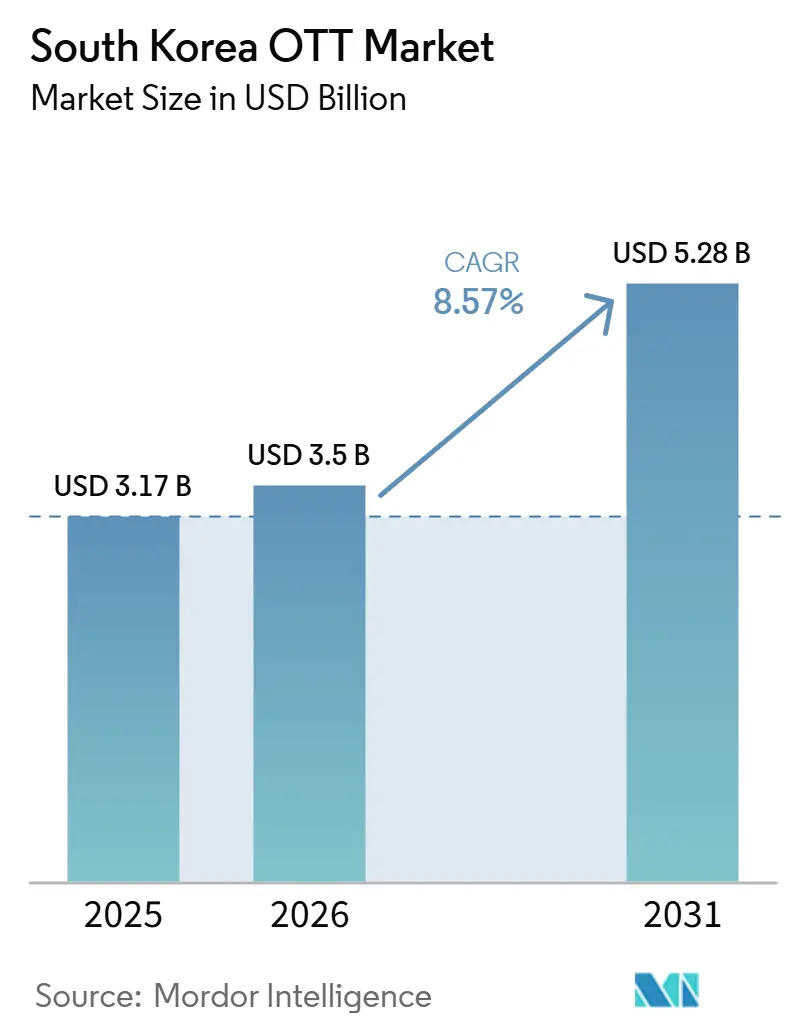
| Base Year Market Size (2025) | USD 3.17 Billion |
| Market Size (2026) | USD 3.5 Billion |
| Market Size (2031) | USD 5.28 Billion |
| Growth Rate (2026 - 2031) | 8.57 % |
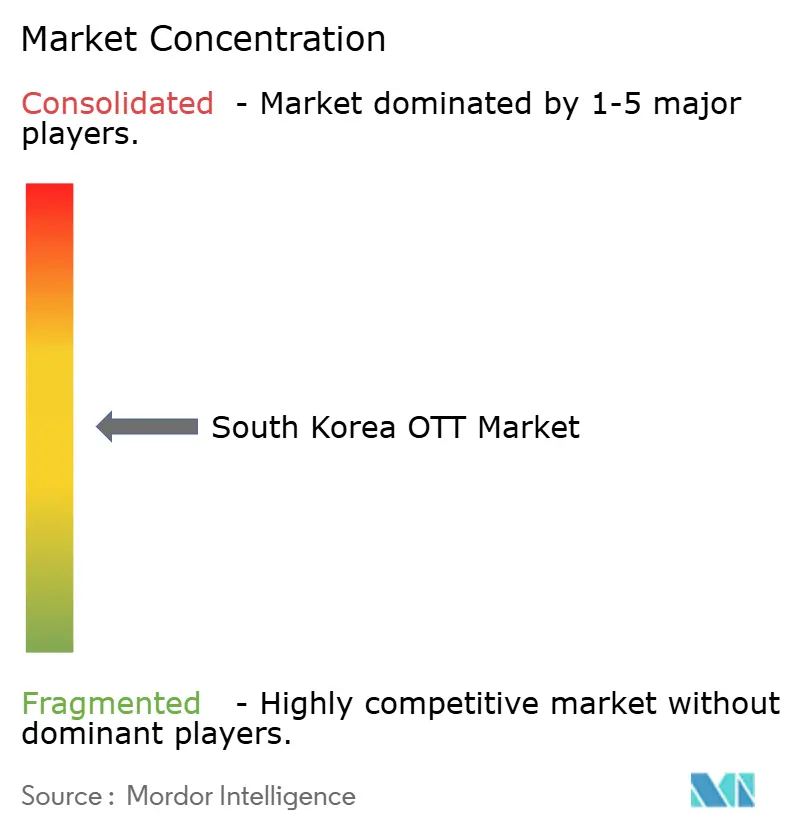
| Market Concentration | Medium |
Major Players *Disclaimer: Major Players sorted in no particular order Image © Mordor Intelligence. Reuse requires attribution under CC BY 4.0. | |
South Korea OTT Market Analysis by Mordor Intelligence
The South Korea OTT market size was valued at USD 3.17 billion in 2025 and estimated to grow from USD 3.44 billion in 2026 to reach USD 5.28 billion by 2031, at a CAGR of 8.57% during the forecast period (2026-2031). South Korea has moved beyond broad household adoption, with OTT use reaching 89.1% and the average subscriber holding 2.1 services in 2025. Paid-service use also increased, which shifts attention from adding subscribers toward improving revenue per user. Competition now centers on content rights, advertising-supported plans, bundles, and access through connected televisions. Domestic platforms face pressure to secure distinctive content while controlling original-production costs. Webtoon adaptations, free ad-supported streaming television, and commerce or telecom bundles offer routes to improve retention and monetization in the South Korea OTT market for platform operators, content partners, advertisers, and subscribers.
Key Report Takeaways
- By revenue model, SVOD held 56.29% of the South Korea OTT market share in 2025, while Hybrid subscription plus ads is projected to expand at a 9.28% CAGR through 2031.
- By device type, Smart TVs accounted for 56.84% of revenue in 2025 and are expected to record a 9.07% CAGR through 2031.
- By content genre, TV shows and episodic content accounted for 49.68% of the South Korea OTT market size in 2025, while documentaries are projected to advance at a 9.14% CAGR through 2031.
Note: Market size and forecast figures in this report are generated using Mordor Intelligence’s proprietary estimation framework, updated with the latest available data and insights as of January 2026.
South Korea OTT Market Trends and Insights
Drivers Impact Analysis*
| Driver | (~) % Impact on CAGR Forecast | Geographic Relevance | Impact Timeline |
|---|---|---|---|
| Rising Smart Device-First Viewing and Multi-Screen Consumption | +2.1% | National, with strong uptake in Seoul, Busan, and Incheon | Short term (≤ 2 years) |
| Acceleration of Premium Korean Content Export and Local Exclusivity Battles | +2.3% | National, with spillover to Asia-Pacific and global audiences | Medium term (2-4 years) |
| Bundled Commerce-and-Entertainment Subscription Ecosystems | +1.8% | National, concentrated in SKT, KT, and LGU+ subscriber bases | Medium term (2-4 years) |
| Rapid Expansion of Ad-Supported Monetization and FAST Inventory | +1.4% | National, with early adoption in Seoul and Gyeonggi smart TV households | Short term (≤ 2 years) |
| Exclusive Sports Rights as a Churn Reduction Tool | +1.2% | National, with greater relevance among urban sports audiences | Medium term (2-4 years) |
| Webtoon-to-Screen IP Conversion Improving Content ROI | +0.9% | National, with licensing potential in Asia-Pacific and North America | Long term (≥ 4 years) |
| Source: Mordor Intelligence | |||
Rising Smart Device-First Viewing and Multi-Screen Consumption
South Korean OTT viewing has developed from short mobile sessions into household viewing on larger screens. Television ownership stood at 94% of households, while the share identifying television as an essential medium increased by 8.4 percentage points in the 2025 survey. Smartphones remained important, with 91.7% of OTT users accessing content through mobile devices in 2025. Average viewing reached 101 minutes on weekdays and 128 minutes on weekends, supporting longer sessions rather than brief mobile use. Smart TV interfaces, remote controls, high-dynamic-range delivery, and FAST channel placement therefore affect where platforms win engagement. These capabilities are becoming more relevant as the South Korea OTT market competes for longer viewing sessions.
Acceleration of Premium Korean Content Export and Local Exclusivity Battles
Korean content is now a recurring part of global streaming catalogs rather than a temporary programming trend. Hallyu-related exports reached USD 18.98 billion in 2025, up 15.9% from 2024, while broadcasting exports rose 29.7%.[1]Ministry of Culture, Sports and Tourism, “2025 Hallyu Trend Report, Global Coverage Analysis,” Ministry of Culture, Sports and Tourism, mcst.go.kr Netflix committed USD 2.5 billion to Korean content between 2023 and 2026, strengthening the visibility of Korean productions across its international service. That investment also raises expectations and costs for writers, producers, cast, and production teams. Domestic services that rely on licensed titles can face narrower exclusivity windows and more expensive negotiations. Co-ownership of intellectual property gives platforms a stronger way to retain value across formats, territories, and later adaptations in the South Korea OTT market.
Bundled Commerce-and-Entertainment Subscription Ecosystems
Telecom bundles have become an important subscription route for the South Korea OTT market. SKT, KT, and LGU+ have moved from data offers toward packages that include streaming access. Coupang Play is part of Coupang’s Wow membership, priced at KRW 7,890 (USD 5.60) per month and links entertainment with delivery and commerce benefits. CJ ENM’s 48.85% stake in TVING gives it links across retail, media production, and entertainment. Naver also offered Netflix’s ad-supported Standard plan to Naver Plus members, showing how commerce partnerships can reduce direct customer-acquisition costs. These arrangements can improve value for subscribers, although the platform still needs content that justifies continued use outside the bundle.
Rapid Expansion of Ad-Supported Monetization and FAST Inventory
Advertising-supported viewing has become a central revenue option in the South Korea OTT market. A 2026 survey by KT Nasmedia found that 60% of South Korean OTT subscribers used ad-supported tiers.[2]KT Nasmedia, “2026 Internet User Survey Report,” KT Nasmedia, asiae.co.kr Wavve launched an ad-supported plan in October 2025 at KRW 5,500 (USD 4.05) per month and offered Full HD viewing with 2 simultaneous screens. The lower entry price gives services a way to retain consumers who might otherwise cancel. FAST channels add another advertising inventory layer on smart televisions. The TVING-Wavve advertising platform combines viewing signals with CJ ENM commerce and lifestyle data, which supports more focused advertising across the 2 services.
Restraints Impact Analysis*
| Restraint | (~) % Impact on CAGR Forecast | Geographic Relevance | Impact Timeline |
|---|---|---|---|
| Platform Fragmentation and Subscription Fatigue | -0.7% | National, particularly among subscribers aged 30-50 years with multiple services | Short term (≤ 2 years) |
| High Content Acquisition and Original Production Costs | -0.5% | National, especially for mid-tier domestic services pursuing premium IP | Medium term (2-4 years) |
| Regulatory Scrutiny on Pricing, Merger Control, and Data Governance | -0.3% | National, under oversight from the Fair Trade Commission, PIPC, and Korea Communications Commission | Medium term (2-4 years) |
| Limited Domestic IP Ownership for Smaller Platforms | -0.2% | National, with direct implications for Watcha, Laftel, and niche services | Long term (≥ 4 years) |
| Source: Mordor Intelligence | |||
Platform Fragmentation and Subscription Fatigue
The average South Korean OTT subscriber maintained 2.1 active services in 2025, but use is uneven across platforms. Consumers can move among smaller services when a desired program or sports event is available. The government plans a one-stop subscription tracker for September 2026, which will present paid streaming subscriptions in a single interface. Easier comparison can reduce the friction involved in cancellation and sharpen price competition. Proposed subscription rules also emphasize full cost disclosure, simpler cancellation, and consent for unfavorable contract changes. Services with inconsistent exclusive content may therefore experience greater churn in the South Korea OTT market.
High Content Acquisition and Original Production Costs
Netflix’s Korean production commitments have raised the competitive standard for content spending. The company invested USD 700 million during its first 5 years, committed a further USD 500 million in 2021, and pledged USD 2.5 billion for 2023-2026.[3]Netflix, “Netflix Continues USD 2.5 Billion Investment Project, to Release 24 Titles This Year,” Digital Today, digitaltoday.co.kr Domestic platforms cannot always match this scale on writers, directors, cast, or production facilities. Higher costs make disciplined commissioning and intellectual-property returns more important for every local service. The planned TVING-Wavve combination must show that shared budgets create better content returns instead of duplicating costly commitments. Smaller platforms also remain exposed when they lack ownership of the intellectual property that supports long-term licensing revenue.
*Our forecasts treat driver/restraint impacts as directional, not additive. The impact forecasts reflect baseline growth, mix effects, and variable interactions.
Segment Analysis
By Revenue Model: Ad-Supported Tiers Restructure SVOD Dominance
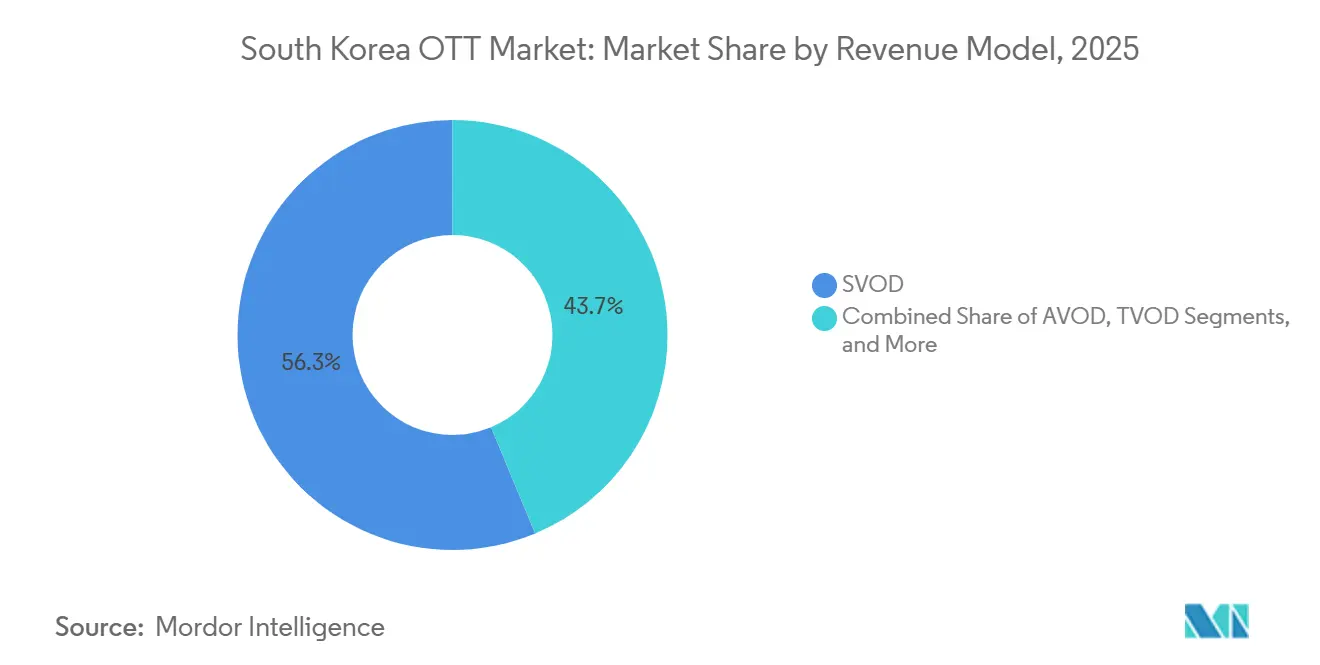
SVOD held 56.29% of the South Korea OTT market share in 2025, reflecting the country’s long period of subscription-led platform growth. Hybrid subscription plus ads is projected to post a 9.28% CAGR between 2026 and 2031, shifting attention from subscriber volume toward how each subscriber generates revenue. Ad-supported plans retain consumers who prefer lower monthly payments, while AVOD provides free access for viewers willing to accept commercial interruptions and can introduce older consumers to streaming. TVOD supports premium film releases before they enter subscription libraries. The South Korea OTT industry therefore uses several payment models for different viewing situations.
The revenue-model mix has a local feature because many consumers receive access through telecom or commerce bundles and may not evaluate each standalone service. The planned subscription tracker can make prices and service choices easier to compare from September 2026. Platforms with limited exclusive content could face greater cancellation risk even when included in a bundle. TVING and Wavve launched a shared advertising platform in October 2025 to connect inventories and audience data. This approach moves hybrid plans beyond discounted subscriptions by creating a more integrated advertising channel and revenue source.



By Device Type: Smart TVs Drive Household-Level Consumption
Smart TVs accounted for 56.84% of the South Korea OTT market size in 2025 and are expected to expand at a 9.07% CAGR through 2031. The device has become a primary access point for shared household viewing, while 29.7% of respondents described television as an essential medium in the 2025 Broadcast Media Usage Survey. That share rose by 8.4 percentage points from the prior year. Smart TV operating systems now influence service and FAST-channel discovery, giving television makers a stronger role in distribution. The South Korea OTT market benefits when services make large-screen viewing simple across remotes, app stores, and high-quality screen formats.
Smartphones and tablets remain widely used, with 91.7% of OTT users accessing content on mobile devices in 2025. Mobile use remains relevant for commuting and younger consumers, although weekday viewing averaged 101 minutes and weekend viewing averaged 128 minutes, supporting longer television sessions. Laptops and desktops retain a smaller role in work-adjacent and individual viewing. FAST channels on television sets add advertising inventory where household viewing is concentrated. The device strategy is therefore linked to engagement, advertising revenue, and the visibility of smaller services in a crowded application environment.
By Content Genre: Episodic Drama Anchors the Market While Documentaries Gain Momentum
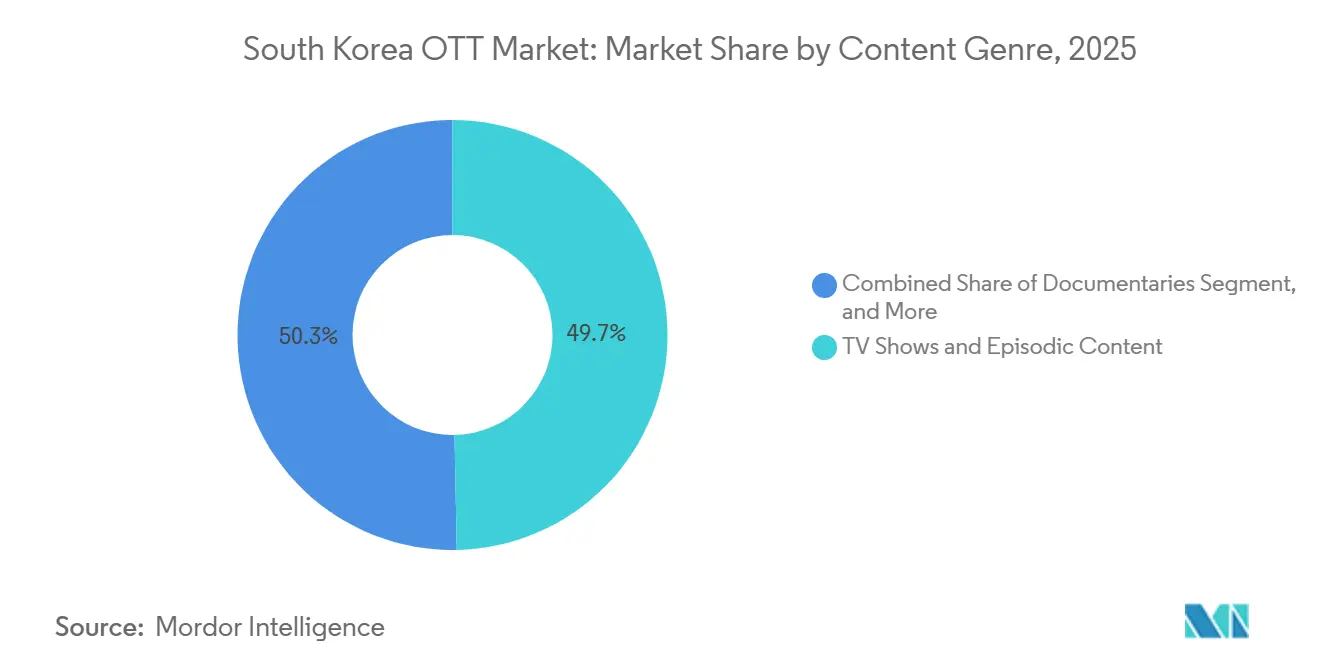
TV shows and episodic content captured 49.68% of the South Korea OTT market size in 2025, and Korean drama supports both domestic viewing and international distribution. Documentaries are projected to record a 9.14% CAGR from 2026 to 2031, giving platforms a way to broaden catalogs beyond expensive scripted series and serve long-form non-fiction demand. Movies and films have 2 roles, encouraging premium TVOD purchases for new releases and providing library depth for SVOD subscribers. The South Korea OTT industry depends on this mix to maintain viewing between major drama launches. Genre variety also reduces reliance on a small number of large productions.
The Others category includes live sports, variety programs, and animated content, which can strengthen engagement when viewers are not watching scripted drama. Variety and reality programming broaden the programming mix available to subscribers. Sports rights can lower churn because live events cannot be easily replaced by a catalog library. Documentary and factual programs offer another differentiating option. Platforms focused only on scripted originals may leave meaningful viewing time and retention opportunities unaddressed in the South Korea OTT market.
Geography Analysis
The sector was valued at USD 3.17 billion in 2025, and the country remains a major producer of Korean-language streaming content. Its domestic environment is closely linked to the wider Asia-Pacific streaming ecosystem, combining a strong production base with intense competition for subscriptions and content rights. Hallyu-related exports reached USD 18.98 billion in 2025, rising 15.9% from 2024, while broadcasting exports increased 29.7%. Global platforms can use Korean programs to attract subscribers across several countries. Domestic operators consequently compete against services that can spread Korean content costs across larger international audiences.
The Seoul Metropolitan Region, including Incheon and Gyeonggi Province, remains important for premium subscriptions, smart TV use, and telecom bundles. Growth is also extending across older consumer groups, with OTT use among people in their 40s reaching 98% in 2025. Use among people in their 60s increased to 70.8% in 2025 from 61.0% in 2023. The remaining domestic opportunity is increasingly tied to value per subscriber. The Audiovisual Media Services Act, discussed at the National Assembly in January 2026, seeks a more unified framework for OTT and broadcasting services and may be harder for smaller domestic platforms to manage.
FAST services can distribute Korean content beyond the domestic audience. KT Studio Genie expanded its Samsung TV Plus presence from 2 to 12 channels in 2025, including 2 international channels for the United States, Canada, the United Kingdom, Australia, and New Zealand. The Global K-FAST Alliance and public support measures position FAST within the broader effort to internationalize Korean content. Samsung and LG television distribution gives these channels a direct, lower-cost route into connected television households across Asia-Pacific and other regions.
Competitive Landscape
The South Korea OTT market has a concentrated structure led by Netflix, Coupang Play, and TVING. These 3 services collectively represented 80% of users, while the remaining audience was divided among Disney+, Wavve, Laftel, U+ Mobile TV, Watcha, and SPOTV NOW. Competition is focused on exclusive content, advertising-supported plans, FAST inventory, bundles, and ownership of intellectual property. This structure places considerable pressure on smaller services that cannot match broad catalogs or large rights budgets, particularly when exclusive programming and premium live sports determine whether subscribers retain a paid service.
The Fair Trade Commission conditionally approved the TVING-Wavve merger in June 2025 and required the services to maintain their existing subscription fees through December 31, 2026. TVING and Wavve agreed in March 2026 to share major original content and introduced Double Pass and 3 Pack bundles before an operational merger. Wavve appointed Lee Yang-gi as chief executive in April 2026 to restart the merger process. These measures create a larger base for domestic content sharing and advertising sales. The price freeze limits immediate revenue actions while the companies work through integration.
Coupang Play extended exclusive K League 1 and K League 2 new-media rights through 2030 in February 2026 and introduced AI-powered 4K upscaling for live football broadcasts. In July 2026, Coupang agreed to pay more than double the existing contract value for UEFA men’s club competition rights for 2027-2031. Netflix confirmed 24 Korean titles for 2026 and continued spending consistent with its USD 2.5 billion commitment. Naver is expanding its role through a 2026 KRW 70 billion (USD 50.7 million) creator-investment program and its Netflix bundle relationship. These moves show that content supply, technology, and distribution partnerships remain closely connected in the South Korea OTT market throughout the reporting period.
South Korea OTT Industry Leaders
Netflix, Inc.
Coupang Corp.
TVING Co., Ltd.
Wavve Co., Ltd.
Disney Entertainment, Inc.
- *Disclaimer: Major Players sorted in no particular order

Recent Industry Developments
- July 2026: Coupang agreed to pay a fee well over double the current contract value to secure UEFA men’s club competition broadcasting rights for the 2027-2031 cycle, accelerating its sports rights escalation strategy and intensifying competitive pressure on SPOTV NOW, which previously held portions of European club competition rights in South Korea.
- April 2026: Wavve appointed Lee Yang-gi, formerly head of CJ ENM’s OTT Competitiveness Reinforcement Task Force, as its new CEO, explicitly to reactivate the stalled TVING-Wavve merger process. KT, which holds a 13.54% stake in TVING through KT Studio Genie, had not yet formally agreed to merger terms as of this appointment.
- March 2026: TVING and Wavve formally agreed to mutually supply major original content across both platforms, introducing a Double Pass and 3 Pack bundle architecture ahead of the pending operational merger, and broadening content cooperation into dramas, entertainment, and documentaries.
- February 2026: Coupang Play extended its exclusive K League 1 and K League 2 new media broadcasting rights through 2030, incorporating AI-powered 4K upscaling into all live football broadcasts for the first time.


South Korea OTT Market Report Scope
The South Korea OTT (Over-the-Top) Market comprises digital platforms that deliver video content, including movies, television series, live streaming, original productions, and user-generated content, directly to consumers over the internet without requiring traditional cable, satellite, or broadcast television subscriptions.
The South Korea OTT Market Report is Segmented by Revenue Model (SVOD, AVOD, TVOD, and Hybrid, Subscription Plus Ads), Device Type (Smartphones and Tablets, Smart TVs, Laptops and Desktops, and Other Device Types), and Content Genre (Movies and Films, TV Shows and Episodic Content, Documentaries, and Other Content Genres). The Market Forecasts are Provided in Terms of Value (USD).
| SVOD |
| AVOD |
| TVOD |
| Hybrid, Subscription Plus Ads |
| Smartphones and Tablets |
| Smart TVs |
| Laptops and Desktops |
| Other Device Types |
| Movies and Films |
| TV Shows and Episodic Content |
| Documentaries |
| Other Content Genres |
| By Revenue Model | SVOD |
| AVOD | |
| TVOD | |
| Hybrid, Subscription Plus Ads | |
| By Device Type | Smartphones and Tablets |
| Smart TVs | |
| Laptops and Desktops | |
| Other Device Types | |
| By Content Genre | Movies and Films |
| TV Shows and Episodic Content | |
| Documentaries | |
| Other Content Genres |


Key Questions Answered in the Report
What is the projected scale of South Korea OTT services?
The South Korean streaming sector is estimated at USD 3.44 billion in 2026 and is forecast to reach USD 5.28 billion by 2031, growing at a CAGR of 8.57%.
Which revenue model leads streaming services in South Korea?
SVOD (Subscription Video on Demand) led with a 56.29% market share in 2025, while the Hybrid subscription plus advertising model is projected to grow fastest at a 9.28% CAGR through 2031.
Why are Smart TVs important for OTT services in South Korea?
Smart TVs accounted for a 56.84% share in 2025 and are projected to grow at a 9.07% CAGR, driven by longer household viewing sessions and increasing connected-TV consumption.
Which content genre has the largest share in South Korea?
TV shows and episodic content held a 49.68% share in 2025, supported by strong domestic demand for Korean drama and serialized entertainment.
What is driving ad-supported streaming adoption in South Korea?
Adoption is driven by lower-priced plans, consumer price sensitivity, and survey findings indicating that 60% of subscribers used ad-supported tiers in 2026.
How are Korean streaming platforms responding to global competition?
Domestic platforms are strengthening their position through mergers, content-sharing partnerships, telecom and commerce bundles, advertising-supported offerings, and exclusive sports rights acquisitions.
Page last updated on:





