
Market Overview
| Study Period | 2020 - 2031 |
|---|---|
| Forecast Data Period | 2026 - 2031 |
| Base Year Market Size (2025) | USD 25.77 Billion |
| Market Size (2026) | USD 26.53 Billion |
| Market Size (2031) | USD 30.71 Billion |
| Growth Rate (2026 - 2031) | 2.97 % |
| Market Concentration | Medium |
Major Players *Disclaimer: Major Players sorted in no particular order Image © Mordor Intelligence. Reuse requires attribution under CC BY 4.0. | |
South Korea Facility Management Market Analysis by Mordor Intelligence
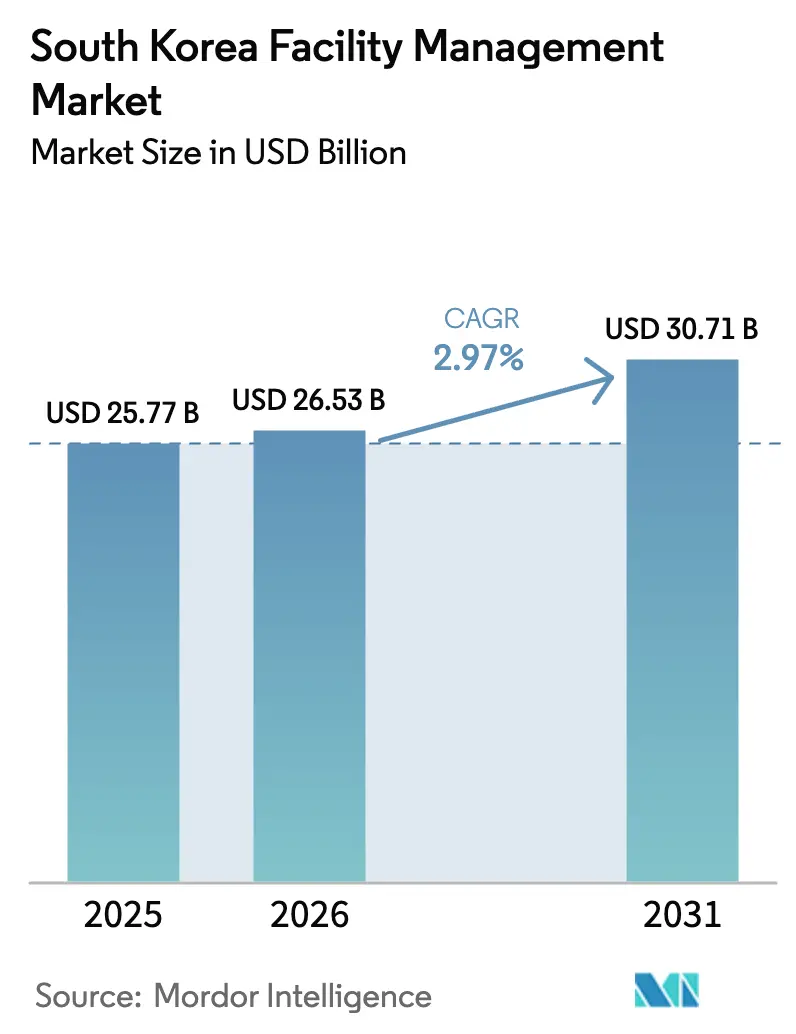
The South Korea facility management market size was valued at USD 25.77 billion in 2025 and estimated to grow from USD 26.53 billion in 2026 to reach USD 30.71 billion by 2031, at a CAGR of 2.97% during the forecast period (2026-2031). This growth is being underpinned by hyperscale data-center construction, stringent safety regulations, and rising demand for energy-efficient building operations. Outsourced, technology-enabled service models are gaining momentum as corporations focus on core competencies and delegate increasingly complex building tasks to specialist providers. Steady urbanization in the Seoul Capital Area and government incentives for zero-energy buildings are expanding the addressable base for professional facility services. Meanwhile, risk-transfer motives linked to the Serious Accidents Punishment Act (SAPA) and emerging ESG disclosure mandates are accelerating the shift toward certified, compliance-oriented partners.
Key Report Takeaways
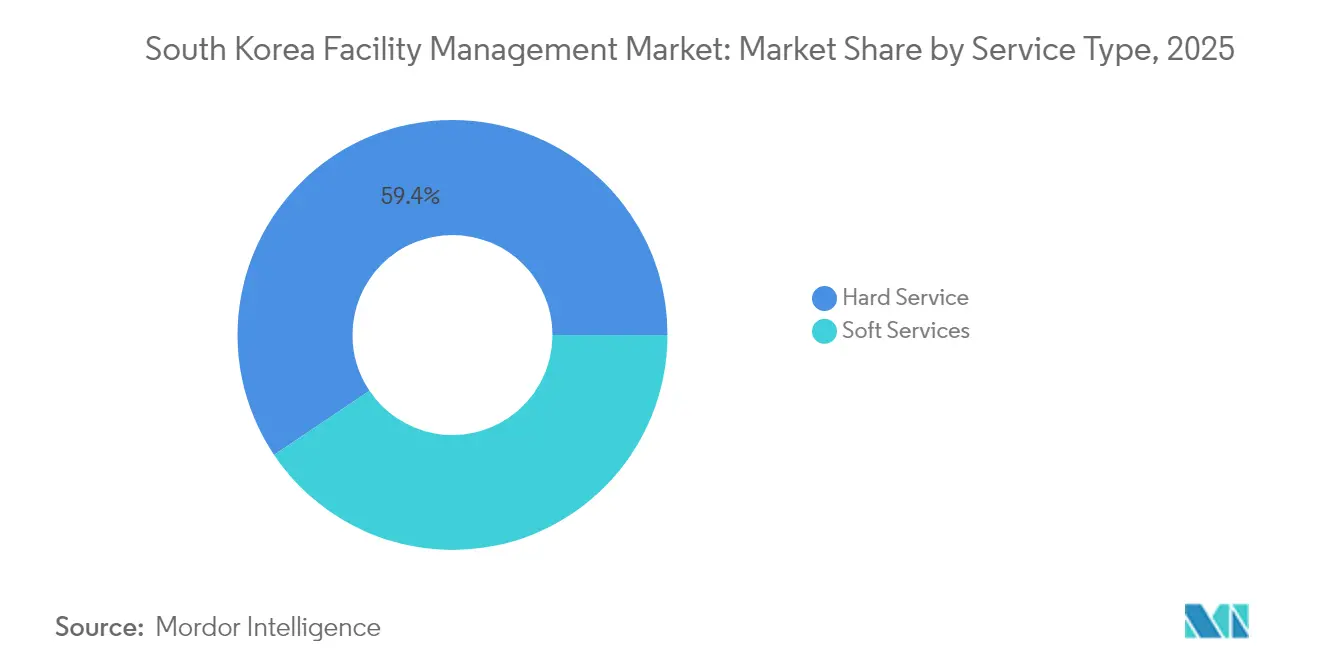
- By service type, hard services dominated with 59.42% South Korea facility management market share in 2025, while soft services are advancing at a 4.41% CAGR through 2031.
- By offering type, outsourced services captured 62.10% of the South Korea facility management market size in 2025 and are expanding at a 4.82% CAGR over the same horizon.
- By end-user industry, the commercial segment led with 42.02% revenue share in 2025, whereas institutional and public infrastructure facilities are forecast to grow at 6.32% CAGR to 2031.
Note: Market size and forecast figures in this report are generated using Mordor Intelligence’s proprietary estimation framework, updated with the latest available data and insights as of 2026.
South Korea Facility Management Market Trends and Insights
Drivers Impact Analysis*
| Driver | (~) % Impact on CAGR Forecast | Geographic Relevance | Impact Timeline |
|---|---|---|---|
| Technology-led integrated FM | +1.2% | National; Seoul Capital Area focus | Medium term (2-4 years) |
| ESG compliance mandates | +0.8% | National; early uptake by large listed firms | Long term (≥ 4 years) |
| Urbanization of metropolitan corridors | +0.6% | Seoul, Busan, Daegu | Long term (≥ 4 years) |
| Labour-standards enforcement | +0.4% | Nationwide; highest in manufacturing clusters | Short term (≤ 2 years) |
| Hyperscale and AI data-center expansion | +0.7% | Gyeonggi, Ulsan, Jeollanam-do | Medium term (2-4 years) |
| Zero-energy building (ZEB) incentives | +0.3% | Nationwide; aging stock concentration | Medium term (2-4 years) |
| Source: Mordor Intelligence | |||
Technology-led Integrated FM Drives Market Transformation
IoT-enabled sensors, AI analytics, and building-management platforms are converging to deliver predictive maintenance that cuts facility downtime by 15-20% while shrinking energy bills by close to one-quarter. [1] Hanwha Systems, “Smart Building Solution,” hanwhasystems.comKorean service providers embed cloud-based diagnostics in elevators, HVAC units, and security networks, enabling real-time fault isolation in dense urban complexes. Labour shortages and rising wage costs are pushing owners to automate inspection routines, sustaining investment in building-automation software even during economic slowdowns. Indoor 5G roll-outs promise faster device-to-device communication, allowing high-bandwidth data streams from smart cameras and environmental sensors to feed central dashboards. Integrated FM contracts built around guaranteed uptime and energy-saving metrics command premium pricing and foster deeper, multi-year alliances with occupiers.
ESG Compliance Mandates Reshape Service Delivery Models
From 2026, listed firms with assets above KRW 2 trillion must publish ESG reports in line with IFRS Sustainability Standards, expanding to all listed companies by 2030. The Korea Sustainability Standards Board has specified carbon-reduction and energy-performance indicators that facility managers must monitor, audit, and improve. Building owners therefore bundle metering, waste-management, and environmental data analytics into FM contracts to prove year-on-year progress. Outcome-based agreements—where providers are remunerated for delivering specific carbon-emission cuts—are gaining traction, particularly among conglomerates seeking to future-proof regulatory disclosures. The shift is steering investment toward smart meters, renewable-ready electrical infrastructure, and LEED/G-SEED certification advisory services, positioning FM partners as guardians of corporate sustainability credentials.
Urbanization Accelerates Demand for Sophisticated FM Services
High-density corridors now hold 46.1% of South Korea’s population and generate 46.2% of its GDP, concentrating facility needs in vertical office towers, mixed-use retail hubs, and co-living complexes. With land finite and rental rates climbing, owners prioritise occupant experience, pushing FM providers to integrate concierge, space-scheduling, and indoor-air-quality optimisation into everyday operations. Living SOC programmes deliver new community centres, libraries, and sports halls in provincial cities, creating fresh institutional FM demand. Urban regeneration projects funded by the National Housing and Urban Fund require adaptive-reuse strategies and tight coordination between heritage preservation and modern safety codes. Case evidence from Gangnam shows integrated FM adoption lifting tenant-retention rates by one-fifth and enabling landlords to charge rent premiums above neighbouring mono-use assets.
Labour Standards Enforcement Creates Compliance Opportunities
The Serious Accidents Punishment Act (SAPA) makes corporate executives criminally liable for fatal incidents, elevating safety management to board-level priority. Workplace accidents spiked to 136,796 cases in 2023, intensifying scrutiny on risk assessments and contractor oversight. Specialist FM partners supply certified safety officers, maintain digital permit-to-work logs, and automate chemical-handling documentation, helping manufacturers reduce incident frequency and avoid reputational damage. Outsourced safety programmes have shown capability to lower workplace injuries by over 40% and to trim compliance administration costs by roughly one-third, according to aggregated case studies in heavy industry.
Restraints Impact Analysis*
| Restraint | (~) % Impact on CAGR Forecast | Geographic Relevance | Impact Timeline |
|---|---|---|---|
| Economic pressures on construction | -0.5% | Nationwide; strongest in SME segments | Short term (≤ 2 years) |
| Technical-skills shortage | -0.3% | Nationwide; acute in IoT and energy disciplines | Medium term (2-4 years) |
| Volatile electricity tariffs | -0.4% | Nationwide; acute for energy-intensive assets | Short term (≤ 2 years) |
| Short-term, price-driven contracts | -0.2% | Nationwide; prevalent in public procurement | Medium term (2-4 years) |
| Source: Mordor Intelligence | |||
Economic Pressures Constrain Service Expansion
Construction revenues slid 6.7% to USD 166 billion in 2023 as tighter monetary policy cooled new-build pipelines, prompting building owners to defer non-essential upgrades. [2]U.S. International Trade Administration, “South Korea – Construction Services,” trade.gov Steel and cement prices surged 35% and 28% respectively in 2024, squeezing capex budgets and steering demand toward minimal-scope maintenance contracts. Facility management teams now pitch demonstrable ROI via energy-cost reductions, deferred capex through asset-life extension, and stricter safety compliance as antidotes to owners’ budget caution.
Workforce Skills Gap Limits Service Quality Advancement
Aging technicians and a preference among graduates for large-firm employment have left mid-sized FM contractors understaffed in advanced controls, cybersecurity, and sustainability analytics. Only 26.1% of certified fire engineers are currently engaged in value-engineering proposals, highlighting under-utilisation of hard-won expertise. [3]Korean Society of Hazard Mitigation, “Applying Value Engineering in the Fire Brigade,” j-kosham.or.kr Project delays lengthen by 20% and labour costs inflate by around 15% when specialist skills are scarce, curbing adoption of smart-building upgrades.
*Our forecasts treat driver/restraint impacts as directional, not additive. The impact forecasts reflect baseline growth, mix effects, and variable interactions.
Segment Analysis
By Service Type: Hard Services Dominate Despite Soft Services Growth Acceleration
Hard services accounted for 59.42% of the South Korea facility management market in 2025 and remain indispensable because mechanical, electrical, and plumbing systems must meet strict uptime and safety codes. Asset-management revenues are rising as 72.3% of national water infrastructure is forecast to reach obsolescence by 2035, amplifying the need for proactive maintenance. Compliance with SAPA has also boosted demand for certified life-safety inspections. Integrated hard-service contracts have delivered 30% downtime reductions and 25% energy savings compared with siloed outsourcing models.
Soft services, though smaller, are projected to outpace hard services at 4.41% CAGR to 2031. Robotic cleaning, AI-driven security analytics, and premium workplace amenities are reshaping expectations among technology tenants in Seoul’s Grade-A offices. Hybrid-work footprints compel continuous re-planning of desk allocation and conference areas, fostering growth in space-optimisation advisory. As ingredient prices climbed 18% in 2024, catering providers introduced menu-engineering software and dynamic pricing to safeguard margins while maintaining employee-experience standards.



By Offering Type: Outsourcing Acceleration Reshapes Service Delivery
Outsourced arrangements represented 62.10% of the South Korea facility management market size in 2025 and will expand at 4.82% CAGR through 2031 as corporations concentrate on core digital-transformation initiatives. Bundled and integrated FM models reduce vendor-management complexity, shifting risk to providers that possess multi-disciplinary talent pools. Comparative studies show enterprises trimming indirect costs by 25% when they migrate from fragmented in-house teams to single-provider frameworks.
In-house operations, still holding 37.90% share, persist in defence, critical-infrastructure, and select public-sector domains where security sovereignty is paramount. Yet these owners bear 25% higher hidden costs related to technology upgrades and compliance administration, prompting a gradual move toward hybrid models. Bulk purchasing of cleaning supplies and maintenance consumables through outsourced providers mitigates material-cost inflation of more than 28% in 2024, strengthening the outsourcing value proposition.
By End-user Industry: Commercial Leadership Challenged by Institutional Growth
The commercial segment led with 42.02% South Korea facility management market share in 2025, anchored by Seoul’s role as a regional headquarters hub and its surging inventory of data-rich office campuses. Demand is especially strong for uptime-orientated services covering building-management systems, cybersecurity overlays, and flexible workspace re-configuration.
Institutional and public infrastructure facilities are slated for the fastest expansion at 6.32% CAGR through 2031 as Living SOC policies channel capital into community centres, hospitals, and transport interchanges. Hospitals that adopt dedicated healthcare-FM protocols have cut infection-control failures by one-fifth and shaved 15% off biomedical-equipment maintenance costs. Industrial complexes and semiconductor fabs seek FM partners with hazardous-materials stewardship and clean-room certification, while hospitality operators rely on cost-efficient linen and housekeeping solutions amid rising tourism traffic.
Geography Analysis
The Seoul Capital Area commands the largest slice of the South Korea facility management market due to its high-rise skyline, dense data-center footprint, and concentration of headquarters buildings. Integrated FM contracts in the city’s central business district achieve 35% higher client-retention rates and secure 20% premium pricing compared with other regions, illustrating the value placed on technical sophistication and rapid response times.
Gyeonggi Province and adjacent corridors are emerging as the fastest-growing markets as hyperscale data-center clusters, logistics hubs, and satellite R&D campuses proliferate. Providers that deploy regionally distributed technician teams capture economies of proximity while mitigating Seoul’s 15% higher average labour costs. Ulsan and Jeollanam-do, newly earmarked for multigigawatt AI data-center complexes, present greenfield opportunities for critical-environment FM specialists equipped to deliver 99.99% uptime guarantees.
Beyond the metropolitan ring, provincial cities benefit from Living SOC infrastructure infusions and green-growth incentives. Tourism-focused coastal zones require guest-experience-centric FM packages for resorts and convention centres. Rural renewables installations create niches in asset-integrity monitoring, though the scarcity of local engineers obliges providers to invest in mobile service units and remote-diagnostics platforms to match metropolitan service benchmarks.
Regulatory Landscape
South Korea facility management is shaped by safety, labor, and building-performance compliance requirements that raise the baseline for inspections, documentation, and certified manpower. The Ministry of Land, Infrastructure and Transport (MOLIT) administers the Special Act on the Safety Control and Maintenance of Establishments, under which national master plans guide annual safety and maintenance plans by management authorities, and facilities are classified (Class I to Class III) with periodic safety inspections and full performance assessments. In parallel, the Serious Accidents Punishment Act (SAPA) elevates executive accountability for severe incidents, pushing asset owners to formalize contractor oversight and permit-to-work controls through professional FM partners.
Standards and sector-specific rules also influence technology adoption inside FM. Public institutions and local governments are required to observe Korean Industrial Standards (KS) under the Industrial Standardization Act, reinforcing specifications for equipment, materials, and management processes used across hard services. For industrial estates, the Industrial Cluster Development and Factory Establishment Act places the Ministry of Trade, Industry and Energy (MOTIE) over industrial-complex infrastructure installation, maintenance, and related charge structures, which affects bundled FM scopes for utilities and shared facilities. As ESG reporting obligations begin in 2026 for large listed firms under IFRS-aligned sustainability standards referenced in the report context, FM providers increasingly need audit-ready energy and carbon data workflows that can withstand scrutiny from corporate governance and disclosure processes.
Value Chain Analysis
The South Korea facility management value chain starts with building owners and occupiers (commercial towers, industrial complexes, institutions, and data centers) specifying service-level, safety, and ESG reporting requirements, then moves through procurement and contract packaging (single, bundled, or integrated FM). Core delivery is executed by FM providers (domestic groups and global firms active locally) that mobilize on-site technicians, safety officers, and soft-service staff, supported by specialist subcontractors for MEP works, fire systems, elevators, and cleaning. Technology vendors supplying BMS, CAFM, IoT sensors, analytics, and cybersecurity overlays increasingly sit upstream of operations, since predictive maintenance and energy optimization depend on instrumented assets and data integration.
Downstream, performance assurance and compliance reporting close the loop through audits, inspection records, and KPI-based governance with clients, including energy and carbon metrics for ESG disclosures and safety documentation aligned with SAPA practices. Government programs are also feeding the chain with capability-building inputs. MOLIT commenced an KRW 18 billion R&D project (2025-2028) for robot-friendly building design, construction, operation, and management, which encourages OEMs, proptech firms, and FM contractors to coordinate on robotic cleaning, inspection automation, and digital-twin-ready asset tagging. Separately, expanded zero-energy building (ZEB) mandates and related energy-efficiency requirements increase demand for commissioning, retro-commissioning, metering, and continuous-optimization services, tightening collaboration between FM providers, equipment makers, and energy solution specialists.
Competitive Landscape
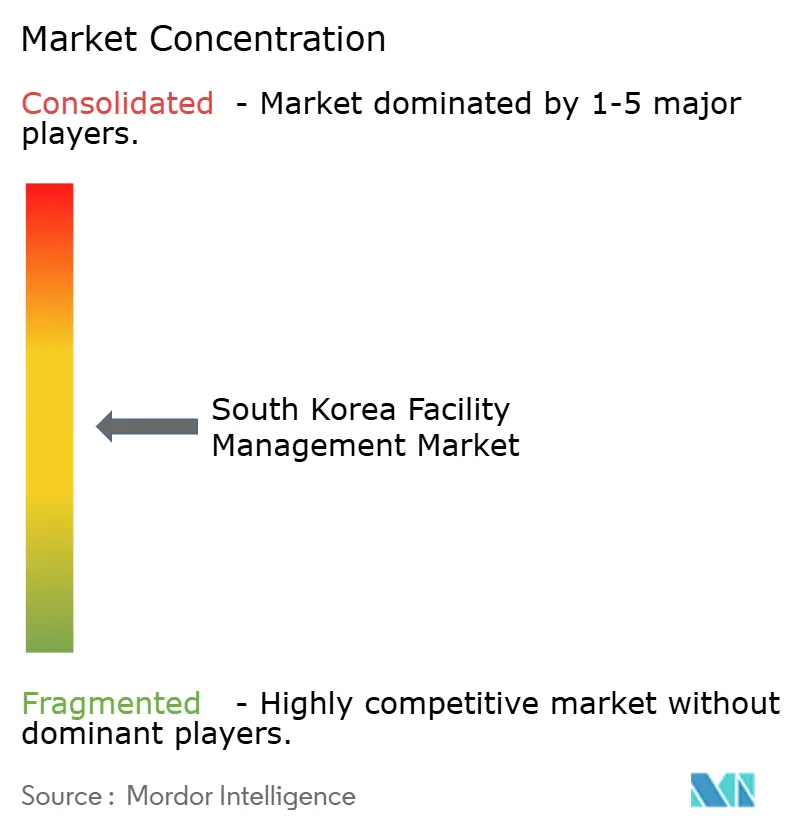
South Korea’s facility-management arena is moderately fragmented. No single firm holds more than 10% national revenue, pushing providers to differentiate through technology investment and sector specialisation. Domestic champions such as S&I Corporation leverage deep regulatory familiarity and have secured landmark data-center mandates, underscoring the premium attached to mission-critical expertise. Global multinationals complement their scale advantage with proprietary CAFM software, yet must tailor workflows to Korea’s stringent labour and safety codes.
Technology is rapidly redefining competitive boundaries. Firms integrating AI-driven analytics into core workflows routinely demonstrate 15-point margin advantages over peers reliant on manual inspection logs. Outcome-based contracts tied to ESG metrics reward agile providers that can quantify carbon reductions and safety improvements in real time. Sector specialists—serving semiconductor clean rooms, pharmaceutical labs, or renewable-energy parks—command price premiums upwards of 40% owing to scarce technical know-how.
Looking ahead, competitive intensity is set to rise as mid-tier contractors form alliances with proptech start-ups to bridge the digital-skills gap. Meanwhile, foreign entrants eye provincial growth corridors opened by mega-data-center investments. The ability to align with SAPA compliance, deliver validated sustainability data, and scale technician pools swiftly will determine share gains during the forecast window.
South Korea Facility Management Industry Leaders
Samkoo Inc Co., Ltd
Hyundai GBFMS
CBRE Group, Inc.
Sodexo Oy
Savills Plc
- *Disclaimer: Major Players sorted in no particular order

Market Opportunities and Future Outlook
A near-term whitespace is the operationalization of ESG and energy-performance data into day-to-day FM delivery, especially for large listed firms moving into mandatory ESG reporting from 2026 under IFRS-aligned sustainability standards referenced in the report context. This creates room for providers that can combine hard services with digital measurement, verification, and audit-ready reporting (submetering, carbon accounting for building operations, and outcome-based energy KPIs) rather than selling standalone maintenance. Evidence of market movement toward smart-building platforms is visible in developer activity: Samsung C&T expanded its Homeniq smart home and building platform to Seohae Grandblue apartments in Incheon in April 2026 and also signed an MOU with Mastern Investment Management to pilot the Bynd smart building platform in commercial real estate, reinforcing demand for FM partners that can operate and integrate platform-driven building services.
Mission-critical and automated facilities form another opportunity area, where hyperscale and AI data center buildouts intensify requirements for 99.99% uptime operations, precision cooling, and integrated MEP maintenance. Telecom and infrastructure players have been formalizing supply-chain and development steps that translate into FM demand: SK Telecom signed an integrated procurement agreement with Schneider Electric in September 2025 for MEP equipment for an AI data center in Ulsan, while KT signed an MOU with DigitalBridge Group in November 2025 to jointly develop AI data centers in Korea. In parallel, public programs broaden the pipeline for technology-enabled FM beyond data centers: MOLIT initiated the 2026 Smart City Development Project to create hubs supporting advanced technology demonstrations, and robot-friendly building R&D (2025-2028) supports service models that incorporate robotics, digital twins, and automated inspection into integrated FM contracts.
Recent Industry Developments
- March 2026: Hyundai GBFMS rebranded as Hyundai Property following approval at its annual shareholders meeting, positioning the company around a total real estate service platform rather than standalone facility management. The rebranding supports bundled offerings that link building operations with broader asset and tenant services, raising competitive pressure on providers that lack integrated capabilities.
- March 2026: Hyundai Property secured facility management contracts for the Page Myeongdong office building in Seoul, the Woolim Lions Valley Phase 2 knowledge industry center, and the SK Rent-a-Car Auto Auction in Cheonan. These wins broaden its operating footprint across offices, industrial-style knowledge centers, and specialized logistics-related facilities, reinforcing demand for multi-site delivery and standardized compliance processes.
- July 2024: S&I Corporation won the operation contract for Seoul's Gasan DCI Data Center. The contract strengthened its credentials in mission-critical operations where uptime, security coordination, and MEP reliability drive premium hard-services demand.


Research Methodology Framework and Report Scope
Market Definition and Coverage
This market covers facility management services delivered for buildings and sites in South Korea, counted in value terms. It includes hard services (such as mechanical and electrical upkeep) and soft services (such as cleaning and security), across both in-house and outsourced delivery.
Scope exclusions: one-off construction and fit-out project spending is excluded, since it is not a recurring facility management service.
Segmentation Overview
- By Service Type
- Hard Services
- Asset Management
- MEP and HVAC Services
- Fire Systems and Safety
- Other Hard FM Services
- Soft Services
- Office Support and Security
- Cleaning Services
- Catering Services
- Other Soft FM Services
- Hard Services
- By Offering Type
- In-house
- Outsourced
- Single FM
- Bundled FM
- Integrated FM
- By End-user Industry
- Commercial (IT and Telecom, Retail andWarehouses, etc.)
- Hospitality (Hotels, Eateries, Large-scale Restaurants)
- Institutional and Public Infrastructure (Govt, Education, Transportation)
- Healthcare (Public and Private Facilities)
- Industrial and Process (Manufacturing, Energy, Mining)
- Other End-user Industries (Multi-housing, Entertainment, Sports and Leisure)
Data Sources, Market Sizing, and Validation
Desk Research
Desk research was used to set the market frame and to collect anchor indicators that behave like demand signals for facility services. We referenced public sources such as Statistics Korea (KOSTAT) for industry and labor series, the Bank of Korea for inflation and macro conditions, and relevant ministries and agencies (for example, MOLIT and the Public Procurement Service) for building, public-infrastructure, and contracting context.
To connect services to likely spend pools, we also reviewed items such as listed-company filings, investor decks, association publications (for example, building and cleaning services associations where available), and reputable Korean business press. Paid subscriptions were used only where they helped with company financials and news screening, and for patent databases to spot maintenance automation direction. These examples are not exhaustive, and other public and internal reference sources were also used to collect data, validate inputs, and clarify assumptions.
Primary Interviews and Surveys
Primary work focused on validating what is actually outsourced in South Korea, how bundled contracts are priced, and how service mix differs by building type and end user. We spoke with facility operators, service providers, procurement teams, and site managers to pressure-test assumed service frequencies, wage pass-through, and contract lengths, then used follow-up calls when desk signals and field responses did not match.
Distribution of primary research fieldwork respondents
| Company type | Respondent position |
|---|---|
| Top tier: 34% | CXOs: 12% |
| Mid tier: 44% | Functional/Unit leaders: 35% |
| Smaller Players: 22% | Managers: 53% |
Market-Sizing & Forecasting
Sizing starts with a top-down build where South Korea end-user activity is translated into an addressable service spend pool, and then filtered by typical outsourcing penetration and service intensity by facility type. We then corroborate totals with selective bottom-up checks, such as rolling up sampled provider revenue tied to FM lines, and using simple ASP x volume checks for common services where unit volumes are observable.
Inputs that matter for this market include commercial and institutional floor space additions, public-infrastructure operating budgets, wage inflation for cleaning and security staff, energy and utility cost movements that affect hard-services contracts, and the typical split between single-service, bundled, and integrated contracts in outsourcing. When a bottom-up view is incomplete (for example, smaller local providers with limited disclosures), we bridge gaps using peer ratios from interviewed firms and apply conservative coverage factors that are reviewed by analysts.
Forecasts are built using scenario analysis with macro and sector variables, and then adjusted with primary feedback on contract repricing cycles and expected outsourcing shifts. Each driver is tied back to a visible demand pool and a set of rate assumptions that can be rechecked.
Data Validation & Update Cycle
Model outputs are tested against independent signals, such as service employment direction, public procurement patterns, and the expected range of FM spend intensity for key end-user groups. Large variances are flagged, assumptions are revisited, and respondents are re-contacted when pricing or scope interpretations seem inconsistent.
Before sign-off, the work is reviewed in steps, including peer checks on calculations, unit logic, and currency timing, followed by a final scan for outliers and narrative alignment. Reports are refreshed annually, and interim updates are made when material events occur (such as policy shifts, major contract waves, or abrupt cost inflation). Right before delivery, we run a last update pass so the client receives the most current view.
Mordor Intelligence's South Korea Facility Management Market Estimate Compared With Other Published Estimates
Published market sizes for facility management in South Korea can look far apart because the line between recurring FM services and adjacent property-related spending is not drawn the same way. Differences also come from what each source assumes about outsourcing share, bundled contract coverage, and how fast labor-heavy services reprice.
One-off construction and fit-out project spending sits outside Mordor Intelligence's scope, which is why some figures look higher when they blend project-like budgets into facilities spend. Another gap driver is the treatment of in-house delivery, where some estimates focus only on outsourced contracts, and others blend in internal cost allocations without a consistent wage and overhead basis. Update cadence and currency timing matter too, since contract repricing in cleaning, security, and M&E maintenance can shift the current-year total even when volumes are stable.
Benchmark comparison
| Source | Market Size | Gaps in Research Methodology |
|---|---|---|
| Mordor Intelligence | USD 25.77 B (2025) | |
| Industry Association A | USD 23.90 B (2025) | Counts mainly outsourced FM contracts and excludes most in-house delivery, which lowers the total in a market where internal teams still cover part of soft services. |
| Global Consultancy B | USD 28.60 B (2025) | Expands the spend pool by blending FM with adjacent property operation items and certain refurbishment-like activities, and it applies faster assumed price escalation for labor-heavy services. |
Taken together, the spread is explained by what is treated as FM versus adjacent building spend, and whether in-house activity is valued consistently. By keeping the variables tied to observable end-user demand pools and cross-checking them with interview-led contract norms, the estimate stays repeatable even when disclosure coverage is uneven.


Key Questions Answered in the Report
What is the current size of the South Korea facility management market?
The market was valued at USD 26.53 billion in 2026 and is forecast to climb to USD 30.71 billion by 2031 at a 2.97% CAGR.
Which service type leads revenue generation?
Hard services—covering MEP, fire safety, and asset management—held 59.42% market share in 2025, driven by strict compliance requirements.
Why are outsourced facility-management models expanding quickly?
Outsourcing captured 62.10% market share in 2025 and is growing at 4.82% CAGR because companies are transferring regulatory risk and technical complexity to specialised providers.
How do ESG mandates influence facility-management demand?
Starting in 2026, large listed firms must report building-performance metrics, pushing them to hire FM partners that can deliver verifiable energy and carbon reductions.
What impact will hyperscale data-center construction have on service providers?
New AI and cloud campuses require 99.99% uptime, precision cooling, and fortified security, creating high-margin opportunities for critical-environment FM specialists.
Which geographic regions offer the fastest growth prospects?
Gyeonggi Province, Ulsan, and Jeollanam-do are poised for rapid expansion owing to large data-center investments and government infrastructure programmes.
Page last updated on:


 Your data is secure and never sold or shared.


