
Market Overview
| Study Period | 2020 - 2031 |
|---|---|
| Forecast Data Period | 2026 - 2031 |
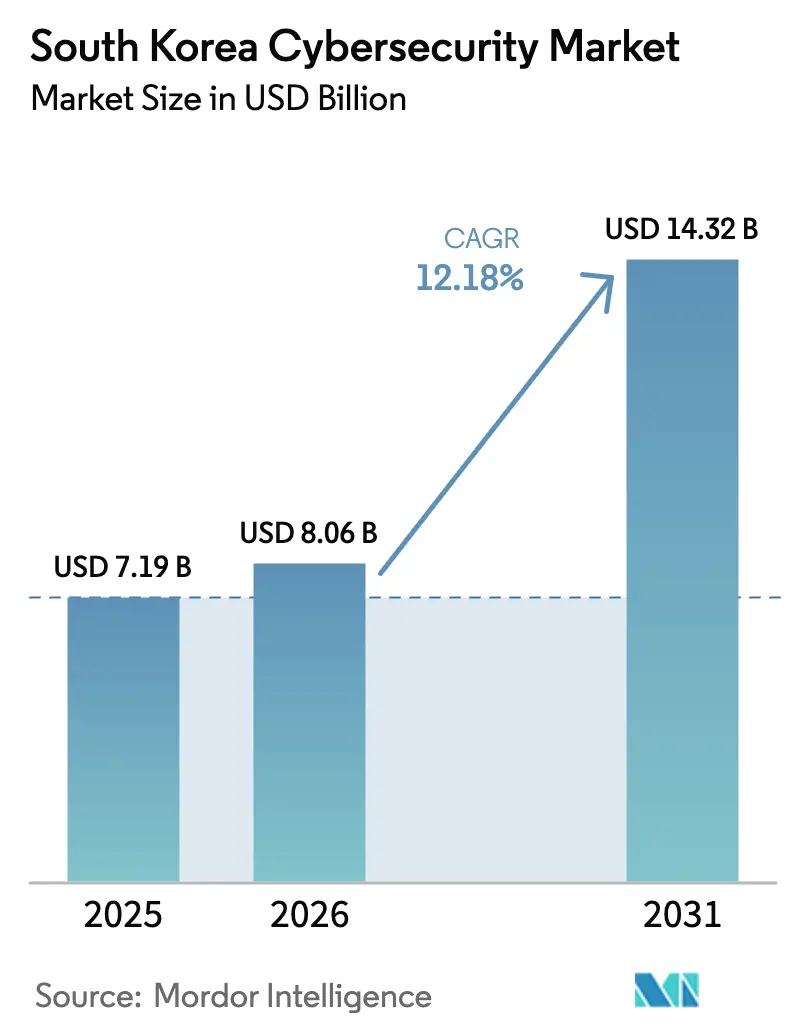
| Base Year Market Size (2025) | USD 7.19 Billion |
| Market Size (2026) | USD 8.06 Billion |
| Market Size (2031) | USD 14.32 Billion |
| Growth Rate (2026 - 2031) | 12.18% CAGR |
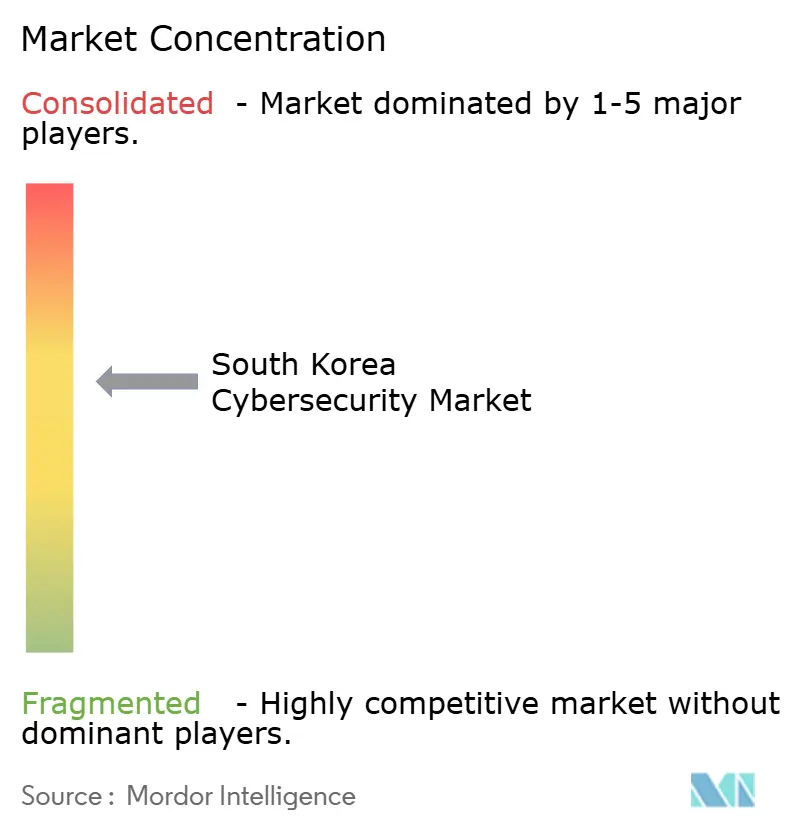
| Market Concentration | Medium |
Major Players *Disclaimer: Major Players sorted in no particular order Image © Mordor Intelligence. Reuse requires attribution under CC BY 4.0. | |
South Korea Cybersecurity Market Analysis by Mordor Intelligence
The South Korea cybersecurity market size was valued at USD 7.19 billion in 2025 and estimated to grow from USD 8.06 billion in 2026 to reach USD 14.32 billion by 2031, at a CAGR of 12.18% during the forecast period (2026-2031). Heightened state-sponsored attacks, expanding 5G and edge roll-outs, and the government’s cloud-first Digital New Deal program are combining to accelerate security spend. Large enterprises remain the biggest buyers, yet small and medium enterprises (SMEs) are quickly raising their budgets as cyber insurance mandates and breach fines tighten. Vendors that deliver identity-centric, zero-trust architectures and managed detection and response services are capturing most growth. Local champions AhnLab, SK Shieldus, and Samsung SDS are scaling AI-driven analytics to defend against the 1.62 million daily hostile probes recorded in 2024, while global leaders Palo Alto Networks and Cisco deepen partnerships to offer unified SASE platforms. Rising salary inflation among scarce security specialists, together with heavy reliance on imported tooling, continues to push total cost of ownership 15–25% above domestic alternatives, leaving room for locally built quantum-resistant solutions.
Key Report Takeaways
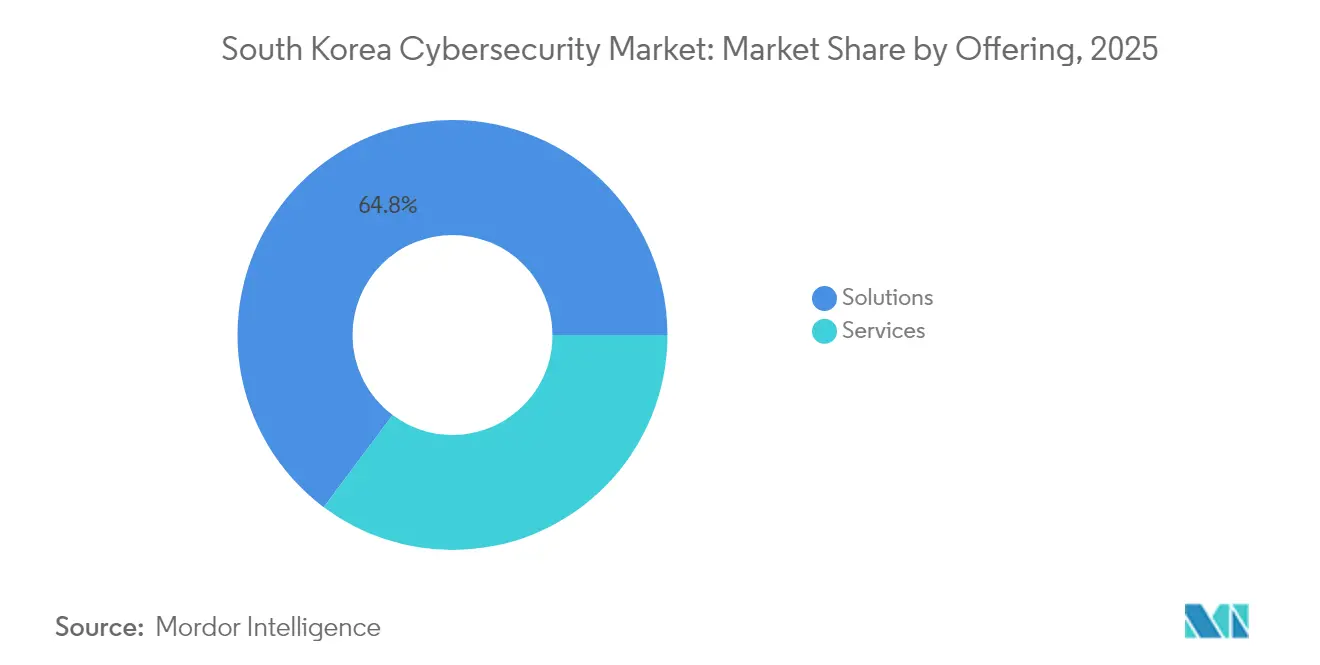
- By offering, solutions retained 64.78% of the South Korea cybersecurity market share in 2025, whereas managed services are projected to register the fastest 14.21% CAGR through 2031.
- By deployment mode, cloud models accounted for 52.27% share of the South Korea cybersecurity market size in 2025 and are set to advance at a 15.42% CAGR to 2031.
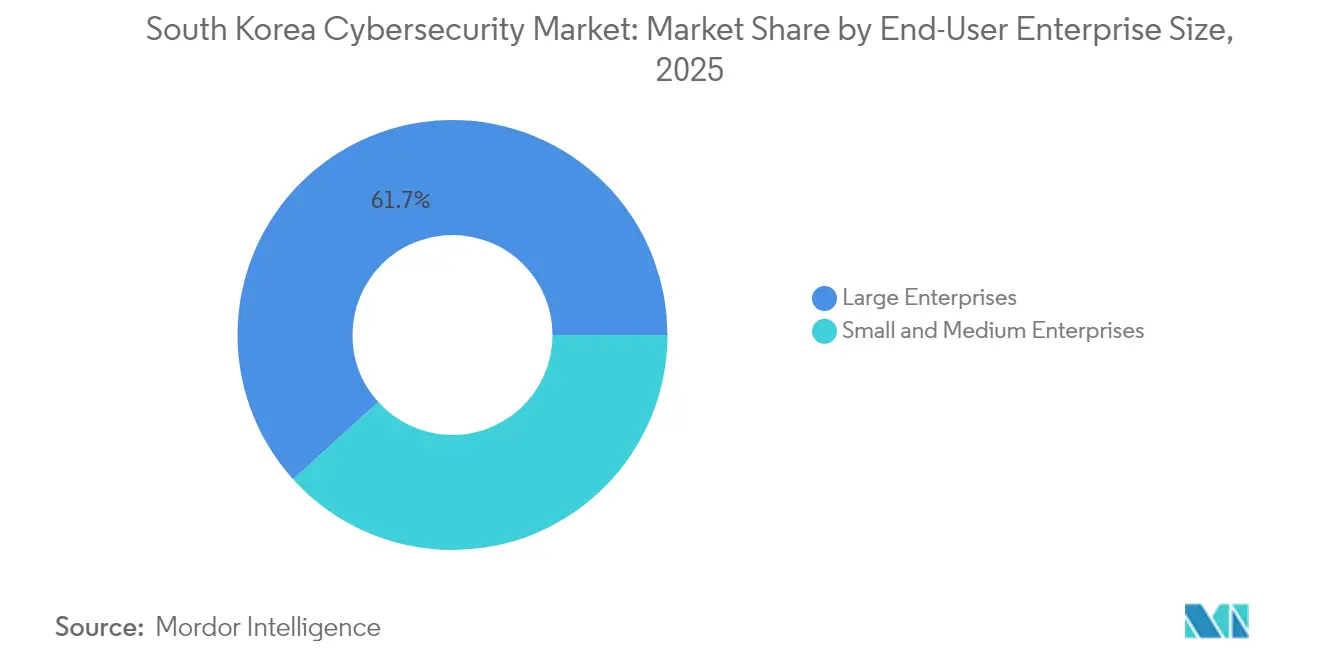
- By end-user enterprise size, large enterprises held 61.70% revenue share in 2025; SMEs are forecast to be the fastest risers at 13.78% CAGR.
- By end-user vertical, BFSI led with 31.40% revenue share in 2025, while healthcare is poised for a 15.28% CAGR to 2031.
Note: Market size and forecast figures in this report are generated using Mordor Intelligence’s proprietary estimation framework, updated with the latest available data and insights as of 2026.
South Korea Cybersecurity Market Trends and Insights
Drivers Impact Analysis*
| Driver | (~) % Impact on CAGR Forecast | Geographic Relevance | Impact Timeline |
|---|---|---|---|
| State-sponsored cyber-espionage escalation from North Korea | +3.2% | National, Seoul metro | Long term (≥ 4 years) |
| 5G and edge roll-out expanding attack surface | +2.8% | National, major cities | Medium term (2–4 years) |
| Digital New Deal and cloud-first mandate | +2.5% | National | Medium term (2–4 years) |
| Smart-factory and OT security demand | +1.9% | Industrial belts | Long term (≥ 4 years) |
| Enterprise shift to zero-trust and SASE | +1.4% | National | Short term (≤ 2 years) |
| Stricter PIPA and Network Act compliance fines | +1.1% | National | Short term (≤ 2 years) |
| Source: Mordor Intelligence | |||
State-sponsored Cyber-espionage Escalation from North Korea
Daily hostile probes averaged 1.62 million in 2024, cementing geopolitical tension as the primary growth catalyst for the South Korea cybersecurity market [1] Korea JoongAng Daily staff, “South Korea Faces 1.6 Million Daily Cyberattacks,” koreajoongangdaily.joins.com. The April 2025 SK Telecom breach, orchestrated with BPFdoor malware, leaked 26.96 million records and erased USD 494.6 million in market capitalization, triggering mandatory threat-hunting across telecom and defence contractors. The National Intelligence Service is now monitoring 3,200 critical facilities, while defence primes reinforce AI-based behavioural analytics that command premium pricing.
5G and Edge Roll-out Expanding Attack Surface
The installation of 80,000 5G base stations by 2024 and swift edge-computing adoption exposed 36 legacy LTE vulnerabilities, widening opportunities for lateral attacks. Operators such as SK Telecom are deploying carrier-grade firewalls to ring-fence traffic, and enterprises are adding micro-segmentation to secure IoT endpoints. Demand for near-real-time intelligence feeds is lifting revenue for cloud-delivered network analytics platforms.
Digital New Deal and Cloud-First Mandate
Government outlays of KRW 58.2 trillion (USD 44.8 billion) through 2025 have baked cloud migration into every public tender. Samsung SDS’ cloud division surged 23% to KRW 652.9 billion (USD 502.2 million) in Q1 2025 on the back of these contracts. The policy requires holistic security posture management, driving uptake of CSPM and CWPP suites that automatically enforce encryption and access controls.
Smart-Factory and OT Security Demand
Targeting 30,000 smart factories by 2025, South Korea’s industrial upgrade is colliding with poorly protected OT networks. Korea Electric Power Corporation weathered 34 incidents in H1 2024, prompting roll-out of hardened firewalls and anomaly detection on power grids. Manufacturers such as Hyundai and LG are funnelling budget into industrial IPS and digital twin monitoring to shield intellectual property.
Restraints Impact Analysis*
| Restraint | (~) % Impact on CAGR Forecast | Geographic Relevance | Impact Timeline |
|---|---|---|---|
| Cyber-talent deficit and salary inflation | –2.1% | National, Seoul corridor | Long term (≥ 4 years) |
| Import-dependence raises TCO and supply-chain risk | –1.7% | National | Medium term (2–4 years) |
| Low security awareness among non-Seoul SMEs | –1.3% | Secondary cities | Medium term (2–4 years) |
| Cultural reluctance to disclose breaches | –0.9% | National | Long term (≥ 4 years) |
| Source: Mordor Intelligence | |||
Cyber-talent Deficit and Salary Inflation
Qualified analysts earn KRW 58–96 million (USD 44,600–73,800) annually and vacancies are growing 15% a year, stretching budgets and slowing complex roll-outs. Universities supply limited hands-on training, so firms pivot to managed services, yet automation cannot fully offset the gap.
Import-dependence Raises TCO and Supply-chain Risk
Foreign toolsets cost 15–25% more over lifecycle owing to licensing and support fees, and geopolitical frictions threaten updates and patches. Government incentives encourage domestic R&D, but feature depth still trails imported products, forcing operators into hybrid stacks that complicate governance.
*Our forecasts treat driver/restraint impacts as directional, not additive. The impact forecasts reflect baseline growth, mix effects, and variable interactions.
Segment Analysis
By Offering: Services Accelerate Despite Solutions Dominance
Solutions continued to generate 64.78% of 2025 revenue for the South Korea cybersecurity market, benefiting from sustained perimeter upgrades and identity platform refresh cycles. Managed security services, however, are charting a 14.21% CAGR to 2031 as clients outsource 24×7 monitoring and incident response. The SK Telecom breach prompted a wave of external audits, lifting demand for forensic analysis and remediation engagements. Network security appliances remain the highest-value solution class, yet unified XDR suites that collapse endpoint, email, and cloud analytics onto one console are gaining adoption. Funding momentum is evident in AI SPERA’s USD 8.5 million round that will scale automated detection for midsized clients.
Service providers are bundling compliance consulting to steer organizations through PIPA and Network Act obligations, an attractive path for SMEs unable to retain in-house counsel. As a result, the South Korea cybersecurity market size captured by services is projected to widen its share incrementally each year, improving margin mixes for integrators and telcos.



By Deployment Mode: Cloud Transformation Accelerates
Cloud deployments commanded 52.27% of revenue in 2025 and are expanding at 15.42% CAGR as government, BFSI, and healthcare workloads migrate. Prisma SASE upgrades in 2025 underscore the pivot to single-vendor platforms blending secure web gateway, zero-trust network access, and SD-WAN services. The South Korea cybersecurity market benefits from automatic patching and elastic scaling, although shared-responsibility confusion continues to spawn misconfigurations.
Hybrid topologies still dominate critical infrastructure segments that must retain on-premise controls for latency or sovereignty. Consequently, vendors offering consistent policy enforcement across clouds and data centers are securing longer contracts. Automated CSPM and container-security modules now ship pre-integrated, lowering deployment times by 30% and thus influencing purchase decisions.
By End-User Enterprise Size: SME Growth Outpaces Enterprise Investments
Large enterprises held 61.70% of 2025 revenue, but SMEs are slated to post 13.78% CAGR as cyber insurance clauses force baseline controls. Webcash and SK Shieldus have packaged endpoint defence, email filtering, and encrypted backup into monthly subscriptions, removing upfront capex for smaller firms. This tiered pricing model reduces sales cycles and is expected to lift the South Korea cybersecurity market size within the SME bracket to more than USD 2.28 billion by 2031.
Enterprises push deeper into AI-powered threat-hunting and SOAR automation, integrating playbooks that cut dwell time by 45%. Many adopt a co-managed approach, retaining core strategy in-house while offloading log-analysis spikes to MSSPs. The dual track allows vendors to cross-sell advanced modules once foundational controls are mature.
By End-User Vertical: Healthcare Surge Challenges BFSI Leadership
BFSI retained 31.40% of spending in 2025, but ransomware-plagued hospitals are seizing budgets fastest with a 15.28% CAGR outlook. Daily losses of USD 2 million during overseas hospital outages shook Korean boards into fast-tracking endpoint isolation and immutable backup roll-outs. Telemedicine growth and connected devices widen the threat plane, fuelling demand for zero-trust segmentation around patient records.
Banks and insurers sustain high outlays on anti-fraud analytics, multi-factor authentication, and mobile payment shielding. Telecom operators, utilities, and defence integrators meanwhile emphasise OT-specific safeguards that map to IEC 62443 frameworks. The South Korea cybersecurity market share enjoyed by industrial users is forecast to edge higher once smart-factory pilots graduate into scaled roll-outs.
Geography Analysis
Seoul’s metropolitan cluster accounted for nearly 59.10% of 2025 revenue, driven by headquarters of ministries, banks, and hyperscalers that collectively operate the densest array of critical assets. Concentration fosters a virtuous ecosystem: skilled labour, venture funding, and mature MSSPs co-locate, raising security baselines and pulling in further investment. Conversely, SMEs in Busan, Daegu, and Incheon lag in awareness, leaving pockets of vulnerability that attackers increasingly exploit.
Busan’s rise as a fintech and blockchain port city introduces bespoke demands for smart-contract audits, while its logistics hubs adopt supply-chain threat monitoring. Daegu’s automotive cluster is channelling budgets into SCADA firewalling and anomaly detection as it rolls out smart-factory infrastructure. National labs are pushing frontier research: Korea Institute of Science and Technology surpassed a 14% photon-loss threshold for quantum error correction in 2024, materially advancing domestic quantum-resistant cryptography capabilities that will feed into future state procurement. Government equalisation funds under the Digital New Deal are incentivising regional security incubators, yet talent scarcity outside Seoul continues to hamper project timelines. The South Korea cybersecurity market therefore shows a bifurcation where metropolitan organisations migrate to zero-trust and SASE frameworks ahead of regional peers, reinforcing managed-service uptake in outer provinces.
Regulatory Landscape
South Korea's cybersecurity compliance environment is anchored by the Personal Information Protection Act (PIPA) and the Network Act, with enforcement pressure rising after high-impact breaches and state-linked activity. In February 2026, amendments to PIPA were passed with a stated effective date of September 11, 2026, raising the maximum administrative penalty ceiling to 10% of revenue. This shift is pushing board-level attention toward privacy engineering, incident response readiness, and third-party risk controls.
In parallel, the Act on Fostering the Artificial Intelligence Industry and Securing Trust (AI Framework Act) took effect on January 22, 2026, introducing safety obligations for high-impact AI. It is now requiring security vendors and large adopters to add governance, transparency, and model-risk controls into cyber programs. On March 12, 2026, the National Assembly passed amendments to the Network Act and Telecommunications Business Act that expanded investigative powers and strengthened CISO responsibilities. In June 2026, MSIT and the National Intelligence Service (NIS) issued a software supply chain security roadmap that raised expectations around SBOM-style documentation and software provenance controls for public and regulated buyers.
Value Chain Analysis
Demand is shaped by regulated and inspection-heavy buyers, notably Critical Information Infrastructure (CII) operators across telecommunications, finance, energy, and healthcare. Here, security controls and auditability drive procurement of monitoring, vulnerability management, and incident response capabilities. MSIT-coordinated vulnerability checks and patch response activity across around 1,200 large private firms support a recurring cycle of assessment, remediation, and managed monitoring, with MSSPs and telco-affiliated providers packaging 24x7 services for both large enterprises and resource-constrained SMEs.
On the supply side, global platform vendors and domestic champions feed products and telemetry into local system integrators, cloud partners, and managed service providers that deliver implementation, SOC operations, and compliance consulting. Korea Information Security Industry Association (KISIA), with a membership base of 200+ companies, acts as a key ecosystem coordinator through industry programs and global startup support. The June 2026 MSIT-NIS software supply chain security roadmap tightens upstream expectations for SBOM and provenance workflows, pulling software publishers, cloud marketplaces, and integrators into stronger verification, testing, and continuous assurance services across the value chain.
Competitive Landscape
The field remains moderately fragmented: the top three local vendors plus five global heavyweights control just under 60% of spend, keeping pricing competitive yet allowing niche specialists to emerge. AhnLab dominates endpoint affairs with tailored Korean-language telemetry, SK Shieldus leverages telecom reach to bundle network security with 5G services, and Samsung SDS converts cloud contracts into recurring security revenue. Among global players, Palo Alto Networks leads SASE roll-outs, Cisco integrates campus and data-center defences, and Microsoft brings identity and productivity telemetry into Sentinel analytics.
Acquisitions and joint ventures are elevating platform completeness. CrowdStrike and Fortinet aligned in January 2025 to knit endpoint signals into firewall policy enforcement, pre-empting threat escalation. Check Point’s Quantum Force appliance widened throughput four-fold via AI offload chips, grabbing telco proof-of-concepts. Domestic patent filings jumped 18% in 2024, led by quantum-safe signature schemes and unsupervised deep-learning NIDS engines, suggesting that intellectual-property depth will become a core moat for local contenders.
Regulatory alignment with the forthcoming AI Basic Act compels vendors to disclose model provenance and bias controls, favouring those with transparent development pipelines. Vendors able to bake explainability into detection alerts are expected to win public-sector tenders.
South Korea Cybersecurity Industry Leaders
IBM Corporation
Check Point Software Technologies Ltd
AVG Technologies (Avast Software s.r.o.)
Fortinet Inc.
Palo Alto Networks Inc.
- *Disclaimer: Major Players sorted in no particular order

Market Opportunities and Future Outlook
Regulatory tightening and supply chain scrutiny are creating whitespace for solutions and services that reduce compliance burden while improving verifiable assurance across hybrid environments. The June 2026 MSIT-NIS software supply chain security roadmap elevates demand for SBOM-aligned tooling, software integrity verification, and continuous controls monitoring that can be embedded into procurement and DevSecOps workflows, especially for public sector and other regulated buyers. At the same time, the operational reality of high attack volumes (1.62 million daily hostile probes recorded in 2024) supports continued uptake of managed detection and response, exposure management, and automated remediation that can run with limited in-house staffing.
A second opportunity area is AI security and governance, where the AI Framework Act (effective January 22, 2026) and the broader shift toward AI-enabled defenses increase requirements for transparency, guardrails, and secure model operations. Partnerships that localize cloud and SASE security for Korean data sovereignty and sector rules provide a practical route to scale these controls; for example, Megazone Cloud's March 2026 partnership with Check Point to deliver AI-optimized security services, including LLM guardrails, signals demand for packaged AI and cloud security capabilities. Market programs that consolidate vulnerability handling also open room for tooling integration, as KISA's vulnerability management center approach and the expansion of bug bounty and vulnerability disclosure initiatives increase the need for triage automation, secure patch distribution, and enterprise-grade reporting across both public and private sectors.
Recent Industry Developments
- April 2026: Fortinet and LG Uplus to commercialize Sovereign SASE by end-2026 for Korean financial and public sector sectors. The launch of Sovereign SASE tailored to Korean compliance needs expands domestically focused security architecture. The initiative strengthens local cybersecurity fabric and regulatory-aligned security offerings in SK market.
- March 2026: Megazone Cloud partnered with Check Point to provide AI-optimized security services, including LLM guardrails. The partnership delivers AI-driven security services for enterprise SK deployments. It enhances local security stack with advanced AI controls and potential SASE integration.
- March 2026: LG Uplus signed an MOU with Fortinet to develop next-generation security services, including SASE capabilities. The collaboration with a major telco expands telecom-backed security services in SK. It paves path for nationwide, telecom-backed security solutions and potential public-sector adoption.


Research Methodology Framework and Report Scope
Market Definition and Coverage
This market measures revenues earned from cybersecurity solutions and services used by organizations operating in South Korea to prevent, detect, and respond to cyber threats across their IT environments, including on-premise and cloud deployments.
Scope exclusions: Consumer-only security apps and informal freelance security work are excluded where they are not billed as enterprise cybersecurity spend.
Segmentation Overview
- By Offering
- Solutions
- Application Security
- Cloud Security
- Data Security
- Identity and Access Management
- Infrastructure Protection
- Integrated Risk Management
- Network Security Equipment
- Endpoint Security
- Other Services
- Services
- Professional Services
- Managed Services
- Solutions
- By Deployment Mode
- On-Premise
- Cloud
- By End-User Vertical
- BFSI
- Healthcare
- IT and Telecom
- Industrial and Defense
- Manufacturing
- Retail and E-commerce
- Energy and Utilities
- Manufacturing
- Others
- By End-User Enterprise Size
- Small and Medium Enterprises (SMEs)
- Large Enterprises
Data Sources, Market Sizing, and Validation
Desk Research
Desk work starts with building a clean view of demand signals and policy direction in South Korea so the model inputs are anchored to real activity. We relied on public sources such as Korea Internet and Security Agency (KISA) releases, Ministry of Science and ICT (MSIT) publications, Bank of Korea macro series, and Statistics Korea (KOSTAT) business and ICT indicators. When needed, we also reviewed OECD digital economy indicators and national cyber strategy and guidance documents that shape compliance-led spend.
On the supply side, we reviewed company filings, investor presentations, tender portals, and reputable press coverage to identify common buying patterns and how spending shifts between solutions and services. A paid subscription for company financials and intelligence was used to standardize revenue disclosures and ownership links, and a patent database was selectively checked to understand where product innovation was concentrated. The sources named here are illustrative only, and there were other public and subscription sources also used to collect data, validate inputs, and clarify open questions.
Primary Interviews and Surveys
Primary work was used to pressure-test the desk assumptions, especially around budget splits between on-premise and cloud security, the share of services, and the pace of replacement versus new deployments. We spoke with a mix of buyers and delivery-side experts across regulated and commercial industries, and we rechecked inputs with specialists who track incident trends and compliance requirements within South Korea. Where feedback diverged by vertical or enterprise size, those differences were carried into the final variables before the model was signed off.
Distribution of primary research fieldwork respondents
| Company type | Respondent position | Region |
|---|---|---|
| Top tier: 27% | CXOs: 13% | |
| Mid tier: 58% | Functional/Unit leaders: 40% | |
| Smaller Players: 15% | Managers: 47% |
Market-Sizing & Forecasting
For sizing, we start with a top-down build that reconstructs South Korea cybersecurity spend from the broader ICT spending pool, and then we filter it using adoption and intensity factors by industry and enterprise size. The key inputs include cloud workload migration pace, regulatory and audit pressure in BFSI and critical infrastructure, incident frequency and response readiness requirements, typical contract duration, and the mix between one-time licenses and recurring services. Because services can be bundled, we use interview-based ranges to allocate managed and professional services without double counting.
Those totals are then corroborated with selective bottom-up checks. This includes sampling vendor revenue exposure to South Korea, reviewing contract announcements and public tenders, and using rough ASP times volume approximations for common security categories. When supplier visibility leaves gaps, we fill them through channel checks and buyer-side budget splits, then re-run the math to test whether implied spend per enterprise remains realistic. Forecasts are produced using scenario analysis, where macro IT budget growth, cloud adoption, and threat-driven urgency are flexed into base, conservative, and aggressive paths. The final trajectory is aligned to what interviewees viewed as achievable under current procurement cycles.
Data Validation & Update Cycle
Validation is done in layers so the final numbers are not driven by any single source. We compare outputs against independent signals like ICT spend direction, public budget cues, and implied per-employee security spend in major verticals, and then anomalies are investigated before sign-off. If a variable creates an unrealistic jump, the assumption is revisited and, when needed, interview follow-ups are triggered to confirm what changed.
Each report is refreshed annually, and interim updates are made when material events occur, such as major regulatory changes or step shifts in cloud adoption. Before delivery, an analyst completes a fresh review pass to incorporate newly released public data and recent market developments so clients receive an up-to-date view.
Mordor Intelligence's South Korea Cybersecurity Market Size Compared With Other Published Estimates
Published market sizes for South Korea cybersecurity can vary even when the topic label looks the same, because the counted spend often depends on what is treated as cybersecurity and how services and cloud security are handled. Differences also come from the year used as the base, the exchange-rate timing, and whether estimates lean toward a conservative or expansion scenario.
In practice, the biggest gaps usually show up in three places: whether physical security and consumer security are mixed in, whether managed services are counted fully or partially when bundled inside IT outsourcing, and how fast cloud security spend is assumed to scale with cloud migration. Some estimates also smooth growth using generic global growth rates, which can miss local procurement cycles and government-driven step changes.
Benchmark comparison
| Source | Market Size | Gaps in Research Methodology |
|---|---|---|
| Mordor Intelligence | USD 7.19 B (2025) | |
| Industry Survey Publisher A | USD 5.10 B (2025) | Often focuses on information security product revenues and undercounts services, and it can exclude cloud-delivered security that is bought as part of broader cloud subscriptions. |
| Regional Advisory B | USD 8.90 B (2025) | Tends to fold adjacent IT services and some non-cyber digital risk work into the total, and it may apply an aggressive cloud security uplift without buyer-side budget checks. |
The spread in the table is mainly explained by how services are treated and whether adjacent IT and risk work is included in the same spend bucket. When managed and professional services are counted only when they are contracted as dedicated security work, and cloud security is tied to South Korea enterprise adoption indicators, the total stays more consistent year to year, which is how the estimate was built at Mordor Intelligence.


Key Questions Answered in the Report
What is the current value of the South Korea cybersecurity market?
The market is valued at USD 8.06 billion in 2026 and is set to expand at a 12.18% CAGR to 2031.
Which segment grows fastest within the market?
Managed security services register the quickest pace with a 14.21% CAGR, driven by talent shortages and 24×7 monitoring needs.
How large is the cloud deployment opportunity?
Cloud models already hold 52.27% revenue share and are projected to grow at 15.42% CAGR as the Digital New Deal mandates cloud-first strategies.
Why is healthcare security spending accelerating?
Hospitals endured multimillion-dollar ransomware losses, pushing the vertical toward a 15.28% CAGR through 2031.
What hampers market growth the most?
A severe cyber-talent shortage inflates salaries and caps project throughput, subtracting an estimated 2.1 percentage points from CAGR forecasts.
Page last updated on:






