
South America Washing Machine Market Size and Share
Market Overview
| Study Period | 2021 - 2031 |
|---|---|
| Forecast Data Period | 2026 - 2031 |
| Base Year Market Size (2025) | USD 3.16 Billion |
| Market Size (2026) | USD 3.35 Billion |
| Market Size (2031) | USD 4.61 Billion |
| Growth Rate (2026 - 2031) | 6.58 % |
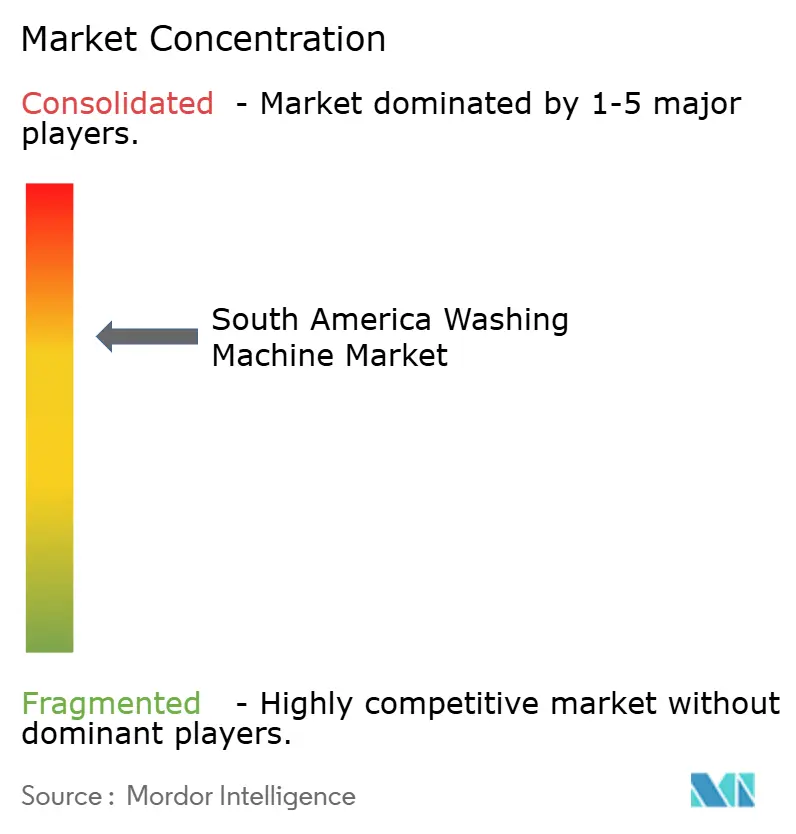
| Market Concentration | Medium |
Major Players *Disclaimer: Major Players sorted in no particular order Image © Mordor Intelligence. Reuse requires attribution under CC BY 4.0. | |
South America Washing Machine Market Analysis by Mordor Intelligence
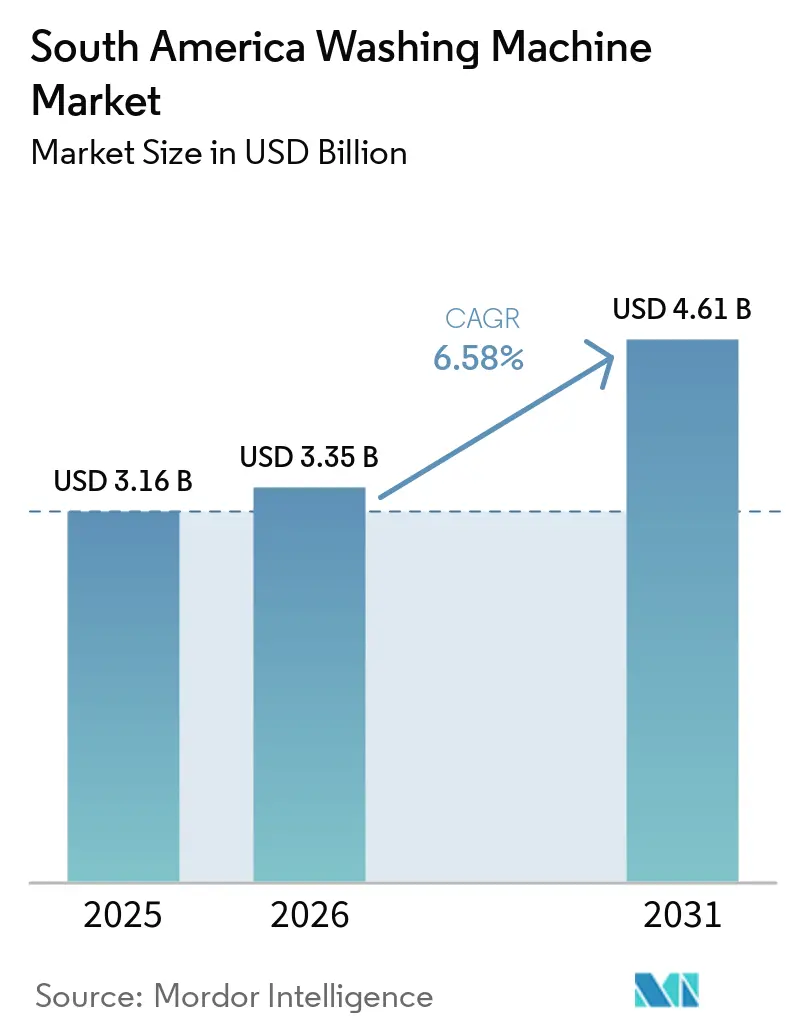
The South America washing machine market size was valued at USD 3.16 billion in 2025 and estimated to grow from USD 3.35 billion in 2026 to reach USD 4.61 billion by 2031, at a CAGR of 6.5% during the forecast period from 2026 to 2031. Replacement demand is becoming a dependable source of sales in Brazil, where many household appliances have been in use for more than 6 years [1]Government of Brazil, “Em Rio Claro SP Alckmin Destaca Expansão da Whirlpool como Exemplo da Nova Indústria Brasil,” Palácio do Planalto, gov.br.. The South America washing machine market is also supported by households moving toward larger, automatic, and energy-efficient appliances. Local manufacturing investment is changing the supply position, as it can improve component availability and shorten delivery times for new models. Companies are responding through connected products, local production plans, and service arrangements for commercial buyers. Economic uncertainty, uneven credit access, and lower-priced semi-automatic or used machines continue to limit demand in several countries.
Key Report Takeaways
- By product type, front-load machines held 38.1% revenue share in 2025, while twin-tub machines are forecast to grow at a 7.2% CAGR through 2031.
- By capacity, the 5-8 kg category held 47.8% of revenue in 2025, while above 8 kg machines are forecast to expand at an 8.5% CAGR through 2031.
- By technology, smart and connected IoT machines held 65.1% of revenue in 2025 and were the fastest-growing technology category through 2031.
- By end user, residential machines held 68.9% of revenue in 2025, while commercial machines are forecast to grow at an 8.1% CAGR through 2031.
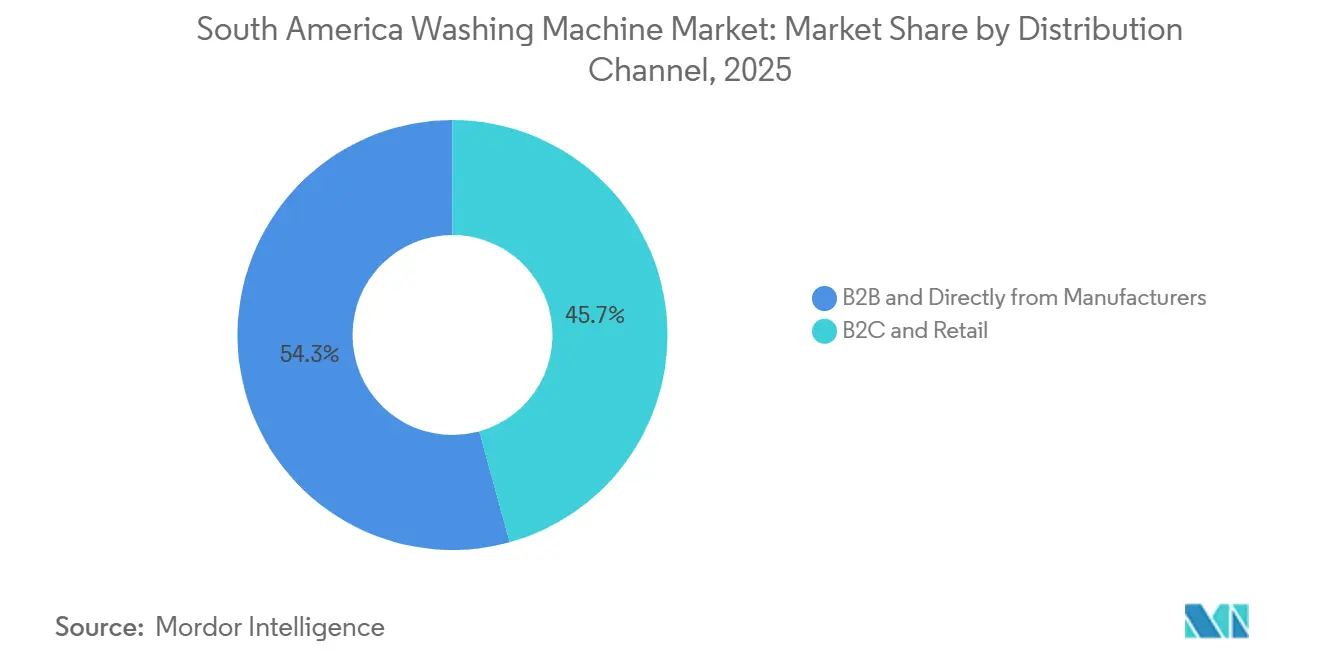
- By distribution channel, B2C and retail held 45.7% of revenue in 2025, while B2B and direct manufacturer channels are forecast to grow at an 8.2% CAGR through 2031.
Note: Market size and forecast figures in this report are generated using Mordor Intelligence’s proprietary estimation framework, updated with the latest available data and insights as of January 2026.
South America Washing Machine Market Trends and Insights
Drivers Impact Analysis*
| Driver | (~) % Impact on CAGR Forecast | Geographic Relevance | Impact Timeline |
|---|---|---|---|
| Replacement Demand and Appliance Upgrades | +1.3% | Brazil, Chile, and Argentina | Short term (≤ 2 years) |
| Automatic and Larger-Capacity Machine Adoption | +1.2% | Brazil, Chile, and Peru | Medium term (2-4 years) |
| E-Commerce, Retail Financing, and Digital Payments | +1% | Brazil, Chile, and Peru | Short term (≤ 2 years) |
| Energy Efficiency Standards and Utility Cost Preferences | +0.7% | Brazil, Chile, and Argentina | Medium term (2-4 years) |
| Local Manufacturing and Import Substitution | +0.9% | Brazil and Argentina | Long term (≥ 4 years) |
| Demand for Washer-Dryer Combinations | +0.5% | Brazil and Chile | Medium term (2-4 years) |
| Source: Mordor Intelligence | |||
Rising Replacement Demand and Appliance Upgrades
Replacement purchases are increasingly important to the South America washing machine market. Brazil already has widespread appliance ownership in urban areas, so many purchases replace existing units instead of serving first-time owners. Government reporting on Whirlpool’s investment stated that many major appliances in Brazil have been used for more than 6 years. This creates a recurring base of demand that is less dependent on new household formation. Customers replacing older semi-automatic or top-load models can also choose front-load machines with larger drums and lower energy use. In Chile, replacement demand is more focused on premium front-load and washer-dryer products.
The replacement cycle gives producers a reason to refresh products and improve service coverage. It supports sales even when household income growth is uneven. This pattern favors companies that can supply spare parts and arrange service quickly. It also raises the value of product features that lower water and electricity use over the life of a machine. Retail financing remains important because an upgrade can cost more than a basic replacement. The South America washing machine market, therefore, depends on both product availability and the ability of buyers to spread the purchase cost.
Growth of Automatic and Larger-Capacity Machines
The South America washing machine market is moving from semi-automatic products toward automatic machines. Local production plans by major manufacturers can reduce the cost gap between entry-level automatic and semi-automatic units. Above 8 kg machines are the fastest-growing capacity category, with an 8.5% CAGR through 2031. These machines meet the needs of larger households and commercial laundry operators. Higher capacity also lets households complete fewer wash cycles each week. This makes larger machines more attractive where family laundry volumes are high.
Samsung expanded its Brazilian top-load range with 14 kg, 17 kg, and 23 kg models. The range shows that suppliers are serving both household and higher-throughput use cases. As automatic ownership rises, repair networks may need more training for electronic controls and connected appliances. Semi-automatic machines still meet a practical need where budgets are limited, and installation conditions are less reliable. The shift will therefore vary by income level and location. The South America washing machine industry continues to include both basic and advanced appliance formats.
Expansion of E-Commerce, Retail Financing, and Instant Payments
Digital commerce is widening the routes through which households can compare and purchase appliances. The South America washing machine market benefits when retailers can combine product listings, delivery, and financing in one transaction. Brazil’s retail networks remain important because washing machines need delivery and installation support. Digital payments can reduce friction at checkout for customers considering mid-priced products. They can also allow manufacturers to run promotions across several retail partners. The effect is strongest where online commerce is paired with practical payment options.
Retailers and manufacturers are using online channels to reach buyers outside large store catchments. This can improve access in secondary cities, although delivery and service coverage remain necessary. Electrolux offered Pix cashback of up to BRL 2,570 on selected appliances during its November 2025 Black Friday campaign. Such campaigns show how brands can influence the purchase decision even when a retailer completes the sale. Online sales are particularly useful for connected machines, where product specifications can be explained in detail. The South America washing machine market still requires physical service capability after the transaction.
Energy-Efficiency Standards and Lower-Utility-Cost Preferences
Energy use has become an important factor in appliance selection across South America. Brazil requires automatic washing machines to carry the National Energy Conservation Label under the Brazilian Energy Labeling Program. The label gives consumers a clear basis for comparing energy performance. It also encourages manufacturers to update motors, controls, and wash programs. Products that reduce operating costs can have greater appeal when household budgets are under pressure. Energy efficiency is therefore part of product design as well as retail communication.
Electrolux registered 2 new 12 kg front-load models in Brazil during November 2025, and both held an A energy rating [2]Instituto Nacional de Metrologia, Qualidade e Tecnologia, “Tabelas de Eficiência Energética para Lavadoras de Roupa,” INMETRO, inmetro.gov.br.. The registrations show that compliance requirements are influencing product renewal. Brands that offer efficient models can compete for customers seeking lower running costs. The focus on efficiency also supports demand for front-load machines and inverter-based systems. These features can strengthen premium positioning, but they must be supported by a price that households can finance. The South America washing machine market will continue to connect appliance performance with monthly utility costs.
Restraints Impact Analysis*
| Restraint | (~) % Impact on CAGR Forecast | Geographic Relevance | Impact Timeline |
|---|---|---|---|
| Inflation, Currency Volatility, and Consumer Credit Costs | -1.1% | Argentina, Brazil, and Peru | Short term (≤ 2 years) |
| Competition from Semi-Automatic and Used Appliances | -0.6% | Brazil, Argentina, and other South American markets | Medium term (2-4 years) |
| Uneven After-Sales Service and Parts Coverage | -0.4% | Peru and other South American markets | Long term (≥ 4 years) |
| Cross-Border Arbitrage and Import Policy Volatility | -0.5% | Argentina, Brazil, border areas, and other South American markets | Medium term (2-4 years) |
| Source: Mordor Intelligence | |||
Inflation, Currency Volatility, and Consumer-Credit Costs
Economic conditions remain a restraint on household appliance spending, especially in Argentina. Argentina’s real GDP grew 4.4% in 2025, although the OECD noted weak industrial capacity use and declining consumer confidence [3]Organisation for Economic Co-operation and Development, “OECD Economic Outlook Volume 2026 Issue 1 Argentina,” OECD Publishing, oecd.org.. This limits the extent to which improved activity translates into steady appliance purchases. High borrowing costs can delay the replacement of working appliances. Currency weakness can also reduce real purchasing power even when nominal incomes increase. These pressures affect higher-priced automatic and connected models most directly.
Credit availability differs across the region, which makes demand less predictable. Consumers may choose to repair an existing unit or purchase a lower-cost product when installments are expensive. In Argentina, changes in import conditions may improve availability, but exchange-rate movements can offset the price benefit. Cross-border trade can also create uneven pricing between neighboring areas. Manufacturers need flexible pricing and service policies to manage these conditions. The South America washing machine market remains exposed to both consumer confidence and financing conditions.
Competition from Semi-Automatic and Used Appliances
Semi-automatic and used machines remain practical alternatives for price-sensitive households. Their lower purchase cost is especially relevant in Brazil’s northeast and in lower-income urban and rural areas. These products can be suitable where water supply, space, or installation conditions are uneven. Used-appliance marketplaces also make second-hand units easier to find across a wider geography. This limits the immediate migration to fully automatic machines. The South America washing machine industry must continue to serve buyers with very different budgets.
Service and parts coverage are also uneven outside major cities. This can make a local brand or a simple semi-automatic design more attractive than a complex imported product. Import-policy changes and cross-border pricing differences can add uncertainty for retailers and buyers. Stronger retail credit and local production could reduce some of these constraints over time. However, entry-level demand will remain sensitive to the upfront price during the forecast period. Producers need product lines that match local income, service, and infrastructure conditions.
*Our forecasts treat driver/restraint impacts as directional, not additive. The impact forecasts reflect baseline growth, mix effects, and variable interactions.
Segment Analysis
By Product Type: Front-Load Machines Lead While Twin-Tub Machines Serve Entry-Level Demand
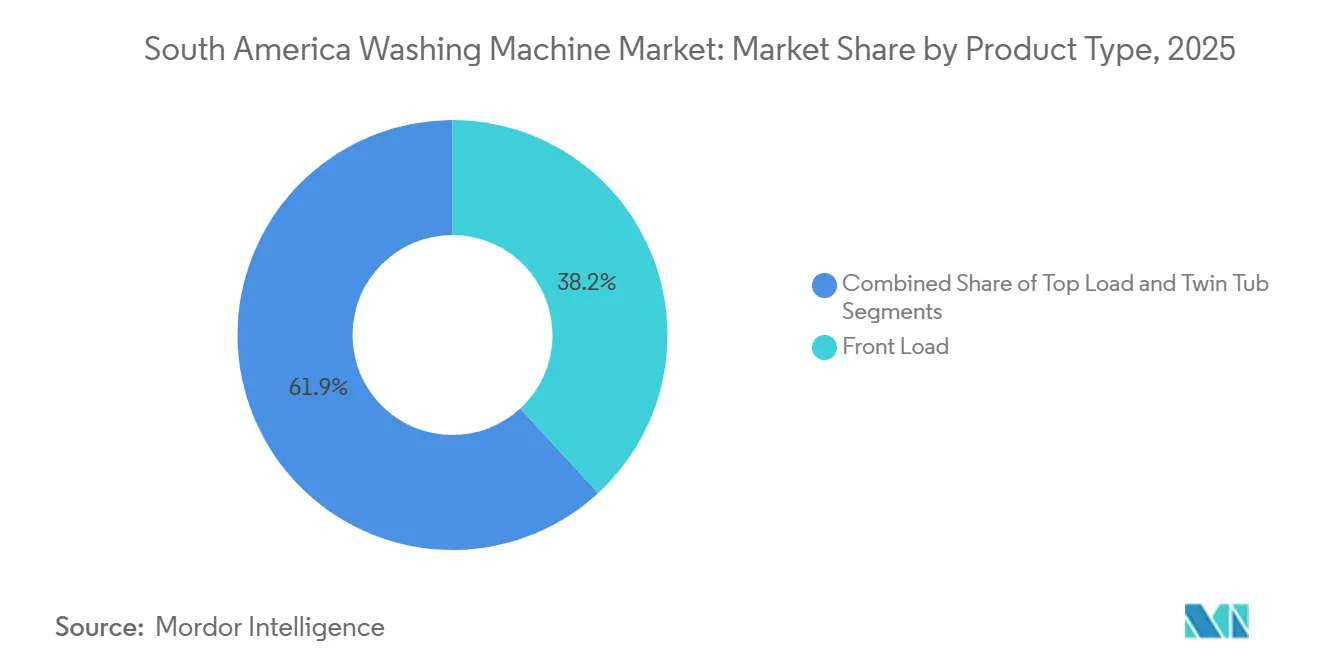
Front-load machines held 38.1% of the South America washing machine market share in 2025. Their position reflects consumer interest in efficient water use, compact layouts, and larger drum options. Front-load formats align well with energy-labeling requirements in Brazil. They are also part of the replacement path for households moving beyond basic top-load models. Samsung’s Brazilian portfolio includes larger top-load models for buyers who prefer that format [4]Samsung Electronics, “Samsung Amplia Portfólio de Lavadoras com Três Novos Modelos de Abertura Superior no Brasil,” Samsung Newsroom Brasil, news.samsung.com.. Top-load products, therefore, continue to serve rural, lower-income, and higher-capacity needs.
Twin-tub machines are forecast to grow at a 7.2% CAGR through 2031. Their growth reflects continued first-time buying in places where fully automatic units remain less affordable. The products also fit households that prioritize a lower initial purchase cost. This does not mean that automatic technology is losing relevance. It shows that different buyer groups are entering the category through different price points. Manufacturers need to retain basic models while building pathways toward automatic upgrades. Both replacement demand and first-time ownership will therefore shape the South America washing machine market size for front-load and twin-tub products.



By Capacity: The 5-8 kg Band Leads While Above 8 kg Machines Expand Faster
The 5-8 kg band accounted for 47.8% of regional revenue in 2025. This capacity fits standard household laundry volumes in Brazil and Chile. It is also a practical step up for households replacing smaller units. The band provides a balance between purchase price, load size, and space requirements. As a result, it remains the center of household demand across much of the region. Its broad relevance helps retailers maintain a wide selection of models in this range.
Above 8 kg machines are forecast to grow at an 8.5% CAGR through 2031. Larger families can use these machines to reduce the number of weekly cycles. Hotels, guesthouses, and laundry services can also use them to increase throughput. Samsung’s 14 kg, 17 kg, and 23 kg top-load additions show the importance of this demand. Below 5 kg machines still serve compact homes and student accommodation. Their outlook is constrained as 5-8 kg entry models become more accessible. The South America washing machine market size for machines above 8 kg reflects household upgrading and commercial expansion.
By Technology: Connected IoT Machines Set the Direction for Product Development
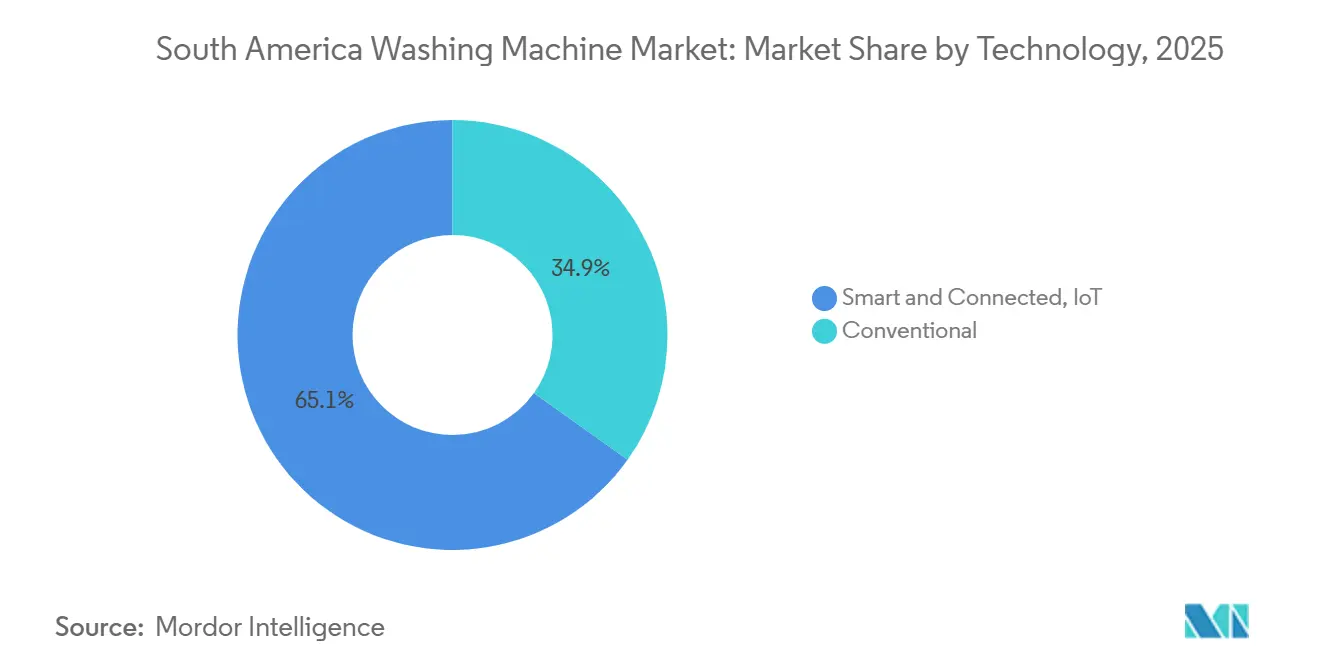
Smart and connected IoT machines held 65.1% of revenue in 2025. This made them the largest technology category in the South America washing machine market. Connectivity is increasingly being added to models that would previously have been positioned as mid-range products. This brings app control and cycle management to a broader set of buyers. It also allows suppliers to differentiate products through software features. The technology is most established in urban markets with stronger retail and digital access.
Connected machines were also the fastest-growing technology category through 2031. Samsung’s current connected product range includes features for energy management and appliance control. Conventional machines retain an important role in lower-priced and semi-automatic segments. The price gap between conventional and connected products will determine the pace of adoption. Product reliability and local service capacity are equally important for connected models. Buyers need clear support after installation. The South America washing machine industry is moving toward connectivity as a broader product standard rather than a feature reserved for premium models.
By End User: Residential Demand Leads While Commercial Demand Grows Faster
Residential machines accounted for 68.9% of revenue in 2025. Household replacement, smart-feature upgrades, and urban household formation support this large base. Residential buyers often consider design, capacity, price, and monthly running costs together. Retail financing remains central to this decision. Product availability through multi-brand retailers also supports residential sales. The segment provides the main volume base for manufacturers across the region.
Commercial machines are forecast to grow at an 8.1% CAGR through 2031. Hotels, guesthouses, formal laundry services, and shared facilities need reliable machines with higher throughput. These customers focus on operating cost, service reliability, and parts availability. Their purchasing process differs from a household purchase because long-term service arrangements have greater importance. Manufacturers with business-to-business support can be better positioned for this demand. The South America washing machine market needs products and service plans designed for both end-user groups.
By Distribution Channel: Retail Leads While B2B and Direct Sales Gain Ground
B2C and retail channels held 45.7% of revenue in 2025. Brazil’s multi-brand appliance retailers remain important because they offer financing, delivery, and local access. These channels are well-suited to bulky products that require transport and installation coordination. Online purchasing is increasingly part of the retail journey. It allows households to compare capacity, energy ratings, and connected features before buying. The South America washing machine market continues to depend on retailers for a broad household reach.
B2B and direct manufacturer channels are forecast to grow at an 8.2% CAGR through 2031. Commercial operators and housing projects can purchase directly when they need multiple machines and service support. Direct arrangements also give brands more control over maintenance and product training. Electrolux’s 2025 Pix cashback campaign showed how manufacturers can influence demand across retailer channels. Direct sales do not replace retailers, but they can complement them for specific customers. The distribution mix will change as commercial demand and connected-product service expand.
Geography Analysis
Brazil held 48.5% of the South America washing machine market share in 2025. Its size reflects a large installed appliance base, broad retail distribution, and growing local manufacturing investment. LG inaugurated a BRL 1.5 billion, USD 310 million home appliance factory in Paraná in August 2026. The facility is intended to support regional supply and plans washing machine production in a later phase. Whirlpool also committed more than BRL 300 million to local front-load component manufacturing at Rio Claro. These investments can improve parts supply and strengthen Brazil’s position as the region’s main production base.
Peru has a different demand profile, with greater scope for first-time ownership outside its main urban centers. Household washing machine penetration reached 30.3% nationally in 2024, while urban penetration was 97.4% and rural penetration was 2.6%. This divide makes urbanization important to the South America washing machine market in Peru. Chile has stronger digital access and more premium replacement demand. Its established retail conditions can support connected front-load and washer-dryer products. Argentina saw demand supported by improved product availability, but its outlook remains tied to real income, currency conditions, and access to consumer credit.
The Rest of South America includes countries with different infrastructure and income conditions. Colombia’s urban population represented 82% of the total population in 2024. Urban demand in Colombia supports appliance sales in Bogotá and Medellín. Bolivia and Paraguay retain more semi-automatic machine use where formal credit and electricity reliability are limited. Uruguay remains a smaller premium-oriented opportunity for energy-efficient front-load products. The South America washing machine market has a regional outlook, but country demand will depend on urban growth, distribution access, and household financing.
Competitive Landscape
The South America washing machine market includes Whirlpool, Electrolux, LG, Samsung, and Midea in the premium and mid-tier range. These brands compete through product features, retail reach, manufacturing position, and service coverage. Whirlpool’s investment in Rio Claro supports local front-load components and a more localized supply position. LG’s Paraná facility provides another example of regional manufacturing investment. These actions can improve availability and parts access. Local brands continue to compete through lower prices, proximity, and established service relationships in secondary markets.
Electrolux refreshed its Brazilian front-load range with 2 registered 12 kg models that achieved A energy ratings in 2025. The move supports competition around efficiency and product renewal. Samsung has broadened its larger-capacity lineup and introduced connected washer-dryer products in Brazil. These examples show that competitive strategies combine efficiency, capacity, and connected functionality. Companies also need strong service networks outside the largest metropolitan areas. This is particularly important for products with electronic controls and integrated drying functions.
The South America washing machine market remains moderately concentrated, with leading global brands holding strong positions but facing local and price-focused competition. Companies that can pair local supply with accessible financing can serve a wider share of demand. There is scope for suppliers serving commercial laundry operators in secondary cities. Compact washer-dryer models can also address demand from smaller urban homes. Lower-water-use products may be relevant in Andean locations where water conditions influence appliance use. Competitive outcomes will depend on whether companies can match product price, service, and local operating conditions.
South America Washing Machine Industry Leaders
Whirlpool Corporation
Electrolux AB
LG Electronics Inc.
Samsung Electronics Co., Ltd.
Midea Group Co., Ltd.
- *Disclaimer: Major Players sorted in no particular order

Recent Industry Developments
- August 2026: LG Electronics inaugurated its new home appliance plant in Fazenda Rio Grande, Paraná, Brazil, representing an investment of USD 310 million, BRL 1.5 billion. The 770,000-square-meter facility initially produces 600,000 refrigerators annually, with washing machine production planned in a second phase. The plant is designed as a strategic regional export hub for South America, with logistics advantages for Chile, Peru, and Argentina.
- August 2026: Samsung showcased the Smart AI Control WD13FG washer-dryer, 13 kg wash and 8 kg dry, priced from BRL 4,899, and the Bespoke AI Laundry premium set at The Brief event in São Paulo. The WD13FG integrates microplastics-reduction technology, AI-optimized energy consumption, and SmartThings connectivity.
- May 2026: Whirlpool announced an investment of more than BRL 300 million to localize front-load washing machine component manufacturing at its Rio Claro, São Paulo facility. The program involved transferring Argentine washing machine production from the Pilar, Buenos Aires plant to Brazil and targeted a production start by September 2026.
- November 2025: Electrolux registered 2 new 12 kg front-load washing machine models, LFB12 and LFC12, with INMETRO in Brazil. Both achieved energy class A under the ENCE labeling framework, indicating a portfolio refresh aligned with efficiency standards.


South America Washing Machine Market Report Scope
| Front Load | With Dryers |
| Without Dryers | |
| Top Load | With Dryers |
| Without Dryers | |
| Twin Tub |
| Below 5 kg |
| 5–8 kg |
| Above 8 kg |
| Conventional |
| Smart and Connected, IoT |
| Residential |
| Commercial |
| B2C and Retail | Multi-Brand Stores |
| Exclusive Brand Outlets | |
| Online | |
| Other Distribution Channels | |
| B2B and Directly from Manufacturers |
| Brazil |
| Peru |
| Chile |
| Argentina |
| Rest of South America |
| By Product Type | Front Load | With Dryers |
| Without Dryers | ||
| Top Load | With Dryers | |
| Without Dryers | ||
| Twin Tub | ||
| By Capacity | Below 5 kg | |
| 5–8 kg | ||
| Above 8 kg | ||
| By Technology | Conventional | |
| Smart and Connected, IoT | ||
| By End-User | Residential | |
| Commercial | ||
| By Distribution Channel | B2C and Retail | Multi-Brand Stores |
| Exclusive Brand Outlets | ||
| Online | ||
| Other Distribution Channels | ||
| B2B and Directly from Manufacturers | ||
| By Geography | Brazil | |
| Peru | ||
| Chile | ||
| Argentina | ||
| Rest of South America | ||


Key Questions Answered in the Report
What is the 2026 size of the South America washing machine market?
The sector is estimated at USD 3.35 billion in 2026 and is forecast to reach USD 4.61 billion by 2031.
What is driving washing machine demand in South America?
Replacement purchases, larger automatic machines, energy efficiency, digital retail, and local manufacturing investment support demand.
Which product type led sales in 2025?
Front-load machines led product revenue with a 38.1% share in 2025.
Which capacity category is growing fastest?
Above 8 kg machines are forecast to grow at an 8.5% CAGR through 2031.
Why is Brazil important for appliance suppliers?
Brazil accounted for 48.5% of the regional value in 2025 and is receiving major local manufacturing investment from LG and Whirlpool.
Which end-user group is expanding fastest?
Commercial users are forecast to grow at an 8.1% CAGR through 2031 as hospitality and formal laundry services expand.
Page last updated on:





