
Market Overview
| Study Period | 2020 - 2031 |
|---|---|
| Forecast Data Period | 2026 - 2031 |
| Base Year Market Size (2025) | USD 0.85 Billion |
| Market Size (2026) | USD 1.06 Billion |
| Market Size (2031) | USD 2.31 Billion |
| Growth Rate (2026 - 2031) | 16.86 % |
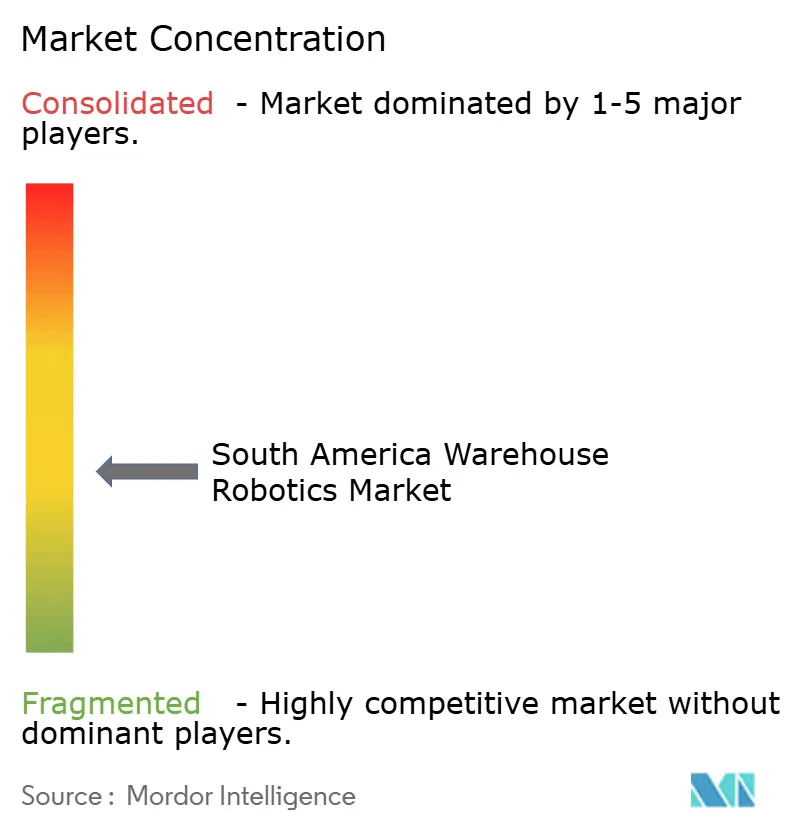
| Market Concentration | Medium |
Major Players *Disclaimer: Major Players sorted in no particular order Image © Mordor Intelligence. Reuse requires attribution under CC BY 4.0. | |
South America Warehouse Robotics Market Analysis by Mordor Intelligence
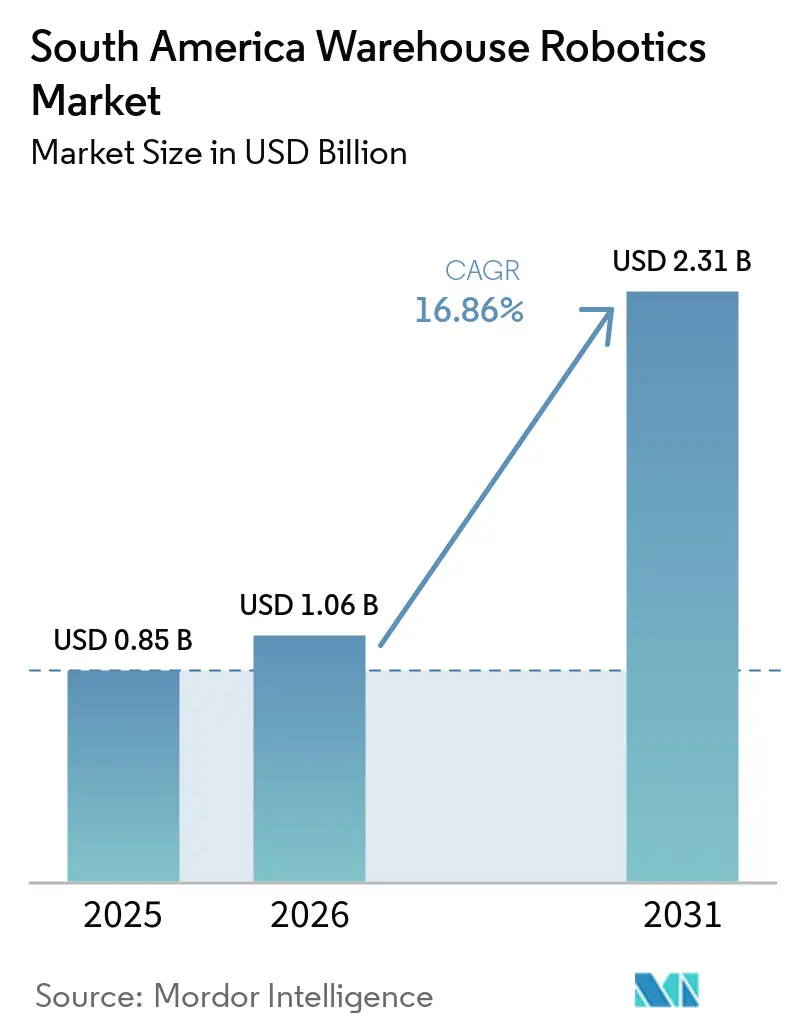
The South America warehouse robotics market size was valued at USD 0.85 billion in 2025 and estimated to grow from USD 1.06 billion in 2026 to reach USD 2.31 billion by 2031, at a CAGR of 16.86% during the forecast period (2026-2031). The South America warehouse robotics market is gaining momentum as e-commerce operators expand fulfillment capacity and seek higher throughput from existing sites. Rising labor costs, limited labor availability, and more complex order profiles are also raising the value of automation across large distribution centers. Mobile robots and modular systems are well-suited to the region's large stock of operating warehouses because they can be deployed without extensive building modifications. Global suppliers are responding by partnering with local integrators that combine robotic equipment with regional racking, installation, and service support. The South America warehouse robotics market also presents an opening among mid-sized logistics providers that face rising order volumes but cannot fund large greenfield projects.
Key Report Takeaways
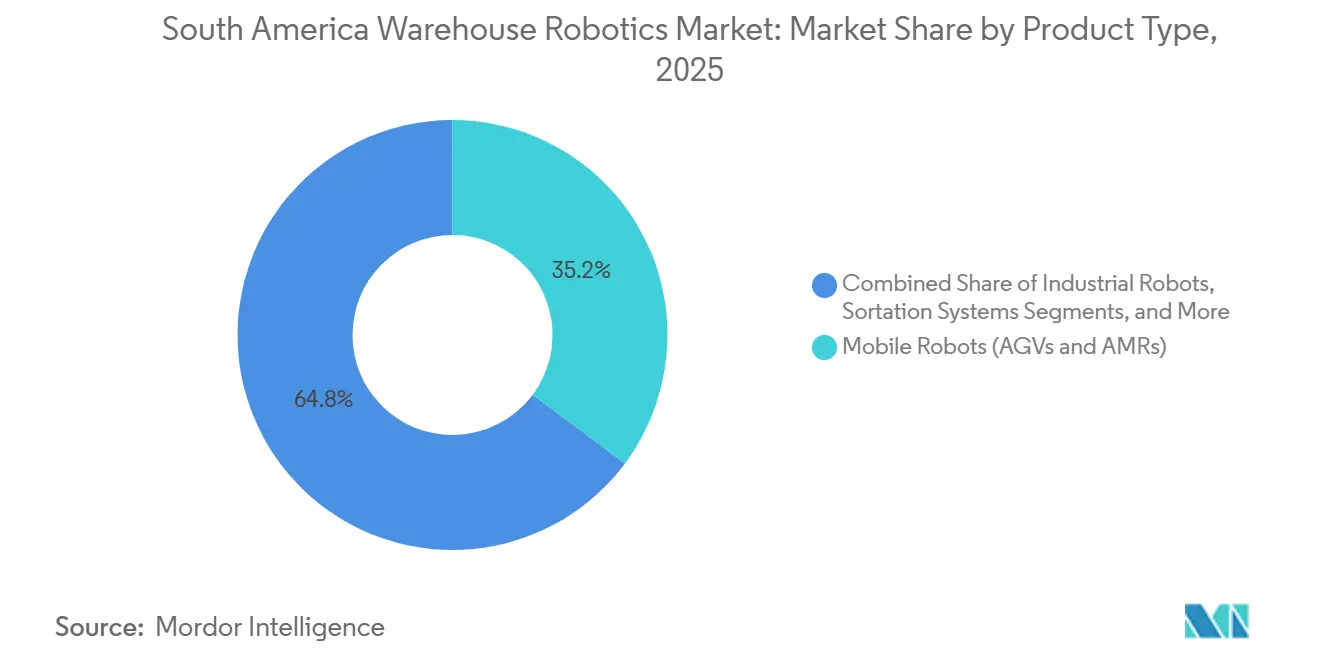
- By product type, mobile robots, including AGVs and AMRs, held 35.19% of the South America warehouse robotics market share in 2025, while automated storage and retrieval systems are projected to expand at a 17.89% CAGR through 2031.
- By function, storage accounted for 40.16% of the South America warehouse robotics market size in 2025, while packaging is projected to expand at an 18.66% CAGR through 2031.
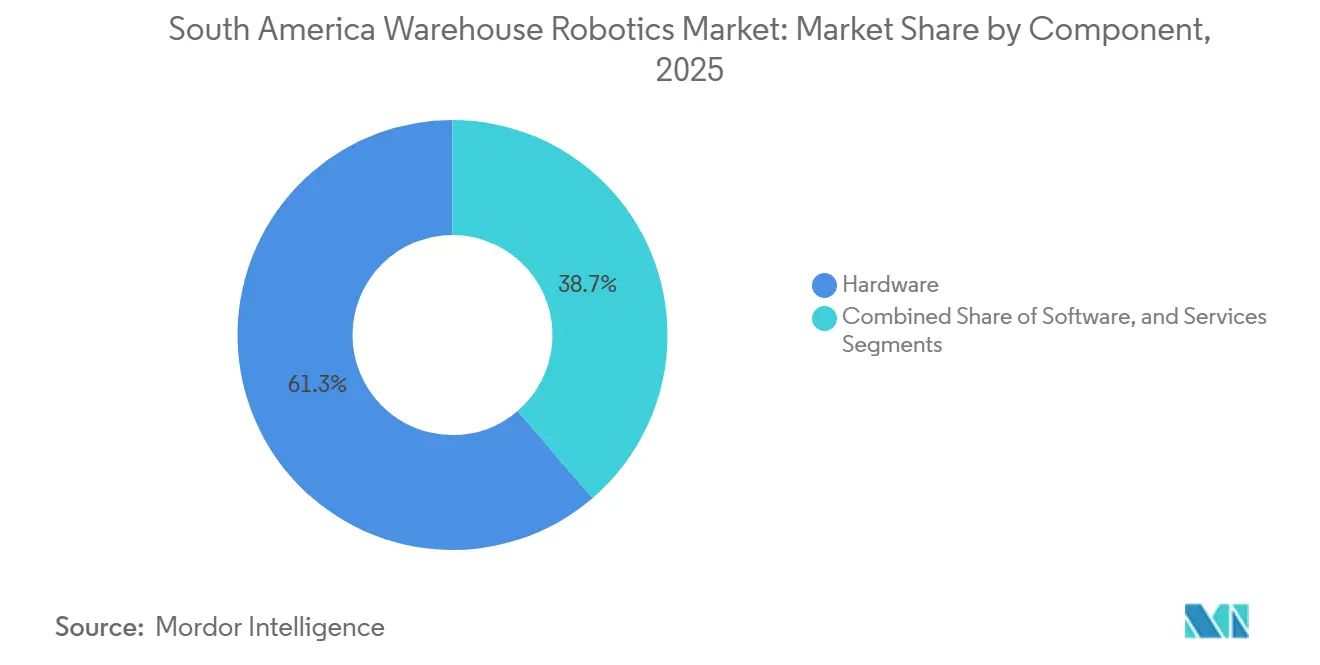
- By component, hardware held 61.28% of the South America warehouse robotics market revenue share in 2025, while software is projected to expand at a 17.86% CAGR through 2031.
- By end-user, retail and e-commerce held 36.21% of the South America warehouse robotics market revenue share in 2025, while pharmaceuticals and healthcare are projected to expand at a 17.43% CAGR through 2031.
- By geography, Brazil held 48.29% revenue share in 2025, while Colombia is projected to expand at an 18.23% CAGR through 2031.
Note: Market size and forecast figures in this report are generated using Mordor Intelligence’s proprietary estimation framework, updated with the latest available data and insights as of January 2026.
Market Trends and Insights
Drivers Impact Analysis of South America Warehouse Robotics Market*
| Driver | (~) % Impact on CAGR Forecast | Geographic Relevance | Impact Timeline |
|---|---|---|---|
| E-Commerce Fulfillment Expansion | +5.2% | Brazil and Chile core, with spillover to Argentina and Colombia | Short term (≤ 2 years) |
| Rising Warehouse Labor Costs and Availability Constraints | +3.5% | Brazil, Chile, and Argentina | Medium term (2-4 years) |
| SKU Proliferation and Omnichannel Order Complexity | +2.2% | Brazil core, with spillover to Colombia and Chile | Medium term (2-4 years) |
| Flexible AMR and Modular Automation Adoption | +2.0% | Brazil and Chile core, expanding to Colombia and Argentina | Medium term (2-4 years) |
| Brownfield Warehouse Modernization | +1.5% | Brazil and Argentina | Medium term (2-4 years) |
| Pharmaceutical Traceability and Temperature-Controlled Handling | +1.0% | Brazil, Colombia, and Chile | Long term (≥ 4 years) |
| Source: Mordor Intelligence | |||
E-Commerce Fulfillment Expansion
Mercado Libre announced more than USD 15 billion in regional investment for 2026, including BRL 57 billion (USD 10.9 billion) in Brazil, USD 3.4 billion in Argentina, USD 750 million in Chile, and USD 600 million in Colombia. The Brazil program includes 14 new distribution centers, which creates demand for sortation, mobile picking, and automated storage systems. The South America warehouse robotics market benefits when these projects move from construction plans to equipment procurement. Mercado Libre's warehouse software and execution systems create an integration reference point for providers seeking fulfillment contracts. Other retailers are also advancing automation to maintain order speed and service levels as Mercado Libre expands. This investment cycle favors suppliers that can support multiple sites with local installation and service capacity.
Rising Warehouse Labor Costs and Availability Constraints
Labor costs and worker availability are making automation more relevant for warehouse operators in Brazil, Chile, and Argentina. Chile's move to a 42-hour workweek in April 2026 increased attention on the cost of labor-intensive logistics activities. In Brazil, rising industrial labor costs have strengthened the case for AMR and ASRS installations in manufacturing and logistics centers. Argentina presents a more challenging environment because the cost of imported equipment constrains the financial appeal of automation. Chile has broader connectivity readiness for fleet management, supported by its fiber network and growing data-center capacity. The South America warehouse robotics market, therefore, favors solutions that reduce repetitive work while remaining practical to implement and maintain locally.
SKU Proliferation and Omnichannel Order Complexity
A wider range of products and sales channels is changing how distribution centers manage picking, packing, and order consolidation. This complexity is encouraging the use of pick-to-wall and goods-to-person systems in the South America warehouse robotics market. Addverb installed 125 robotic sorters at Mercado Libre's São Paulo sortation center, where the system handled 5,000 sorts per hour with 99.99% order accuracy.[1]Addverb Technologies, “Sortation Center for an E-Commerce Player, Brazil,” Addverb Technologies, addverb.com The deployment replaced a manual pick-to-wall process and demonstrated the expected performance scale at high-volume sites. Walmart Chile is investing USD 200 million to expand its Lo Aguirre distribution center and deploy more than 1,400 autonomous robots, making it a facility that handles more than 310,000 cases each day. These projects show why retailers are linking robotics investment to greater order variety, faster processing, and more consistent fulfillment quality.
Flexible AMR and Modular Automation Adoption
AMRs are suited to existing warehouses because they can operate without the fixed infrastructure required by some storage systems. In Brazil, AMRs are projected to represent more than 60% of new intralogistics automation deployments by the end of 2026. The South America warehouse robotics market is responding to this preference for staged investment and shorter commissioning periods. Geekplus partnered with Mindugar in May 2026 to offer Shelf-to-Person and Tote-to-Person systems with region-specific racking for distribution centers. Bertolini also incorporated Geekplus mobile robot technology into its intralogistics offering for retail, e-commerce, distribution, and logistics clients. These arrangements reduce the disruption and integration burden for operators modernizing active warehouses.
Restraints Impact Analysis of South America Warehouse Robotics Market*
| Restraint | (~) % Impact on CAGR Forecast | Geographic Relevance | Impact Timeline |
|---|---|---|---|
| High Upfront Investment and Extended Payback Periods | -2.5% | Brazil, Colombia, and Argentina | Medium term (2-4 years) |
| Integration Complexity With Legacy WMS and Facility Infrastructure | -1.8% | Brazil core and Colombia | Medium term (2-4 years) |
| Shortage of Robotics Technicians and Local Service Capacity | -1.3% | Argentina, Colombia, and Rest of South America | Long term (≥ 4 years) |
| Currency Volatility and Imported Component Exposure | -1.0% | Argentina and Brazil | Short term (≤ 2 years) |
| Source: Mordor Intelligence | |||
High Upfront Investment and Extended Payback Periods
Warehouse robotics projects can carry high initial costs because imported components, freight, and local implementation work add to the equipment price. The cost burden is particularly important for mid-sized operators with lower throughput or seasonal demand. Longer payback periods can delay projects even where the operational case for automation is clear. Robotics-as-a-Service models can reduce capital requirements by combining robot fleets, software, and maintenance under an operating expense arrangement. These models have been more accessible to large Brazilian logistics operators with strong credit profiles. The South America warehouse robotics industry will need commercial models that make automation more attainable for smaller buyers without weakening service coverage.
Integration Complexity With Legacy WMS and Facility Infrastructure
Legacy enterprise resource planning and warehouse management systems can delay robotics projects when they lack the interfaces needed for real-time equipment control. This issue is important in the South America warehouse robotics market because many distribution centers use locally developed platforms. Colombian market analysis indicated that ASRS, AI-enabled WMS, and collaborative robotics were not yet standard in local distribution centers in 2026. Some Brazilian operators are replacing legacy WMS platforms as part of robotics programs rather than building new integration links. Comau acquired Invent Smart Intralogistics Solutions in July 2026 to add AI-based capabilities for order fulfillment, picking, sorting, and warehouse orchestration. Older facilities can also have limited column spacing, floor capacity, or ceiling clearance, which often makes AMRs more feasible than fixed ASRS installations.
*Our forecasts treat driver/restraint impacts as directional, not additive. The impact forecasts reflect baseline growth, mix effects, and variable interactions.
South America Warehouse Robotics Market Segment Analysis
By Product Type:
Mobile Robots Lead While ASRS Gains GroundMobile robots, including AGVs and AMRs, accounted for 35.19% of the product segment in 2025 because they can be retrofitted into existing warehouses without major structural work. Industrial robots serve precision tasks in automotive and electronics operations, while conveyors remain important in sustained food and beverage distribution lines. Sortation systems are seeing increased demand in e-commerce, and Addverb's São Paulo installation achieved 5,000 sorts per hour with 99.99% accuracy. Palletizers help manufacturers create consistent loads for transport across South America's fragmented road and rail network. The South America warehouse robotics market favors mobile robots when operators need flexibility inside active facilities.
ASRS is projected to grow at a 17.89% CAGR from 2026 to 2031. Stara's June 2025 AutoStore center in Brazil used 7 robots across 18,144 storage locations, dispatching up to 14,000 items daily. Cube storage can increase cubic utilization within existing building envelopes, which suits height-constrained industrial parks. Danich installed a high-density automated storage site for Empresas San Clemente's Chilean fruit operation in April 2026. These projects show adoption beyond traditional cold-chain and pharmaceutical applications.



By Function:
Storage Anchors Revenue While Packaging Leads GrowthStorage held 40.16% of revenue in 2025, supported by large fulfillment centers in Brazil and Chile that manage rising SKU counts. Emergent Cold LatAm opened a 33,000-pallet automated frozen-food storage facility in Santiago, showing growth in temperature-controlled and ambient applications. Trans-shipment automation is advancing alongside the cross-dock build-out in Brazil, Argentina, and Colombia. New cross-dock sites increasingly allow AMR movement rather than relying solely on forklift operations. The South America warehouse robotics market benefits as storage, staging, and dispatch functions become more connected.
Packaging is projected to grow at an 18.66% CAGR from 2026 to 2031 because smaller baskets and mixed-SKU orders increase outbound labor needs. Walmart Chile's Pudahuel expansion will integrate storage and packaging workflows at a 130,000 m² facility. The site will use around 2,300 robots across 4 models and process more than 310,000 cases daily. Infor Brasil projected 23% growth in Brazilian logistics technology investment during 2025, with automation receiving the largest allocation. Receiving automation and quality inspection can extend this progression as inbound logistics becomes more digital.
By Component:
Hardware Dominates While Software Investment AcceleratesHardware accounted for 61.28% of revenue in 2025, indicating that physical systems remain the first stage in many automation programs. AMR fleets, conveyors, and cube-storage structures account for this early spending, while services provide installation, integration, and long-term maintenance. Limited technician capacity makes bundled service agreements important for reliable deployment and recurring supplier revenue. Comau's July 2026 acquisition of Invent Smart added warehouse-software capabilities to its hardware-led portfolio. The South America warehouse robotics industry remains hardware-led, but customers increasingly expect implementation support and systems integration.
Software is projected to grow at a 17.86% CAGR from 2026 to 2031 as fleet management and warehouse execution systems reach mid-sized providers. These platforms offer a lower-capital entry point by coordinating work before customers invest in large fleets. Geekplus combines intelligent software with its Shelf-to-Person and Tote-to-Person systems in regional deployments. Brazil's logistics technology investment supports software growth as operations move beyond first-generation hardware programs. Providers need systems that integrate with local warehouse platforms and mixed-fleet equipment.
By End-User:
Retail and E-Commerce Leads While Pharmaceuticals and Healthcare ExpandsRetail and e-commerce held 36.21% of revenue in 2025, reflecting investment by high-throughput fulfillment operators. Mercado Libre's 2026 program includes 14 Brazilian distribution centers and a USD 115 million facility in Escobar, Argentina, with a total area exceeding 100,000 m². Food and beverage is the second-largest end-user vertical, with cold-chain investment increasing in Chile and Brazil. Bem Brasil invested BRL 45 million (USD 7.8 million) in a fully automated warehouse in Minas Gerais, using Mecalux technology. Automotive and electronics operators use robots, guided vehicles, storage systems, and conveyors to meet specialized material-handling needs.
Pharmaceuticals and healthcare are projected to grow at a 17.43% CAGR from 2026 to 2031. ANVISA's phased resumption of mandatory SNGPC reporting from September 2025 through January 2026 supports demand for traceable, controlled handling.[2]National Health Surveillance Agency, “SNGPC: Retorno da Transmissão Regular Obrigatória,” ANVISA, gov.br RD Saúde opened an automated Viana distribution center with AMRs and autonomous case-handling robots, processing 250,000 packages daily for 200 stores. Pharmaceutical operations need item-level traceability and temperature-deviation records alongside efficient material movement. The South America warehouse robotics market presents a clear opportunity where distribution expansion and compliance needs converge.
Geography Analysis
Brazil Warehouse Robotics Market
Brazil held 48.29% of regional revenue in 2025, making it the largest country in the South America warehouse robotics market, with deployments in e-commerce, agricultural parts distribution, and pharmaceutical logistics. Mercado Libre committed BRL 57 billion (USD 10.9 billion) to Brazil in 2026, including the construction of 14 new distribution centers. Brazil's intralogistics sector is projected to grow by up to 17% annually over the next 3-5 years. Suzano's 2025 AMR deployment for cellulose bale handling also shows automation spreading beyond retail and pharmaceuticals.
Chile and Argentina Warehouse Robotics Market
Chile is attracting dense investment, including Walmart's USD 200 million Pudahuel project, which will expand the site to 130,000 m² and use around 2,300 robots.[3]Chile's Foreign Investment Promotion Agency, “Walmart Invierte USD 200 Million para Ampliar su Centro Logístico en Pudahuel,” InvestChile, investchile.gob.cl Chile's tax treatment of automation and a shorter workweek supports its commercial case for investment. Argentina faces higher effective costs for imported robotic components. Mercado Libre's USD 3.4 billion investment in Argentina for 2026 shows that large operators can proceed despite that constraint. This contrast makes Argentina more dependent on well-capitalized buyers, while Chile has a stronger setting for large automated sites.
South America Warehouse Robotics Market
Colombia is projected to grow at an 18.23% CAGR from 2026 to 2031, the highest growth rate among countries in the region. Automation penetration below 20% leaves room for early vendors and partnerships with local integrators. Mercado Libre plans USD 600 million of Colombian investment in 2026, supporting a new fulfillment infrastructure cycle. AR Racking installed an AR Shuttle system at Global Trading de Colombia in 2025 and planned a broader rollout for 2026. Peru, Ecuador, Uruguay, Paraguay, and Bolivia remain earlier-stage markets tied to pharmaceutical cold chains, exports, and airport cargo modernization.
Competitive Landscape
The South America warehouse robotics market is moderately fragmented, with global technology suppliers competing alongside regional integrators. Geekplus uses a partnership-led approach through Mindugar and Bertolini Sistemas de Armazenagem. These alliances combine Shelf-to-Person and Tote-to-Person systems with racking designed for brownfield facilities. AutoStore has cube-storage installations in Brazilian agricultural and pharmaceutical settings, while Hai Robotics serves high-density pharmaceutical storage. Suppliers often enter through hardware and build longer-term software and fleet-management relationships.
The South America warehouse robotics market has openings among mid-sized Brazilian logistics providers, secondary-city networks, and pharmaceutical cold-chain facilities. These customers need tailored systems because standard large-format configurations may not suit their sites or budgets. Comau acquired 100% of Invent Smart Intralogistics Solutions in July 2026, adding warehouse orchestration, picking, sorting, and order fulfillment capabilities.[4]Comau, “Comau Has Acquired Invent Smart Intralogistics Solutions,” Comau, comau.com The transaction supports an integrated hardware-and-software model for mid-sized and large distribution centers. AutoStore and Symbotic provide benchmarks for integrated systems, while partnerships provide access to advanced picking and palletizing capabilities.
Berkshire Grey and Dexterity focus on AI-enabled picking and palletizing tasks that require more than transport or storage equipment. The South America warehouse robotics market is likely to favor providers that pair these capabilities with local implementation and service support. Local integrators understand building layouts, racking needs, and procurement practices. Flexible brownfield deployment, systems integration, and service coverage are becoming more important than equipment sales alone.
South America Warehouse Robotics Industry Leaders
Geekplus Technology Co., Ltd.
Exotec S.A.S.
Locus Robotics Corporation
GreyOrange, Inc.
AutoStore Holdings Ltd.
- *Disclaimer: Major Players sorted in no particular order
South America Warehouse Robotics Market Companies Covered in this Report
- Geekplus Technology Co., Ltd.
- Exotec S.A.S.
- Locus Robotics Corporation
- GreyOrange, Inc.
- Symbotic Inc.
- AutoStore Holdings Ltd.
- Hai Robotics Co., Ltd.
- Shanghai Quicktron Intelligent Technology Co., Ltd.
- Scallog SAS
- inVia Robotics, Inc.
- Vecna Robotics, Inc.
- Berkshire Grey, Inc.
- Magazino GmbH
- Addverb Technologies Private Limited
- ForwardX Robotics, Inc.
- Syrius Technology (Shenzhen) Co., Ltd.
- Mujin, Inc.
- IAM Robotics, Inc.
- Brightpick Technologies, s.r.o.
- Dexterity, Inc.

Recent Industry Developments in South America Warehouse Robotics Market
- July 2026: Comau completed the acquisition of 100% of Invent Smart Intralogistics Solutions, a São Paulo-based warehouse automation and intralogistics technology company. The transaction adds AI-driven logistics, intelligent warehouse orchestration software, picking, sorting, and order fulfillment capabilities to Comau's platform. Brazil's warehouse automation sector is projected to grow at up to 17% annually over the next 3-5 years, and the acquisition accelerates Comau's ability to serve mid-sized and large distribution centers in the country.
- May 2026: Geekplus Technology Co., Ltd. and Mindugar announced a strategic partnership to deploy integrated warehouse automation solutions across South American distribution centers, combining Geekplus's Shelf-to-Person systems, P800 and PopPick, and the Tote-to-Person RoboShuttle Plus with Mindugar's regional racking infrastructure. The partnership targets e-commerce, retail, and third-party logistics operators seeking scalable brownfield automation.
- April 2026: Mercado Libre announced total 2026 investments exceeding USD 15 billion across South America, including BRL 57 billion (USD 10.9 billion) in Brazil with 14 new distribution centers, USD 3.4 billion in Argentina, including a USD 115 million, 100,000 m² facility in Escobar, USD 750 million in Chile, and USD 600 million in Colombia. These investments are expected to drive multi-year procurement of robotics and fulfillment technologies.
- March 2026: Walmart Chile announced a USD 200 million expansion of its Pudahuel, Lo Aguirre, distribution center, doubling the facility to 130,000 m² and deploying around 2,300 robots across 4 model types. The project will increase daily case-processing capacity to more than 310,000 units, positioning it as Walmart's most technically advanced distribution center globally and the most automated distribution center in South American retail.


South America Warehouse Robotics Market Report Scope
The South America Warehouse Robotics Market comprises the revenue generated from the sale, deployment, integration, software licensing, maintenance, and support of robotic systems and automation solutions used within warehouses, fulfillment centers, distribution centers, and logistics facilities across South America. The market includes robotic hardware, software, and related services that automate storage, material handling, order fulfillment, packaging, sorting, and warehouse operations.
The South America Warehouse Robotics Market Report is Segmented by Product Type (Industrial Robots, Sortation Systems, Conveyors, Palletizers, Automated Storage and Retrieval Systems [ASRS], and Mobile Robots [AGVs and AMRs]), Function (Storage, Packaging, Trans-shipments, and Other Functions), Component (Hardware, Software, and Services), End-User (Retail and E-Commerce, Food and Beverage, Automotive, Pharmaceuticals and Healthcare, Electronics and Electrical Equipment, and Other End-Users), and Geography (Brazil, Argentina, Chile, Colombia, and Rest of South America). The Market Forecasts are Provided in Terms of Value (USD).
By Product Type
| Industrial Robots |
| Sortation Systems |
| Conveyors |
| Palletizers |
| Automated Storage and Retrieval System (ASRS) |
| Mobile Robots (AGVs and AMRs) |
By Function
| Storage |
| Packaging |
| Trans-shipments |
| Other Functions |
By Component
| Hardware |
| Software |
| Services |
By End-User
| Retail and E-Commerce |
| Food and Beverage |
| Automotive |
| Pharmaceuticals and Healthcare |
| Electronics and Electrical Equipment |
| Other End-Users |
By Country
| Brazil |
| Argentina |
| Chile |
| Colombia |
| Rest of South America |
| By Product Type | Industrial Robots |
| Sortation Systems | |
| Conveyors | |
| Palletizers | |
| Automated Storage and Retrieval System (ASRS) | |
| Mobile Robots (AGVs and AMRs) | |
| By Function | Storage |
| Packaging | |
| Trans-shipments | |
| Other Functions | |
| By Component | Hardware |
| Software | |
| Services | |
| By End-User | Retail and E-Commerce |
| Food and Beverage | |
| Automotive | |
| Pharmaceuticals and Healthcare | |
| Electronics and Electrical Equipment | |
| Other End-Users | |
| By Country | Brazil |
| Argentina | |
| Chile | |
| Colombia | |
| Rest of South America |


Key Questions Answered in the Report
What is the South America warehouse robotics market size?
The South America warehouse robotics market was valued at USD 0.85 billion in 2025 and is estimated at USD 1.06 billion in 2026. It is forecast to reach USD 2.31 billion by 2031 at a 16.86% CAGR, supported by fulfillment investment and modular automation adoption.
Which product category leads warehouse robotics adoption in South America?
Mobile robots, including AGVs and AMRs, led with 35.19% share in 2025 because they can be deployed in existing facilities with limited structural changes. The South America warehouse robotics market uses these systems where operators need staged investment, fast implementation, and minimal interruption to daily operations.
Which warehouse function is growing fastest in the region?
Packaging is projected to grow at an 18.66% CAGR through 2031 as retailers manage smaller orders, mixed-SKU baskets, and customized outbound workflows. The South America warehouse robotics market is also linking packaging equipment with storage and sortation systems to manage higher order variability.
Why are pharmaceutical distributors adopting warehouse robotics?
Pharmaceutical and healthcare applications are projected to grow at a 17.43% CAGR through 2031, supported by requirements for batch traceability and temperature monitoring. Automated systems also help distributors manage growing order volumes while maintaining controlled handling records across complex delivery networks.
Which country has the fastest projected growth for warehouse robotics?
Colombia is projected to grow at an 18.23% CAGR through 2031, supported by low automation penetration and rising fulfillment infrastructure investment. The South America warehouse robotics market has room for early providers that build local integrator relationships and responsive service coverage.
What challenges affect warehouse robotics projects in South America?
High upfront costs, legacy WMS integration, technician shortages, and currency exposure can slow projects, especially for smaller operators and imported systems. Providers that offer flexible financing, practical integration, and local maintenance support can reduce these barriers.
Page last updated on:





