
Market Overview
| Study Period | 2019 - 2031 |
|---|---|
| Forecast Data Period | 2026 - 2031 |
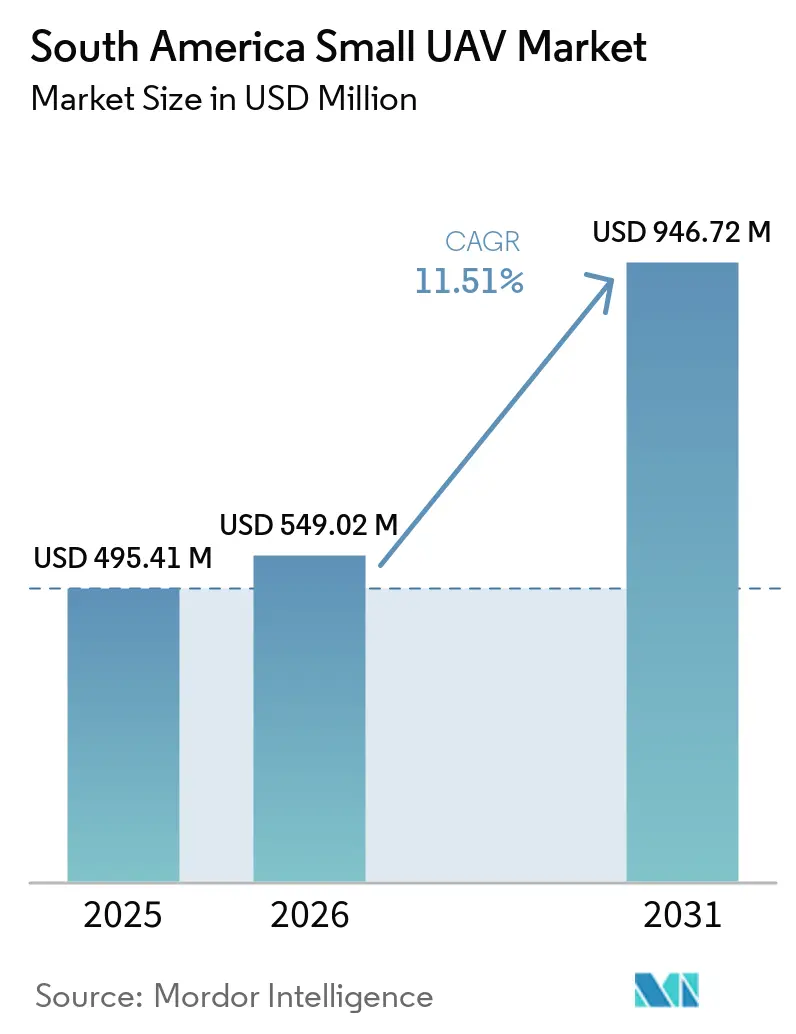
| Base Year Market Size (2025) | USD 495.41 Million |
| Market Size (2026) | USD 549.02 Million |
| Market Size (2031) | USD 946.72 Million |
| Growth Rate (2026 - 2031) | 11.51 % |
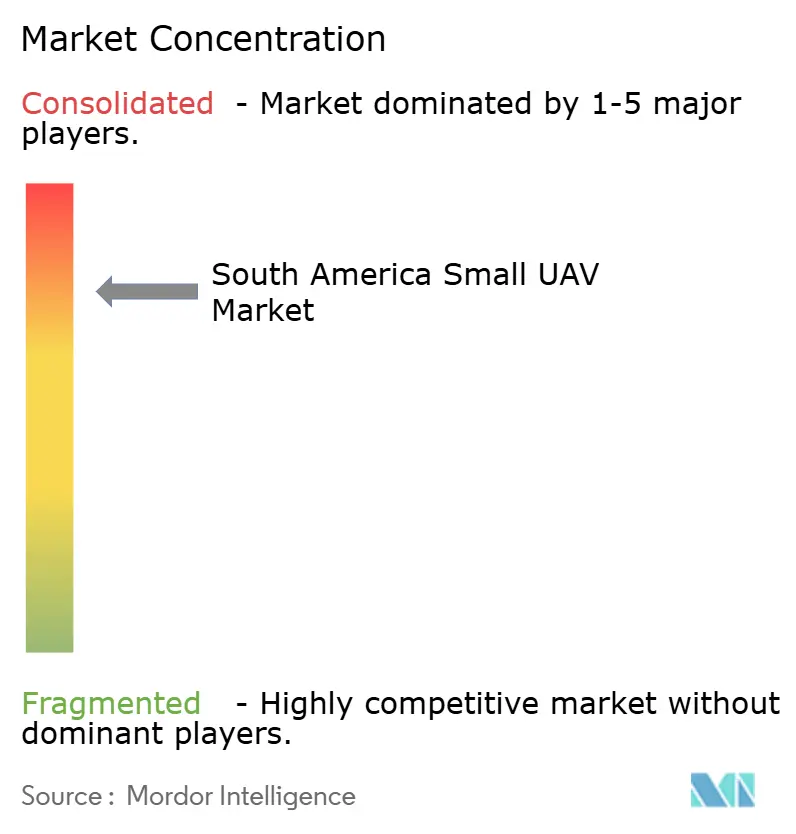
| Market Concentration | Medium |
Major Players *Disclaimer: Major Players sorted in no particular order Image © Mordor Intelligence. Reuse requires attribution under CC BY 4.0. | |
South America Small UAV Market Analysis by Mordor Intelligence
The South America small UAV market size was valued at USD 495.41 million in 2025, and is forecast to grow from USD 549.02 million in 2026 to reach USD 946.72 million by 2031, at an 11.51% CAGR during the forecast period (2026-2031). Demand is moving from periodic border patrols toward persistent surveillance across borders, waterways, forests, and remote terrain. Brazil and Colombia account for much of the near-term procurement activity because their security programs require regular intelligence collection. Local production is also becoming an increasingly important factor in procurement decisions, particularly where governments seek domestic capability and reduced dependence on imports. Export-control rules shape supplier selection and create room for Brazilian, Israeli, Turkish, and European systems that can meet local requirements. The South America small UAV market also faces uneven funding conditions, as fiscal pressure in Argentina and limited capital allocations in Peru can delay planned purchases.
Key Report Takeaways
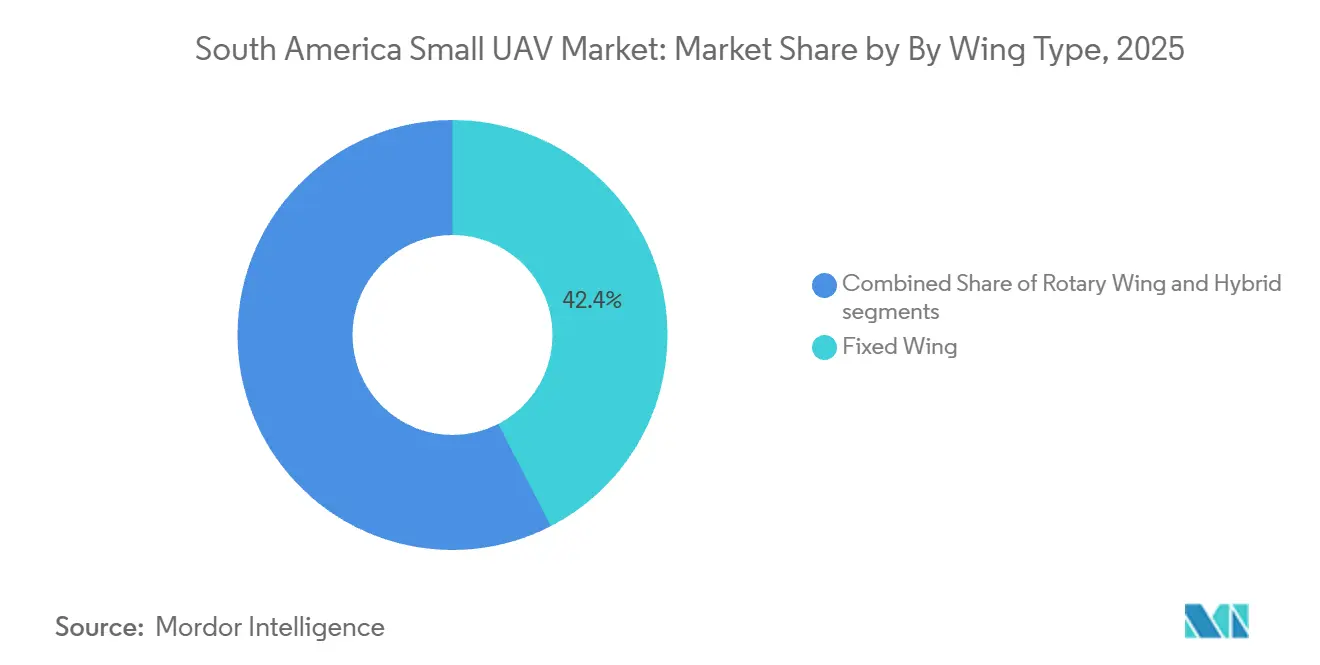
- By wing type, fixed-wing platforms held 42.44% of the South America small UAV market share in 2025, while hybrid platforms are projected to grow at a 12.67% CAGR through 2031.
- By size class, mini systems held 40.18% of revenue in 2025, while nano/micro systems are projected to grow at a 13.82% CAGR through 2031.
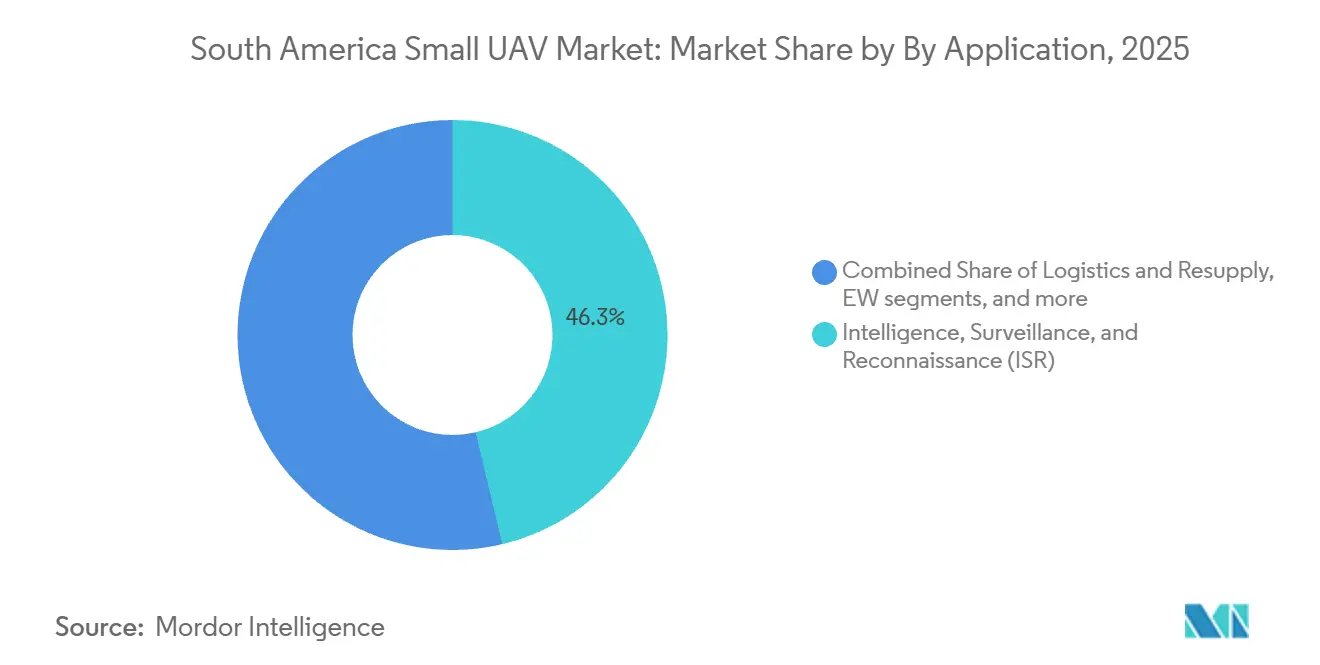
- By application, ISR accounted for 46.28% of revenue in 2025, while electronic warfare is projected to grow at a 13.29% CAGR through 2031.
- By propulsion type, batteries held 39.98% of revenue in 2025, while fuel cell systems are projected to grow at a 14.91% CAGR through 2031.
- By geography, Brazil held 41.93% of revenue in 2025, while Chile is projected to grow at a 13.55% CAGR through 2031.
Note: Market size and forecast figures in this report are generated using Mordor Intelligence’s proprietary estimation framework, updated with the latest available data and insights as of January 2026.
Market Trends and Insights
Drivers Impact Analysis of South America Small UAV Market*
| Driver | (~) % Impact on CAGR Forecast | Geographic Relevance | Impact Timeline |
|---|---|---|---|
| Defense modernization and tactical ISR demand | +2.80% | Brazil, Colombia, Chile | Long term (≥ 4 years) |
| Border, maritime, and Amazon basin surveillance requirements | +1.90% | Brazil, Colombia, Peru, Bolivia, and Amazon basin states | Medium term (2-4 years) |
| Indigenous South American development and local content objectives | +1.30% | Brazil, Colombia, Argentina, and Chile | Long term (≥ 4 years) |
| Counter-UAS and low-cost attritable-system requirements | +1.60% | Colombia, Brazil, and Argentina | Short term (≤ 2 years) |
| US security assistance and interoperability requirements | +1.10% | Colombia, Brazil, Peru, and Chile | Medium term (2-4 years) |
| Mountainous and remote-terrain operational access | +0.70% | Colombia, Peru, Bolivia, Chile, and Ecuador | Long term (≥ 4 years) |
| Source: Mordor Intelligence | |||
Defense Modernization and Tactical ISR Demand
South American armed forces are renewing equipment programs, with small UAVs supporting surveillance and operational coordination. Brazil’s Army has incorporated unmanned systems into exercises to address threats posed by remotely piloted aircraft. During the Operação Sagitta Primus, a major anti-aircraft exercise conducted by the Brazilian Army in July 2026, layered counter-RPAS procedures involving armored vehicles, signal jammers, and electronic response centers were tested. The exercise demonstrates the operational value of coordination among surveillance, electronic measures, and ground forces. ISR coverage supports identifying and tracking threats before a force commits other assets. These requirements support demand for systems that can provide persistent situational awareness across land, air, and electronic environments.
Border, Maritime, and Amazon Basin Surveillance Requirements
The Amazon basin has limited fixed infrastructure, which creates an ongoing need for mobile surveillance assets. Brazil’s Army Commander stated in June 2026 that border areas remain vulnerable without drone-led technology. CENSIPAM conducts small-UAV purchases for forest monitoring through Brazil’s federal procurement system. Colombia’s USD 300 million Atlante II contract for 16 ISR UAVs supports maritime, riverine, and border monitoring needs. The contract covers aircraft scheduled for delivery from 2027 to 2030, which extends demand beyond a single procurement year. The South America small UAV market, therefore, favors platforms that can operate across forest, riverine, and maritime settings.
Indigenous South American Development and Local Content Objectives
Brazil, Colombia, and Argentina are working to reduce reliance on imported UAV systems. Local programs affect vendor selection because governments increasingly assess industrial participation alongside technical performance. The Colombian Ministry of Defense introduced DRAGOM at F-AIR in July 2025 as a domestically developed reconnaissance and attack drone. The ministry stated that DRAGOM entered the operational inventory of Colombia’s Army, Navy, and Air Force.[1] Argentina’s INVAP and FAdeA are developing the IA-300 VTOL SVANT for the Army and Marine Corps. International suppliers may face weaker tender positions if they do not provide local production, technology participation, or domestic support arrangements.
Counter-UAS and Low-Cost Attritable-System Requirements
The increasing use of commercial drones by armed groups is driving demand for counter-drone equipment and low-cost unmanned platforms. Colombia’s National Anti-Drone Shield Project has a reported total budget of COP 6.2 trillion (USD 1.97 billion), with COP 1 trillion (USD 317.41 million) allocated for 2026. Colombia contracted USD 25 million of Dedrone Tactical systems by June 2026 to protect military bases. The program also included operational trials involving more than 100 companies from 21 countries across electronic and kinetic counter-drone methods.[2] Brazil integrated its domestic SCE 0100 anti-drone system into SISFRON in 2025. The South America small UAV market gains a related demand channel as electronic warfare measures increase the value of lower-cost, more replaceable unmanned vehicles.
Restraints Impact Analysis of South America Small UAV Market*
| Restraint | (~) % Impact on CAGR Forecast | Geographic Relevance | Impact Timeline |
|---|---|---|---|
| Procurement cycles and constrained defense budgets | -2.10% | Argentina, Peru, Bolivia, and the wider region | Short term (≤ 2 years) |
| Export controls, technology-transfer limits, and dependence on imported subsystems | -1.40% | Brazil, Colombia, and Chile | Medium term (2-4 years) |
| Shortage of military UAV operators, maintainers, and mission analysts | -0.90% | Region-wide, particularly Peru, Bolivia, and Ecuador | Long term (≥ 4 years) |
| Fragmented airspace, certification, and rules of engagement | -0.60% | Cross-border and multinational operating zones | Medium term (2-4 years) |
| Source: Mordor Intelligence | |||
Procurement Cycles and Constrained Defense Budgets
Long approval cycles and intermittent budget releases can delay purchases even when operating needs are clear. Argentina’s defense spending was USD 3.88 billion in 2025, equal to 0.76% of GDP. The government froze many procurement programs outside its F-16 acquisition, which left the indigenous UAV program dependent on FONDEF financing. Peru’s 2026 defense appropriation was USD 2.55 billion, representing a 14% nominal increase. Much of that allocation was directed toward a combat aircraft program rather than toward expanding the small UAV fleet. Brazil and Colombia are therefore likely to receive a greater share of near-term contracts in the South America small UAV market.
Export Controls, Technology-Transfer Limits, and Dependence on Imported Subsystems
Brazil’s March 2025 Category 3 SARP notice required eligible systems to be free from US International Traffic in Arms Regulations restrictions. This requirement narrowed the role of some US prime contractors and increased the relevance of domestic, Israeli, and Turkish offerings. Imported subsystems remain a constraint even where a platform is not itself subject to a restriction. Propulsion units, electro-optical and infrared payloads, and data-link software can include controlled components. These dependencies can extend procurement lead times and raise the total cost of ownership for military users. They also reinforce interest in local assembly, maintenance, and alternative supply arrangements across the South America small UAV market.
*Our forecasts treat driver/restraint impacts as directional, not additive. The impact forecasts reflect baseline growth, mix effects, and variable interactions.
South America Small UAV Market Segment Analysis
By Wing Type:
Fixed-Wing Platforms Support ISR Revenue While Hybrid Configurations Grow FasterFixed-wing systems held 42.44% of the South America small UAV market share in 2025. Their endurance supports large-area coverage over the Amazon basin, border corridors, and maritime areas. Fixed-wing fleets also create demand for maintenance, spare parts, and operator training after the initial system purchase. The Brazilian Air Force continued to operate Hermes 900 systems, designated RQ-900 in service, with a BRL 134 million (USD 23.5 million) support package covering maintenance, spares, and training through 2030. This type of support arrangement broadens demand beyond airframe procurement.
Rotary-wing systems serve shorter-range missions where vertical access and precise positioning are more important. They are relevant in urban locations, riverine settings, and mountainous terrain with limited landing areas. Chile’s use of CAMCOPTER S-100 systems in Araucanía shows the operational case for this approach. Hybrid systems are projected to grow at a 12.67% CAGR through 2031, the highest rate among wing types. These aircraft combine vertical launch capability with fixed-wing cruise endurance. The South America small UAV industry is likely to value this configuration where forces need to deploy ISR assets from remote or restricted locations.

By Size Class:
Mini Systems Lead Revenue While Nano/Micro Platforms Support Squad-Level UseMini systems weighing between 2 and 20 kg accounted for 40.18% of the South America small UAV market in 2025. Their position reflects their use across ISR, logistics, and early electronic warfare tasks. These systems offer a balance between portability, payload capacity, and flight endurance. They are also practical for forces that need a deployable system without the logistics burden of larger aircraft. The existing base of mini systems supports continued demand for training, maintenance, and replacement units. It also gives suppliers a familiar platform category in which to add new payloads.
Nano/micro systems under 2 kg are projected to grow at a 13.82% CAGR through 2031. Their growth reflects demand for squad-level awareness, counter-UAS testing, and man-portable use by jungle and mountain units. Small systems weighing between 21 and 150 kg remain important for persistent ISR coverage along strategic routes. Brazil’s classification framework affects how programs are structured because systems weighing between 21 and 150 kg fall within Class 2. This classification affects certification requirements before systems enter service. The South America small UAV market size for nano/micro systems benefits from tactical demand where rapid deployment and reduced transport needs matter.
By Application:
ISR Holds the Largest Revenue Position While Electronic Warfare AdvancesISR accounted for 46.28% of the South America small UAV market share in 2025. Border monitoring, counter-narcotics operations, and forest surveillance sustain this application. Brazil’s CENSIPAM uses small UAV procurement for forest monitoring through the federal system. The US Department of Commerce identifies Brazil’s use of automated and autonomous systems across public-sector applications.[3] ISR operations require regular data collection, which supports a recurring need for platforms, payloads, and trained personnel. This makes ISR the core application for regional spending on small UAVs.
Electronic warfare is projected to grow at a 13.29% CAGR through 2031. Demand stems from counter-UAS doctrine and the need to collect or disrupt signals in contested operating areas. Brazil developed the SCE 0100 system domestically and deployed it at scale by June 2025. Combat and loitering munition applications are also gaining attention in regional force planning. Logistics and resupply remain smaller applications but can support operations where road access is weak. Training and simulation activity remains linked to the growing installed base of systems and the need for qualified crews.
By Propulsion Type:
Batteries Lead Current Revenue While Fuel Cells Extend Mission EnduranceBattery-powered systems held 39.98% of revenue in 2025. They are widely used in mini and nano/micro platforms because they have a low acoustic signature and simpler logistics. Their operating model suits missions that do not require long endurance or complex fuel support. Lower battery costs also support broader deployment of smaller tactical platforms. The installed base of battery systems is expected to remain important through the forecast period. Internal-combustion systems also retain a role where energy density and fuel commonality are required.
Fuel cell systems are projected to grow at a 14.91% CAGR through 2031, the highest rate among propulsion types. BlueBird Aero Systems reported in February 2025 that its hydrogen fuel-cell WanderB-VTOL completed field validation with more than 6 hours of endurance and 1,000 operating hours before maintenance. Heven AeroTech received a US Army Basic Ordering Agreement for its hydrogen-powered Z1 UAV in January 2026. The company stated that the platform offers more than 10 hours of endurance and a 740 km range. Longer endurance is relevant for remote Amazon and Andean operations where resupply is difficult. The South America small UAV industry can use this capability to address missions that battery systems cannot sustain.
Geography Analysis
Brazil Small UAV Market
Brazil held 41.93% of the South America small UAV market share in 2025. SISFRON, Army Aviation modernization, and the ASTROS loitering-munition program support the country’s demand. SISFRON has USD 2.8 billion allocated to cover 16,886 km of the frontier with sensors. Brazil also used Hermes 900 drones during the 2024 Rio Grande do Sul floods for search-and-rescue operations. This use showed the systems’ value in civil emergencies as well as defense tasks. The Brazilian Navy established its 1st Squadron of Remotely Piloted Aircraft at São Pedro da Aldeia Naval Air Base in 2025. The unit created a maritime ISR requirement at an institutional scale.
Chile Small UAV Market
Chile is projected to grow at a 13.55% CAGR through 2031. Its procurement approach emphasizes capability quality and interoperability with European partners. Carabineros de Chile acquired 2 CAMCOPTER S-100 systems for USD 6.80 million in December 2024. The systems were used in Araucanía after operators completed 2 months of training in Vienna. Chile’s DAN 151 Edition 3 provides the operating framework for public-interest RPAS missions. A proposed Edition 4 would align registration, authorization, and restricted-zone rules more closely with European Union standards. The Chilean Air Force is also developing a national UAV through PDAC, in collaboration with ENAER and DTS.
South America Small UAV Market
Colombia faces pressing operational demand after drone attacks by armed groups increased 138% year over year through 2025. Its defense ministry designated counter-UAV systems as standard platoon equipment and launched the COP 6.2 trillion (USD 1.97 billion) National Anti-Drone Shield Project. DRAGOM shows Colombia’s ambition to be both a buyer and a regional producer of UAV systems. Argentina maintained domestic technology projects despite fiscal restrictions on foreign procurement. Peru signed a USD 28.1 million agreement with NORINCO for 2 CW-15 UAVs that include Beidou-GPS 3D cartographic and surveillance capability. Bolivia, Ecuador, Uruguay, and Paraguay show early institutional demand, although fiscal limits and limited domestic industrial capacity constrain procurement. The South America small UAV market therefore has different demand conditions across its national markets.
Competitive Landscape
The South America small UAV market has moderate concentration at the platform-vendor level. Israeli and US-origin systems remain important in higher-value ISR applications. Domestic and European entrants are gaining positions in electronic warfare, counter-UAS, and nano/micro categories. Elbit Systems has a sustained presence in Brazil through logistics support for the Brazilian Air Force’s Hermes 900 fleet. This relationship supports recurring maintenance and supply activity through 2030. Brazilian procurement rules that restrict ITAR-controlled systems can favor suppliers with fewer US content restrictions.
AeroVironment received a 5-year USD 874.26 million Foreign Military Sales (FMS) indefinite-delivery, indefinite-quantity (IDIQ) contract from the US Army in December 2025. The contract covers JUMP 20, Puma, Raven, P550, and Titan counter-UAS systems for allied and partner forces. It offers a procurement route for eligible South American forces seeking systems in Groups 1-3. XMOBOTS holds a regional position in the Brazilian Army through the Nauru 1000C. The company is also pursuing an armed Nauru 1000C ISTAR variant with MBDA Enforcer Air missiles. Its domestic position may help it compete for Brazil’s Armed Drone procurement process.
Quantum Systems addresses demand for hybrid fixed-wing vertical-takeoff systems. Its Vector platform fits the requirements for launch from locations with limited ground infrastructure. EDGE Group’s Brasília facility supports a co-production approach that aligns with Brazil’s local-content priorities. CIAC’s DRAGOM demonstrates the cost pressure that domestic systems can create in lower-cost categories. Parrot Drones SAS, Israel Aerospace Industries, and Turkish suppliers can benefit where compliance requirements limit US offerings.
South America Small UAV Industry Leaders
-
AeroVironment, Inc.
-
Teledyne Technologies Incorporated
-
Elbit Systems Ltd.
-
XMOBOTS AEROESPACIAL E DEFESA LTDA
-
EDGE Group PJSC
- *Disclaimer: Major Players sorted in no particular order
South America Small UAV Market Companies Covered in this Report
- AeroVironment, Inc.
- Teledyne Technologies Incorporated
- Elbit Systems Ltd.
- XMOBOTS AEROESPACIAL E DEFESA LTDA
- Lockheed Martin Corporation
- The Boeing Company
- Parrot Drones SAS
- EDGE Group PJSC
- Israel Aerospace Industries Ltd.
- Quantum Systems GmbH
- Bavovna AI Navigation
Recent Industry Developments in South America Small UAV Market
- July 2026: The Argentine Army launched a tender to acquire nearly 30 light reconnaissance drones. These tactical multi-sensor UAVs require over 40 minutes of endurance, a 10 km data link, and daylight and thermal imaging capabilities. Additionally, Argentina and the US established a bilateral defense collaboration to co-develop, manufacture, and market military reconnaissance drones and counter-UAS platforms.
- July 2025: The Colombian Ministry of Defense officially launched DRAGOM at F-AIR 2025. Developed by CIAC with 100% Colombian engineering, DRAGOM, priced at USD 30,000 per unit, is the country's first domestically produced military reconnaissance and attack drone.
South America Small UAV Market Report Scope
The small UAV class comprises Class I unmanned aircraft systems with a mass of less than 150 kg, as defined by the NATO UAS classification framework, adapted from STANAG 4670 and ATP-3.3.8.1. Class, I UAS comprises micro, mini, and small categories and is generally employed at the tactical-unit and tactical-sub-unit levels for missions including surveillance, reconnaissance, intelligence gathering, and other tactical operations. The market study covers the procurement and deployment of small UAVs across military and defense applications in South America. These UAVs find applications in ISR, combat, loitering munitions, logistics and resupply, EW, and training and simulation.
The South America small UAV market is segmented by wing type, size class, application, propulsion type, and geography. By wing type, the market is segmented into fixed-wing, rotary-wing, and hybrid. By size class, the market is segmented into nano/micro, mini, and small. By application, the market is segmented into ISR, combat – loitering munition, logistics and resupply, electronic warfare (EW), and training and simulation. By propulsion type, the market is segmented into internal combustion engines, batteries, and fuel cells. The report also covers market sizes and forecasts for the South America small UAV market across 5 countries in the region. For each segment, the market size is provided in terms of value (USD).
Segmentation Overview
By Wing Type
| Fixed Wing |
| Rotary Wing |
| Hybrid |
By Size Class
| Nano/Micro (Less than 2 kg) |
| Mini (2 to 20 kg) |
| Small (21 to 150 kg) |
By Application
| Intelligence, Surveillance, and Reconnaissance (ISR) |
| Combat – Loitering Munition |
| Logistics and Resupply |
| Electronic Warfare (EW) |
| Training and Simulation |
By Propulsion Type
| Internal Combustion Engines |
| Batteries |
| Fuel Cells |
By Geography
| Brazil |
| Argentina |
| Colombia |
| Chile |
| Peru |
| Rest of South America |
| By Wing Type | Fixed Wing |
| Rotary Wing | |
| Hybrid | |
| By Size Class | Nano/Micro (Less than 2 kg) |
| Mini (2 to 20 kg) | |
| Small (21 to 150 kg) | |
| By Application | Intelligence, Surveillance, and Reconnaissance (ISR) |
| Combat – Loitering Munition | |
| Logistics and Resupply | |
| Electronic Warfare (EW) | |
| Training and Simulation | |
| By Propulsion Type | Internal Combustion Engines |
| Batteries | |
| Fuel Cells | |
| By Geography | Brazil |
| Argentina | |
| Colombia | |
| Chile | |
| Peru | |
| Rest of South America |
Key Questions Answered in the Report
What is the projected growth rate for South America small UAV demand?
The South America small UAV market is forecast to grow at an 11.51% CAGR from 2026 to 2031, reaching USD 946.72 million by 2031.
Which wing configuration leads regional revenue?
Fixed-wing systems held 42.44% of revenue in 2025 because they support long-endurance border, forest, and maritime surveillance missions.
Which small UAV application is growing fastest in South America?
Electronic warfare is projected to grow at a 13.29% CAGR through 2031 as counter-UAS and SIGINT requirements increase.
Why are fuel-cell UAVs gaining attention in South America?
Fuel-cell systems are projected to grow at a 14.91% CAGR because longer endurance supports remote Amazon and Andean operations.
Which country leads regional small UAV revenue?
Brazil held 41.93% of regional revenue in 2025, supported by SISFRON, Army modernization, and maritime ISR activity.
What limits small UAV procurement in South America?
Long approval cycles, constrained budgets, export controls, and imported subsystem dependence can delay programs and increase lifecycle costs.