
South America Security Services Market Size and Share
Market Overview
| Study Period | 2020 - 2031 |
|---|---|
| Forecast Data Period | 2026 - 2031 |
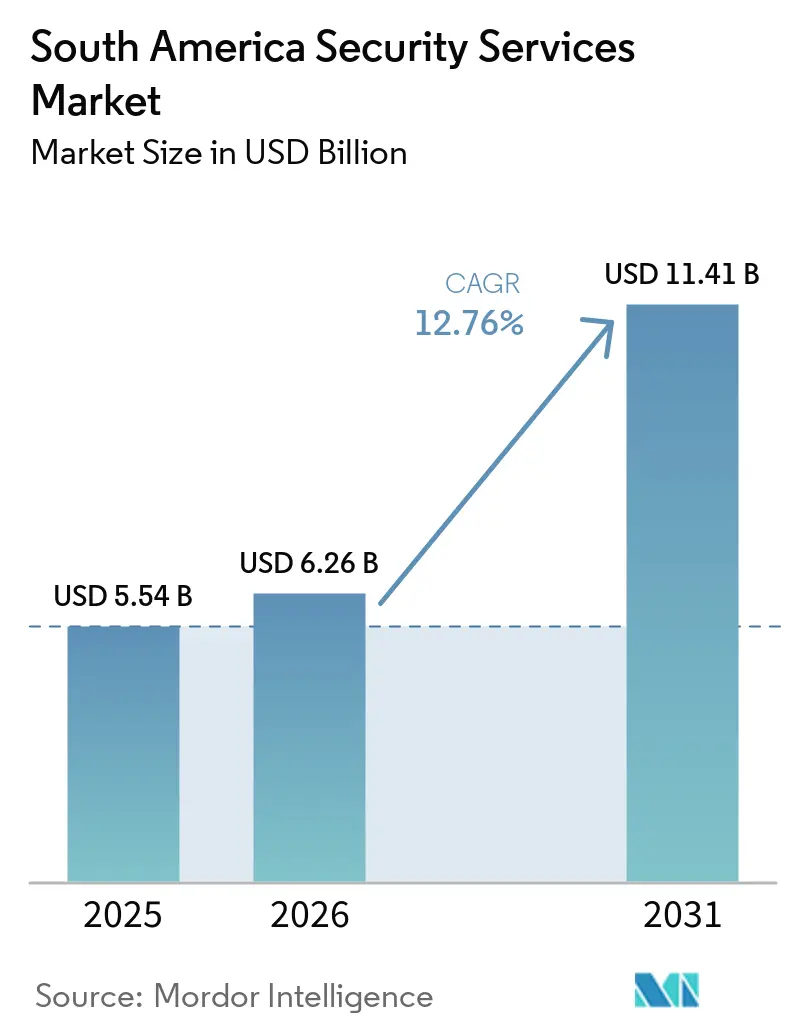
| Base Year Market Size (2025) | USD 5.54 Billion |
| Market Size (2026) | USD 6.26 Billion |
| Market Size (2031) | USD 11.41 Billion |
| Growth Rate (2026 - 2031) | 12.76 % |
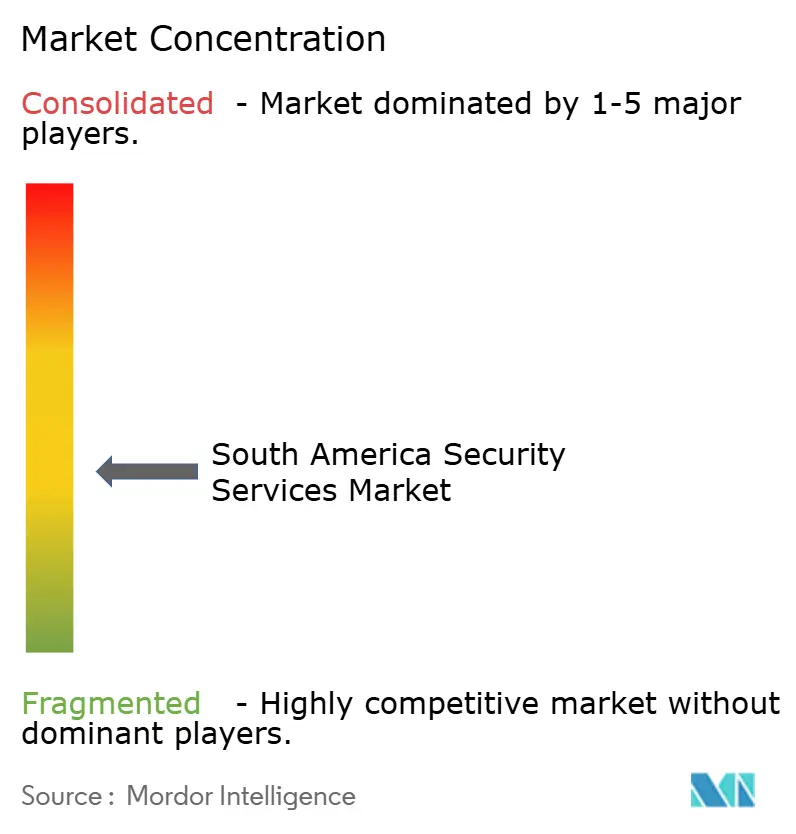
| Market Concentration | Medium |
Major Players *Disclaimer: Major Players sorted in no particular order Image © Mordor Intelligence. Reuse requires attribution under CC BY 4.0. | |
South America Security Services Market Analysis by Mordor Intelligence
The South America security services market size was valued at USD 5.54 billion in 2025 and estimated to expand from USD 6.26 billion in 2026 to reach USD 11.41 billion by 2031, at a CAGR of 12.76% during the forecast period 2026-2031. Ransomware activity, cloud migration, and a shortage of qualified security staff are moving buyers toward recurring managed services. These conditions are shifting spending from standalone security products toward contracts that assign more operating responsibility to providers and offer continuous monitoring, detection, incident handling, and clear reporting across a buyer's core systems. Larger vendors are widening their platforms with AI-supported monitoring, while regional firms compete through local threat knowledge, Portuguese- and Spanish-language coverage, and a closer understanding of country-specific fraud and compliance requirements. The South America security services market also has room to expand among smaller businesses as cloud-delivered detection services reduce entry costs. Currency volatility and differing data-protection rules may slow purchasing decisions in some countries.
Key Report Takeaways
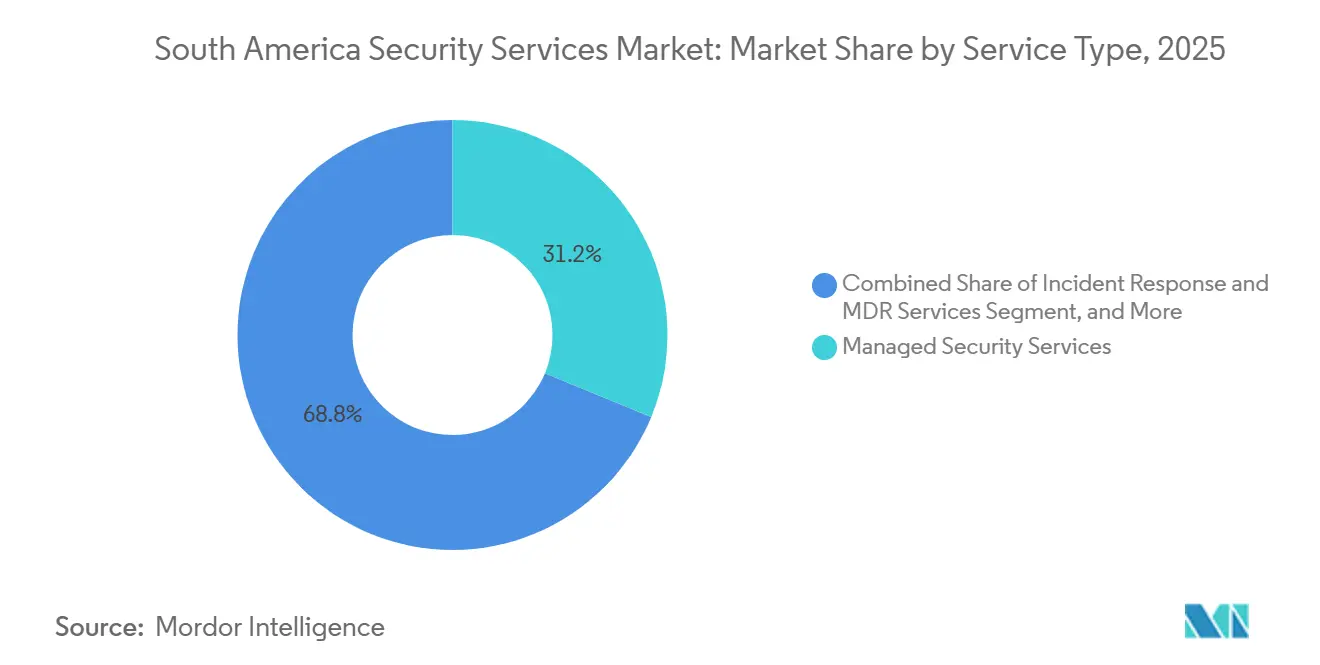
- By service type, Managed Security Services held 31.23% of the South America security services market share in 2025, while Incident Response and MDR Services are projected to expand at a 13.11% CAGR through 2031.
- By deployment mode, cloud accounted for 62.67% of the segment in 2025, and is projected to expand at a 13.24% CAGR through 2031.
- By end-user industry, BFSI accounted for 23.44% of the segment in 2025, while Transportation and Logistics is projected to expand at a 12.93% CAGR through 2031.
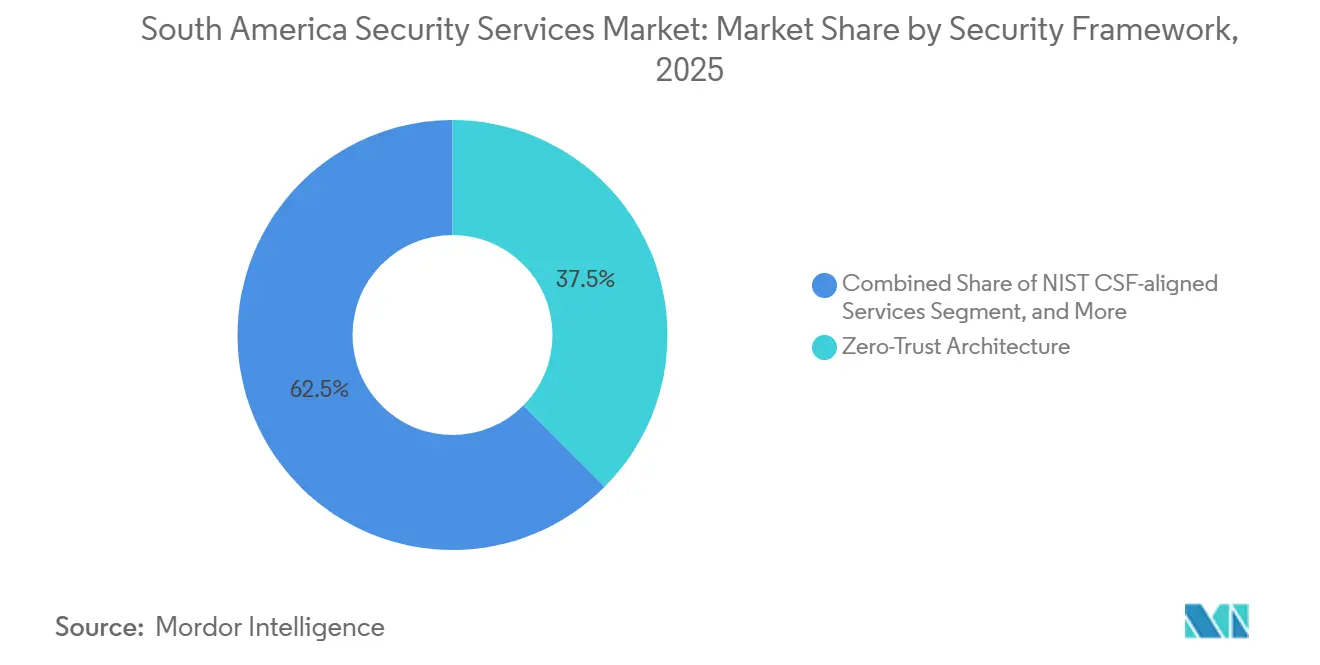
- By security framework, Zero-Trust Architecture held 37.48% of the segment in 2025 and is projected to expand at a 13.47% CAGR through 2031.
- By organization size, large enterprises accounted for 68.14% of the segment in 2025, while Small and Medium-sized Enterprises are projected to expand at a 13.22% CAGR through 2031.
- By geography, Brazil held 46.33% of the South America security services market size in 2025, while Colombia is projected to expand at a 13.34% CAGR through 2031.
Note: Market size and forecast figures in this report are generated using Mordor Intelligence’s proprietary estimation framework, updated with the latest available data and insights as of January 2026.
Market Trends and Insights
Drivers Impact Analysis of South America Security Services Market*
| Driver | (~) % Impact on CAGR Forecast | Geographic Relevance | Impact Timeline |
|---|---|---|---|
| Rising Frequency and Severity of Ransomware Attacks | +3.2% | Global, with acute concentration in Brazil, Colombia, and Argentina | Short term (≤ 2 years) |
| Cloud Migration and Hybrid-Environment Expansion | +2.8% | Brazil, Chile, and Colombia, with spillover to Peru and Argentina | Medium term (2-4 years) |
| Regulatory-Driven Demand for Continuous Monitoring and Incident Response | +2.1% | Brazil, Chile, and Colombia, with early uptake in Argentina and Peru | Short term (≤ 2 years) |
| Outsourcing Caused by Cybersecurity Talent Shortages | +1.8% | Region-wide, with acute demand in Brazil, Colombia, and Chile | Medium term (2-4 years) |
| Language-Localized Security Operations for Portuguese- and Spanish-Speaking Buyers | +1.0% | Region-wide, strongest in Brazil, Colombia, Peru, and Argentina | Long term (≥ 4 years) |
| Increasing IT and Operational Technology Convergence in Industrial Infrastructure | +0.9% | Brazil, Chile, Colombia, and Argentina, concentrated in energy and industrial hubs | Long term (≥ 4 years) |
| Source: Mordor Intelligence | |||
Rising Frequency and Severity of Ransomware Attacks
Ransomware-as-a-service programs have lowered the entry barrier for attackers across South America, extending campaigns from large financial centers into smaller cities and industrial corridors. Healthcare providers, municipal bodies, logistics operators, and financial firms now face a broader range of attacks that can disrupt services, expose data, and delay operations. Colombian organizations faced substantial ransomware recovery costs. Additionally, a significantly higher proportion recovered within one week than in the preceding study. This improvement in recovery performance makes managed detection and response retainers a more common expectation, rather than a premium option reserved for the largest organizations. Insurance providers may also place more value on a customer's containment capability, which makes continuous monitoring more relevant during policy discussions. The South America security services market benefits as buyers seek faster containment, documented incident handling, and ready access to specialist responders.
Cloud Migration and Hybrid-Environment Expansion
Cloud migration is reshaping demand for security services across the region, as applications, identities, and data move beyond internal networks. Brazil is expected to make significant cybersecurity investments in the coming years as cloud adoption expands the exposure of business systems.[1] Cloud access security brokers, cloud security posture management, and workload protection have become more relevant as organizations use multiple cloud environments and software-as-a-service applications. Legacy on-premises contracts often cannot provide the controls needed for cloud-native workloads, particularly where systems use application programming interfaces and distributed identity management. Mid-sized businesses are frequently adopting cloud services faster than their security teams can prepare for the related risks and operating changes. That gap leads to managed service purchases and may result in longer contracts than buyers initially expected.
Regulatory-Driven Demand for Continuous Monitoring and Incident Response
Regulation is making security monitoring less discretionary for regulated organizations across the region. Brazil's Central Bank introduced resolutions requiring licensed institutions to adopt penetration testing and continuous monitoring. Colombia launched a national digital security strategy focused on governance, resilience, workforce development, and regulatory modernization. These frameworks encourage public entities and critical infrastructure operators to adopt managed or co-managed security operations with clearer reporting and response processes. Security requirements also extend across supply chains, as regulated buyers often require stronger controls from vendors, contractors, and technology partners. The South America security services market, therefore, serves logistics, industrial, and healthcare organizations that may not be directly covered by primary regulations.
Outsourcing Caused by Cybersecurity Talent Shortages
Workforce shortages are leading organizations to outsource functions they would prefer to retain internally, including monitoring, threat hunting, incident investigation, and cloud security oversight. Brazil's information security workforce has expanded steadily over the past decade; however, a shortage of qualified professionals remains a major constraint. Many enterprises cannot sustain 24/7 monitoring, threat hunting, and cloud security teams with their own staff, especially when they operate several locations or use a mix of legacy and cloud systems. Regional managed service providers can spread specialist staff costs across several customers and support coverage in Portuguese and Spanish. This model can offer continuous coverage at a lower cost than a dedicated internal team, while giving buyers access to skills that are difficult to recruit locally. The South America security services market is supported by this need, especially in Brazil, Colombia, and Chile.
Restraints Impact Analysis of South America Security Services Market*
| Restraint | (~) % Impact on CAGR Forecast | Geographic Relevance | Impact Timeline |
|---|---|---|---|
| Shortage of Certified Cybersecurity Professionals | -1.5% | Region-wide, most acute in Brazil, Colombia, and Chile | Short term (≤ 2 years) |
| Economic Volatility and Reduced SME Security Budgets | -1.2% | Argentina and Peru, with spillover to the mid-market in Colombia and Brazil | Short term (≤ 2 years) |
| Fragmented Data-Protection and Cybersecurity Regulations | -0.8% | Brazil, Colombia, and Chile, with compliance friction extending to Argentina and Peru | Medium term (2-4 years) |
| High Cost and Integration Complexity of Advanced Detection Platforms | -0.7% | Region-wide, acute in Brazil's mid-market, Colombia, and Chile | Medium term (2-4 years) |
| Source: Mordor Intelligence | |||
Shortage of Certified Cybersecurity Professionals
The same shortage that prompts outsourcing also limits how quickly providers can add delivery capacity, particularly for services that require experienced analysts at all hours. Established providers face long hiring cycles for CISSP, CEH, and GIAC-certified analysts, and competition for these skills raises delivery costs. The problem is more pronounced outside São Paulo, Bogotá, and Santiago, where training resources, larger employers, and more mature security communities are concentrated. Peru and smaller Andean markets may depend on remote delivery for threat hunting, operational technology security, and cloud workload protection, which can introduce response and language challenges. Brazil's Hackers do Bem program aimed to train cybersecurity professionals, but the shortage of qualified talent remained a critical constraint. The South America security services market may therefore be limited by the provider talent pipeline as well as customer demand.
Economic Volatility and Reduced SME Security Budgets
Economic instability can reduce security budgets among smaller organizations, particularly in Argentina and Peru, even when management recognizes the operational impact of a serious cyber incident. Businesses under financial pressure may delay contract renewals or narrow the scope of security services, which can leave weaknesses unaddressed for several years. Smaller businesses often struggle to absorb recurring subscription costs when cash flow is under pressure and revenue is earned in local currency. Currency depreciation further increases the local cost of services billed in USD, especially for providers that price cloud-delivered platforms and specialist response in dollars. In Argentina, USD-denominated contracts may appeal to global providers but can become unaffordable for businesses earning revenue in pesos. This divides the potential customer base and can slow security adoption among the smaller firms expected to expand most quickly.
*Our forecasts treat driver/restraint impacts as directional, not additive. The impact forecasts reflect baseline growth, mix effects, and variable interactions.
South America Security Services Market Segment Analysis
By Service Type:
MDR Changes Established Monitoring ModelsManaged Security Services held 31.23% of the South America security services market in 2025, supported by established security operations centers in São Paulo and Santiago. Long-term customer relationships, existing workflow integration, and multiyear agreements also create significant switching costs for buyers that need uninterrupted monitoring. Professional and Integration Services and Consulting and Assessment Services support organizations redesigning security architectures for cloud migration and zero-trust programs, including control design, implementation planning, and compliance readiness. Threat Intelligence and Hunting Services are gaining interest as buyers move beyond alert review toward active detection of regional threat actors, payment fraud campaigns, credential abuse, and targeted social engineering. Incident Response and MDR Services are projected to expand at a 13.11% CAGR through 2031, making them the fastest service category.
The average eCrime breakout time has declined significantly, narrowing the window available for manual response teams.[2] Regional providers, such as Redbelt Security and ISH Tecnologia, are developing intelligence on boleto fraud, Pix manipulation, and Portuguese-language social engineering. IBM reported that security programs using AI and automation shortened the attack life cycle considerably compared with manual-only programs.[3] Enterprises increasingly need coverage across cloud, endpoint, identity, and operational technology systems. The boundary between conventional managed security and MDR is becoming less distinct as providers expand detection and response capabilities, create dedicated intelligence research units, use locally tuned MITRE ATT&CK mappings, and connect cloud, endpoint, identity, and operational technology monitoring within the same service, and buyers are consequently comparing providers on the depth of their regional intelligence, the speed of their incident response, and the practical quality of their containment processes.

By Deployment Mode:
Cloud Spending Exceeds On-Premises RenewalCloud deployment accounted for 62.67% of the South America security services market in 2025, supported by infrastructure expansion in São Paulo and Santiago, where regional availability supports lower latency for regulated workloads. Security-as-a-service models have become more feasible as regional cloud capacity has expanded, giving providers a clearer path to deliver scalable monitoring, posture management, and cloud workload protection. Organizations that migrate applications to cloud platforms often find that legacy on-premises tools cannot adequately protect cloud-native workloads, particularly when application interfaces, identities, and data stores span multiple environments. This creates a need to reallocate security spending, even when a business has not planned to change vendors. Brazil's cybersecurity investment outlook reflects the growing focus on cloud security subscriptions.
On-premises delivery remains important for defense, central banking, and industrial control environments. These sectors may require data sovereignty, operational continuity, or air-gapped systems that restrict cloud connectivity. Argentina's currency instability is also encouraging some organizations to extend on-premises agreements when the future peso cost of USD cloud contracts is uncertain. Local security integrators can retain a role in this renewal activity, while hybrid environments create further demand for consulting because buyers must decide which workloads can move to cloud-delivered security services. These decisions often involve legacy industrial systems, regulated data, recovery requirements, and long-standing contracts with local integrators, while providers that can assess these constraints and manage controls across both environments can maintain an important role even as cloud deployment becomes more common.
By End-User Industry:
BFSI Leads, Logistics Expands FastestBFSI accounted for 23.44% of the South America security services market size in 2025 because fraud exposure, regulatory scrutiny, and reputational risk make security spending urgent. Major cybersecurity incidents at Brazilian financial institutions have increased significantly in recent years. Fraud has become the leading cause of incidents, surpassing technical failures. Financial institutions are responding through behavioral analytics, transaction monitoring, API security services, and continuous monitoring of payment activity across customer-facing digital channels. The IT and Telecom and Government and Defense sectors also account for a substantial share, as national security strategies translate into departmental budgets and monitoring requirements for public-facing systems, networks, and essential services.
Transportation and Logistics is projected to expand at a 12.93% CAGR through 2031. Digitized ports, cargo tracking, warehouse systems, and cross-border documentation expose operational systems that were previously separate from enterprise IT, increasing the need to monitor both information and operating environments. Healthcare organizations face added pressure to protect patient records and interconnected clinical systems. Healthcare and Life Sciences therefore faces stronger pressure to improve security coverage. Mining, oil and gas, and energy operators also require more protection as IT and operational technology systems become connected. A disruption in these settings can affect safety, production schedules, transport links, and essential services, rather than only financial results, which raises the potential value of an engagement and increases interest in services that bring operational technology expertise alongside conventional enterprise security monitoring.
By Security Framework:
Zero Trust Becomes the Default Compliance PositionZero-Trust Architecture held 37.48% of the South America security services market share in 2025 and is projected to expand at a 13.47% CAGR through 2031. Enterprises are replacing implicit network trust with continuous identity checks, least-privilege controls, and microsegmentation. Perimeter-focused models are not well-suited to hybrid cloud environments, where users, applications, devices, and data move across internal networks and cloud platforms. National guidance in Brazil, Colombia, and Chile aligns with ISO/IEC and NIST Cybersecurity Framework practices, encouraging clearer evidence of identity, access, monitoring, and incident-response controls. These factors are encouraging a wider use of zero-trust controls.
ISO/IEC-based Managed Services retain steady demand among regulated enterprises that require ISO/IEC 27001 certification from providers. NIST CSF-aligned Services are gaining traction among subsidiaries of U.S.-headquartered organizations and Colombian companies using NIST-derived controls. Providers must often map the same operating evidence to several framework requirements, which increases the value of reporting methods that can be adapted for a buyer's regulatory and procurement setting. Platform-neutral providers can use this need to offer unified security operations across different compliance settings, and the South America security services industry is favoring providers that can support multiple frameworks without requiring a customer to replace its existing security architecture. This flexibility is important for groups with U.S.-headquartered parents, locally regulated subsidiaries, and suppliers that must present different forms of compliance evidence. It also gives platform-neutral providers a practical route to compete for broader mandates that single-framework specialists may not be able to serve.
By Organization Size:
SMEs Make Security Spending More EssentialLarge enterprises accounted for 68.14% of organizational spending in 2025, reflecting the concentration of budgets in multinationals, state-owned enterprises, and large financial institutions. These buyers can fund extensive programs and face demanding regulatory requirements, including continuous monitoring, formal incident handling, audit preparation, and controls for third-party suppliers. Their procurement processes commonly run for several years and depend on formal requests for proposals, detailed technical evaluations, service-level commitments, and evidence of local delivery experience. This creates stable, high-value revenue for established managed security service providers. It also creates barriers for newer firms that lack references and regional coverage.
Small and Medium-sized Enterprises are projected to expand at a 13.22% CAGR through 2031. Lower minimum costs for cloud-native MDR, fintech digitization in Peru and Colombia, and supply-chain security requirements support this demand. Smaller customers commonly favor subscriptions, shorter terms, clearly defined outcomes, and services that do not require them to build a large internal operations team before receiving protection. Providers need efficient delivery models to serve them profitably while maintaining strong detection and response. The South America security services industry may reward firms that can package institutional-grade services for this underserved group. To do so, providers need pricing that remains accessible, standardized onboarding, clear service boundaries, and automation that keeps delivery costs under control, while a service model that combines these features with credible incident response can help a provider win customers that have historically delayed professional security operations.
Geography Analysis
Brazil Security Services Market
Brazil held 46.33% of the South America security services market size in 2025 and remained the region's main source of demand, with a large concentration of enterprise and financial-sector security activity. Financial sector obligations also support persistent demand for managed services. Brazil's Central Bank rules require licensed financial institutions to conduct penetration testing and continuous monitoring. Brazil is the only South American economy classified in the highest tier of the International Telecommunication Union Global Cybersecurity Index. Cybersecurity investment is projected to increase significantly over the forecast period.
Colombia and Chile Security Services Market
Colombia is projected to expand at a 13.34% CAGR through 2031. Its National Digital Security Strategy 2025-2027 is supporting managed service procurement among public agencies and critical infrastructure operators. The rollout of Bre-B introduced new real-time fraud risks for the financial sector. A greater proportion of Colombian ransomware victims recovered within one week compared with the preceding year. Chile is also promoting compliance-driven procurement following the introduction of its cybersecurity framework law, which established the National Cybersecurity Agency and incident-reporting requirements for critical infrastructure.
South America Security Services Market
Argentina's National Cybersecurity Centre became operational in January 2026 and raised public-sector security expectations. Peso volatility is also leading some Argentine buyers to select USD subscriptions, which can favor global vendors while limiting affordability for local small businesses. Peru's e-commerce activity supports demand for security services, particularly around digital transactions. Bolivia and Paraguay have lower service penetration but can offer higher percentage expansion for providers that invest in Portuguese- and Spanish-language delivery. The South America security services market requires providers to balance Brazil-focused intelligence with coverage of Colombian, Chilean, Peruvian, and Argentine threats. Domestic specialists have an advantage where local intelligence and regulatory knowledge matter most, because providers serving Brazil, Colombia, Chile, Peru, and Argentina need to adapt their threat research and operating processes to distinct fraud methods, languages, and compliance expectations, while a regional strategy that relies only on Brazil-focused intelligence may leave customers in other countries with less useful context during an incident.
Competitive Landscape
The South America security services market has a two-tier structure, with global vendors leading competition for large enterprises while regional specialists, telecommunications-linked providers, and boutique managed service firms compete across the mid-market and smaller customer base. IBM, Palo Alto Networks, CrowdStrike, Microsoft, Cisco, and Fortinet seek to combine endpoint, identity, network, and cloud security within unified platforms. This approach can reduce the number of vendors a customer manages and supports recurring managed service revenue. In March 2026, CrowdStrike and IBM expanded their collaboration to integrate Charlotte AI with IBM's Autonomous Threat Operations Machine and extend Falcon into IBM Consulting-managed threat detection and response services.
Regional specialists compete with local fraud intelligence, Portuguese- and Spanish-language incident response, and services aligned to country-specific rules. Regional specialists are developing intelligence on boleto fraud, Pix manipulation, and local social engineering methods. OT security for industrial and energy operators, third-party cyber risk management, and SME services remain areas with room for additional specialists. In March 2026, Tenchi Security identified South America as the primary target for its international channel expansion strategy.
Palo Alto Networks expanded its Brazil strategy in May 2026 with investments in Unit 42 threat intelligence, incident response, commercial hiring, and autonomous security operations capabilities. CrowdStrike also made Falcon available through Microsoft Marketplace in February 2026, allowing Azure consumption commitment eligibility. IBM and LATAM Airlines Group signed a March 2025 contract for AI-supported cyber defense and intelligence services across Brazil, Chile, Colombia, Ecuador, and Peru. Kaspersky Lab and Fujitsu have a more limited fit with broad regional enterprise demand than firms with wider local delivery capacity. The South America security services market is likely to favor providers that combine fast detection with locally relevant intelligence, although global platforms can offer breadth, automation, and broad product integration, while regional firms can offer language coverage and familiarity with local fraud patterns, and the strongest competitive positions may therefore come from service models that combine these strengths in a way that meets both enterprise scale and country-level operating needs.
South America Security Services Industry Leaders
-
IBM Corporation
-
Microsoft Corporation
-
Palo Alto Networks, Inc.
-
Fortinet, Inc.
-
Stefanini Participações S.A.
- *Disclaimer: Major Players sorted in no particular order
South America Security Services Market Companies Covered in this Report
- IBM Corporation
- Microsoft Corporation
- Palo Alto Networks, Inc.
- Fortinet, Inc.
- Stefanini Participacoes S.A.
- Telefonica Brasil S.A.
- Cisco Systems, Inc.
- Check Point Software Technologies Ltd.
- CrowdStrike Holdings, Inc.
- Zscaler, Inc.
- Broadcom Inc.
- Trend Micro Incorporated
- Sophos Limited
- Kaspersky Lab
- Wipro Limited
- Capgemini SE
- Fujitsu Limited
- NTT DATA Group Corporation
- Tempest Security Intelligence
- ISH Tecnologia S.A.
- Modulo Security Solutions S.A.
- Clavis Seguranca da Informacao Ltda.
Recent Industry Developments in South America Security Services Market
- March 2026: CrowdStrike and IBM announced an expansion of their strategic collaboration integrating CrowdStrike Charlotte AI with IBM's Autonomous Threat Operations Machine, ATOM, for machine-speed investigation and containment, and extended the Falcon platform into IBM Consulting's managed Threat Detection and Response global services, directly strengthening both companies' South American managed security services delivery.
- March 2026: Tenchi Security announced an international expansion strategy with South America as its primary target market, strengthening its partner ecosystem to scale its third-party cyber risk management platform across financial services, healthcare, and telecommunications sectors in the region.
- February 2026: CrowdStrike and Microsoft announced the availability of the Falcon platform on Microsoft Marketplace with full Azure Consumption Commitment decrement eligibility, removing procurement friction for South American enterprises already committed to Microsoft Azure cloud infrastructure and enabling faster MSSP contract bundling.
- February 2026: ISH Tecnologia released its Annual Cybersecurity Report 2025, documenting advanced adversary tactics observed in Brazil throughout 2025, including supply-chain exploitation, credential abuse, and low-visibility persistent attacks, providing the enterprise sector with a domestically sourced threat landscape baseline.
South America Security Services Market Report Scope
South America Security Services Market refers to the provision of physical and electronic security solutions, including manned guarding, electronic surveillance, access control, monitoring, and related risk-management services. It covers static and mobile security officers, reception and concierge security, control-room operations, event security, executive protection, cash-in-transit, alarm response, and specialized guarding for industrial, commercial, and critical-infrastructure sites.
The South America Security Services Market Report is Segmented by Service Type (Managed Security Services, Professional/Integration Services, Consulting and Assessment Services, Threat-Intelligence and Hunting Services, and Incident Response and MDR Services), Deployment Mode (On-Premises, and Cloud), End-User Industry (IT and Telecom, Government and Defense, BFSI, Healthcare and Life Sciences, Industrial and Critical Infrastructure, Transportation and Logistics, and Other End-user Industries), Security Framework (Zero-Trust Architecture, ISO/IEC-based Managed Services, and NIST CSF-aligned Services), Organization Size (Large Enterprises, and Small and Medium-sized Enterprises), and Geography (Brazil, Argentina, Chile, Colombia, Peru, and Rest of South America). The Market Forecasts are Provided in Terms of Value (USD).
Segmentation Overview
| Managed Security Services |
| Professional/Integration Services |
| Consulting and Assessment Services |
| Threat-Intelligence and Hunting Services |
| Incident Response and MDR Services |
| On-premises |
| Cloud |
| IT and Telecom |
| Government and Defense |
| BFSI |
| Healthcare and Life Sciences |
| Industrial and Critical Infrastructure |
| Transportation and Logistics |
| Other End-user Industries |
| Zero-Trust Architecture |
| ISO/IEC-based Managed Services |
| NIST CSF-aligned Services |
| Large Enterprises |
| Small and Medium-sized Enterprises |
| Brazil |
| Argentina |
| Chile |
| Colombia |
| Peru |
| Rest of South America |
| By Service Type | Managed Security Services |
| Professional/Integration Services | |
| Consulting and Assessment Services | |
| Threat-Intelligence and Hunting Services | |
| Incident Response and MDR Services | |
| By Deployment Mode | On-premises |
| Cloud | |
| By End-user Industry | IT and Telecom |
| Government and Defense | |
| BFSI | |
| Healthcare and Life Sciences | |
| Industrial and Critical Infrastructure | |
| Transportation and Logistics | |
| Other End-user Industries | |
| By Security Framework | Zero-Trust Architecture |
| ISO/IEC-based Managed Services | |
| NIST CSF-aligned Services | |
| By Organization Size | Large Enterprises |
| Small and Medium-sized Enterprises | |
| By Geography | Brazil |
| Argentina | |
| Chile | |
| Colombia | |
| Peru | |
| Rest of South America |
Key Questions Answered in the Report
What is the size of the South America security services sector?
The regional security services total is estimated at USD 6.26 billion in 2026 and is forecast to reach USD 11.41 billion by 2031 at a 12.76% CAGR. Recurring managed services, cloud security, and demand for faster response are expected to support this expansion across the region.
What is driving demand for security services in South America?
Ransomware, cloud migration, regulatory monitoring requirements, and shortages of qualified security workers are strengthening demand for managed services. These pressures lead organizations in the South America security services market to seek continuous monitoring, specialized response capacity, and more predictable security operations costs.
Which service type leads security services demand in South America?
Managed Security Services led with 31.23% of the service segment in 2025. Incident Response and MDR Services are projected to expand at a 13.11% CAGR through 2031 as boards place more emphasis on rapid containment and ready access to specialist teams.
Which country leads regional demand?
Brazil held 46.33% of regional revenue in 2025, supported by its large economy, concentration of enterprise demand, and financial-sector security rules. The rules that took effect in 2026 also require licensed financial institutions to adopt continuous monitoring and penetration testing.
Which end-user sector is expanding the fastest?
Transportation and Logistics is projected to expand at a 12.93% CAGR through 2031 as freight, port, and trade systems become more digital. Providers must protect connected operating environments as well as conventional enterprise information systems in this sector.
Why are co-managed security operations gaining adoption?
Co-managed operations let organizations retain strategic oversight while providers handle continuous monitoring, alert review, and containment. The model reduces the burden of round-the-clock staffing while allowing internal leaders to remain involved in governance and major incident decisions.