
Market Overview
| Study Period | 2021 - 2031 |
|---|---|
| Forecast Data Period | 2026 - 2031 |
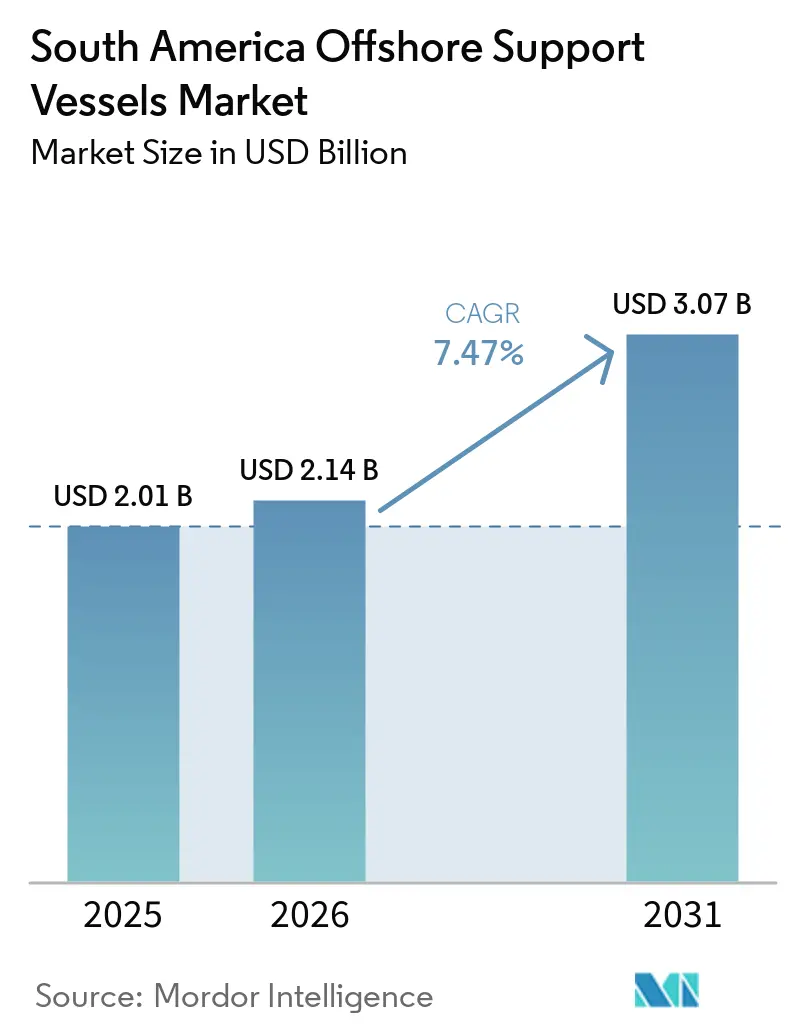
| Base Year Market Size (2025) | USD 2.01 Billion |
| Market Size (2026) | USD 2.14 Billion |
| Market Size (2031) | USD 3.07 Billion |
| Growth Rate (2026 - 2031) | 7.47 % |
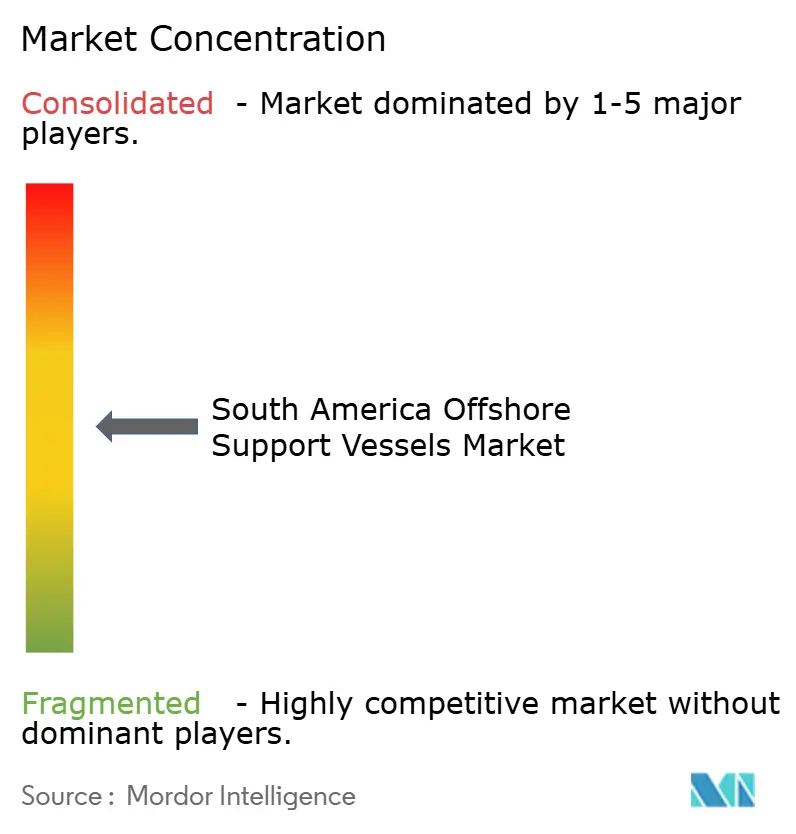
| Market Concentration | Medium |
Major Players *Disclaimer: Major Players sorted in no particular order Image © Mordor Intelligence. Reuse requires attribution under CC BY 4.0. | |
South America Offshore Support Vessels Market Analysis by Mordor Intelligence
The South America Offshore Support Vessels Market size is expected to increase from USD 2.01 billion in 2025 to USD 2.14 billion in 2026 and reach USD 3.07 billion by 2031, at a CAGR of 7.47% over 2026-2031. The South America offshore support vessels market is supported by sustained deepwater activity in Brazil, where Petrobras has set out investment and vessel procurement programs that link vessel demand to a large installed production base, rather than to a small number of isolated exploration campaigns[1]. Petrobras’ pre-salt production base gives vessel owners a visible workload for supply, anchor handling, inspection, and subsea support work. The South America offshore support vessels market also faces tighter access conditions because local-content requirements and flag rules shape the vessels that can compete for Brazilian work. Long-term build-and-charter awards favor operators that can arrange financing, local construction, and lower-emission propulsion systems. New offshore wind and Argentine export infrastructure broaden the opportunity set, although their vessel demand is expected to emerge later than the established Brazilian oil and gas workload.
Key Report Takeaways
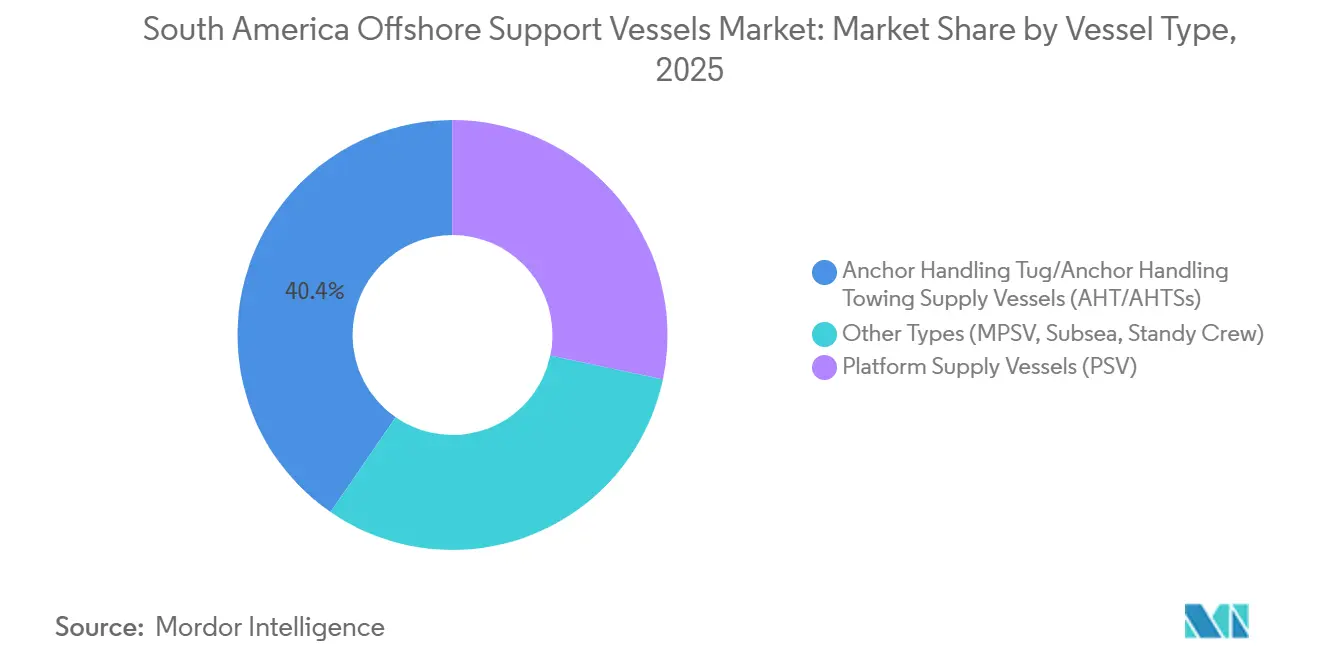
- By vessel type, AHT/AHTS vessels held 40.4% of the South America offshore support vessels market share in 2025, while Other Types is forecast to grow at a 7.8% CAGR through 2031.
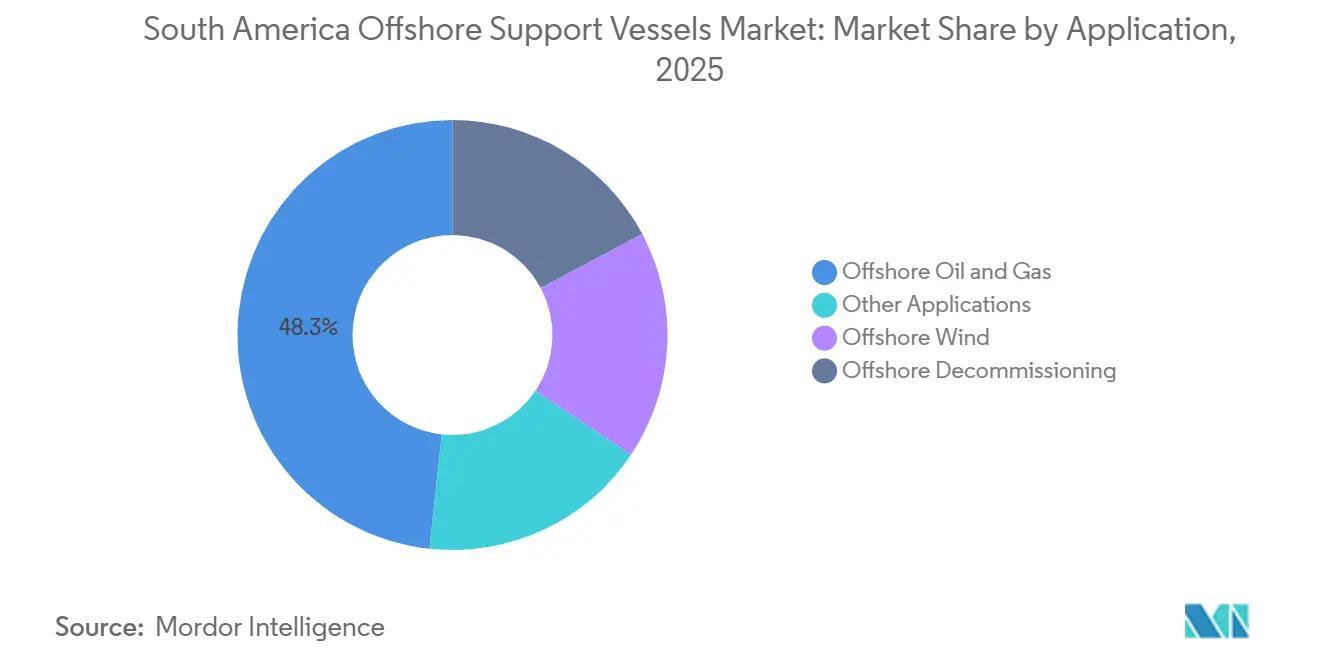
- By application, offshore oil and gas accounted for 48.3% of the South America offshore support vessels market size in 2025, while offshore wind is forecast to expand at an 8.1% CAGR through 2031.
- By geography, Brazil held 68.5% of the South America offshore support vessels market share in 2025, while Argentina is projected to record an 8.2% CAGR through 2031.
Note: Market size and forecast figures in this report are generated using Mordor Intelligence’s proprietary estimation framework, updated with the latest available data and insights as of January 2026.
Market Trends and Insights
Drivers Impact Analysis of South America Offshore Support Vessels Market*
| Driver | (~) % Impact on CAGR Forecast | Geographic Relevance | Impact Timeline |
|---|---|---|---|
| Deepwater Pre-Salt Production Expansion | +2.50% | Brazil (Santos and Campos Basins primarily) | Long term (≥ 4 years) |
| Petrobras Offshore Fleet Renewal Program | +2.00% | Brazil, with supply chain spill-over to Argentina and Chile | Medium term (2-4 years) |
| Subsea Inspection, Maintenance and Repair Backlog | +1.00% | Brazil; emerging in Argentina (VMOS subsea infrastructure) | Short term (≤ 2 years) |
| Offshore Decommissioning Vessel Demand | +0.50% | Brazil (Campos Basin legacy assets) | Medium term (2-4 years) |
| Offshore Wind Project Optionality | +0.50% | Brazil (Rio de Janeiro, Rio Grande do Norte); early-stage Colombia | Long term (≥ 4 years) |
| Hybrid Vessel Replacement Economics | +0.30% | Brazil; global supply chain influence | Medium term (2-4 years) |
| Source: Mordor Intelligence | |||
Deepwater Pre-Salt Production Expansion
Brazil’s pre-salt fields support large offshore developments with established geology, infrastructure, and production systems. Petrobras produced more than 3 million barrels per day in 2026, with over 80% coming from pre-salt assets. Petrobras is progressing the P-80, P-82, and P-83 systems for Búzios, and each unit is designed to produce 225,000 barrels of oil per day. Equinor began a 6-well drilling campaign for the Raia project in the Campos Basin in March 2026, with first production targeted for 2028[2]. These projects extend the South America offshore support vessels market beyond short-cycle vessel demand because each production unit requires continuing logistics, mooring, and subsea support throughout its operating life, including routine materials movements and intervention work. The operating conditions also favor DP2 and DP3 vessels with deepwater ROV capability, which raises the equipment and financing threshold for new suppliers.
Petrobras Offshore Fleet Renewal Program
Petrobras’ Open Sea Program brings together new vessel construction and long-duration operating contracts. Petrobras signed contracts in December 2024 for 12 new platform supply vessels to be built in Brazil with 40% local content. The contract structure provides 4 years for mobilization and 12 years for operations, giving local yards and vessel owners a longer revenue base. In May 2026, DOF announced contracts for 4 newbuild subsea support vessels that will be built at Navship in Santa Catarina[3]. The South America offshore support vessels market is therefore placing greater weight on operators that can coordinate construction, financing, vessel availability, supplier delivery schedules, and the operational preparation needed before a vessel enters a long-term charter. Starnav’s hybrid vessels use mtu Series 4000 engines, battery systems, HVO fuel capability, and IMO Tier III equipment, showing how technical requirements are becoming part of procurement decisions.
Subsea Inspection, Maintenance and Repair Backlog
The growing number of offshore production units is increasing the need for inspection, maintenance, and repair work on subsea equipment. Oceaneering announced USD 180 million in Petrobras contracts in August 2025 for work-class ROV services across Brazilian operations[4]. DOF announced 3 Petrobras contracts in 2025 for more than 4,000 planned inspections in the Santos, Campos, and Espírito Santo basins. The work covers mooring systems, flowlines, risers, and related subsea structures that require regular monitoring. The South America offshore support vessels market benefits because inspection programs use specialized ROV and support vessels under multiyear contracts, which are tied to recurring maintenance requirements rather than to a single drilling or installation campaign. These contracts reduce reliance on short-term spot activity and give operators a steadier base of vessel use.
Offshore Decommissioning Vessel Demand
Brazil’s decommissioning program is creating demand for multi-purpose support vessels, diving support vessels, and other specialized units. Petrobras’ 2025-2029 business plan includes the decommissioning of 10 platforms by 2029. ANP Resolution 817 requires a decommissioning plan to be submitted before offshore facilities are withdrawn from service. The planning requirement allows operators to identify marine logistics and vessel needs earlier in the field closure process. Brazil lacks a domestically flagged heavy-lift crane vessel for removing large topsides, which can limit the availability of suitable assets for major removal work. The South America offshore support vessels market can benefit where owners have crane-equipped, diving, or multi-purpose vessels that match this work and can combine marine logistics with inspection, removal support, and other field closure tasks.
Restraints Impact Analysis of South America Offshore Support Vessels Market*
| Restraint | (~) % Impact on CAGR Forecast | Geographic Relevance | Impact Timeline |
|---|---|---|---|
| Local-Content Compliance and Brazilian-Flag Constraints | -1.50% | Brazil (national); partial spill-over to Argentina via flag-preference policy | Short term (≤ 2 years) |
| High Capital Intensity and Financing Dependence | -1.20% | Brazil, Argentina, Chile; global capital markets influence | Medium term (2-4 years) |
| Fragmented Offshore Wind Project Pipeline | -0.50% | Brazil, Colombia; nascent in Chile, Uruguay | Long term (≥ 4 years) |
| Port, Shipyard and Specialized-Crew Bottlenecks | -0.80% | Brazil (Rio de Janeiro, Vitória, Macaé); Santa Catarina yards | Short to medium term |
| Source: Mordor Intelligence | |||
Local-Content Compliance and Brazilian-Flag Constraints
Brazil’s local-content rules add requirements to offshore vessel construction and chartering. Law 15,075 of 2024 and related rules set local-content conditions for maritime support vessels and link some incentives to compliance. The ANTAQ circularization process checks whether a Brazilian-flag vessel is available before foreign tonnage is chartered. Brazil had 390 Brazilian-flagged vessels among 481 active OSVs in February 2026, leaving limited flexibility when specialized demand rises. The South America offshore support vessels market also faces port turnaround, drydock, and crew constraints, particularly when class-docking requirements cluster in the Brazilian fleet and several vessels require the same specialized repair resources during a limited period. These conditions favor established local operators but can delay access to vessels that are needed for specialized assignments.
High Capital Intensity and Financing Dependence
Hybrid vessel newbuilds require large up-front commitments and long-term financing. Petrobras’ procurement model favors charters that can support construction funding over a multi-year operating period. The local-content requirement can increase the cost of sourcing vessel components and construction services in Brazil. Domestic financing costs and the need for legal and tax support further increase the resources needed to submit long-term bids. The South America offshore support vessels market is consequently becoming more favorable to companies with access to capital, established financing relationships, compliant vessels, and the ability to carry construction and mobilization costs before long-term charter revenue begins. This pattern supports consolidation and leaves smaller owners more dependent on legacy vessels and shorter charter terms.
*Our forecasts treat driver/restraint impacts as directional, not additive. The impact forecasts reflect baseline growth, mix effects, and variable interactions.
South America Offshore Support Vessels Market Segment Analysis
By Vessel Type:
AHTS Dominance Narrows as Subsea and Specialty Tonnage AcceleratesAHT/AHTS vessels accounted for 40.4% of the South America offshore support vessels market in 2025. Their leading position reflects the mooring demands of ultra-deepwater FPSOs, which require high-bollard-pull anchor handling at water depths reaching 3,000 meters. DOF’s Skandi Iguaçu was contracted for Petrobras work with more than 350 metric tons of bollard pull. DOF also secured long-term AHTS work for the Skandi Angra, Skandi Paraty, and Skandi Urca. Platform supply vessels remain important because active FPSOs need regular fuel, cargo, and materials supply. The 12 hybrid PSVs ordered for Petrobras work reinforce the need for local supply capacity. Vessel owners with equipment suited to deepwater operations have a clearer route into long-term contracts.
Other Types, including multi-purpose, subsea support, standby, and crew vessels, are the fastest-growing vessel type segment at a 7.8% CAGR through 2031. The South America offshore support vessels market size for this group is being supported by inspection, maintenance, repair, and decommissioning assignments. DOF’s May 2026 awards cover 4 new ROV support vessels for Petrobras work and a 12-year contract term. Oceaneering’s Petrobras contracts also require ROV services for inspection, FPSO hookups, mooring inspections, and pile installations. The category benefits from work that cannot be completed by conventional supply or anchor-handling vessels. ANP decommissioning rules also add advance planning for multi-purpose and diving support vessels. This mix of services gives specialized vessel owners a role in both new production activity and end-of-life field work.

By Application:
Oil and Gas Holds Scale While Wind Builds Structural MomentumOffshore oil and gas held 48.3% of regional revenue in 2025. Petrobras plans to maintain investment in offshore production systems and exploration activity through 2030. Búzios development, the Raia project, and existing pre-salt production require continuing vessel support. This workload covers cargo transport, anchor handling, ROV intervention, inspection, and subsea logistics. Long-term contracts provide greater operating visibility than short-cycle activity. Decommissioning and other service work add further assignments for specialist vessels. This demand base remains the central source of revenue for the regional fleet.
Offshore wind is forecast to expand at an 8.1% CAGR through 2031. Brazil enacted Law 15,097 in January 2025, which created the legal framework for offshore electricity generation. Petrobras’ 18 MW Rio de Janeiro pilot became the first offshore wind project in South America to enter formal environmental licensing. Fugro began geotechnical work for the pilot in April 2026, with final reporting scheduled for 2027. The first vessel opportunities are likely to center on survey and site-investigation work before larger installation requirements emerge. The South America offshore support vessels market is not expected to see material wind-related vessel demand until regulatory steps and project construction progress further.
Geography Analysis
Brazil Offshore Support Vessels Market
Brazil held 68.5% of regional revenue in 2025. The country had 481 OSVs operating in its waters in February 2026, including 390 Brazilian-flagged vessels. Petrobras’ Búzios projects and existing pre-salt production support vessel demand in the Santos and Campos basins. Equinor’s Raia drilling campaign also adds a separate support requirement in the Campos Basin. Brazilian flag-preference and local-content requirements remain important access conditions for foreign operators.
Argentina Offshore Support Vessels Market
Argentina is projected to record the region’s highest growth rate at an 8.2% CAGR through 2031. The Vaca Muerta Oil Sur project links Neuquén production to an offshore export terminal at Punta Colorada in Río Negro. Argentina also launched the CAN_200 offshore exploration tender through Decree 590/2026 in July 2026. The development of export infrastructure and exploration acreage expands the country’s offshore activity beyond earlier episodic campaigns. Vessel demand is expected to include construction, subsea installation, and logistics support. The South America offshore support vessels market, therefore, has a second regional demand center that could broaden over the forecast period as export infrastructure, offshore construction activity, and exploration planning create different types of vessel assignments.
Wider South America Offshore Support Vessels Market
Chile and the Rest of South America represent a smaller share of regional activity in 2025. Chile’s Viento Azul floating wind proposal remained in the permitting stage in mid-2026. Uruguay’s offshore wind potential and planned drilling in block OFF-5 may influence future activity in nearby waters. Guyana’s deepwater work can affect availability and charter rates for high-specification AHTS and PSV vessels across the wider region. These markets currently provide optionality rather than comparable volume to Brazil. Exploration results and permitting decisions could alter the regional balance later in the forecast period.
Competitive Landscape
The South America offshore support vessels market has a moderate level of concentration. Competition is increasingly divided between larger operators that can meet Petrobras’ build-and-charter terms and smaller domestic owners with established fleet positions. Tidewater acquired Wilson Sons UltraTug and its Brazilian PSV fleet for USD 500 million in 2025. CBO and OceanPact announced an all-stock merger that would combine fleets across anchor handling, supply, and subsea support. Operators that can combine local construction, lower-emission equipment, and long-term financing have a stronger position in major tenders.
DOF’s multiyear Petrobras awards show the value of specialized vessels and contract execution. DOF secured 4 long-term AHTS contracts in Brazil in May 2025. In May 2026, DOF also announced contracts for 4 new ROV support vessels to serve Petrobras. Rolls-Royce supplied 40 mtu engines for Starnav’s hybrid offshore vessels in July 2026. These investments support vessels with battery systems, HVO capability, and IMO Tier III compliance. The South America offshore support vessels market is becoming less favorable to vessels that cannot meet these operational and environmental requirements, especially where major tenders specify hybrid systems, ROV capability, local compliance, or deeper-water operating capacity.
There is still room for specialist companies in decommissioning, subsea support, and offshore wind survey work. Brazil does not have a domestically flagged heavy-lift crane vessel for large topside removal. Fugro’s geotechnical assignment for Petrobras’ Rio de Janeiro wind pilot gives the company an early role in site-investigation work. Environmental licensing and vessel compliance requirements will affect access to higher-value Petrobras tenders. Scale matters, but specialized assets and dependable execution remain material competitive factors.
South America Offshore Support Vessels Industry Leaders
-
Tidewater Inc.
-
Companhia Brasileira de Offshore (CBO)
-
OceanPact Serviços Marítimos S.A.
-
DOF Group ASA
-
Starnav Serviços Marítimos Ltda.
- *Disclaimer: Major Players sorted in no particular order
South America Offshore Support Vessels Market Companies Covered in this Report
- Tidewater Inc.
- Companhia Brasileira de Offshore (CBO)
- OceanPact Serviços Marítimos S.A.
- DOF Group ASA
- Starnav Serviços Marítimos Ltda.
- Bram Offshore Transportes Marítimos Ltda.
- Edison Chouest Offshore LLC
- Bourbon Corporation SA
- Solstad Offshore ASA
- Seacor Marine Holdings Inc.
- Hornbeck Offshore Services, Inc.
- Maersk Supply Service A/S
- Bravante Group
- CMM Offshore Brasil Ltda.
- OOS Shipping do Brasil Ltda.
- Posidonia Shipping
- Companhia de Navegação Norsul
- Wilson Sons S.A.
- Ultratug Participações S.A.
Recent Industry Developments in South America Offshore Support Vessels Market
- July 2026: Rolls-Royce announced it supplied 40 mtu 16V 4000 M33S engines on July 13, 2026, for Starnav’s 10 new hybrid PSVs and OSRVs, including 6 PSVs and 4 OSRVs, for Petrobras under 12-year contracts. Each 92.1-meter vessel integrates a dedicated battery bank, HVO fuel capability, and IMO Tier III SCR systems.
- May 2026: DOF Group secured USD 2 billion in 12-year Petrobras contracts for 4 newbuild ROV support vessels to be constructed at Brazil’s Navship yard in Santa Catarina, supporting subsea IMR operations from 2030.
- March 2026: Petrobras awarded Fugro a geotechnical site investigation contract for its 18 MW Rio de Janeiro offshore wind pilot project. Field operations commenced in April 2026, and final reporting is scheduled for 2027.
- March 2026: Equinor began drilling operations for the Raia gas project in the Campos Basin pre-salt through a 6-well campaign. First production is targeted for 2028.
South America Offshore Support Vessels Market Report Scope
Offshore Support Vessels (OSVs) are specialized marine vessels designed to provide transportation, logistical, construction, maintenance, and operational support to offshore oil and gas platforms, wind farms, subsea installations, and other offshore facilities. They transport personnel, equipment, fuel, water, drilling materials, and other supplies between shore bases and offshore assets.
The South America Offshore Support Vessels Market is segmented by vessel type, application, and geography. By vessel type, the market is segmented into Anchor Handling Tug/Anchor Handling Tug Supply (AHT/AHTS) vessels, Platform Supply Vessels (PSVs), and other vessel types. By application, the market is segmented into offshore oil and gas, offshore wind, offshore decommissioning, and other applications. By geography, the market is segmented into Brazil, Argentina, Chile, and the Rest of South America. The report also covers the market size and forecasts for the South America offshore support vessels market across these key countries and segments. For each segment, the market sizing and forecasts are provided on the basis of value (USD).
Segmentation Overview
By Vessel Type
| Anchor Handling Tug/Anchor Handling Towing Supply Vessels (AHT/AHTSs) |
| Platform Supply Vessels (PSV) |
| Other Types (MPSV, Subsea, Standby Crew) |
By Application
| Offshore Oil and Gas |
| Offshore Wind |
| Offshore Decommissioning |
| Other Applications |
By Geography
| Brazil |
| Argentina |
| Chile |
| Rest of South America |
| By Vessel Type | Anchor Handling Tug/Anchor Handling Towing Supply Vessels (AHT/AHTSs) |
| Platform Supply Vessels (PSV) | |
| Other Types (MPSV, Subsea, Standby Crew) | |
| By Application | Offshore Oil and Gas |
| Offshore Wind | |
| Offshore Decommissioning | |
| Other Applications | |
| By Geography | Brazil |
| Argentina | |
| Chile | |
| Rest of South America |
Key Questions Answered in the Report
What is the projected value of the South America offshore support vessels market by 2031?
The South America offshore support vessels market is projected to reach USD 3.07 billion by 2031, growing at a 7.47% CAGR from 2026. Its expansion is tied mainly to Brazilian deepwater production, long-term vessel contracts, and specialized subsea work.
Which vessel type leads demand in South America?
AHT/AHTS vessels led with 40.4% of revenue in 2025 because ultra-deepwater FPSOs require anchor handling and mooring support. This vessel class also supports field installation and continuing mooring work around complex production systems.
What is driving offshore support vessel demand in Brazil?
Pre-salt production, new FPSO systems, subsea inspection work, and Petrobras procurement programs are the main drivers. The South America offshore support vessels market also gains support from work that continues after facilities move from installation into normal operations.
Which application is growing fastest through 2031?
Offshore wind is the fastest-growing application, with a projected CAGR of 8.1%. Survey and site-investigation work should appear before larger construction support requirements, because regulatory approvals and project development are still moving forward.
Why do Brazilian flag and local-content rules matter for vessel owners?
The rules affect access to Brazilian charters and favor owners with compliant vessels, local construction capability, and established operating positions. They can also limit foreign vessel availability when Brazilian-flag assets have priority in the chartering process.
Which country is expected to grow fastest in the region?
Argentina is forecast to grow at an 8.2% CAGR through 2031, supported by export terminal development and offshore exploration activity. The South America offshore support vessels market could gain assignments for subsea installation, construction, and logistics as those programs advance.