
South America Net-Zero Energy Buildings Market Size and Share
Market Overview
| Study Period | 2020 - 2031 |
|---|---|
| Forecast Data Period | 2026 - 2031 |
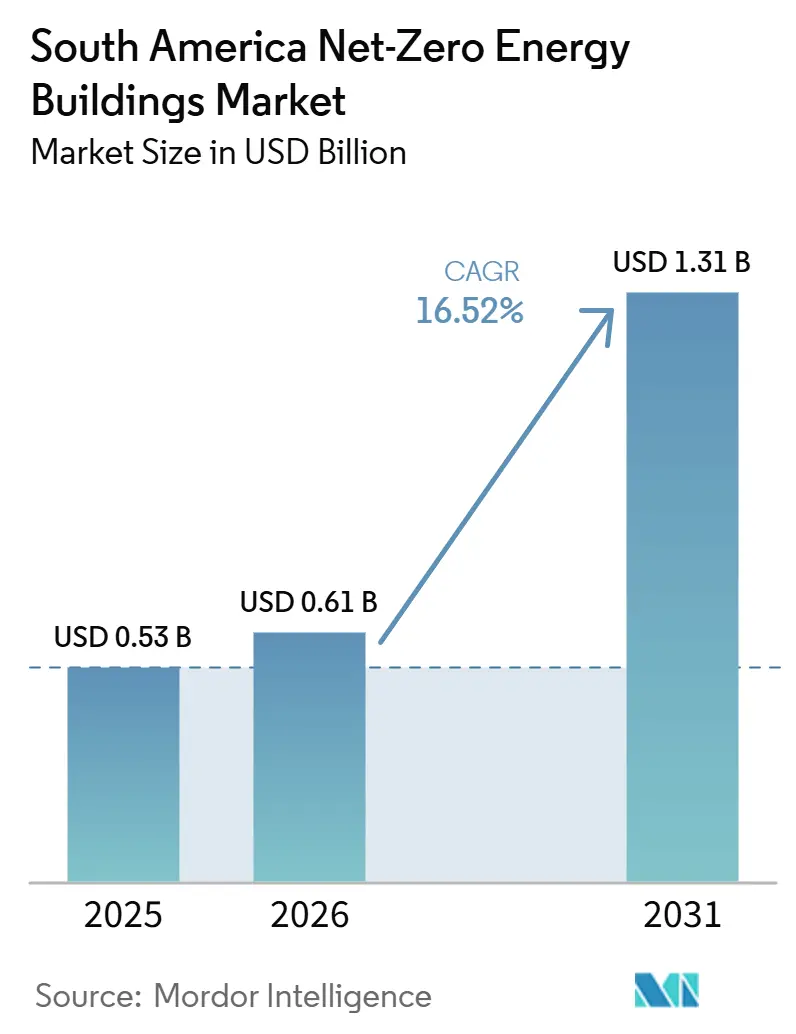
| Base Year Market Size (2025) | USD 0.53 Billion |
| Market Size (2026) | USD 0.61 Billion |
| Market Size (2031) | USD 1.31 Billion |
| Growth Rate (2026 - 2031) | 16.52 % |
| Market Concentration | Medium |
Major Players *Disclaimer: Major Players sorted in no particular order Image © Mordor Intelligence. Reuse requires attribution under CC BY 4.0. | |
South America Net-Zero Energy Buildings Market Analysis by Mordor Intelligence
The South America Net-Zero Energy Buildings Market size is expected to grow from USD 0.53 billion in 2025 to USD 0.61 billion in 2026 and is forecast to reach USD 1.31 billion by 2031 at 16.52% CAGR over 2026-2031.
Energy performance rules, corporate emissions targets, and lower-cost solar and control systems are changing how developers assess building projects across the region, where buildings and construction represent a USD 4.1 trillion business opportunity by 2030. The South America net-zero energy buildings market is moving beyond isolated flagship properties as public programs and certification pathways set clearer requirements for new buildings and renovations. This change rewards projects that consider the building envelope, energy supply, controls, and operating data together rather than treating certification as a final design-stage task. Brazil and Colombia provide the strongest near-term foundation because they combine compliance measures with deeper certification activity. The South America net-zero energy buildings market also offers opportunities for firms that can integrate design, commissioning, controls, and verified operational results. Limited finance, uneven local implementation, and imported component costs will continue to slow adoption outside the larger markets.
Key Report Takeaways
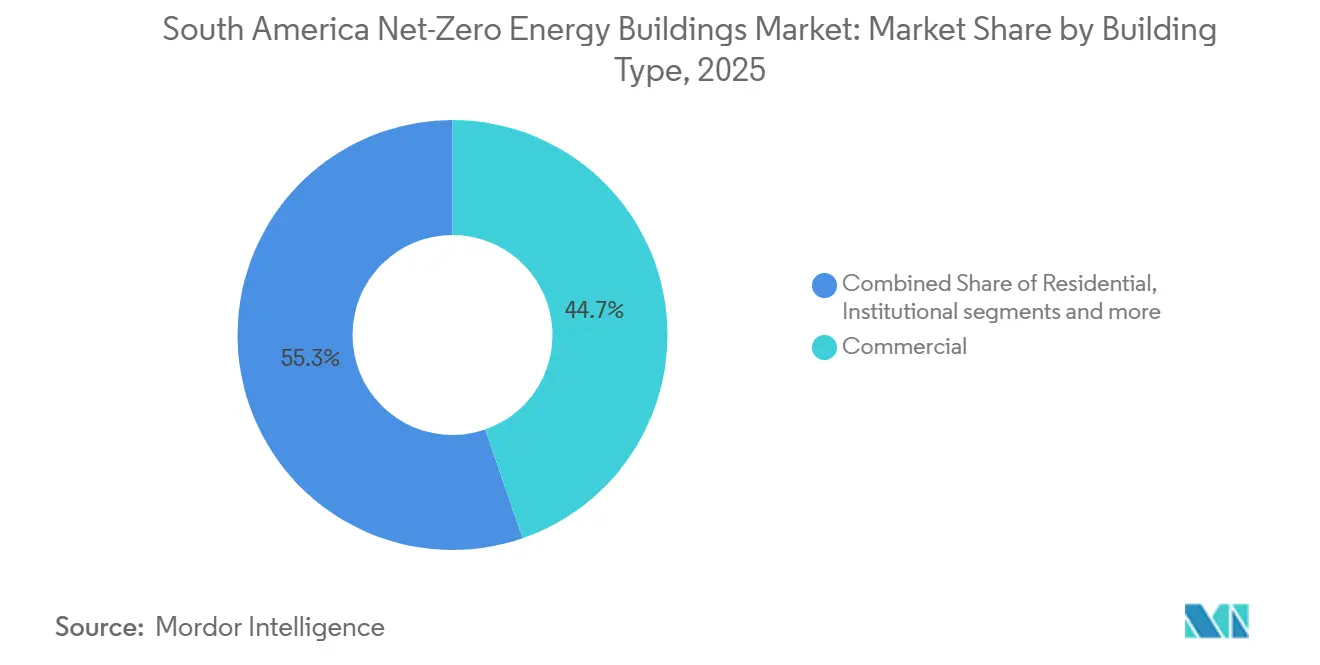
- By building type, commercial buildings held 44.70% of the South America net-zero energy buildings market share in 2025, while institutional buildings are forecast to grow at a 17.40% CAGR through 2031.
- By offerings, solutions accounted for 69.50% of the South America net-zero energy buildings market size in 2025, while services are expected to record a 17.80% CAGR through 2031.
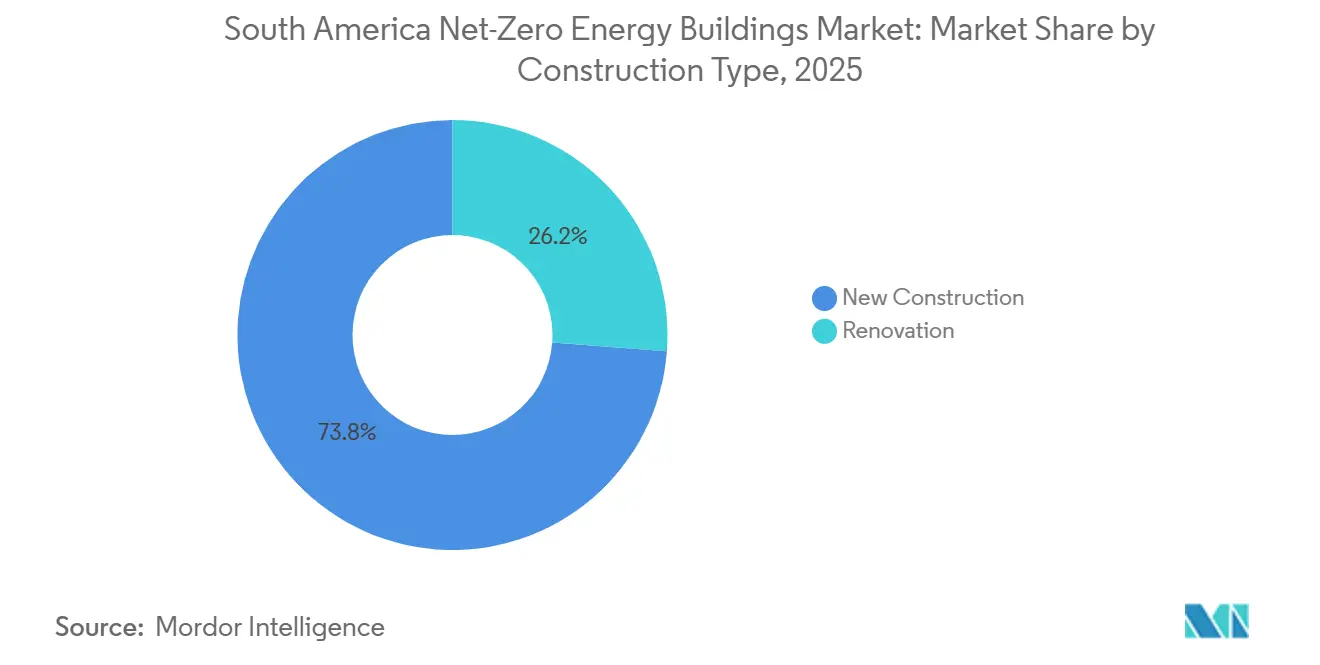
- By construction type, new construction held 73.80% of the South America net-zero energy buildings market size in 2025, while renovation is forecast to expand at a 17.10% CAGR through 2031.
- By geography, Brazil represented 46.80% of the South America net-zero energy buildings market share in 2025, while Colombia is forecast to grow at an 18.20% CAGR through 2031.
Note: Market size and forecast figures in this report are generated using Mordor Intelligence’s proprietary estimation framework, updated with the latest available data and insights as of January 2026.
Market Trends and Insights
Drivers Impact Analysis of South America Net-Zero Energy Buildings Market*
| Drivers | (~) % Impact on CAGR Forecast | Geographic Relevance | Impact Timeline |
|---|---|---|---|
| Energy Performance Regulations and Green Certification Drive Net-Zero Building Adoption | +3.5% | Brazil, Colombia, Chile, Argentina, and Peru | Medium term (2-4 years) |
| Corporate Decarbonization Goals Increase Demand for Sustainable Buildings | +2.9% | Brazil, Colombia, Chile, and Argentina | Medium term (2-4 years) |
| Declining Costs of Distributed Solar and Smart Controls Improve Project Viability | +2.8% | Brazil, Chile, Colombia, and Argentina | Short term (≤ 2 years) |
| Grid Reliability and Climate Risks Increase Demand for Energy-Resilient Buildings | +2.3% | Brazil, Colombia, and Chile | Medium term (2-4 years) |
| Performance-Linked Finance and Green Leases Support Net-Zero Investments | +2.1% | Chile, Brazil, Colombia, and Argentina | Medium term (2-4 years) |
| Local Net-Zero Demonstration Projects Accelerate Market Development | +1.8% | Brazil, Chile, and Colombia | Short term (≤ 2 years) |
| Source: Mordor Intelligence | |||
Energy Performance Regulations and Green Certification Drive Net-Zero Building Adoption
Brazil’s CGIEE Resolution No. 4/2025 set minimum energy performance requirements for new buildings and linked compliance to the timing of construction permits. Federal public buildings must reach the ENCE Level A rating from 2027 and a near-zero energy building standard by 2035, while private buildings must meet Level C from 2030. The Ministry of Mines and Energy stated that the measure could save 17 million megawatt-hours and avoid USD 0.5 billion in electricity costs by 2040[1]Brazil Ministry of Mines and Energy, “Resolution CGIEE No. 4/2025,” Valor Econômico, valor.globo.com. That timetable gives developers time to adjust designs, while making future minimum performance more predictable for investors and product suppliers. Colombia’s Resolution 0194 of 2025 recognizes Excellence in Design for Greater Efficiencies (EDGE) as a compliance route, making certification more relevant to project approval. Colombia had more than 364,000 EDGE-certified housing units across 25.4 million square meters and 1,282 projects by 2026. These measures give the South America net-zero energy buildings market a clearer path from voluntary certification to measured performance.
Corporate Decarbonization Goals Increase Demand for Sustainable Buildings
Corporate tenants and asset owners are making energy performance a more visible part of site selection and portfolio management. Siemens reported that 57% of surveyed organizations planned to increase investment in energy efficiency, 55% in smart building technologies, and 54% in building electrification within the following year[2]Siemens AG, “Infrastructure Transition Monitor 2025, Inside Smarter Buildings,” Siemens, siemens.com. In Brazil, green certifications are increasingly relevant to real estate fund strategy and to leasing decisions in major business districts. This demand supports commercial buildings, where owners can combine lower operating costs with stronger environmental credentials and respond to tenant reporting requirements. It also underscores the need for commissioning, certification, and advisory services when a building must demonstrate actual performance rather than design intent. The South America net-zero energy buildings market, therefore, has room for service providers that can help owners convert stated targets into verified results, particularly where a lease or financing agreement requires evidence of energy savings.
Declining Costs of Distributed Solar and Smart Controls Improve Project Viability
Improving solar economics makes on-site generation more practical for building owners in Brazil and neighboring countries. A 2026 analysis found that direct solar self-generation in Brazil could reduce costs by up to 32.9% compared with power purchase agreements and yield an internal rate of return of 11.8% to 18.1%. Brazil’s distributed generation framework and the ANEEL guidance on battery storage tariffs reduce some barriers to pairing solar with storage. Smart controls enhance the value of this equipment by adjusting energy use in response to changing building loads, identifying inefficient operating patterns, and supporting maintenance planning. Johnson Controls reported that its AI-based optimization applications can reduce energy costs by up to 30%. These conditions strengthen the case for the South America net-zero energy buildings market, particularly for projects that need both lower emissions and stronger control over operating expenses.
Grid Reliability and Climate Risks Increase Demand for Energy-Resilient Buildings
Grid reliability has become a design consideration for buildings that depend on uninterrupted power. Brazil’s power system has a high share of renewable energy, but extreme weather and hydrological conditions can affect supply and distribution networks. The United Nations Sustainable Development Solutions Network documented the exposure of Brazilian electricity infrastructure to cyclones, floods, and wildfires[3]United Nations Sustainable Development Solutions Network, “Brazil’s Power Infrastructure Resilience in the Face of Extreme Weather Events,” United Nations Sustainable Development Solutions Network, unsdsn.org. On-site solar, storage, efficient envelopes, and building controls can help facilities maintain essential functions during grid disruption, which is particularly relevant for health care, education, and public service sites. Colombia’s climate plan includes a goal to establish 8 thermal districts in cities by 2030, which supports the deployment of lower-emission cooling infrastructure. The South America net-zero energy buildings market benefits when resilience and energy performance are considered together, especially in health, education, and public facilities.
Restraints Impact Analysis of South America Net-Zero Energy Buildings Market*
| Restraints | (~) % Impact on CAGR Forecast | Geographic Relevance | Impact Timeline |
|---|---|---|---|
| High Upfront Costs and Limited Green Financing Restrict Market Adoption | -2.1% | Regional, especially Argentina, smaller cities in Brazil and Colombia, and the rest of South America | Long term (≥ 4 years) |
| Fragmented Regulatory Enforcement and Limited Operational Data Increase Compliance Challenges | -1.5% | Argentina, the rest of South America, and secondary Brazilian cities | Medium term (2-4 years) |
| Dependence on Imported High-Performance Building Components Raises Project Costs | -1.2% | Brazil, Argentina, and the rest of South America | Short term (≤ 2 years) |
| Split Incentives in Existing Building Retrofits Slow Net-Zero Adoption | -0.9% | Brazil, Colombia, and Chile | Medium term (2-4 years) |
| Source: Mordor Intelligence | |||
High Upfront Costs and Limited Green Financing Restrict Market Adoption
Upfront cost remains a major barrier, particularly for private developers outside large urban centers. Siemens found that 60% of commercial real estate executives surveyed considered decarbonization too expensive, while 33% reported adequate access to financing. High local interest rates and limited green finance products make it harder to fund equipment and design changes before energy savings are realized. The World Green Building Council found that 68% of respondents in the Americas cited the lack of financial products as a primary barrier to adoption. This creates a practical gap between a project that looks viable over its operating life and one that can secure construction funding at the outset. The International Finance Corporation identifies Energy-as-a-Service models as a way to shift capital spending toward payments tied to guaranteed savings. Until such structures become more common, the South America net-zero energy buildings market will remain concentrated in projects with stronger balance sheets or public support.
Fragmented Regulatory Enforcement and Limited Operational Data Increase Compliance Challenges
Rules are advancing at different speeds across South America, which complicates investment planning. Brazil’s private-sector requirements do not start until 2030, leaving a period when voluntary certification still carries much of the responsibility for changing behavior. Argentina has a national residential energy label, but it is voluntary at the federal level, and mandatory measures are largely local. Santa Fe Province issued social housing requirements in 2025, while Rosario applies thermal performance requirements to new construction. Limited performance data also prevents owners from demonstrating to lenders how a completed building operates. This reduces the ability to compare projects, identify reliable savings, and build common documentation for investors. The South America net-zero energy buildings market needs more consistent measurement, reporting, and verification before sustainability-linked financing can scale beyond leading cities.
*Our forecasts treat driver/restraint impacts as directional, not additive. The impact forecasts reflect baseline growth, mix effects, and variable interactions.
South America Net-Zero Energy Buildings Market Segment Analysis
By Building Type:
Commercial Buildings Hold the Largest PositionCommercial buildings accounted for 44.70% of the South America net-zero energy buildings market in 2025. Corporate environmental commitments, lease requirements, and green certification activity in prime office districts supported this position. In São Paulo, institutional investors and multinational occupiers have made certified space more relevant to portfolio quality and tenant attraction. The Global Network for Zero certified a Brazilian law firm office in June 2025, showing that operational net-zero recognition is reaching standard commercial settings. Commercial owners can more readily justify investments when energy savings, rental positioning, and compliance needs align. This makes the segment central to the South America net-zero energy buildings industry.
Institutional buildings are forecast to expand at a 17.40% CAGR through 2031, the fastest rate among building types. Public mandates and the need for resilient facilities support demand from hospitals, universities, and public buildings. Brazil’s PROCEL Energia Zero program committed USD 17.5 million in 2025 for zero-energy retrofits of public facilities, including health and education buildings. The Hospital Oncopediátrico Erastinho in Curitiba received LEED Zero Energy certification in 2024, which provided a regional benchmark for health facilities. Residential demand should also increase as private housing is included in Brazil’s future performance framework. Industrial properties are less advanced because retrofits are complex, and landlords and tenants often do not share the benefits of energy investments.



By Offering:
Solutions Lead While Services Gain ImportanceSolutions held 69.50% of the South America net-zero energy buildings market in 2025. This category includes net-zero development, retrofits, integrated design and delivery, and smart building equipment. Its large position reflects the capital-intensive nature of installing efficient envelopes, photovoltaic systems, controls, and related infrastructure. Brazil had 1,447 certified projects covering 74.7 million square meters by 2025, with reported average energy savings of 31% and water savings of 47% across the certified stock. This installed base creates a continuing need for providers to maintain, optimize, and verify building performance. The South America net-zero energy buildings industry remains dependent on solutions, as each project begins with physical design and equipment decisions.
Services are forecast to grow at a 17.80% CAGR through 2031, the fastest rate within offerings. Architectural and engineering work, commissioning, certification, consulting, and construction support are becoming more important as requirements become enforceable. Brazil’s public building rules from 2027 and Colombia’s EDGE recognition increase the value of independent compliance work. Johnson Controls opened an Innovation Centre in Sorocaba in 2026 that demonstrates OpenBlue, Metasys, and technologies for automation, fire detection, heating, ventilation, air conditioning, and refrigeration. The company’s move illustrates how equipment suppliers are adding digital and managed-service capabilities. As owners seek proof of operating results, service revenue can rise faster than equipment procurement in the South America net-zero energy buildings market.
By Construction Type:
New Construction Remains Larger than RenovationNew construction accounted for 73.80% of the South America net-zero energy buildings market in 2025. Developers can incorporate passive solar design, efficient thermal envelopes, on-site generation, and building management systems before a project is built. Brazil’s CGIEE Resolution No. 4/2025 and Colombia’s Resolution 0194 of 2025 mainly reinforce demand for new projects through their compliance pathways. New construction also avoids some disruption and technical constraints that occur in occupied properties. This advantage keeps new projects at the center of planned certification pipelines in Brazil and Colombia. The segment’s current scale provides the main revenue base for the South America net-zero energy buildings market.
Renovation is forecast to expand at a 17.10% CAGR through 2031. Existing commercial and public properties built before current energy standards represent a large pool for energy upgrades. PROCEL Energia Zero directed USD 17.5 million toward public building retrofits in 2025, with eligibility criteria including buildings at least 12 months old and with a constructed area of at least 500 square meters. Owners face the risk that inefficient buildings may become less attractive to tenants and lenders. Green leases and performance-based contracts can reduce the divide between the party funding an upgrade and the party receiving the utility savings. This creates a longer-term path for renovation in the South America net-zero energy buildings market.
Geography Analysis
Brazil Net-Zero Energy Buildings Market
Brazil held 46.80% of the South America net-zero energy buildings market in 2025. Its leading position reflects stronger certification activity, a larger financing base, and the phased national performance rules. Bradesco had committed USD 43.8 billion to sustainable financing since 2021 and increased its target by USD 17.5 billion after meeting the original target in 2025. The PROCEL Energia Zero program also supports public-sector retrofits. Brazil recorded embodied carbon intensity of 0.23 metric tons of carbon dioxide equivalent per square meter in building projects in 2026, compared with a cited European Union range of 0.43 to 0.82 metric tons. These conditions give the South America net-zero energy buildings market a deeper project pipeline in Brazil than elsewhere in the region.
Colombia and Chile Net-Zero Energy Buildings Market
Colombia is forecast to grow at an 18.20% CAGR through 2031, the fastest country rate in the region. Resolution 0194 of 2025, along with the acceptance of EDGE certification, removes uncertainty about compliance. CAMACOL reported that 91% of Colombia’s 364,000 EDGE-certified units were residential, which shows the importance of housing in the country’s certification activity. CAF has a five-year program to reduce emissions from buildings and public spaces in Barranquilla, Cali, and Pasto by 40% by 2030. Chile also has supportive conditions through its climate framework and a USD 100 million International Finance Corporation green loan to Santander Chile for EDGE-certified construction.
South America Net-Zero Energy Buildings Market
Argentina remains at an earlier stage because requirements vary by jurisdiction. Santa Fe’s 2025 social housing measure and Rosario’s thermal performance rules provide local examples, while the updated national residential energy label is a step toward broader alignment. Peru, Uruguay, Ecuador, Paraguay, and Bolivia also remain less mature, with technology availability and affordability acting as practical constraints. The World Green Building Council found that more than 60% of respondents from Ecuador, Paraguay, and Venezuela said energy-efficiency technologies were neither widely available nor affordable. These markets offer future growth potential for the South America net-zero energy buildings market, but their development depends on local finance, supply chains, and more consistent enforcement.
Competitive Landscape
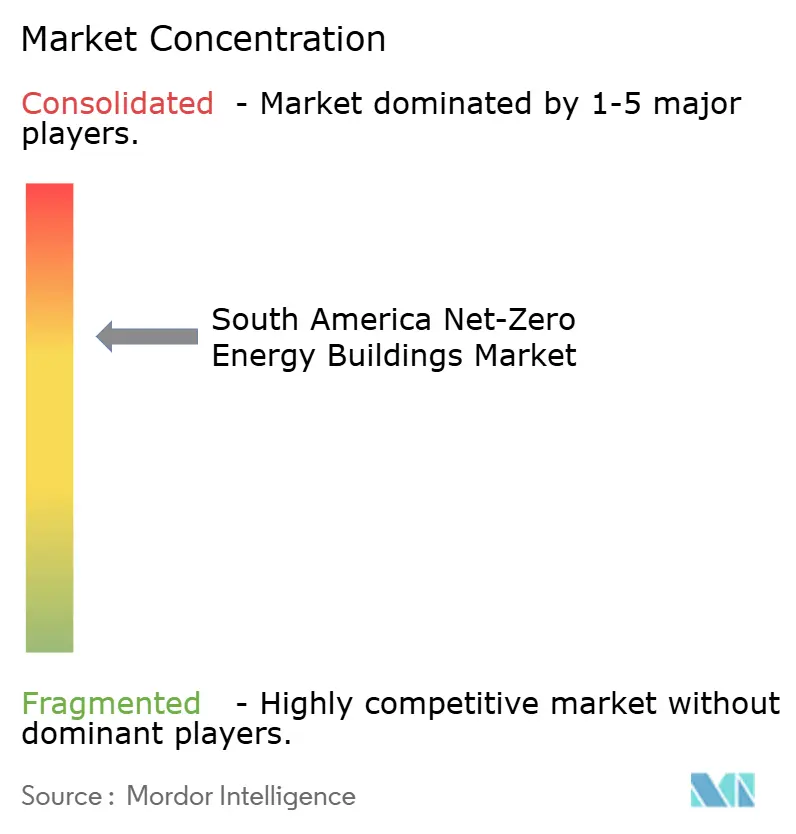
The South America net-zero energy buildings market is moderately consolidated. Schneider Electric, Johnson Controls, Siemens, Honeywell, Trane Technologies, Carrier Global, and ABB have established positions in integrated building energy management systems. Saint-Gobain, Kingspan, ROCKWOOL, Sika, and Legrand compete in building envelopes and electrical infrastructure. These larger companies have regional manufacturing, technical capacity, and service networks that smaller firms often lack, and they can draw on global product testing and software development. Their broad portfolios allow them to combine equipment, digital tools, and service contracts within a single project, reducing the number of suppliers an owner must coordinate. Competition is strongest where building owners seek a provider that can take responsibility for performance over time.
Technology acquisitions are a central part of competitive strategy in the South America net-zero energy buildings market. Carrier acquired 75F in July 2026 to add cloud-native, wireless building automation for commercial, light commercial, retrofit, and data center applications. Johnson Controls acquired Nantum AI in April 2026 to strengthen AI-driven energy optimization within its OpenBlue ecosystem. Trane Technologies completed its BrainBox AI acquisition in January 2026, adding a platform deployed across more than 14,000 commercial buildings. These actions help incumbents shift from hardware sales toward recurring software, optimization, and managed services.
The South America net-zero energy buildings market also presents an opportunity for renovation-as-a-service for mid-sized commercial properties beyond major metropolitan areas. Many such owners cannot fund deep upgrades upfront and may not have direct access to large original equipment manufacturers. Energy-as-a-service arrangements can address this need by linking payments to energy savings and shifting some design, equipment, and performance risk to a specialist provider. Saint-Gobain announced a USD 78-87 million investment in a drywall production line in Feira de Santana, Brazil, expected to increase local capacity by 75% from 2028. Sika also opened manufacturing plants in Argentina and Colombia as part of its global expansion. Such supply investments can improve access to envelope materials as performance requirements are increasingly applied.
South America Net-Zero Energy Buildings Industry Leaders
Schneider Electric SE
Johnson Controls International plc
Siemens AG
Honeywell International Inc.
Daikin Industries, Ltd.
- *Disclaimer: Major Players sorted in no particular order
South America Net-Zero Energy Buildings Market Companies Covered in this Report
- Schneider Electric SE
- Johnson Controls International plc
- Siemens AG
- Honeywell International Inc.
- Daikin Industries, Ltd.
- Trane Technologies plc
- Carrier Global Corporation
- Mitsubishi Electric Corporation
- Panasonic Holdings Corporation
- ABB Ltd.
- Saint-Gobain
- Kingspan Group plc
- ROCKWOOL A/S
- Sika AG
- Legrand SA
- Bosch Building Technologies
- Belimo Holding AG
- Skanska AB
- Lendlease Group
- WSP Global Inc.

Recent Industry Developments in South America Net-Zero Energy Buildings Market
- July 2026: Carrier Global Corporation acquired 75F, a cloud-native AI-enabled building automation company, to strengthen its intelligent building strategy across large commercial, light commercial, retrofit, and data center applications.
- May 2026: Johnson Controls completed the acquisition of Alloy Enterprises, a thermal management platform specialist for high-performance data centers and mission-critical facilities.
- April 2026: Johnson Controls acquired Nantum AI to accelerate AI-driven energy optimization within its OpenBlue digital ecosystem.


South America Net-Zero Energy Buildings Market Report Scope
The South America Net-Zero Energy Buildings Market Report is Segmented by Building Type (Residential, Commercial, Institutional, and Industrial), by Offerings (Solutions and Services), by Construction Type (New Construction and Renovation), and by Country (Brazil, Argentina, Colombia, Chile, and Rest of South America). The Market Forecasts are Provided in Terms of Value (USD).
| Residential |
| Commercial |
| Institutional |
| Industrial |
| Solutions (New Net-Zero Energy Building Development, Net-Zero Building Retrofit, Integrated Design & Delivery and Smart Net-Zero Building Solutions) |
| Services (Architectural & Engineering Design, Construction Services, Commissioning & Certification Services and Consulting Services) |
| New Construction |
| Renovation |
| Brazil |
| Argentina |
| Colombia |
| Chile |
| Rest of South America |
| By Building Type | Residential |
| Commercial | |
| Institutional | |
| Industrial | |
| By Offerings | Solutions (New Net-Zero Energy Building Development, Net-Zero Building Retrofit, Integrated Design & Delivery and Smart Net-Zero Building Solutions) |
| Services (Architectural & Engineering Design, Construction Services, Commissioning & Certification Services and Consulting Services) | |
| By Construction Type | New Construction |
| Renovation | |
| By Country | Brazil |
| Argentina | |
| Colombia | |
| Chile | |
| Rest of South America |


Key Questions Answered in the Report
What is the forecast growth rate for South America's net-zero energy buildings?
The sector is forecast to grow at a 16.52% CAGR from 2026 to 2031, reaching USD 1.31 billion.
Which country leads net-zero energy building activity in South America?
Brazil held 46.80% of regional revenue in 2025, supported by certification activity, financing, and performance rules.
Which country is growing fastest in this sector?
Colombia is forecast to grow at an 18.20% CAGR through 2031, supported by the EDGE compliance route.
Which building type has the largest share?
Commercial buildings held 44.70% of revenue in 2025, driven by corporate tenants, green leases, and certified office activity.
Why are building services growing faster than solutions?
Services are forecast to grow at a 17.80% CAGR because owners increasingly need commissioning, certification, and verified operating performance.
What is the main barrier to net-zero building adoption in South America?
High upfront costs and limited access to suitable green financing constrain adoption, especially outside major cities.
Page last updated on:





