
South America Metal Packaging Market Size and Share
Market Overview
| Study Period | 2020 - 2031 |
|---|---|
| Forecast Data Period | 2026 - 2031 |
| Base Year Market Size (2025) | USD 8.45 Billion |
| Market Size (2026) | USD 8.85 Billion |
| Market Size (2031) | USD 11.41 Billion |
| Growth Rate (2026 - 2031) | 5.21 % |
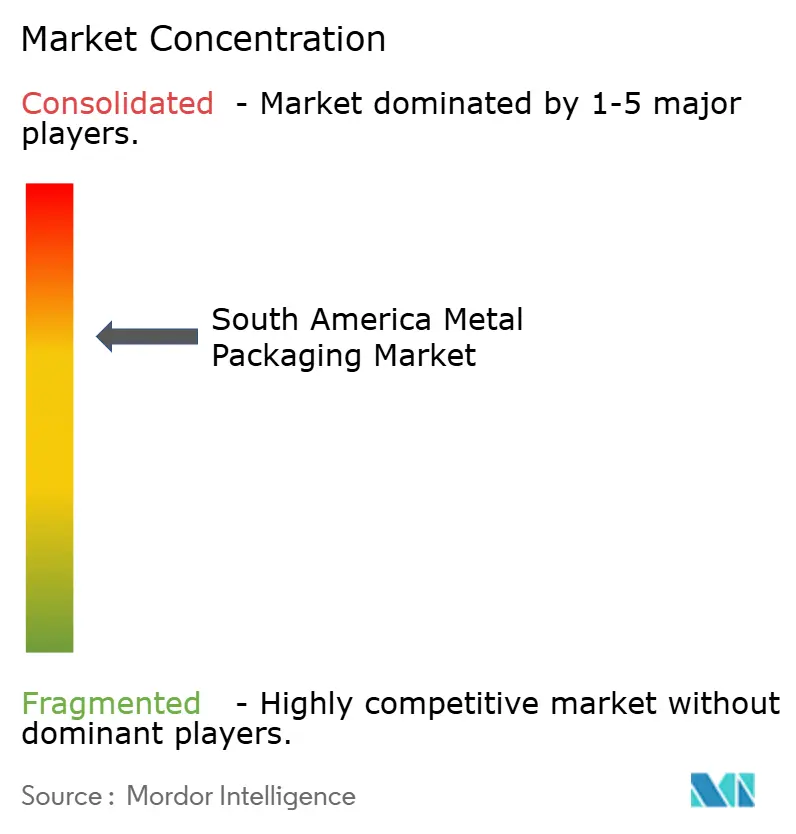
| Market Concentration | Medium |
Major Players *Disclaimer: Major Players sorted in no particular order Image © Mordor Intelligence. Reuse requires attribution under CC BY 4.0. | |
South America Metal Packaging Market Analysis by Mordor Intelligence
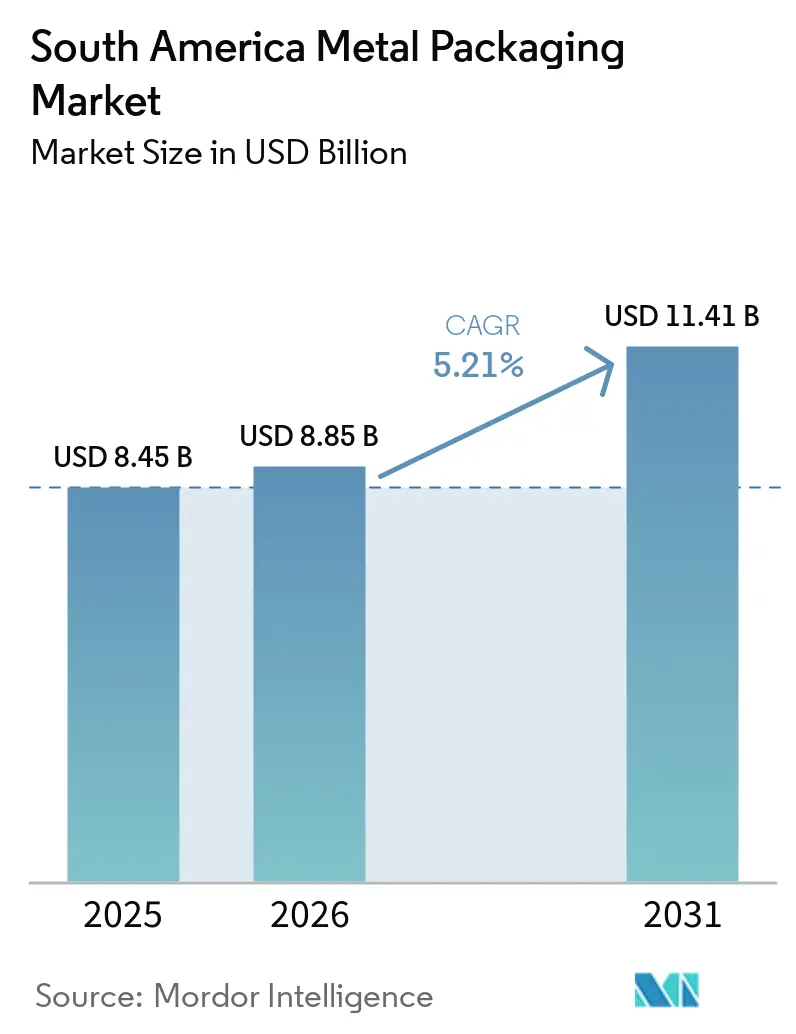
The South America Metal Packaging Market size was valued at USD 8.45 billion in 2025, USD 8.85 billion in 2026, and is estimated to grow from USD 8.85 billion in 2026 to reach USD 11.41 billion by 2031, at a CAGR of 5.21% during the forecast period (2026-2031). Demand is driven by beer, ready-to-drink beverages, canned water, and processed foods, which require durable packaging over long distribution routes. Brazil sold 34.1 billion aluminum cans in 2025, its second-highest recorded volume, even as traditional beer and soft drink volumes softened. Canned water, ready-to-drink beverages, and canned cachaça offset part of that decline, broadening the South America Metal Packaging Market's demand base. High recycling rates and new local can capacity improve material availability and delivery reliability for beverage brands. Higher aluminum prices and currency volatility remain important cost risks because many converters buy imported coil while selling to customers in local currencies
Key Report Takeaways
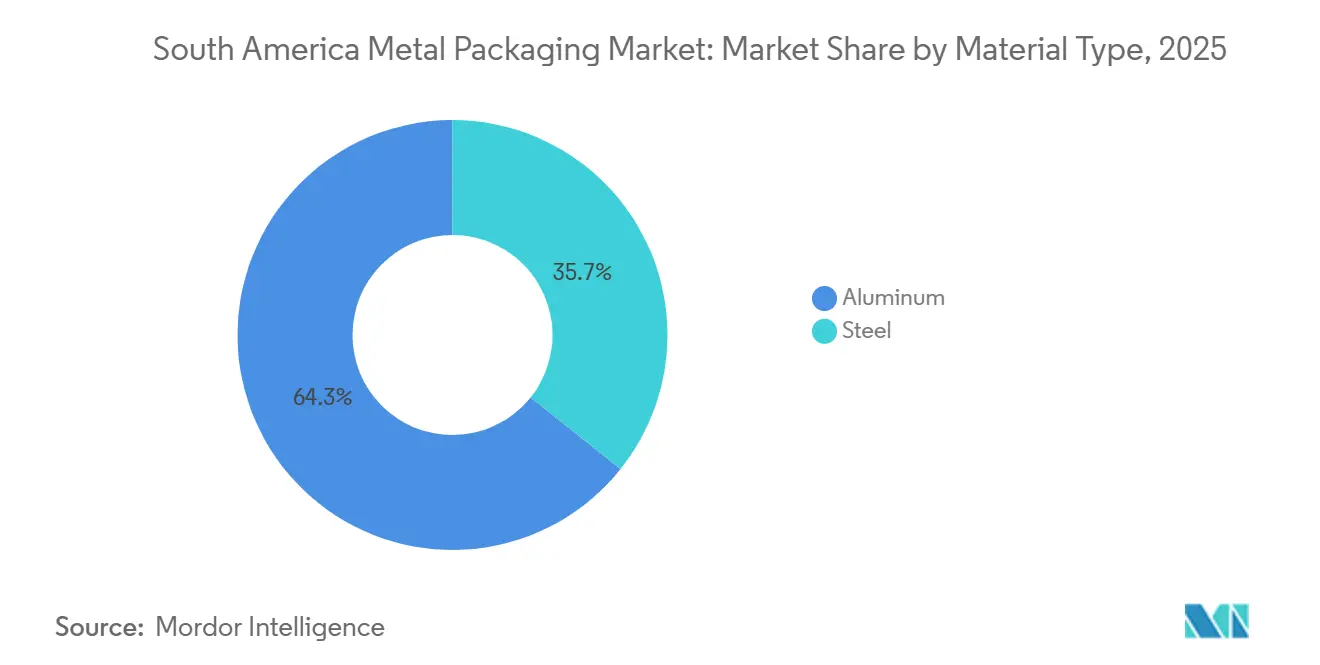
- By material type, aluminum held 64.28% of the South America Metal Packaging Market share in 2025, while aluminum is projected to grow at a 6.74% CAGR through 2031.
- By product type, beverage cans accounted for 41.33% of the South America Metal Packaging Market size in 2025, while aerosol cans are forecast to expand at a 6.89% CAGR through 2031.
- By end-user industry, beverages held 52.16% share in 2025, while cosmetics and personal care are projected to grow at a 7.11% CAGR through 2031.
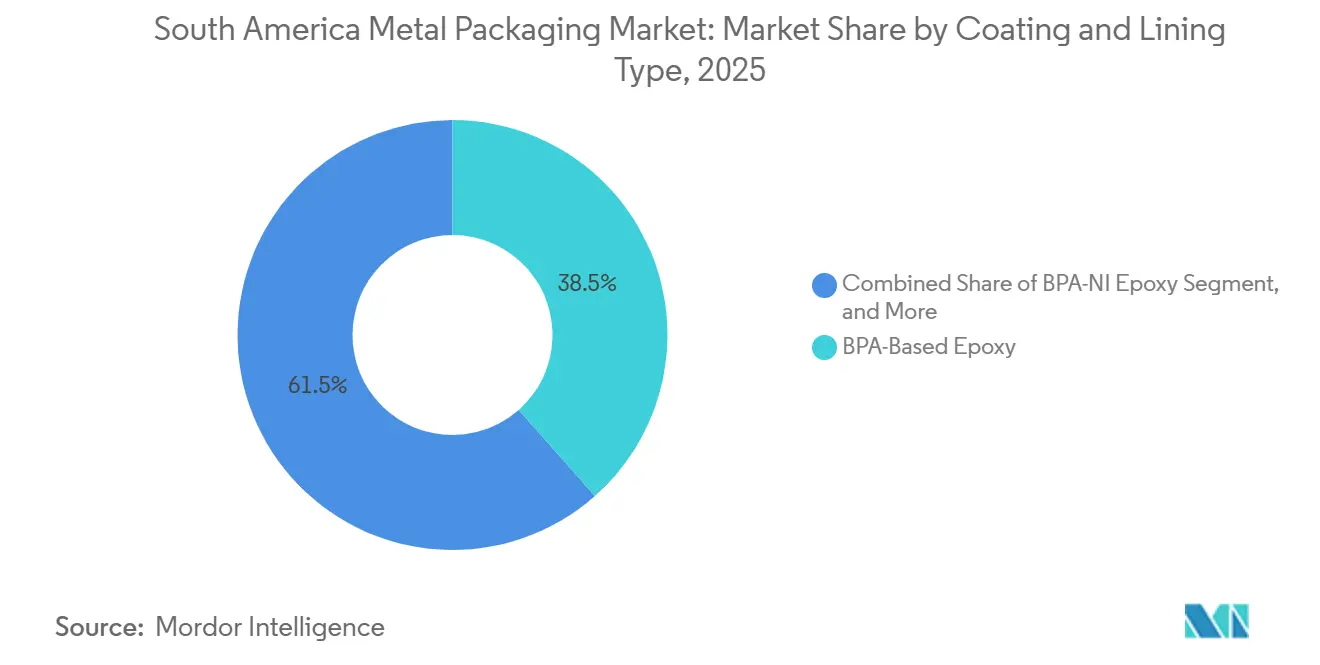
- By coating and lining type, BPA-based epoxy held 38.47% share in South America Metal Packaging Market in 2025, while BPA-NI epoxy is forecast to advance at a 6.52% CAGR through 2031.
- By container capacity, the 251-500 ml format held 45.69% share in 2025, while the less-than-250 ml format is forecast to expand at a 6.83% CAGR through 2031.
- By geography, Brazil held 33.74% of the South America Metal Packaging Market share in 2025, while Colombia is forecast to grow at a 6.61% CAGR through 2031.
Note: Market size and forecast figures in this report are generated using Mordor Intelligence’s proprietary estimation framework, updated with the latest available data and insights as of January 2026.
Market Trends and Insights
Drivers Impact Analysis of South America Metal Packaging Market*
| Driver | (~) % Impact on CAGR Forecast | Geographic Relevance | Impact Timeline |
|---|---|---|---|
| Growth in Canned Beer and Ready-to-Drink Beverage Consumption | +1.5% | Brazil and Colombia core, with spillover to Argentina, Chile, and Venezuela | Short term (≤ 2 years) |
| Recyclability and Circular-Economy Commitments | +1.1% | Brazil dominant, with growing uptake across MERCOSUR | Medium term (2-4 years) |
| Longer Shelf Life and Barrier Protection for Food and Beverages | +0.8% | Brazil, Argentina, and Chile | Medium term (2-4 years) |
| Expansion of Processed Food and Convenience Consumption | +0.6% | Brazil and Argentina core, with Colombia and Chile emerging | Medium term (2-4 years) |
| Premiumization of Beverage and Personal Care Packaging | +0.5% | Urban Brazil, Colombia, and Chile | Long term (≥ 4 years) |
| Brazil-Led Localization of Can Supply and Regional Beer Logistics | +0.3% | Brazil, with spillover to Paraguay and Bolivia | Short term (≤ 2 years) |
| Source: Mordor Intelligence | |||
Growth in Canned Beer and Ready-to-Drink Beverage Consumption
Canned beer and ready-to-drink beverages are the largest drivers of demand for the South America Metal Packaging Market. Brazil sold 34.1 billion aluminum cans in 2025, with canned water, ready-to-drink beverages, and canned cachaça adding volume as established beverage categories slowed. These formats usually use single-serve aluminum or steel cans rather than glass or PET. This gives new beverage launches a direct effect on can demand.[1]Abralatas, “Aluminum Can Sector Shows 12% Growth,” Abralatas, abralatas.org.br Abralatas expected a new growth cycle in 2026, supported by the FIFA World Cup and broader category demand. The South America Metal Packaging Market benefits as the demand mix becomes less dependent on conventional beer volumes.
Recyclability and Circular-Economy Commitments
Brazil’s aluminum can collection system supports a major cost and sourcing advantage for the South America Metal Packaging Market. The country recycled 97.3% of beverage cans in 2024 and reached 100% in 2025. More than 80% of the aluminum sheet used for Brazilian can production came from recycled material, according to Abralatas.[2]Agência Brasil, “Brasil Reciclou 97,3% das Latinhas de Alumínio em 2024,” Agência Brasil, agenciabrasil.ebc.com.br Recycled content can reduce producers’ exposure to primary metal costs and meet procurement requirements from multinational beverage customers. Ball Beverage Packaging South America and Ardagh Metal Packaging Brasil received Aluminum Stewardship Initiative Performance Standard V3.1 certifications in 2025. These credentials strengthen the South America Metal Packaging Market's position in supply contracts that require traceability and responsible material management.[3]Abralatas, “ESG Report 2025: Partnerships for the Circular Economy,” Abralatas, abralatas.org.br
Longer Shelf Life and Barrier Protection for Food and Beverages
Metal containers provide protection against light, oxygen, and moisture, which is valuable along long inland supply routes. Brazil’s interior, Argentina’s southern distribution routes, and Colombia’s mountain corridors create conditions where spoilage and cold-chain interruptions can be material concerns. Aluminum and steel cans provide multi-year ambient shelf life for beans, tomatoes, fish, and ready-to-eat meals. This packaging performance supports the South America Metal Packaging Market in lower-income urban and peri-urban locations where refrigeration may be less reliable. Argentina incorporated updated technical rules for food-contact coatings, utensils, lids, and metal equipment through Joint Resolution No. 8/2026. The added validation requirements favor manufacturers that can document coating performance and compliance with migration requirements.
Expansion of Processed Food and Convenience Consumption
Urban households are increasing their demand for processed and ready-to-eat food that can be stored and transported without refrigeration. Food cans support pet food, seafood, canned pulses, beans, tomatoes, and prepared meals across the South America Metal Packaging Market. The expansion of modern supermarkets in secondary cities widens access to these products. Steel remains important because it combines strength with suitability for retort sterilization and a lower material cost per unit of stored volume. This keeps steel relevant even where aluminum dominates beverage packaging. Growth in packaged food supports stable demand across the South America Metal Packaging Market because food formats are less exposed to the purchasing cycles of discretionary products.
Restraints Impact Analysis of South America Metal Packaging Market*
| Restraint | (~) % Impact on CAGR Forecast | Geographic Relevance | Impact Timeline |
|---|---|---|---|
| Aluminum, Steel, and Energy Price Volatility | -0.9% | Global, with highest exposure in Brazil and Colombia | Short term (≤ 2 years) |
| High Conversion, Tooling, and Compliance Costs | -0.6% | South America-wide, with greater pressure in Venezuela and other smaller markets | Medium term (2-4 years) |
| Uneven Collection Economics Across Secondary South American Cities | -0.3% | Brazil interior, Colombia, and Venezuela | Long term (≥ 4 years) |
| Coating Qualification Bottlenecks for Localized Supply | -0.2% | Argentina, Colombia, and the wider region during BPA-NI transitions | Medium term (2-4 years) |
| Source: Mordor Intelligence | |||
Aluminum, Steel, and Energy Price Volatility
Commodity prices are the most immediate cost restraint for the South America Metal Packaging Market. LME aluminum reached USD 3,672 per metric ton in April 2026 after conflict in the Middle East threatened 9% of global primary aluminum smelting capacity. South American converters are exposed because many depend on imported aluminum coil. Input costs can rise faster than selling prices when contracts restrict mid-season increases. Energy costs can add further pressure because aluminum production and recycling depend on a reliable power supply. The result is a choice between absorbing higher costs and passing them through to customers, which can constrain margins and near-term investment.
High Conversion, Tooling, and Compliance Costs
New can diameters, coating systems, and line configurations require significant investment before they can be commercialized. Brazil’s ANVISA Resolution RDC 961/2025 added Tetramethyl Bisphenol F Diglycidyl Ether as an authorized alternative for food-contact applications. Producers still need to validate migration limits, sensory effects, and long-term can performance for each application. This process can keep production lines tied to existing coating systems during qualification. Smaller operators in Argentina and Colombia face a larger burden because they cannot spread testing costs across broad plant networks. These costs can encourage toll filling, partnerships, or consolidation within the South America Metal Packaging Market.[4]Agência Nacional de Vigilância Sanitária, “Resolução RDC ANVISA Nº 961, de 6 de Fevereiro de 2025,” Diário Oficial da União, in.gov.br
*Our forecasts treat driver/restraint impacts as directional, not additive. The impact forecasts reflect baseline growth, mix effects, and variable interactions.
South America Metal Packaging Market Segment Analysis
By Material Type:
Aluminum Retains Its Structural LeadAluminum held 64.28% of South America Metal Packaging Market revenue in 2025. Its position reflects lightweighting, recyclability, and barrier performance in beverage cans. Brazil’s 100% beverage-can recycling rate in 2025 strengthens local access to secondary material. The system reduces dependence on primary ingot compared with markets with weaker collection systems. Ball and Ardagh’s 2025 ASI certifications also support sourcing requirements from multinational beverage companies.
Steel remains relevant for food cans, industrial drums, and bulk containers where strength and retort processing matter. Greif received the Best Metal Packaging Supplier award in the drums category at Brazil’s 2025 Paint and Pintura Award. Aluminum is forecast to grow at a 6.74% CAGR through 2031 as producers expand capacity to meet demand for canned water, ready-to-drink cocktails, and energy drinks. These beverage formats are increasingly shifting from PET to aluminum. The South America Metal Packaging Market will therefore retain a two-material structure, with aluminum leading in beverages and steel maintaining specialized uses in food and industry.


By Product Type:
Beverage Cans Lead While Aerosols Grow FasterBeverage cans accounted for 41.33% of product-type revenue in 2025. Beer, soft drinks, canned water, and ready-to-drink beverages underpin this leading position. Brazil’s growth in canned water and emerging beverage categories has reduced reliance on traditional beer demand. Aerosol cans are forecast to grow at a 6.89% CAGR through 2031. Demand comes from personal care and household products, including deodorants, hair sprays, and cleaning products.
Food cans remain important because they support ambient distribution over long distances. Bulk containers and drums serve agribusiness, chemicals, paints, and industrial customers. Caps and closures benefit from premium beer and spirits formats that require higher-specification components. Food cans and aerosols also face reformulation requirements for their coatings under the current regulatory direction. The South America Metal Packaging Market, therefore, contains both high-volume beverage demand and smaller product lines with more specialized technical needs.
By End-User Industry:
Beverage Remains the Core Demand BaseBeverage accounted for 52.16% of revenue in 2025, giving it the largest share of the South America Metal Packaging Market among end users. Beer and carbonated drinks provide the established volume base. Ready-to-drink spirits, energy drinks, and functional beverages broaden demand for aluminum cans. Cosmetics and personal care are forecast to grow at a 7.11% CAGR through 2031. This segment uses metal aerosols for deodorants, hair sprays, and skin care products.
Food packaging was the second-largest end-user category in 2025. Canned beans, tomatoes, seafood, and ready-to-eat meals retain demand because they offer storage convenience and price efficiency. Household products include insecticides, air fresheners, and cleaning sprays in aerosol containers. Other customers include paints, coatings, and industrial chemicals that use steel drums and bulk packaging. The South America Metal Packaging Market is partly protected from cycles in industrial demand by the more stable consumption of beverages and shelf-stable food.
By Coating and Lining Type:
BPA-NI Epoxy Gains Regulatory SupportBPA-based epoxy held 38.47% of revenue in 2025 because it has established performance records and supply chains. BPA-NI epoxy is forecast to grow at a 6.52% CAGR through 2031. Argentina’s 2026 update incorporated technical regulations for coatings and metal equipment in food contact. Brazil’s RDC 961/2025 provides a recognized route for qualifying an alternative material. These developments direct product development spending toward BPA-NI systems.
Polyester- and PET-based coatings are used in applications requiring resistance to acidic beverages or specific food ingredients. Acrylic and hybrid systems remain under commercial evaluation. Qualification is difficult for smaller producers that lack internal coating research capacity. Those companies may rely on validated systems from global suppliers. The South America Metal Packaging Market could become more concentrated in technically demanding coating applications as compliance documentation becomes a larger part of customer qualification.

By Container Capacity:
Smaller Formats Expand the Product MixThe 251-500 ml band held 45.69% of the South America Metal Packaging Market size in 2025. The result reflects widespread use of the 350 ml beer can and standard ready-to-drink formats. The less-than-250 ml range is forecast to grow at a 6.83% CAGR through 2031. Small cans are used for ready-to-drink cocktails, premium spirits, energy shots, and craft beer. These uses align with single-portion consumption and premium positioning.
The 501-1000 ml band serves larger beer formats used in on-premise and outdoor consumption. Formats above 1000 ml mainly serve industrial and institutional customers who buy drums, pails, and bulk containers. Ball’s Guarambaré facility produces ends and shells for regional supply chains that serve several neighboring countries. Flexible, high-speed lines can support a broader mix of sizes. Smaller formats can generate more revenue per liter, making format diversity a commercial opportunity for producers and beverage brands.
Geography Analysis
Brazil Metal Packaging Market
Brazil accounted for 33.74% of the South America Metal Packaging Market in 2025. The country is the regional anchor for can volumes, production capacity, and aluminum recycling. Its sector sold 34.1 billion cans in 2025 and achieved a 100% recycling rate. Crown is adding a third line at Ponta Grossa, which will lift annual capacity from 2.4 billion to 3.6 billion cans when commercial production begins in Q3 2026. CANPACK began building a facility in Poços de Caldas in May 2025 with an investment of BRL 710 million (USD 123 million), and planned an initial capacity of 1.3 billion cans per year. ANVISA’s 2025 material list also makes Brazil a central location for coating qualification work.
Argentina Metal Packaging Market
Argentina retained demand for beverage cans despite weaker consumer purchasing power and reduced industrial investment. Beer demand showed resilience as a relatively affordable social product. Greif presented its industrial metal packaging portfolio at Envase 2025 in Buenos Aires, confirming continuing demand from agri-industrial and chemicals customers. Argentina adopted updates to food-contact requirements in June and July 2026. These changes increase the importance of compliance documentation for local suppliers. Ball’s Guarambaré operation complements supply to Argentine converters by producing can ends and shells regionally.
South America Metal Packaging Market
Colombia is forecast to record the highest growth at a 6.61% CAGR through 2031. A growing middle class, broader access to modern retail, and a larger canned beverage category support the South America Metal Packaging Market size in the country. CANPACK announced a USD 140 million second aluminum beverage-can plant near Barranquilla in September 2025, with a capacity of 1 billion can bodies per year and a planned start in Q1 2027. Chile supports premium cans for craft beer and ready-to-drink spirits, while Venezuela’s economic conditions constrain investment in new packaging. Peru, Ecuador, Bolivia, Uruguay, and Paraguay are increasingly supplied through networks centered on Brazil. Growth in brewery and beverage distribution in Lima and Quito can increase demand for imported cans, as local production remains limited.
Competitive Landscape
The South America Metal Packaging Market is moderately consolidated in beverage cans but more fragmented in food cans, aerosols, drums, and closures. Ardagh Metal Packaging, Ball Corporation, and Crown Holdings operate major aluminum can networks in the region. High-speed beverage-can lines require a capital investment of USD 100 million or more, creating a barrier to new entrants. This favors firms with established access to capital, customer contracts, and multi-plant operating experience. CANPACK has become an important challenger through new production projects in Brazil and Colombia. Its capacity investments can lower freight costs for beverage customers and add competitive pressure to established suppliers.
Crown’s Ponta Grossa expansion is a clear example of incumbent capacity investment for demand growth. CANPACK’s Barranquilla project is supported by a long-term customer agreement and is intended to supply Colombia and nearby markets. Ardagh’s Brazilian operations recorded a 14% increase in shipments in Q1 2026, underscoring the continuing importance of its local network. In Q2 2026, Ardagh reported that Brazilian shipments declined by 15% due to changes in customer mix. Contract renewals and local capacity decisions can therefore shift volumes even among established producers.
Aerosols, premium closures, and compliant BPA-NI coating supply offer targeted openings for suppliers with specialized capabilities. ASI certification provides a recognized signal of material stewardship for global beverage brands. In industrial packaging, Greif and Mauser retain relationships in paints, chemicals, and agricultural products. These customer groups value dependable delivery, technical support, and local fabrication. Smaller producers may find it harder to meet coating and documentation requirements without support from global suppliers. The South America Metal Packaging Market remains competitive because regional demand supports new investment, while technical and capital requirements limit the number of viable large-scale entrants.
South America Metal Packaging Industry Leaders
Crown Holdings, Inc.
Ball Corporation
Ardagh Metal Packaging S.A.
CANPACK S.A.
Nampak Limited
- *Disclaimer: Major Players sorted in no particular order
South America Metal Packaging Market Companies Covered in this Report
- Ardagh Metal Packaging S.A.
- Ball Corporation
- Crown Holdings, Inc.
- CANPACK S.A.
- Silgan Holdings Inc.
- Nampak Limited
- Toyo Seikan Group Holdings, Ltd.
- CPMC Holdings Limited
- Daiwa Can Company
- Hokkan Holdings Limited
- ORG Technology Co., Ltd.
- Baosteel Packaging Co., Ltd.
- Mauser Packaging Solutions
- Greif, Inc.
- TUBEX Holding GmbH
- Colep Packaging
- Envases Group
- Tecnocap S.p.A.
- Massilly Holding S.A.S.
- Pelliconi & C. S.p.A.
- Astir Vitogiannis Bros S.A.
- Trivium Packaging B.V.
- Jamestrong Packaging Pty Ltd
- Independent Can Company
- United Can Company

Recent Industry Developments in South America Metal Packaging Market
- July 2026: Argentina's ANMAT incorporated MERCOSUR Resolution No. 48/23 into the Argentine Food Code via Joint Resolution No. 8/2026, establishing updated technical regulations for coatings, utensils, lids, and metal equipment in food contact. A 180-day compliance window was granted to manufacturers, effectively requiring formulation and documentation reviews for all can coatings supplied into Argentina by early 2027.
- July 2026: Ardagh Metal Packaging raised its full-year 2026 Adjusted EBITDA guidance to USD 775-790 million after Q2 results beat internal forecasts, driven by sharp European volume recovery. Brazil shipments declined 15% in Q2 2026 on customer mix changes, signaling that key long-term can supply contract resets are actively redistributing volume across competitors in the region.
- April 2026: Abralatas confirmed Brazil's aluminum can sector sold 34.1 billion units in 2025, the second-highest volume on record, with canned water (+24% versus 2024), ready-to-drink beverages, energy drinks, and canned cachaça emerging as structural growth categories replacing declining volumes in traditional beer and soft drinks. Abralatas projected a new growth cycle in 2026, anchored by the FIFA World Cup and continued category diversification.
- April 2026: LME aluminum prices surged to USD 3,672 per metric ton, a 4-year high, after conflict in the Middle East threatened 9% of global primary aluminum smelting capacity. The U.S. Midwest aluminum premium reached USD 2,521.50 per metric ton at the same time. South American can makers that depend on imported coil faced higher input-cost exposure, especially Colombian importers without domestic primary production.


South America Metal Packaging Market Report Scope
The South America Metal Packaging Market refers to the production and distribution of containers made primarily from aluminum and steel. This includes various products such as food, beverage, and aerosol cans, bulk shipping drums, and closures, which are available in different capacities and lined with specialized coatings like BPA-free epoxies or polyester. These durable and recyclable packaging solutions are primarily utilized by the beverage, food, and personal care industries across the region to ensure product safety, extend shelf life, and maintain quality.
The South America Metal Packaging Market Report is Segmented by Material Type (Aluminum and Steel), Product Type (Cans (Food Cans, Beverage Cans, and Aerosol Cans), Bulk Containers, Shipping Barrels and Drums, and Caps and Closures), End-User Industry (Beverage, Food, Cosmetics and Personal Care, Household, and Other End-User Industry), Coating and Lining Type (BPA-Based Epoxy, BPA-NI Epoxy, Polyester / PET, and Other Coating / Lining Type), Container Capacity (Less than 250 ml, 251-500 ml, 501-1000 ml, and More than 1000 ml), and Geography (Brazil, Argentina, Colombia, Chile, Venezuela, and Rest of South America). The Market Forecasts are Provided in Terms of Value (USD).
| Aluminum |
| Steel |
| Cans | Food Cans |
| Beverage Cans | |
| Aerosol Cans | |
| Bulk Containers | |
| Shipping Barrels and Drums | |
| Caps and Closures |
| Beverage |
| Food |
| Cosmetics and Personal Care |
| Household |
| Other End-User Industry |
| BPA-Based Epoxy |
| BPA-NI Epoxy |
| Polyester / PET |
| Other Coating / Lining Type |
| Less than 250 ml |
| 251-500 ml |
| 501-1000 ml |
| More than 1000 ml |
| Brazil |
| Argentina |
| Colombia |
| Chile |
| Rest of South America |
| By Material Type | Aluminum | |
| Steel | ||
| By Product Type | Cans | Food Cans |
| Beverage Cans | ||
| Aerosol Cans | ||
| Bulk Containers | ||
| Shipping Barrels and Drums | ||
| Caps and Closures | ||
| By End-User Industry | Beverage | |
| Food | ||
| Cosmetics and Personal Care | ||
| Household | ||
| Other End-User Industry | ||
| By Coating and Lining Type | BPA-Based Epoxy | |
| BPA-NI Epoxy | ||
| Polyester / PET | ||
| Other Coating / Lining Type | ||
| By Container Capacity | Less than 250 ml | |
| 251-500 ml | ||
| 501-1000 ml | ||
| More than 1000 ml | ||
| By Geography | Brazil | |
| Argentina | ||
| Colombia | ||
| Chile | ||
| Rest of South America | ||


Key Questions Answered in the Report
What is the size of the South America Metal Packaging Market?
The South America Metal Packaging Market was valued at USD 8.45 billion in 2025 and is estimated at USD 8.85 billion in 2026. It is forecast to reach USD 11.41 billion by 2031 at a 5.21% CAGR.
Which material leads packaging demand in South America?
Aluminum led with 64.28% revenue share in 2025. Its position is supported by beverage-can demand, lightweighting, and Brazils recycling infrastructure.
Which product category is growing fastest?
Aerosol cans are forecast to grow at a 6.89% CAGR through 2031, supported by personal care and household applications.
Which end-user segment is growing fastest?
Cosmetics and personal care is forecast to grow at a 7.11% CAGR through 2031, led by demand for aerosol products.
Which country is expanding fastest in the region?
Colombia is forecast to grow at a 6.61% CAGR through 2031. CANPACK’s planned USD 140 million facility near Barranquilla supports local can supply.
What is changing in food-contact can coatings?
BPA-NI epoxy is forecast to grow at a 6.52% CAGR through 2031 as producers qualify alternatives under evolving food-contact requirements.
Page last updated on:





