
Market Overview
| Study Period | 2020 - 2031 |
|---|---|
| Forecast Data Period | 2026 - 2031 |
| Base Year Market Size (2025) | USD 145.48 Million |
| Market Size (2026) | USD 156.61 Million |
| Market Size (2031) | USD 234.89 Million |
| Growth Rate (2026 - 2031) | 8.44 % |
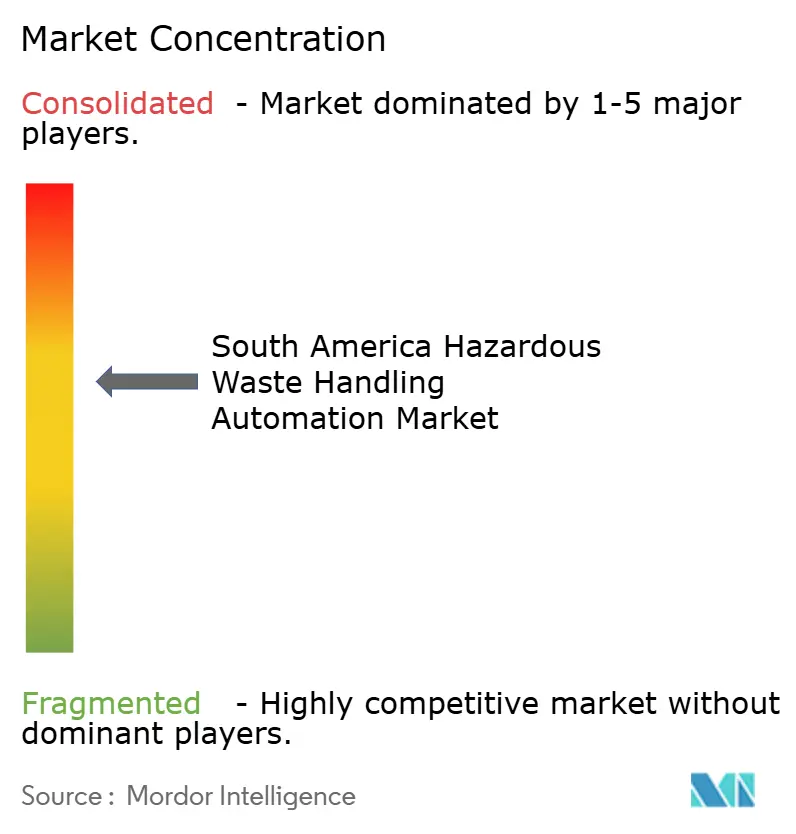
| Market Concentration | Medium |
Major Players *Disclaimer: Major Players sorted in no particular order Image © Mordor Intelligence. Reuse requires attribution under CC BY 4.0. | |
South America Hazardous Waste Handling Automation Market Analysis by Mordor Intelligence
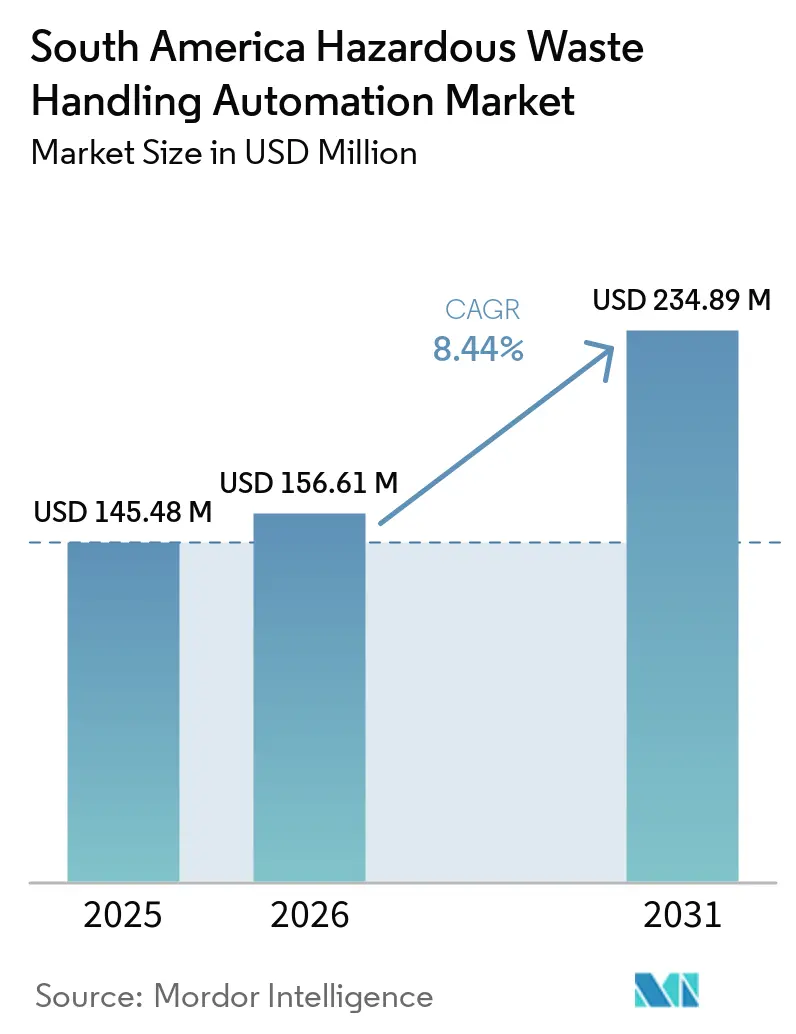
The South America hazardous waste handling automation market size was valued at USD 145.48 million in 2025 and is estimated to expand from USD 156.61 million in 2026 to reach USD 234.89 million by 2031, at a CAGR of 8.44% during the forecast period 2026-2031. The South America hazardous waste handling automation market is moving from manual handling toward systems that record, contain, sort, and transfer hazardous material with less direct worker contact. Industrial activity in chemicals, petrochemicals, mining, oil and gas, energy, healthcare, and manufacturing continues to generate waste streams requiring controlled treatment. Brazil remains the central demand base because its industrial footprint, enforcement capacity, and capital equipment purchasing ability are more developed than elsewhere in the region. Colombia is creating a separate demand cycle as its updated hazardous-waste obligations place greater importance on traceable movement and documented responsibility across the waste chain. The South America hazardous waste handling automation market also faces uneven implementation, high imported equipment costs, and limited service coverage outside the main industrial centers.
Key Report Takeaways
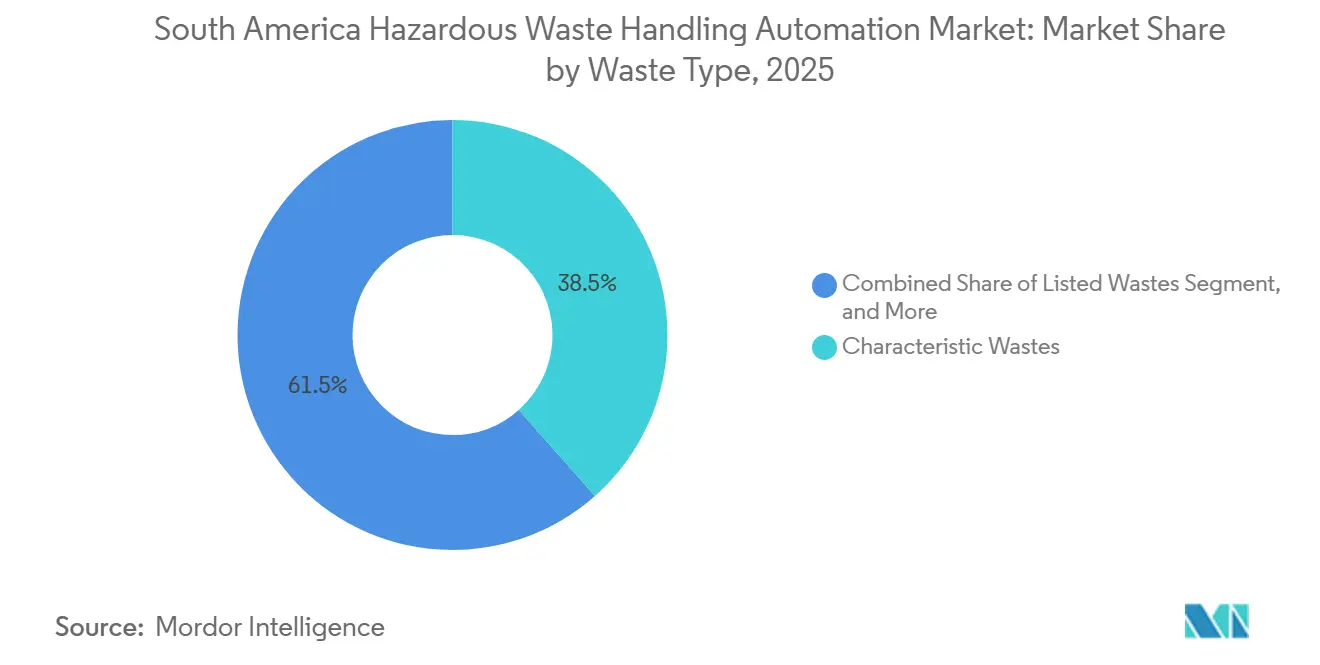
- By waste type, Characteristic Wastes held 38.47% of the South America hazardous waste handling automation market share in 2025, while Mixed Wastes are projected to expand at a 9.24% CAGR through 2031.
- By product type, Manipulator Arms accounted for 36.19% of revenue in 2025, while Size Reduction Systems are expected to advance at a 9.41% CAGR through 2031.
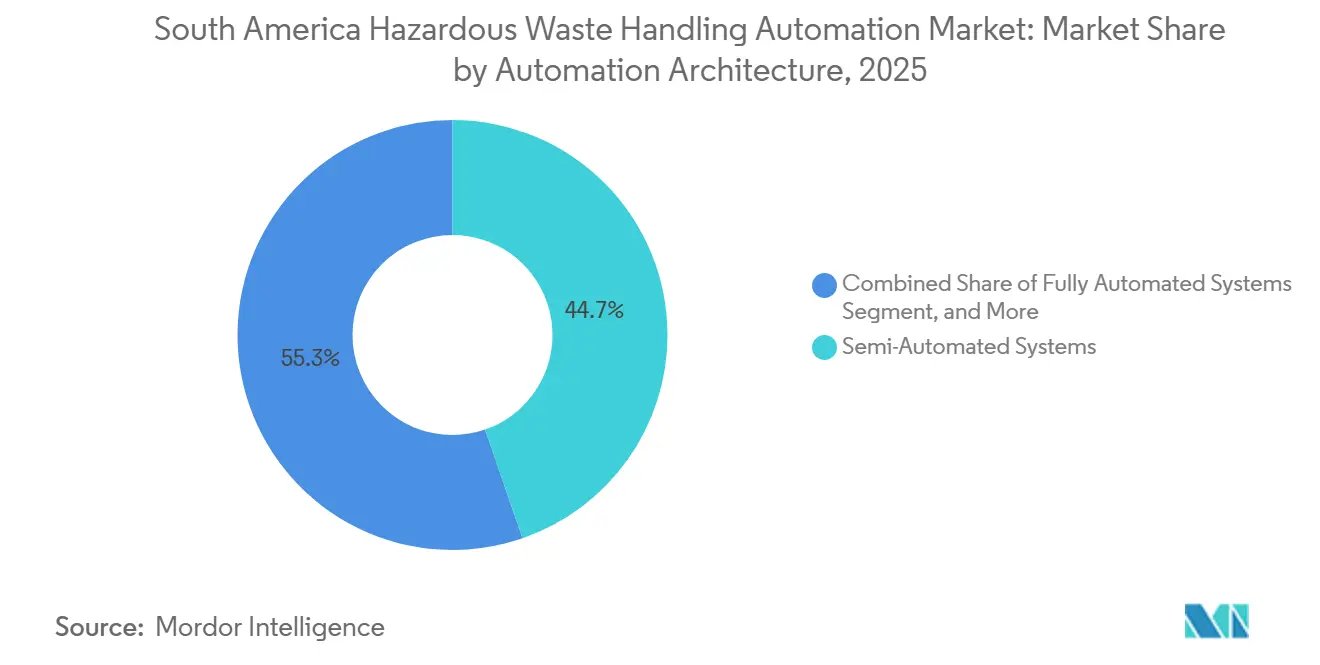
- By automation architecture, Semi-Automated Systems held 44.72% of revenue in 2025, while AI-Enabled Autonomous Systems are projected to expand at a 9.04% CAGR through 2031 in the the South America hazardous waste handling automation market.
- By end-user industry, Chemical and Petrochemical accounted for 31.58% of revenue in 2025, while Pharmaceutical and Research Institutions are projected to grow at a 9.82% CAGR through 2031.
- By geography, Brazil accounted for 43.84% of revenue in 2025, while Colombia is expected to expand at a 9.21% CAGR through 2031 in the the South America hazardous waste handling automation market.
Note: Market size and forecast figures in this report are generated using Mordor Intelligence’s proprietary estimation framework, updated with the latest available data and insights as of January 2026.
South America Hazardous Waste Handling Automation Market Trends and Insights
Drivers Impact Analysis*
| Driver | (~) % Impact on CAGR Forecast | Geographic Relevance | Impact Timeline |
|---|---|---|---|
| Expansion of Brazil's Industrial Hazardous Waste Base | +2.1% | Brazil core, with spillover to Argentina and Peru | Short term (≤ 2 years) |
| Mandatory Digital Traceability and Compliance Documentation | +1.8% | Brazil and Colombia core, extending to Argentina | Short term (≤ 2 years) |
| Worker Exposure Reduction in High-Risk Industrial Operations | +1.5% | Regionwide, concentrated in Brazil's chemical and mining corridors | Medium term (2-4 years) |
| Growth of Mining, Chemicals, Energy, and Healthcare Waste Streams | +1.3% | Brazil, Peru, and Colombia | Medium term (2-4 years) |
| Rising Demand for On-Site Medical Waste Treatment | +0.9% | Brazil, Colombia, and Argentina | Medium term (2-4 years) |
| Retrofit Demand From Aging Manual Handling Infrastructure | +0.7% | Brazil and Argentina | Long term (≥ 4 years) |
| Source: Mordor Intelligence | |||
Expansion of Brazil's Industrial Hazardous Waste Base
Brazil's concentration of chemical production, oil refining, and base-metal processing gives it the region's broadest base of hazardous industrial waste. The São Paulo-Campinas corridor and Pará's Carajás mineral province are important locations because their industrial operations create material that needs containment, transport, classification, and treatment. This waste base supports recurring demand for handling equipment rather than only occasional project demand. Operators need systems that can handle toxic, reactive, flammable, and contaminated material under controlled conditions. The South America hazardous waste handling automation market benefits when large plants move capital spending forward to improve their waste-handling processes. Smaller regional generators can also become equipment buyers when digital records and auditable waste plans become part of ordinary compliance practice.
Mandatory Digital Traceability and Compliance Documentation
Colombia's Decreto 766, issued on July 15, 2026, redefined responsibilities for hazardous waste generators, transporters, and managers. The measure requires interoperable information flows between the national waste registry and the national transport registry. It places more value on reliable records at each movement point in the hazardous-waste chain. Automated equipment can support this need by connecting transfer events, sensors, containment units, and operating records. A 2024 academic review of Colombia's RESPEL framework identified limited coverage by licensed managers and insufficient incentives for technology investment as constraints to better waste management.[1]Universidad Nacional de Colombia, “Gestión Integral de Residuos Peligrosos, RESPEL en Colombia,” Universidad Nacional de Colombia, doi.org The South America hazardous waste handling automation market, therefore, has an opening for systems that combine physical handling with traceability functions.
Worker Exposure Reduction in High-Risk Industrial Operations
Chemical plants, refineries, mining operations, and laboratories have strong reasons to reduce physical contact between workers and hazardous materials. Manipulator arms, enclosed transfer equipment, remote controls, and sensor-linked systems can move workers away from the most exposed handling points. Brazil's industrial waste rules require safe and segregated handling of toxic residues, reinforcing the importance of safer site practices. Remote robotic work has also shown how operators can maintain control and precision without remaining close to hazardous debris. In March 2026, RAICo and Nuclear Restoration Services demonstrated haptic teleoperation with 3D visualization and force feedback for radioactive-debris sorting at Oldbury in the United Kingdom.[2]RAICo, “Adapting Robots to Sort Radioactive Debris on Decommissioning Sites,” RAICo, raico.org The South America hazardous waste handling automation market can draw on these operating models where chemical, mining, and defense-related applications require both worker protection and dependable control.
Growth of Mining, Chemicals, Energy, and Healthcare Waste Streams
Resource extraction and process industries are producing more varied waste profiles across South America. Mining produces tailings, process chemicals, contaminated equipment, and other residues that require controlled movement. Chemical and energy operations create solvents, acids, spent catalysts, transformer oil, batteries, and ash. Healthcare facilities also need on-site or closely managed handling of pathological, chemical, and pharmaceutical waste. These demand sources broaden the customer base beyond large chemical complexes. The South America hazardous waste handling automation industry is supported when equipment vendors can adapt one handling platform to different materials, site layouts, and safety requirements.
Restraints Impact Analysis*
| Restraint | (~) % Impact on CAGR Forecast | Geographic Relevance | Impact Timeline |
|---|---|---|---|
| High Imported Equipment and Spare-Parts Costs | -1.5% | All geographies, most acute in Argentina and Peru | Short term (≤ 2 years) |
| Uneven Enforcement and Permitting Across South American Countries | -0.9% | Rest of South America, Peru, and parts of Argentina | Medium term (2-4 years) |
| Limited Local Automation-Service and Maintenance Capability | -0.7% | All geographies outside the São Paulo metropolitan area | Long term (≥ 4 years) |
| Fragmented Waste Volumes and Long Equipment Payback Periods | -0.6% | Smaller industrial cities across all countries | Long term (≥ 4 years) |
| Source: Mordor Intelligence | |||
High Imported Equipment and Spare-Parts Costs
Advanced manipulator arms, AI-enabled sorting equipment, and industrial shredding installations are commonly supplied from outside South America. Buyers often pay for this equipment and its replacement parts in USD, which exposes projects to local currency movements. Peso depreciation in Argentina and volatility in the Brazilian real can change a project's economics during a budget cycle. Operators may defer purchases, reduce the project scope, or buy less integrated equipment when exchange conditions worsen. Import controls, licensing requirements, and tariffs can add further cost and administrative work for systems linked to cross-border waste treatment. These conditions limit adoption most sharply among mid-sized operators that cannot manage foreign-exchange exposure over long capital-equipment cycles.
Uneven Enforcement and Permitting Across South American Countries
Hazardous-waste rules and permitting practices differ across countries and sometimes across states or provinces. A system accepted under oversight in São Paulo may need different documentation or approvals in another Brazilian state. Remote mining zones and secondary cities can face longer permit processes than major urban centers. Delays create uncertainty about when a facility can use new equipment and when it can recover its investment. Peru's 2025 regulatory changes affecting waste electrical and electronic equipment also showed how mid-cycle changes can alter the rules that supported an investment decision. The South America hazardous waste handling automation market is developing more slowly, and suppliers must redesign compliance features for each installation and extend their sales process.
*Our forecasts treat driver/restraint impacts as directional, not additive. The impact forecasts reflect baseline growth, mix effects, and variable interactions.
Segment Analysis
By Waste Type: Characteristic Wastes Lead, Mixed Streams Diversify Demand
Characteristic Wastes held 38.47% of the South America hazardous waste handling automation market share in 2025. This position reflects the large volumes of toxic, reactive, corrosive, and flammable residues created by chemical production, oil refining, and base metals processing. These materials require controlled containment because manual handling can increase safety and environmental risks. The category includes waste streams that often need documented classification before transport, treatment, or disposal. Automated transfer, sealed storage, and sorting systems can help facilities standardize the handling of these streams. Listed Wastes and Universal Wastes provide additional demand from spent batteries, fluorescent lamps, pesticide containers, and similar materials. Extended producer responsibility programs in Brazil and Colombia add to the need for organized collection and treatment of these waste types. Treatment facilities need equipment that can isolate materials without creating additional exposure during loading or unloading. The South America hazardous waste handling automation market remains tied to how consistently industrial operators apply classification and handling requirements. This segment continues to provide a stable base for suppliers with strong containment and service capabilities.
Mixed Wastes are projected to expand at a 9.24% CAGR through 2031. Pharmaceutical effluents, energy-from-waste residues, and blended chemical streams from electronics and specialty-material facilities often contain multiple material types that a single, simple process cannot manage. This increases the value of systems that identify, separate, and direct material into the right treatment path. Operators may use sensors, vision tools, enclosed conveyors, and controlled sorting stations when the composition of incoming material varies. A 2024 study at a landfill in Quilmaná, Peru, evaluated an AI-, IoT-, and blockchain-based system for landfill management and reported a 35% reduction in residual waste sent to the landfill and a 40% decline in CH₄ emissions over 12 months. The study does not establish performance across all hazardous waste applications, but it provides a regional example of digital classification and monitoring in a waste-management setting. Vendors can use comparable evidence to explain how automation could support complex material segregation. Mixed-stream operators must also manage variation in packaging, moisture, and contamination between loads. Mixed streams also encourage facilities to consider integrated systems instead of standalone containment equipment. This requirement can increase demand for flexible configurations within the South America hazardous waste handling automation market.



By Product Type: Manipulator Arms Anchor the Market, Size Reduction Systems Accelerate
Manipulator Arms accounted for 36.19% of product revenue in 2025. They are used in high-dexterity tasks such as drum movement, container sorting, glovebox work, and transferring materials that workers should not touch directly. Their established position comes from the need to combine reach, controlled motion, and separation between the operator and hazardous material. Arms can be used in chemical plants, laboratories, treatment facilities, and selected mining applications. They may also be integrated with cameras, remote controls, force feedback, or enclosed cells. The March 2026 RAICo and Nuclear Restoration Services demonstration showed a haptic teleoperation arrangement that combined 3D visualization with force-feedback control for debris sorting. Such systems demonstrate a useful operating principle for applications where direct visibility and direct physical access are limited. Customers also value arms that can operate in constrained spaces without requiring a major site redesign. Telescoping masts, cranes, and trusses remain relevant at tank farms, large waste pits, and utility sites where lifting capacity and reach matter more than fine manipulation. These equipment choices allow the South America hazardous waste handling automation market to serve both precision and infrastructure-scale tasks.
Size Reduction Systems are expected to advance at a 9.41% CAGR through 2031. Operators use shredding, granulation, and pre-treatment equipment before incineration or secure landfill when material size, shape, or packaging prevents efficient downstream processing. These systems are especially relevant for chemical solids, pharmaceutical waste, containers, and other hazardous materials that require consistent preparation. The equipment can also make handling more predictable by reducing bulky or irregular materials into a manageable form. It must be designed with containment, cleaning, maintenance, and worker safety in mind. Demand is driven by the need to prepare waste before final treatment, rather than sending unprocessed material directly for disposal. Equipment vendors can differentiate their systems through durability, containment performance, and service support. Customers also assess whether a system can manage variable feedstock without frequent stoppages or difficult cleaning procedures. The product category also benefits when facilities seek to reduce storage burdens and simplify their treatment workflow. Its performance is important to the broader South America hazardous waste handling automation market because reduction can shape every later treatment stage.
By Automation Architecture: Semi-Automated Systems Dominate, AI-Enabled Platforms Emerge
Semi-Automated Systems commanded 44.72% of revenue in 2025. Their lead reflects a retrofit-first approach across industrial facilities that still use older process designs and manual waste workflows. Chemical and petrochemical sites can add sensor-triggered gates, conveyor interlocks, remote controls, and monitoring devices without replacing their entire plant layout. This reduces disruption and can limit the permits or shutdowns required for a full greenfield installation. Semi-automation can therefore provide a practical step between manual work and a fully autonomous operation. It also allows facilities to preserve human oversight where material conditions vary, or safety procedures require operator approval. Operators can sequence their investments and address the highest-risk transfer points before making broader changes. The South America hazardous waste handling automation market size for this architecture is driven by the large number of sites that require incremental upgrades rather than complete replacements. This approach is likely to remain relevant even as more advanced systems become available. It provides suppliers with a route to serve cost-sensitive facilities while demonstrating measurable safety and workflow benefits.
AI-Enabled Autonomous Systems are projected to expand at a 9.04% CAGR through 2031. Their role is increasing as facilities look for systems that can recognize material conditions, adjust handling actions, and record events with less continuous manual input. Vision systems and sensors can support classification, anomaly detection, routing, and remote oversight. These features are most useful where mixed waste, high throughput, or inaccessible work areas make ordinary rule-based automation less effective. The technology still needs reliable data, site-specific training, and maintenance support to work consistently in industrial conditions. It is likely to be used first in higher-volume chemical and mining applications, where the cost of an error or worker exposure is high. Implementation will depend on whether operators can integrate software, safety procedures, and existing equipment into a reliable process. Fully Automated Systems occupy a middle position, especially in greenfield pharmaceutical and specialty-chemical facilities with uniform processes and strict contamination-control requirements. Over time, systems with more autonomous capability may take share from both semi-automated and fully automated configurations when their payback case improves. This change gives the South America hazardous waste handling automation market a path toward more data-led operating models.
By End-User Industry: Chemical Sector Leads, Pharma and Research Drive the Upside
Chemical and Petrochemical held 31.58% of revenue in 2025. Brazil's petrochemical infrastructure, including operations around Camaçari and the São Paulo industrial corridor, supports the segment's leading role. These sites handle acids, caustics, solvents, spent catalysts, and other materials that need secure movement and documented management. Their handling requirements can remain important even when broader commodity conditions change. Automated equipment helps operators reduce exposure at transfer points and establish more consistent containment procedures. Energy and utility operators add demand for systems used with transformer oil, spent acid batteries, and fly ash. Manufacturing facilities also create heavy-metal sludge, spent coatings, and electroplating effluent that require specialized handling. Many of these facilities manage waste continuously, which favors dependable equipment and planned maintenance over occasional manual interventions. The South America hazardous waste handling automation industry has a dependable demand base in these process sectors because they manage varied and recurring waste streams. This installed base can support upgrades as safety requirements and digital recordkeeping needs become more demanding.
Pharmaceutical and Research Institutions are projected to advance at a 9.82% CAGR through 2031. Domestic production of active pharmaceutical ingredients and generic formulations is expanding in Brazil, Colombia, and Argentina as producers seek to reduce import reliance. Pharmaceutical facilities often require strict separation of chemical residues, active ingredients, contaminated packaging, and laboratory waste. The segment therefore favors systems that combine controlled treatment, traceability, and reliable material identification. Research institutions add demand where experiments produce small but sensitive volumes of chemicals or biological material. On-site treatment is useful where a facility needs to reduce storage time and limit the movement of hazardous material through public areas. System design must also support cleaning, segregation, and repeatable operating records for regulated sites. Government and defense buyers can require specialized systems for chemical-defense waste and other controlled materials. Licensed waste-management operators also provide demand because they process material for multiple generators and need reliable throughput across different waste profiles. These customers widen the opportunity set for the South America hazardous waste handling automation market beyond the traditional chemical base.
Geography Analysis
Brazil accounted for 43.84% of the South America hazardous waste handling automation market share in 2025. Its lead reflects the region's largest concentration of hazardous waste generation, established environmental oversight, and greater capacity to fund capital equipment. Chemical production, oil refining, mining, and metals processing create recurring demand for containment, shredding, manipulation, and traceability-linked upgrades. Metropolitan and industrial locations also offer stronger conditions for installation, training, and after-sales support.
Colombia is projected to expand at a 9.21% CAGR through 2031. Decreto 766, issued in July 2026, restructured responsibilities across the hazardous-waste chain and emphasized interoperable digital records. The measure raises the value of systems that record transfer events and maintain a reliable chain of custody. It creates opportunities among chemical, healthcare, and manufacturing operators who previously used paper-based procedures. Secondary industrial cities such as Barranquilla, Cartagena, and Bucaramanga may favor simpler systems, while service availability and permitting will influence adoption.
Peru and the Rest of South America remain less penetrated, although their industrial sites are adopting more digital and automated practices. Peru's mining activity provides a base for remote operation and safety monitoring in demanding work environments. The Quilmaná study reported a 35% reduction in residual landfill waste and a 40% reduction in CH₄ emissions over 12 months using an AI-, IoT-, and blockchain-based management system.[3]Flores et al., “Design and Implementation of an AI, IoT, and Blockchain-Based System for Circular Economy Transition in Landfill Management,” International Journal of Informatics and Communication Technology, ijict.iaescore.com Argentina has a meaningful industrial base, but currency conditions and import exposure can lengthen equipment payback periods. Bolivia, Paraguay, Ecuador, Uruguay, and Chile depend on stable rules, local maintenance capability, and financing suited to smaller volumes.
Competitive Landscape
The South America hazardous waste handling automation market is moderately consolidated because established equipment specialists offer technical portfolios that local integrators cannot easily replicate. Companies compete on reliability, safety design, material recognition capability, and after-sales support. European suppliers have an advantage in systems specified for containment, sorting, shredding, remote handling, and process monitoring. Local integrators remain important where customers need project adaptation, installation support, and familiarity with national operating conditions. The competitive gap is most visible in AI-supported classification and controlled manipulation of hazardous materials.
AI integration is becoming a clearer basis for product differentiation. ZenRobotics Oy and Recycleye Ltd. are suppliers of machine vision and deep-learning-based waste classification. STADLER Anlagenbau GmbH is associated with connected process equipment and predictive-maintenance functions. Remote monitoring, compliance documentation, and maintenance subscriptions can create recurring vendor relationships after an equipment sale. These services matter where technical personnel are limited outside major industrial centers.
The main opening lies in mid-tier systems for generators that are too large for manual work but cannot justify highly customized robotic platforms. Waste Robotics Inc., Danu Robotics Ltd., SSI Shredding Systems, Inc., and Granutech-Saturn Systems Corporation address robotic handling, size reduction, or related service needs. Suppliers can also pursue treatment operators and producer-responsibility organizations in Brazil and Colombia. This diverse base of buyers and suppliers supports a moderate competitive structure.
South America Hazardous Waste Handling Automation Industry Leaders
PaR Systems, Inc.
KOKS Group B.V.
SSI Shredding Systems, Inc.
ECODAS S.A.S.
Ecosteryl S.A.
- *Disclaimer: Major Players sorted in no particular order

Recent Industry Developments
- August 2026: SANY Group shipped its first batch of SKT110Ei pure-electric autonomous mining trucks to South America on August 12, 2026, in the company's first autonomous mining solution deployment in the region. The project integrates cloud-based dispatching with localized operations and maintenance services, signaling greater willingness among South American mining operators to use autonomous systems in primary material-handling chains, with direct implications for hazardous waste stream management at mine sites.
- July 2026: Colombia's Ministerio de Ambiente y Desarrollo Sostenible issued Decreto 766 de 2026 on July 15, 2026, restructuring hazardous-waste obligations for generators, transporters, and managers under Decreto 1076 de 2015. The decree mandates interoperable RUA-RNDC data flows and creates a compliance event that supports traceability-capable handling systems in Colombia's chemical, healthcare, and manufacturing sectors.
- April 2026: Brazil's CONAMA concluded a public consultation proposing mandatory Waste Transport Manifests for Class 2 non-hazardous wastes and uniform large-generator criteria to replace fragmented state-level standards. The expected 2026-2027 implementation expands the population of generators that need digital manifesting infrastructure.
- March 2026: RAICo and NRS completed an on-site demo of a haptic teleoperated waste-sorting robotic arm system at NRS Oldbury, UK, combining 3D visualization with force-feedback control. The system achieved positive operator feedback and active trials for nuclear fuel element debris sorting are planned for mid-2027. The technology specification is under evaluation by South American chemical and defense waste operators.


South America Hazardous Waste Handling Automation Market Report Scope
The South America Hazardous Waste Handling Automation Market refers to the market for automated, semi-automated, and AI-enabled systems, equipment, and associated technologies used to safely identify, collect, move, manipulate, process, sort, reduce, transfer, and manage hazardous waste across industrial, commercial, research, government, defense, and specialized waste-management environments in South America.
The South America Hazardous Waste Handling Automation Market Report is Segmented by Waste Type (Listed Wastes, Characteristic Wastes, Universal Wastes, and Mixed Wastes), Product Type (Manipulator Arms, Telescoping Masts, Cranes, Trusses, and Size Reduction Systems), Automation Architecture (Semi-Automated Systems, Fully Automated Systems, and AI-Enabled Autonomous Systems), End-User Industry (Manufacturing, Chemical and Petrochemical, Energy and Utilities, Mining and Metals, Pharmaceutical and Research Institutions, Government and Defense, and Waste Management Operators), and Geography (Brazil, Argentina, Colombia, Peru, and Rest of South America). The Market Forecasts are Provided in Terms of Value (USD).
By Waste Type
| Listed Wastes |
| Characteristic Wastes |
| Universal Wastes |
| Mixed Wastes |
By Product Type
| Manipulator Arms |
| Telescoping Masts |
| Cranes |
| Trusses |
| Size Reduction Systems |
By Automation Architecture
| Semi-Automated Systems |
| Fully Automated Systems |
| AI-Enabled Autonomous Systems |
By End-User Industry
| Manufacturing |
| Chemical and Petrochemical |
| Energy and Utilities |
| Mining and Metals |
| Pharmaceutical and Research Institutions |
| Government and Defense |
| Waste Management Operators |
By Geography
| Brazil |
| Argentina |
| Colombia |
| Rest of South America |
| By Waste Type | Listed Wastes |
| Characteristic Wastes | |
| Universal Wastes | |
| Mixed Wastes | |
| By Product Type | Manipulator Arms |
| Telescoping Masts | |
| Cranes | |
| Trusses | |
| Size Reduction Systems | |
| By Automation Architecture | Semi-Automated Systems |
| Fully Automated Systems | |
| AI-Enabled Autonomous Systems | |
| By End-User Industry | Manufacturing |
| Chemical and Petrochemical | |
| Energy and Utilities | |
| Mining and Metals | |
| Pharmaceutical and Research Institutions | |
| Government and Defense | |
| Waste Management Operators | |
| By Geography | Brazil |
| Argentina | |
| Colombia | |
| Rest of South America |


Key Questions Answered in the Report
What is the South America hazardous waste handling automation market size?
The sector was valued at USD 145.48 million in 2025, is estimated at USD 156.61 million in 2026, and is projected to reach USD 234.89 million by 2031 at an 8.44% CAGR. The outlook reflects wider use of controlled handling, digital records, and equipment that reduces direct worker contact with hazardous materials. It also reflects continuing waste-management needs across industrial, healthcare, mining, and manufacturing sites.
Which country leads hazardous waste handling automation in South America?
Brazil led with 43.84% of revenue in 2025 because of its large chemical, mining, metals, and refining base. Its industrial areas also provide better conditions for vendor training, equipment installation, and routine maintenance than many smaller regional locations. The country is therefore the main regional base for both initial sales and equipment upgrades.
Which waste category is expanding fastest?
Mixed Wastes are projected to expand at a 9.24% CAGR through 2031, supported by complex material streams from pharmaceuticals, energy-from-waste operations, and electronics facilities. These waste streams need flexible sorting, containment, and treatment processes because their material composition can vary between loads. Facilities may use integrated equipment where separate manual steps cannot maintain consistent segregation.
What equipment is most widely used for hazardous material handling?
Manipulator Arms held 36.19% of product revenue in 2025 because they support controlled movement in high-risk handling tasks. They are suited to work involving drums, containers, gloveboxes, and other settings where a worker needs distance from hazardous materials without losing control. Their versatility supports use in chemical plants, laboratories, treatment centers, and selected mining applications.
Why are pharmaceutical facilities adopting more automation?
Pharmaceutical and Research Institutions are projected to advance at a 9.82% CAGR through 2031 as facilities need controlled treatment, traceability, and separation of sensitive waste streams. On-site systems can also reduce storage time and limit the movement of chemical and laboratory waste through shared facility areas. This makes automation relevant to both larger production sites and specialized research locations.
What limits adoption across South America?
Imported equipment costs, currency volatility, uneven permitting, fragmented waste volumes, and limited local maintenance services can delay projects. These constraints are strongest for mid-sized operators that need to match a safety investment with predictable financing, technical support, and workable payback periods. They can also cause buyers to favor staged retrofits, narrower project scopes, or deferred purchases during unstable currency conditions. Vendors that provide local service arrangements, training, and clear maintenance plans can reduce some of these practical barriers. Smaller facilities may also lack sufficient waste throughput to justify high-cost, fully integrated equipment. These factors explain why adoption differs sharply between large industrial corridors and remote or secondary locations. The result is a gradual, uneven transition from manual handling to more automated site processes.
Page last updated on:





