
Market Overview
| Study Period | 2021 - 2031 |
|---|---|
| Forecast Data Period | 2026 - 2031 |
| Base Year Market Size (2025) | USD 10.25 Billion |
| Market Size (2026) | USD 10.67 Billion |
| Market Size (2031) | USD 13.41 Billion |
| Growth Rate (2026 - 2031) | 4.68 % |
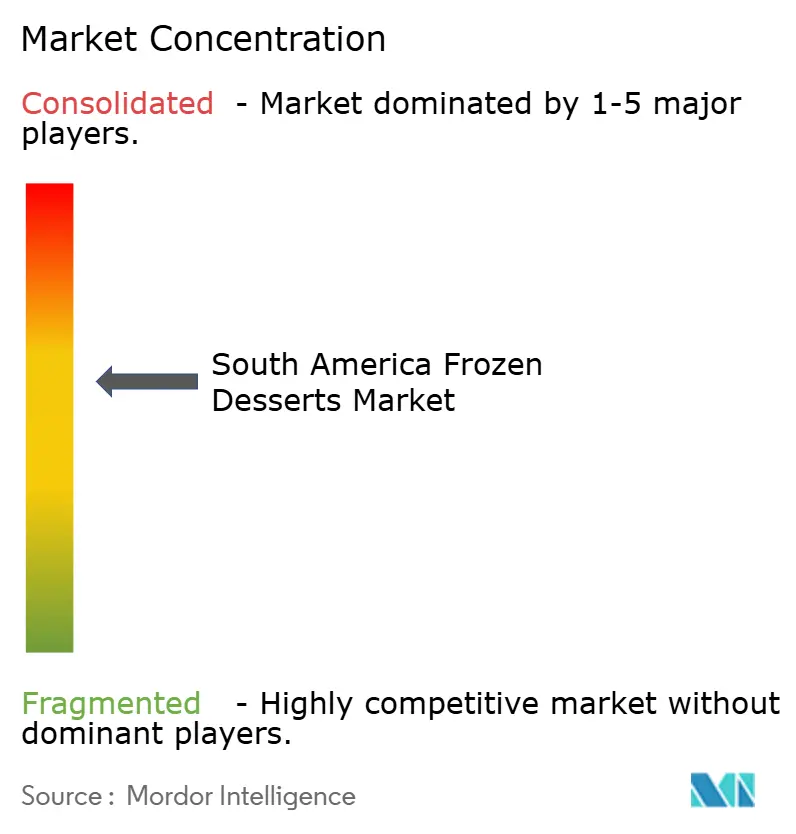
| Market Concentration | Medium |
Major Players *Disclaimer: Major Players sorted in no particular order Image © Mordor Intelligence. Reuse requires attribution under CC BY 4.0. | |
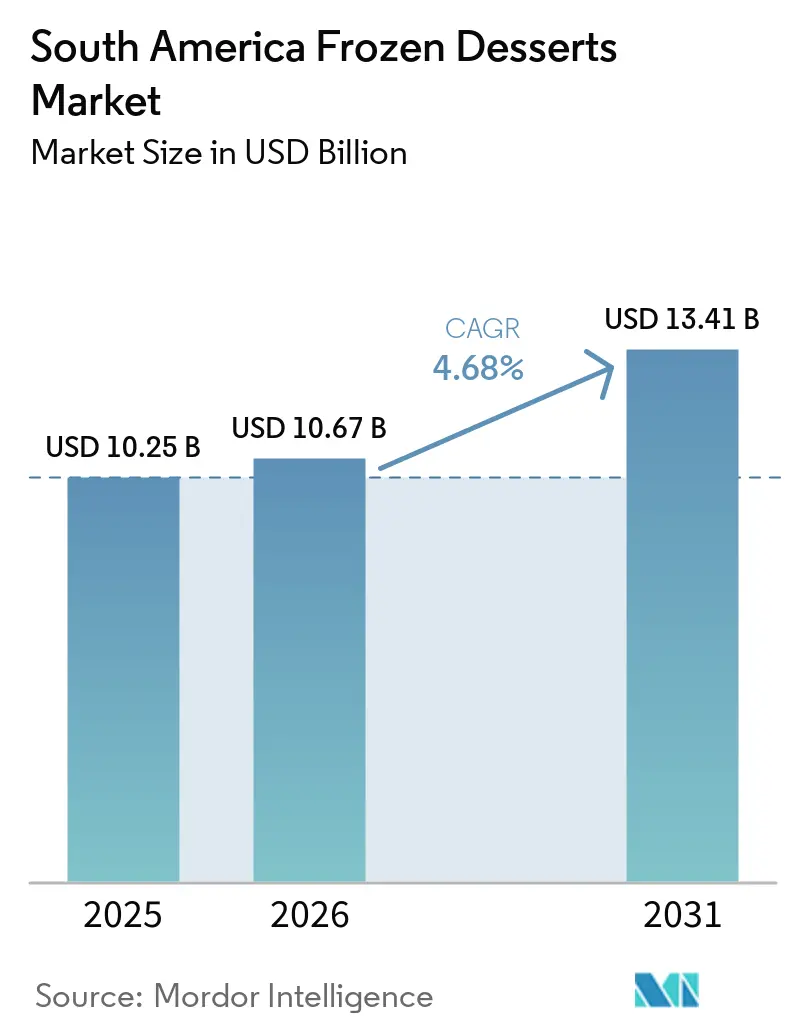
South America Frozen Desserts Market Analysis by Mordor Intelligence
The South America frozen desserts market size was valued at USD 10.25 billion in 2025 and estimated to grow from USD 10.67 billion in 2026 to reach USD 13.41 billion by 2031, at a CAGR of 4.68% during the forecast period (2026-2031). Ice cream remains the region’s established frozen treat, while demand is moving toward premium recipes, single-serve products, and choices with lower sugar or dairy-free ingredients. The addressable consumer base is widening as urban households gain access to modern grocery retail and more reliable refrigerated distribution. Cold storage investment is particularly important because it allows brands to serve inland cities with more consistent quality and availability.
Key Report Takeaways
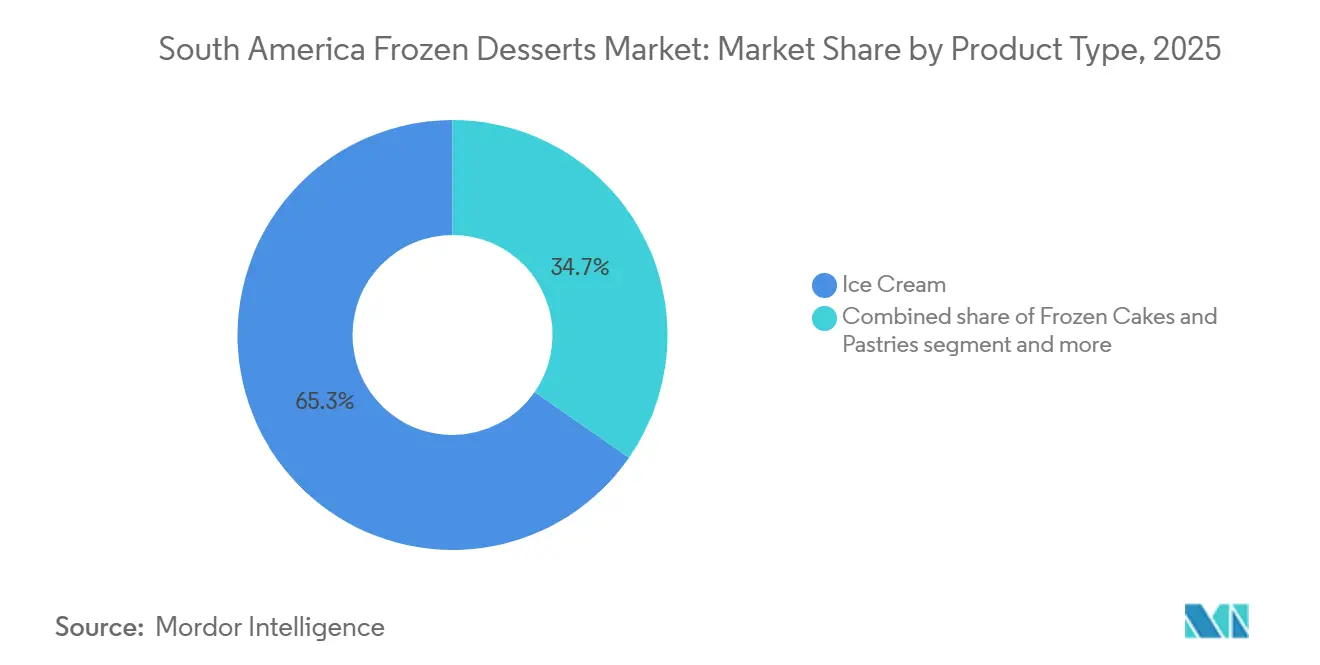
- By product type, ice cream held 65.34% of the South America frozen desserts market share in 2025, while frozen yogurt is projected to grow at a 6.07% CAGR through 2031.
- By category, conventional products accounted for 88.61% of revenue in 2025, while organic products are forecast to advance at a 5.93% CAGR through 2031.
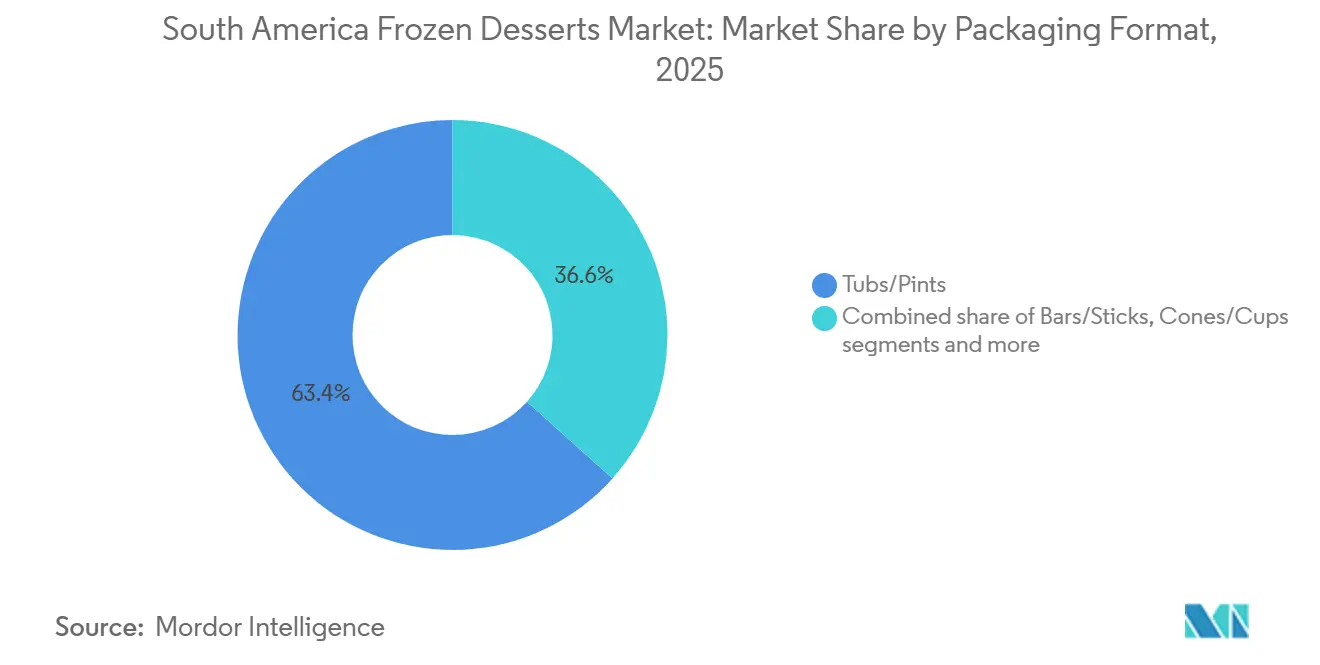
- By packaging format, tubs and pints held 63.37% of revenue in 2025, while bars and sticks are forecast to grow at a 6.26% CAGR through 2031.
- By geography, Brazil held 51.76% of regional revenue in 2025, while Colombia is forecast to grow at a 5.7% CAGR through 2031.5.81% CAGR through 2031.
Note: Market size and forecast figures in this report are generated using Mordor Intelligence’s proprietary estimation framework, updated with the latest available data and insights as of January 2026.
Market Trends and Insights
Drivers Impact Analysis of South America Frozen Desserts Market*
| Driver | (~) % Impact on CAGR Forecast | Geographic Relevance | Impact Timeline |
|---|---|---|---|
| Rising Demand for Ice Cream and Frozen Dairy Desserts | +1.4% | Regional, core concentration in Brazil, Argentina, and Chile | Short term (≤ 2 years) |
| Growing Popularity of Premium and Artisanal Frozen Desserts | +0.9% | Brazil, Chile, Colombia, and Argentina urban centers | Medium term (2-4 years) |
| Increasing Demand for Convenient and Ready-to-Eat Desserts | +0.7% | Brazil and Colombia high-density urban markets and quick-commerce corridors | Short term (≤ 2 years) |
| Rising Adoption of Innovative Flavors and Novel Product Formats | +0.5% | Brazil, Colombia, and Chile metro areas and food court environments | Medium term (2-4 years) |
| Growing Availability of Plant-Based and Dairy-Free Frozen Desserts | +0.5% | Brazil, Chile, and Colombia, with emerging availability in Argentina | Medium term (2-4 years) |
| Increasing Investment in Cold Chain Infrastructure and Frozen Food Distribution | +0.8% | Region-wide, with near-term gains in Brazil, Peru, and Colombia | Short term (≤ 2 years) and Medium term (2-4 years) |
| Source: Mordor Intelligence | |||
Rising Demand for Ice Cream and Frozen Dairy Desserts
Frozen dairy desserts are becoming a year-round purchase in the South America frozen desserts market. Higher household income, broader modern retail coverage, and habitual consumption of ice cream support this pattern. Brazil remains the central source of regional volume and value, supported by a large consumer base and dense retail access. The supplied research identifies a shift from volume toward higher-value products with premium coatings, inclusions, and portion-controlled novelties. This change gives the South America frozen desserts market a stronger basis for manufacturers to protect revenue even when unit growth slows. Demand in Chile and Argentina also points to continuing consumer interest despite wider pressure on household budgets.
Growing Popularity of Premium and Artisanal Frozen Desserts
Premium and artisanal products are changing price expectations in the South America frozen desserts market. Consumers increasingly value recognizable ingredients, local sourcing, and distinctive flavor profiles. Lucciano’s expanded into Chile in 2025, reaching its 83rd international location and extending its artisanal gelato concept beyond Argentina. Small producers are using ingredients such as maqui berry, quinoa, açaí, and cacao to establish a regional identity. This creates a challenge for mid-priced brands because they must offer a clear reason to buy beyond a familiar name. Freddo’s new outlets and seasonal lines in Uruguay show that regular product renewal can help premium operators maintain consumer attention
Growing Availability of Plant-Based and Dairy-Free Frozen Desserts
Plant-based products are broadening the South America frozen desserts market rather than simply replacing dairy products. These options appeal to consumers who seek dairy-free choices, reduced sugar, or different ingredient combinations. The Magnum Ice Cream Company partnered with Chilean food technology company NotCo in September 2025 to use the Giuseppe platform for reformulation and plant-based product development. Los Los introduced a vegan açaí popsicle in Brazil in November 2025 with Sociedade Vegetariana Brasileira certification and 51% Amazonian açaí pulp. Paccari also launched vegan ice cream in Ecuador during 2025, using its fine-cacao positioning to support a premium offer. These developments show how dairy-free products can support portfolio differentiation across the South America frozen desserts market.
Increasing Investment in Cold Chain Infrastructure and Frozen Food Distribution
Cold chain capacity determines whether the South America frozen desserts market can expand beyond major urban areas. Reliable storage and refrigerated transport reduce product losses and support consistent product quality. Emergent Cold LatAm acquired Comfrio in September 2025, creating a network of 37 facilities in 12 Brazilian states with 610,000 pallet positions and 4 million cubic meters of storage capacity. IceStar entered Peru through its acquisition of Fripusa and announced a USD 50 million investment plan over 3 years. These projects improve the foundation for broader South America frozen desserts market distribution in markets where access has been uneven. Better infrastructure can also make small-format retail and food delivery more practical in cities outside the largest metropolitan areas.
Restraints Impact Analysis of South America Frozen Desserts Market*
| Restraint | (~) % Impact on CAGR Forecast | Geographic Relevance | Impact Timeline |
|---|---|---|---|
| Volatility in Milk, Cream, Sugar, Cocoa, and Other Raw Material Prices | -0.5% | Region-wide, with cocoa and sugar pressure most acute in Brazil and Colombia | Short term (≤ 2 years) and Medium term (2-4 years) |
| High Costs of Refrigerated Storage and Frozen Transportation | -0.3% | Brazil, Peru, and Andean sub-regions with high freight and energy costs | Short term (≤ 2 years) |
| Limited Cold Chain Infrastructure in Remote and Underserved Areas | -0.4% | Remote areas of Brazil’s North and Northeast, rural Andean areas, and Amazon-adjacent zones | Medium term (2-4 years) and Long term (≥ 4 years) |
| High Energy Consumption and Refrigeration Costs | -0.2% | Brazil and Argentina, where energy price instability compounds operating costs | Medium term (2-4 years) |
| Source: Mordor Intelligence | |||
Volatility in Milk, Cream, Sugar, Cocoa, and Other Raw Material Prices
Raw material volatility remains an immediate risk for manufacturers in the South America frozen desserts market. Dairy, sugar, and cocoa costs can move at the same time and narrow the margin available to producers. J.P. Morgan expects cocoa prices to remain structurally elevated at USD 6,000 per tonne over the medium term, even after a sharp decline from the 2025 peak. Brazil’s sugar supply conditions are also sensitive to weather and trade policy, which can affect input availability[1]. Brands in the South America frozen desserts market may respond through reformulation, smaller portions, price increases, or different ingredient mixes. The NotCo partnership also indicates that some large producers view formulation technology as one way to manage commodity exposure
Limited Cold Chain Infrastructure in Remote and Underserved Areas
Cold chain gaps limit the reach of the South America frozen desserts market in remote and inland areas. Distribution is more reliable in major cities than in rural Andean locations, Amazon-adjacent areas, and parts of Brazil’s North and Northeast. A cold cargo terminal planned at the Pecém port complex in Ceará carries annual capacity for 60,000 tonnes of frozen or chilled cargo. Such projects can improve access, but they do not remove the continuing need for local storage, refrigerated vehicles, and stable electricity. Brazil’s food-service requirements also require operators to maintain temperature-control documentation, making compliant infrastructure essential for expansion[2]. Companies that develop distribution before consumer demand matures may gain a strong position in the South America frozen desserts market when purchasing power rises in these locations.
*Our forecasts treat driver/restraint impacts as directional, not additive. The impact forecasts reflect baseline growth, mix effects, and variable interactions.
South America Frozen Desserts Market Segment Analysis
By Product Type:
Ice Cream Leads, While Frozen Yogurt Broadens the Growth MixIce cream held 65.34% of regional revenue in 2025, making it the region’s leading product type. Its position reflects long-standing consumption patterns in Brazil, Argentina, Colombia, Chile, Peru, and neighboring markets. It spans supermarket tubs, sticks, cones, ice cream parlor products, and branded novelties. Established dairy products offer familiar flavor and texture, helping producers retain wide household appeal. The South America frozen desserts market relies on the segment because it provides the base for premium formulations, coated bars, and formats designed for impulse purchases. Producers can use local fruits and regional flavor profiles to differentiate products without moving away from ice cream’s core appeal.
Manufacturers are placing greater emphasis on product value within ice cream. Premium inclusions, portion-controlled formats, and artisanal positioning can lift revenue per unit. This makes the category less dependent on higher volumes alone. Frozen cakes and pastries play a complementary role in restaurant and foodservice menus, where ease of preparation matters. Sorbets, gelatos, and other formats support experimentation with maracuyá, guanábana, açaí, and cupuaçu. Brazil’s labeling requirements for added sugar and calorie declarations also encourage companies to consider reformulated products and clearer nutrition information. Frozen yogurt is projected to grow at a 6.07% CAGR through 2031 because it sits between indulgence and health-focused positioning. Its growth gives brands a way to address lower-fat preferences without leaving the frozen treat category.

By Category:
Conventional Products Lead, While Organic Options Build a BaseConventional products accounted for 88.61% of the South America frozen desserts market size in 2025. This large position reflects accessible pricing, broad distribution, and established household buying habits. For many consumers, conventional ice cream remains an affordable treat bought through retail, neighborhood stores, and foodservice outlets. Large manufacturers rely on this segment to maintain distribution scale. The segment also provides the volume needed to support freezer networks and retail promotions. Its wide reach means that changes in ingredient costs can have a direct effect on both price and profitability.
Organic products are forecast to grow at a 5.93% CAGR through 2031. Their current base is smaller, but their appeal is increasing among urban consumers who look for ingredient transparency and cleaner labels. Brazil’s Southeast and São Paulo metropolitan area are important demand centers for these products. Producers in Ecuador and Brazil can use cacao, coconut milk, and Amazonian fruits to distinguish certified offerings. These products often carry a premium price, which gives companies a route to higher-value sales. Availability remains limited outside major cities because certified ingredients and refrigerated distribution cost more. The South America frozen desserts industry will need to balance this higher cost structure against the price expectations of consumers.
By Packaging Format:
Tubs and Pints Lead, While Bars and Sticks GainTubs and pints accounted for 63.37% of revenue in 2025. This format suits supermarket-led household purchases and supports multipack promotions. Families can include tubs in planned weekly grocery shopping, which makes them a stable part of retail demand. The format also gives brands room for premium flavors, larger serving sizes, and take-home desserts. Retailers favor it because it encourages a larger basket value than a single novelty. Growth in urban households and dual-income families supports this planned take-home use.
Bars and sticks are forecast to grow at a 6.26% CAGR through 2031. Their convenience suits street vending, kiosks, bakeries, food courts, and quick-service restaurants. Individually portioned products also give brands a clear way to build impulse demand. Froneri announced a BRL 155 million investment in Brazil during 2025, including BRL 100 million to expand its freezer network by 20% annually and BRL 55 million for cold storage at its Jacarepaguá factory[3]. The investment indicates the importance of freezer availability for single-serve growth. Cones and cups occupy a middle ground between take-home purchases and individual treats. Multipack bars and sticks further connect household buying with impulse-format consumption.
By Distribution Channel:
Retail Holds the Base, While Foodservice Gains VisibilityRetail represented 82.61% of revenue in 2025, making it the leading channel for the South America frozen desserts market. Supermarkets and hypermarkets anchor the channel through dedicated freezer sections and promotional displays. These stores also reassure buyers that frozen products have remained within the required temperature range. Convenience and grocery stores remain important in neighborhoods where modern retail access is incomplete. Their role is especially relevant to low-cost and impulse products. Retail scale therefore continues to shape how brands plan the South America frozen desserts market offer, freezer placement, promotions, and product assortment their freezer placement, promotions, and product assortment.
Foodservice and HoReCa are forecast to grow at a 5.81% CAGR through 2031. Restaurant dessert menus, artisanal parlors, and high-footfall locations help consumers try premium products before they encounter them in a store. This can strengthen a brand’s recognition and support later retail listings. The channel also benefits from consumer interest in dining outside the home. Foodservice operators can present frozen desserts with limited kitchen preparation, which makes them useful menu additions. Online retail remains less developed for frozen desserts because reliable last-mile refrigeration is necessary. As delivery infrastructure develops, it may add another route for the South America frozen desserts market to reach urban consumers.
Geography Analysis
Brazil Frozen Desserts Market
Brazil held 51.76% of the regional South America frozen desserts market share in 2025. Its position is supported by population scale, established frozen food distribution, and a large network of ice cream retail locations. The country has both multinational brands and domestic operators with experience in retail and foodservice. Its cities offer a suitable setting for premium ice cream, novelty products, and delivery-enabled retail. Consumers in São Paulo and other major centers are helping move the category toward more frequent purchasing. Producers also have access to a broad range of local fruits and flavors that can support differentiated products. Regulatory requirements on labeling and food handling make compliant manufacturing and distribution necessary.
South America Frozen Desserts Market
Colombia is forecast to grow at a 5.77% CAGR through 2031. The country has become more attractive for producers seeking expansion outside Brazil. Its major cities provide dense foodservice, retail, and consumer delivery networks. Grupo Nutresa’s acquisition of Mimo’s adds a sizable consumer-facing platform to its frozen dessert operations. The company’s later acquisition of Industrias Tío Rico in Venezuela extended its manufacturing and brand base within northern South America. Chile supports value growth through modern retail and consumers with an interest in premium products. Argentina combines a strong artisanal tradition and dairy manufacturing base with consumer purchasing pressure from wider macroeconomic conditions.
Andean South America Frozen Desserts Market
Peru and the rest of South America offer a longer-term route for expansion as cold chain capacity reaches more secondary cities. Lima, Arequipa, and Trujillo offer a growing base for frozen dessert consumption. IceStar’s entry into Peru through Fripusa and its USD 50 million investment plan could strengthen the logistics needed to serve those locations. Nestlé’s planned transfer of its remaining ice cream operations in Chile and Peru to Froneri can also change the competitive position in the Andean markets. Ecuador has shown plant-based product activity through Paccari’s vegan launch. Venezuela gained greater strategic importance after Grupo Nutresa acquired Industrias Tío Rico. These markets remain smaller than Brazil, but they matter because investment and new formats can reshape their local structure.
Competitive Landscape
The South America frozen desserts market is moderately consolidated, with multinational groups, regional leaders, and artisanal producers competing across different price points. The Magnum Ice Cream Company and Froneri benefit from established brands, manufacturing scale, and extensive frozen distribution networks. These advantages support product availability across supermarkets, convenience stores, and foodservice outlets. Competition is driven by brand recognition, pricing, flavor innovation, product quality, and distribution reach. Regional consumption patterns and purchasing power also influence product positioning across individual countries.
Nestlé S.A. maintains a competitive position through its established food brands, product development capabilities, and broad distribution network. The company competes in frozen desserts through its ice cream portfolio and benefits from its experience in consumer marketing and retail distribution. Its market approach supports product availability across different price points and consumer segments. Grupo Arcor S.A.I.C. is another significant regional participant, leveraging its established confectionery business, consumer brand recognition, and distribution presence in South America.
Regional manufacturers and smaller producers further intensify competition through locally preferred flavors, competitive pricing, and differentiated product offerings. Artisanal ice cream businesses appeal to consumers seeking premium ingredients, distinctive flavors, and freshly prepared desserts, particularly in urban markets. Manufacturers also compete through innovations in portion sizes, packaging formats, and indulgent or health-oriented formulations. Retailers and foodservice operators influence market access through shelf-space allocation, promotions, and product assortment decisions.
South America Frozen Desserts Industry Leaders
-
Froneri International Limited
-
Nestlé S.A.
-
Grupo Arcor S.A.I.C.
-
The Magnum Ice Cream Company N.V.
-
Grupo Nutresa S.A.
- *Disclaimer: Major Players sorted in no particular order
South America Frozen Desserts Market Companies Covered in this Report
- The Magnum Ice Cream Company N.V.
- Nestlé S.A.
- Grupo Arcor S.A.I.C.
- Grupo Nutresa S.A.
- Grupo Helacor S.A.
- Colombina S.A.
- Froneri International Limited
- General Mills, Inc.
- Mars, Incorporated
- Danone S.A.
- Grupo Bimbo, S.A.B. de C.V.
- Sorvetes Jundiá Indústria e Comércio Ltda.
- Creme Mel Sorvetes
- Chiquinho Sorvetes
- Frutos do Brasil
- Los Paleteros
- Cacau Show
- Emporio La Rosa
- Savory
- Baskin-Robbins Franchising LLC
Recent Industry Developments in South America Frozen Desserts Market
- August 2026: General Mills confirmed Häagen-Dazs will cease distribution in Brazil, ending a 29-year presence following the company’s portfolio restructuring that includes a BRL 800 million divestiture of its Brazilian operations.
- May 2026: Grupo Nutresa completed the acquisition of Mimo’s ice cream chain in Colombia for COP 50,000 million. The deal added more than 200 points of sale and a Medellín production facility with capacity exceeding 5 million liters per year.
- July 2025: Froneri announced a BRL 155 million investment in Brazil, including BRL 100 million to expand its freezer network and BRL 55 million for cold storage at its Jacarepaguá factory.
South America Frozen Desserts Market Report Scope
Frozen desserts are sweet food products that are prepared by freezing or partially freezing ingredients such as milk, cream, sugar, fruit, and other flavoring components. The South America frozen desserts market is segmented by product type, category, packaging format, distribution channel and geography. Based on product type, the market is segmented into ice cream, frozen yogurt, frozen cakes and pastries and others. Based on category, the market is segmented into conventional and organic. Based on packaging format, the market is segmented into tub/pints, bars/sticks, cones/cups and others. Based on distribution channel, the market is segmented into foodservice/HoReCa and retail. Based on geography, the market is segmented into Brazil, Argentina, Chile, Colombia, Peru and Rest of South America. For each segment, the market sizing and forecasting have been done in value terms (USD billion).
Segmentation Overview
By Product Type
| Ice Cream |
| Frozen Yogurt |
| Frozen Cakes and Pastries |
| Others |
By Category
| Conventional |
| Organic |
By Packaging Format
| Tubs/Pints |
| Bars/Sticks |
| Cones/Cups |
| Others |
By Distribution Channel
| Foodservice/HoReCa | |
| Retail | Supermarkets/Hypermarkets |
| Convenience/Grocery Stores | |
| Online Retail Stores | |
| Other Distribution Channels |
By Geography
| Brazil |
| Argnetina |
| Chile |
| Colombia |
| Peru |
| Rest of South America |
| By Product Type | Ice Cream | |
| Frozen Yogurt | ||
| Frozen Cakes and Pastries | ||
| Others | ||
| By Category | Conventional | |
| Organic | ||
| By Packaging Format | Tubs/Pints | |
| Bars/Sticks | ||
| Cones/Cups | ||
| Others | ||
| By Distribution Channel | Foodservice/HoReCa | |
| Retail | Supermarkets/Hypermarkets | |
| Convenience/Grocery Stores | ||
| Online Retail Stores | ||
| Other Distribution Channels | ||
| By Geography | Brazil | |
| Argnetina | ||
| Chile | ||
| Colombia | ||
| Peru | ||
| Rest of South America | ||
Key Questions Answered in the Report
What is the forecast growth rate for frozen desserts in South America?
The category is forecast to grow at a 4.68% CAGR from 2026 to 2031, reaching USD 13.41 billion in 2031.
Which product leads sales across South America?
Ice cream leads, with 65.34% of regional revenue in 2025.
Which format is expected to grow fastest?
Bars and sticks are forecast to grow at a 6.26% CAGR through 2031, supported by impulse purchases and wider freezer placement.
Why is Colombia important for frozen dessert companies?
Colombia is projected to grow at a 5.77% CAGR through 2031 and has attracted investment in retail locations and production assets.
How important is retail for frozen dessert sales?
Retail accounted for 82.61% of revenue in 2025 because supermarkets and hypermarkets provide freezer capacity, visibility, and consumer confidence.