
Market Overview
| Study Period | 2021 - 2031 |
|---|---|
| Forecast Data Period | 2026 - 2031 |
| Base Year Market Size (2025) | USD 497.76 Million |
| Market Size (2026) | USD 528.63 Million |
| Market Size (2031) | USD 723.79 Million |
| Growth Rate (2026 - 2031) | 6.49 % |
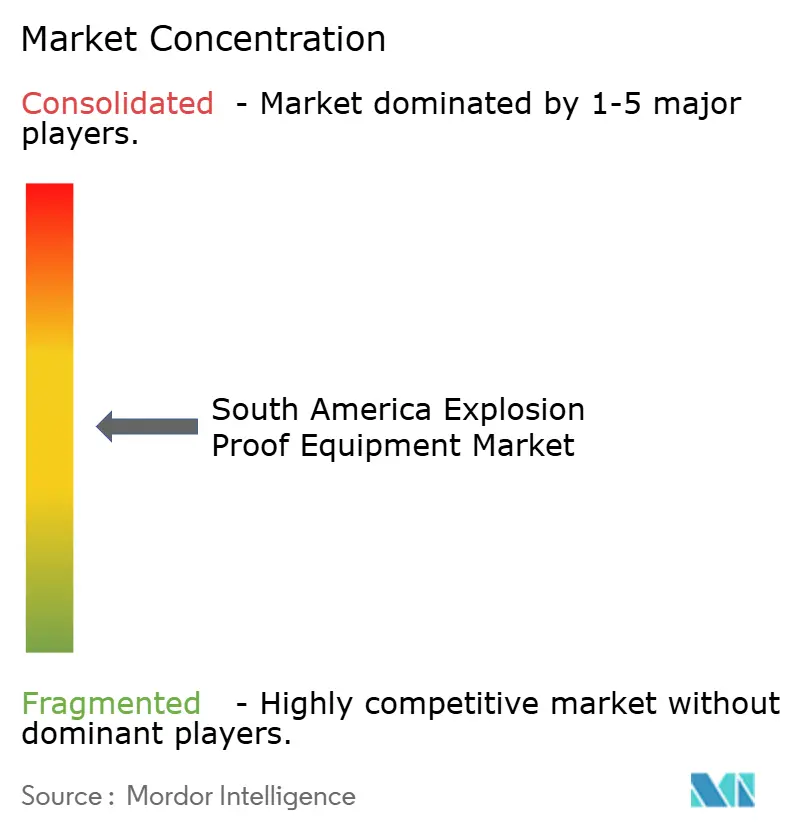
| Market Concentration | Medium |
Major Players *Disclaimer: Major Players sorted in no particular order Image © Mordor Intelligence. Reuse requires attribution under CC BY 4.0. | |
South America Explosion Proof Equipment Market Analysis by Mordor Intelligence
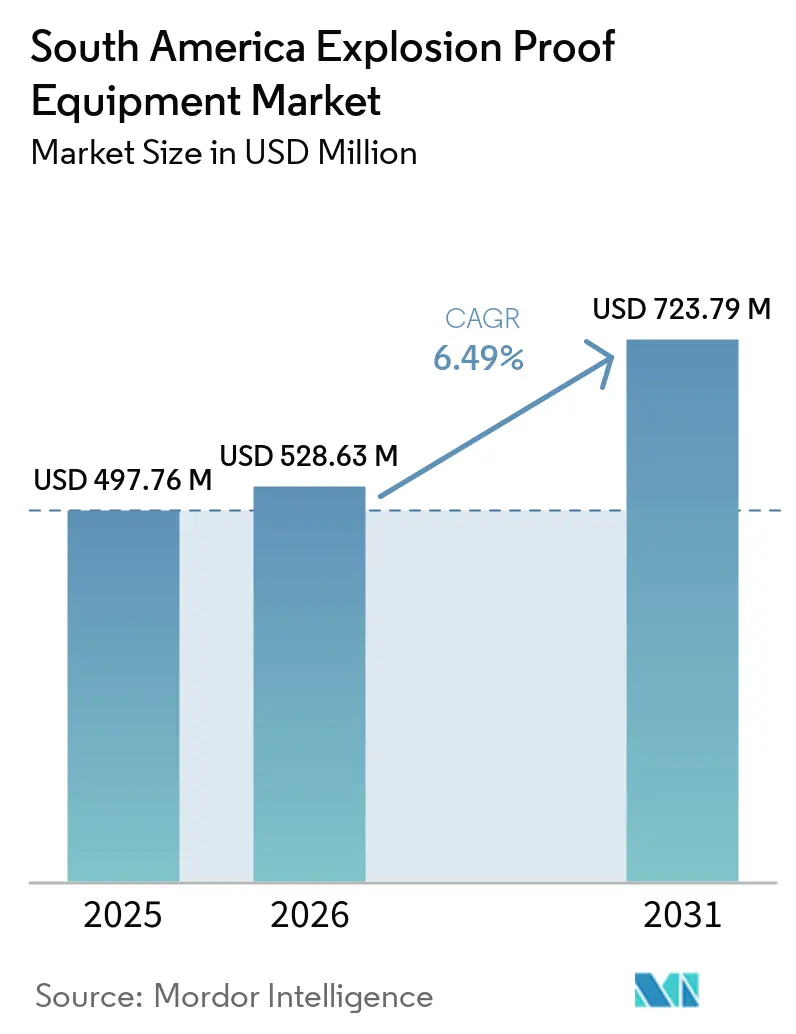
The South America explosion proof equipment market was valued at USD 497.8 million in 2025 and is estimated to grow from USD 528.6 million in 2026 to USD 723.8 million by 2031, at a CAGR of 6.5% during the forecast period (2026-2031). Brazil’s offshore oil and gas projects, regional mining activity, and tighter hazardous-area compliance requirements support demand for certified equipment. Operators in classified locations cannot replace compliant equipment with standard industrial alternatives, which supports demand for products that meet required protection specifications. Procurement is also becoming more focused on lifecycle compliance, testing, installation, maintenance, documentation, and the availability of qualified service support rather than on initial equipment supply alone. The South America explosion proof equipment market is shaped by Brazil’s certification framework and the need for suppliers to accommodate different regulatory practices, operating conditions, and technical service expectations across the region. Currency movements, import delays, the cost of compliance, constrained access to specialized skills, and differences in national requirements can slow purchasing decisions, especially for imported systems and projects that depend on several international suppliers and must meet multiple approval requirements before delivery.
Key Report Takeaways
- By method of protection, Explosion Prevention held 42.90% of the South America explosion proof equipment market size in 2025 and is forecast to grow at a 8% CAGR through 2031.
- By zone, Zone 1 accounted for 37.8% of the South America explosion proof equipment market size in 2025, while Zone 20 is projected to expand at a 7.8% CAGR through 2031.
- By end-user industry, Oil and Gas held 29.73% of the South America explosion proof equipment market size in 2025 and is expected to record a 7.7% CAGR through 2031.
- By system, Cable Glands and Accessories accounted for 31.7% of the South America explosion proof equipment market size in 2025, while Automation and Control Systems is forecast to grow at a 7.8% CAGR through 2031.
- By geography, Brazil represented 63.7% of the South America explosion proof equipment market size in 2025 and is forecast to advance at a 7.2% CAGR through 2031.
Note: Market size and forecast figures in this report are generated using Mordor Intelligence’s proprietary estimation framework, updated with the latest available data and insights as of January 2026.
South America Explosion Proof Equipment Market Trends and Insights
Drivers Impact Analysis*
| Driver | (~) % Impact on CAGR Forecast | Geographic Relevance | Impact Timeline |
|---|---|---|---|
| Brazil Offshore Oil and Gas and Refining Infrastructure Expansion | +2.2% | Brazil, with spillover to Colombia offshore activity | Long term (≥ 4 years) |
| Copper, Iron Ore, Lithium, and Gold Mining Expansion | +1.8% | Chile and Peru, with growth in Argentina and Brazil | Medium term (2-4 years) |
| Hazardous-Area Compliance and Certification Enforcement | +1.5% | Brazil, Chile, and Colombia | Medium term (2-4 years) |
| Industrial Automation and IIoT Retrofit Adoption | +1.3% | Brazil and Argentina, with relevance to Peru | Long term (≥ 4 years) |
| Installed-Base Replacement Across Process Industries | +0.9% | Brazil and Colombia | Short term (≤ 2 years) |
| Dust-Zone Safety Upgrades in Grain, Sugar, and Biofuels Processing | +0.7% | Brazil, Argentina, and Peru | Short term (≤ 2 years) |
| Source: Mordor Intelligence | |||
Expansion of Brazil Offshore Oil and Gas and Refining Infrastructure
Petrobras’s 2026-2030 business plan allocates USD 69.2 billion to exploration and production and includes 8 new production systems, 11 Búzios FPSOs, refinery expansion plans, and a strategy that keeps offshore production and related processing assets at the center of its capital program.[1]Petrobras, “Business Plan 2026-2030,” Petrobras Agency, agencia.petrobras.com.br These developments require certified motors, cable glands, junction boxes, lighting, automation equipment, field instrumentation, and supporting electrical infrastructure in classified locations, with specifications often set before construction begins. The May 2026 contracts between Petrobras and SBM Offshore for 2 SEAP FPSOs represent investments exceeding BRL 60 billion, or USD 11.9 billion, and extend equipment specification activities over several years, from engineering through commissioning.[2]U.S. Securities and Exchange Commission, “SEC Filing 6-K: SEAP FPSO Contracts Signed with SBM Offshore,” U.S. Securities and Exchange Commission, sec.gov Each FPSO creates demand across equipment supply, installation, inspection, replacement work, documentation, and the ongoing maintenance programs required after it enters operation. Existing offshore assets also require equipment replacement during field extension and maintenance programs, particularly where components must remain suitable for the designated hazardous-area classification. This combination of new construction and installed-base work supports a longer procurement cycle for the South America explosion-proof equipment market and provides qualified suppliers opportunities across both original equipment and aftermarket activities.
Expansion of Copper, Iron Ore, Lithium, and Gold Mining
Mining sites require equipment suitable for combustible dust and hazardous operating conditions in crushing, conveying, drilling, mineral processing, pumping, and material transfer activities. Dust can occur in underground works, ore-handling circuits, enclosed processing areas, and storage points, thereby broadening the use of hazardous-area equipment beyond oil and gas facilities. The South America explosion-proof equipment market, therefore, has exposure to mining projects that require reliable electrical distribution, motors, lighting, monitoring systems, cable connections, and enclosures that meet demanding site conditions. Equipment selection depends on the zone classification, dust characteristics, temperature requirements, installation conditions, maintenance access, and the need to protect personnel and plant assets. Remote mining operations also place greater value on durable products, spare parts availability, and local maintenance support because extended downtime can disrupt essential processing tasks. These operating conditions make certified equipment an integral part of the site design, commissioning, maintenance, and replacement processes rather than a stand-alone purchase.
Stricter Hazardous-Area Compliance and Certification Enforcement
Brazil requires certification for equipment used in explosive atmospheres under INMETRO requirements, even where suppliers already hold international approvals. The IECEx Certified Equipment Scheme provides an international framework for testing and certification of equipment used in explosive atmospheres, which supports a common technical reference for manufacturers, operators, and certification bodies. ABENDI reported that Brazil had 9 active INMETRO-accredited certification bodies and that the ABNT NBR IEC 60079 series continued to develop in line with IEC standards in 2025. Compliance requirements can increase lead times and supplier costs, but they also favor vendors with established certification portfolios, recognized technical documentation, and familiarity with local approval processes. The South America explosion proof equipment market benefits when plant owners upgrade equipment to maintain compliance with current requirements and when procurement teams prioritize documented suitability for the intended zone. Certification also gives buyers a clearer basis for evaluating products used in high-risk applications and can make product traceability more important during installation and maintenance.
Industrial Automation and IIoT Retrofit Adoption
Industrial sites are introducing connected instrumentation and control equipment into classified areas. ABENDI identified IIoT, cybersecurity, and two-wire Ethernet as important technology topics for explosive-atmosphere installations in Brazil during 2025. This changes procurement requirements because field devices and communication systems must meet both operational and hazardous-area standards and support reliable data exchange in demanding plant environments. Retrofit projects can create demand even where a plant is not expanding its physical capacity, since operators may need better monitoring, maintenance records, and visibility across installed equipment. Operators may replace legacy field devices to improve data collection, asset visibility, inspection records, and compatibility with updated control systems. The South America explosion proof equipment market is consequently moving toward more integrated control, sensing, communications, and diagnostic solutions, which increases the value of engineering expertise during selection and commissioning. Suppliers that combine certified devices with local engineering support are well-positioned for these retrofit programs because customers need help connecting new hardware with existing operating practices.
Restraints Impact Analysis*
| Restraint | (~) % Impact on CAGR Forecast | Geographic Relevance | Impact Timeline |
|---|---|---|---|
| Certification and Lifecycle Compliance Costs | -1.2% | Brazil, Chile, and Colombia | Long term (≥ 4 years) |
| Upfront Cost for Certified Equipment and Engineering | -1% | All South American markets, especially Peru and Bolivia | Medium term (2-4 years) |
| Fragmented National Acceptance of Ex Standards | -0.7% | Chile, Colombia, and Peru | Long term (≥ 4 years) |
| Currency Volatility, Import Delays, and Specialist Shortages | -0.6% | Argentina, Colombia, Brazil, and Chile | Short term (≤ 2 years) |
| Source: Mordor Intelligence | |||
High Certification and Lifecycle Compliance Costs
Certification costs can be significant because equipment approval may involve testing, factory assessment, surveillance, certificate renewal, technical records, and ongoing evidence that product specifications remain compliant. Brazil’s regulatory framework can create additional work for suppliers that already hold IECEx or ATEX approvals. ABENDI reported that more than 280 Brazilian professionals held IECEx Certified Persons competence certificates by December 2025. The available qualified workforce remains limited relative to the training, inspection, installation, and maintenance needs of hazardous-area installations. Smaller operators can delay upgrades when certification and training costs rise or when compliance work competes with other capital priorities. These costs can limit addressable demand in the South America explosion proof equipment market, particularly for smaller projects with limited procurement budgets and limited access to specialist engineering resources.
High Upfront Cost for Certified Equipment and Engineering
Certified equipment generally costs more than standard industrial products because it must meet specific protection, materials, ingress-protection, temperature, testing, and traceability requirements. The design of a classified installation also requires zone studies, equipment selection, installation controls, and checks that the completed system matches the planned protection approach. These requirements can raise initial project costs for mining, process, storage, and material-handling applications. Capital-constrained operators may defer projects or replace equipment in stages rather than procure complete systems, which can lengthen the period before a facility reaches its planned configuration. The constraint is most acute where equipment must be imported and local technical support, spare parts, or certified service capability is limited. Once a facility adopts certified systems, however, the maintenance and replacement requirements can support established supplier relationships and continuing demand for approved components.
*Our forecasts treat driver/restraint impacts as directional, not additive. The impact forecasts reflect baseline growth, mix effects, and variable interactions.
Segment Analysis
By Method of Protection: Explosion Prevention Leads on Scale and Growth
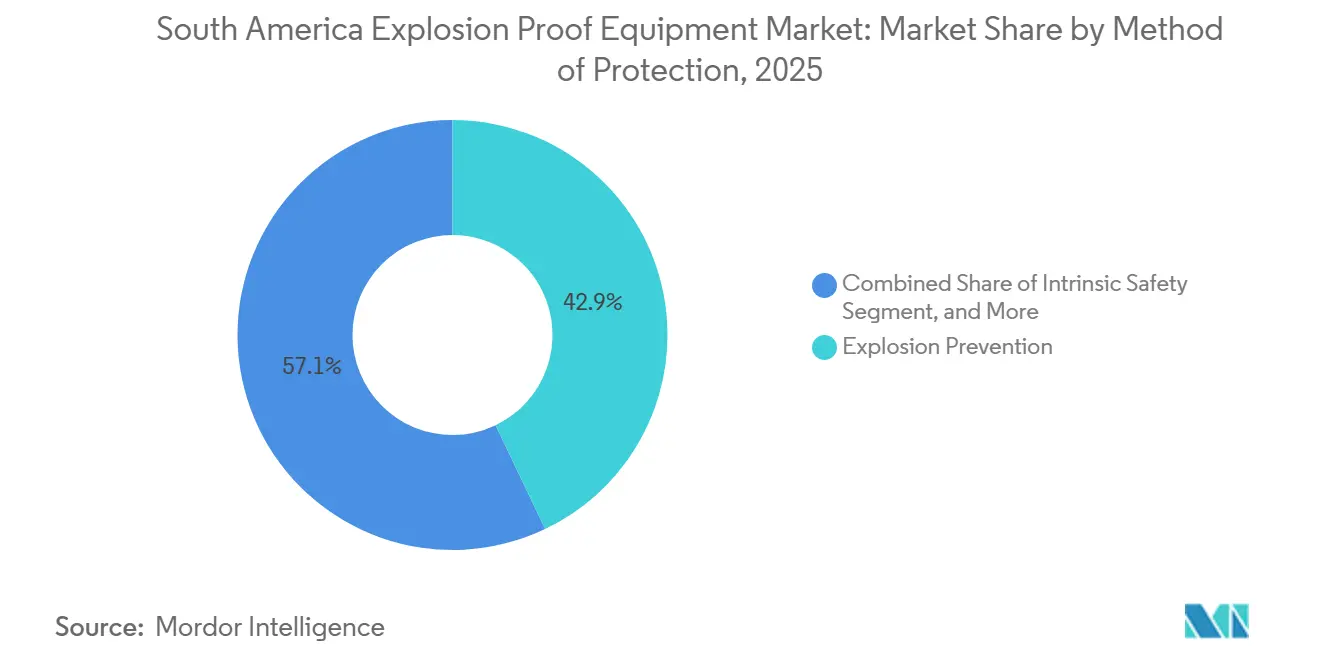
Explosion Prevention held 42.9% of the South America explosion proof equipment market share in 2025 and is expected to grow at a 8% CAGR through 2031. The category includes increased safety, non-sparking, and encapsulation approaches that operators select when they seek a suitable balance of protection, equipment weight, maintenance access, and installation practicality. It is relevant to offshore installations where equipment layout, available space, and the weight of installed systems affect project design and maintenance planning. The South America explosion proof equipment market size for this method also reflects the need to match the protection approach to the type of hazard, the equipment function, and the conditions at the operating location. ABENDI noted ongoing development of Brazilian explosive-atmosphere standards and maintenance practices during 2025, reinforcing the importance of appropriate selection and documented inspection.[3]ABENDI, “Instalações e Equipamentos Elétricos e Mecânicos em Atmosferas Explosivas: Retrospectiva Ex 2025 e Perspectivas Ex 2026,” ABENDI, abendi.org.br
Flameproof equipment remains important in oil and gas wellhead and process areas where robust ignition containment is required, while intrinsic safety is widely applicable to instrumentation and sensor circuits in gas-hazard locations. Pressurization and purging are suited to larger control enclosures and analyzers where replacing each individual component may not be practical or may require extensive changes to installed systems. Physical separation measures, such as barriers and blast walls, address applications where equipment layout and separation are central to risk control. Suppliers must maintain a broad protection portfolio because no single method fits every process, location, maintenance arrangement, or hazard classification. This requirement keeps product selection closely linked to site-specific engineering, inspection, installation, and maintenance practices.



By Zone: Zone 1 Dominates Supply, Zone 20 Supports Faster Growth
Zone 1 represented 37.8% of regional value in 2025. This zone is associated with locations where flammable gas may be present during normal operations, including offshore platforms, refinery units, receiving terminals, and other hydrocarbon-processing assets. Brazil’s offshore assets form a substantial installed base for Zone 1 equipment because upstream operations require extensive electrical, instrumentation, detection, and communications systems. Equipment replacement can remain necessary as mature assets undergo maintenance and life-extension work, and the South America explosion proof equipment market supports these needs through motors, lighting, enclosures, glands, controls, and detection equipment. Petrobras’s planned exploration, production, and refining investments maintain the importance of these applications.
Zone 20 is forecast to advance at a 7.8% CAGR through 2031, making it the fastest-growing zone classification in the supplied estimates. It applies to locations where combustible dust clouds are continuously present or present for long periods, including enclosed grain, sugar, biofuels, mining, and other material-handling processes. Zones 2 and 22 cover a broad range of applications where hazardous gas or dust is less likely to be continuously present, while Zones 0 and 21 remain important for narrower applications that require protection against continuous-presence hazards. This spread of zone classifications requires suppliers to provide equipment that is appropriate for the operating environment, hazard profile, inspection regime, and practical installation conditions. It also means that a facility may require several protection solutions rather than a single equipment design across all areas.
By End-User Industry: Oil and Gas Anchors Demand
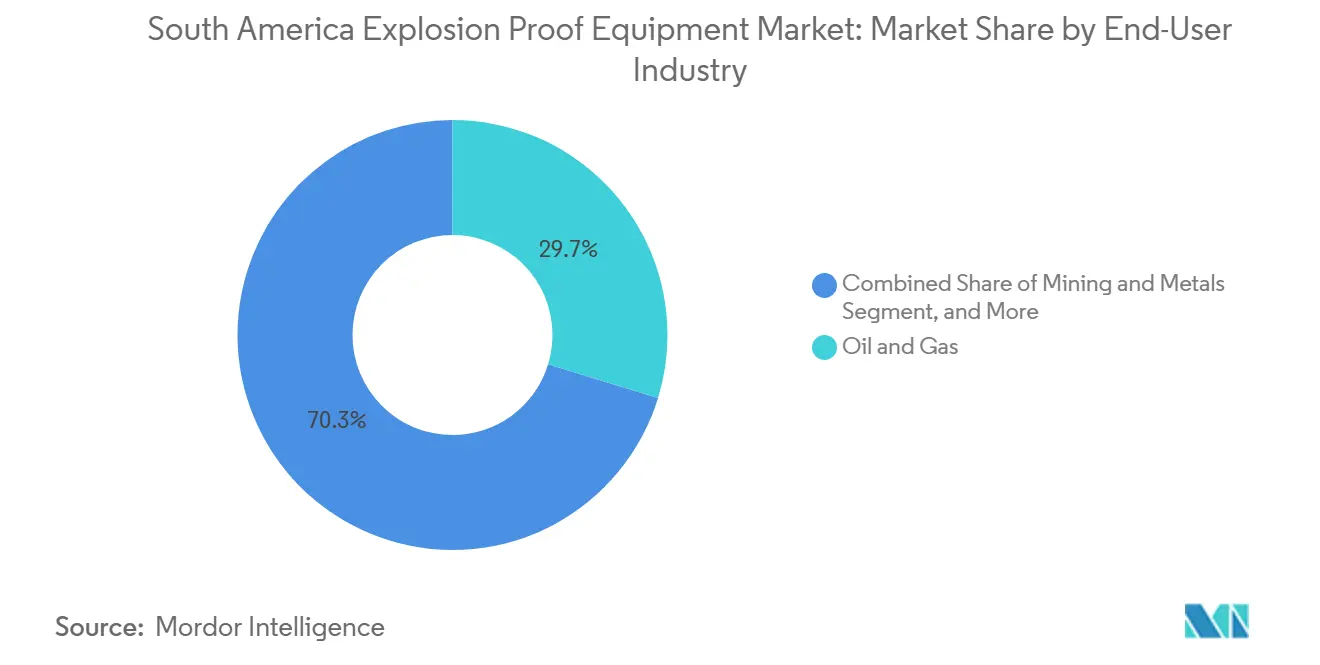
Oil and Gas accounted for 29.73% of the South America explosion proof equipment market size in 2025 and is projected to grow at a 7.7% CAGR through 2031. Petrobras’s business plan includes exploration and production investment, 8 new production systems, and 11 Búzios FPSOs. These facilities require certified equipment across process units, electrical systems, controls, detection systems, communications infrastructure, and maintenance programs throughout their operating life. Refinery activity also creates requirements for equipment used in hydrocarbon processing and storage operations, where equipment selection must comply with the applicable hazardous-area classification. The scale of Brazil’s upstream and downstream activity makes Oil and Gas the principal source of regional demand and reinforces replacement requirements at existing offshore and refinery assets.
Mining and Metals presents another major use case because extraction and processing sites can contain combustible dust and other hazardous conditions, while Chemicals and Petrochemicals require certified products across process units, tanks, and production areas where flammable substances are handled. Food and Beverage Processing can require dust-zone equipment in sugar, grain, and powder-handling systems, and pharmaceutical production, wastewater treatment, hydrogen production, and fuel-cell applications are smaller application areas in the supplied analysis. Their equipment needs differ by process design, hazard classification, local operating conditions, and the type of electrical or control system installed. This range of applications gives suppliers opportunities to adapt core products for multiple end-user settings while maintaining the required approvals and service capability. It also reduces reliance on a single application base, even though oil and gas remains the largest source of demand.
By System: Cable Glands Anchor Volume, Automation and Control Systems Drive Growth
Cable Glands and Accessories held 31.7% of regional value in 2025. These products are necessary at cable entry points across offshore platforms, refineries, mines, and other classified installations, where they help preserve the intended protection level of the overall assembly. Their demand is recurring because new connections, maintenance work, equipment replacement, and system modifications each require suitable certified cable-management components. Cable glands must support the enclosure's protection level and the site's installation requirements, giving the category a broad addressable base across almost every system type. Lighting Systems, Motors, and Drives also remain material system categories because they support routine plant operations in areas where reliable equipment is required.
Automation and Control Systems is expected to record a 7.8% CAGR through 2031. Growth reflects the adoption of integrated safety, sensing, communications, and control functions in classified areas, where operators need certified field hardware when they replace legacy architectures with connected monitoring and control systems. ABENDI highlighted IIoT, cybersecurity, and two-wire Ethernet as active themes for Brazil’s explosive-atmosphere installations. Material Handling Equipment and Surveillance and Detection systems complement this trend by supporting safe movement of materials and continuous monitoring of hazardous conditions. Integrated systems can increase the importance of technical service, commissioning, maintenance support, and staff familiarity with both safety and communications requirements after the original sale.
Geography Analysis
Brazil commanded 63.7% of the South America explosion proof equipment market share in 2025 and is forecast to expand at a 7.2% CAGR through 2031. Petrobras’s 2026-2030 plan provides a large project base for offshore production and refinery-related procurement. Brazil also requires equipment for explosive atmospheres to meet domestic certification requirements. This structure favors suppliers that have local approvals, distribution, technical knowledge, service capacity, and familiarity with the documentation expected by plant owners. ABENDI reported continuing expansion of the local standards and certification ecosystem in 2025.
Chile and Argentina are important secondary markets with different demand patterns. Chile’s demand is closely connected to mining activity and the need for rugged equipment in processing and underground operations, while Argentina combines potential demand from upstream oil and gas activity with mining and lithium-related processing needs. Both countries can face procurement constraints when products are imported, technical support is limited, or local commercial conditions delay delivery. The South America explosion proof equipment market, therefore, requires suppliers to adjust their channel, inventory, after-sales, and technical-support strategies to local conditions. These differences make a uniform regional sales approach less effective than country-specific product and service planning.
Colombia and Peru represent smaller but developing opportunities within the regional grouping. Colombia has demand from offshore and onshore oil and gas operations, while Peru offers potential demand across mining and metals projects that need reliable hazardous-area electrical equipment. These countries rely more heavily on imported ATEX and IECEx-certified equipment than Brazil, and their procurement environments remain competitive because they do not have a domestic certification layer equivalent to Brazil’s system. Local maintenance, delivery reliability, engineering support, and product availability can influence supplier selection in these markets.
Competitive Landscape
The South America explosion proof equipment market is moderately concentrated, with global automation suppliers, Ex specialists, and regional manufacturers active across different product categories. Certification requirements create a barrier for suppliers without recognized approvals, local compliance support, technical documentation, and the capacity to assist customers during installation and maintenance. WEG holds a differentiated regional position because it manufactures motors in Brazil and serves local industrial customers through established channels. In September 2025, WEG announced BRL 1.1 billion (USD 207 million) in industrial expansion investments to be completed by 2028. The investment strengthens its manufacturing capacity for large-scale equipment and supports its ability to serve regional energy and industrial projects.
Global suppliers compete through broad product portfolios and integrated system offerings. Emerson introduced a flameproof Rosemount 965 Flame Detector model in July 2026 for hazardous-location use in oil and gas, chemical, and storage applications. Such launches enable large suppliers to integrate field detection products into broader instrumentation and safety portfolios. Specialist vendors, including R. STAHL, Pepperl+Fuchs, BARTEC, G.M. International, and Hawke International, compete where protection expertise and detailed zone knowledge are central to customer requirements, while local providers compete on delivery times, repair capability, availability, and service support. The South America explosion proof equipment market rewards suppliers that can combine certified products with practical local service.
Digital integration is becoming a stronger competitive factor in control and monitoring applications because larger automation firms can bundle field devices, safety controls, communication tools, and engineering services for major upstream and process projects. Specialists retain relevance where a project requires specific protection methods or zone classifications that are not adequately served by general industrial products. WEG’s October 2024 launch of the W51Xdb high-voltage flameproof motor series added an option for hazardous applications in petrochemical, hydrogen, energy, and oil and gas settings. Competition is therefore based on product approval, technical fit, local support, and the capacity to serve the complete equipment lifecycle.
South America Explosion Proof Equipment Industry Leaders
WEG S.A.
ABB Ltd.
Siemens AG
Eaton Corporation plc
Emerson Electric Co.
- *Disclaimer: Major Players sorted in no particular order

Recent Industry Developments
- July 2026: Emerson launched a new flameproof model for the Rosemount 965 Flame Detector, adding hazardous-location certification using QuadSense technology. The product targets hydrocarbon flame detection in oil and gas facilities, chemical plants, and storage tank farms across South America, where Emerson holds established instrument-loop positions in Brazilian refineries.
- May 2026: Petrobras signed contracts with SBM Offshore for the construction of 2 FPSO units for the Sergipe Deepwater SEAP I and SEAP II project, representing investments exceeding BRL 60 billion, or USD 11.9 billion. The FPSOs, designed to produce up to 240,000 barrels of oil per day combined, are expected to deliver first oil by 2030, triggering multi-year equipment specification, manufacturing, and installation procurement cycles for Zone 1 and Zone 2 certified hardware.
- September 2025: WEG announced a BRL 1.1 billion, or USD 207 million, investment plan to be executed by 2028, including a new BRL 900 million manufacturing facility in Guaramirim, Santa Catarina, dedicated to large-scale equipment including synchronous compensators and high-speed induction motors. The expansion strengthens WEG’s capacity to serve classified-area equipment demand from Petrobras’s offshore build-out and South America’s energy transition projects from its home-country manufacturing base.


South America Explosion Proof Equipment Market Report Scope
The South America Explosion Proof Equipment Market Report is Segmented by Method of Protection (Explosion Containment, Intrinsic Safety, Pressurization/Purged, Explosion Prevention, and Explosion Segregation), Zone (Zone 0, Zone 1, Zone 2, Zone 20, Zone 21, and Zone 22), End-User Industry (Oil and Gas, Chemicals, Mining, Energy and Power, Pharmaceuticals, Food and Beverage, Wastewater, Hydrogen, and Other End-User Industries), System (Power Supply, Motors and Drives, Automation and Control, Lighting, Material Handling, Surveillance, Heating and HVAC, and Other Systems), and Geography (Brazil, Argentina, Chile, Colombia, Peru, and Rest of South America). The Market Forecasts are Provided in Terms of Value (USD).
By Method of Protection
| Explosion Containment (Flame-Proof) |
| Intrinsic Safety |
| Pressurization / Purged |
| Explosion Prevention |
| Explosion Segregation |
By Zone
| Zone 0 |
| Zone 1 |
| Zone 2 |
| Zone 20 |
| Zone 21 |
| Zone 22 |
By End-User Industry
| Oil and Gas |
| Chemicals and Petrochemicals |
| Mining and Metals |
| Energy and Power |
| Pharmaceuticals |
| Food and Beverage Processing |
| Wastewater Treatment |
| Hydrogen Production and Fuel Cells |
| Other End-User Industries |
By System
| Power Supply and Distribution |
| Motors and Drives |
| Automation and Control Systems |
| Lighting Systems |
| Material Handling Equipment |
| Surveillance and Detection |
| Heating and HVAC |
| Other Systems |
By Country
| Brazil |
| Argentina |
| Chile |
| Colombia |
| Peru |
| Rest of South America |
| By Method of Protection | Explosion Containment (Flame-Proof) |
| Intrinsic Safety | |
| Pressurization / Purged | |
| Explosion Prevention | |
| Explosion Segregation | |
| By Zone | Zone 0 |
| Zone 1 | |
| Zone 2 | |
| Zone 20 | |
| Zone 21 | |
| Zone 22 | |
| By End-User Industry | Oil and Gas |
| Chemicals and Petrochemicals | |
| Mining and Metals | |
| Energy and Power | |
| Pharmaceuticals | |
| Food and Beverage Processing | |
| Wastewater Treatment | |
| Hydrogen Production and Fuel Cells | |
| Other End-User Industries | |
| By System | Power Supply and Distribution |
| Motors and Drives | |
| Automation and Control Systems | |
| Lighting Systems | |
| Material Handling Equipment | |
| Surveillance and Detection | |
| Heating and HVAC | |
| Other Systems | |
| By Country | Brazil |
| Argentina | |
| Chile | |
| Colombia | |
| Peru | |
| Rest of South America |


Key Questions Answered in the Report
What is the projected value of the South America explosion proof equipment market by 2031?
The South America explosion proof equipment market is forecast to reach USD 723.8 million by 2031, from USD 528.6 million in 2026, at a 6.5% CAGR.
Which application accounts for the largest demand for explosion proof equipment in South America?
Oil and Gas held 29.73% of 2025 regional value and is projected to expand at a 7.7% CAGR through 2031.
Why is Brazil the leading country for explosion proof equipment demand?
Brazil represented 63.7% of 2025 regional value, supported by offshore oil and gas activity and domestic certification requirements.
Which protection method is growing fastest in the region?
Explosion Prevention is projected to grow at a 7.98% CAGR through 2031 and held 57.7% of 2025 value.
What is driving automation and control system demand in hazardous areas?
Connected instrumentation, IIoT adoption, and the need for certified field devices are supporting Automation and Control Systems, which is forecast to grow at a 7.8% CAGR.
Page last updated on:





