
Market Overview
| Study Period | 2020 - 2031 |
|---|---|
| Forecast Data Period | 2026 - 2031 |
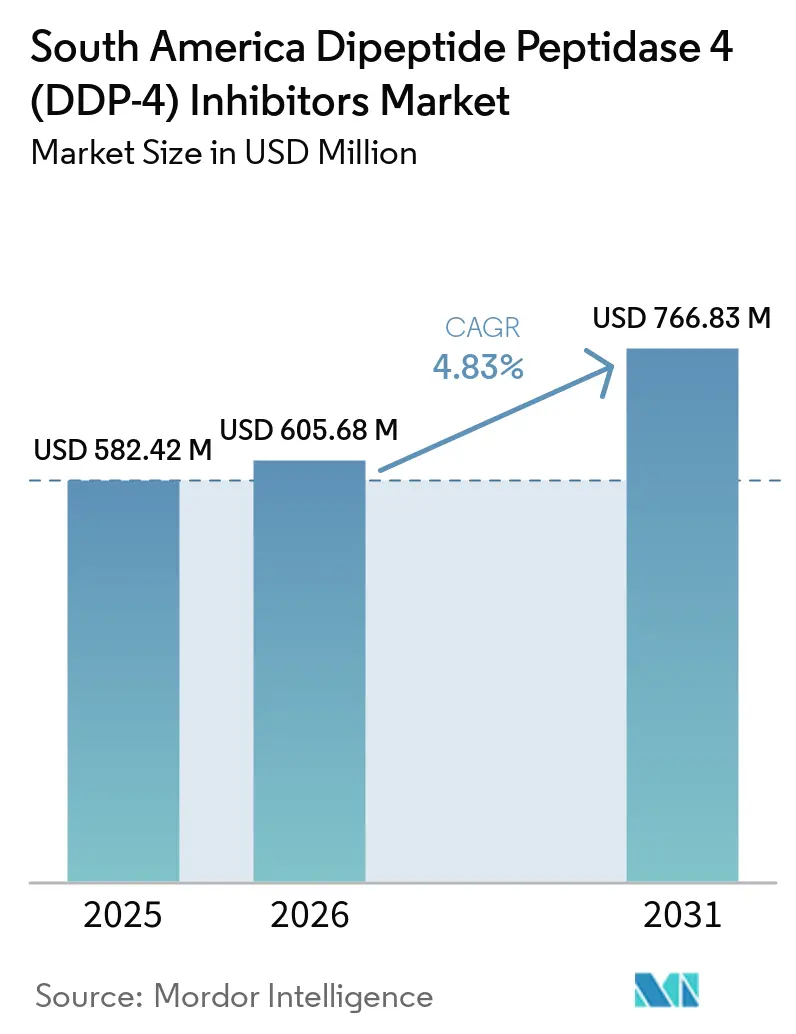
| Base Year Market Size (2025) | USD 582.42 Million |
| Market Size (2026) | USD 605.68 Million |
| Market Size (2031) | USD 766.83 Million |
| Growth Rate (2026 - 2031) | 4.83 % |
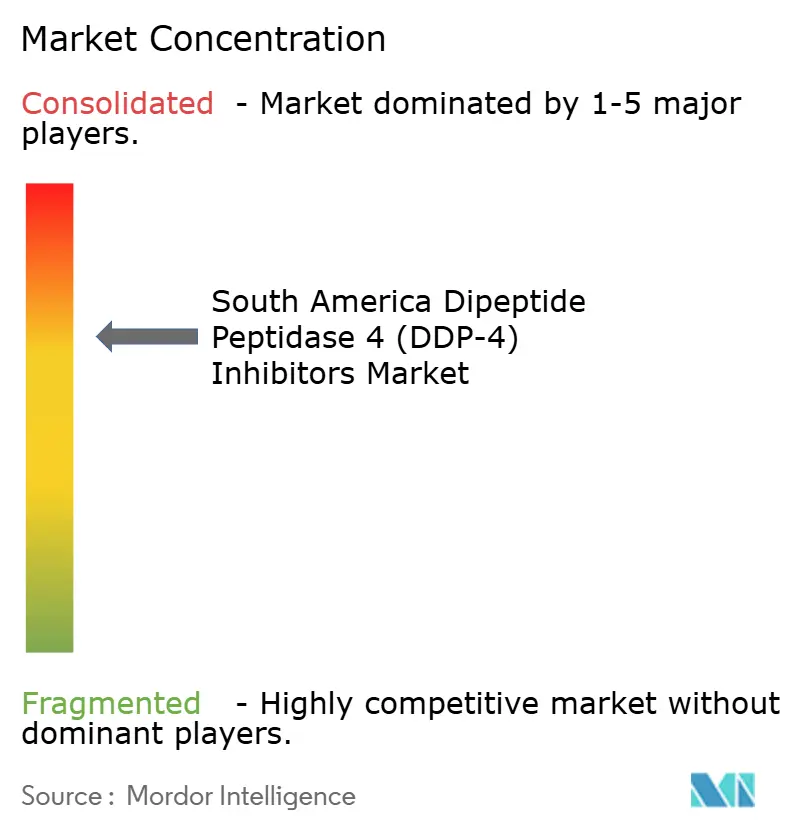
| Market Concentration | Medium |
Major Players *Disclaimer: Major Players sorted in no particular order Image © Mordor Intelligence. Reuse requires attribution under CC BY 4.0. | |
South America Dipeptide Peptidase 4 (DDP-4) Inhibitors Market Analysis by Mordor Intelligence
The South America dipeptide peptidase 4 (DDP-4) inhibitors market is expected to increase from USD 582.42 million in 2025 to USD 605.68 million in 2026 to reach USD 766.83 million by 2031, at a CAGR of 4.83% during the forecast period (2026-2031).
The market is supported by a growing number of adults living with diabetes, particularly in Brazil and Argentina. Regional health systems also face rising diabetes-related costs, which increase the need for practical treatment options. Oral medicines remain relevant for patients who cannot access, tolerate, or consistently use injectable therapies. Generic substitution is reducing branded prices while helping preserve treatment volumes in public and private channels. Companies with local supply arrangements, established bioequivalence approvals, and access to public tenders are positioned to serve this changing demand pattern.
Key Report Takeaways
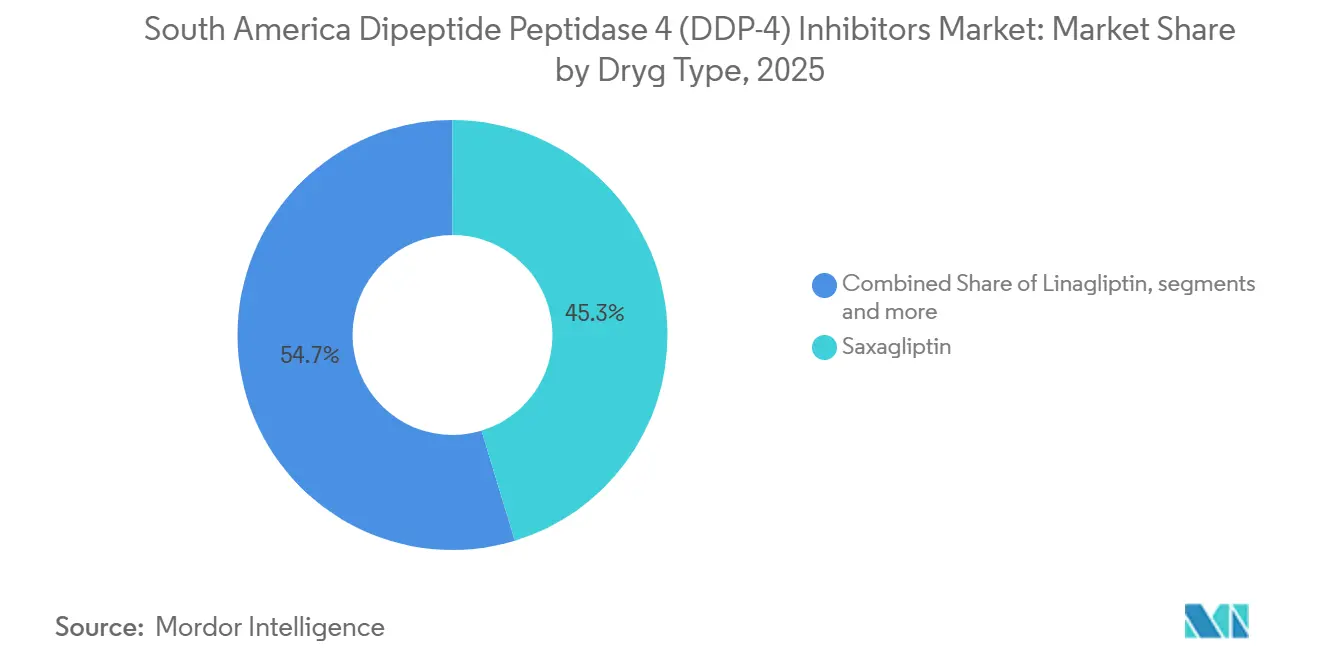
- By drug type, saxagliptin held 45.32% of the South American DPP-4 inhibitors market share in 2025, while linagliptin is forecast to grow at a 5.22% CAGR through 2031.
- By medication type, branded medications held 71.42% of the South American DPP-4 inhibitors market share in 2025, while generic medications are expected to grow at a 6.24% CAGR through 2031.
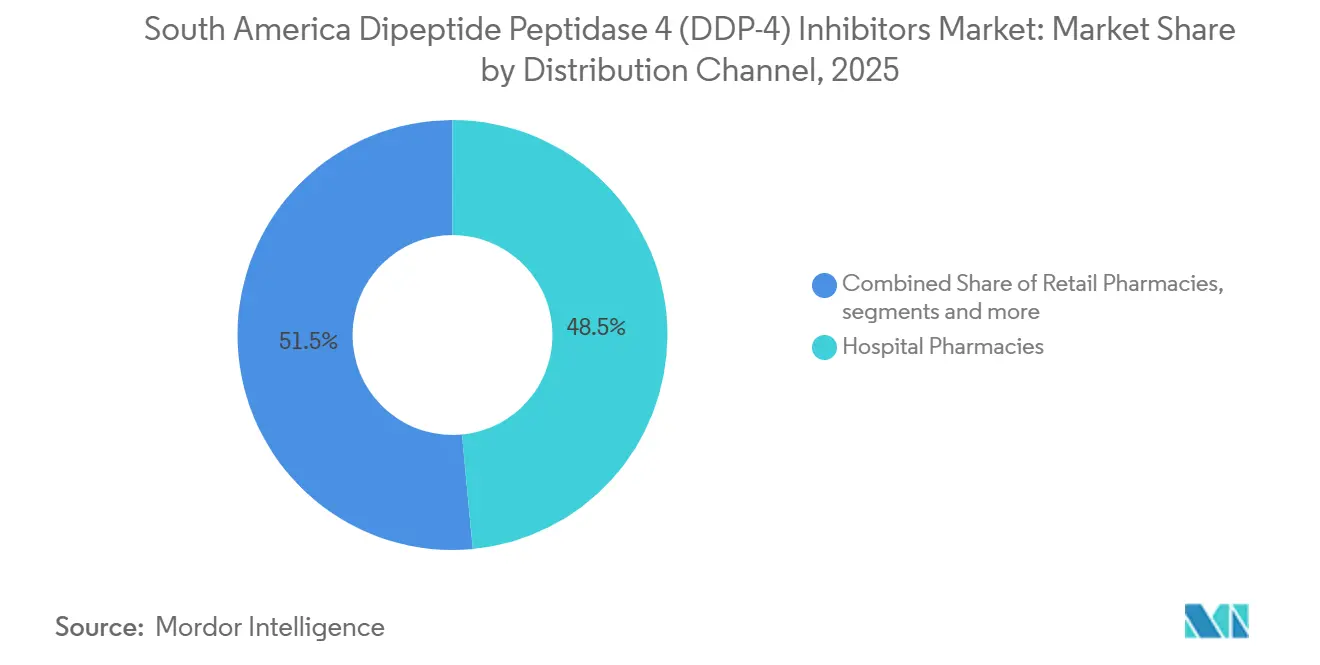
- By distribution channel, hospital pharmacies held 48.52% of revenue in 2025, while online pharmacies are forecast to grow at a 5.63% CAGR through 2031.
- By country, Brazil held 56.72% of revenue in 2025, while Argentina is projected to grow at a 7.16% CAGR through 2031.
Note: Market size and forecast figures in this report are generated using Mordor Intelligence’s proprietary estimation framework, updated with the latest available data and insights as of January 2026.
Market Trends and Insights
Drivers Impact Analysis of South America Dipeptide Peptidase 4 (DDP-4) Inhibitors Market*
| Driver | (~) % Impact on CAGR Forecast | Geographic Relevance | Impact Timeline |
|---|---|---|---|
| Rising Type 2 Diabetes Prevalence | +1.2% | Across South America, with greatest concentration in Brazil and Argentina | Long term (≥ 4 years) |
| Growing Need for Weight-Neutral Oral Therapies | +0.8% | Across South America, with strong relevance in Brazil, Argentina, and mid-tier countries | Medium term (2-4 years) |
| Expansion of Combination Therapy Regimens | +0.7% | Primarily Brazil and Argentina, with secondary effects in Colombia and Chile | Medium term (2-4 years) |
| Increasing Diabetes Diagnosis and Treatment | +0.6% | Brazil, Colombia, and Peru, where undiagnosed patient burdens remain high | Long term (≥ 4 years) |
| Renal-Disease-Linked Preference for Linagliptin | +0.5% | Brazil, Argentina, and Colombia | Medium term (2-4 years) |
| Generic Tendering and Local Manufacturing | +0.4% | Primarily Brazil and Argentina | Short term (≤ 2 years) |
| Source: Mordor Intelligence | |||
Rising Type 2 Diabetes Prevalence
The International Diabetes Federation estimated that 35 million adults lived with diabetes across South and Central America in 2024, and 30.4%, or 10.7 million people, remained undiagnosed.[1] Brazil recorded a clear increase in adult diabetes prevalence, from 5.5% in 2006 to 12.9% in 2024.[2] The same national evidence linked the disease burden with excess weight affecting 60% of Brazilian adults. The South American DPP-4 inhibitors market, therefore, has a larger pool of patients who may need continuing glucose-lowering treatment after diagnosis. Primary-care screening in lower-income urban areas can bring people with episodic healthcare contact into treatment pathways. Affordable oral therapies can be important when those patients begin treatment outside specialist settings.
Growing Need for Weight-Neutral Oral Therapies
DPP-4 inhibitors provide a weight-neutral oral option, unlike sulfonylureas and insulin regimens that may create a risk of weight gain. This characteristic is important where obesity and type 2 diabetes commonly occur together and where treatment adherence can be affected by the burden of injectable care. Brazil’s 2025 clinical guidance retained DPP-4 inhibitors as treatment options for suitable patients with HbA1c below 7.5% who cannot access or tolerate GLP-1 receptor agonists or SGLT2 inhibitors. This guidance preserves a defined role for oral treatment within the South American DPP-4 inhibitors market, rather than treating the class as interchangeable with injectable therapies. Higher prices for injectable medicines can lead physicians and patients to consider weight-neutral oral alternatives. Generic availability can make that choice more accessible in price-sensitive settings and can preserve DPP-4 use while branded products face erosion.
Expansion of Combination Therapy Regimens
Clinical guidance in Brazil supports dual therapy at diagnosis when HbA1c is 7.5% or higher. This approach broadens the role of DPP-4 inhibitors beyond use as a single medicine for patients who present later in disease progression. Fixed-dose products combining a DPP-4 inhibitor with metformin can reduce pill burden and make adherence simpler for people managing multiple medicines. Generic combinations can also fit public procurement budgets more easily than separate branded products. DPP-4 and SGLT2 combinations are appearing in Brazilian tertiary hospital formularies and package more than glucose control within a single oral regimen. Their cardiovascular and renal treatment relevance can help maintain DPP-4 prescribing where standalone injectable alternatives are not appropriate or feasible.
Renal-Disease-Linked Preference for Linagliptin
More diagnosis and treatment of diabetes can increase prescription demand in Brazil, Colombia, and Peru, especially among patients who previously had no regular contact with diabetes services. The International Diabetes Federation expects the number of adults with diabetes in South and Central America to reach 52 million by 2050. Linagliptin does not require dose adjustment across stages of chronic kidney disease because it is primarily eliminated through biliary pathways. A 2025 clinical review reported lower hypoglycemia risk for DPP-4 inhibitors, especially linagliptin, than for sulfonylureas in people with type 2 diabetes and chronic kidney disease.[3] A 2024 study also found financial benefits from renal dose-adjusted DPP-4 prescribing for patients with diabetes and chronic kidney disease. Local manufacturing, established bioequivalence certification, and decentralized generic tenders can help qualified suppliers serve this demand in Brazil and Argentina.
Restraints Impact Analysis of South America Dipeptide Peptidase 4 (DDP-4) Inhibitors Market*
| Restraint | (~) % Impact on CAGR Forecast | Geographic Relevance | Impact Timeline |
|---|---|---|---|
| Competition From GLP-1 Receptor Agonists and SGLT2 Inhibitors | -1.3% | Across South America, with the strongest effect in Brazil | Medium term (2-4 years) |
| Reimbursement and Out-of-Pocket Affordability Constraints | -0.8% | Argentina, Colombia, and Peru, where insurance coverage is limited | Long term (≥ 4 years) |
| Country-Level Regulatory and Bioequivalence Requirements | -0.5% | Brazil and Argentina, with less effect in Colombia and Chile | Medium term (2-4 years) |
| Diminishing Branded Value After Patent Expiry | -1.1% | Primarily Brazil, with secondary effects in Argentina and Colombia | Medium term (2-4 years) |
| Source: Mordor Intelligence | |||
Competition from GLP-1 Receptor Agonists and SGLT2 Inhibitors
The South American DPP-4 inhibitors market faces increased competition from GLP-1 receptor agonists and SGLT2 inhibitors. Lower-cost GLP-1 products can draw patients with obesity, high HbA1c levels, or cardiovascular risk toward injectable care. Brazil approved domestic production for liraglutide-based products in December 2024. Injectable therapies still require cold-chain handling and patient training. These requirements limit access beyond larger urban areas and specialist services. Oral DPP-4 therapies retain an operational advantage for primary care and rural use.
Reimbursement and Out-of-Pocket Affordability Constraints
Fragmented reimbursement limits the ability of branded DPP-4 products to expand across South America. Brazil’s public formulary has focused on metformin and sulfonylureas, leaving many DPP-4 purchases in private co-payment channels. Price sensitivity is especially relevant in Argentina, Colombia, and Peru. Separate registration and bioequivalence requirements in Brazil and Argentina add cost to multi-country product management. Patent expiry can also reduce branded value quickly when generic products become available. Merck’s 2024 annual report disclosed exclusivity for Januvia and Janumet through May 2026, illustrating the value exposure facing established oral diabetes brands.
*Our forecasts treat driver/restraint impacts as directional, not additive. The impact forecasts reflect baseline growth, mix effects, and variable interactions.
South America Dipeptide Peptidase 4 (DDP-4) Inhibitors Market Segment Analysis
By Drug Type:
Saxagliptin Leads While Linagliptin Gains Clinical RelevanceSaxagliptin held 45.32% of value in 2025, making it the largest molecule in the South American DPP-4 inhibitors market. Its position was built through more than a decade of physician familiarity, earlier category-leading clinical trial data, and formulary placement in Brazil and Argentina. Branded Onglyza and a growing generic supply base support continuing use across hospital and private care settings. Generic supply helps sustain patient volumes even when branded unit prices decline. Linagliptin is forecasted to expand at a 5.22% CAGR through 2031 because it offers a distinct option for patients who also have chronic kidney disease.
The South American DPP-4 inhibitors market for linagliptin is supported by its biliary elimination, which removes the need for renal dose adjustments across chronic kidney disease stages. Clinical evidence associates linagliptin with a lower risk of hypoglycemia than sulfonylureas in patients with diabetes and chronic kidney disease. Vildagliptin retains a credible Brazilian private-care position through branded products and generic combinations with metformin, while alogliptin remains in selected institutional contracts.

By Medication Type:
Generic Products Grow as Branded Products Retain ValueBranded medications accounted for 71.42% of value in 2025, while generic medications are forecasted to grow at a 6.24% CAGR through 2031. Originators retain value through established hospital formulary relationships, specialist familiarity, and private insurance preferences in Brazil and Argentina. The South American DPP-4 inhibitors market is nevertheless shifting toward bioequivalent alternatives through Brazilian public tenders and provincial procurement in Argentina. Generic products can lower acquisition costs for health systems and make established molecules more attainable for self-paying patients. This shift supports treatment volume even as it compresses branded pricing.
The South American DPP-4 inhibitors market size is also shaped by which suppliers can satisfy country-specific bioequivalence and registration standards. ANVISA requirements can favor manufacturers with established evidence packages, local regulatory capabilities, and consistent supply arrangements. The resulting process can reduce the number of companies able to compete effectively for public tenders.
By Distribution Channel:
Hospitals Remain Central as Online Access ExpandsHospital pharmacies accounted for 48.52% of the distribution value in 2025 and remained the largest channel in the South American DPP-4 inhibitors market. State procurement contracts and accredited hospital networks underpin this position in Brazil. Hospital purchasing also establishes price benchmarks that can influence the wider medicines supply chain. Retail pharmacies serve insured and self-paying urban patients in Brazil, Argentina, and Chile, where pharmacy chains provide direct dispensing outside institutional procurement. Together, hospital and retail settings provide established channels for patients who need uninterrupted oral diabetes therapy.
Online pharmacies are expected to grow at 5.63% CAGR through 2031. Oral DPP-4 tablets are suited to ordinary e-commerce fulfillment because they are shelf-stable and do not need cold-chain delivery. This provides an operational advantage over GLP-1 pens, which need temperature-controlled handling and more complex last-mile delivery. Digital access can make repeat purchases easier for established chronic-condition patients, particularly where pharmacy chains have widened online ordering. The digital channel complements hospital procurement and physical retail access rather than replacing either source of supply.
Geography Analysis
Brazil Dipeptide Peptidase 4 (DDP-4) Inhibitors Market
Brazil held 56.72% of the South American DPP-4 inhibitors market share in 2025, giving it the region’s largest country position. The country combines public procurement through the Unified Health System, broad private formulary access, and a developed retail pharmacy network. These channels support dispensing across large urban populations and institutional care settings. Adult diabetes prevalence rose from 5.5% in 2006 to 12.9% in 2024. Brazil’s 2025 clinical guidance continued to recognize DPP-4 inhibitors as oral options for suitable people without high cardiovascular risk.
Argentina Dipeptide Peptidase 4 (DDP-4) Inhibitors Market
Argentina is projected to grow at a 7.16% CAGR through 2031, the highest rate among the countries covered. The International Diabetes Federation recorded 4.3 million adults with diabetes in Argentina in 2024 and an age-standardized diabetes prevalence of 14%. Argentina’s 2025 clinical guidance retained DPP-4 inhibitors within the oral treatment algorithm. Separate stability-testing and registration requirements can increase costs for imported finished-dose products. They can also create openings for generic manufacturers that develop locally adapted dossiers.
Broader South America Dipeptide Peptidase 4 (DDP-4) Inhibitors Market
Colombia, Chile, Peru, and the rest of South America represented the remaining value in 2025. Colombia’s wider health coverage can improve diabetes diagnosis and the use of oral antidiabetics in primary care. Chile’s regulatory setting can support generic entry and a competitive price environment. Peru and smaller countries remain constrained by healthcare infrastructure gaps, while PAHO supports regional diabetes screening and early diagnosis.
Competitive Landscape
The South American DPP-4 inhibitors market is moderately concentrated, with a significant number of branded originator manufacturers accounting for a significant share of market revenue. AstraZeneca supplies saxagliptin, while Boehringer Ingelheim and Eli Lilly co-promote linagliptin. Merck & Co. supplies sitagliptin, Novartis supplies vildagliptin, and Takeda supplies alogliptin. These companies retain specialist relationships and hospital formulary positions developed through years of prescribing use. Their branded portfolios are supported by established clinical evidence in diabetes and cardiorenal care.
Generic competition in the South American DPP-4 inhibitors market includes EMS, Hypera, Eurofarma, Torrent, Sandoz, Teva, Glenmark, and Viatris. Supplier competition depends on bioequivalence documentation, registration timing, local supply capabilities, and tender pricing. Eurofarma markets Evogliptin as Suganon under a license for the South American region. Its generic semaglutide plans show a strategy that spans competing treatment classes. EMS received approval to produce a domestic liraglutide-based product in Brazil in 2024.
The South American DPP-4 inhibitors market has room for cost-competitive manufacturers in Colombia, Peru, and Chile. These countries have lower generic penetration than Brazil and are expanding private pharmacy and insurance networks. Fixed-dose DPP-4 and SGLT2 combinations can offer a stronger position than standalone DPP-4 monotherapy because they join glycemic, cardiovascular, and renal needs in one tablet. This may make substitution less direct for prescribers and hospital formulary committees.
South America Dipeptide Peptidase 4 (DDP-4) Inhibitors Industry Leaders
-
Merck & Co., Inc.
-
Boehringer Ingelheim International GmbH
-
AstraZeneca PLC
-
Novartis AG
-
Eli Lilly and Company
- *Disclaimer: Major Players sorted in no particular order
South America Dipeptide Peptidase 4 (DDP-4) Inhibitors Market Companies Covered in this Report
- AstraZeneca
- Boehringer Ingelheim
- Bristol-Myers Squibb
- Eli Lilly and Company
- EMS S.A.
- Eurofarma Laboratorios S.A.
- Glenmark Pharmaceuticals
- GlaxoSmithKline
- Hypera S.A.
- Merck
- Novartis
- Pfizer
- Sandoz Group AG
- Sanofi
- Siegfried Holding AG
- Takeda Pharmaceuticals
- Teva Pharmaceutical Industries
- Torrent Pharmaceuticals Limited
- Viatris
- Zydus Lifesciences Limited
Recent Industry Developments in South America Dipeptide Peptidase 4 (DDP-4) Inhibitors Market
- August 2026: According to the Consortia Advancing Standards in Research Administration Information, Chile’s clinical trial approval process involves two parallel tracks that must both be completed before a study can begin: an ethics and scientific review by an accredited Comité Ético Científico (CEC) and separate authorization from Chile’s national regulatory authority, the Instituto de Salud Pública (ISP), through its medicines agency, ANAMED (Agencia Nacional de Medicamentos).
- May 2025: Salius Pharma, a supplier of high-grade pharmaceutical APIs, expanded its presence into the chronic therapeutic space across Argentina, Peru, Chile, and other countries.
South America Dipeptide Peptidase 4 (DDP-4) Inhibitors Market Report Scope
According to the report’s scope, the South American dipeptide peptidase 4 (DPP‑4) inhibitors market refers to the regional pharmaceutical segment focused on oral antidiabetic drugs that inhibit the enzyme dipeptidyl peptidase‑4, thereby enhancing incretin activity and improving glycemic control in patients with type 2 diabetes.
The South American dipeptide peptidase 4 (DPP‑4) inhibitors market is segmented into drug type, medication type, distribution channel, and country. By drug type, the market is segmented into saxagliptin, linagliptin, alogliptin, vildagliptin, and other drug types. By medication type, the market is segmented into branded medication and generic medication. By distribution channel, the market is segmented into hospital pharmacies, retail pharmacies, online pharmacies, and other distribution channels. By country, the market is segmented into Brazil, Argentina, Colombia, Chile, Peru, and the rest of South America. The report offers values (USD) for all the above segments.
Segmentation Overview
By Drug Type
| Saxagliptin |
| Linagliptin |
| Alogliptin |
| Vildagliptin |
| Other Drug Types |
By Medication Type
| Branded Medication |
| Generic Medication |
By Distribution Channel
| Hospital Pharmacies |
| Retail Pharmacies |
| Online Pharmacies |
| Other Distribution Channels |
By Country
| Brazil |
| Argentina |
| Colombia |
| Chile |
| Peru |
| Rest of South America |
| By Drug Type | Saxagliptin |
| Linagliptin | |
| Alogliptin | |
| Vildagliptin | |
| Other Drug Types | |
| By Medication Type | Branded Medication |
| Generic Medication | |
| By Distribution Channel | Hospital Pharmacies |
| Retail Pharmacies | |
| Online Pharmacies | |
| Other Distribution Channels | |
| By Country | Brazil |
| Argentina | |
| Colombia | |
| Chile | |
| Peru | |
| Rest of South America |
Key Questions Answered in the Report
What is the projected value of South America's DPP-4 inhibitor market in 2031?
The market value is projected to reach USD 766.8 million by 2031, from USD 582.42 million in 2025 to USD 605.68 million in 2026, at 4.83% CAGR.
Which DPP-4 drug type leads regional sales?
Saxagliptin led by value with 45.32% in 2025, while linagliptin is expected to grow at 5.22% CAGR through 2031.
Which country has the largest role in South America?
Brazil held 56.72% of 2025 revenue, supported by public procurement, private formularies, and retail pharmacy access.
How are generic medicines changing DPP-4 treatment access?
Generic medications are expected to grow at 6.24% through 2031 as tenders and price-sensitive patients shift toward bioequivalent products.