
Market Overview
| Study Period | 2020 - 2031 |
|---|---|
| Forecast Data Period | 2026 - 2031 |
| Base Year Market Size (2025) | USD 2.43 Billion |
| Market Size (2026) | USD 2.55 Billion |
| Market Size (2031) | USD 3.34 Billion |
| Growth Rate (2026 - 2031) | 5.56 % |
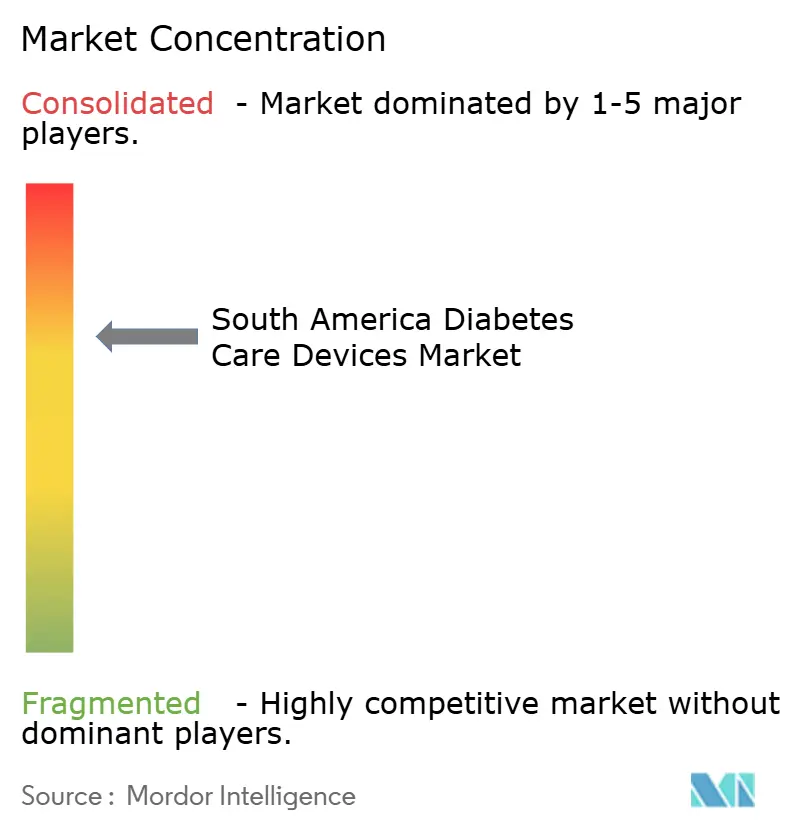
| Market Concentration | Medium |
Major Players *Disclaimer: Major Players sorted in no particular order Image © Mordor Intelligence. Reuse requires attribution under CC BY 4.0. | |
South America Diabetes Care Devices Market Analysis by Mordor Intelligence
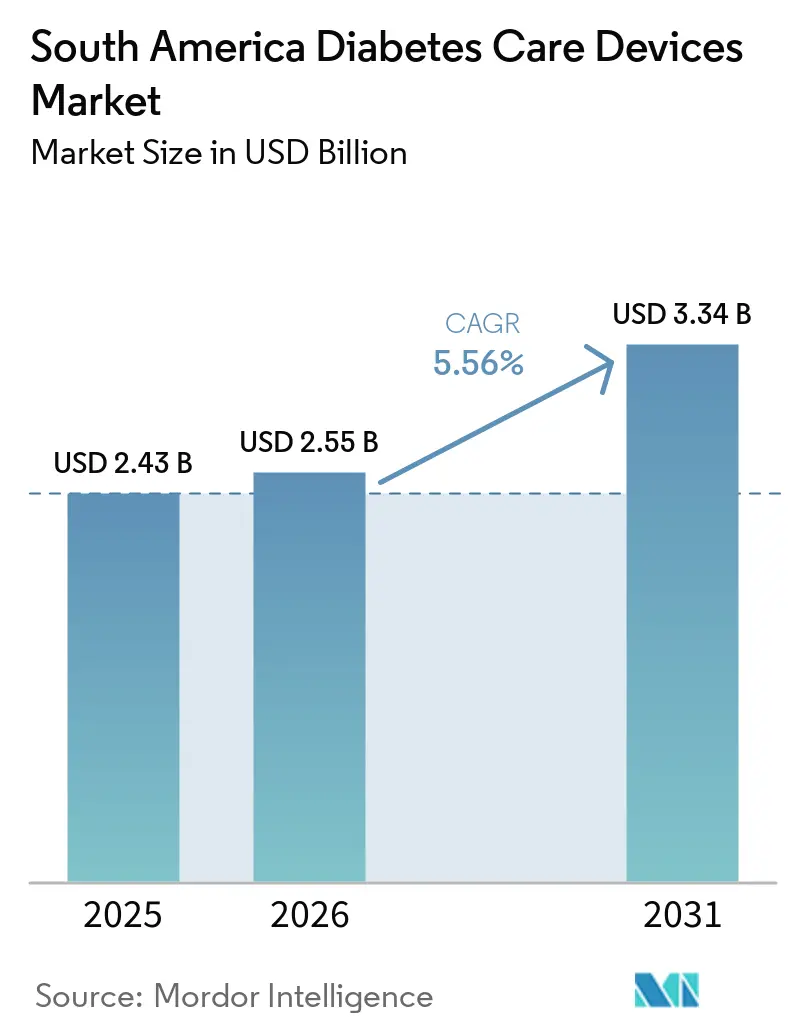
The South America diabetes care devices market is expected to grow from USD 2.43 billion in 2025 and is estimated to grow from USD 2.57 billion in 2026 to reach USD 3.34 billion by 2031, at a CAGR of 5.56% during the forecast period (2026-2031).
The region had 35.4 million adults living with diabetes in 2024, while 30.4% of those adults remained undiagnosed, leaving a large group outside regular treatment and monitoring pathways. Diabetes-related health expenditure reached USD 81 billion in 2024, which indicated a substantial clinical and financial need for better access to care. Public screening, insulin coverage, and telehealth programs are bringing more people into active care, which supports demand for monitoring and delivery products. Manufacturers are pursuing connected monitoring systems, pharmacy partnerships, and local distribution models, while affordability and registration requirements continue to limit the uptake of advanced devices. The South American diabetes care devices market, therefore, combines large public procurement volumes for basic monitoring with a smaller but expanding demand base for continuous monitoring and pump systems. Its future direction depends on whether funding, diagnosis, clinical training, and device availability can expand together across public and private care systems, through coordinated procurement, clinician education, reliable connectivity, and supply-chain support for patients who start therapy in a hospital but manage it at home.
Key Report Takeaways
- By device type, monitoring devices held 61.24% of the South American diabetes care devices market share in 2025, while continuous glucose monitoring is projected to grow at a 6.23% CAGR through 2031.
- By diabetes type, type 2 diabetes accounted for 86.33% of demand in 2025 and is forecast to expand at 7.34% CAGR through 2031.
- By distribution channel, hospital pharmacies held 43.45% of revenue in 2025, while online pharmacies are forecast to grow at a 6.71% CAGR through 2031.
- By end-user, hospitals and clinics accounted for 45.22% of revenue in 2025, while homecare settings are projected to grow at a 5.91% CAGR through 2031.
- By country, Brazil held 46.37% of revenue in 2025, while Argentina is projected to expand at an 8.15% CAGR through 2031.
Note: Market size and forecast figures in this report are generated using Mordor Intelligence’s proprietary estimation framework, updated with the latest available data and insights as of January 2026.
Market Trends and Insights
Drivers Impact Analysis of South America Diabetes Care Devices Market*
| Driver | (~) % Impact on CAGR Forecast | Geographic Relevance | Impact Timeline |
|---|---|---|---|
| Rising Diabetes Prevalence and Diagnosis Rates | +1.8% | Global, concentrated in Brazil, Argentina, and Colombia | Short term (≤ 2 years) |
| Growing Adoption of Continuous and Connected Monitoring | +1.4% | Brazil and Argentina, with expansion to Chile and Colombia | Medium term (2-4 years) |
| Expansion of Home-Based and Remote Diabetes Management | +0.9% | Brazil, Chile, and Argentina, with early adoption in Peru and Colombia | Medium term (2-4 years) |
| Public-Health Screening and Diabetes-Program Expansion | +0.6% | Brazil and national programs across South America | Short term (≤ 2 years) |
| Interoperability Between CGM, Smart Pens, Pumps, and Mobile Platforms | +0.5% | Private urban centers in Brazil and Argentina | Long term (≥ 4 years) |
| Increasing Adoption of CGM Among Pediatric and Type 1 Diabetes Patients | +0.4% | Brazil, Chile, and Argentina | Long term (≥ 4 years) |
| Source: Mordor Intelligence | |||
Rising Diabetes Prevalence and Diagnosis Rates
The growing number of people living with diabetes provides the basic demand base for the South American diabetes care devices market. The adult diabetes population in South and Central America is projected to rise from 35.4 million in 2024 to 51.5 million by 2050, a 46% increase.[1] Argentina recorded an age-standardized diabetes prevalence of 14% in 2024, followed by Chile at 12.2% and Brazil at 10.6%, supporting demand in markets with more developed private care channels. Gestational diabetes affected 12.5% of pregnancies in the region in 2024, or 967,000 live births, which creates a separate need for monitoring during pregnancy and can increase later awareness of diabetes care. As diagnosis programs reach more people, entry-level glucose meters, strips, lancets, and related support services become more relevant across the South American diabetes care devices market.
Growing Adoption of Continuous and Connected Monitoring
Continuous glucose monitoring is moving beyond specialist use in the leading countries of the South American diabetes care devices market. Abbott launched FreeStyle Libre 2 Plus in Brazil in June 2024 with automatic readings every minute, an 8.2% mean absolute relative difference, and 15-day sensor wear.[2] A 2025 Brazilian study found that flash CGM users on a digital platform were younger than blood glucose meter users, with mean ages of 31.6 years and 36.2 years, respectively.[3] The same study showed that use was concentrated in the higher-income Southeast, which reflects the continued importance of private affordability. Abbott and Medtronic formed a global alliance in August 2024 to link CGM and pump technologies, strengthening the role of interoperable systems in care pathways. These changes support recurring sensor demand and make switching between connected platforms less straightforward for patients and providers.
Expansion of Home-Based and Remote Diabetes Management
Home-based care is expanding the settings where the South American diabetes care devices market can serve people with diabetes. A 2024 Brazilian trial found that teleconsultation for Type 2 diabetes in the public health system achieved HbA1c reductions comparable with in-person care. This evidence supports the use of remote follow-up for patients who need regular monitoring but cannot easily attend specialist appointments. Argentina’s Jujuy province started a remote monitoring program for diabetes and renal disease in August 2024 using Bluetooth-connected devices and clinical supervision. Patients enrolled in remote programs need a steady supply of sensors, lancets, strips, or infusion sets, rather than a single device purchase. This makes recurring consumable demand an important feature of the South American diabetes care devices market as telehealth networks develop.
Public-Health Screening and Diabetes-Program Expansion
Public programs are expanding access to diabetes care products beyond commercially insured patients in the South American diabetes care devices market. Brazil’s Conitec recommended in November 2024 that rapid-acting and long-acting insulin analogs be extended to Type 2 patients in the Unified Health System, which can increase the use of insulin delivery products. In April 2025, Brazil’s Ministry of Health, Bio-Manguinhos, Biomm, and Gan&Lee formed a partnership for domestic insulin glargine production, supported by more than BRL 930 million (USD 179 million) in government investment. Public insulin access and clinical evidence for pediatric CGM use can both broaden demand for delivery and monitoring products.
Restraints Impact Analysis of South America Diabetes Care Devices Market*
| Restraint | (~) % Impact on CAGR Forecast | Geographic Relevance | Impact Timeline |
|---|---|---|---|
| High Out-of-Pocket Cost and Uneven Reimbursement | -1.2% | South America, most acute in Colombia, Peru, and Bolivia | Short term (≤ 2 years) |
| Regulatory Fragmentation and Lengthy Device Registration | -0.8% | South America, especially Colombia, Peru, and smaller markets | Medium term (2-4 years) |
| Limited Specialist, Technical-Support, and Connectivity Coverage Outside Major Cities | -0.6% | Interior and rural areas across South America | Long term (≥ 4 years) |
| Dependence on Imported Diabetes Care Devices and Currency Volatility | -0.5% | Argentina and Colombia, with effects across the region | Short term (≤ 2 years) |
| Source: Mordor Intelligence | |||
High Out-of-Pocket Cost and Uneven Reimbursement
Affordability remains a primary constraint on advanced device adoption in the South American diabetes care devices market. Brazilian evidence showed that only 2.5% of flash CGM platform users were located in the lower-income North, while users were concentrated in the Southeast. Brazil’s public system covers glucose meters and strips, but most patient groups do not receive public reimbursement for CGM sensors. Imported premium systems are also exposed to currency depreciation, especially in Argentina, where exchange-rate changes can quickly reduce patient affordability. Reimbursement decisions and local purchasing capacity will determine how widely advanced monitoring can move beyond private-pay users.
Regulatory Fragmentation and Lengthy Device Registration
Regulatory requirements and uneven care infrastructure slow the broader development of the South American diabetes care devices market. ANVISA classifies most advanced CGM and pump systems as Class III or IV products under RDC 751/2022, requiring full marketing authorization and Good Manufacturing Practices certification. ANVISA’s 2024 update under IN 290 created an abbreviated review route for some Class III and IV products already authorized by Medical Device Single Audit Program member authorities. The ANVISA-ANMAT recognition arrangement simplified pathways for Class I and II products, but did not create the same simplification for most advanced CGM and pump systems. Outside major cities, limited specialist care, technical support, internet access, and device training also make sustained use more difficult. These limits affect the areas where the South American diabetes care devices market has the greatest need for lower-cost and easier-to-support solutions.
*Our forecasts treat driver/restraint impacts as directional, not additive. The impact forecasts reflect baseline growth, mix effects, and variable interactions.
South America Diabetes Care Devices Market Segment Analysis
By Device Type:
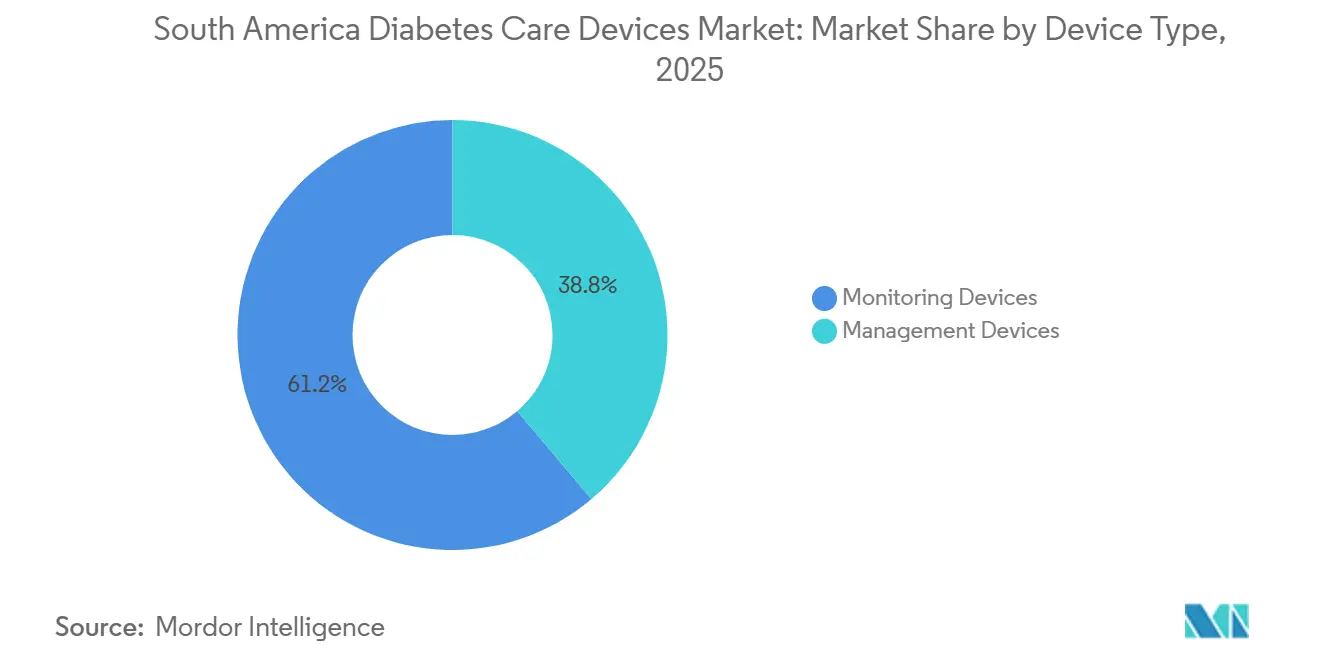
Monitoring Devices Lead While CGM Changes the MixMonitoring devices held 61.24% of the South American diabetes care devices market share in 2025. Self-monitoring blood glucose systems, including meters, strips, and lancets, remain the standard approach within Brazil’s public procurement system and comparable public networks. Their scale comes from large tenders, familiar prescribing patterns, and the need for low-cost consumables. Continuous glucose monitoring is the fastest-growing device subcategory, with a forecasted CAGR of 6.23% through 2031. New sensor products have made CGM easier to use while retaining clinical accuracy. The South American diabetes care devices market size for monitoring, therefore, remains closely linked to basic products, even as sensor use expands in private care.
Management devices include insulin pumps, disposable pens, reusable pen cartridges, syringes, and jet injectors. Disposable pens and reusable cartridges account for most management-device volume because insulin delivery remains widely needed for insulin-treated patients. Novo Nordisk has manufacturing operations in Brazil that support insulin supply, while Sanofi and Eli Lilly maintain insulin delivery portfolios in the region. Pump adoption starts from a smaller base and is concentrated in specialist centers in São Paulo, Buenos Aires, and Santiago.
By Diabetes Type:
Type 2 Volume Supports Wider Device UseType 2 diabetes accounted for 86.33% of demand in 2025 and is projected to grow at a 7.34% CAGR through 2031. This group shapes device volumes in the South American diabetes care devices industry because many patients use strips and meters, while some insulin-treated patients need delivery products. Brazil’s November 2024 recommendation to extend insulin analog coverage under SUS can move more Type 2 patients from oral therapy alone toward insulin delivery use. Screening and diagnosis can therefore increase demand for starter monitoring kits and ongoing supplies.
Type 1 diabetes represents a smaller share of patient volume but creates strong demand for CGM sensors, pumps, and closed-loop systems. Gestational diabetes and other conditions also require monitoring when more intensive glycemic control is needed. Gestational diabetes prevalence reached 12.5% in 2024, creating temporary but clinically important device demand during pregnancy.
By Distribution Channel:
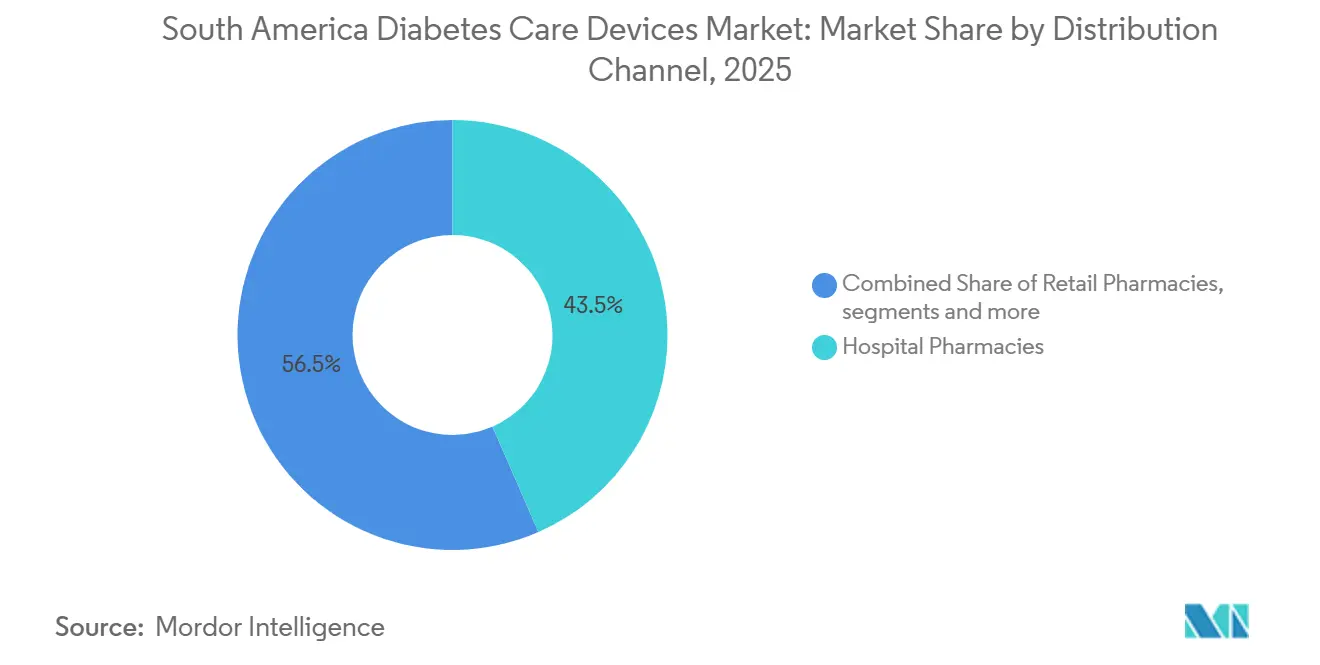
Hospital Pharmacies Lead While Online Pharmacies ExpandHospital pharmacies held 43.45% of revenue in 2025, the largest distribution-channel position in the South American diabetes care devices market. Advanced devices are often dispensed through outpatient pharmacies linked to endocrinology centers and hospital formularies. Procurement committees can affect access for a large group of patients when they decide which products are included. Retail pharmacies serve substantial outpatient demand for meters, strips, lancets, and other recurring supplies. Hospital and retail presence remains important because many patients need professional guidance during initial device selection and use.
Online pharmacies are forecasted to grow at a 6.71% CAGR through 2031, making them the fastest-growing distribution channel. Growth is strongest in Brazil and Argentina, where smartphone access and digital prescriptions help patients obtain recurring supplies. Subscription bundles for strips and lancets can reduce the risk that patients delay refills between appointments. The online channel can support continuity of care, but its reach remains limited by connectivity, payment access, and delivery infrastructure in less urban areas.

By End-User:
Hospitals and Clinics Lead, While Homecare BuildsHospitals and clinics held 45.22% of end-user revenue in 2025. Specialist diabetes and endocrinology centers in São Paulo, Buenos Aires, Bogotá, and Santiago are key settings for the first use of CGM systems and pumps. These providers offer training that helps patients understand device use, alerts, and supply replacement. Many patients later buy consumables through retail or online pharmacies after the first hospital-based onboarding. This creates a handoff between institutional training and community distribution.
Homecare settings are projected to grow at a 5.91% CAGR through 2031. The South American diabetes care devices market benefits when remote programs move regular monitoring from facilities into patients’ homes. Argentina’s OSEP introduced a virtual patient-assistance initiative in November 2025 for 3,000 insulin-using patients using WhatsApp-based glycemic monitoring. Remote programs increase regular use of strips, sensors, lancets, and infusion sets while reducing some avoidable in-person visits. Their wider use depends on staffing, device support, connectivity, and public reimbursement.
Geography Analysis
Brazil Diabetes Care Devices Market
Brazil held 46.37% of the South American diabetes care devices market share in 2025. The country has an estimated 20 million people with diabetes and a regulatory framework overseen by ANVISA. Central procurement through SUS supports substantial volumes of basic monitoring products. Private insurers support higher-cost CGM and pump use, especially in the Southeast. Brazil’s domestic insulin glargine initiative also targeted 20 million vials for SUS patients in 2025, which can support wider insulin treatment access. The country’s combination of scale, public procurement, private care, and local production makes it the main commercial base for the South American diabetes care devices market.
Southern Cone and Colombia Diabetes Care Devices Market
Argentina is the fastest-growing country, with a projected CAGR of 8.15% through 2031. Its diabetes prevalence was 14% in 2024, and specialist services are concentrated in Buenos Aires. Currency volatility continues to constrain the affordability of imported premium products. Chile and Colombia are the third and fourth-largest country markets, supported by concentrated urban medical services. Colombia has specialist concentration in major cities, but its separate device registration requirements add complexity for suppliers.
Western and Southern South America Diabetes Care Devices Market
Peru, Bolivia, and the rest of South America have a less developed demand profile. Peru recorded a diabetes prevalence of 6.4% in 2024, while Bolivia recorded 3.4%, and Paraguay recorded 9.4%. These figures also reflect differences in diagnosis capacity and access to screening. The Inter-American Development Bank’s 2025 gSense grant supports digital diabetes management within Peru’s public primary-care network: lower incomes and limited specialist infrastructure favor affordable meters, strips, and lancets over premium CGM systems. Local distributor partnerships are important because they can reduce the difficulty of direct entry into the South American diabetes care devices market.
Competitive Landscape
The South American diabetes care devices market is moderately concentrated among global companies with established regulatory experience, clinical relationships, and distribution networks. Abbott has a strong CGM position through FreeStyle Libre and has used product features and accessible pricing to broaden sensor adoption. The June 2024 Brazilian launch of FreeStyle Libre 2 Plus introduced minute-by-minute readings, optional alarms, and 15-day wear. F. Hoffmann-La Roche maintains a broad SMBG position through Accu-Chek products. Medtronic remains active in advanced pump systems through MiniMed 780G in private specialist care. These companies benefit from brands that physicians, procurement teams, and trained users already recognize.
Roche and RD Saúde launched the Caretech private-label glucose meter line in June 2025 through Drogasil and Droga Raia stores. The partnership widened access to basic monitoring products and used the pharmacy-chain reach to reinforce retail availability. MedLevensohn and Servier Brazil launched a CGM access program in July 2025 for Sempre Cuidando beneficiaries. These measures show that distribution partnerships and targeted affordability programs are becoming important ways to expand use in the South American diabetes care devices market.
Smaller suppliers can find opportunities in lower-cost SMBG products and differentiated CGM or pump formats. Senseonics offers implantable CGM technology, while Ypsomed provides patch-pump delivery systems designed around different patient preferences. Connected care is also becoming an area of competition because data from sensors can be shared with pumps, mobile applications, and remote-care teams. ANVISA’s software-as-a-medical-device rules under RDC 657/2022 provide a compliance route for platforms that combine device supply, glucose data analysis, and telemedicine services. The South American diabetes care devices market remains led by major multinational suppliers, while price-focused and digitally enabled offerings broaden the range of competitors.
South America Diabetes Care Devices Industry Leaders
-
Abbott Laboratories
-
Medtronic PLC
-
F. Hoffmann-La Roche Ltd.
-
LifeScan Inc.
-
DexCom, Inc.
- *Disclaimer: Major Players sorted in no particular order
South America Diabetes Care Devices Market Companies Covered in this Report
- Abbott Laboratories
- Arkray
- Ascensia Diabetes Care Holdings AG
- B. Braun
- Beckton Dickinson
- Dexcom
- Eli Lilly and Company
- Roche
- Insulet
- I-Sens
- Lifescan
- Medtronic
- Nipro
- Novo Nordisk
- OMRON
- Sanofi
- Senseonics
- Tandem Diabetes Care
- Terumo
- Ypsomed
Recent Industry Developments in South America Diabetes Care Devices Market
- June 2026: TempraMed Technologies signed an exclusive distribution agreement with Mobil Saúde for its temperature-sensitive insulin storage portfolio, including VIVI Cap, in Brazil, one of the world's largest insulin markets, with plans to expand across South America in subsequent phases. The partnership directly addresses cold-chain reliability challenges that affect the efficacy of temperature-sensitive diabetes therapies in the region's diverse climatic conditions.
- July 2025: MedLevensohn and Servier Brazil launched a CGM access program providing Sempre Cuidando patient-support program beneficiaries 99% discounts on the Smart CGM transmitter and 10% on sensors, one of the most aggressive pricing interventions yet by a pharmaceutical company to expand CGM uptake outside purely private-pay channels in Brazil.
- June 2025: F. Hoffmann-La Roche and RD Saúde launched Caretech, the first private-label glucose meter line in South America, across Drogasil and Droga Raia outlets, marking the first instance of Roche associating a diabetes device with a retail pharmacy brand partner in the region, and significantly widening SMBG accessibility for Brazil's approximately 20 million people with diabetes.
South America Diabetes Care Devices Market Report Scope
According to the report’s scope, the South American diabetes care devices market refers to the regional healthcare segment dedicated to medical devices used for monitoring, managing, and treating diabetes. It includes blood glucose monitoring systems, continuous glucose monitors (CGMs), insulin delivery devices such as pens and pumps, and emerging digital health solutions tailored for diabetic care.
The South American diabetes care devices market is segmented into device type, diabetes type, distribution channel, end-user, and country. By device type, the market is segmented into monitoring devices and management devices. The monitoring devices are further segmented into self-monitoring blood glucose (SMBG) devices and continuous glucose monitoring (CGM) devices. The self-monitoring blood glucose (SMBG) devices are further divided into glucometers, test strips, and lancets. The continuous glucose monitoring (CGM) devices are further divided into sensors and durables (receivers & transmitters). The management devices are further segmented into insulin pump devices, insulin disposable pens, insulin cartridges in reusable pens, and insulin syringes & jet injectors. By diabetes type, the market is segmented into type 1 diabetes, type 2 diabetes, and gestational diabetes & others. By distribution channel, the market is segmented into hospital pharmacies, retail pharmacies, online pharmacies, and other distribution channels. By end-user, the market is segmented into hospitals and clinics, homecare settings, and other end-users. By country, the market is segmented into Brazil, Argentina, Colombia, Chile, Peru, and the rest of South America. The report offers values (USD) for all the above segments.
Segmentation Overview
By Device Type
| Monitoring Devices | Self-Monitoring Blood Glucose (SMBG) Devices | Glucometers |
| Test Strips | ||
| Lancets | ||
| Continuous Glucose Monitoring (CGM) Devices | Sensors | |
| Durables (Receivers & Transmitters) | ||
| Management Devices | Insulin Pump Devices | |
| Insulin Disposable Pens | ||
| Insulin Cartridges in Reusable Pens | ||
| Insulin Syringes & Jet Injectors | ||
By Diabetes Type
| Type 1 Diabetes |
| Type 2 Diabetes |
| Gestational Diabetes & Others |
By Distribution Channel
| Hospital Pharmacies |
| Retail Pharmacies |
| Online Pharmacies |
| Other Distribution Channels |
By End-User
| Hospitals and Clinics |
| Homecare Settings |
| Other End-Users |
By Country
| Brazil |
| Argentina |
| Colombia |
| Chile |
| Peru |
| Rest of South America |
| By Device Type | Monitoring Devices | Self-Monitoring Blood Glucose (SMBG) Devices | Glucometers |
| Test Strips | |||
| Lancets | |||
| Continuous Glucose Monitoring (CGM) Devices | Sensors | ||
| Durables (Receivers & Transmitters) | |||
| Management Devices | Insulin Pump Devices | ||
| Insulin Disposable Pens | |||
| Insulin Cartridges in Reusable Pens | |||
| Insulin Syringes & Jet Injectors | |||
| By Diabetes Type | Type 1 Diabetes | ||
| Type 2 Diabetes | |||
| Gestational Diabetes & Others | |||
| By Distribution Channel | Hospital Pharmacies | ||
| Retail Pharmacies | |||
| Online Pharmacies | |||
| Other Distribution Channels | |||
| By End-User | Hospitals and Clinics | ||
| Homecare Settings | |||
| Other End-Users | |||
| By Country | Brazil | ||
| Argentina | |||
| Colombia | |||
| Chile | |||
| Peru | |||
| Rest of South America | |||
Key Questions Answered in the Report
What is the forecast growth rate for the diabetes care devices market in South America?
The South American diabetes care devices market is forecasted to grow at a 5.56% CAGR from 2026 to 2031, from USD 2.43 billion in 2025 to USD 2.55 billion in 2026, reaching USD 3.34 billion by 2031.
Which device category generates the most revenue in South America?
Monitoring devices led with 61.24% of revenue in 2025 because meters, strips, and lancets remain central to public procurement and routine care.
Which country leads diabetes device demand in South America?
Brazil held 46.37% of revenue in 2025, supported by its large diabetes population, SUS procurement, private insurance base, and ANVISA framework.
Which distribution channel is growing fastest for diabetes products?
Online pharmacies are projected to grow at a 6.71% CAGR through 2031 as digital prescriptions, teleconsultations, and recurring supply subscriptions become more common.