
Market Overview
| Study Period | 2020 - 2031 |
|---|---|
| Forecast Data Period | 2026 - 2031 |
| Base Year Market Size (2025) | USD 333.89 Million |
| Market Size (2026) | USD 343.15 Million |
| Market Size (2031) | USD 404.67 Million |
| Growth Rate (2026 - 2031) | 3.35 % |
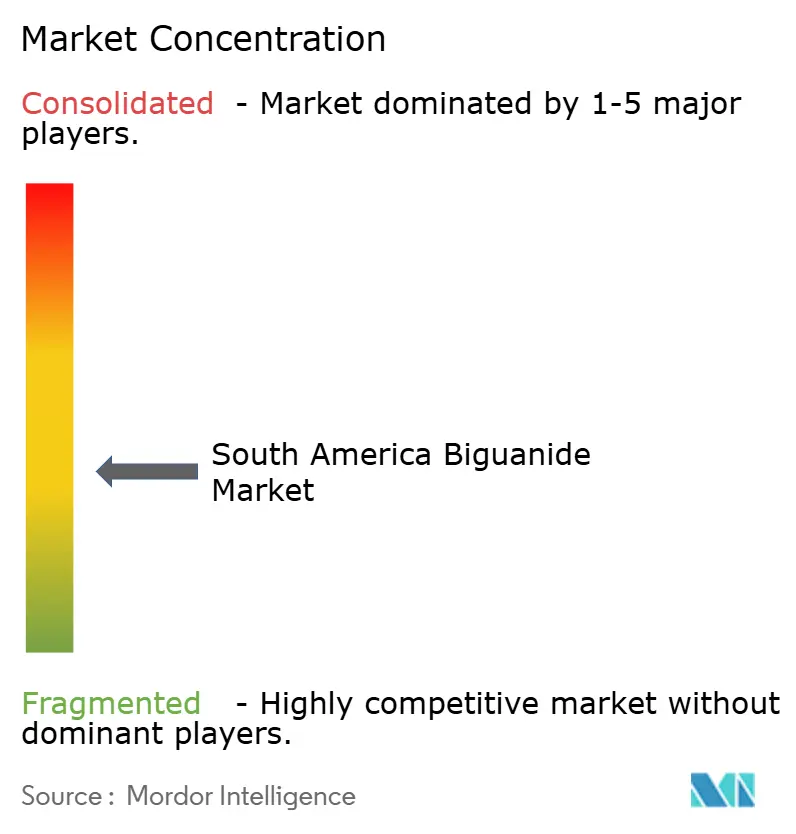
| Market Concentration | Medium |
Major Players *Disclaimer: Major Players sorted in no particular order Image © Mordor Intelligence. Reuse requires attribution under CC BY 4.0. | |
South America Biguanide Market Analysis by Mordor Intelligence
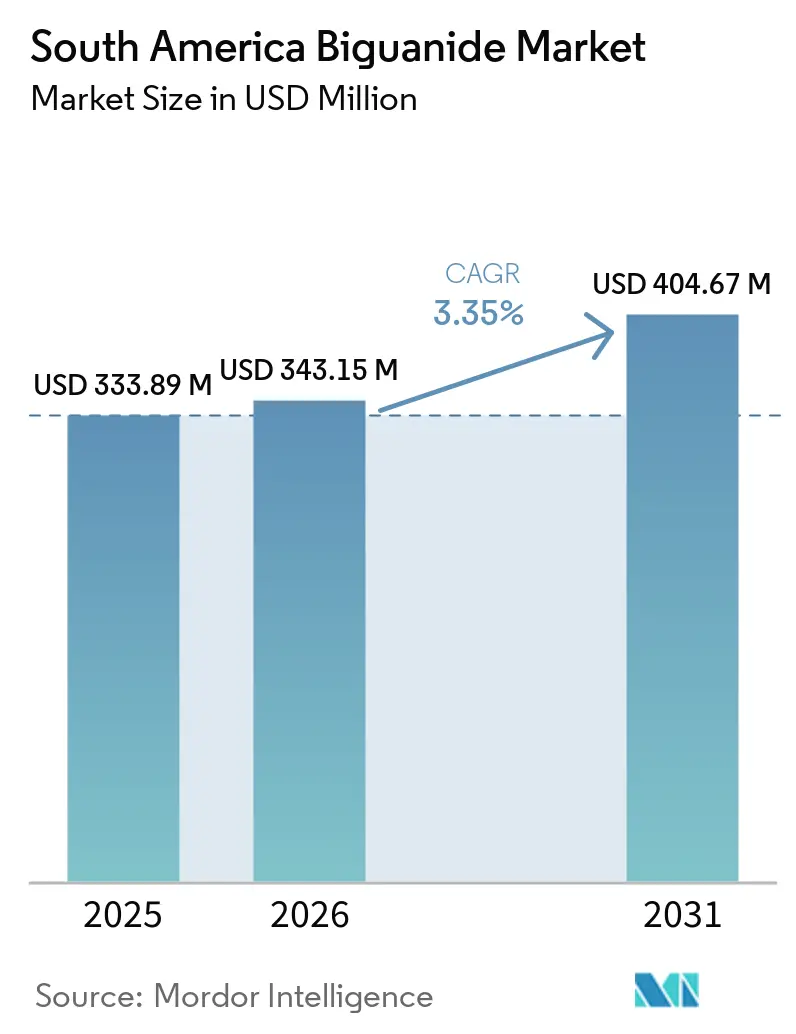
The South America biguanide market is expected to increase from USD 333.89 million in 2025 to USD 343.15 million in 2026 to reach USD 404.67 million by 2031, at a CAGR of 3.35% during the forecast period (2026-2031).
The South American biguanide market is supported by the region’s large diabetes burden and the continuing need for low-cost oral treatment within public health systems. The International Diabetes Federation recorded 35.4 million adults with diabetes in South and Central America in 2024, while 10.7 million adults remained undiagnosed. Public procurement, generic competition, and metformin’s role in treatment guidelines sustain demand across countries with different reimbursement models. The South American biguanide market also benefits as extended-release products and fixed-dose combinations become more available through registered generic products. Newer GLP-1 receptor agonists and SGLT-2 inhibitors create pressure in private care, although their pricing and access requirements limit broad substitution of metformin.
Key Report Takeaways
- By dosage form, immediate-release tablets held 43.22% of the market share in 2025, while extended-release tablets are forecast to grow at a 4.25% CAGR through 2031.
- By formulation type, monotherapy held 52.36% of the market share in 2025, while fixed-dose combinations are expected to grow at a 5.31% CAGR through 2031.
- By indication, Type 2 Diabetes Mellitus held 78.64% of the market share in 2025, while polycystic ovary syndrome is expected to grow at a 4.76% CAGR through 2031.
- By distribution channel, hospital pharmacies held 45.25% of the market share in 2025, while online pharmacies are forecast to grow at a 5.65% CAGR through 2031.
- By country, Brazil held 54.42% of the market share in 2025, while Argentina is projected to grow at a 6.17% CAGR through 2031.
Note: Market size and forecast figures in this report are generated using Mordor Intelligence’s proprietary estimation framework, updated with the latest available data and insights as of January 2026.
Market Trends and Insights
Drivers Impact Analysis of South America Biguanide Market*
| Driver | (~) % Impact on CAGR Forecast | Geographic Relevance | Impact Timeline |
|---|---|---|---|
| High Type 2 Diabetes Prevalence | +1.1% | All South American markets, with the highest absolute burden in Brazil and Colombia | Short term (≤ 2 years) |
| Continued First-Line Use of Metformin | +0.7% | All South American markets | Medium term (2-4 years) |
| Affordable Genericization Across Public Health Systems | +0.5% | Brazil, Colombia, Peru, and Chile | Short term (≤ 2 years) |
| Expanding Metformin Use in PCOS and Gestational Diabetes | +0.4% | Brazil and Argentina | Medium term (2-4 years) |
| Public Tender Cycles and Volume-Based Procurement | +0.3% | Brazil, Colombia, Chile, and Peru | Medium term (2-4 years) |
| Regional Demand for Locally Packaged and Bioequivalent Products | +0.2% | Brazil, Argentina, and Colombia | Long term (≥ 4 years) |
| Source: Mordor Intelligence | |||
High Type 2 Diabetes Prevalence
The South American biguanide market draws its largest treatment base from Type 2 diabetes, which represents most diagnosed and undiagnosed diabetes cases in the region. The IDF reported 35.4 million adults living with diabetes across South and Central America in 2024, with an age-standardized prevalence of 10.1%.[1] It projected prevalence to reach 11.5% by 2050, and it estimated that 30.4% of affected adults were undiagnosed.[2] This undiagnosed group can enter care as screening coverage improves in primary care and community settings. Diabetes-related health expenditure reached USD 81 billion in 2024, which reinforces the case for earlier treatment with affordable therapies. Urban growth, low physical activity, and rising obesity add to the patient base that requires long-term glucose management.
Continued First-Line Use of Metformin
Metformin remains the initial drug treatment in major South American diabetes pathways, which gives the South American biguanide market a durable base of demand. The Asociación Latinoamericana de Diabetes included metformin as initial pharmacotherapy for Type 2 diabetes in its 2025 standards of care.[3] Brazil’s SUS treatment guidance describes metformin as the treatment of choice for monotherapy and recommends extended-release metformin when gastrointestinal effects affect persistence. The guidance matters because public formularies continue to shape medicine use for patients who cannot pay for newer classes. Metformin’s established safety record also allows clinicians to use it across a broad range of early treatment settings. This role creates steady prescription volumes even when specialists select newer medicines for patients with elevated cardiovascular risk.
Affordable Genericization Across Public Health Systems
Genericization widens access to metformin products and supports volume demand in the South American biguanide market. ANVISA granted Eurofarma the first Brazilian generic registration for a dapagliflozin-metformin fixed-dose combination in May 2026. The registration required a minimum 35% price reduction against the reference product under Brazil’s generic medicine framework. State procurement for immediate-release and extended-release tablets has continued to support dispensing volumes in Brazil. Comparable tender systems in Colombia and Peru also make registered generic status important for formulary access. Volume-based procurement and demand for locally packaged, bioequivalent products favor suppliers that can meet quality requirements while supplying consistently at competitive prices.
Expanding Metformin Use in PCOS and Gestational Diabetes
Use beyond Type 2 diabetes broadens the treatment population for the South American biguanide market. A 2024 review of hospital-based studies in Brazil, Mexico, and Chile reported a pooled polycystic ovary syndrome prevalence of 30%, and the Brazilian sample recorded 40%. The 2025 ALEG consensus included metformin in evidence-based regional protocols for polycystic ovary syndrome care. It also identified cost and access as barriers to consistent use in secondary and tertiary care. In Brazil, the MevIP trial is comparing metformin and insulin for gestational diabetes, where the trial protocol cited an incidence range of 5% to 18%. A positive result could support future prescribing guidance and open a distinct care pathway for pregnant patients.
Restraints Impact Analysis of South America Biguanide Market*
| Restraint | (~) % Impact on CAGR Forecast | Geographic Relevance | Impact Timeline |
|---|---|---|---|
| Price Controls and Tender-Driven Margin Compression | -0.6% | Brazil, Chile, Colombia, and Peru | Short term (≤ 2 years) |
| Increasing Competition from GLP-1 Receptor Agonists and SGLT-2 Inhibitors | -0.5% | Brazil and Argentina | Medium term (2-4 years) |
| NDMA and Nitrosamine Compliance Costs | -0.3% | All South American markets, with the highest burden in Brazil and Argentina | Medium term (2-4 years) |
| Currency Volatility and Imported Active Pharmaceutical Ingredient Exposure | -0.4% | Argentina, Colombia, and Peru | Medium term (2-4 years) |
| Source: Mordor Intelligence | |||
Price Controls and Tender-Driven Margin Compression
Tender-led purchasing holds medicine prices low, but it constrains supplier margins in the South American biguanide market. Suppliers must compete on price while maintaining product registration, bioequivalence, and continuous supply standards. This pressure is strongest in Brazil, Chile, Colombia, and Peru, where public purchasing represents a large share of demand. Argentina, Colombia, and Peru also face exposure to imported active pharmaceutical ingredients and foreign exchange movements. These costs can make it difficult for smaller suppliers to maintain pricing commitments across tender cycles. The result is a commercial environment that rewards scale, local packaging capacity, and stable procurement planning.
Increasing Competition from GLP-1 Receptor Agonists and SGLT-2 Inhibitors
Newer antidiabetic medicines can reduce metformin monotherapy use among patients with more complex clinical needs. Argentina’s 2025 SAD guidance prioritized GLP-1 receptor agonists and SGLT-2 inhibitors for high-risk patients regardless of HbA1c targets. These products remain much more expensive than generic metformin, so public formulary use of metformin remains broad. Manufacturers also face recurring work on nitrosamine risk assessment and batch testing. ANVISA’s RDC 677/2022 established requirements for risk assessment and corrective action for active ingredients and finished medicines. The burden is particularly important for extended-release products and can favor suppliers with established quality-control capacity.
*Our forecasts treat driver/restraint impacts as directional, not additive. The impact forecasts reflect baseline growth, mix effects, and variable interactions.
South America Biguanide Market Segment Analysis
By Dosage Form:
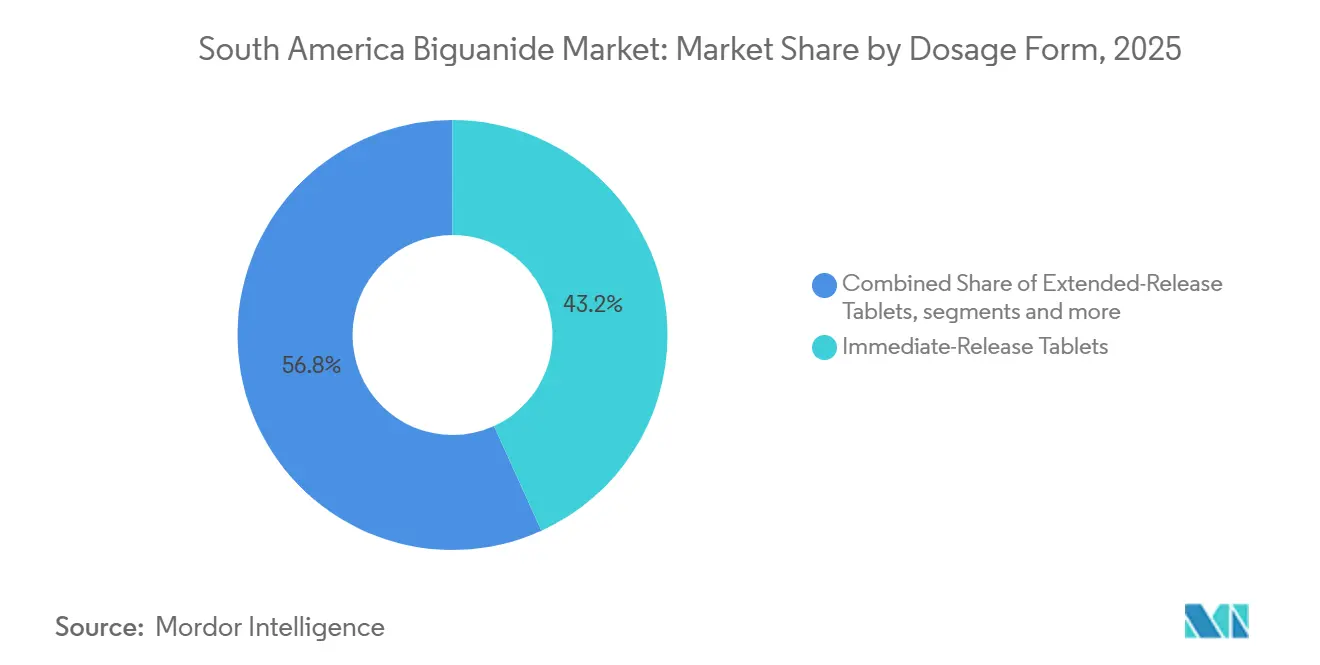
Extended-Release Products Gain GroundImmediate-release tablets held 43.22% of the dosage-form segment in 2025, representing the largest component of the South American biguanide market for dosage forms. Public procurement in Brazil, Colombia, Chile, and Peru supports this format because buyers focus on low-cost registered generic products. Immediate-release tablets are familiar to prescribers and have an established supply base for high-volume public programs. The format remains important where medicine budgets are limited. It therefore provides the volume foundation for manufacturers participating in tenders.
Extended-release tablets are forecast to grow at a 4.25% CAGR through 2031, supported by tolerance benefits and wider generic availability. Brazil’s SUS guidance recommends the extended-release form when gastrointestinal effects affect treatment persistence. A Goiás state procurement record included metformin 850 mg extended-release tablets in the standard medicine list. Extended-release products typically carry unit prices that are 20% to 40% higher than immediate-release equivalents, which supports value where standard tablet prices are under tender pressure. Oral solutions retain a smaller stable role for pediatric and older patients who have difficulty swallowing tablets.

By Formulation Type:
Fixed-Dose Combinations Add New Access PathsMonotherapy held 52.36% of the formulation-type segment in 2025, reflecting broad agreement that metformin is a suitable initial treatment for many people with Type 2 diabetes. This position accounts for the largest formulation contribution to the South American biguanide market. Standalone metformin is simple for public programs to procure and dispense. Its low cost is important in systems that manage large patient populations. Monotherapy will remain the core entry point even as combination treatment becomes more common for selected patients.
Fixed-dose combinations are forecast to expand at a 5.31% CAGR through 2031, the highest rate among formulation types. ANVISA approved Jardiance Duo, combining empagliflozin and metformin hydrochloride, in January 2026, and Eurofarma’s May 2026 generic registration widened the route for lower-cost dapagliflozin-metformin treatment. Single-tablet regimens can reduce pill burden and simplify pharmacy procurement. SAD’s 2025 guidance supports combination therapy from diagnosis for high-risk patients. These products bring the biguanide category closer to the broader oral antidiabetic treatment space.
By Indication:
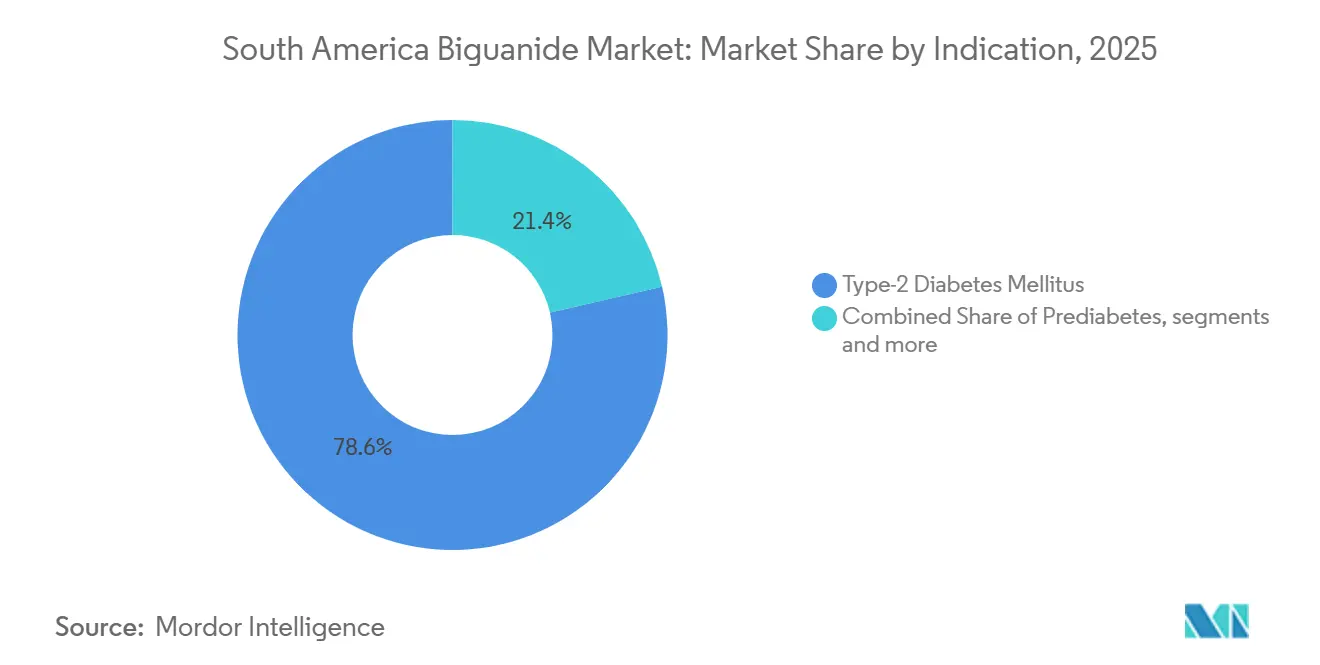
PCOS Extends Demand Beyond Diabetes CareType 2 diabetes mellitus held 78.64% of the indication segment in 2025, which was the largest share in the South American biguanide market size by indication. The result reflects metformin’s continued clinical primacy in routine diabetes management. Public formularies and treatment protocols were designed around this use. Screening of undiagnosed adults can add more patients to this established pathway. This large treatment base gives the category more stability than its smaller emerging indications.
Polycystic ovary syndrome is expected to grow at a 4.76% CAGR through 2031. The 2025 ALEG consensus strengthened the regional basis for using metformin within evidence-based PCOS protocols, and a cited 2024 review found a 30% pooled clinical prevalence across its hospital-based South American samples. Prediabetes and gestational diabetes remain smaller parts of the indication mix. The Brazilian MevIP trial is evaluating metformin against insulin in gestational diabetes. If its primary objective is met, future clinical guidance could create a separate source of demand for pregnant women.
By Distribution Channel:
Digital Dispensing Expands Private AccessHospital pharmacies held 45.25% of the distribution-channel segment in 2025, the largest South American biguanide market share across channels. Their lead reflects SUS tenders in Brazil, EsSalud procurement in Peru, and comparable institutional buying systems. Tender purchasing allows authorities to plan demand and purchase standard products at scale. Hospital pharmacy demand is less exposed to retail channel changes.
Online pharmacies are expected to grow at a 5.65% CAGR through 2031. A survey of 29 retail networks found digital medicine revenue reached BRL 20 billion (~USD 3.61 billion), and online sales represented 18% of Brazilian pharmaceutical retail. Retail pharmacies remain important for private-pay prescriptions in large cities. Digital platforms offer price visibility, electronic prescription integration, and home delivery.
Geography Analysis
Brazil Biguanide Market
Brazil held 54.42% of the South American biguanide market share in 2025 and remains the region’s central commercial geography. Its size reflects population, healthcare infrastructure, pharmaceutical purchasing power, and the scale of SUS coverage. The public system lists metformin in 500 mg and 850 mg formulations, creating consistent demand for registered suppliers. Farmácia Popular further supports patient access to metformin among eligible households. ANVISA’s 2026 decisions on Jardiance Duo and generic dapagliflozin-metformin products increase the availability of combination therapies. Brazil’s digital pharmacy retail also gives manufacturers another route to reach private-pay patients.
Argentina Biguanide Market
Argentina is projected to expand at a 6.17% CAGR from 2026 to 2031, the fastest rate in the South American biguanide market. Growth begins from a smaller base and is linked to recovering pharmaceutical spending volumes as macroeconomic conditions stabilize. The country recorded USD 2.5 billion in pharmaceutical imports during 2024, which shows its continued dependence on imported inputs. This dependence creates foreign exchange and supply-planning pressures for products using imported active ingredients. SAD’s 2025 guidance gives GLP-1 and SGLT-2 medicines a greater role for high-risk patients. Affordability constraints in public care nevertheless preserve metformin as the usual starting therapy for many newly diagnosed patients.
Broader South American Markets
Chile has a mature and stable environment where GES supports pharmacological treatment for Type 2 diabetes, including metformin. The country’s bioequivalence requirements narrow competition to suppliers that can meet technical registration standards. Colombia is the third-largest geographic contributor, supported by the SGSSS and procurement from INVIMA-registered suppliers. Combination treatments have room to grow in Colombia as treatment pathways add medicines when metformin alone does not achieve targets. Peru and the rest of South America account for smaller shares, with public procurement and fragmented private networks shaping local access. Ecuador and Uruguay have more developed pharmaceutical systems than Bolivia and Paraguay, where distribution and affordability gaps constrain generic metformin access in rural areas.
Competitive Landscape
The South American biguanide market is moderately fragmented because branded and generic suppliers compete through different routes. Merck KGaA’s Glifage XR is a major branded reference product in Brazil. Brazilian domestic generic manufacturers compete with Indian exporters such as Aurobindo Pharma, Lupin, and Sun Pharmaceutical Industries. These suppliers use local distribution, manufacturing, or active ingredient integration to compete for public contracts. Brazil’s large share of regional demand gives established in-country operations an advantage in registration, supply planning, and tender participation. The South American biguanide market, therefore, has meaningful barriers for new suppliers without local regulatory and commercial capabilities.
Fixed-dose combinations are becoming an important area of competition. Eurofarma received the first Brazilian generic registration for a dapagliflozin-metformin combination in May 2026. This move allows domestic manufacturers to compete in combination products rather than only in standard metformin tablets. Boehringer Ingelheim and Eli Lilly also gained ANVISA approval for Jardiance Duo in January 2026. These actions show that both branded and generic companies are expanding their offerings around metformin combinations. Product breadth can improve a supplier’s position when hospital pharmacies prefer fewer vendors with several registered medicines.
Manufacturers are also diversifying into GLP-1 products as semaglutide biosimilar opportunities emerge in Brazil. EMS, Hypera, Eurofarma, and Biomm confirmed filings or manufacturing plans for biosimilar semaglutide products in January 2026. This response allows established diabetes suppliers to participate in a faster-growing therapeutic area that also competes with biguanides. ANVISA’s nitrosamine framework favors companies with reliable analytical testing and quality systems. Smaller suppliers can face difficulty meeting these demands while bidding at low tender prices. Opportunities remain for suppliers that offer bioequivalent extended-release metformin at competitive prices in Colombia, Peru, and Chile.
South America Biguanide Industry Leaders
-
Merck KGaA
-
Teva Pharmaceutical Industries Ltd.
-
Sanofi
-
Dr. Reddy’s Laboratories Limited
-
Eurofarma Laboratórios S.A.
- *Disclaimer: Major Players sorted in no particular order
South America Biguanide Market Companies Covered in this Report
- Ache Laboratorios Farmaceuticos S.A.
- Apotex
- Aurobindo Pharma
- Boehringer Ingelheim
- Bristol-Myers Squibb
- Dr. Reddy’s Laboratories
- EMS S.A.
- Eurofarma Laboratorios S.A.
- GlaxoSmithKline
- Hypera S.A.
- Laboratorio Teuto Brasileiro S.A.
- Laboratorios Bago S.A.
- Lupin
- Merck
- Roemmers S.A.
- Sandoz Group AG
- Sanofi
- Sun Pharmaceuticals Industries
- Takeda Pharmaceuticals
- Teva Pharmaceutical Industries
Recent Industry Developments in South America Biguanide Market
- May 2026: ANVISA granted Eurofarma the first generic registration for the dapagliflozin + metformin fixed-dose combination in Brazil under Resolution RE 2.105/2026. The registration mandates a minimum 35% price reduction versus AstraZeneca's Xigduo XR reference product under Brazil's Generic Law 9.787/1999, opening generic FDC competition in the dapagliflozin-metformin category for the first time and significantly expanding patient access to dual-mechanism T2DM therapy.
- March 2026: EMS acquired Medley, Sanofi's Brazilian generics unit, for approximately BRL 3.2 billion (approximately USD 560 million), broadening its generics portfolio across multiple therapeutic classes, including metformin formulations formerly under the Medley brand. The transaction is subject to CADE (Conselho Administrativo de Defesa Econômica) approval and, if cleared, would make EMS the largest domestic pharmaceutical company in Brazil by generics revenue.
- January 2026: ANVISA approved Jardiance Duo (empagliflozin + metformin hydrochloride) for T2DM, developed by Boehringer Ingelheim and Eli Lilly, in dosages of 5 mg/850 mg, 12.5 mg/850 mg, and 12.5 mg/1,000 mg. The product awaited CMED price analysis before commercial launch, representing the highest-profile branded FDC entry into Brazil's biguanide-combination market in 2026.
South America Biguanide Market Report Scope
According to the report’s scope, the South American biguanide market refers to the regional pharmaceutical segment focused on biguanide‑class oral antidiabetic drugs, primarily metformin, which is widely recognized as the standard first‑line therapy for type 2 diabetes.
The South American biguanide market is segmented into dosage form, formulation type, indication, distribution channel, and geography. By dosage form, the market is segmented into immediate-release tablets, extended-release tablets, and oral solutions. By formulation type, the market is segmented into monotherapy and fixed-dose combinations (FDCs). By indication, the market is segmented into type-2 diabetes mellitus, prediabetes, polycystic ovary syndrome, and gestational diabetes mellitus. By distribution channel, the market is segmented into hospital pharmacies, retail pharmacies, online pharmacies, and other distribution channels. By geography, the market is segmented into Brazil, Argentina, Colombia, Chile, Peru, and the rest of South America. The report offers values (USD) for all the above segments.
Segmentation Overview
By Dosage Form
| Immediate-Release Tablets |
| Extended-Release Tablets |
| Oral Solutions |
By Formulation Type
| Monotherapy |
| Fixed-Dose Combinations (FDCs) |
By Indication
| Type-2 Diabetes Mellitus |
| Prediabetes |
| Polycystic Ovary Syndrome |
| Gestational Diabetes Mellitus |
By Distribution Channel
| Hospital Pharmacies |
| Retail Pharmacies |
| Online Pharmacies |
| Other Distribution Channels |
By Country
| Brazil |
| Argentina |
| Colombia |
| Chile |
| Peru |
| Rest of South America |
| By Dosage Form | Immediate-Release Tablets |
| Extended-Release Tablets | |
| Oral Solutions | |
| By Formulation Type | Monotherapy |
| Fixed-Dose Combinations (FDCs) | |
| By Indication | Type-2 Diabetes Mellitus |
| Prediabetes | |
| Polycystic Ovary Syndrome | |
| Gestational Diabetes Mellitus | |
| By Distribution Channel | Hospital Pharmacies |
| Retail Pharmacies | |
| Online Pharmacies | |
| Other Distribution Channels | |
| By Country | Brazil |
| Argentina | |
| Colombia | |
| Chile | |
| Peru | |
| Rest of South America |
Key Questions Answered in the Report
What is the South American biguanide market size?
The South American biguanide market is expected to grow from USD 333.89 million to USD 343.15 million in 2026 and is forecast to reach USD 404.67 million by 2031, at 3.35% CAGR.
What is driving demand for biguanides in South America?
High diabetes prevalence, public procurement, and generic access support demand.
Which formulation is growing fastest?
Fixed-dose combinations are projected to grow at a 5.31% CAGR through 2031 as generic combination products enter Brazil.
Which country has the greatest regional demand?
Brazil accounted for 54.42% of the regional value in 2025, supported by SUS and other public access programs.