
Market Overview
| Study Period | 2020 - 2031 |
|---|---|
| Forecast Data Period | 2026 - 2031 |
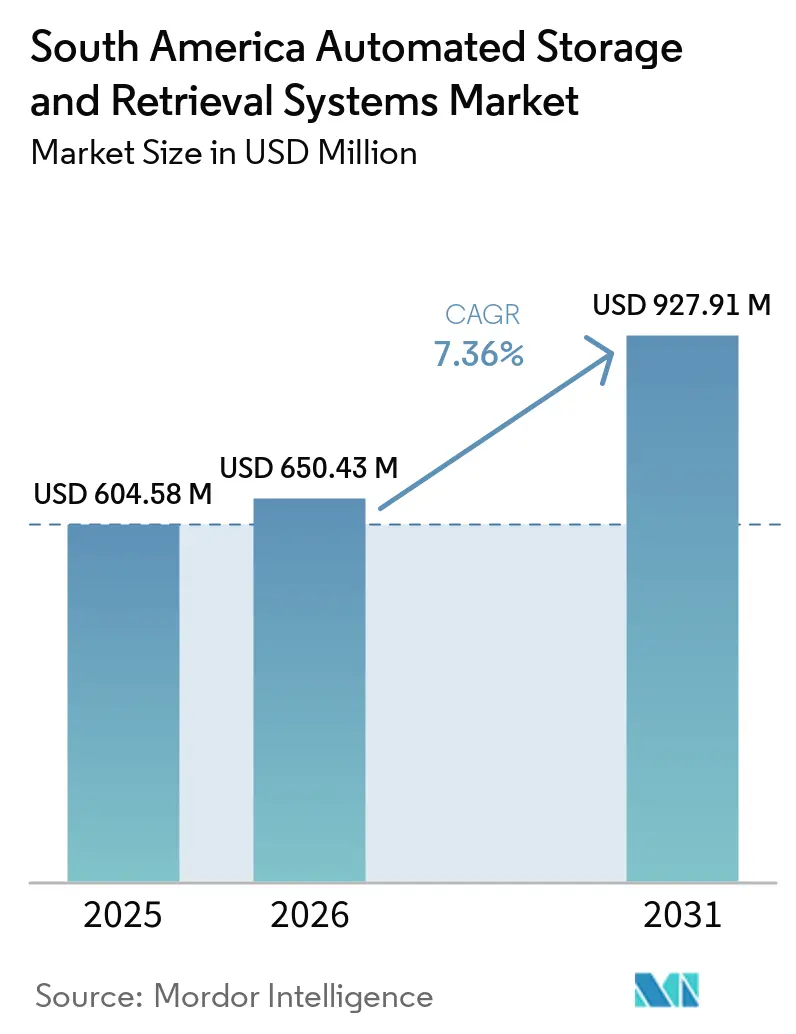
| Base Year Market Size (2025) | USD 604.58 Million |
| Market Size (2026) | USD 650.43 Million |
| Market Size (2031) | USD 927.91 Million |
| Growth Rate (2026 - 2031) | 7.36 % |
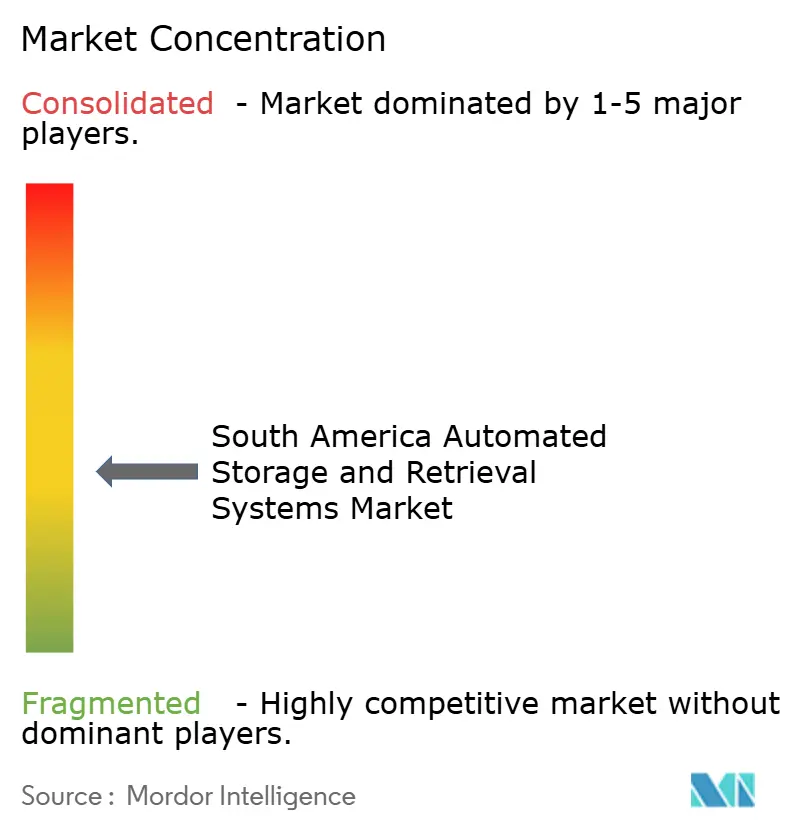
| Market Concentration | Medium |
Major Players *Disclaimer: Major Players sorted in no particular order Image © Mordor Intelligence. Reuse requires attribution under CC BY 4.0. | |
South America Automated Storage and Retrieval Systems Market Analysis by Mordor Intelligence
The South America automated storage and retrieval systems market size was valued at USD 604.58 million in 2025 and estimated to grow from USD 650.43 million in 2026 to reach USD 927.91 million by 2031, at a CAGR of 7.36% during the forecast period (2026-2031). The South America automated storage and retrieval systems market is supported by tighter logistics capacity in major cities, a smaller pool of warehouse workers, and faster fulfillment requirements. Greenfield projects and retrofit programs address different buyer needs, since new facilities can incorporate automation in their original design while established sites need systems that work around existing operations. Food exporters and pharmaceutical distributors are also placing more value on traceability and temperature control, which widens the group of potential buyers. The South America automated storage and retrieval systems market offers opportunities for providers that can combine equipment, software, integration, and local service. Imported equipment costs and exchange-rate shifts remain important factors in project timing and financing decisions.
Key Report Takeaways
- By product type, Fixed-Aisle Crane Systems held 29.34% of the South America automated storage and retrieval systems market share in 2025, while Shuttle-Based Systems are projected to expand at a 7.87% CAGR through 2031.
- By load type, Unit Loads held 33.28% of revenue in 2025, while Mini Loads are projected to expand at a 7.94% CAGR from 2026 to 2031.
- By application, Storage and Buffering accounted for 31.62% of the South America automated storage and retrieval systems market size in 2025, while Goods-to-Person Order Picking is projected to grow at a 8.38% CAGR through 2031.
- By end-user industry, Automotive accounted for 21.73% of revenue in 2025, while E-commerce and Retail are projected to expand at a 8.16% CAGR through 2031.
- By geography, Brazil accounted for 46.82% of regional revenue in 2025, while Colombia is projected to grow at a 8.27% CAGR through 2031.
Note: Market size and forecast figures in this report are generated using Mordor Intelligence’s proprietary estimation framework, updated with the latest available data and insights as of January 2026.
Market Trends and Insights
Drivers Impact Analysis of South America Automated Storage and Retrieval Systems Market*
| Driver | (~) % Impact on CAGR Forecast | Geographic Relevance | Impact Timeline |
|---|---|---|---|
| E-commerce Fulfillment Density Requirements | +2.2% | Brazil, Colombia, Chile | Short term (≤ 2 years) |
| Warehouse Labor Scarcity and Wage Inflation | +1.8% | Brazil, Argentina | Short term (≤ 2 years) |
| Manufacturing and Distribution Network Modernization | +1.4% | Brazil, Argentina, Chile | Medium term (2-4 years) |
| Cold-Chain and Temperature-Controlled Storage Expansion | +1.1% | Brazil, Chile, Rest of South America | Medium term (2-4 years) |
| High-Density Storage in Land-Constrained Logistics Nodes | +0.8% | Brazil, Colombia | Medium term (2-4 years) |
| Localized South American Integration and Service Capability | +0.5% | Regional | Long term (≥ 4 years) |
| Source: Mordor Intelligence | |||
E-commerce Fulfillment Density Requirements
E-commerce has raised the throughput requirements for fulfillment centers across the South America automated storage and retrieval systems market. Mercado Libre added 125 automated sorting robots at its Cajamar facility in September 2025, with the capacity to process 105,000 items a day within a 670 m² operating area. The installation reduced order preparation time by 1 hour and extended same-day delivery cutoffs in served cities by 1 hour. Walmart Chile announced a USD 200 million automation program in July 2025, covering more than 1,400 autonomous robots, 30,000 m² of automated space, and processing capacity of 310,000 boxes a day.[1] As online assortments expand and delivery windows narrow, goods-to-person configurations are becoming more relevant for high-volume fulfillment. This trend favors high-density retrieval systems, in which facilities need to process more orders within limited floor space.
Warehouse Labor Scarcity and Wage Inflation
Warehouse labor constraints are changing the investment case for the South America automated storage and retrieval systems market. Operators increasingly view automation as a way to maintain service levels when hiring and retention are difficult. Logistics wage growth in Brazil outpaced headline inflation between 2022 and 2025, while construction and agribusiness also competed for workers. This environment shortened the expected payback period in high-throughput Brazilian sites from the former 8-12-year range to 5-7 years. Modular systems and operating-lease models could make automation more accessible to mid-sized operators. Providers with entry-level systems and reliable after-sales support can therefore address buyers who had previously been excluded by conventional project-scale requirements.
Manufacturing and Distribution Network Modernization
Manufacturing modernization is expanding the South America automated storage and retrieval systems market beyond automotive assembly. Food processing, pharmaceutical production, and consumer goods operations need different retrieval patterns and storage capacities. Ypê commissioned an automated distribution center in Amparo, São Paulo, with 77 autonomous robots, 50,000 pallet positions, and the capacity to handle 250 trucks each day. The facility represented an investment of BRL 300 million (USD 51.4 million) using the stated 2025 annual average exchange rate. Production-linked warehouses continue to require high unit-load capacity and accurate sequencing, which sustains demand for crane systems and pallet shuttles. Traceability needs among food and pharmaceutical exporters also encourage investments in warehouse systems capable of consistently recording inventory movements.
Cold-Chain and Temperature-Controlled Storage Expansion
Cold-chain infrastructure provides a separate source of demand for the South America automated storage and retrieval systems market. Automated cold stores require insulated structures, equipment rated for low temperatures, and energy management systems, which increases their value relative to ambient facilities. Emergent Cold LatAm opened an automated food cold-storage facility in Olivo, Maipú, Santiago, following a significant investment, with substantial pallet storage capacity. The site received EDGE Advanced certification, which requires substantial reductions in energy and water consumption. Bem Brasil installed multiple Mecalux automated clad-rack warehouses at its Perdizes plant, using Pallet Shuttle stacker cranes in sub-zero conditions across substantial pallet storage capacity. Food exports and pharmaceutical temperature-control requirements can keep this demand stream active even if retail automation budgets slow.
Restraints Impact Analysis of South America Automated Storage and Retrieval Systems Market*
| Restraint | (~) % Impact on CAGR Forecast | Geographic Relevance | Impact Timeline |
|---|---|---|---|
| High Upfront Investment and Extended Payback | -2.5% | Regional, most acute in Argentina and Brazil | Medium term (2-4 years) |
| Skilled Automation Labor Shortage | -1.6% | Regional | Medium term (2-4 years) |
| Currency Volatility and Imported-Equipment Exposure | -1.2% | Argentina, Brazil | Short term (≤ 2 years) |
| Brownfield Reliability, Power Quality, and Interoperability Risk | -0.8% | Brazil, Argentina | Long term (≥ 4 years) |
| Source: Mordor Intelligence | |||
High Upfront Investment and Extended Payback
High capital requirements remain a major restraint in the South America automated storage and retrieval systems market. Mid-sized mini-load systems can require substantial investment in equipment and integration before civil works begin. Financing conditions can extend payback periods, particularly where interest rates and equipment lending costs are high. Imported equipment also exposes leasing arrangements to the same currency risks that affect direct purchases. Older warehouse management or enterprise systems can materially increase project costs when they cannot connect directly with warehouse control software. Long-duration credit lines for logistics modernization can help, though larger projects remain the primary recipients of such financing.
Skilled Automation Labor Shortage
The availability of technical workers can limit the pace of deployment across the South America automated storage and retrieval systems market. Facilities need personnel who can program, maintain, and optimize warehouse control systems, robotic shuttles, and cranes. The gap is particularly visible where training programs have not kept pace with automation investment. Integrators reported extended stabilization periods after commissioning, during which throughput can remain below design capacity. Buyers increasingly evaluate field service and remote monitoring alongside the initial equipment price. Vendors with local technicians and robust training programs can reduce the operational risk for first-time automation users.
*Our forecasts treat driver/restraint impacts as directional, not additive. The impact forecasts reflect baseline growth, mix effects, and variable interactions.
South America Automated Storage and Retrieval Systems Market Segment Analysis
By Product Type:
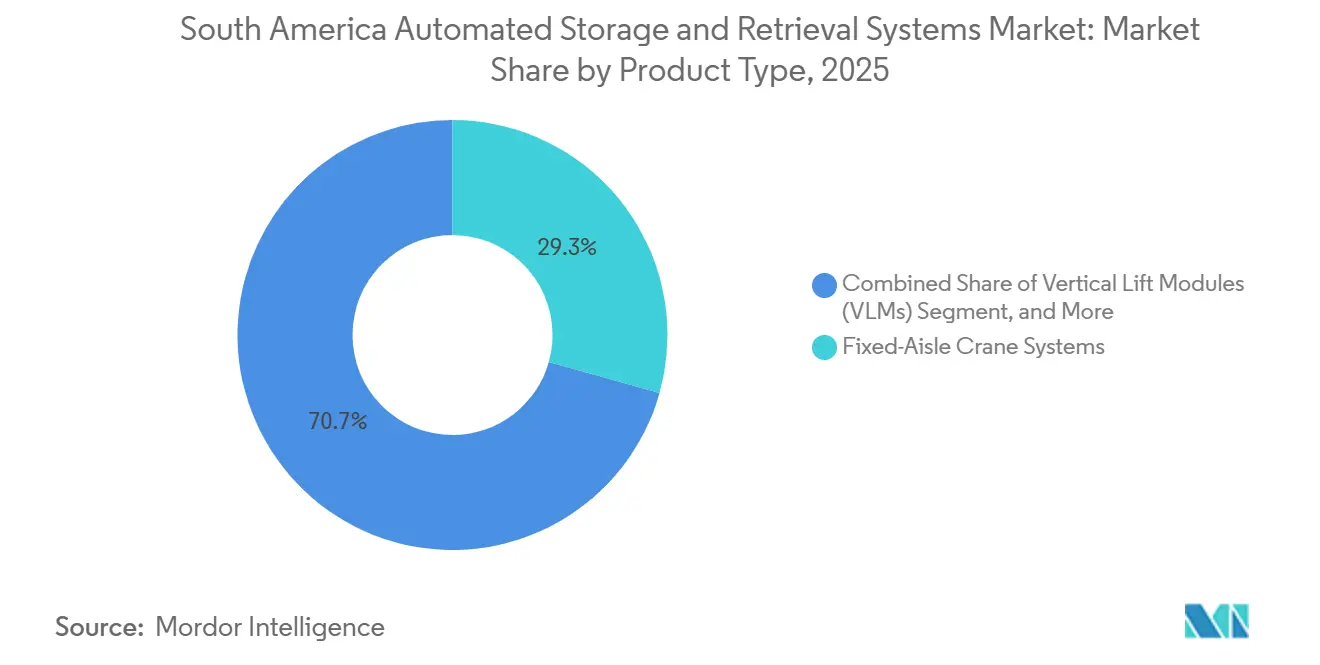
Crane Systems Retain A Core Role While Shuttle Systems Grow FasterShuttle-Based Systems are projected to grow at a 7.87% CAGR through 2031, the fastest rate among product formats. Their modular and multi-depth designs suit facilities with varied stock keeping units and high order volumes. The South America automated storage and retrieval systems market size is driven by e-commerce and third-party logistics sites that require adaptable storage layouts. Fixed-Aisle Crane Systems held 29.34% of product revenue in 2025. The segment continues to serve automotive sequencing and high-bay food manufacturing, where large pallet loads and vertical storage are central operating requirements. These facilities often use storage heights of 20-40 m, which makes crane-based architectures practical for large industrial distribution sites.
Havan allocated BRL 150 million (USD 25.7 million) using the stated 2025 annual average exchange rate to a new stacker crane in its Barra Velha distribution center expansion. The project forms part of a BRL 250 million (USD 42.8 million) investment, based on the stated 2025 annual average exchange rate, and is planned to increase the facility's built area to 250,000 m². Vertical Lift Modules and Carousel Modules remain relevant for point-of-use picking in pharmaceutical, electronics, and spare-parts operations. Cube-based robotic storage is still at an early stage in the region, but it is gaining attention in fashion and pharmaceutical fulfillment. Stara opened an agricultural-parts distribution center with an AutoStore system in Goiás during June 2026, showing that these formats are moving into agribusiness supply chains. The South America automated storage and retrieval systems industry can therefore retain demand for cranes while expanding the use of modular robotic systems.

By Load Type:
Unit Loads Lead Industrial Operations While Mini Loads Support Faster PickingUnit Loads accounted for 33.28% of revenue in 2025, representing the largest share of the South America automated storage and retrieval systems market by load type. Manufacturing and food distribution commonly move pallets from receiving to storage and then to dispatch. Pallet-level automation is especially useful in cold storage, where manual handling at temperatures below -20 °C poses operational challenges. Mini Loads are projected to grow at a 7.94% CAGR from 2026 to 2031. This format supports carton and tote retrieval for e-commerce operations that carry broad product assortments. It also helps operators improve storage accuracy and shorten picking cycles without relying on full-pallet movements.
Pallet Load Shuttles are increasingly used in food and beverage facilities where rapid pallet rotation supports continuous production lines. Mid Loads support automotive suppliers that need sub-pallet component sequencing for assembly operations. Totes, Cartons, and Others serve pharmaceutical distributors with high-mix, low-volume requirements. Hai Robotics installed its HaiPick System 3 solution at RD Saúde's Viana distribution center, which has more than 62,000 double-deep storage locations.[2] The design capacity was 1,140 totes per hour for pharmacy replenishment, which shows how tote automation can support large distribution networks.
By Application:
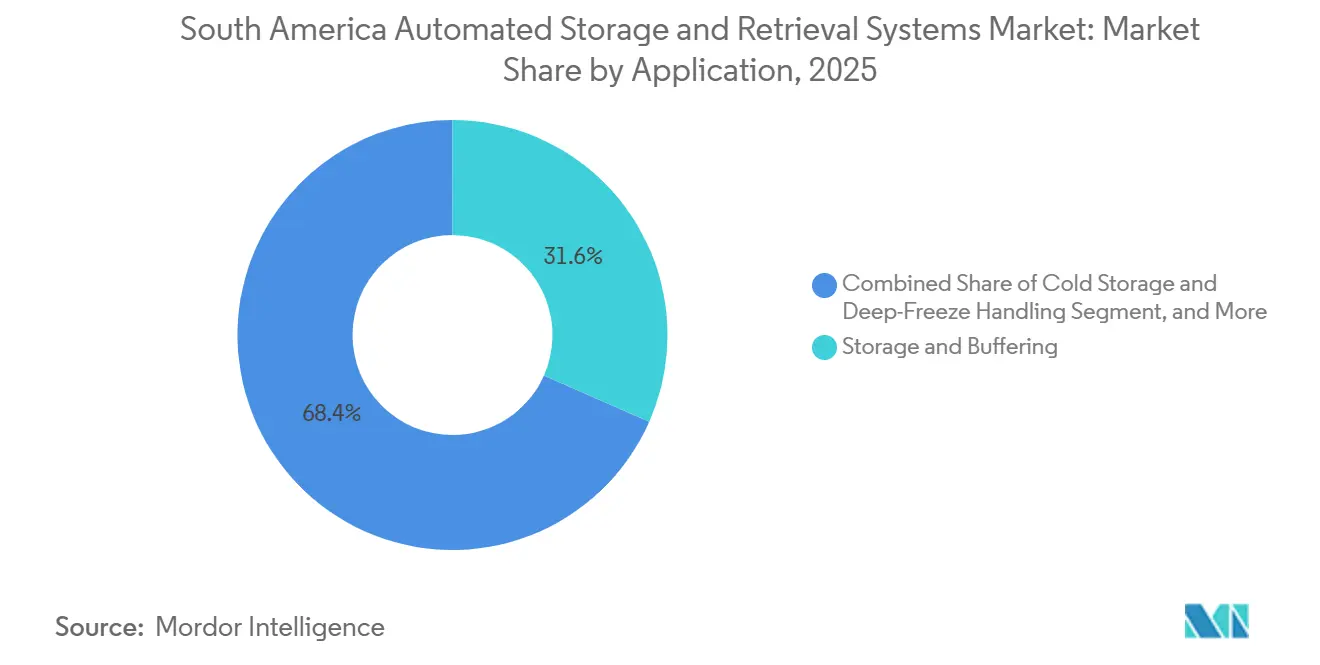
Order Picking Gains Importance Alongside Storage and BufferingStorage and Buffering accounted for 31.62% of application revenue in 2025, the leading application within the South America automated storage and retrieval systems market. Much of the installed base was designed to receive inbound pallets or hold production output. Goods-to-Person Order Picking is projected to grow at an 8.38% CAGR through 2031. Pharmaceutical distributors and online retailers are adopting this approach to reduce walking time and increase order throughput. The application uses automated systems to bring inventory to workers rather than requiring workers to travel through storage aisles. It is increasingly suited to operations where service levels depend on frequent, accurate order fulfillment.
RD Saúde's Viana site deployed robots for high-bay case handling and companion autonomous mobile robot operations. The system was designed to deliver high picking accuracy and throughput. Kitting and Sequencing remain important in automotive supply chains, where line-side component delivery must meet fixed cycle times. Cold Storage and Deep-Freeze Handling carries a premium because systems must operate reliably in low-temperature environments. Copacol operated stacker cranes across multiple corridors in a deep-freeze facility, supporting the daily receipt and dispatch of meat products. Assembly and Production Support is also gaining relevance as manufacturers use just-in-time processes that require sequenced component delivery.
By End-User Industry:
Automotive Holds the Largest Share While E-commerce And Retail Grow FasterAutomotive accounted for 21.73% of end-user revenue in 2025, giving it the largest share of the South America automated storage and retrieval systems market by end-user industry. Automotive plants need frequent, predictable part retrieval to support just-in-time production. The segment is expanding from traditional body-shop storage to trim-and-finish sequencing. Shuttle systems can support shorter retrieval cycles and help reduce line-side inventories. E-commerce and Retail is projected to grow at an 8.16% CAGR through 2031. Regional online platforms are adding goods-to-person capacity as order volumes and item ranges increase.
Food and Beverages remain a major source of demand because producers require cold storage and first-in, first-out inventory control. Bem Brasil's recent installation provided substantial pallet capacity and supported higher production and revenue over the following year. Third-party logistics providers are also developing multi-client facilities that allow smaller sellers to use automated fulfillment without owning a dedicated site. Pharmaceutical distribution requires accurate batch and package tracking, which increases the importance of integrated warehouse management systems. The South America automated storage and retrieval systems market benefits when this service model reduces the initial investment required from mid-sized customers. Compliance and fulfillment needs are likely to keep retail, logistics, and pharmaceutical applications active alongside established industrial demand.
Geography Analysis
Brazil Automated Storage and Retrieval Systems Market
Brazil held 46.82% of the South America automated storage and retrieval systems market share in 2025, making it the region's largest national market. São Paulo's logistics clusters support investment in crane, shuttle, and cube-based systems. Demand is spreading into taller, denser facilities in cities such as Cajamar, Campinas, and Uberlândia. It is also moving into cold-chain and pharmaceutical uses where traceability and temperature control are operating requirements. Mercado Libre's Cajamar project added 125 sorting robots in September 2025, providing capacity for 105,000 items per day.
South America Automated Storage and Retrieval Systems Market
Argentina, Chile, and Colombia form a second group of national markets, each with a different demand base. Chile has developed cold-chain automation around export-oriented food logistics. Emergent Cold LatAm's Maipú facility added 33,000 pallet positions in March 2026 after a USD 35 million investment. Walmart Chile's planned USD 200 million distribution center automation program also highlights retail's role in the country. Argentina's demand is anchored in food manufacturing, while Colombia is projected to record the region's fastest CAGR at 8.27% through 2031.
The Rest of South America includes Ecuador, Peru, Uruguay, Paraguay, and Bolivia, and remains at an earlier stage of adoption. Export-oriented food processors and pharmaceutical distributors are often the first buyers because their compliance and throughput needs can justify automated operations. Ecuador's Puerto Bolívar was nearing completion of a USD 30 million refrigerated, port-side warehouse during 2026. Peru has seen early projects in pharmaceutical distribution and retail linked to the Callao port complex and growing online sales. Project values in these markets have generally remained below USD 10 million. The South America automated storage and retrieval systems market could broaden as logistics operators establish more modern warehouse clusters outside the largest economies.
Competitive Landscape
The South America automated storage and retrieval systems market is moderately fragmented among system integrators. KNAPP, SSI Schaefer, and Kardex have strong positions in large projects due to regional service coverage and established references. Local specialists, including Crosetto Ingeniería, serve mid-sized projects and complex retrofits. Competition is shaped by the ability to integrate equipment with warehouse software and provide continuing technical support. KNAPP Sudamérica operates from São José dos Pinhais, Paraná, and serves 5 South American countries. Its regional presence gives it direct access to local project requirements.
KNAPP presented its AeroBot autonomous storage and retrieval system in São Paulo during August 2026 and identified Drogaria Araujo as the first South American deployment.[3] The system can move through floors and rack structures without fixed-track infrastructure. Hai Robotics gained a large pharmaceutical reference through its RD Saúde deployment in Brazil. Asian suppliers are becoming more visible in pharmaceutical and e-commerce projects where cube and shuttle designs are gaining use. Their ability to work with credible local integration partners is important when customers evaluate complex projects.
Daifuku acquired German conveyor and automotive painting-system manufacturer Eisenmann in April 2026, extending its automotive supply-chain capabilities. Providers are also seeking opportunities in defense stores, airport baggage handling, government operations, and agricultural spare-parts distribution. Preconfigured warehouse management and automation combinations can be valuable for pharmaceutical distributors that need traceability functions. Food exporters may also value systems that simplify inventory control and temperature-integrity records. The South America automated storage and retrieval systems market industry remains open to both global suppliers and local specialists because project needs vary by facility, sector, and country.
South America Automated Storage and Retrieval Systems Industry Leaders
-
Daifuku Co., Ltd.
-
SSI SCHAEFER GMBH & CO KG
-
Murata Machinery, Ltd.
-
Kardex Holding AG
-
KNAPP AG
- *Disclaimer: Major Players sorted in no particular order
South America Automated Storage and Retrieval Systems Market Companies Covered in this Report
- Daifuku Co., Ltd.
- SSI SCHAEFER GMBH & CO KG
- Murata Machinery, Ltd.
- Kardex Holding AG
- KNAPP AG
- TGW Logistics Group GmbH
- Mecalux, S.A.
- System Logistics S.p.A.
- Ferretto Group S.p.A.
- Modula S.p.A.
- Hänel GmbH & Co. KG
- AutoStore Holdings Ltd.
- Exotec SAS
- Hai Robotics Co., Ltd.
- HWArobotics Co., Ltd.
- Geekplus Co., Ltd.
- BEUMER Group GmbH & Co. KG
- Swisslog Holding AG
- Vanderlande Industries B.V.
Recent Industry Developments in South America Automated Storage and Retrieval Systems Market
- August 2026: KNAPP Sudamérica presented its AeroBot autonomous storage-and-retrieval robot system at ILOS in São Paulo on August 19, 2026, revealing the first South American deployment for Brazilian pharmacy chain Drogaria Araujo. The AeroBot navigates floors and rack structures autonomously and accesses storage locations without fixed-track infrastructure.
- March 2026: Emergent Cold LatAm inaugurated an automated food cold-storage facility at Olivo in Maipú, Santiago, Chile, after a USD 35 million investment expanded capacity to 33,000 pallet positions. The facility received EDGE Advanced certification and has a stated goal of achieving EDGE Zero Carbon certification.
- August 2025: Bem Brasil completed 2 automated clad-rack warehouses from Mecalux at its Perdizes, Minas Gerais, plant. The Pallet Shuttle system operated at -25 °C across 66,000 pallet positions and supported a 10% production increase and a 30% revenue increase in the following 12 months.
- July 2025: Walmart Chile announced a USD 200 million investment to automate its Lo Aguirre distribution center in Santiago. The project will deploy more than 1,400 autonomous robots and goods-to-person technology across 30,000 m² of automated space, with a target of processing 310,000 boxes each day.
South America Automated Storage and Retrieval Systems Market Report Scope
The South America automated storage and retrieval systems market covers automated, computer-controlled systems that store, retrieve, and manage materials within warehouses, distribution centers, and manufacturing facilities.
The South America Automated Storage and Retrieval Systems Market Report is Segmented by Product Type (Fixed-Aisle Crane Systems, Shuttle-Based Systems, Vertical Lift Modules (VLMs), Carousel Modules (Vertical and Horizontal), and Cube-Based/Robotic Cube Storage Systems), Load Type (Unit Loads, Pallet Load Shuttles, Mini Loads, Mid Loads, and Totes, Cartons, and Others), Application (Storage and Buffering, Goods-to-Person Order Picking, Kitting and Sequencing, Assembly and Production Support, and Cold Storage and Deep-Freeze Handling), End-User Industry (Manufacturing [Automotive, Food and Beverages, Pharmaceuticals and Life Sciences, Electronics and Semiconductors, and Metals and Machinery], and Non-Manufacturing [E-commerce and Retail, Third-Party Logistics (3PL) and Warehousing, Airports and Baggage Handling, and Defense and Government Stores]), and Geography (Brazil, Argentina, Chile, Colombia, and Rest of South America). The Market Forecasts are Provided in Terms of Value (USD).
Segmentation Overview
By Product Type
| Fixed-Aisle Crane Systems |
| Shuttle-Based Systems |
| Vertical Lift Modules (VLMs) |
| Carousel Modules (Vertical and Horizontal) |
| Cube-Based/Robotic Cube Storage Systems |
By Load Type
| Unit Loads |
| Pallet Load Shuttles |
| Mini Loads |
| Mid Loads |
| Totes, Cartons, and Others |
By Application
| Storage and Buffering |
| Goods-to-Person Order Picking |
| Kitting and Sequencing |
| Assembly and Production Support |
| Cold Storage and Deep-Freeze Handling |
By End-User Industry
| Manufacturing | Automotive |
| Food and Beverages | |
| Pharmaceuticals and Life Sciences | |
| Electronics and Semiconductors | |
| Metals and Machinery | |
| Non-Manufacturing | E-commerce and Retail |
| Third-Party Logistics (3PL) and Warehousing | |
| Airports and Baggage Handling | |
| Defense and Government Stores |
By Geography
| Brazil |
| Argentina |
| Chile |
| Colombia |
| Rest of South America |
| By Product Type | Fixed-Aisle Crane Systems | |
| Shuttle-Based Systems | ||
| Vertical Lift Modules (VLMs) | ||
| Carousel Modules (Vertical and Horizontal) | ||
| Cube-Based/Robotic Cube Storage Systems | ||
| By Load Type | Unit Loads | |
| Pallet Load Shuttles | ||
| Mini Loads | ||
| Mid Loads | ||
| Totes, Cartons, and Others | ||
| By Application | Storage and Buffering | |
| Goods-to-Person Order Picking | ||
| Kitting and Sequencing | ||
| Assembly and Production Support | ||
| Cold Storage and Deep-Freeze Handling | ||
| By End-User Industry | Manufacturing | Automotive |
| Food and Beverages | ||
| Pharmaceuticals and Life Sciences | ||
| Electronics and Semiconductors | ||
| Metals and Machinery | ||
| Non-Manufacturing | E-commerce and Retail | |
| Third-Party Logistics (3PL) and Warehousing | ||
| Airports and Baggage Handling | ||
| Defense and Government Stores | ||
| By Geography | Brazil | |
| Argentina | ||
| Chile | ||
| Colombia | ||
| Rest of South America | ||
Key Questions Answered in the Report
What is the South America automated storage and retrieval systems market size?
The South America automated storage and retrieval systems market size is estimated at USD 650.43 million in 2026 and is forecast to reach USD 927.91 million by 2031, at a 7.36% CAGR.
What is driving automated warehouse adoption in South America?
E-commerce fulfillment, warehouse labor constraints, manufacturing modernization, and cold-chain expansion are supporting adoption. These needs require operators to improve throughput, make better use of floor space, and manage inventory movements with greater consistency.
Which product type is growing fastest in South America?
Shuttle-Based Systems are projected to grow at a 7.87% CAGR through 2031, supported by flexible storage needs in e-commerce and third-party logistics operations.
Which application is growing fastest for automated storage systems?
Goods-to-Person Order Picking is projected to grow at an 8.38% CAGR through 2031 as retailers and pharmaceutical distributors focus on higher throughput.
Which country leads regional demand for storage and retrieval systems?
Brazil led regional revenue with a 46.82% share in 2025, supported by logistics clusters in São Paulo and expanding cold-chain and pharmaceutical demand.
What limits adoption of warehouse automation in South America?
High upfront costs, technical labor shortages, currency exposure, and integration issues in older facilities can delay projects.