
Market Overview
| Study Period | 2019 - 2031 |
|---|---|
| Forecast Data Period | 2026 - 2031 |
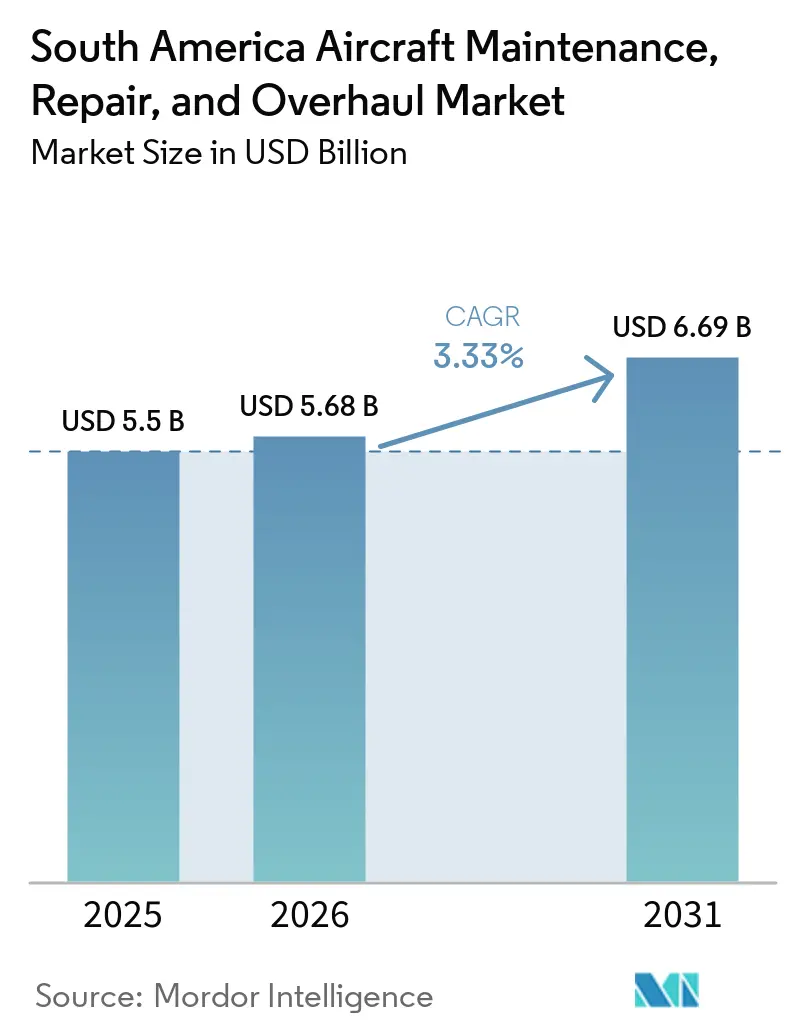
| Base Year Market Size (2025) | USD 5.5 Billion |
| Market Size (2026) | USD 5.68 Billion |
| Market Size (2031) | USD 6.69 Billion |
| Growth Rate (2026 - 2031) | 3.33 % |
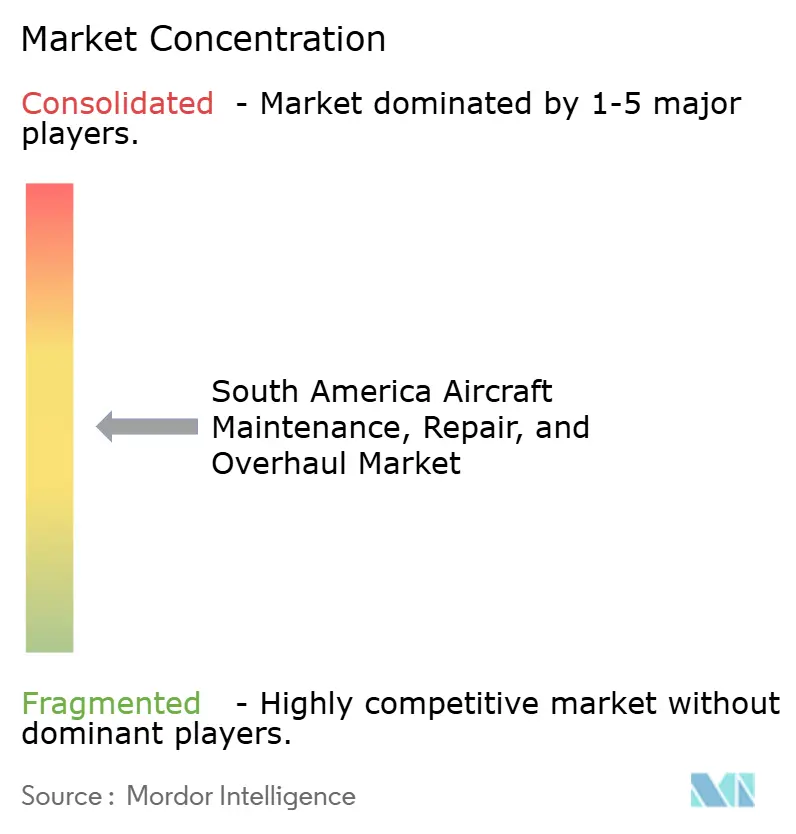
| Market Concentration | Medium |
Major Players *Disclaimer: Major Players sorted in no particular order Image © Mordor Intelligence. Reuse requires attribution under CC BY 4.0. | |
South America Aircraft Maintenance, Repair, and Overhaul Market Analysis by Mordor Intelligence
The South America aircraft maintenance, repair, and overhaul market size was valued at USD 5.50 billion in 2025 and is forecast to grow from USD 5.68 billion in 2026 to reach USD 6.69 billion by 2031, at a CAGR of 3.33% during the forecast period (2026-2031). Traffic recovery supports more frequent line work, airframe checks, and component replacement. Brazil remains the region’s principal maintenance base because it combines fleet scale with established repair facilities. Outsourcing to North America and Europe continues to limit local revenue capture and creates room for regional capacity expansion. Digital maintenance systems are changing service planning and favor providers that can combine repair capability with aircraft data analysis. The regional opportunity rests on retaining work that has historically been sent abroad and building support capacity closer to active fleets.
Key Report Takeaways
- By MRO type, engine MRO accounted for 44.50% of the South America aircraft maintenance, repair, and overhaul market share in 2025, while component MRO is forecast to grow at a 4.75% CAGR through 2031.
- By aircraft type, fixed-wing aircraft accounted for 84.25% of the South America aircraft maintenance, repair, and overhaul market size in 2025 and is projected to grow at a 4.40% CAGR through 2031.
- By application, commercial aviation accounted for 66.70% of the South America aircraft maintenance, repair, and overhaul market size in 2025 and is projected to grow at a 4.35% CAGR through 2031.
- By service provider, airline-affiliated MRO held 41.95% of the South America aircraft maintenance, repair, and overhaul market share in 2025, while independent third-party MRO is forecast to grow at a 4.41% CAGR through 2031.
- By geography, Brazil held 54.30% of regional revenue in 2025, while Colombia is forecast to grow at a 4.30% CAGR through 2031.
Note: Market size and forecast figures in this report are generated using Mordor Intelligence’s proprietary estimation framework, updated with the latest available data and insights as of January 2026.
Market Trends and Insights
Drivers Impact Analysis of South America Aircraft Maintenance, Repair, and Overhaul Market*
| Driver | (~) % Impact on CAGR Forecast | Geographic Relevance | Impact Timeline |
|---|---|---|---|
| Commercial fleet and passenger traffic recovery | +0.65% | Brazil, Colombia, Argentina, Chile | Short term (≤ 2 years) |
| Fleet aging and airworthiness-driven maintenance demand | +0.55% | Brazil, Argentina, Rest of South America | Medium term (2-4 years) |
| Embraer-centered regional jet and executive aviation ecosystem | +0.45% | Brazil, Colombia | Medium term (2-4 years) |
| Expansion of outsourced MRO by low-cost and regional operators | +0.45% | Colombia, Brazil, Chile | Short term (≤ 2 years) |
| MRO capacity localization and cross-border customer capture | +0.40% | Brazil, Colombia, Peru, Ecuador | Medium term (2-4 years) |
| Digital predictive maintenance and connected-aircraft adoption | +0.30% | Brazil, Colombia | Long term (≥ 4 years) |
| Source: Mordor Intelligence | |||
Commercial Fleet and Passenger Traffic Recovery
Aircraft utilization continued to increase across major South American aviation markets in 2025. Brazil transported 129.6 million passengers, up 9.4% year over year, while Argentina reached 50.65 million passengers, up 12%. Colombia recorded 57.52 million passengers, and Peru reached 44.7 million, up 5.5%. Peru also recorded more than 476,000 aircraft operations, an increase of 4.6%. Higher flight activity directly supports MRO demand because maintenance intervals are linked to flight hours, landings, and calendar time. LATAM provides a direct example: aircraft maintenance expense increased 5.7% to USD 862.7 million in 2025, partly due to higher operational activity. Continued traffic and fleet utilization therefore support line maintenance, scheduled checks, component replacement, and other utilization-driven services across the South America aircraft maintenance, repair, and overhaul market.
Fleet Aging and Airworthiness-Driven Maintenance Demand
South American airline fleets combine legacy aircraft with new-generation narrowbodies, driving demand for a range of maintenance technologies. LATAM ended 2025 with 371 aircraft and an average fleet age of 12.2 years after adding 26 aircraft during the year, including 24 A320-family narrowbodies. GOL Aerotech supports B737 Classic, B737NG, and B737 MAX aircraft and performs CFM56-7B and limited LEAP-1B engine work, while LATAM operates PW1100G-powered A320neo-family aircraft under a long-term Pratt & Whitney maintenance agreement. Regulatory requirements are also becoming more reliability-based. ANAC published IS 120-017A in March 2025, establishing an acceptable reliability program methodology for Brazilian public air transport operators and aligning maintenance program requirements more closely with the US regulatory approach. This mixed fleet and regulatory environment supports demand for certified airframe, engine, component, and reliability-management capabilities.
Embraer-Centered Regional Jet and Executive Aviation Ecosystem
Embraer's large installed base in Brazil creates a distinct MRO ecosystem covering commercial, executive, and defense aircraft. LATAM placed an order in September 2025 for up to 74 E195-E2 aircraft, including 24 firm orders valued at approximately USD 2.1 billion at list prices and 50 purchase options. Current plans call for the first commercial E195-E2 services in Brazil in late November 2026, with up to 14 aircraft entering the fleet through March 2027. Azul also received Embraer's 2,000th E-Jet, an E195-E2, in September 2026. On the defense side, Embraer signed a long-term support agreement with the Brazilian Air Force in June 2026 covering KC-390 component repair and overhaul, spare parts, engineering services, and technical support. These programs expand the installed base and require OEM-authorized maintenance, spares, engineering, and lifecycle support in South America.
Digital Predictive Maintenance and Connected-Aircraft Adoption
Digital maintenance tools are becoming increasingly important in MRO operations across South America. In April 2025, LATAM signed a multi-year agreement to implement Lufthansa Technik's AVIATAR platform across more than 300 A320-family, B777, and B787 aircraft, with initial results showing 20% fewer delays and cancellations. LATAM's São Carlos MRO facility has also used AI-enabled drones for external aircraft inspections since 2019, making the process approximately 12 times more efficient than traditional inspections. In early 2025, Azul developed an AI-based maintenance planning system that predicted and prevented approximately 150 maintenance events per month before the project was paused due to corporate restructuring and a transition in maintenance leadership. These deployments indicate that predictive analytics, digital records, and automated inspection are increasingly complementing traditional MRO capabilities, strengthening demand for providers that can combine maintenance execution with aircraft data and engineering expertise.
Restraints Impact Analysis of South America Aircraft Maintenance, Repair, and Overhaul Market*
| Restraint | (~) % Impact on CAGR Forecast | Geographic Relevance | Impact Timeline |
|---|---|---|---|
| Skilled technician and licensed inspector shortages | -0.45% | Brazil, Colombia, Argentina, Chile | Short term (≤ 2 years) |
| Foreign-exchange volatility and imported-part cost exposure | -0.55% | Brazil, Argentina, Ecuador | Medium term (2-4 years) |
| Limited local repair depth for new-generation engines and avionics | -0.35% | Brazil, Colombia | Long term (≥ 4 years) |
| Fragmented national approvals and cross-border release-to-service friction | -0.30% | South America, Peru, Ecuador | Medium term (2-4 years) |
| Source: Mordor Intelligence | |||
Skilled Technician and Licensed Inspector Shortages
The availability of qualified maintenance personnel is becoming an important capacity constraint for the South America aircraft maintenance, repair, and overhaul market. Boeing projects that Latin America will require 42,000 new maintenance technicians through 2045, reflecting both fleet growth and the replacement of workers leaving the industry.[1] Brazil already shows strong demand for technical training. LATAM opened its School of Mechanics at the São Carlos MRO in December 2024, with 70 employee-students, and opened the program to external candidates in August 2025. The first external selection attracted around 1,700 applicants for an initial 20 places, prompting the airline to expand the class. Continued hiring and training requirements can constrain the pace at which MRO providers build capacity in specialist areas such as engines, avionics, and structural maintenance, where certification and practical experience take time to develop.
Foreign-Exchange Volatility and Imported-Part Cost Exposure
Foreign-exchange movements remain an important cost constraint for the South America aircraft maintenance, repair, and overhaul market. Aircraft engines, spare parts, and many specialist components are priced in US dollars, while a significant portion of regional airline revenues is generated in local currencies. Azul states that its aircraft, engines, and spare parts are priced in US dollars, exposing maintenance costs to exchange-rate movements. This effect was evident in 2025, when Azul's maintenance expense increased by 4.4% to BRL 824.1 million (~USD 147.3 million), partly due to a 4.3% average depreciation of the Brazilian real against the US dollar. Argentina also continues to operate under a managed exchange-rate band, although aircraft-parts import procedures and foreign-trade payment rules were eased during 2025. Currency volatility can therefore increase the local cost of parts, engine support, tooling, and inventory, complicating investment decisions for MRO providers whose revenues are not fully dollar-linked.
*Our forecasts treat driver/restraint impacts as directional, not additive. The impact forecasts reflect baseline growth, mix effects, and variable interactions.
South America Aircraft Maintenance, Repair, and Overhaul Market Segment Analysis
By MRO Type:
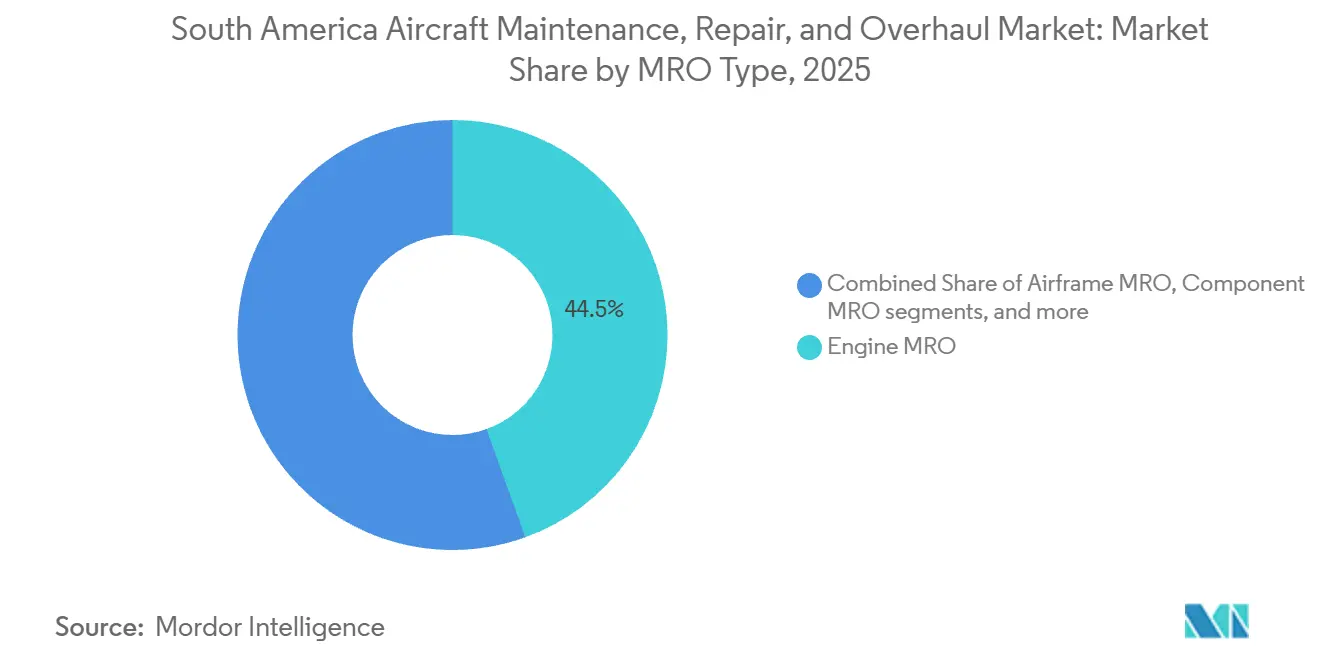
Component Repair Expands Alongside Engine Overhaul DemandEngine MRO accounted for an estimated 44.50% of the South America aircraft maintenance, repair, and overhaul market in 2025, reflecting the high value and technical complexity of engine inspection, repair, and overhaul across legacy and new-generation fleets. Demand is supported by the region's mix of CFM56-, V2500-, LEAP-, and PW1100G-powered aircraft. Azul operates LEAP-1A-powered A320neos, LATAM operates PW1100G-JM-powered A320neo-family aircraft, and Avianca has selected LEAP-1A engines for additional A320neo-family aircraft, while GOL's B737 MAX fleet uses LEAP-1B engines. Full engine overhaul capability remains capital-, tooling-, and certification-intensive, which keeps engine MRO concentrated among larger airline-affiliated, OEM-linked, and specialized providers.
Component MRO is forecast to be the fastest-growing MRO type, expanding at a 4.75% CAGR through 2031, as regional repair capability develops across landing gear, avionics, structures, and other repairable components. In April 2026, DTX Aerospace and Liebherr-Aerospace signed a License Service Agreement authorizing DTX's ANAC-approved Rio de Janeiro facility to maintain Embraer ERJ-family nose landing gear components, with access to OEM technical documentation, genuine spare parts, and engineering support. Airframe, line maintenance, and modification activity also remain relevant, supported by South America's large installed fleet. LATAM ended 2025 with 223 A320ceo-family aircraft and 68 A320neo-family aircraft, and plans to retrofit 41 B787 shipsets with RECARO premium seating beginning in 2027. These developments support broader regional MRO capability beyond engine overhaul.

By Aircraft Type:
Fixed Wing Aircraft Maintain The Core WorkloadFixed-wing aircraft accounted for an estimated 84.25% of the South America aircraft maintenance, repair, and overhaul market in 2025, supported by the region's large commercial airline fleet and military fixed-wing platforms. The segment benefits from recurring maintenance across legacy and new-generation aircraft, including scheduled airframe, engine, and component work. The large installed base of earlier-generation aircraft continues to require regular maintenance, while commercial, cargo, regional, and government fleets provide a broad and recurring workload. Rotary-wing MRO remains a smaller segment, supported primarily by Brazil's offshore energy, public service, search-and-rescue, and aeromedical helicopter operations.
Fixed-wing aircraft are also forecast to be the fastest-growing aircraft type, expanding at a 4.40% CAGR through 2031, as new narrowbody deliveries increase requirements for approved maintenance programs, tooling, technical data, trained personnel, and component support. In July 2026, Avianca selected 100 CFM LEAP-1A engines for 50 A320neo-family aircraft under an Abra Group agreement that also includes spare engines and long-term services covering Avianca's A320neo-family fleet and GOL's LEAP-1B-powered B737 MAX fleet. Avianca states that aircraft already in service and on order across Abra brands will represent more than 650 LEAP-powered aircraft. This expanding new-generation fleet base will support sustained fixed-wing maintenance demand across South America.
By Application:
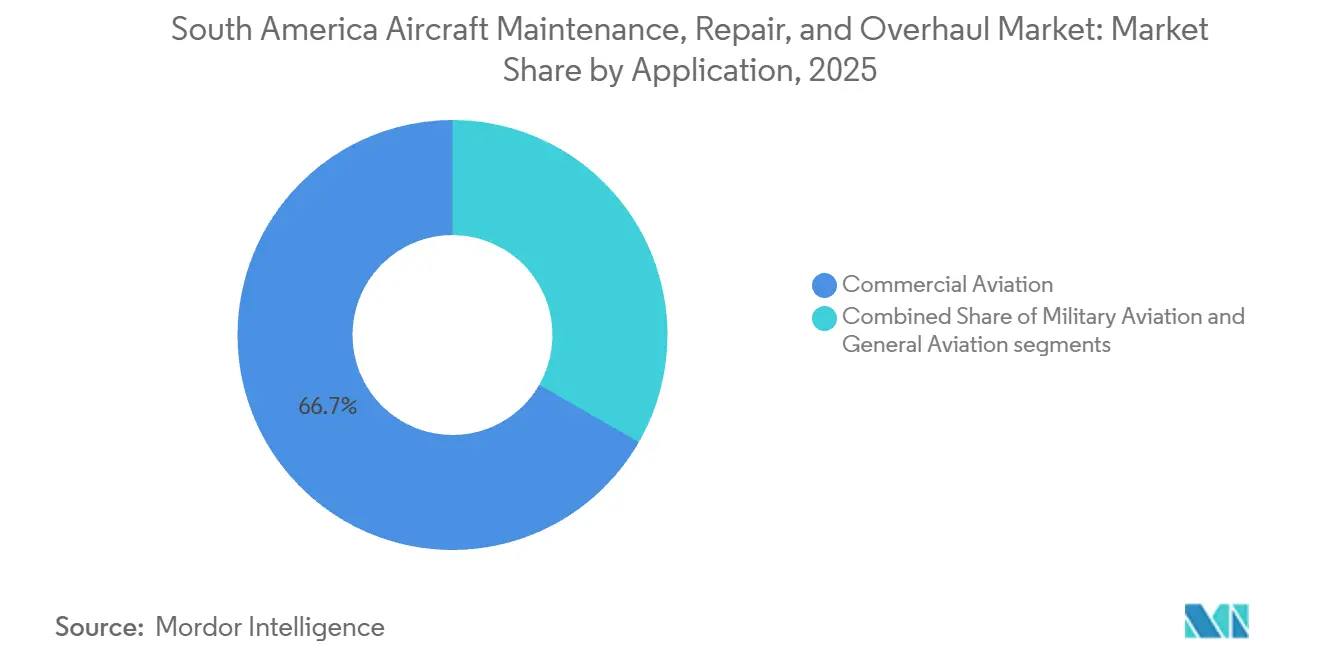
Commercial Aviation Leads Demand GrowthCommercial aviation accounted for an estimated 66.70% of the South America aircraft maintenance, repair, and overhaul market in 2025, supported by the scale of passenger traffic and aircraft utilization across major regional markets. Brazil transported 129.6 million passengers in 2025, up 9.4%, while Colombia reached 57.52 million passengers. Argentina recorded 50.65 million airport passengers, up 12%, and Peru reached 44.7 million, up 5.5%. Higher aircraft utilization increases flight hours and cycle accumulation, supporting recurring line maintenance, scheduled inspections, engine work, and component replacement. Cargo, military, and general aviation provide additional workloads, including Embraer's E190F passenger-to-freighter program, KC-390 support for the Brazilian Air Force, FAdeA's military MRO activities in Argentina, and business and agricultural aviation maintenance in Brazil.
Commercial aviation is also forecast to be the fastest-growing application, expanding at a 4.35% CAGR through 2031, as passenger traffic, fleet utilization, and new aircraft deliveries increase across South America. Growth in airline operations raises recurring maintenance requirements across airframes, engines, and components, while the introduction of new-generation fleets adds demand for approved tooling, technical support, and trained personnel. Cargo activity provides a supplementary maintenance base despite mixed conditions in Q2 2026, while military and general aviation offer more stable workloads outside commercial airline cycles.[2] This diversified application mix supports continued MRO demand, with commercial aviation remaining the primary growth driver of the market.
By Service Provider:
Airline-Affiliated Providers Lead, While Independents Grow FasterAirline-affiliated MRO providers accounted for an estimated 41.95% of the South America aircraft maintenance, repair, and overhaul market in 2025, supported by large captive fleets and established maintenance infrastructure. LATAM's São Carlos complex covers approximately 95,000 m² and includes nine hangars and 22 workshops, performing more than 60% of the group's scheduled maintenance. The facility employs approximately 2,000 people according to LATAM's latest 25th-anniversary reporting, while a 2026 Delta TechOps release cites approximately 2,400 professionals. Azul also maintains significant internal capacity at Viracopos, where its 35,000 m² hangar completed more than 130 heavy checks during its first six years, with each heavy check requiring more than 2,100 man-hours per day. These facilities give airline-affiliated providers a strong position in heavy airframe and component maintenance.
Independent third-party MRO is forecast to grow at a 4.41% CAGR through 2031 as additional regional capacity and certified repair capabilities enter the market. In 2026, MRO Holdings integrated Rionegro MRO in Colombia into its Americas network. The facility has three hangars, a capacity for up to eight production lines, and provides heavy airframe maintenance, component support, modifications, and painting for narrowbody and widebody aircraft. OEM-linked providers and military maintenance organizations remain important in specialized work, including Embraer's Brazilian support network and FAdeA's military MRO operations in Argentina. The service-provider landscape comprises large airline-affiliated facilities, independent repair stations, OEM networks, and defense-focused providers, with contract access that depends heavily on certification scope, technical capability, and skilled labor availability.
Geography Analysis
Brazil Aircraft Maintenance, Repair, and Overhaul Market
Brazil accounted for an estimated 54.30% of the South America aircraft maintenance, repair, and overhaul market in 2025, supported by the scale of its commercial fleet and established maintenance infrastructure. LATAM MRO São Carlos covers approximately 95,000 m² and includes nine hangars, 22 specialized workshops, and approximately 2,400 professionals. The facility holds approvals from authorities, including EASA, FAA, and Chile's DGAC, and performs around 60% of LATAM Group's scheduled maintenance. LATAM reported USD 4 billion in direct investment in Brazil between 2023 and 2026, while the São Carlos expansion separately includes BRL 78 million (USD 15.22 million) in research, development, and innovation projects approved through the Finep-BNDES program. Azul operates another large maintenance base at Viracopos, where its 35,000 m² hangar holds ANAC, EASA, and DGAC approvals and mobilizes more than 2,100 man-hours per day during heavy checks. Together, these facilities give Brazil substantial airframe, component, and heavy-maintenance capacity for domestic and regional fleets.
Colombia Aircraft Maintenance, Repair, and Overhaul Market
Colombia is forecast to be the fastest-growing named geography, expanding at a 4.30% CAGR through 2031, as third-party maintenance capacity develops. In March 2026, the former Avianca heavy-maintenance facility at Rionegro transferred to MRO Holdings and began operating as Rionegro MRO. The facility has three hangars supporting narrowbody and widebody aircraft. It provides heavy airframe maintenance, component support, modifications, and painting, with a location positioned to serve airlines across the Americas. This addition strengthens Colombia's role as an independent MRO base and broadens regional alternatives to airline-affiliated maintenance centers.
South America Aircraft Maintenance, Repair, and Overhaul Market
Argentina, Chile, Peru, and Ecuador provide additional maintenance capacity at a smaller scale. Argentina recorded 50.65 million airport passengers in 2025, up 12%, while FAdeA in Córdoba provides military aircraft, engine, component, and structural MRO capabilities. Aircraft parts import procedures were simplified in March 2025, although currency volatility remains a cost consideration. In Chile, APAS operates a DGAC- and FAA-certified MRO facility at Santiago Airport with heavy maintenance, engine support, component overhaul, and NDT capabilities. Peru handled 44.7 million passengers in 2025, up 5.5%, supporting a growing aviation activity base, while Ecuador's use of the US dollar reduces local-currency mismatch for many dollar-denominated aviation inputs. The development of these national MRO markets will continue to depend on the scope of certification, technical capabilities, airline fleet growth, and the ability to attract third-party maintenance work.
Competitive Landscape
The South America aircraft maintenance, repair, and overhaul market includes large airline-affiliated and OEM-linked providers, as well as a more fragmented independent repair tier. LATAM and Azul operate among the region's largest airline-affiliated maintenance facilities and are expanding third-party services alongside captive fleet work. LATAM's São Carlos facility supports external customers and entered an A320 component-repair collaboration with Delta TechOps in April 2026, while Azul TecOps was established to commercialize Azul's maintenance capabilities for other operators. Independent capacity is also expanding. In March 2026, Avianca transferred its Rionegro heavy-maintenance facility in Colombia to an MRO Holdings subsidiary. The three-hangar facility supports narrowbody and widebody heavy maintenance, components, modifications, and painting. Avianca identified the outsourcing of a capital- and resource-intensive activity as one of the strategic benefits of the transaction, showing independent providers can gain work as airlines balance internal capabilities with third-party maintenance.
Engine MRO has a strong presence among OEM-linked and specialist providers, although capabilities vary by engine family. GE Aerospace's Celma operation in Brazil is a major commercial-engine MRO center supporting CFM56, LEAP, CF6, and GEnx engines. Pratt & Whitney Canada maintains PT6A capability in Belo Horizonte; Safran operates helicopter engine MRO in Brazil; and MTU Maintenance do Brasil provides on- and near-wing services for engines, including CFM56, LEAP, V2500, CF34, and GE90. Local next-generation engine capability is also expanding, with GE Aerospace investing approximately USD 80 million in a new LEAP repair shop in Três Rios. International certifications remain an important competitive differentiator. LATAM São Carlos holds approvals from EASA, FAA, and DGAC, while Azul TecOps obtained EASA approval in March 2024, enabling it to perform maintenance on EU-registered aircraft and components. Multi-regulatory approvals expand the range of international customers and aircraft that South American providers can serve.
Digital support and inventory management are becoming additional competitive capabilities. In April 2026, Embraer signed a Collaborative Inventory Planning agreement with Jazz Aviation covering 25 E175 aircraft. The program uses data-driven spare-parts planning, with Embraer managing materials and covering most inventory investment to help reduce aircraft downtime. Although the Jazz agreement relates to Canada, the capability is relevant to Embraer's expanding E-Jet support ecosystem as E195-E2 fleets grow in South America. Larger MRO and OEM-linked providers can increasingly combine physical maintenance with inventory, engineering, and digital support, while specialized independent companies can compete through defined repair scopes and regulatory approvals. This creates a competitive structure in which breadth favors larger providers, while technical specialization continues to provide entry points for focused regional MRO companies.
South America Aircraft Maintenance, Repair, and Overhaul Industry Leaders
-
LATAM Airlines Group S.A.
-
Safran SA
-
Azul S.A. (Azul TecOps)
-
GOL Linhas Aéreas S.A.
-
RTX Corporation
- *Disclaimer: Major Players sorted in no particular order
South America Aircraft Maintenance, Repair, and Overhaul Market Companies Covered in this Report
- MRO Holdings Group
- Azul S.A. (Azul TecOps)
- GOL Linhas Aéreas S.A.
- RTX Corporation
- Embraer S.A.
- GE Aerospace (General Electric Company)
- Safran SA
- MTU Aero Engines AG
- Rolls-Royce Holdings plc
- FAdeA S.A.
- IAS – Indústria de Aviação e Serviços
- Helibras (Airbus SE)
- LATAM Airlines Group S.A.
- APAS Chile
Recent Industry Developments in South America Aircraft Maintenance, Repair, and Overhaul Market
- July 2026: Abra Group and CFM International expanded their partnership with an order for 100 LEAP-1A engines to power 50 Avianca A320neo-family aircraft. The agreement also includes spare engines and long-term service support for Avianca’s A320neo fleet and GOL’s B737 MAX aircraft.
- April 2026: Delta TechOps and LATAM Airlines Brasil launched an A320 component repair agreement using LATAM’s São Carlos MRO facility. Delta TechOps serves as the sole commercial interface, while LATAM provides repair capacity, expanding regional component MRO capabilities, and supporting Delta and third-party airline customers globally.
South America Aircraft Maintenance, Repair, and Overhaul Market Report Scope
Aircraft maintenance, repair, and overhaul (MRO) encompasses the inspection, maintenance, repair, overhaul, modification, and technical support activities required to keep aircraft, engines, components, and systems airworthy and operational. These services include scheduled and unscheduled maintenance, engine and component repair, line maintenance, airframe checks, modifications, upgrades, and related activities performed by airline-affiliated facilities, independent MRO providers, OEM-linked service centers, and military maintenance organizations.
The South America aircraft maintenance, repair, and overhaul market is segmented by MRO type, aircraft type, application, service provider, and geography. By MRO type, the market is segmented into airframe MRO, engine MRO, component MRO, line maintenance, and modifications and upgrades. By aircraft type, the market is segmented into fixed-wing and rotary-wing aircraft. By application, the market is segmented into commercial aviation, military aviation, and general aviation. By service provider, the market is segmented into airline-affiliated MRO, independent third-party MRO, OEM-captive MRO, and military depots. The report also covers the market sizes and forecasts for the South America aircraft maintenance, repair, and overhaul market in seven countries across the region. For each segment, the market size is provided in terms of value (USD).
Segmentation Overview
By MRO Type
| Airframe MRO |
| Engine MRO |
| Component MRO |
| Line Maintenance |
| Modifications and Upgrades |
By Aircraft Type
| Fixed-Wing |
| Rotary-Wing |
By Application
| Commercial Aviation | Passenger |
| Cargo/Freighter | |
| Military Aviation | |
| General Aviation |
By Service Provider
| Airline-affiliated MRO |
| Independent Third-party MRO |
| OEM-Captive MRO |
| Military Depots |
By Geography
| Brazil |
| Colombia |
| Argentina |
| Chile |
| Peru |
| Ecuador |
| Rest of South America |
| By MRO Type | Airframe MRO | |
| Engine MRO | ||
| Component MRO | ||
| Line Maintenance | ||
| Modifications and Upgrades | ||
| By Aircraft Type | Fixed-Wing | |
| Rotary-Wing | ||
| By Application | Commercial Aviation | Passenger |
| Cargo/Freighter | ||
| Military Aviation | ||
| General Aviation | ||
| By Service Provider | Airline-affiliated MRO | |
| Independent Third-party MRO | ||
| OEM-Captive MRO | ||
| Military Depots | ||
| By Geography | Brazil | |
| Colombia | ||
| Argentina | ||
| Chile | ||
| Peru | ||
| Ecuador | ||
| Rest of South America | ||
Key Questions Answered in the Report
What is the projected value of aircraft maintenance, repair, and overhaul in South America by 2031?
The South America aircraft maintenance, repair, and overhaul market is forecast to reach USD 6.69 billion by 2031, growing at a 3.33% CAGR from 2026.
Which MRO service has the largest regional revenue share?
Engine MRO led with 44.50% of regional revenue in 2025.
What is driving commercial aviation maintenance demand in South America?
Higher passenger traffic, greater aircraft utilization, and expanding intra-regional routes support commercial aviation, which is forecast to grow at a 4.35% CAGR.
Why does Brazil lead regional aircraft maintenance activity?
Brazil held 54.30% of regional revenue in 2025 and contains large, multi-certified maintenance facilities operated by LATAM and Azul.
Which provider category is growing fastest in the region?
Independent third-party MRO is forecast to grow at a 4.41% CAGR through 2031 as airlines expand outsourcing.
What limits the development of local repair capacity?
Shortages of certified technicians, foreign-exchange exposure, fragmented approvals, and limited local repair depth for new engines and avionics constrain capacity.