
Singapore Travel Insurance Market Size and Share
Market Overview
| Study Period | 2020 - 2031 |
|---|---|
| Forecast Data Period | 2026 - 2031 |
| Base Year Market Size (2025) | USD 262.15 Million |
| Market Size (2026) | USD 279.97 Million |
| Market Size (2031) | USD 378.21 Million |
| Growth Rate (2026 - 2031) | 6.20 % |
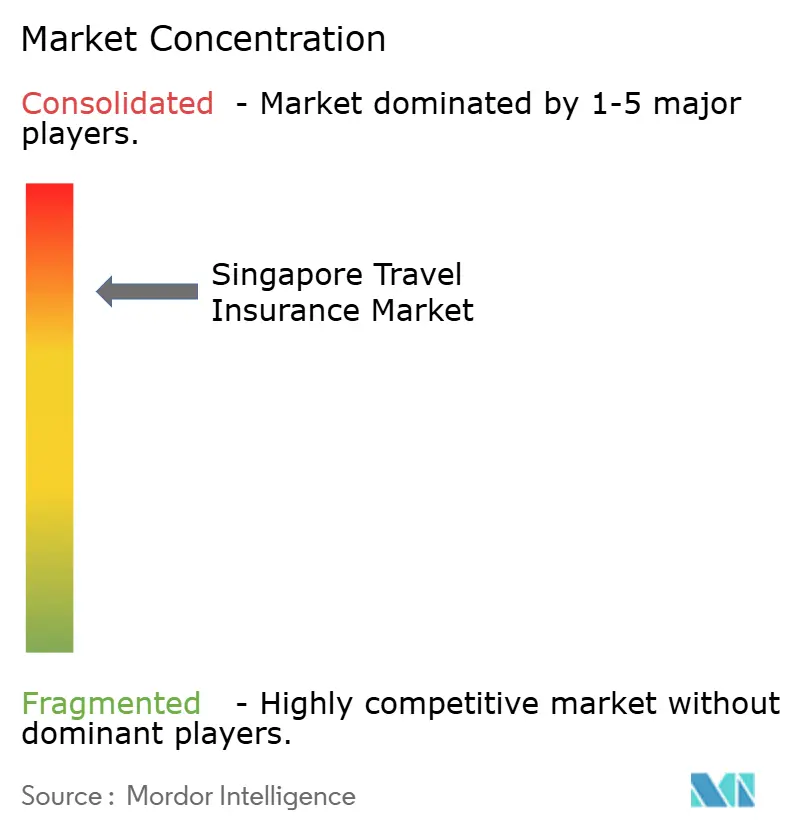
| Market Concentration | High |
Major Players *Disclaimer: Major Players sorted in no particular order Image © Mordor Intelligence. Reuse requires attribution under CC BY 4.0. | |
Singapore Travel Insurance Market Analysis by Mordor Intelligence
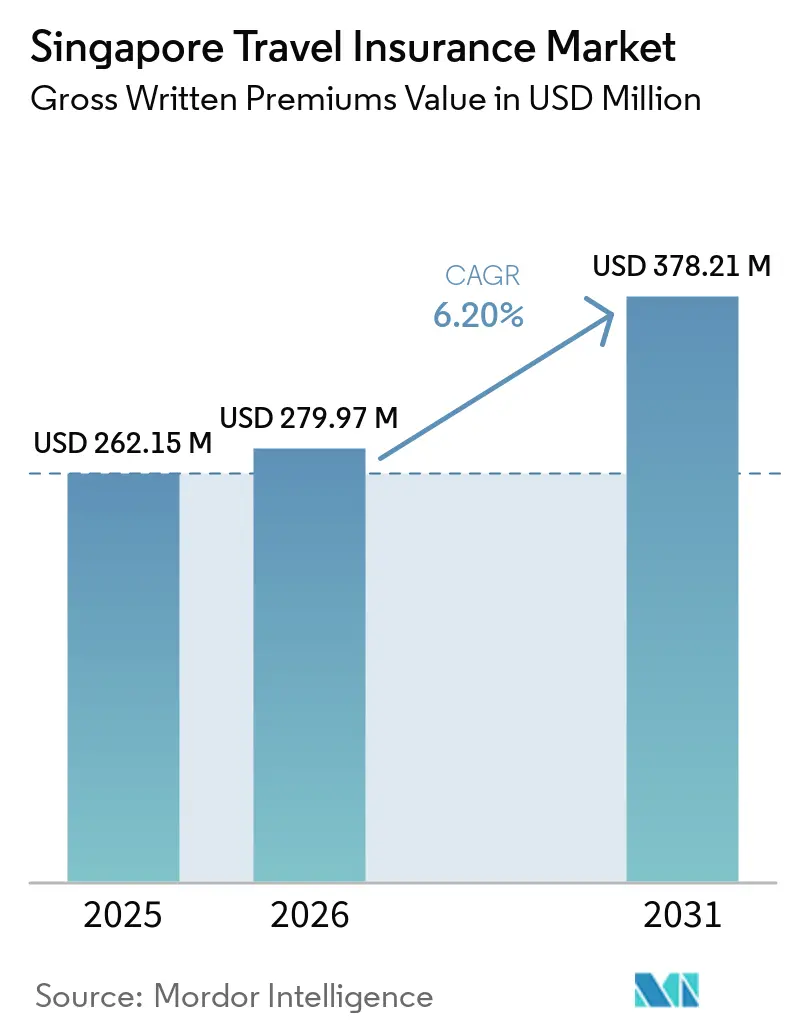
The Singapore Travel Insurance Market size in terms of gross written premiums value is projected to expand from USD 262.15 million in 2025 and USD 279.97 million in 2026 to USD 378.21 million by 2031, registering a CAGR of 6.20% between 2026 and 2031.
High insurance adoption changes the basis for growth because insurers have less room to win first-time buyers. The General Insurance Association of Singapore reported travel insurance gross written premiums of SGD 336.7 million (USD 249.2 million) in 2025, following 8.6% growth, alongside 10.6 million outbound trips by Singapore residents. Growth, therefore, depends more on broader coverage, recurring annual policies, and accessible digital purchasing. Rising overseas medical costs also encourage travelers to consider higher limits and more complete protection. Digital partnerships can place insurance close to the booking or airport journey, which can reduce the effort needed to purchase a policy.
Key Report Takeaways
- By trip type, single-trip insurance captured 59.67% of the Singapore travel insurance market share in 2025, while annual multi-trip insurance is projected to grow at a 7.62% CAGR through 2031.
- By distribution channel, direct insurer channels held 40.12% of the Singapore travel insurance market share in 2025, while other channels are projected to grow at an 8.44% CAGR through 2031.
- By buyer type, retail buyers captured 80.44% of the Singapore travel insurance market share in 2025, while corporate travel insurance is projected to grow at an 8.16% CAGR through 2031.
- By geography, the central region captured 26.95% of the Singapore travel insurance market share in 2025, while the north-east region is projected to grow at a 7.19% CAGR through 2031.
Note: Market size and forecast figures in this report are generated using Mordor Intelligence’s proprietary estimation framework, updated with the latest available data and insights as of January 2026.
Singapore Travel Insurance Market Trends and Insights
Drivers Impact Analysis*
| Driver | (~) % Impact on CAGR Forecast | Geographic Relevance | Impact Timeline |
|---|---|---|---|
| Growth In Overseas Travel by Singapore Residents | +1.5% | National | Short term (≤ 2 years) |
| Frequent Regional and Long-Haul Travel From Singapore | +0.9% | National, with Asia-Pacific corridor intensity | Medium term (2-4 years) |
| Rising Overseas Medical Emergency and Evacuation Exposure | +1.1% | Global, with exposure in Japan, the United States, and Australia | Long term (≥ 4 years) |
| Demand For Trip Cancellation and Disruption Protection | +0.7% | Global | Short term (≤ 2 years) |
| Preference For Flexible and Comprehensive Coverage | +0.6% | National | Medium term (2-4 years) |
| Expansion Of Digital and Travel-Intermediary Distribution | +0.7% | National, with Asia-Pacific spillover | Long term (≥ 4 years) |
| Source: Mordor Intelligence | |||
Growth In Overseas Travel By Singapore Residents
Singapore residents made 10.6 million overseas trips in 2025, compared with 10.3 million in 2024[1]General Insurance Association of Singapore, “Singapore’s Domestic General Insurance Business Surpasses SGD 6 Billion in Premiums,” GIA Press Release, gia.org.sg. This travel volume supports demand for policies that cover medical events, cancellations, baggage loss, and travel delays. More frequent departures create more occasions for insurers and intermediaries to offer coverage. The Singapore travel insurance market also benefits when repeat travelers see insurance as a routine travel purchase. Higher travel activity does not automatically mean a similar rise in policy count because some travelers move to annual cover. It nevertheless supports demand for policies with broader limits and repeat-use features.
Rising Overseas Medical Emergency And Evacuation Exposure
Medical cost inflation in Japan, Australia, and the United States reduces the value of older coverage limits. Chubb enhanced TravellerShield Plus from 30 April 2026 with new benefit categories, reflecting the need to keep protection relevant to changing travel risks[2]Chubb Insurance Singapore, “TravellerShield Plus,” DBS Bank, dbs.com.sg. The General Insurance Association of Singapore reported that net incurred travel claims rose 14.6% in 2025, while travel gross written premiums grew 8.6%. This difference places pressure on underwriting margins and policy pricing. Insurers need destination-level risk information to assess medical exposure and update coverage limits. Clear communication of limits, exclusions, and claim requirements remains important when policyholders compare plans.
Preference For Flexible And Comprehensive Coverage
Flexible policies allow customers to select protection for the risks that matter to a particular trip. MSIG Singapore launched TravelEasy Flex in April 2025 with plans starting from SGD 9 (USD 6.7), allowing policyholders to customize coverage at the component level[3]MSIG Insurance Singapore, “MSIG Launches TravelEasy Flex, an Affordable Travel Insurance That Can Be Tailored to Policyholders’ Needs,” MSIG Insurance Singapore, msig.com.sg. This design can reduce the initial price barrier while giving customers the option to add benefits. Income Insurance offers a Cancel For Any Reason benefit that differentiates its travel product from standard coverage. The Singapore travel insurance market can gain premium value when travelers select additional riders rather than only the lowest-priced policy. Digital claims capabilities are also important because flexible benefits need clear administration after a loss.
Expansion Of Digital And Travel-Intermediary Distribution
Embedded insurance makes coverage available when a traveler is already arranging transport or preparing to depart. Zurich Insurance Singapore and ComfortDelGro introduced Zurich Travel Comfort in the CDG Zig ride-hailing application in January 2025. The service reached more than 1 million monthly active users and placed travel insurance close to trips to Changi Airport. In May 2026, SimplyGo and Embed Financial Group Holdings entered a partnership to explore an embedded micro-insurance platform within the SimplyGo application[4] SimplyGo Pte. Ltd., “SimplyGo and EFGH Enter Strategic Partnership to Explore Embedded Micro-Insurance Services,” SimplyGo, simplygo.com.sg. These channels can shorten the purchase process and extend insurer access beyond traditional direct websites. The Travel Agents Regulations 2017 also require licensed travel agents to prompt customers to consider travel insurance before they receive payment.
Restraints Impact Analysis*
| Restraint | (~) % Impact on CAGR Forecast | Geographic Relevance | Impact Timeline |
|---|---|---|---|
| Intense Price Competition for Short-Duration Trips | -0.8% | National | Short term (≤ 2 years) |
| Policy Exclusions and Complexity | -0.5% | National | Medium term (2-4 years) |
| Increasing Medical and Travel Disruption Claims Costs | -0.7% | National, with exposure in Asia-Pacific and United States corridors | Short term (≤ 2 years) |
| Claims Documentation and Verification Requirements | -0.4% | National | Short term (≤ 2 years) |
| Source: Mordor Intelligence | |||
Price Competition And Low Premiums For Short-Duration Trips
Single-trip insurance held 59.67% of the Singapore travel insurance market in 2025, making it the main area of price competition. Buyers often compare short-duration regional plans mainly on price when the policy benefits appear similar. This can limit insurers’ ability to raise premiums even as claims costs increase. The General Insurance Association of Singapore reported that travel underwriting profit fell 23.8% to SGD 29.7 million (USD 22 million) in 2025. The decline occurred despite growth in travel gross written premiums and reflects the pressure created by rising claims. Smaller insurers may face added costs when they cannot spread compliance and operating investments across a large policy base.
Policy Exclusions And Complexity
Travel insurance exclusions can be difficult for infrequent travelers to understand. Standard policies commonly limit protection for pre-existing conditions, pandemics, and certain geopolitical events. Insurers applied conflict exclusions for new policies covering Middle East travel during 2026, which made the scope of cover especially important for affected itineraries. Products that address pre-existing conditions can include co-payments and sub-limits that require careful comparison. MAS Notice 120 requires disclosure and advisory processes for accident and health insurance products, including the explanation of relevant exclusions at sale. Clearer product communication can reduce dissatisfaction after a claim and support repeat purchase decisions.
*Our forecasts treat driver/restraint impacts as directional, not additive. The impact forecasts reflect baseline growth, mix effects, and variable interactions.
Segment Analysis
By Trip Type: Single-Trip Insurance Provides Scale While Annual Plans Gain Demand
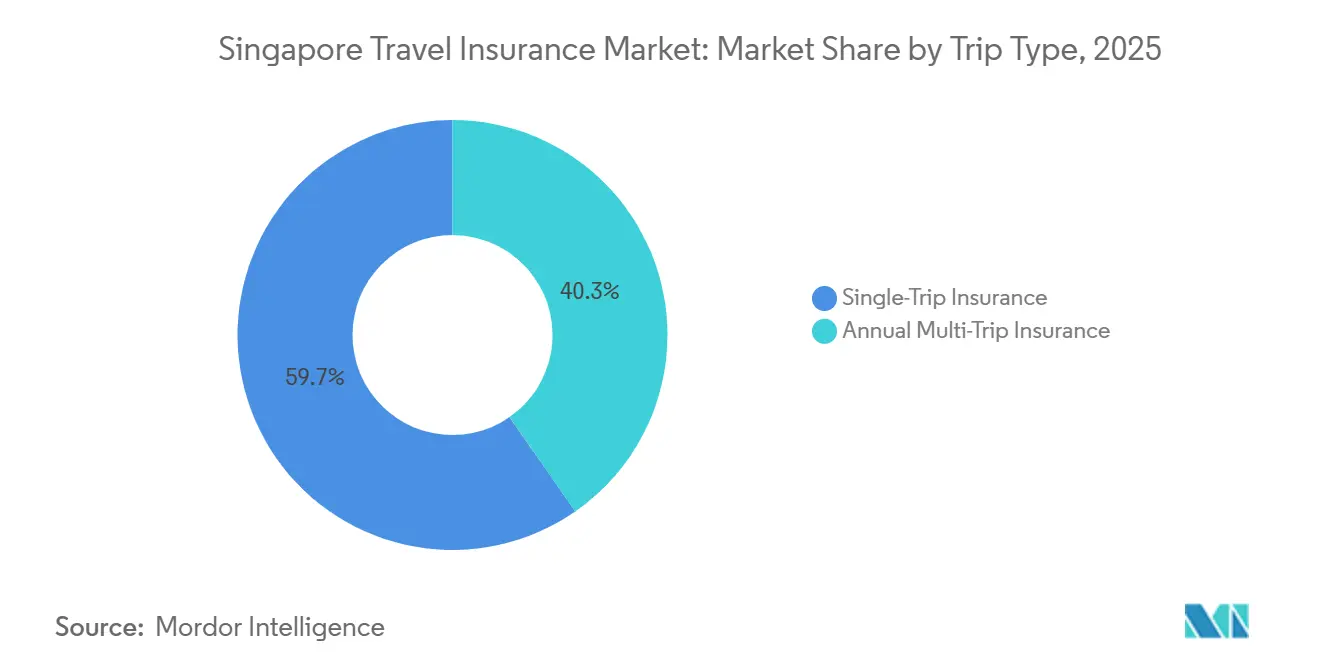
Single-trip insurance held 59.67% of the Singapore travel insurance market share in 2025. It remains the default option for travelers who take 1 or 2 overseas holidays each year. Short-haul travel within the Association of Southeast Asian Nations and medium-haul travel in Northeast Asia support this pattern. Per-trip premiums are often easier to justify when a traveler does not expect to travel repeatedly. The segment, therefore, gives insurers a broad base of policyholders, although it also faces strong price competition. Its large volume makes claims service and policy clarity important points of competition.
Annual multi-trip insurance is the fastest-growing trip type at a 7.62% CAGR through 2031. The Singapore travel insurance market size for annual multi-trip insurance is supported by frequent travelers who take 3 or more overseas trips. Higher medical costs in Japan, the United States, and Australia have lifted annual-plan premiums by 8-12% in 2026 from 2024 levels. Income Insurance’s annual policy covers unlimited trips of up to 90 calendar days per journey and includes its "cancel for any reason" benefit. The Insurance Act 1966 and related policy-owner protection arrangements support confidence among retail policyholders. Insurers can use broader benefits and repeat-use convenience to distinguish annual products from single-trip cover.


By Distribution Channel: Direct Insurers Lead While Other Channels Expand
Direct insurer channels held 40.12% of the Singapore travel insurance market share in 2025. Established insurers have built direct websites and mobile interfaces for policy issuance and claims submission. Direct models give insurers control over the customer journey, product presentation, and renewal communication. Agents, brokers, and banks remain relevant for family policies, senior travelers, and coverage involving pre-existing conditions. These channels can provide guidance when customers need help comparing limits or exclusions. Their role is particularly important when customers value advice before purchasing higher-value coverage.
Other channels are projected to grow at an 8.44% CAGR through 2031. This part of the Singapore travel insurance market includes ride-hailing, transit, e-commerce, and travel-booking environments. Tiq by Etiqa provides automated flight-delay payouts by detecting eligible disruption events and crediting the policyholder’s PayNow eWallet. MSIG reported that 20% of travel claims were automatically approved and paid within 48 hours following its use of generative artificial intelligence and robotic process automation. Faster handling can make digital channels more attractive for simple claims. The Singapore travel insurance market size can benefit from the expansion of these digital and embedded distribution models, while the role of intermediaries increasingly shifts toward advice before a claim rather than manual support after an event.
By Buyer Type: Retail Buyers Lead While Corporate Demand Rises
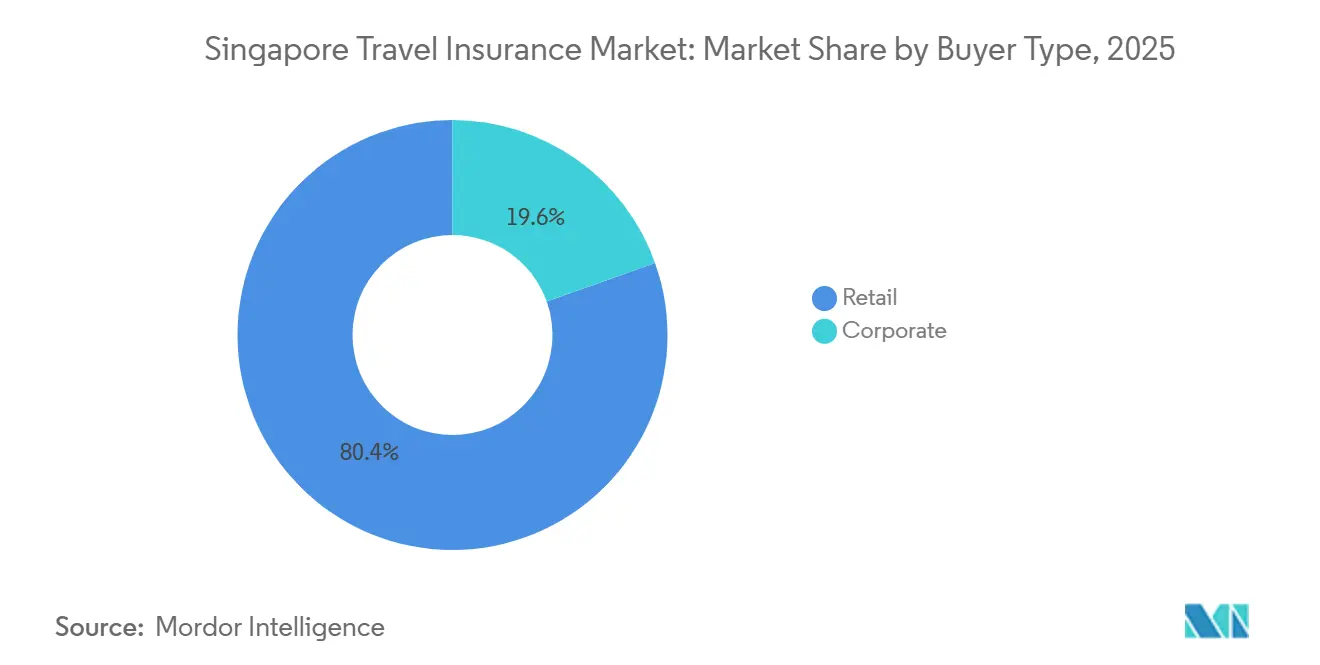
Retail buyers captured 80.44% of the Singapore travel insurance market share in 2025. High household travel frequency and widespread awareness of travel cover support the segment’s scale. Retail customers buy both single-trip and annual policies through direct, intermediary, and digital channels. The broad customer base makes promotional activity common, particularly on online platforms. Price pressure is strongest in standard short-trip products with similar coverage designs. Insurers, therefore, need strong service, flexible benefits, and simple digital journeys to protect revenue quality.
Corporate travel insurance is projected to grow at an 8.16% CAGR through 2031 in the Singapore travel insurance market. Corporate group policies support employees traveling for meetings, events, and other business purposes. Singapore’s role as a meetings, incentives, conventions, and exhibitions hub supports demand for employee travel protection. Singlife’s corporate travel insurance brochure offers a 15% bulk discount for 50 or more insured people. Corporate buyers may value consistent coverage terms and annual administration across employee groups. The Singapore travel insurance market size can benefit from the expansion of corporate travel programs, creating opportunities for insurers to offer higher-value coverage and build more stable renewal relationships.
Geography Analysis
The Central Region held 26.95% of the Singapore travel insurance market share in 2025. The region includes the Central Business District, Orchard Road, Buona Vista, Bishan, and Toa Payoh. It has a high concentration of corporate offices, expatriate workers, and higher-income households. These travelers often need annual multi-trip policies or comprehensive plans with higher medical limits. The Central Region’s role in business activity also supports corporate travel demand. Its policy mix can generate higher premiums than areas focused mainly on short, price-sensitive trips.
The North-East Region is projected to grow at a 7.19% CAGR through 2031. Punggol and Sengkang have younger and more digitally engaged resident populations. Mobile-first purchasing and embedded distribution can be relevant for this group. The Singapore travel insurance market size in the region can benefit from policies available through transport and other everyday digital applications. Zurich’s CDG Zig integration and the SimplyGo partnership show how travel protection can be presented close to the start of a journey. This route may be particularly suited to travelers who prefer quick digital transactions.
The East Region includes Tampines, Bedok, Pasir Ris, and the area around Changi Airport. Its proximity to the airport can make insurance prompts at check-in or transit more relevant. The West Region includes Jurong, Clementi, Tengah, and Bukit Batok, while the North Region includes Woodlands, Yishun, and Sembawang. These regions have smaller shares and more price-sensitive single-trip buyers. Digital platforms can lower the effort required to purchase a policy across these areas. The Insurance Act 1966 and the Monetary Authority of Singapore’s insurance regulations provide a common regulatory setting across all planning regions.
Competitive Landscape
The Singapore travel insurance market is concentrated among a group of major insurers. Income Insurance, MSIG Insurance, FWD Singapore, Allianz Insurance Singapore, Chubb Insurance Singapore, and Singlife are key participants. More than 20 licensed general insurers are active in travel insurance lines. Other providers serve specialized needs, including Takaful-compliant cover, corporate policies, and higher medical-limit products. Competition centers on digital purchasing, claims speed, service quality, and product flexibility.
MSIG has invested in digital claims processing and reported that 20% of travel claims were automatically approved and paid within 48 hours. Tiq by Etiqa offers automated flight-delay payments without manual claim submission for eligible events. Zurich and ComfortDelGro launched Zurich Travel Comfort within the CDG Zig application in January 2025. These moves show how claims automation and embedded distribution can improve convenience for travelers. They also place pressure on insurers that rely mainly on conventional sales processes. The Singapore travel insurance industry is therefore shaped by execution in digital service as well as by product coverage.
Insurers have opportunities in protection for seniors and travelers with pre-existing conditions. They can also seek new platform partnerships that reach customers during booking, transit, or airport travel. SimplyGo and Embed Financial Group Holdings entered a strategic partnership in May 2026 to explore embedded micro-insurance services. AIG Asia Pacific stopped direct Travel Guard retail sales in Singapore in January 2026, and Zurich Insurance Singapore underwrites the brand’s retail products. MAS Notice 133 Amendment 2026 updated the risk-based capital valuation framework for licensed insurers from 31 March 2026. Stronger digital and risk-management capabilities can matter more as compliance requirements develop. The competitive position of smaller firms may depend on their ability to manage these costs while maintaining clear customer service.
Singapore Travel Insurance Industry Leaders
Income Insurance Limited
FWD Singapore Pte. Ltd.
MSIG Insurance (Singapore) Pte. Ltd.
Chubb Insurance Singapore Limited
Allianz Insurance Singapore Pte. Ltd.
- *Disclaimer: Major Players sorted in no particular order

Recent Industry Developments
- May 2026: SimplyGo Pte. Ltd. and Embed Financial Group Holdings entered a Strategic Partnership Agreement to co-develop an embedded micro-insurance platform within the SimplyGo app, enabling real-time policy issuance, premium collection, and insurance connectivity for commuters traveling to Changi Airport. The initiative targets mass-market insurance buyers who are currently underserved by traditional channels.
- April 2026: Chubb Insurance Singapore enhanced TravellerShield Plus, effective 30 April 2026, adding new benefit categories including fraudulent transaction coverage for DBS and POSB cards, up to SGD 4,000 (USD 3,000) under Standard and SGD 6,000 (USD 4,600) under Platinum. Enhancements apply automatically to all new single-trip and annual policies from that date.
- March 2026: The General Insurance Association of Singapore announced that Singapore’s domestic general insurance sector crossed SGD 6 billion (USD 4.4 billion) in gross written premiums for the first time in 2025. Travel insurance gross written premiums grew 8.6% to SGD 336.7 million (USD 249.2 million), while net incurred claims rose 14.6% and underwriting profit fell 23.8% to SGD 29.7 million (USD 22 million).
- March 2026: Etiqa Insurance Singapore returned to NATAS Travel Fair 2026 as the Official Travel Insurer for the fifth consecutive year and launched Travel Takaful, a Shariah-compliant travel protection plan for leisure travel, business trips, and Umrah journeys.


Singapore Travel Insurance Market Report Scope
| Single-Trip Insurance |
| Annual Multi-Trip Insurance |
| Direct Insurer Channels |
| Insurance Agents and Brokers |
| Banks |
| Other Channels |
| Retail |
| Corporate |
| Central Region |
| East Region |
| North Region |
| North-East Region |
| West Region |
| By Trip Type | Single-Trip Insurance |
| Annual Multi-Trip Insurance | |
| By Distribution Channel | Direct Insurer Channels |
| Insurance Agents and Brokers | |
| Banks | |
| Other Channels | |
| By Buyer Type | Retail |
| Corporate | |
| By Geography | Central Region |
| East Region | |
| North Region | |
| North-East Region | |
| West Region |


Key Questions Answered in the Report
What is the projected value of Singapore travel insurance in 2031?
The Singapore travel insurance market is forecast to reach USD 378.21 million by 2031, growing at a 6.2% CAGR from 2026.
Which trip policy type has the largest share in Singapore?
Single-trip insurance held 59.67% share in 2025, reflecting the importance of short and occasional overseas trips.
Which travel policy type is growing fastest in Singapore?
Annual multi-trip insurance is projected to grow at a 7.62% CAGR through 2031, supported by frequent travelers.
Which sales channel leads travel insurance purchases in Singapore?
Direct insurer channels held 40.12% share in 2025, while other channels have the fastest projected growth at 8.44% CAGR.
What is driving corporate travel insurance demand in Singapore?
Corporate travel insurance is projected to grow at an 8.16% CAGR through 2031, supported by business travel and group coverage needs.
Which area is expected to grow fastest for travel insurance purchases?
The North-East Region is forecast to grow at a 7.19% CAGR through 2031, supported by younger, digitally engaged residents.
Page last updated on:





