
Singapore Engineering Insurance Market Size and Share
Market Overview
| Study Period | 2020 - 2031 |
|---|---|
| Forecast Data Period | 2026 - 2031 |
| Base Year Market Size (2025) | USD 267.68 Million |
| Market Size (2026) | USD 286.95 Million |
| Market Size (2031) | USD 375.03 Million |
| Growth Rate (2026 - 2031) | 5.50 % |
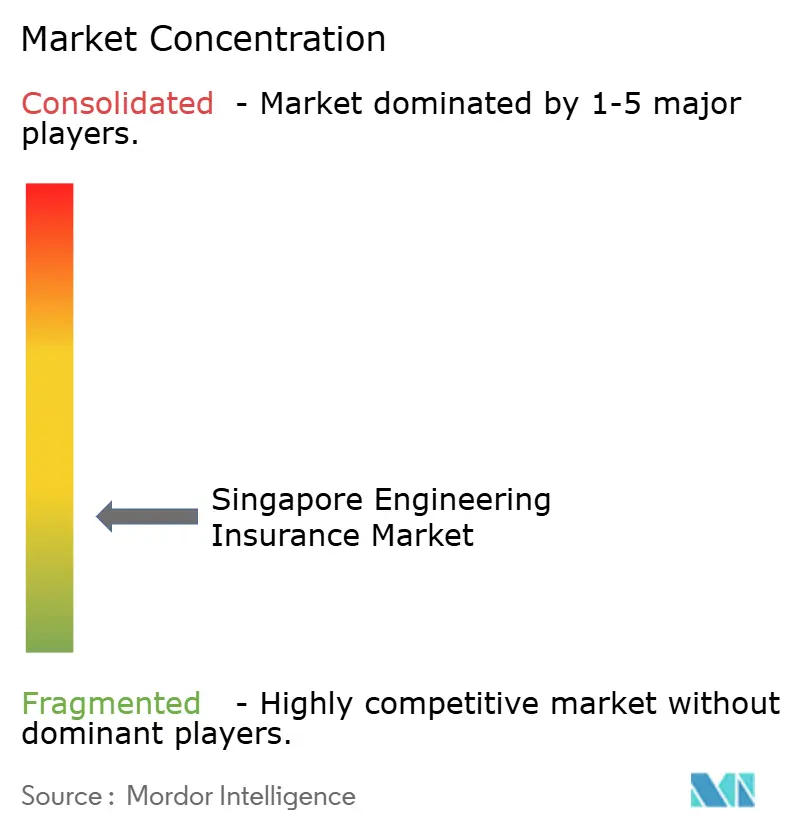
| Market Concentration | Low |
Major Players *Disclaimer: Major Players sorted in no particular order Image © Mordor Intelligence. Reuse requires attribution under CC BY 4.0. | |
Singapore Engineering Insurance Market Analysis by Mordor Intelligence
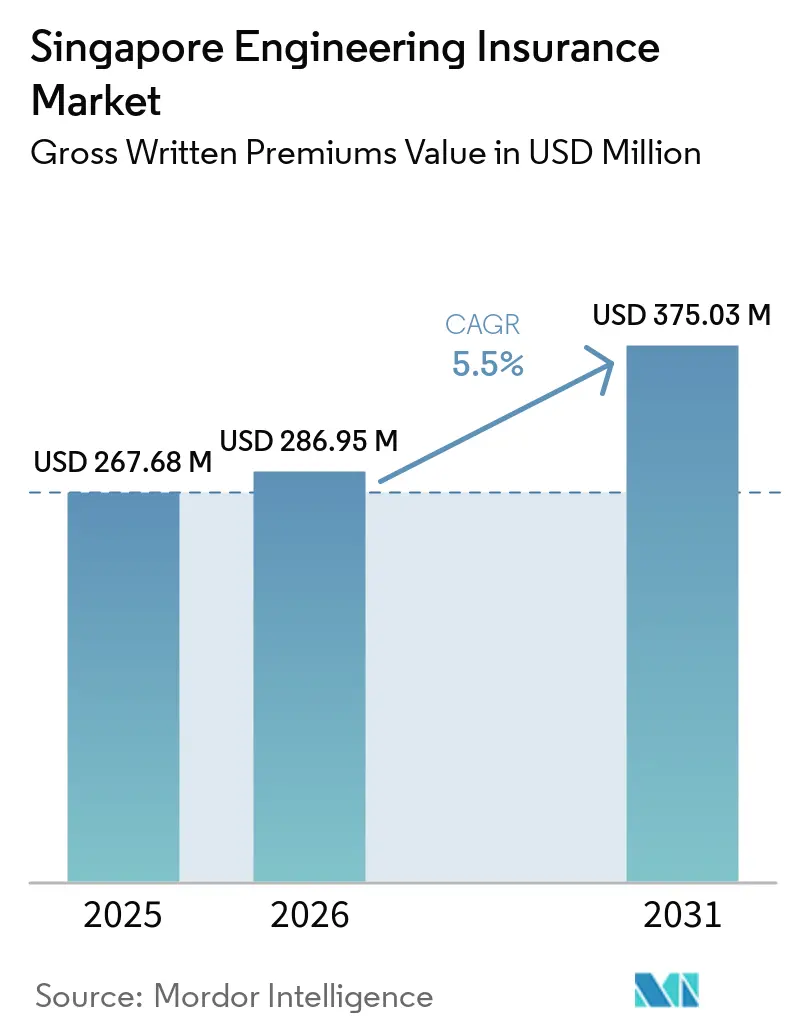
The Singapore Engineering Insurance Market size in terms of gross written premiums value is expected to increase from USD 267.68 million in 2025 to USD 286.95 million in 2026 and reach USD 375.03 million by 2031, growing at a CAGR of 5.5% over 2026-2031.
Public infrastructure work, airport expansion, rail projects, port construction, and industrial investment support demand for project and operational cover. The Building and Construction Authority (BCA) expects construction demand of SGD 47 billion (USD 34.8 billion) to SGD 53 billion (USD 39.2 billion) in 2026, following SGD 50.5 billion (USD 37.4 billion) in 2025, while the 2027 to 2030 pipeline is expected to range from SGD 39 billion (USD 28.9 billion) to SGD 46 billion (USD 34.0 billion) annually. This pipeline gives insurers a broader base for multi-year policy pricing, even after individual projects pass their peak construction stages, because several projects will require coverage through testing, commissioning, and early operational periods. Data centers, semiconductor plants, low-carbon energy assets, and specialty chemical facilities are increasing insured values and changing the technical requirements for underwriting. Competition remains strong, so insurers need to balance capacity, pricing, claims control, and specialist expertise as the Singapore engineering insurance market develops.
Key Report Takeaways
- By product type, project works insurance captured 67.89% of the Singapore engineering insurance market share in 2025, while operational plant and equipment insurance is projected to grow at a 7.23% CAGR through 2031.
- By application, buildings held 49.58% of the Singapore engineering insurance market share in 2025, while digital infrastructure is projected to grow at an 8.43% CAGR through 2031.
- By end user, government and statutory boards captured 37.67% of the Singapore engineering insurance market share in 2025, while private owner-operators are projected to grow at a 7.56% CAGR through 2031.
- By geography, the west region held 28.49% of the Singapore engineering insurance market share in 2025, while the east region is projected to grow at a 6.82% CAGR through 2031.
Note: Market size and forecast figures in this report are generated using Mordor Intelligence’s proprietary estimation framework, updated with the latest available data and insights as of January 2026.
Singapore Engineering Insurance Market Trends and Insights
Drivers Impact Analysis*
| Driver | (~) % Impact on CAGR Forecast | Geographic Relevance | Impact Timeline |
|---|---|---|---|
| Public Infrastructure and Large-Scale Construction Pipeline | +1.4% | West Region, East Region, and island-wide MRT extensions | Short term (≤ 2 years) |
| Complex Engineering Projects and Higher Insured Values | +0.6% | Global, with concentration in the Central and West Regions | Medium term (2-4 years) |
| Advanced Manufacturing and High-Tech Infrastructure Expansion | +0.7% | East Region and North Region | Medium term (2-4 years) |
| Data Center and Digital Infrastructure Development | +1.1% | West Region and East Region | Short term (≤ 2 years) |
| Energy Transition and Renewable Infrastructure Expansion | +0.8% | West Region and island-wide grid upgrades | Long term (≥ 4 years) |
| Regional Specialty Insurance and Reinsurance Hub Position | +0.5% | Island-wide, with the Association of Southeast Asian Nations spillover | Long term (≥ 4 years) |
| Source: Mordor Intelligence | |||
Public Infrastructure and Large-Scale Construction Project Pipeline
Singapore’s 2026 construction program brings several complex projects into the same period, increasing demand for specialist engineering underwriting. Civil engineering demand is projected to reach SGD 11.6 billion (USD 8.6 billion) to SGD 13.4 billion (USD 9.9 billion) in 2026, compared with SGD 9.3 billion (USD 6.9 billion) in 2025[1]Building and Construction Authority, “Steady Construction Demand in 2026 as Singapore Steps Up Support for Built Environment Firms Through Collaboration and Innovation,” BCA Newsroom, www1.bca.gov.sg. The pipeline includes mass rapid transit extensions, Changi Airport Terminal 5 works, and Tuas Terminal berth construction, alongside the Marina Bay Sands expansion and Tengah General Hospital. These projects have different exposure profiles from standard residential construction because they involve complex designs, long delivery schedules, concentrated asset values, and multiple contractors working under tightly controlled programs. A cross-island tunnel can create a much larger engineering exposure than many conventional building projects because a loss may affect specialist works, project schedules, and connected infrastructure. This activity supports premium demand across construction, erection, testing, commissioning, and early operational stages within the Singapore engineering insurance market.
Growth in Data Centers and Digital Infrastructure Development
Data center development is becoming a distinct engineering risk category within the Singapore engineering insurance market. Singapore’s Economic Development Board and Infocomm Media Development Authority awarded 200 megawatts of new data center capacity under the DC-CFA2 program in August 2026[2]ST Telemedia Global Data Centres, “STT GDC Selected to Develop 50MW of Sustainable AI-Ready Data Centre Capacity in Singapore,” STT GDC Newsroom, sttelemediagdc.com. The awarded facilities are planned for Jurong Island’s 20-hectare low-carbon precinct, which targets up to 700 megawatts of total capacity and requires participating projects to meet Green Mark for Data Centres Platinum standards. Digital Realty has targeted nearly SGD 7 billion (USD 5.18 billion) in Singapore investment, including more than SGD 4.3 billion (USD 3.18 billion) for new data center development. These projects require all-risk construction, delay in start-up, equipment, and business interruption cover across several phases, from site preparation and installation through commissioning and handover. Their specialized mechanical and electrical systems also require policy terms that address higher asset values, utility dependence, equipment failure, and complex operational dependencies.
Energy Transition and Renewable Infrastructure Project Expansion
Energy transition projects are widening the range of risks placed in the Singapore engineering insurance market. Budget 2026 committed SGD 800 million (USD 597 million) over 5 years under the Decarbonisation R&D Grand Challenge for solar, hydrogen, energy storage, and carbon capture work. The Energy Market Authority granted conditional approvals for 900 megawatts of low-carbon electricity imports from Malaysia in 2026[3]Energy Market Authority, “EMA Grants Conditional Approvals for 900 MW of Electricity Trade Between Peninsular Malaysia and Singapore,” Energy Market Authority, ema.gov.sg. These approvals involve submarine cable construction, which has limited local loss experience, high potential loss values per incident, and technical exposure across the route, landing points, and related connection infrastructure. Jurong Island is planned to host 9 hydrogen-ready power plants with more than 3.7 gigawatts of combined potential by 2030, alongside ammonia import facilities and supporting storage systems. Insurers, therefore, need technical capability for assets that differ from conventional gas-fired generation and standard construction projects.
Expansion of Advanced Manufacturing and High-Tech Industrial Infrastructure
Advanced manufacturing investment is increasing demand for cover that spans construction and operational equipment risks. Applied Materials opened its USD 500 million Tampines Campus in 2025, more than doubling its advanced cleanroom capacity in Singapore[4]Singapore Economic Development Board, “Applied Materials Expands Singapore Manufacturing for AI,” Singapore EDB, edb.gov.sg. Micron broke ground on an advanced wafer fabrication facility in January 2026 with a USD 24 billion investment and 700,000 square feet of cleanroom space. Cleanroom systems, specialty chemical plants, and automated logistics facilities can carry higher equipment values, exacting operating requirements, and greater business interruption exposure than conventional industrial sites. A failure of a single manufacturing tool can create a material interruption to production, which makes equipment performance and recovery planning important to coverage design. This raises the importance of equipment breakdown, business interruption, risk surveys, and project controls in the Singapore engineering insurance market.
Restraints Impact Analysis*
| Restraint | (~) % Impact on CAGR Forecast | Geographic Relevance | Impact Timeline |
|---|---|---|---|
| Underwriting Competition and Pressure on Premium Rates | -0.8% | Island-wide, especially standard buildings and civil construction | Short term (≤ 2 years) |
| Limited Domestic Project Base in a Mature Land-Constrained Market | -0.6% | Island-wide, partly offset by offshore business | Long term (≥ 4 years) |
| Claims Complexity from Design Defects and Defective Workmanship | -0.4% | East and West Region construction clusters and high-specification projects | Medium term (2-4 years) |
| Climate and Extreme Weather Risk Assessment Requirements | -0.3% | Coastal and low-lying zones, including East Region port and reclamation assets | Long term (≥ 4 years) |
| Source: Mordor Intelligence | |||
Intense Underwriting Competition and Downward Pressure on Premium Rates
International carrier capacity creates pressure on premium rates for standard project classes. This pressure can reduce margins even as high-value data centers and hydrogen projects require more technical underwriting, engineering review, and claims planning. Onshore engineering gross written premiums were SGD 85.3 million (USD 63.1 million) in the first quarter of 2026, down 52.4% from SGD 179.3 million (USD 132.7 million) in the first quarter of 2025. The change reflects the timing of large projects and does not remove the underlying demand created by committed infrastructure programs, but it can make quarterly premium performance uneven. Carriers with offshore books or reinsurance income have greater scope to manage this volatility and preserve discipline when domestic project flow changes. The Singapore engineering insurance market, therefore, rewards disciplined underwriting rather than volume-led competition.
Limited Domestic Project Base in a Mature and Land-Constrained Market
Singapore’s limited land area restricts the volume of domestic projects that can enter the Singapore engineering insurance market. Major construction cycles will eventually level off, and the Building and Construction Authority expects annual construction demand of SGD 39 billion (USD 28.9 billion) to SGD 46 billion (USD 34.0 billion) from 2027 to 2030. This is lower than the current peak range and may limit new policy volume in project works, especially when projects are completed, and fewer comparable projects enter construction. The constraint makes renewals, operational cover, regional risk placements, and specialist solutions more important for insurers that want to maintain a stable premium base. Singapore’s role as a regional specialty hub can partly offset lower domestic project volume through the underwriting of Association of Southeast Asian Nations risks. That role reduces reliance on local construction activity alone and supports a broader mix of specialty engineering placements.
*Our forecasts treat driver/restraint impacts as directional, not additive. The impact forecasts reflect baseline growth, mix effects, and variable interactions.
Segment Analysis
By Product Type: Project Works Leads While Operational Equipment Coverage Gains Ground
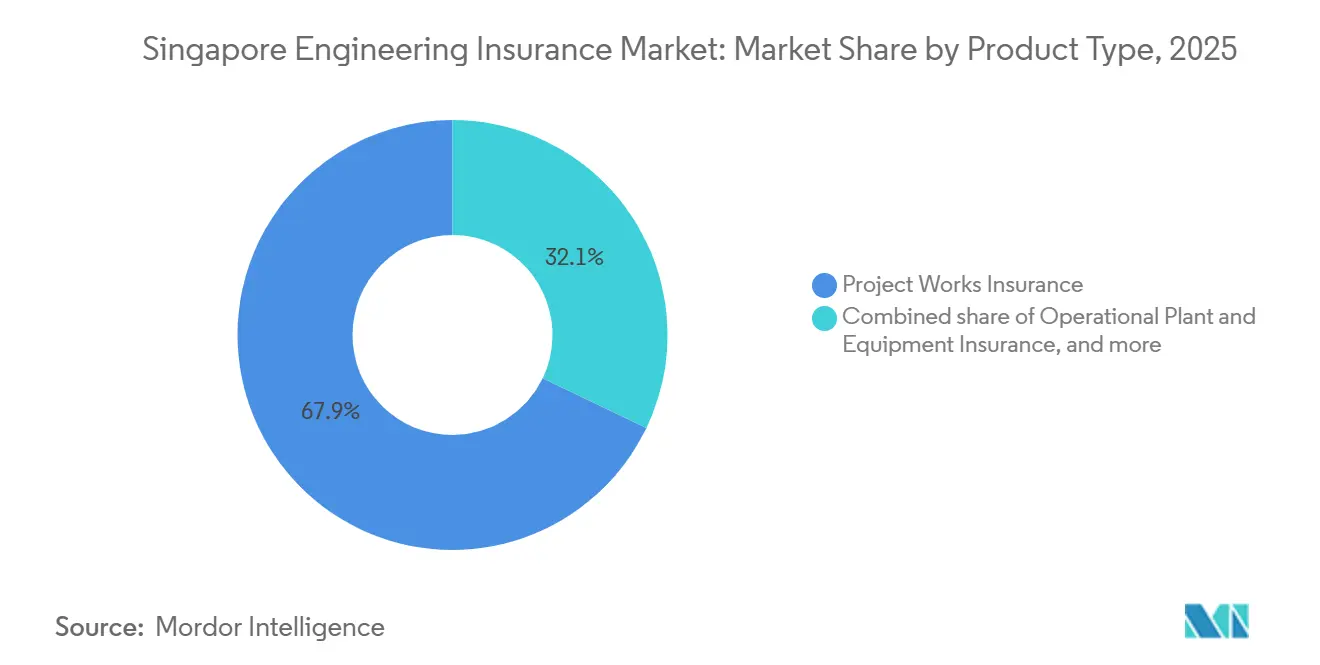
Project works insurance held 67.89% of the Singapore engineering insurance market share in 2025. Its leading position reflected the concentration of public infrastructure and other large construction contracts within the insured base. Construction all-risk and erection all-risk policies support civil, institutional, and commercial works during their build phases. Public-sector contract requirements also create recurring demand for these policies, and the category remains closely linked to the timing of major contract awards. Project Works Insurance should remain central while airport, port, rail, public-housing, and related infrastructure projects continue through their construction stages.
Operational plant and equipment insurance is projected to grow at a 7.23% CAGR from 2026 to 2031. The Singapore engineering insurance market size reflects demand from semiconductor fabrication plants, data center systems, energy storage installations, and other operating assets with complex equipment. These facilities need protection for machinery breakdown, electrical failure, and business interruption after construction has finished. Contractors’ plant and machinery insurance remains more closely linked to construction output, equipment replacement, and the turnover of Singapore’s crane and machinery fleet. Technical underwriters with equipment-risk expertise are therefore well placed to serve a premium mix that is gradually shifting toward higher-value operating facilities.


By Application: Buildings Remain the Largest Base as Digital Infrastructure Expands
Buildings accounted for 49.58% of the Singapore engineering insurance market share in 2025. This position reflected the continued delivery of public housing, institutional redevelopment, hospital, university, and commercial building projects. The housing and development board planned around 55,000 build-to-order units between 2025 and 2027, supporting a steady pipeline of building work. Civil and transport infrastructure benefits from active contract awards, while energy, water, and waste utility work is supported by the integrated waste management facility phase 2. Industrial and process manufacturing on Jurong Island adds replacement-value exposure through specialty chemical facilities and other industrial assets.
Digital infrastructure is forecast to grow at an 8.43% CAGR from 2026 to 2031. The Singapore engineering insurance market size is supported by engineering insurance demand arising from the data center capacity allocation framework and the planned 700-megawatt Jurong Island park. Data centers combine major construction values with exacting electrical, cooling, backup-power, and continuity requirements. These characteristics can create risk accumulation that standard construction all-risk structures were not designed to manage across several facilities or phases. The Infocomm Media Development Authority’s resilience and incident-reporting guidance also affects policy wording and the assessment of engineering, property, and cyber-related exposures.
By End User: Government Procurement Supports Volume and Private Operators Drive Growth
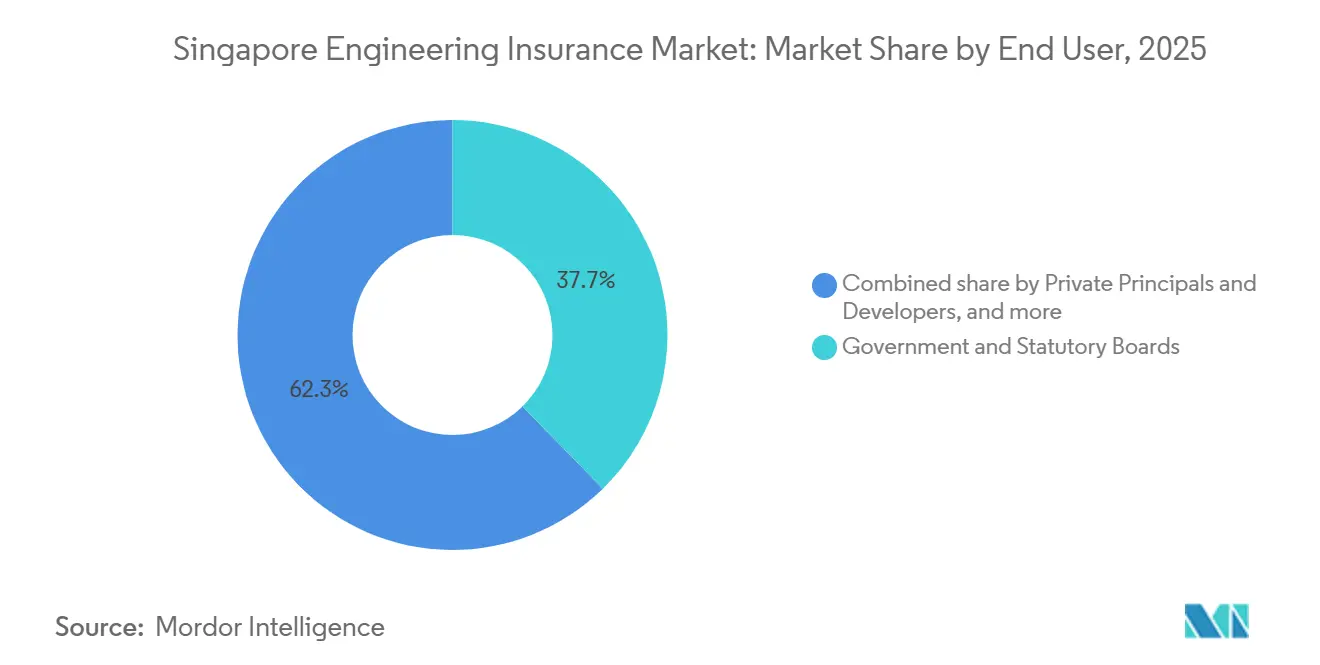
Government and statutory boards held 37.67% of the Singapore engineering insurance market share in 2025. Public agencies routinely require comprehensive engineering protection across tender contracts, creating a predictable premium base. This demand supports construction all-risk and contractors’ plant policies for a broad range of publicly procured works. Contractors form the second-largest end-user group because their insurance needs follow tender volumes, project activity, and policy requirements. Private principals and developers have more flexible purchasing behavior, with large commercial and data center projects attracting competition, while smaller private projects may buy only the required level of cover.
Private owner-operators are forecast to grow at a 7.56% CAGR from 2026 to 2031. The Singapore engineering insurance market size is supported by demand from semiconductor manufacturers, data center operators, and specialty chemical companies for operational insurance after project completion. Their policies can combine plant, machinery, equipment breakdown, and business interruption protection within longer renewal cycles. This differs from a single construction placement because the cover can continue through the operating life of the asset. Applied Materials’ USD 500 million Tampines Campus illustrates the operational exposure associated with automated manufacturing, cleanroom systems, and utility infrastructure.
Geography Analysis
The west region held 28.49% of the Singapore engineering insurance market share in 2025. The Singapore engineering insurance market size is supported by Jurong Island’s concentration of energy, chemical, digital infrastructure, and new energy projects, while Tuas Mega Port adds civil engineering demand across large construction packages. The Urban Redevelopment Authority identifies the West as a future-ready economic hub with manufacturing and sustainability activity. Jurong Innovation District adds engineering exposure across research, prototyping, and production facilities, broadening the region’s insured asset base beyond heavy industry. The concentration of large industrial assets raises both premium potential and risk accumulation for insurers, particularly where several high-value projects are located within the same operating area.
The east region is projected to grow at a 6.82% CAGR from 2026 to 2031, the highest rate among the regional areas. Changi Airport Terminal 5, the Loyang-Changi data center cluster, and advanced manufacturing projects support this growth. Applied Materials’ Tampines Campus more than doubled the company’s advanced cleanroom capacity and supports ongoing operational engineering demand. Micron’s new wafer fabrication facility adds USD 24 billion of investment and supports construction and future operational insurance needs. Together, these projects connect logistics, manufacturing, digital infrastructure, and associated equipment exposure across the eastern corridor.
The central region is supported by commercial redevelopment and health and education projects. The North-East Region includes industrial engineering activity in Defu and data center activity in Tai Seng. The North Region is supported by the Woodlands Checkpoint redevelopment and Micron’s Woodlands facility. Coastal requirements also affect how insurers assess risks in the East and West Regions, particularly for ports, reclamation, and other coastal assets. The Public Utilities Board’s Coastal Protection Code requires coastal landowners to plan protection measures for projected sea-level rise, with obligations effective from 2028.
Competitive Landscape
The Singapore engineering insurance market is fragmented among international specialty carriers, Japan-affiliated composite insurers, and Lloyd’s syndicates. Relevant international carriers include HDI Global SE, Chubb Insurance Singapore, Zurich Insurance, and Berkshire Hathaway Specialty Insurance. Japan-affiliated participants include MSIG, Sompo, and Tokio Marine, while Lloyd’s Asia provides a platform for more than 200 underwriters across 15 syndicates. This range of participants provides capacity for high-value commercial, infrastructure, manufacturing, and digital-infrastructure risks. It also increases the need for carriers to differentiate through risk engineering, project controls, data quality, and specialist underwriting rather than price alone.
Chubb Singapore held a 6% share of local fund gross premiums in Singapore’s property and casualty sector in 2024. HDI Global Singapore expanded its data center and renewable energy portfolios during the first half of 2026. The branch also reported a group combined ratio of 90.7% and continued its Xcelerate29 strategy. These examples show that insurers are directing capacity and technical resources toward data center and energy-transition risks. The competitive context also reflects the broader Asia-Pacific insurance environment, with international firms applying capabilities developed in the United Kingdom and the United States to regional specialty risks.
Insurers in the Singapore engineering insurance market have scope to develop cover for weather-related project delays, hydrogen and ammonia operating assets, and integrated data center exposures. Data center clients may need policies that address construction, operating equipment, and cyber-physical dependencies in a coordinated way. The Monetary Authority of Singapore’s proposed Protected Cell Company framework could offer an option for alternative risk transfer for large project owners. The competitive structure does not indicate a dominant carrier with a controlling engineering position. Available market-share information is limited to Chubb’s broader property and casualty position, so it does not establish a leading engineering insurer.
Singapore Engineering Insurance Industry Leaders
NTUC Income Insurance Ltd
Chubb Insurance Singapore Limited
MSIG Insurance (Singapore) Pte Ltd
AIG Asia Pacific Insurance Pte Ltd
QBE Insurance (Singapore) Pte Ltd
- *Disclaimer: Major Players sorted in no particular order

Recent Industry Developments
- August 2026: Singapore's EDB and IMDA awarded 200 megawatts of new data centre capacity under DC-CFA2 to Digital Realty, Equinix, Keppel Data Centres, and STT GDC (50 megawatts each) on Jurong Island's 20-hectare low-carbon park, with facilities required to meet Green Mark for Data Centres Platinum standards, directly expanding multi-phase engineering insurance demand.
- July 2026: MAS, with IMF technical assistance, initiated Singapore's first-ever physical climate risk scenario analysis for the financial sector. Under MAS transition planning rules effective from 2027, institutions must demonstrate mitigation of physical climate threats, directly affecting underwriting standards for engineering risks on climate-exposed assets.
- April 2026: Digital Realty targeted approximately SGD 7 billion (USD 5.3 billion) in Singapore investment, including more than SGD 4.3 billion (USD 3.3 billion) in new data centre development, with an Innovation Lab planned at its Loyang facility in H2 2026, generating multi-year CAR and delay in start-up insurance exposure.
- March 2026: MAS Notice 133 (Amendment) 2026 took effect on 31 March 2026, updating the RBC 2 valuation and capital framework; a companion amendment effective 1 January 2026 tightened AT1 and Tier 2 capital recognition criteria, requiring insurers, including engineering lines, to calibrate capital buffers with greater granularity.


Singapore Engineering Insurance Market Report Scope
| Project Works Insurance |
| Operational Plant and Equipment Insurance |
| Contractors’ Plant and Machinery Insurance |
| Buildings |
| Civil and Transport Infrastructure |
| Energy, Water and Waste Utilities |
| Industrial and Process Manufacturing |
| Digital infrastructure |
| Contractors |
| Private Principals and Developers |
| Private Owner-Operators |
| Government and Statutory Boards |
| Central Region |
| East Region |
| North Region |
| North-East Region |
| West Region |
| By Product Type | Project Works Insurance |
| Operational Plant and Equipment Insurance | |
| Contractors’ Plant and Machinery Insurance | |
| By Application | Buildings |
| Civil and Transport Infrastructure | |
| Energy, Water and Waste Utilities | |
| Industrial and Process Manufacturing | |
| Digital infrastructure | |
| By End User | Contractors |
| Private Principals and Developers | |
| Private Owner-Operators | |
| Government and Statutory Boards | |
| By Geography | Central Region |
| East Region | |
| North Region | |
| North-East Region | |
| West Region |


Key Questions Answered in the Report
What is the projected value of Singapore engineering insurance in 2031?
The sector is projected to reach USD 375.03 million by 2031, expanding at a 5.5% CAGR from 2026.
Which product has the largest share in Singapore engineering insurance?
Project Works Insurance led with 67.89% share in 2025, supported by public infrastructure and major construction contracts.
Which application is growing fastest in Singapore?
Digital Infrastructure is projected to expand at an 8.43% CAGR through 2031, supported by data center investment.
Which end user is expected to grow most quickly?
Private Owner-Operators are forecast to grow at a 7.56% CAGR through 2031 as operating facilities require longer-term coverage.
Which Singapore region has the highest growth outlook?
The East Region is projected to grow at a 6.82% CAGR through 2031, supported by airport, data center, and manufacturing activity.
What factors are shaping engineering insurance demand in Singapore?
Infrastructure construction, data centers, semiconductor plants, and energy-transition projects are increasing demand for specialist underwriting.
Page last updated on:





