
Singapore Cargo Insurance Market Size and Share
Market Overview
| Study Period | 2020 - 2031 |
|---|---|
| Forecast Data Period | 2026 - 2031 |
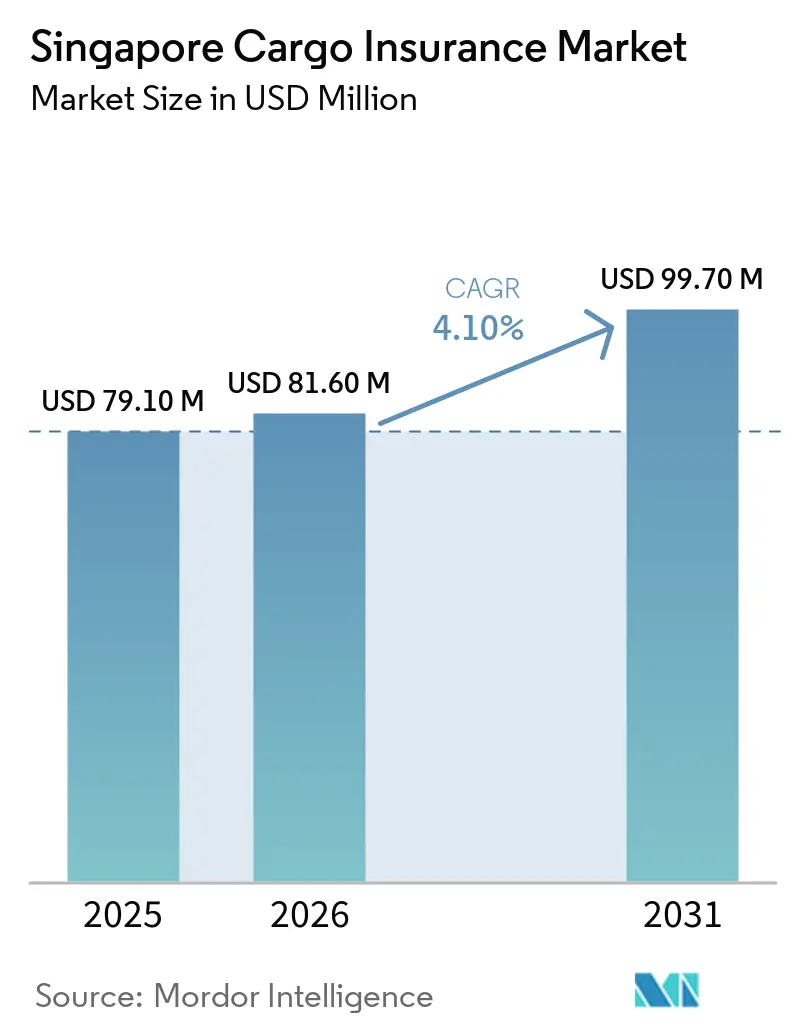
| Base Year Market Size (2025) | USD 79.10 Million |
| Market Size (2026) | USD 81.60 Million |
| Market Size (2031) | USD 99.70 Million |
| Growth Rate (2026 - 2031) | 4.10 % |
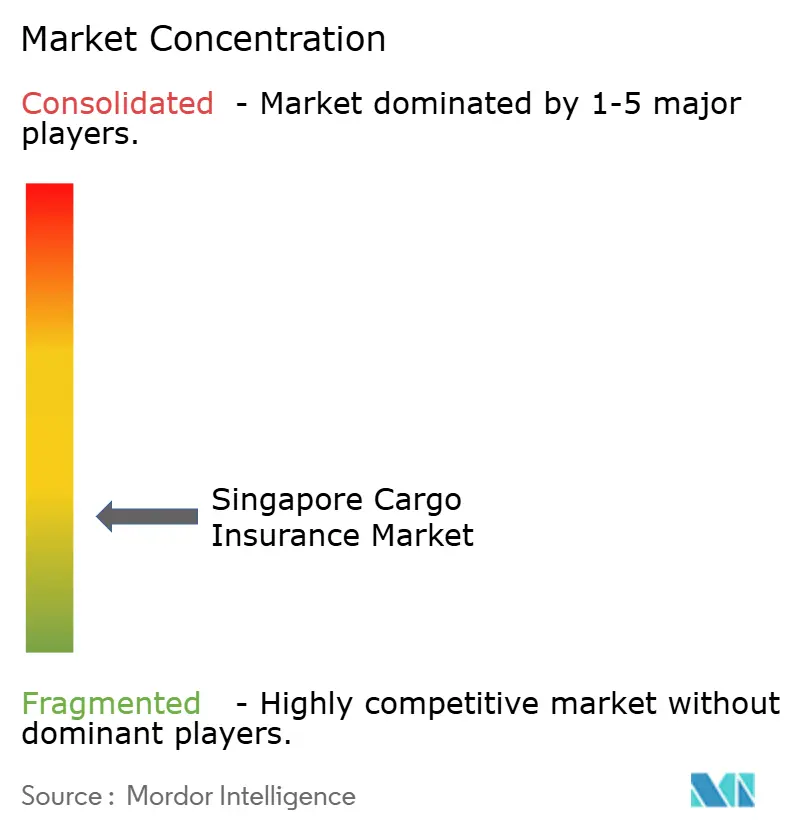
| Market Concentration | Low |
Major Players *Disclaimer: Major Players sorted in no particular order Image © Mordor Intelligence. Reuse requires attribution under CC BY 4.0. | |
Singapore Cargo Insurance Market Analysis by Mordor Intelligence
The Singapore cargo insurance market size was valued at USD 79.1 million in 2025, is estimated at USD 81.6 million in 2026, and is forecast to reach USD 99.7 million by 2031, growing at a CAGR of 4.1% during 2026-2031. Singapore handled a record 44.7 million TEUs in 2025, while merchandise trade reached USD 1.1 trillion, supporting a large and concentrated base of cargo exposures. The Singapore cargo insurance market benefits from the city-state’s role in transshipment, trade finance, and regional distribution. Rising electronics trade raises insured values, while more complex shipments require broader policy structures and specialist underwriting. Digital trade documents and automated placement tools can reduce processing time for routine transactions, although specialist cargo will continue to need broker and insurer review. Rate pressure in standard cargo business may limit premium growth, which makes underwriting discipline and risk engineering more important for insurers operating in Singapore.
Key Report Takeaways
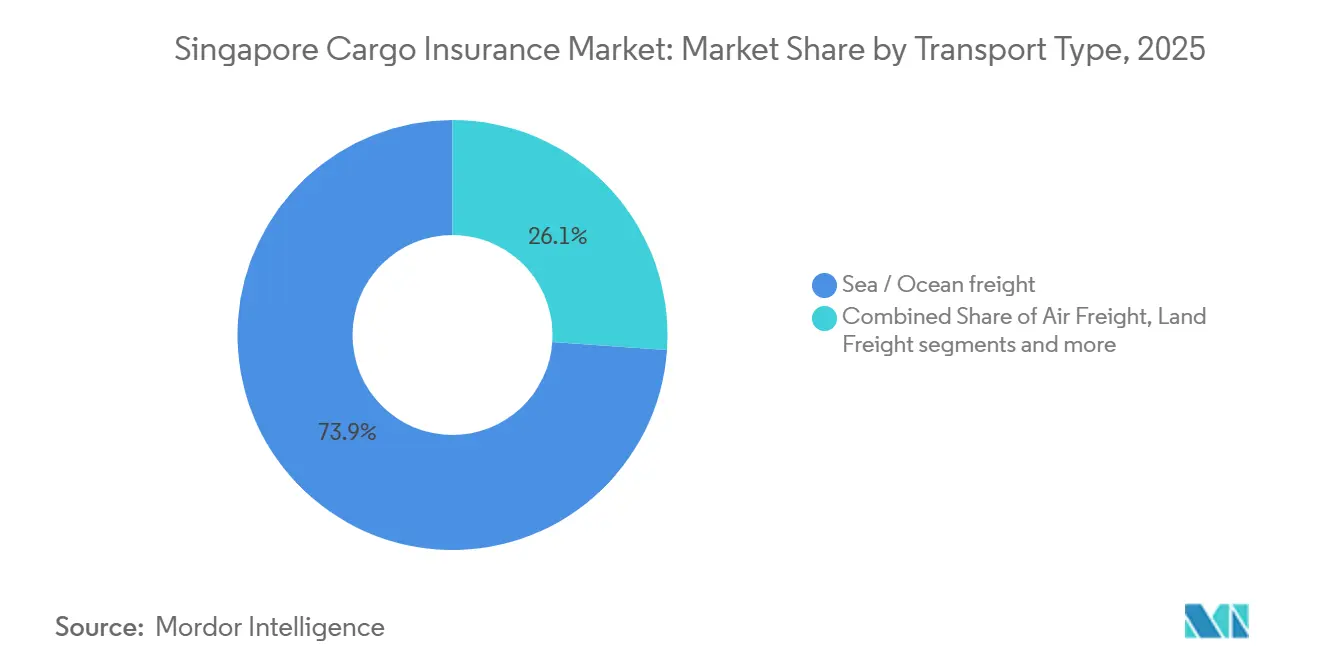
- By transport mode, sea and ocean freight held 73.9% of the Singapore cargo insurance market share in 2025, while air freight is projected to grow at a CAGR of 5.8% through 2031.
- By cargo type, electronics, electrical equipment, and semiconductors held 27.1% of the Singapore cargo insurance market share in 2025, while pharmaceuticals and healthcare are forecast to grow at a CAGR of 6.0% through 2031.
- By end user, trading houses, importers, and exporters held 36.1% of the Singapore cargo insurance market share in 2025, while retailers and e-commerce cargo owners are projected to grow at a CAGR of 6.3% through 2031.
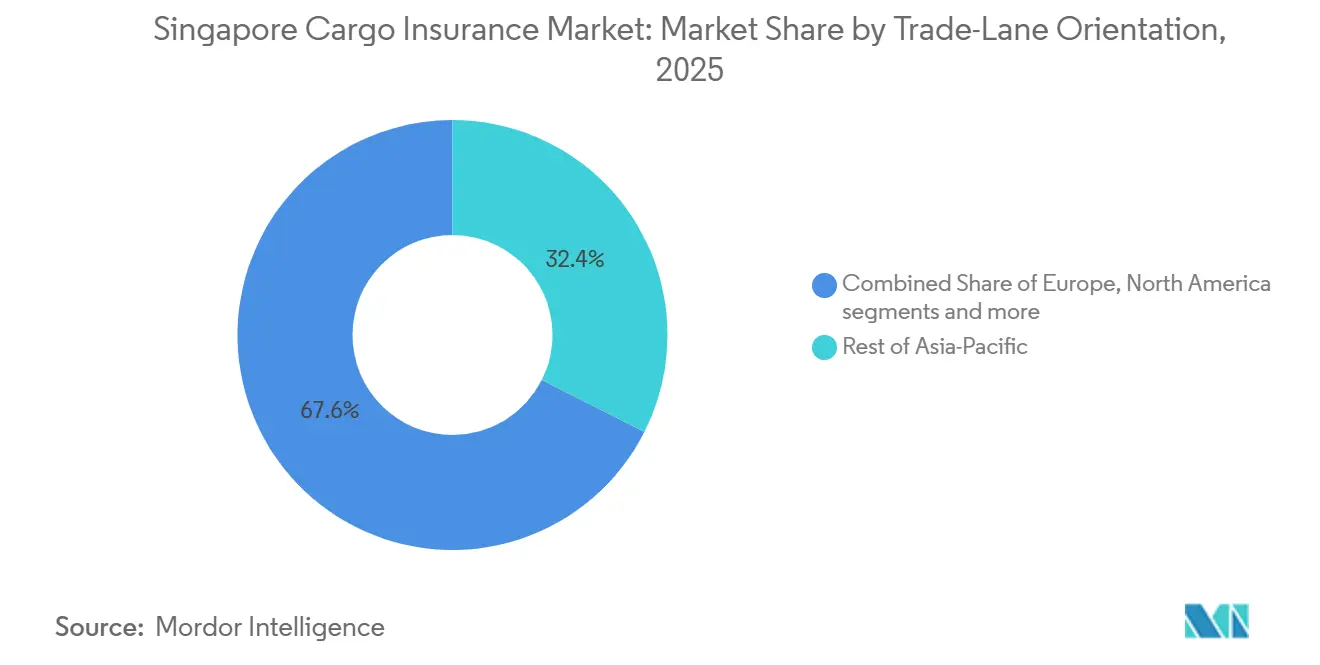
- By trade-lane orientation, the Rest of Asia-Pacific held 32.4% of the Singapore cargo insurance market share in 2025, while North America is projected to grow at a CAGR of 5.5% through 2031.
- By distribution channel, brokers held 77.7% of the Singapore cargo insurance market share in 2025, while the direct channel is forecast to grow at a CAGR of 7.2% through 2031.
Note: Market size and forecast figures in this report are generated using Mordor Intelligence’s proprietary estimation framework, updated with the latest available data and insights as of January 2026.
Singapore Cargo Insurance Market Trends and Insights
Drivers Impact Analysis*
| Driver | (~) % Impact on CAGR Forecast | Geographic Relevance | Impact Timeline |
|---|---|---|---|
| Singapore’s Transshipment and Trading Hub Position | +0.9% | Global, concentrated at Singapore port infrastructure | Long-term (≥ 4 years) |
| Cross-Border and Multimodal Cargo Growth | +0.7% | Southeast Asia and Singapore intra-ASEAN corridors | Medium term (2-4 years) |
| Supply-Chain Disruptions and Transit Risk Exposure | +0.8% | Global, with acute exposure in the Malacca and Red Sea corridors | Short term (≤ 2 years) |
| High-Value and Specialized Cargo Trade | +0.6% | Asia-Pacific, North America, and Europe trade lanes | Medium term (2-4 years) |
| Digital Cargo Insurance and Trade Documentation | +0.4% | Global, with Singapore as a trade and technology center | Long term (≥ 4 years) |
| Cargo Visibility and Risk Management Demand | +0.3% | North America and Europe, with Singapore as an origin and transshipment node | Medium term (2-4 years) |
| Source: Mordor Intelligence | |||
Singapore’s Position as a Major Asia-Pacific Transshipment and Trading Hub
Singapore’s port processed a record 44.7 million TEUs in 2025, up 8.6% from 2024, and the Singapore cargo insurance market draws on the concentration of goods moving through this network[1]Maritime and Port Authority of Singapore, “Singapore Posts Record Port Performance in 2025 and Develops Future Readiness Through Industry Collaborations for 2026,” MPA, mpa.gov.sg.. The port activity supports regular movement of containerized goods across global shipping routes. Electronics, petrochemicals, and project goods can carry high declared values and require more detailed insurance arrangements. These shipments often use open-cover structures instead of isolated policies because traders and logistics firms manage recurring movements. More than 200 international shipping groups operated from Singapore after 35 companies opened or expanded operations there in 2025. Singapore’s registered fleet reached 137.5 million gross tons at the end of 2025, adding to the country’s wider marine services base.
Rising Exposure to Supply-Chain Disruptions and Cargo Transit Risks
Cargo exposure rises when vessels are delayed, rerouted, or held at transshipment points. Singapore’s role as a major transfer point means that disruptions can leave cargo in ports, bonded warehouses, and yards for longer periods. Extended dwell times can increase accumulation risk for insurers, even when the number of shipments does not change. The Singapore cargo insurance market, therefore, needs policy limits and declarations that reflect where goods are held during a disruption. Geopolitical events also increase interest in transit-risk, war-risk, and political violence cover for affected routes. This creates a different pricing environment from routine commodity shipments because the risk depends on route conditions, cargo concentration, and the duration of delay.
Growing Trade in High-Value and Specialized Cargo
Singapore’s electronic non-oil domestic exports rose 12.7% in 2025, supported by demand for integrated circuits, and export orders remained strong into the first quarter of 2026. The electronics cluster accounted for 43.2% of manufacturing nominal value added in 2025, and semiconductors made up 80.2% of that cluster’s output[2]Ministry of Trade and Industry Singapore, “Singapore’s Electronics Cluster and the Impact of the AI Boom,” Economic Survey of Singapore, mti.gov.sg.. These goods can produce high values on a single conveyance and may exceed ordinary policy limits. Insurers may use co-insurance, specialist risk review, and tighter concentration controls for these shipments. Battery materials, renewable energy components, and temperature-sensitive pharmaceuticals also require specific underwriting knowledge. The Singapore cargo insurance market can gain from this mix of cargo, but insurers need to match capacity and policy terms to the physical and financial characteristics of each shipment.
Digitalization of Cargo Insurance and Trade Documentation
The Infocomm Media Development Authority launched the TradeTrust Readiness Program in February 2026 to support live commercial adoption of electronic bills of lading[3]Infocomm Media Development Authority, “TradeTrust Readiness Programme,” IMDA, imda.gov.sg.. The 12-month program connects digital trade platforms with carriers and supports a more practical shift from paper documents. The International Group of P&I Clubs approved four TradeTrust-enabled platforms, which support the use of eligible electronic bills of lading in insured maritime trade. Digital documentation can reduce uncertainty when cargo insurers review declarations and supporting records. Cargo Community Network and Otonomi launched automated delay insurance on CUBEforall in October 2025, using real-time transport data for policy binding and claims settlement. The Singapore cargo insurance market is likely to see routine, lower-complexity placements move faster through digital channels, while high-limit and unusual risks remain subject to detailed review.
Restraints Impact Analysis*
| Restraint | (~) % Impact on CAGR Forecast | Geographic Relevance | Impact Timeline |
|---|---|---|---|
| Competition and Downward Premium Rate Pressure | -0.6% | Global, most pronounced across Asia, including Singapore | Short term (≤ 2 years) |
| Complex Underwriting for Emerging and Multimodal Risks | -0.3% | Global, with particular exposure on Singapore-origin multimodal lanes | Medium term (2-4 years) |
| Cargo Accumulation During Port and Supply-Chain Disruptions | -0.4% | Singapore port, bonded warehouses, and transshipment facilities | Short term (≤ 2 years) |
| Limited Loss Data for New High-Value Cargo Categories | -0.2% | Global, with material relevance to Singapore cargo flows | Medium term (2-4 years) |
| Source: Mordor Intelligence | |||
Intense Competition and Downward Pressure on Cargo Insurance Premium Rates
The Singapore cargo insurance market is characterized by intense competition among direct insurers, international composite insurers, specialty insurers, and Lloyd’s syndicates, giving brokers and large commercial buyers greater flexibility to compare coverage terms, service levels, and premium rates. Increased underwriting capacity and competitive pricing can benefit trading and logistics companies by reducing insurance costs in the short term; however, sustained downward pressure on premiums can constrain insurers’ premium income and underwriting margins, particularly when cargo values and shipment activity increase faster than insurance rates. This may limit insurers’ ability to invest in technology, specialist underwriting expertise, risk engineering, and cargo-monitoring capabilities, while also creating pressure to maintain adequate pricing for higher-exposure cargo accumulated at ports, warehouses, distribution centers, and transshipment facilities.
Complexity in Underwriting Emerging and Multimodal Cargo Risks
Multimodal shipments move by sea, air, and land under a connected commercial arrangement. This can make responsibility and coverage more difficult to establish when a loss occurs during transfer between modes. Singapore is especially exposed to this issue because transshipment is central to its logistics role. New cargo types, including advanced electronics, battery materials, and high-capacity computing equipment, may have values or loss characteristics outside standard policy assumptions. QBE identified technology, geopolitics, and cargo complexity as key issues for Asia-Pacific marine insurers in 2026[4].QBE Insurance, “Braving New Worlds: The QBE Marine Insurance Risk Outlook for Asia 2026,” QBE Singapore Newsroom, qbe.com. The Singapore cargo insurance market may face cautious capacity decisions until insurers develop more consistent data, terms, and underwriting approaches for these risks.
*Our forecasts treat driver/restraint impacts as directional, not additive. The impact forecasts reflect baseline growth, mix effects, and variable interactions.
Segment Analysis
By Transport Mode: Sea Freight Leads Premiums While Air Freight Expands
Sea and ocean freight held 73.9% of the Singapore cargo insurance market share in 2025, making it the largest transport mode in the Singapore cargo insurance market. The position reflects Singapore’s role as a major liner and transshipment hub. Cargo owners moving large and regular volumes commonly use open-cover arrangements to manage repeated declarations. The mode includes commodity flows, manufactured goods, and high-value containerized cargo. Port scale supports a deep flow of insurable exposures across many shipping lines and destinations. Land freight serves the Singapore-Johor and wider Peninsular Malaysia corridor. This business is smaller and more stable because routes are shorter and transport patterns are more established. It remains important for cargo moving between ports, warehouses, industrial sites, and regional distribution centers.
Air freight is the fastest-growing transport mode, with a forecast CAGR of 5.8% through 2031. Changi Airport handled 2.1 million tonnes of freight in 2025, up 4.5% from the prior year. Air freight supports electronics, semiconductor equipment, pharmaceuticals, and other goods where speed and cargo value are central. These shipments can command higher premiums per unit of insured value because a delay or loss may have greater commercial consequences. The Singapore cargo insurance market size is exposed to the shift toward air cargo through policy demand for time-sensitive goods. Faster air cargo growth can support premium yield even if sea freight continues to dominate total premium. Insurers still need to assess packaging, security, temperature control, and handling quality. The difference between sea and air risks supports separate underwriting practices within marine cargo portfolios.


By Cargo Type: Electronics Lead Premiums While Pharmaceuticals Grow Fastest
Electronics, electrical equipment, and semiconductors held 27.1% of the Singapore cargo insurance market share in 2025, making it the largest cargo type segment. Singapore’s electronics base supports this position through large regional and global trade flows. The sector accounted for 43.2% of manufacturing nominal value added in 2025, while semiconductor output represented 80.2% of the electronics cluster. High unit values make loss prevention, secure handling, and accumulation controls important for insurers. Machinery, industrial equipment, and project cargo form another material source of demand. Chemicals, petroleum products, and dangerous goods also require specialist policy terms because of their physical loss characteristics. Food, perishables, and general merchandise add volume across routine regional movements.
Pharmaceuticals and healthcare products are the fastest-growing cargo type, with a forecast CAGR of 6.0% through 2031. Temperature-sensitive goods introduce an additional coverage issue because a temperature deviation can create a loss even without physical damage. Requirements for temperature monitoring, packaging, transport time, and notification of deviations therefore influence the Singapore cargo insurance market size. Pharmaceutical movement through air and sea routes supports demand for endorsements designed for controlled conditions. Lithium-ion battery materials and renewable energy components also add complexity because insurers need to consider their particular fire and handling risks. These goods cannot always be evaluated in the same way as standard ambient cargo. The growing mix of complex shipments can support specialist premium demand. It also makes loss data, risk engineering, and capacity management more important for cargo insurers.
By End User: Trading Houses Lead Demand While E-Commerce Changes Shipment Patterns
Trading houses, importers, and exporters held 36.1% of the Singapore cargo insurance market share in 2025, making them the largest end-user group. Singapore’s role as an entrepôt explains the importance of firms that buy, sell, and re-export goods. Non-oil re-exports increased 17.7% in 2025, following 10.2% growth in 2024. These businesses often have recurring movements and need structured policies that can cover many shipments. Manufacturers and industrial producers form a stable group because supply chains connect Singapore facilities with regional suppliers and customers. Freight forwarders, non-vessel-operating common carriers, and logistics providers also need cover related to cargo responsibility and stock throughput. Project owners and engineering contractors need specialized terms for heavy equipment and unusual loads. Each end-user group differs in the frequency, value, and contractual structure of its cargo exposures.
Retailers and e-commerce cargo owners are the fastest-growing end-user group, with a forecast CAGR of 6.3% through 2031. Their shipments are often smaller, more frequent, and more dispersed than traditional large-consignment cargo. This can shift insurance demand toward per-shipment products and automated placement. Cross-border transactions are particularly relevant because sellers and buyers may be located in different jurisdictions. The Singapore cargo insurance market size can address this business with digital certificates, embedded cover, and simplified claims processes. However, the segment also requires clear information on shipment value, carrier performance, and delivery conditions. Standardized products may work for routine packages, while higher-value goods still require detailed review. The e-commerce shift broadens the buyer base beyond established trading houses. It also increases the importance of efficient policy administration and real-time shipment information.
By Trade-Lane Orientation: Asia-Pacific Provides Volume While North America Grows Fastest
The rest of Asia-Pacific held 32.4% of the Singapore cargo insurance market share in 2025, representing the largest trade-lane orientation. The category includes cargo links with China, Japan, South Korea, Australia, and the wider Indo-Pacific. Electronics and semiconductor movements add high insured values to many of these routes. The Singapore cargo insurance market size benefits from its role as an origin, destination, and transfer point for these flows. Southeast Asia is another important orientation because intra-ASEAN production networks connect electronics, automotive components, agrifood, and consumer goods. Singapore’s re-export activity supports recurring regional cargo movements. Europe, the Middle East, and Africa, and the rest of the world provide additional business through manufactured goods, refinery products, project cargo, and commodities. Each route can have different transit conditions and policy requirements.
North America is the fastest-growing trade-lane orientation, with a forecast CAGR of 5.5% through 2031. Electronic non-oil domestic exports grew 12.7% in 2025, supporting the flow of technology products from Singapore. The United States was Changi’s second-largest air cargo market in 2025. Long-distance routes require attention to transit duration, carrier selection, storage, and handovers. The Singapore cargo insurance market can support these flows through policies that recognize high-value and time-sensitive cargo. Middle East routes can require additional attention when regional conditions affect transit security and route availability. Insurers need to distinguish routine cargo coverage from specialist extensions for more exposed routes. This supports a more differentiated approach to trade-lane underwriting.
By Distribution Channel: Brokers Lead While Direct Placement Grows Through Digital Tools
Brokers accounted for 77.7% of the Singapore cargo insurance market share in 2025, making them the leading distribution channel in the Singapore cargo insurance market. Their position reflects the complexity of open-cover negotiation, high-limit placements, and specialist marine risks. Brokers help cargo owners compare policy terms, insurer capacity, exclusions, and claims support. They are especially relevant when clients move varied goods across many countries. The Lloyd’s Asia structure also supports broker involvement in specialist placements. Agents serve smaller traders and exporters that may not require bespoke open-cover programs. Direct placement remains smaller because many commercial cargo buyers still value advice for complex risks. The channel structure, therefore, reflects both insurance complexity and the differing needs of cargo owners.
The direct channel is the fastest-growing distribution channel, with a forecast CAGR of 7.2% through 2031. Online certificates and connected platforms can make routine cargo cover easier to place. Cargo Community Network and Otonomi introduced a parametric delay insurance product through CUBEforall in October 2025. The service uses transport data to support automated policy binding and claims settlement. Digital tools can be useful for smaller commercial shippers that need fast coverage for clearly defined cargo risks. The Singapore cargo insurance market size is therefore likely to combine broker-led advice for complex risks with direct processes for standard shipments. This does not remove the need for underwriting because data quality and policy limits remain important. It changes how insurers and intermediaries reach smaller and more frequent buyers.
Competitive Landscape
The Singapore cargo insurance market has a fragmented structure with large composite insurers and specialist syndicates serving different parts of the portfolio. Chubb, AIG, MSIG, Allianz, and Zurich operate alongside Lloyd’s Asia syndicates, including Canopius, Markel, MS Amlin, Chaucer, Antares, and Munich Re Syndicate Singapore. Larger insurers can offer risk engineering, claims services, capital strength, and digital investment. Syndicates can provide capacity for unusual cargo, high limits, and specialized marine risks. Competition is strongest in placement, product design, and specialist capability rather than in unregulated entry.
MSIG Singapore partnered with MSIG Specialty Marine in September 2025, appointing it as an underwriting agent for protection and indemnity risks written from Singapore. The move expanded MSIG’s marine product range and strengthened its local access to specialist marine capability. Cargo Community Network and Otonomi launched automated delay insurance on CUBEforall in October 2025. This product addresses a need for a clearer and faster response to defined cargo delays. These developments show how insurers, intermediaries, and trade platforms are improving documentation and product delivery.
Smaller traders may need simple protection when shipment values are below the level that justifies a customized open-cover program. Digital distributors and specialist managing general agents can serve this demand with per-shipment products connected to booking or logistics data. Licensed insurers remain important because they provide the balance sheet and regulated capacity behind those products. Complex cargo, high limits, and unusual routes are likely to remain dependent on experienced underwriters and brokers.
Singapore Cargo Insurance Industry Leaders
MSIG Insurance (Singapore) Pte. Ltd.
Chubb Insurance Singapore Limited
AIG Asia Pacific Insurance Pte. Ltd.
QBE Insurance (Singapore) Pte. Ltd.
Sompo Insurance Singapore Pte. Ltd.
- *Disclaimer: Major Players sorted in no particular order

Recent Industry Developments
- February 2026: IMDA launched the TradeTrust Readiness Program to accelerate electronic Bill of Lading adoption in maritime trade, running February 2026 to March 2027; simultaneously, four TradeTrust-enabled platforms — AEOTrade, BlockPeer, Credore, and SGTraDex — received International Group of P&I Clubs approval, removing the primary insurance barrier to commercial eBL adoption across Singapore’s maritime trade corridors.
- January 2026: Singapore’s port achieved a record 44.7 million TEUs of container throughput in 2025 (+8.6% from 2024); the Maritime and Port Authority confirmed multi-fuel bunkering development — covering LNG, ammonia, and methanol — and expansion of Green and Digital Shipping Corridors with nine partner nations for 2026.
- October 2025: Cargo Community Network and insurtech Otonomi launched parametric cargo delay insurance on the CUBEforall open data platform, enabling automated policy binding triggered by real-time flight data with an instant-payout “no-claim” settlement model; the partnership marked Otonomi’s Asia-Pacific market entry, serving CCN’s network of over 16,000 freight forwarder users globally.
- July 2025: MAS issued Consultation Paper ID 08/25 on a proposed General Insurance Catastrophe Risk Requirement, opening a quantitative impact study for direct insurers and reinsurers, including cargo underwriters with port-concentration accumulation exposure; the consultation closed in September 2025.


Singapore Cargo Insurance Market Report Scope
The Singapore cargo insurance market comprises insurers, specialty underwriters, and Lloyd’s market participants that provide financial protection for goods transported by sea, air, road, and multimodal routes, covering risks such as loss, damage, theft, accidents, and other transit-related exposures. The market primarily serves Singapore’s extensive trading, logistics, shipping, manufacturing, and transshipment activities, with policies ranging from single-shipment coverage to annual cargo programs and broader marine trade solutions.
The Singapore Cargo Insurance Market is Segmented by Transport Mode (Sea/Ocean, Air, Land), Cargo Type (Electronics, Machinery, and More), End User (Manufacturers, Trading Houses, E-Commerce, Freight Forwarders, Project Owners, Others), Trade-Lane (Singapore, Southeast Asia, Asia-Pacific, Europe, North America, and More), and Distribution Channel (Brokers, Agents, Direct). The Market Forecasts are Provided in Terms of Value (USD).
| Sea / Ocean Freight |
| Air Freight |
| Land Freight |
| Electronics, Electrical Equipment and Semiconductors |
| Machinery, Industrial Equipment and Project / Out-of-Gauge Cargo |
| Chemicals, Petroleum Products and Dangerous Goods |
| Pharmaceuticals and Healthcare Products |
| Food, Perishables and Other Temperature-Controlled Cargo |
| Bulk Commodities |
| General Merchandise and Other Manufactured Goods |
| Manufacturers and Industrial Producers |
| Trading Houses, Importers and Exporters |
| Retailers and e-commerce Cargo Owners |
| Freight Forwarders, NVOCCs and Logistics Operators |
| Project Owners, EPC and Infrastructure Companies |
| Other Commercial Cargo Owners |
| Singapore Domestic Movements |
| Southeast Asia |
| Rest of Asia-Pacific |
| Europe |
| North America |
| Middle East and Africa |
| Rest of World |
| Brokers |
| Agents |
| Direct |
| By Transport Mode | Sea / Ocean Freight |
| Air Freight | |
| Land Freight | |
| By Cargo Type | Electronics, Electrical Equipment and Semiconductors |
| Machinery, Industrial Equipment and Project / Out-of-Gauge Cargo | |
| Chemicals, Petroleum Products and Dangerous Goods | |
| Pharmaceuticals and Healthcare Products | |
| Food, Perishables and Other Temperature-Controlled Cargo | |
| Bulk Commodities | |
| General Merchandise and Other Manufactured Goods | |
| By End User | Manufacturers and Industrial Producers |
| Trading Houses, Importers and Exporters | |
| Retailers and e-commerce Cargo Owners | |
| Freight Forwarders, NVOCCs and Logistics Operators | |
| Project Owners, EPC and Infrastructure Companies | |
| Other Commercial Cargo Owners | |
| By Trade-Lane Orientation | Singapore Domestic Movements |
| Southeast Asia | |
| Rest of Asia-Pacific | |
| Europe | |
| North America | |
| Middle East and Africa | |
| Rest of World | |
| By Distribution Channel | Brokers |
| Agents | |
| Direct |


Key Questions Answered in the Report
What is the projected value of Singapore cargo insurance in 2031?
The Singapore cargo insurance market is forecast to reach USD 99.7 million by 2031, growing at a CAGR of 4.1% from 2026.
Which transport mode has the largest cargo insurance premium base in Singapore?
Sea and ocean freight led with 73.9% of premium in 2025, supported by Singapore’s large transshipment network.
Which cargo category is growing fastest in Singapore?
Pharmaceuticals and healthcare are forecast to grow at a CAGR of 6.0% through 2031, supported by demand for temperature-sensitive coverage.
Why are brokers important for cargo coverage in Singapore?
Brokers held 77.7% of distribution in 2025 because many cargo owners need help with open-cover programs, high limits, and specialist terms.
What is driving direct cargo insurance placement?
The direct channel is forecast to grow at a CAGR of 7.2% through 2031 as digital certificates and automated placement tools simplify routine cover.
Which trade lane is expected to expand fastest from Singapore?
North America is forecast to grow at a CAGR of 5.5% through 2031, supported by electronics and semiconductor cargo flows.
Page last updated on:





