
Semiochemicals Market Size and Share
Market Overview
| Study Period | 2022 - 2032 |
|---|---|
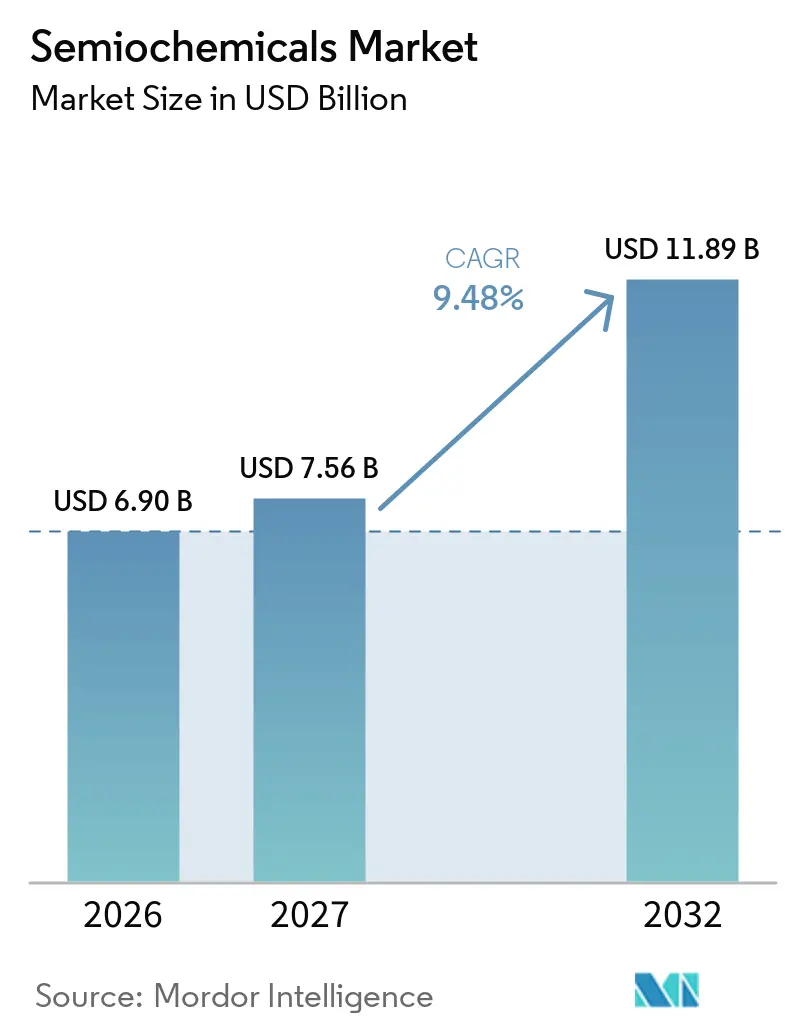
| Market Size (2027) | USD 7.56 Billion |
| Market Size (2032) | USD 11.89 Billion |
| Growth Rate (2027 - 2032) | 9.48 % |
| Fastest Growing Market | Africa |
| Largest Market | Asia Pacific |
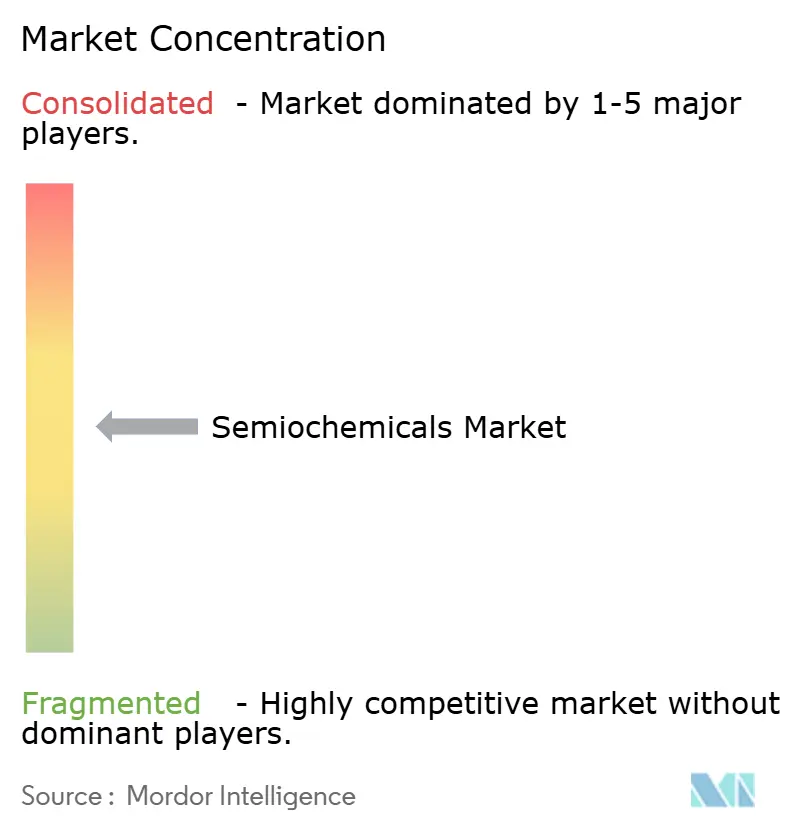
| Market Concentration | Medium |
Major Players *Disclaimer: Major Players sorted in no particular order Image © Mordor Intelligence. Reuse requires attribution under CC BY 4.0. | |
Semiochemicals Market Analysis by Mordor Intelligence
The semiochemicals market was valued at USD 6.90 billion in 2026 and is projected to grow from USD 7.56 billion in 2027 to USD 11.89 billion by 2032, registering a CAGR of 9.48% during the forecast period 2027 to 2032. Regulatory restrictions on broad-spectrum insecticides, increased emphasis on pollinator safety, and advancements in precision agriculture are transforming pest management practices for growers. Controlled-release formulations and Internet of Things (IoT) dispensers now provide season-long pest control with sub-gram dosages, making them cost-effective for both specialty and row crops. Growers are increasingly combining multiple chemical signals, such as pheromones and kairomones, to delay pest resistance and protect beneficial insects. Additionally, strategic acquisitions by major crop protection companies underscore efforts to integrate biological modes of action with semiochemicals, while venture-backed companies are driving cost reductions through fermentation-based production methods.
Key Report Takeaways
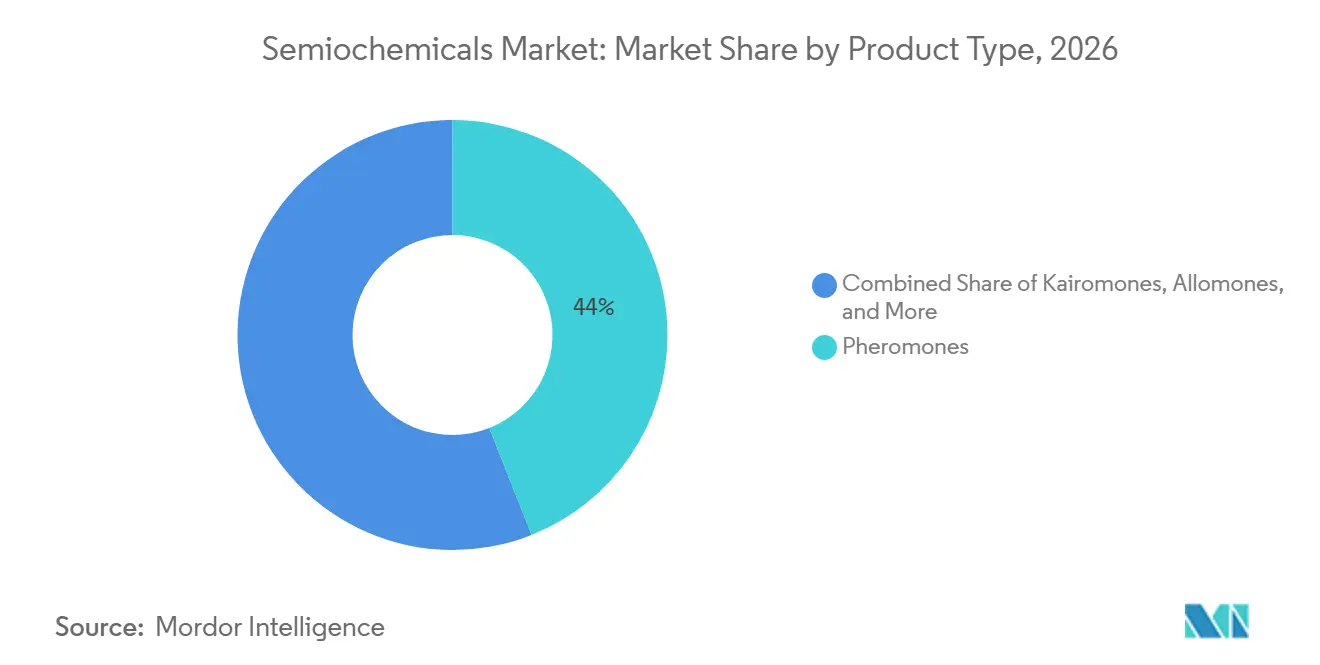
- By product type, pheromones were the largest segment and held 44.0% of the semiochemicals market share in 2026, while semiochemical blends are the fastest-growing segment and are forecast to expand at a 15.8% CAGR between 2027 and 2032.
- By source, synthetic was the largest segment and held 38.0% of the semiochemicals market share in 2026, while plant-derived is the fastest-growing segment and is forecast to expand at a 14.6% CAGR between 2027 and 2032.
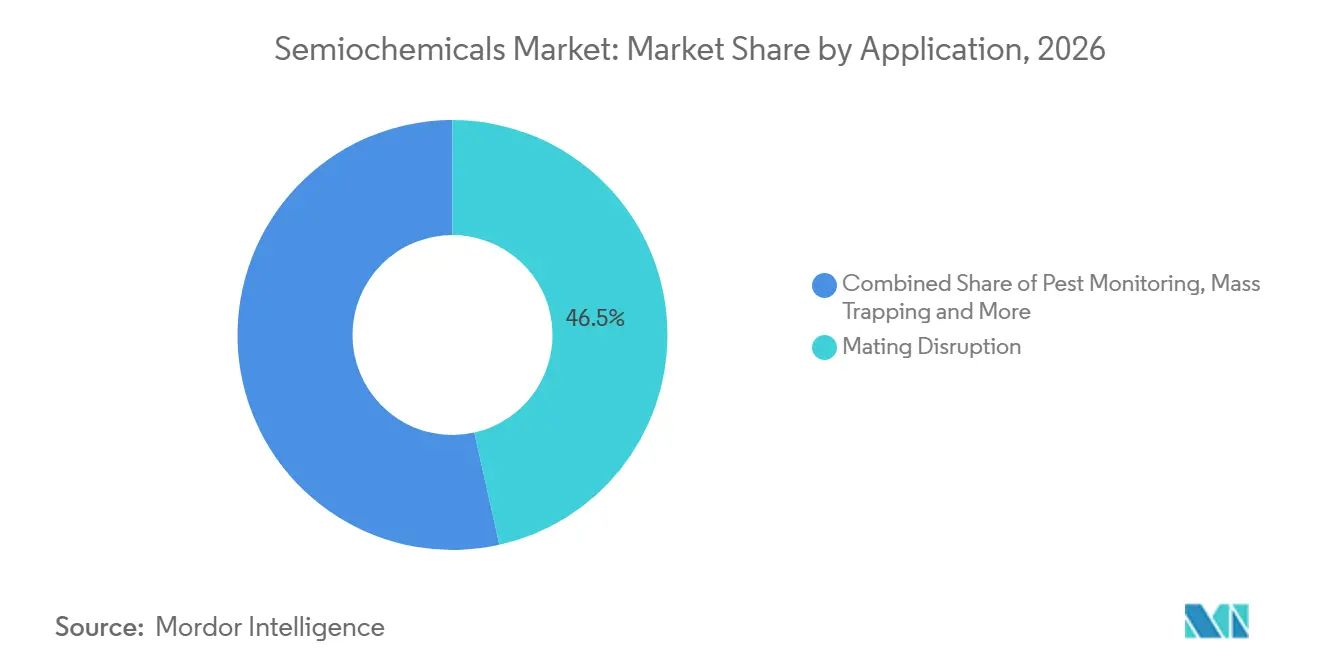
- By application, mating disruption was the largest segment and held 46.5% of the semiochemicals market share in 2026, while livestock feed-intake modulation is the fastest-growing segment and is forecast to expand at an 18.2% CAGR between 2027 and 2032.
- By livestock species, poultry was the largest segment and held 31.0% of the semiochemicals market share in 2026, while aquaculture is the fastest-growing segment and is forecast to expand at a 17.4% CAGR between 2027 and 2032.
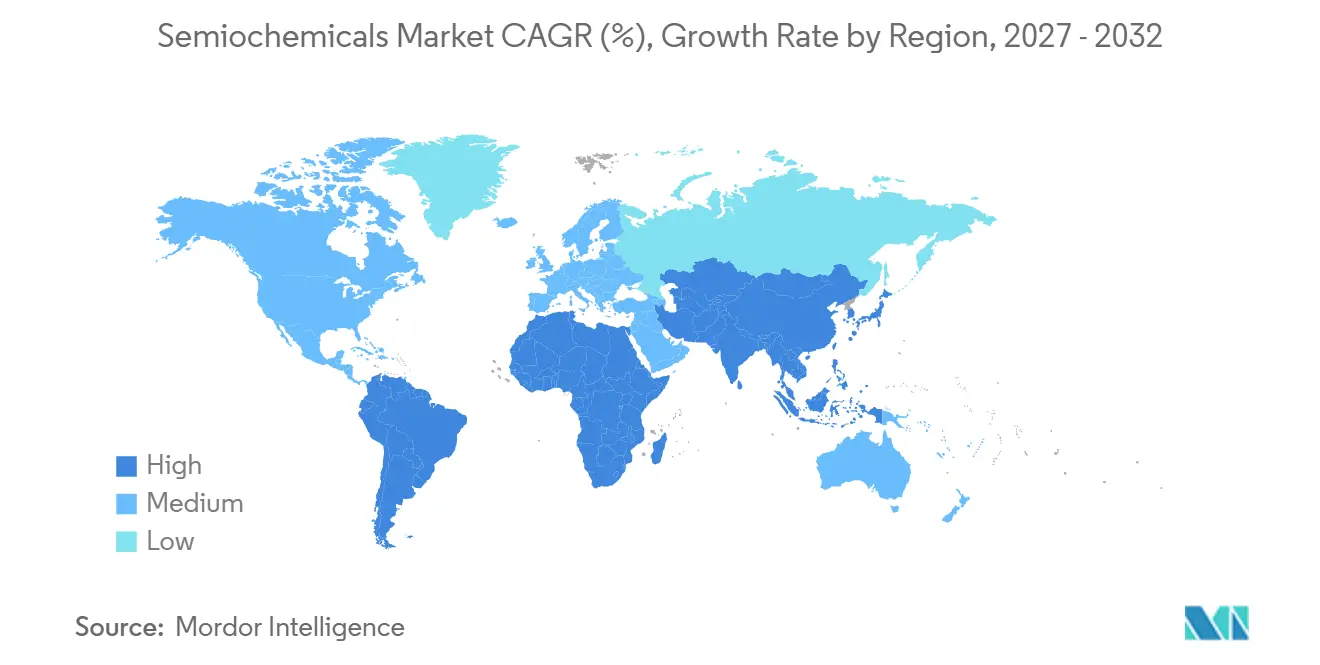
- By geography, Asia-Pacific was the largest region and held 33.0% of the semiochemicals market share in 2026, while Africa is the fastest-growing region and is forecast to expand at a 14.9% CAGR between 2027 and 2032.
Note: Market numbers in this report are based on Mordor Intelligence's proprietary estimation framework, which combines nine months of actuals with Q4 projections for base year 2026.
Market Trends and Insights
Drivers Impact Analysis of Semiochemicals Market*
| Driver | (~) % Impact on CAGR Forecast | Geographic Relevance | Impact Timeline |
|---|---|---|---|
| Adoption of Pheromone-Based Mating-Disruption in High-Value Fruit Crops | +2.1% | North America, Europe, Chile, and Australia | Medium term (2-4 years) |
| Regulatory Bans on Broad-Spectrum Pesticides Favoring Bio-Rational Solutions | +1.8% | Global, strongest enforcement in European Union and England | Short term (≤ 2 years) |
| Rapid Expansion of Organic Acreage in Asia-Pacific | +1.5% | China, India, and Southeast Asia | Medium term (2-4 years) |
| Feed Conversion-Efficiency Gains in Poultry Through Kairomone Blends | +1.3% | Brazil, United States of America, and China | Long term (≥ 4 years) |
| Precision-Ag Platforms Integrating Semiochemical Dispensers | +1.2% | North America, Europe, advanced and South America | Medium term (2-4 years) |
| Emergence of Climate-Resilient Semiochemical Formulations | +0.9% | Africa, Southeast Asia, and Brazil | Long term (≥ 4 years) |
| Source: Mordor Intelligence | |||
Adoption of Pheromone-Based Mating-Disruption in High-Value Fruit Crops
Mating disruption has become a widely adopted semiochemical strategy in almond, pistachio, and walnut orchards due to its effectiveness in suppressing target pest populations without promoting resistance. Suterra’s aerosol Puffer devices, deployed at a rate of one unit per acre, now cover over 400,000 acres in California. This method has reduced navel orangeworm damage by more than 50% when combined with monitoring traps [1]. The technique minimizes the need for repeated insecticide applications, reduces residue levels that could jeopardize export certification, and helps preserve beneficial arthropods essential for integrated pest management programs. Additionally, growers report operational cost savings due to the once-per-season refill schedule and fewer sprayer passes. The adoption of this approach is expanding into grape and citrus orchards as generic insecticides become less effective and consumer demand for residue-free produce continues to grow.
Regulatory Bans on Broad-Spectrum Pesticides Favoring Bio-Rational Solutions
England's decision to phase out clothianidin, imidacloprid, and thiamethoxam by December 2024 highlights a global trend toward stricter pesticide regulations [2]. In the European Union, straight-chain lepidopteran pheromones benefit from a streamlined approval process, reducing dossier costs and fostering portfolio expansion. This regulatory advantage accelerates commercialization for established players with existing data packages, while new kairomones are required to undergo full toxicology assessments. This disparity increases the attractiveness of semiochemicals for growers aiming to meet regulatory requirements without compromising yields, driving the semiochemicals market toward double-digit growth rates.
Rapid Expansion of Organic Acreage in Asia-Pacific
China and India are increasing organic vegetable and fruit production, supported by government incentives and growing consumer awareness of health benefits. As organic standards restrict the use of synthetic insecticides, there is consistent demand for pheromone traps and mating-disruption products. Field demonstrations pairing lemongrass-based attractants with pheromone lures have shown enhanced trap catches and reduced pest damage [3]. Smallholders in Southeast Asia, once hesitant due to upfront costs, are adopting subscription models that bundle monitoring devices, advisory services, and credit, shortening payback to a single season. The semiochemicals market thus deepens its foothold in the region’s expanding organic value chains.
Feed Conversion-Efficiency Gains in Poultry Through Kairomone Blends
Poultry integrators are testing semiochemical feed additives that calm birds, reduce aggression, and improve uniformity. Early commercial trials show a 2-4% improvement in feed-conversion ratios, delivering savings across millions of broilers per cycle. Reduced mortality and lower antibiotic usage align with brand commitments to animal welfare. Success in poultry is driving research in aquaculture, where water-stable kairomones are reducing cannibalism among shrimp and finfish. As nutritionists document performance gains, livestock producers are reallocating budgets previously used for growth promotants to semiochemicals, expanding the semiochemicals market beyond crop applications.
Restraints Impact Analysis of Semiochemicals Market*
| Restraint | (~) % Impact on CAGR Forecast | Geographic Relevance | Impact Timeline |
|---|---|---|---|
| High Formulation and Micro-Encapsulation Costs | -0.8% | Global, acute among price-sensitive smallholders | Short term (≤ 2 years) |
| Limited Field-Efficacy Data Under Tropical Humidity | -0.6% | Africa, Southeast Asia, and Central America | Medium term (2-4 years) |
| Fragmented Distribution in South America Smallholder Channels | -0.5% | Brazil and Argentina | Medium term (2-4 years) |
| Regulatory Uncertainty Over Synthetic-Analog Approvals in Europe | -0.4% | Continental Europe | Long term (≥ 4 years) |
| Source: Mordor Intelligence | |||
High Formulation and Micro-Encapsulation Costs
Manufacturers incur an added cost of USD 50-150 per kilogram when using polymer coatings or mesoporous silica in controlled-release systems. While almond and wine grape growers benefit from savings due to reduced re-sprays, those cultivating maize or rice, operating on tighter margins, are more cautious. There's promise in industrial-scale fermentation, yet the pursuit of enantiomeric purity and stable yields demands significant capital. As reported by Unife, public-private initiatives in the European Union are backing process-optimization trials to cut costs by 50% in just two seasons. However, until such advancements materialize, the pricing remains a barrier for widespread adoption in staple broadacre crops.
Limited Field-Efficacy Data Under Tropical Humidity
Most peer-reviewed studies focus on Mediterranean or temperate climates, leaving agronomists in humid regions without tailored protocols. In these humid areas, pheromones degrade faster, and insect flight patterns shift, shortening the protective duration. While manufacturers are running multi-location trials in Ghana, Kenya, and Malaysia, registration agencies mandate data from two growing seasons, which delays product launches. Furthermore, grower cooperatives demand demonstration plots before adoption, prolonging the learning curve and hindering the growth of the semiochemicals market in tropical regions.
*Our forecasts treat driver/restraint impacts as directional, not additive. The impact forecasts reflect baseline growth, mix effects, and variable interactions.
Semiochemicals Market Segment Analysis
By Product Type:
Blends Address Resistance and Multi-Pest PressurePheromones accounted for the largest share of the semiochemicals market, representing 44.0% in 2026. This growth reflects a shift among growers toward multi-molecule solutions to address rising resistance and overlapping pest cycles. Field studies suggest that blends combining sex pheromones with host-plant kairomones can reduce infestation by up to 70% across multiple target species per hectare. Furthermore, research pipelines tracking over 60 candidate blends, including allomones for repellency and synomones for natural enemy attraction, underscore ongoing innovation in the market.
Semiochemical blends are the fastest-growing segment, with a projected CAGR of 15.8% from 2027 to 2032. The market's growth is driven by increasing consumer intolerance for pesticide residues and heightened audit requirements from produce retailers. Manufacturers are utilizing artificial intelligence-guided formulation techniques to synchronize the release curves of each component, ensuring balanced ratios throughout the growing season. Licensing agreements enable specialty-crop growers to refill dispensers with custom canisters tailored to their specific pest complexes, fostering recurring revenue streams. Additionally, the semiochemicals market is gaining resilience as blends replace insect growth regulators that are being phased out due to regulatory changes, reducing the likelihood of single-mode resistance outbreaks.

By Source:
Plant-Derived Molecules Capture Clean-Label DemandSynthetic pheromones held 38.0% of market share in 2026, while plant-derived volatiles are forecast to be the fastest-growing segment at a CAGR of 14.6% from 2027 to 2032, driven by increasing demand for organic certification and consumer trust. Steam-distilled essential oils such as thymol, eugenol, and geraniol offer dual functionality as repellents and microbial inhibitors, enabling hybrid formulations that combine behavioral and bioactive control.
Supply chains face challenges due to the low essential oil yields of 0.3-2.0% from fresh biomass, prompting companies to secure dedicated acreage for production. Advances in metabolic engineering of rosemary and basil are targeting a three-fold increase in volatile compound output, while green extraction technologies aim to minimize solvent waste. Synthetic biology companies are utilizing yeast fermentation of terpene pathways to address seasonal supply gaps. Integrated solutions combining synthetic backbone pheromones with plant-derived boosters leverage the advantages of both approaches, addressing regulatory, cost, and efficacy requirements within a single formulation.
By Application:
Livestock Modulation Emerges as Fastest-Growing FrontierMating disruption held 46.5% of the semiochemicals market share in 2026. Meanwhile, the livestock feed-intake modulation segment is forecast to grow at a CAGR of 18.2% from 2027 to 2032. This growth is attributed to improvements in feed efficiency, animal welfare outcomes, and strong adoption in commercial operations. Field studies indicate that poultry applications using kairomone-based fogging systems can reduce mortality and improve flock behavior within 72 hours.
Regulatory requirements for animal applications differ from those for crop protection, necessitating residue studies in meat and eggs. Early dossier approvals in Brazil and the United States indicate a move toward regulatory harmonization, which is projected to encourage further investment. The expansion of controlled-environment agriculture has facilitated cross-learning opportunities. For instance, the same IoT nebulizers used for aroma release in vertical farms are also being utilized to optimize feed-intake stimulants in poultry sheds, creating economies of scale for device manufacturers.
By Livestock Species:
Poultry Leads, Aquaculture AcceleratesPoultry held 31.0% of the semiochemicals market share in 2026, driven by the sector’s high sensitivity to feed costs and efficiency improvements, with a 3% gain in feed-conversion ratio translating into approximately USD 1.10 in additional profit per bird. Aquaculture is forecast to be the fastest-growing segment at a CAGR of 17.4% from 2027 to 2032, supported by shrimp and finfish trials demonstrating strong adoption potential, while innovations such as water-compatible microcapsules enhance feeding synchronization, reduce cannibalism, and improve biomass gain.
In East Asia, swine producers are experimenting with barn diffusers to address tail-biting issues. Yet, the high capital costs and longer production cycles are barriers to broader acceptance. For ruminants, the emphasis is on feedlot settings, not on pastures. In pastures, wind dispersion makes it tough to maintain consistent dosing, complicating the process. Research into using pheromones for rumen modulation hints at a possible reduction in methane emissions. This breakthrough could attract climate-finance incentives, bolstering the push for sustainable livestock management.
Geography Analysis
APAC Semiochemicals Market
Asia-Pacific held the largest market share of the semiochemicals market at 33.0% in 2026. This dominance is supported by the combined organic acreage of China and India. Government initiatives, including funding for demonstration farms that utilize pheromone traps and micro-sprinkler mating-disruption systems, have played a crucial role in improving agricultural practices. These measures have significantly reduced vegetable rejection rates by addressing pest-related challenges, thereby enhancing grower confidence and encouraging the adoption of semiochemicals across the region.
Africa Semiochemicals Market
Africa is projected to be the fastest-growing region in the semiochemicals market, with a CAGR of 14.9% from 2027 to 2032. Growth is fueled by donor-supported integrated pest management programs that focus on residue-free export crops such as mangoes, avocados, and cut flowers. Advances in climate-resilient formulations, which now endure high humidity in East Africa, have extended lure life from three to six months. Additionally, policy harmonization under the African Continental Free Trade Area is reducing registration barriers, facilitating regional approvals, and supporting broader market expansion.
The Americas Semiochemicals Market
In North America, the semiochemicals market shows a high installed base in tree nuts and pome fruit orchards. However, growth is plateauing as market penetration nears saturation. Expansion persists in maize-growing regions, where Provivi, Inc.’s cost-effective pheromone sachets effectively reduce fall armyworm pressure without triggering secondary pest outbreaks. In South America, market uptake is accelerating with the establishment of cold-chain hubs near Mato Grosso grain corridors. These hubs address product-integrity challenges that previously hindered demand, enabling stronger market growth.
Competitive Landscape
The market is moderately concentrated in 2026 among five major players, including Shin-Etsu Chemical Co., Ltd., Suterra LLC, ISCA Technologies, Inc., Koppert Biological Systems B.V., and Provivi, Inc. Established companies like Suterra LLC, Shin-Etsu Chemical Co., Ltd., and ISCA Technologies, Inc. leverage decades of entomological expertise and extensive global distribution networks. Meanwhile, newer entrants such as SemiosBio Technologies Inc. and Provivi, Inc. focus on fermentation-based synthesis and IoT integration, addressing cost barriers that previously limited adoption in row crops. BASF SE’s acquisition of AgBiTech in January 2026 expanded its biological portfolio to include nucleopolyhedroviruses, highlighting the ongoing convergence of microbial and semiochemical technologies.
Technological advancements in the market are centered on dose-controlled aerosol devices, stereoselective fermentation, and polymer engineering designed to extend field efficacy. SemiosBio Technologies Inc. operates one of the largest pest-monitoring sensor networks globally, utilizing predictive algorithms to adjust pheromone releases based on real-time pest pressure. These innovations enhance precision and reduce waste, making semiochemicals more effective and sustainable. Koppert Biological Systems B.V., through its August 2025 agreement with Insect Science, expanded its product portfolio to include behavior-modification solutions. This partnership complements Koppert Biological Systems B.V.’s existing expertise in bumblebees and macrobials, enabling it to offer a broader range of pest management solutions.
Strategic partnerships are facilitating faster market entry in emerging regions by combining technological expertise with established distribution networks. For example, the collaboration between Andermatt Group and Provivi, Inc in August 2025 has enabled the deployment of fall armyworm control solutions across East Africa, leveraging Andermatt’s robust biocontrol distribution infrastructure. These partnerships allow companies to address pest challenges effectively in regions with limited access to advanced agricultural technologies. Simultaneously, start-ups are attracting investor interest by targeting specialized segments such as livestock welfare and aquaculture.
Semiochemicals Industry Leaders
-
Shin-Etsu Chemical Co., Ltd.
-
Suterra LLC
-
ISCA Technologies, Inc.
-
Koppert Biological Systems B.V.
-
Provivi, Inc.
- *Disclaimer: Major Players sorted in no particular order
Semiochemicals Market Companies Covered in this Report
- Suterra LLC
- Shin-Etsu Chemical Co., Ltd.
- Koppert Biological Systems B.V.
- ISCA Technologies, Inc.
- Russell IPM Ltd
- Provivi, Inc.
- Bedoukian Research, Inc.
- Trece, Inc.
- Biobest Group NV
- BASF SE
- Mitsui Chemicals Agro, Inc.
- Sumitomo Chemical Co., Ltd.
- FMC Corporation
- SemiosBio Technologies Inc.
- Exosect Ltd.
Recent Industry Developments in Semiochemicals Market
- April 2025: FMC Corporation has launched its global pheromone solutions portfolio in Brazil, securing its inaugural product registration for Sofer Fall pheromone. Specifically designed to combat the fall armyworm, Sofer employs advanced mating disruption technology, enhanced by microencapsulation.
- September 2024: Syngenta Biologicals partnered with Provivi, Inc to develop new pheromone solutions for Yellow Stem Borer and Fall Armyworm in Asian rice and corn production. This collaboration aligns with rapid organic-acreage growth in Asia-Pacific and signals that agrochemical majors view semiochemicals as strategic to protecting staple crops.
Global Semiochemicals Market Report Scope
Semiochemicals are signaling compounds that influence the behavior of organisms, particularly insects and animals. These compounds, including pheromones, kairomones, allomones, and synomones, are widely applied in agriculture and livestock systems for pest control, mating disruption, monitoring, and behavioral modification. The semiochemicals market report is segmented by product type (pheromones, kairomones, allomones, synomones, and semiochemical blends), by source (plant-derived, insect-derived, and synthetic), by application (pest monitoring, mating disruption, mass trapping, livestock feed-intake enhancement, and stress reduction and behavior modification), by livestock species (poultry, swine, ruminants (cattle, sheep, goat) aquaculture, and other livestock species), and by geography (North America, South America, Europe, Asia-Pacific, Middle East, and Africa). The market forecasts are provided in terms of value (USD).
Segmentation Overview
| Pheromones |
| Kairomones |
| Allomones |
| Synomones |
| Semiochemical Blends |
| Plant-derived |
| Insect-derived |
| Synthetic |
| Pest Monitoring |
| Mating Disruption |
| Mass Trapping |
| Livestock Feed-Intake Modulation |
| Stress Reduction and Welfare |
| Poultry |
| Swine |
| Ruminants (Cattle, Sheep, Goat) |
| Aquaculture |
| Other Livestock Species |
| North America | United States |
| Canada | |
| Mexico | |
| Rest of North America | |
| South America | Brazil |
| Argentina | |
| Rest of South America | |
| Europe | Germany |
| France | |
| United Kingdom | |
| Italy | |
| Spain | |
| Russia | |
| Rest of Europe | |
| Asia-Pacific | China |
| India | |
| Japan | |
| Australia | |
| South Korea | |
| Rest of Asia-Pacific | |
| Middle East | Saudi Arabia |
| Turkey | |
| United Arab Emirates | |
| Rest of Middle East | |
| Africa | South Africa |
| Nigeria | |
| Egypt | |
| Rest of Africa |
| By Product Type | Pheromones | |
| Kairomones | ||
| Allomones | ||
| Synomones | ||
| Semiochemical Blends | ||
| By Source | Plant-derived | |
| Insect-derived | ||
| Synthetic | ||
| By Application | Pest Monitoring | |
| Mating Disruption | ||
| Mass Trapping | ||
| Livestock Feed-Intake Modulation | ||
| Stress Reduction and Welfare | ||
| By Livestock Species | Poultry | |
| Swine | ||
| Ruminants (Cattle, Sheep, Goat) | ||
| Aquaculture | ||
| Other Livestock Species | ||
| By Geography | North America | United States |
| Canada | ||
| Mexico | ||
| Rest of North America | ||
| South America | Brazil | |
| Argentina | ||
| Rest of South America | ||
| Europe | Germany | |
| France | ||
| United Kingdom | ||
| Italy | ||
| Spain | ||
| Russia | ||
| Rest of Europe | ||
| Asia-Pacific | China | |
| India | ||
| Japan | ||
| Australia | ||
| South Korea | ||
| Rest of Asia-Pacific | ||
| Middle East | Saudi Arabia | |
| Turkey | ||
| United Arab Emirates | ||
| Rest of Middle East | ||
| Africa | South Africa | |
| Nigeria | ||
| Egypt | ||
| Rest of Africa | ||
Key Questions Answered in the Report
What is the semiochemicals market size?
The semiochemicals market was valued at USD 6.90 billion in 2026 and is projected to grow from USD 7.56 billion in 2027 to USD 11.89 billion by 2032, registering a CAGR of 9.48% during the forecast period 2027 to 2032.
Which application will grow fastest through 2032?
Livestock feed-intake modulation is projected to advance at the fastest 18.2% CAGR from 2027 to 2032 as integrators validate feed-conversion gains.
Why are semiochemical blends gaining traction?
Blends target multiple pests simultaneously, helping manage resistance and complex pest complexes while achieving a 15.8% CAGR from 2027 to 2032.
Which region shows the highest growth rate?
Africa is set to expand at the fastest 14.9% CAGR from 2027 to 2032 due to donor-funded integrated pest-management programs and export-crop residue mandates.