
Secondary Refrigerants Market Size and Share
Market Overview
| Study Period | 2021 - 2031 |
|---|---|
| Market Size (2026) | USD 718.61 Million |
| Market Size (2031) | USD 985.94 Million |
| Growth Rate (2026 - 2031) | 6.53 % |
| Fastest Growing Market | Asia-Pacific |
| Largest Market | Europe |
| Market Concentration | Medium |
Major Players *Disclaimer: Major Players sorted in no particular order Image © Mordor Intelligence. Reuse requires attribution under CC BY 4.0. | |
Secondary Refrigerants Market Analysis by Mordor Intelligence
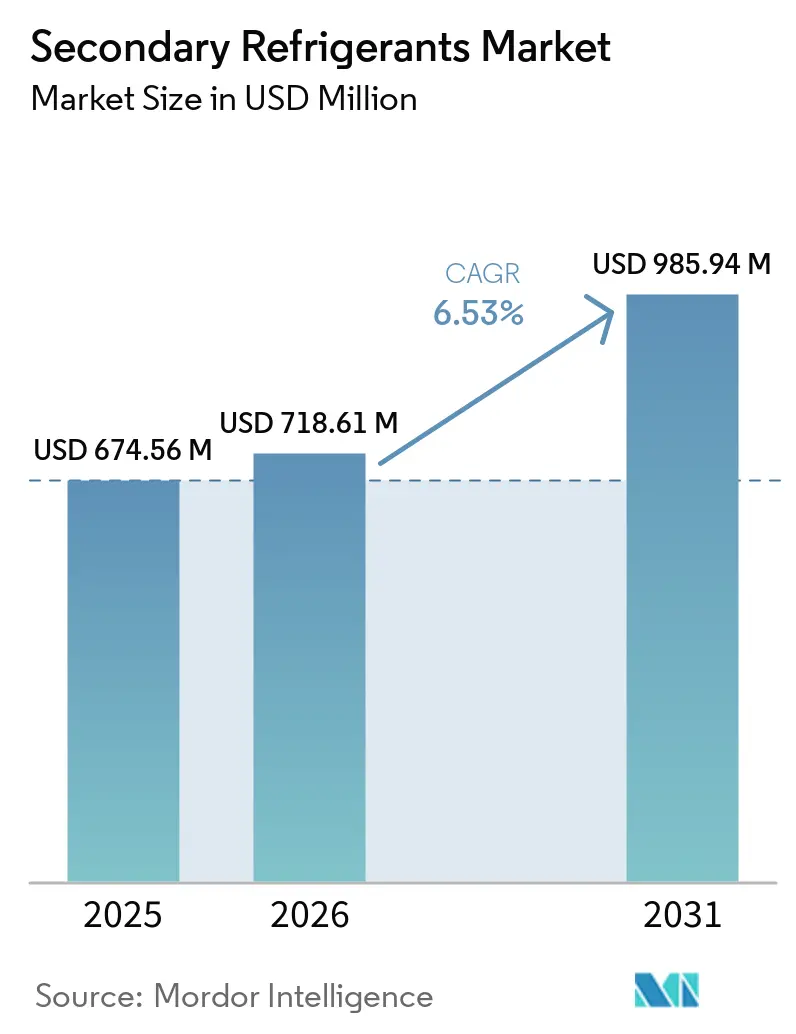
The Secondary Refrigerants Market size was valued at USD 674.56 million in 2025 and is estimated to grow from USD 718.61 million in 2026 to reach USD 985.94 million by 2031, at a CAGR of 6.53% during the forecast period (2026-2031). Regulatory limits on hydrofluorocarbons are moving refrigeration design toward systems that use smaller primary refrigerant charges and secondary fluid loops. The U.S. Environmental Protection Agency set hydrofluorocarbon consumption allowances at 60% of the historical baseline for 2024 through 2028, followed by 30% for 2029 through 2033 and 15% from 2036 onward. Europe is maintaining a firm compliance path under Regulation EU 2024/573, which prohibits servicing certain air-conditioning and heat-pump equipment with fluorinated gases having a global warming potential of 2,500 or more from January 1, 2026. These measures support demand for secondary refrigerant systems across heat pumps, food refrigeration, industrial cooling, and air conditioning. Suppliers also face a widening divide between cost-focused retail formulations and the tightly controlled fluids needed for data-center cooling. The secondary refrigerants market therefore rewards companies that can combine reliable fluid chemistry, corrosion management, and application-specific technical support.
Key Report Takeaways
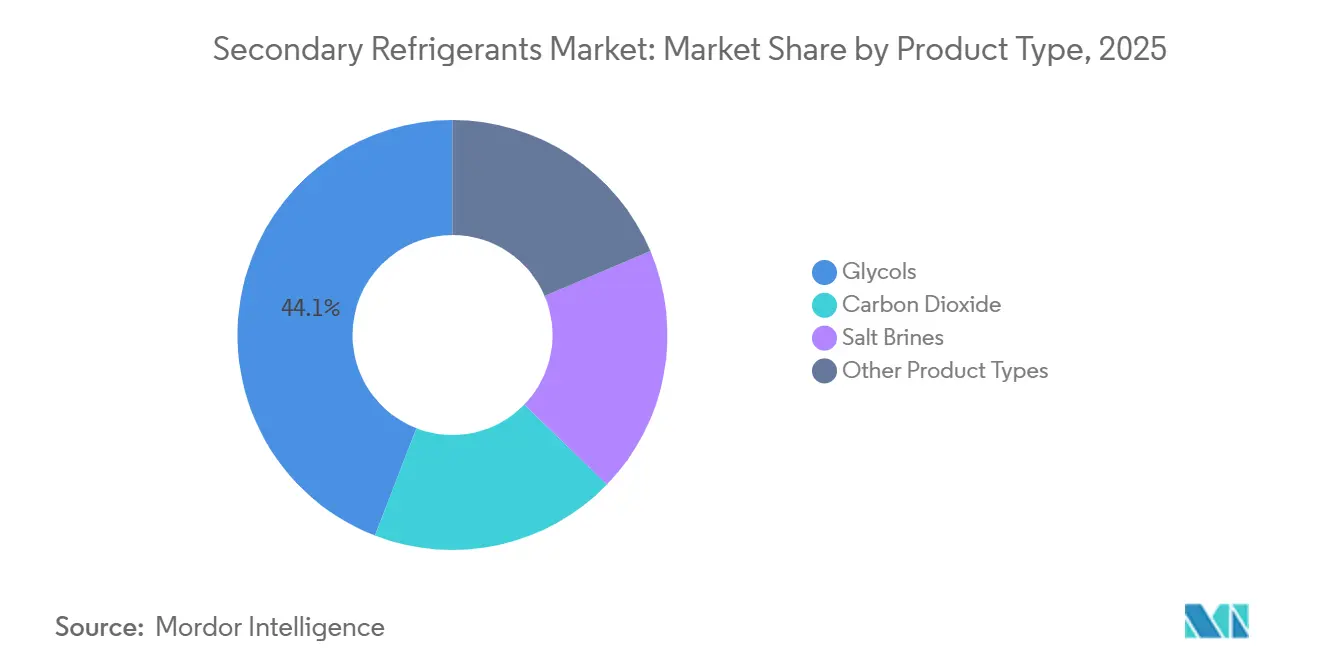
- By product type, glycols held 44.13% of the secondary refrigerants market share in 2025, while carbon dioxide is projected to advance at an 8.35% CAGR through 2031.
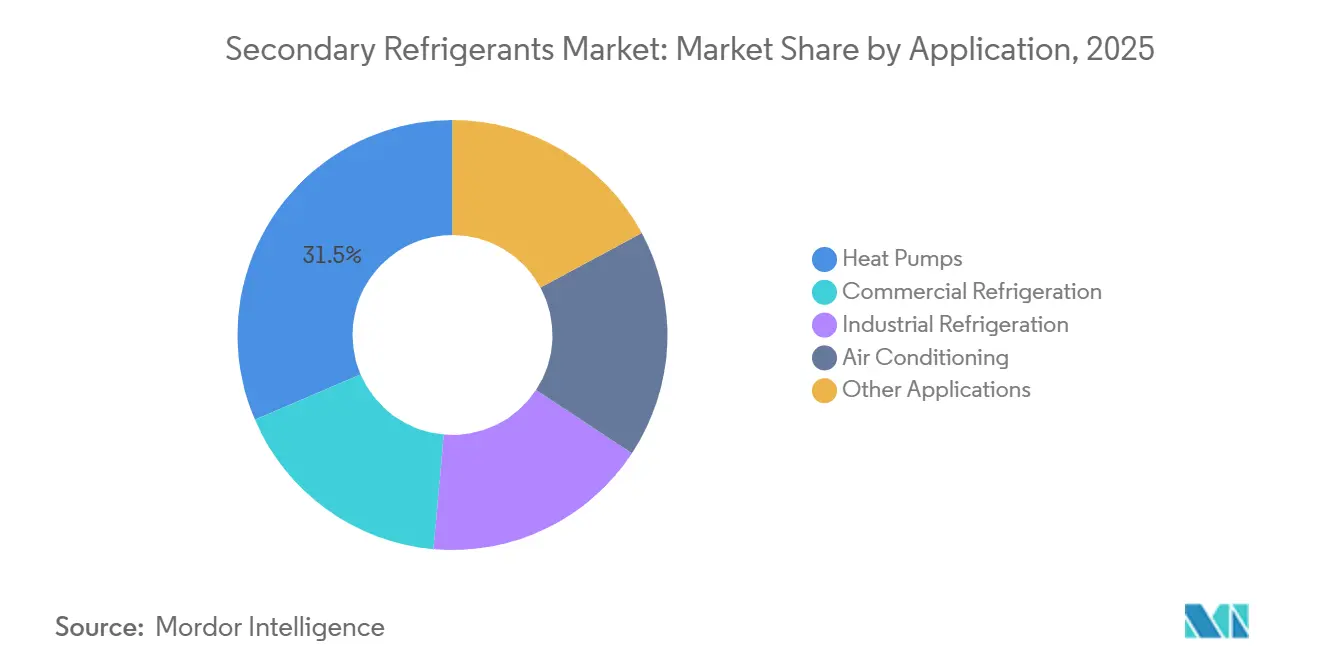
- By application, heat pumps held 31.45% of the secondary refrigerants market share in 2025, while air conditioning is projected to advance at an 8.63% CAGR through 2031.
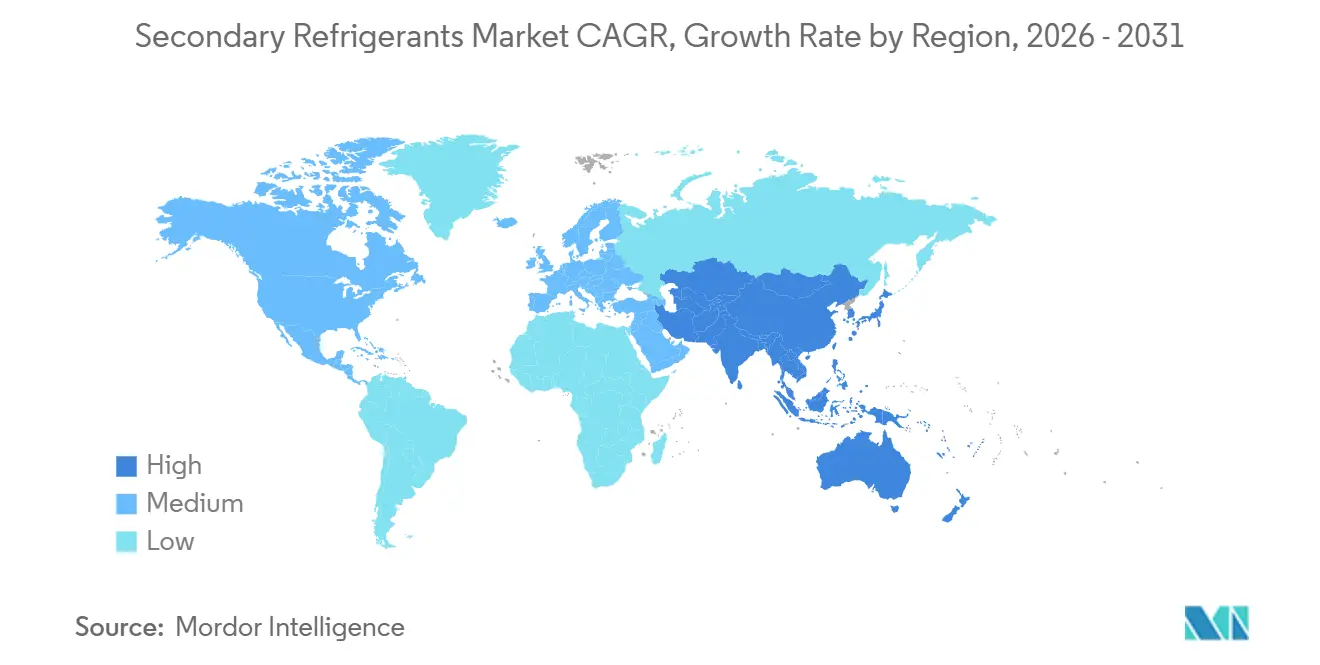
- By geography, Europe held 33.67% of the secondary refrigerants market share in 2025, while Asia-Pacific is projected to advance at an 8.10% CAGR through 2031.
Note: Market size and forecast figures in this report are generated using Mordor Intelligence’s proprietary estimation framework, updated with the latest available data and insights as of January 2026.
Global Secondary Refrigerants Market Trends and Insights
Drivers Impact Analysis*
| Driver | (~) % Impact on CAGR Forecast | Geographic Relevance | Impact Timeline |
|---|---|---|---|
| Regulatory Phase-down of High-GWP Primary Refrigerants | +1.8% | Global, strongest in EU and North America | Short term (≤ 2 years) |
| Heat-pump and District-energy Deployment | +1.5% | Europe (core), with spillover to North America and APAC | Medium term (2-4 years) |
| Cold-chain, Food Processing, and Pharmaceutical Capacity Expansion | +1.2% | APAC and North America as primary, Europe as secondary | Medium term (2-4 years) |
| Data-center and Electronics Liquid-cooling Build-out | +0.9% | Global, concentrated in North America, APAC, and Northern Europe | Short term (≤ 2 years) |
| Demand for Energy-efficient, Low-leakage Cooling | +0.7% | Global | Long term (≥ 4 years) |
| Source: Mordor Intelligence | |||
Regulatory Phase-down of High-GWP Primary Refrigerants
The phase-down of hydrofluorocarbons is changing equipment decisions in the secondary refrigerants market. The American Innovation and Manufacturing Act program reduced U.S. hydrofluorocarbon production and consumption allowances to 60% of historical baselines for 2024 through 2028[1]U.S. Environmental Protection Agency, “Frequent Questions on the Phasedown of Hydrofluorocarbons,” U.S. Environmental Protection Agency, epa.gov. The program requires new residential split-system air-conditioning and heat-pump installations from January 1, 2026, to use refrigerants with a global warming potential below 700. In Europe, servicing air-conditioning and heat-pump equipment with fluorinated gases having a global warming potential of 2,500 or more has been prohibited since January 1, 2026. Indirect designs reduce the quantity of primary refrigerant used in occupied and food-contact areas. Glycol and brine loops can therefore help operators manage future compliance needs while maintaining serviceability.
Heat-pump and District-energy Deployment
Heat-pump deployment is increasing the use of circulating fluids in the secondary refrigerants market. The European Heat Pump Association reported sales of 2.9 million heat pumps across 21 European countries in 2025, a 13% increase from 2024[2]European Heat Pump Association, “Heat Pump Sales Testify to Government Action,” European Heat Pump Association, ehpa.org. Germany recorded 50% sales growth in 2025, and heat pumps accounted for half of heating equipment sold in the country. European sales rose a further 17% in the first quarter of 2026. Large heat pumps in district heating networks need fluid circulation across extended piping runs. Germany had nearly 900 megawatts of district-heating heat-pump capacity under construction or planning in 2026. Those installations also require fluid monitoring, inhibitor replenishment, and replacement services over their operating life.
Cold-chain, Food Processing, Pharmaceutical Capacity Expansion
Cold-chain expansion supports demand for controlled-temperature systems in the secondary refrigerants market. DP World announced a EUR 100 million investment in a 55,000 m² temperature-controlled logistics hub at the Port of Antwerp in August 2026. Pharmaceutical storage places a high value on uniform temperatures and controlled fluid flow. Those requirements can favor secondary systems with tighter freeze-point margins and managed fluid quality. Data centers are also introducing a separate source of demand for glycol-water coolants. Higher rack densities have moved glycol formulations from conventional heating, ventilation, and air-conditioning chillers into direct-to-chip cold-plate loops. Dynalene, Inc. received Open Compute Project Accepted recognition for its PG-D25 direct-to-chip propylene glycol coolant in August 2026. These applications require low ionic contamination, biofouling resistance, and copper compatibility, which broadens the role of specialized secondary fluids.
Demand for Energy-efficient, Low-leakage Cooling
Energy use and leakage control are becoming more important selection factors in the secondary refrigerants market. Secondary loops allow designers to limit the charge of the primary refrigerant circuit. This configuration can reduce the exposure created by leaks in retail, industrial, and building cooling systems. Carbon dioxide systems can also use secondary-loop arrangements to limit direct-emissions risks. The North American Sustainable Refrigeration Council projected that secondary-carbon-dioxide store installations in the United States would increase 620% between 2024 and 2028. System performance still depends on appropriate fluid selection, pipe design, and pump operation. Suppliers that pair efficient formulations with ongoing fluid management can address both operating and maintenance needs.
Restraints Impact Analysis*
| Restraint | (~) % Impact on CAGR Forecast | Geographic Relevance | Impact Timeline |
|---|---|---|---|
| Higher Upfront Cost of Pumps, Heat Exchangers, and Secondary Piping | -1.5% | Global, acutest in cost-sensitive APAC and South American markets | Medium term (2-4 years) |
| Fluid Viscosity and Pumping Penalty at Low Temperatures | -1.0% | Global, most pronounced in sub-zero industrial and cold-chain applications | Long term (≥ 4 years) |
| Compatibility, Corrosion, and Fluid-life Management | -0.8% | Global | Long term (≥ 4 years) |
| Source: Mordor Intelligence | |||
Higher Upfront Cost of Pumps, Heat Exchangers, and Secondary Piping
Indirect refrigeration systems require circulation pumps, plate heat exchangers, and secondary piping. These additions can raise capital expenditure by 20% to 35%, depending on facility size and design complexity. Cost sensitivity is especially important for mid-scale cold-storage operators in Southeast Asia and Latin America. Many cold-storage projects use target payback periods of 4 to 7 years. The added cost of a secondary loop can extend payback toward the outer end of that range. Modular skid designs and improvements in plate heat-exchanger fabrication can narrow the gap over time. Markets without policy incentives, however, may continue to see slower adoption of indirect systems.
Fluid Viscosity and Pumping Penalty at Low Temperatures
Glycol and formate-salt fluids become more viscous at temperatures below -20 °C. A 50% ethylene glycol formulation can have a viscosity 6 to 10 times higher at -30 °C than at 0 °C. Higher viscosity increases pump energy use and can require larger pipes and pumps. The effect is most significant in blast freezing, cold-storage tunnels, and other sub-zero food processing systems. Potassium formate and potassium acetate blends can reduce the pumping penalty, but they have higher material costs and need specific corrosion inhibitor programs. Material compatibility, corrosion protection, pH monitoring, and timely fluid replacement also remain necessary to preserve system performance and fluid life.
*Our forecasts treat driver/restraint impacts as directional, not additive. The impact forecasts reflect baseline growth, mix effects, and variable interactions.
Segment Analysis
By Product Type: Glycols Lead While Carbon Dioxide Gains Pace
Glycols held 44.13% of the secondary refrigerants market share in 2025. Ethylene glycol and propylene glycol work with stainless steel, copper, aluminum, and carbon steel systems when appropriate inhibitor packages are used. Propylene glycol has a food-safety advantage in applications where incidental food contact is possible. Salt brines remain relevant in deep-freeze uses where lower material cost can offset higher corrosion risk. Carbon dioxide is projected to advance at an 8.35% CAGR through 2031. Carbon dioxide has a global warming potential of 1 and a high volumetric heat capacity, which supports its use in commercial refrigeration secondary-loop designs.
The secondary refrigerants market size for carbon dioxide is supported by supermarket operators seeking alternatives to legacy hydrofluorocarbon racks. The North American Sustainable Refrigeration Council projected that secondary-carbon-dioxide store installations in the United States would grow 620% between 2024 and 2028. Climalife stated that its Greenway Neo N fluid, made from bio-1,3-propanediol produced through renewable-corn fermentation, has up to 84% lower carbon dioxide emissions and uses 70% less nonrenewable energy than conventional propylene glycol. The fluid has NSF HT1 registration for food-adjacent uses. Food and pharmaceutical buyers are increasingly assessing the embodied carbon of heat-transfer fluids. This places greater importance on certified renewable feedstocks and documented fluid performance.



By Application: Heat Pumps Lead While Air Conditioning Accelerates
Heat pumps held 31.45% of the secondary refrigerants market share in 2025. District-energy and ground-source heat-pump systems commonly circulate brine or glycol between ground loops, heat exchangers, and building distribution equipment. This equipment base supports continuing secondary-fluid use throughout installation, maintenance, and replacement cycles. European rules require district heating and cooling systems to source at least 50% of their energy from renewables, waste heat, or high-efficiency cogeneration by 2027. Commercial refrigeration also uses secondary-loop rack systems to minimize primary refrigerant charge. Industrial refrigeration requires formulations that can operate at temperatures as low as -50 °C.
The secondary refrigerants market size for air conditioning is projected to advance at an 8.63% CAGR through 2031. Urban growth, data-center construction, and commercial real estate development are expanding the use of chilled-water plants in Asia-Pacific, the Middle East, and parts of South America. These plants can use glycol in cooling-tower and air-handling loops. A 2026 study of integrated carbon-dioxide supermarket systems in Southern Europe recorded annual integrated coefficients of performance from 3.00 to 3.22 under different climate conditions. The result supports the application of secondary-loop designs in warmer climates, giving designers a performance reference beyond conventional temperature-zone assumptions.
Geography Analysis
Europe held 33.67% of the secondary refrigerants market share in 2025. The region combines district-energy infrastructure, strict fluorinated-gas rules, and active heat-pump deployment. European heat-pump sales reached 2.9 million units in 2025 across 21 countries. Germany recorded 50% heat-pump sales growth in 2025. Germany’s Kälte-Klima-Richtlinie program supports eligible refrigeration and cooling systems using non-halogenated refrigerants through the end of 2026.
Asia-Pacific is projected to advance at an 8.10% CAGR through 2031. Demand is linked to cold-chain investment in China, India, and the Association of Southeast Asian Nations. China added more than 15 million cubic meters of refrigerated warehouse capacity from 2019 to 2025. Japan and South Korea have mature cooling systems where retrofits and charge-reduction programs create incremental demand. Vietnam, Thailand, and Indonesia are developing modern cold chains as investment activity increases. This creates an opening for glycol, brine, and carbon dioxide systems suited to local operating conditions.
North America drives demand through supermarket conversions and pharmaceutical cold-chain activity. The regulatory path under the American Innovation and Manufacturing Act continues to encourage lower-global-warming-potential refrigerant systems. The secondary refrigerants market size in the region also benefits from data-center investments that require specialized liquid coolants. South America has demand from food processing and cold storage. The Middle East and Africa have emerging needs in commercial real estate and temperature-controlled logistics. These regions remain smaller demand pools, but cooling infrastructure can create longer-term fluid requirements.

Competitive Landscape
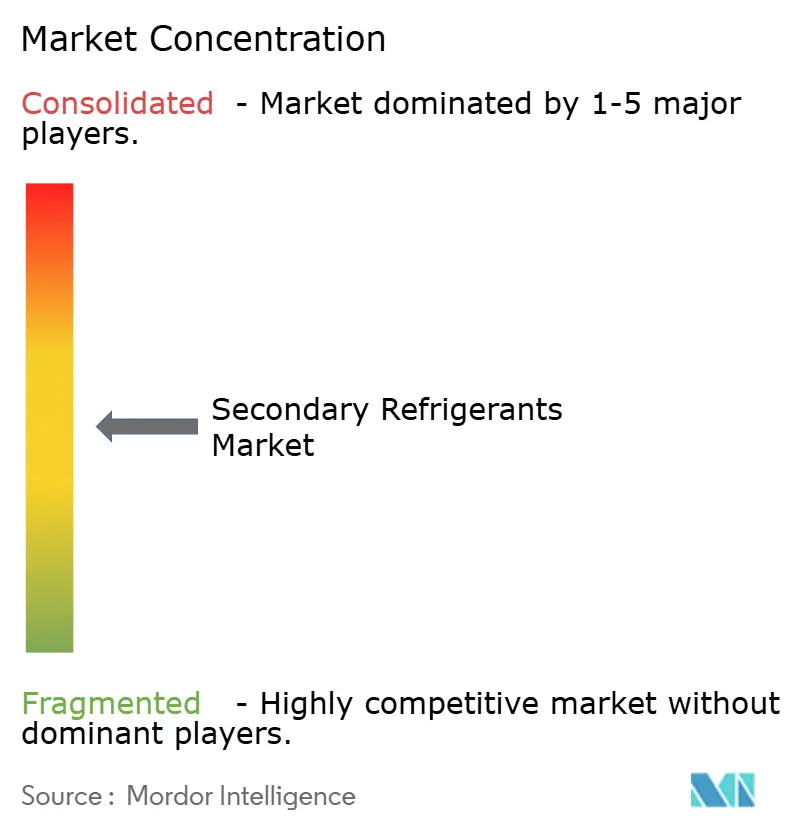
The secondary refrigerants market is moderately concentrated, with the top five players including Linde PLC, Eastman Chemical Company, CLARIANT, A-Gas International Limited, and Dynalene, Inc. Specialist suppliers include Climalife Groupe Dehon, SRS Frigadon Ltd, Gas Servei, and Hydratech. Their positions often depend on precision formulations, local technical support, and long-term fluid-management relationships. These relationships can include monitoring, inhibitor service, and periodic fluid replacement.
Eastman Chemical Company expanded its United States distribution coverage in October 2025 by appointing RelaDyne as an authorized distributor for Therminol heat-transfer fluids. The move also extended access to Eastman’s Fluid Genius digital monitoring platform. BASF marked 20 years of refrigeration-ester production at its Jinshan, Shanghai facility in May 2026. BASF stated that its biomass-balance approach can provide refrigeration lubricants with up to 90% renewable raw material content. These actions show the value of regional production capacity, distribution coverage, and technical services. Large suppliers can use existing glycol supply chains to serve several applications with differentiated additive packages.
Data-center cooling is creating a specialized product area within the secondary refrigerants market. Arteco launched ZITREC EC direct-to-chip coolants in April 2025 for high-performance computing applications. The line includes monopropylene glycol, monoethylene glycol, and water-based formulations with organic additive technology. Dynalene, Inc.’s Open Compute Project Accepted PG-D25 recognition gives it a defined position in this segment. Bio-based coolants are another developing area. Climalife Groupe Dehon’s Greenway Neo N and Arteco’s ECO coolant portfolio show how suppliers are addressing renewable and recycled feedstock requirements.
Secondary Refrigerants Industry Leaders
Linde PLC
Eastman Chemical Company
CLARIANT
A-Gas International Limited
Dynalene, Inc.
- *Disclaimer: Major Players sorted in no particular order

Recent Industry Developments
- April 2026: Ilerfred installed a propane (R-290) refrigeration system using glycol water at -8 °C as a secondary cooling fluid for potato storage chambers at a logistics facility. The installation demonstrates the use of glycol-based secondary refrigerants with low-Global Warming Potential (GWP) primary refrigerants in cold-chain applications, supporting demand for indirect refrigeration systems.
- April 2026: G&D Chillers standardized A2L refrigerants across its glycol chiller platform for applications including food processing, manufacturing, data centers, and pharmaceuticals. The shift supports the transition toward lower-GWP primary refrigerants while maintaining glycol-based secondary cooling systems, strengthening demand for secondary refrigerants in industrial and commercial cooling.


Global Secondary Refrigerants Market Report Scope
Secondary refrigerants are heat-transfer fluids that circulate between a primary refrigeration system and the areas requiring cooling. They transfer thermal energy efficiently while enabling temperature control across refrigeration and air-conditioning systems.
The Secondary Refrigerants Market is segmented by product type, application, and geography. By product type, the market is segmented into glycols, salt brines, carbon dioxide, and other product types. By application, the market is segmented into heat pumps, commercial refrigeration, industrial refrigeration, air conditioning, and other applications. The report also covers the market size and forecasts for secondary refrigerants in 15 countries across major regions. For each segment, the market sizing and forecasts have been done on the basis of value (USD).
| Glycols |
| Salt Brines |
| Carbon Dioxide |
| Other Product Types |
| Heat Pumps |
| Commercial Refrigeration |
| Industrial Refrigeration |
| Air Conditioning |
| Other Applications |
| Asia-Pacific | China |
| India | |
| Japan | |
| South Korea | |
| ASEAN Countries | |
| Rest of Asia-Pacific | |
| North America | United States |
| Canada | |
| Mexico | |
| Europe | Germany |
| United Kingdom | |
| France | |
| Italy | |
| NORDIC Countries | |
| Rest of Europe | |
| South America | Brazil |
| Argentina | |
| Rest of South America | |
| Middle East and Africa | Saudi Arabia |
| South Africa | |
| Rest of Middle East and Africa |
| By Product Type | Glycols | |
| Salt Brines | ||
| Carbon Dioxide | ||
| Other Product Types | ||
| By Application | Heat Pumps | |
| Commercial Refrigeration | ||
| Industrial Refrigeration | ||
| Air Conditioning | ||
| Other Applications | ||
| By Geography | Asia-Pacific | China |
| India | ||
| Japan | ||
| South Korea | ||
| ASEAN Countries | ||
| Rest of Asia-Pacific | ||
| North America | United States | |
| Canada | ||
| Mexico | ||
| Europe | Germany | |
| United Kingdom | ||
| France | ||
| Italy | ||
| NORDIC Countries | ||
| Rest of Europe | ||
| South America | Brazil | |
| Argentina | ||
| Rest of South America | ||
| Middle East and Africa | Saudi Arabia | |
| South Africa | ||
| Rest of Middle East and Africa | ||


Key Questions Answered in the Report
What is the size of the secondary refrigerants market?
The secondary refrigerants market stands at USD 718.61 million in 2026 and is projected to reach USD 985.94 million by 2031.
What is driving demand for secondary refrigerants?
Hydrofluorocarbon phase-down rules, heat-pump deployment, cold-chain investment, and liquid cooling for data centers are supporting demand.
Which product type led the market share in 2025?
Glycols led with a 44.13% share in 2025, supported by broad material compatibility and food-adjacent applications.
Which application is expected to grow fastest through 2031?
Air conditioning is projected to advance at an 8.63% CAGR through 2031 as chilled-water systems expand.
Page last updated on:





