
Market Overview
| Study Period | 2020 - 2031 |
|---|---|
| Forecast Data Period | 2026 - 2031 |
| Base Year Market Size (2025) | USD 2.30 Billion |
| Market Size (2026) | USD 2.49 Billion |
| Market Size (2031) | USD 3.73 Billion |
| Growth Rate (2026 - 2031) | 8.37 % |
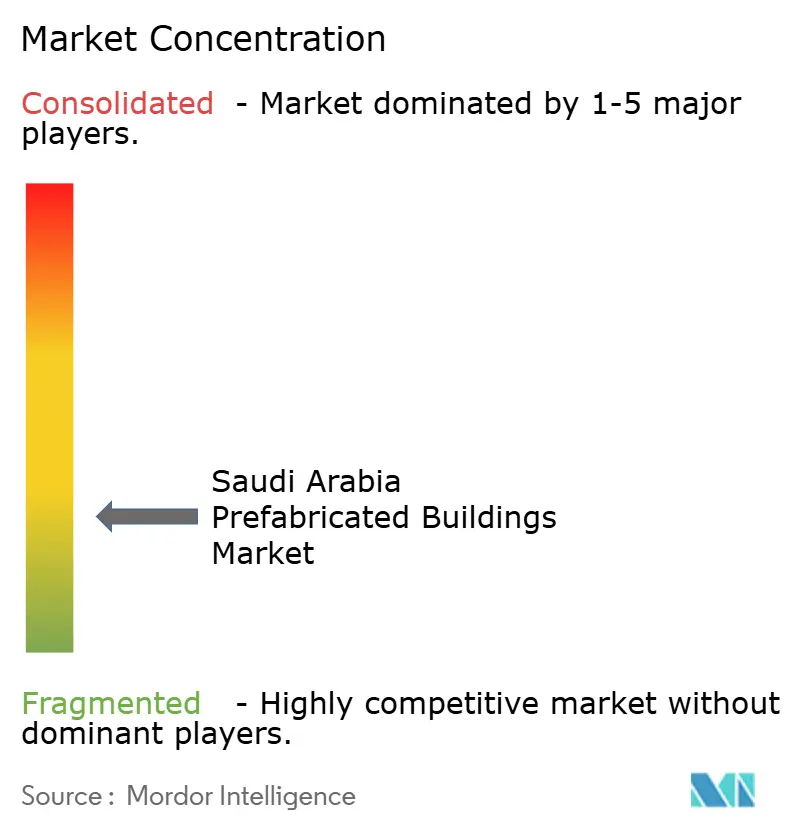
| Market Concentration | Medium |
Major Players *Disclaimer: Major Players sorted in no particular order Image © Mordor Intelligence. Reuse requires attribution under CC BY 4.0. | |
Saudi Arabia Prefabricated Buildings Market Analysis by Mordor Intelligence
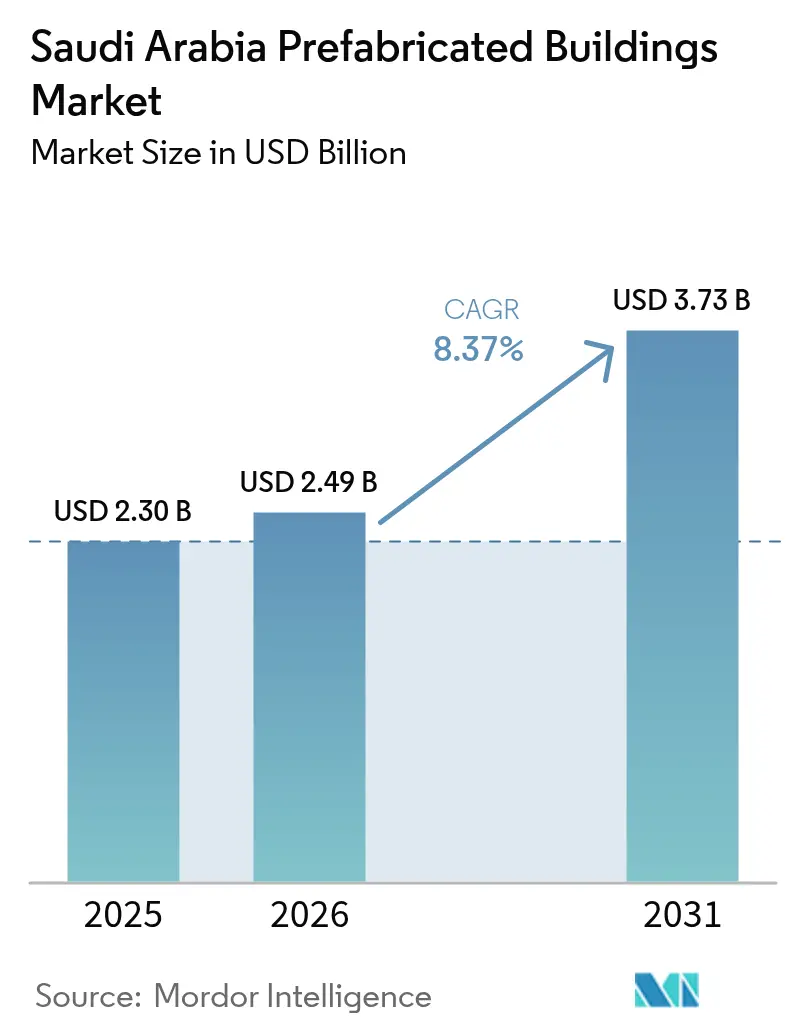
Saudi Arabia prefabricated buildings market size in 2026 is estimated at USD 2.49 billion, growing from 2025 value of USD 2.30 billion with 2031 projections showing USD 3.73 billion, growing at 8.37% CAGR over 2026-2031. This brisk expansion reflects Vision 2030 deadlines that favor rapid, industrialized construction, sovereign-wealth-fund capital channels, and an expanding pipeline of hotel capacity required for rising Hajj and Umrah visitation. Public Investment Fund (PIF) allocations of USD 19.4 billion to 91 green projects—including USD 372 million for eight prefabricated green-building developments—signal government preference for factory-built envelopes that meet Mostadam and SBC 2018 energy-efficiency thresholds. NEOM’s construction workforce has doubled to more than 140,000, and its USD 1.3 billion robotics joint venture with Samsung C&T is institutionalizing off-site assembly as the default delivery model for giga projects[1]. Modular hotel programs anchored to religious-tourism targets of 36 million pilgrims by 2030 are accelerating demand for standardized, climate-controlled accommodation around Makkah and Madinah. Meanwhile, SBC 2018 enforcement is narrowing the field to operators with advanced quality-management systems, reinforcing a flight-to-scale dynamic that rewards large, technology-enabled fabricators.
Key Report Takeaways
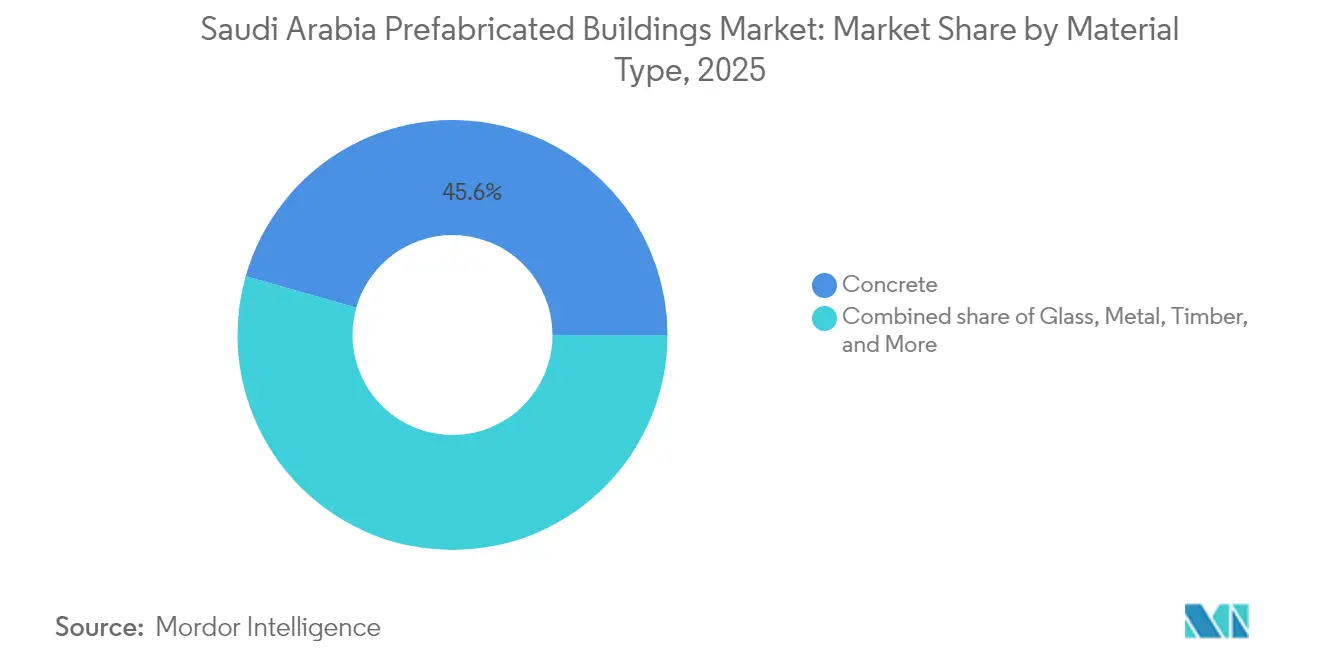
- By material type, concrete captured 45.60% of Saudi Arabia prefabricated buildings market share in 2025; timber is forecast to expand at a 9.49% CAGR through 2031.
- By application, the residential segment accounted for a 37.40% share of the Saudi Arabia prefabricated buildings market size in 2025, while commercial buildings are advancing at a 9.07% CAGR through 2031.
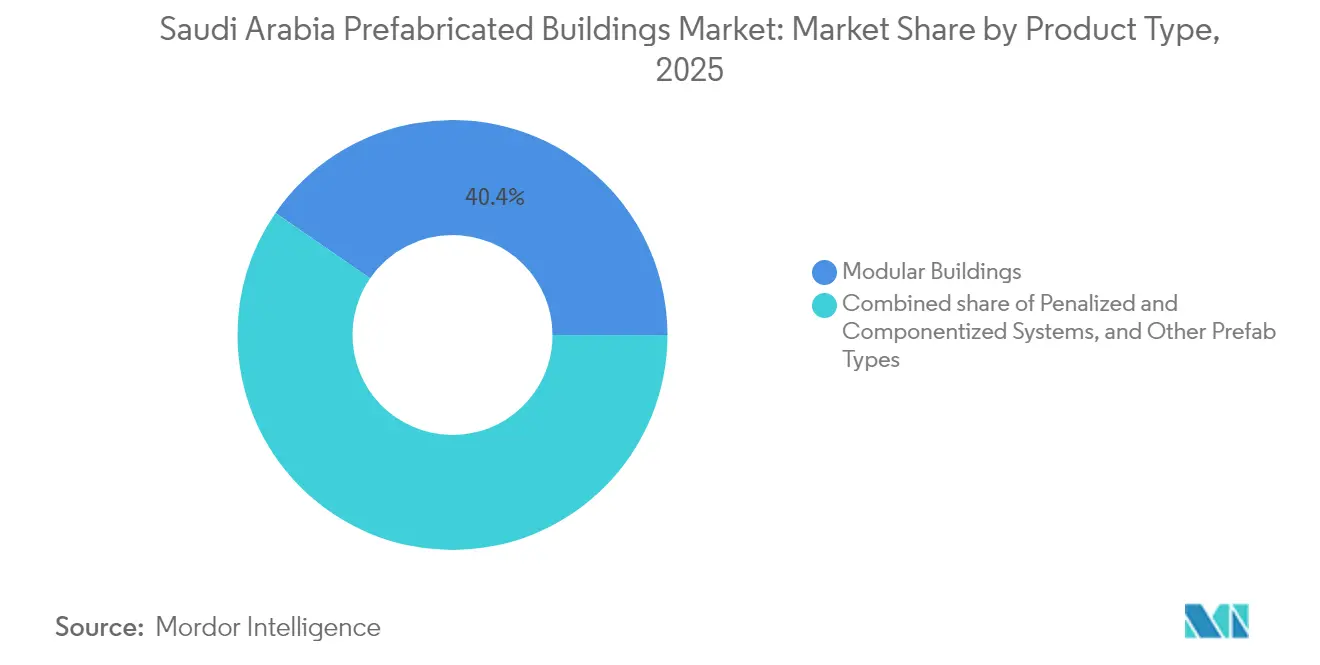
- By product type, modular buildings held a 40.40% share of the Saudi Arabia prefabricated buildings market in 2025 and are projected to grow at a 9.35% CAGR between 2026 and 2031.
- By city, Riyadh led with a 34.60% share of the Saudi Arabia prefabricated buildings market in 2025; Jeddah is recording the fastest trajectory at a 9.66% CAGR to 2031.
Note: Market size and forecast figures in this report are generated using Mordor Intelligence’s proprietary estimation framework, updated with the latest available data and insights as of 2026.
Saudi Arabia Prefabricated Buildings Market Trends and Insights
Drivers Impact Analysis*
| Driver | % Impact on CAGR Forecast | Geographic Relevance | Impact Timeline |
|---|---|---|---|
| Vision 2030 megaproject deadlines accelerating off-site adoption | +2.1% | National, with concentration in NEOM, Red Sea, Qiddiya | Medium term (2-4 years) |
| Public-sector housing PPPs demanding rapid delivery | +1.8% | National, with early gains in Riyadh, Jeddah, Eastern Province | Short term (≤ 2 years) |
| Rising Hajj/Umrah visitor volumes boosting modular hotel demand | +1.4% | Makkah, Madinah regions with spillover to transport corridors | Long term (≥ 4 years) |
| Mandatory green-building code favouring energy-efficient prefab envelopes | +1.2% | National implementation with stricter enforcement in major cities | Medium term (2-4 years) |
| Sovereign-wealth-fund backed industrialized-construction JV funding | +1.7% | Concentrated in giga-project zones, expanding to secondary cities | Long term (≥ 4 years) |
| AI-driven mass-customisation factories in King Salman Energy Park | +0.8% | Eastern Province with technology transfer to other industrial zones | Long term (≥ 4 years) |
| Source: Mordor Intelligence | |||
Vision 2030 Megaproject Deadlines Accelerating Off-Site Adoption
The USD 1.5 trillion Vision 2030 portfolio has reset construction schedules, prompting developers to embed prefabrication into project baselines to meet fixed completion dates. Samsung C&T’s rebar automation program at NEOM reduces manual steel-fixing labor by up to 80%, compressing structural cycles and improving safety compliance. The Red Sea Project mandates “unprecedented levels of prefabrication,” ensuring its 50 resorts and 8,000 rooms achieve carbon-neutral operations while staying on-schedule. Dedicated logistics corridors, including the expanding Port of NEOM, streamline oversized-module throughput, further embedding factory-built methods into giga-project delivery. The resulting economies of scale are closing the historical cost premium of off-site solutions, positioning the Saudi Arabia prefabricated buildings market as a primary beneficiary of Vision 2030 capital flows.
Public-Sector Housing PPPs Demanding Rapid Delivery
Saudi Arabia’s Housing Program enabled more than 1 million households to secure homes by 2024, lifting national ownership to 63.74% and underscoring the urgency for rapid-delivery construction. PPP frameworks stewarded by the National Center for Privatization involve 200 projects across 17 sectors, with housing, schools, and staff accommodations prioritized for modular deployment. Saudi Aramco’s USD 229 million staff-housing PPP on Abu Ali Island leverages factory-finished modules to meet a 28-month schedule for 500 residents. ROSHN’s Sedra community applies modular shells to accelerate a 30,000-unit roll-out east of Riyadh, signaling mainstream acceptance of prefabrication for mass housing.
Rising Hajj / Umrah Visitor Volumes Boosting Modular Hotel Demand
Umrah pilgrim arrivals jumped 58% year-on-year to 13.5 million in 2023, and the government targets 36 million by 2030, driving the need for 320,000–362,000 new hotel rooms valued at USD 110 billion[2]. The USD 27 billion Masar mixed-use spine in Makkah and the USD 7 billion Thakher Makkah district both specify modular hotels that can flex capacity around peak pilgrimage periods. Prefabricated guestrooms deliver consistent finishes within compressed site windows, while factory-integrated MEP systems reduce commissioning time and ensure Mostadam compliance. Major operators such as Marriott and Accor are specifying premium modules to safeguard brand standards, reinforcing modular hotels as the default supply strategy for religious-tourism growth corridors.
Mandatory Green-Building Code Favoring Energy-Efficient Prefab Envelopes
SBC 2018 and its green-building addendum (SBC 1001-CR) oblige new buildings to meet strict U-value and airtightness thresholds, tilting the market toward factory-controlled envelopes that consistently achieve those metrics. The Mostadam rating encourages prefabricated projects to pre-install PV conduits, high-performance insulation, and smart HVAC systems, reducing on-site waste and rework. Academic modelling shows that correct insulation selection can cut operational energy by 2–14% across climate zones. PIF-owned HQ buildings are already reporting 20% energy savings through prefab facades, validating the regulatory push and supporting market expansion.
Restraints Impact Analysis*
| Restraint | % Impact on CAGR Forecast | Geographic Relevance | Impact Timeline |
|---|---|---|---|
| Limited domestic CLT/LVL supply raising import dependence | -1.3% | National, with acute impact on timber-intensive projects | Medium term (2-4 years) |
| Harsh-climate logistics for oversize modules in western desert corridors | -0.9% | Western regions, NEOM, Red Sea Project areas | Short term (≤ 2 years) |
| Fragmented municipal permitting outside Riyadh metro | -0.7% | Secondary cities, rural development zones | Long term (≥ 4 years) |
| Source: Mordor Intelligence | |||
Limited Domestic CLT / LVL Supply Raising Import Dependence
Saudi projects specifying engineered timber currently import slabs from Europe and Australia, exposing budgets to currency swings and freight volatility. NEOM’s first 1,500 timber modules used Australian hardwood, illustrating lead-time risk for large timber interiors. Vision 2030 localization goals add pressure to cultivate domestic glulam, CLT, and LVL mills, yet capital intensity and feedstock constraints postpone meaningful capacity until late-decade. Until then, high-end timber towers remain vulnerable to shipment delays and spot-price surges that can derail project schedules and dampen Saudi Arabia prefabricated buildings market momentum.
Harsh-Climate Logistics for Oversize Modules in Western Desert Corridors
Moving 14-meter hotel modules from Gulf coast yards to Red Sea resorts entails 1,000-kilometer hauls across dune terrain where ambient temperatures reach 50 °C. Thermal expansion risks panel delamination, dictating specialized low-velocity convoys and costly climactic controls. Contractors such as Besix cite logistics as the single biggest hurdle on west-coast megaprojects, eclipsing even engineering complexity. Although Port of NEOM upgrades and Red Sea Global’s dedicated causeways alleviate some choke points, final-mile routes still restrict payload size, compelling multi-drop deliveries that erode prefab time-savings.
*Our forecasts treat driver/restraint impacts as directional, not additive. The impact forecasts reflect baseline growth, mix effects, and variable interactions.
Segment Analysis
By Material Type: Concrete Resilience and Timber Momentum
Concrete held a commanding 45.60% share of Saudi Arabia prefabricated buildings market in 2025, buttressed by widespread precast yards integrated with local cement and rebar supply chains. Durability under extreme heat and wind-blown sand preserves lifecycle value, maintaining concrete’s status as the default structural choice across housing, hotel, and industrial assets. Engineered timber, however, is projected to log a 9.49% CAGR, pivoting on sustainability codes and high-end aesthetics demanded by luxury segments of NEOM and Red Sea resorts. Saudi Arabia's prefabricated buildings market size for engineered timber is still marginal today, yet net-zero targets are stimulating policy interest in localized CLT plants, which could pivot share gains decisively after 2028. Composite and hybrid skins combining aluminum frames with insulated panels are also scaling as developers pursue lighter foundations for coastal reclamations.
Concrete’s cost stability and on-site familiarity keep it dominant among public-sector schools and hospitals, but innovation within admixtures and precast connection systems is creating weight and time advantages previously associated only with steel. Timber’s status as the fastest-growing material is amplified by Mostadam point incentives for sequestered carbon, a factor that offsets import premiums in prestige projects. R&D initiatives exploring basalt-fiber reinforcement and rammed-earth interior walls reflect a broader experimentation trend as Vision 2030 architects seek culturally resonant, climate-appropriate assemblies.

By Application: Residential Scale Faces Commercial Surge
Residential builds retained 37.40% share of Saudi Arabia prefabricated buildings market size in 2025, tethered to government homeownership milestones and multizone communities such as ROSHN Sedra. Permanent modular construction reduces the average villa handover cycle from 14 months to fewer than 8 months, allowing public agencies to track quarterly keys-in-hand targets. Commercial stock is forecast to pace the market at 9.07% CAGR through 2031, mirroring hospitality demand curves tied to pilgrimage peaks and office pipeline expansions linked to Riyadh’s global financial-center ambitions. Saudi Arabia prefabricated buildings market share within commerce is also driven by data-center shells in Oxagon and SPARK, which favor pre-wired steel pods for rapid commissioning.
Beyond core segments, the “Others” bucket—spanning healthcare, education, and industrial—absorbs PPP deals for 4,000 schools and multiple field hospitals. Pre-assembled operating theaters shorten fit-out schedules while supporting infection-control standards, demonstrating prefabrication’s value beyond speed alone. Compliance with SBC 2018 pushes residential and commercial developers alike toward consistent thermal envelopes achievable only in controlled factory environments.
By Product Type: Modular Buildings Dominate and Innovate
Modular buildings captured 40.40% of Saudi Arabia prefabricated buildings market share in 2025 and will maintain momentum at a 9.35% CAGR through 2031. Red Sea International’s 770,000 m² annual capacity underscores the industrial scale that has emerged to serve giga-project demand. Robotics-enabled finishing lines allow eight-story modules to roll out at five-day takt times, while AI-driven quality-inspection cameras reduce defect rates. Panelized and componentized systems retain niches where irregular footprints complicate volumetric approaches, such as museum atriums and airport canopies. Saudi Arabia prefabricated buildings market size for panelized systems is set to grow more modestly but will benefit from hybrid integration into volumetric cores.
Additive-manufactured elements, highlighted by the world’s first 3D-printed mosque completed in 2024, signal an innovation frontier that may compress bespoke façades into single-day prints. NEOM’s robotics unit blurs conventional boundaries by combining panelization with fully serviced pods, hinting at a convergent ecosystem where product-type distinctions dissolve under unified digital fabrication platforms.
Geography Analysis
Riyadh generated 34.60% of Saudi Arabia's prefabricated buildings market value in 2025, leveraging centralized permitting and anchor projects such as the USD 50 billion Mukaab mixed-use cube now under construction. Capital-centric budgets, coupled with a robust industrial base—44.3% of national factories are sited here—create continuous demand for volumetric housing and Class-A office shells. Jeddah posts the steepest growth curve at 9.66% CAGR, energized by Red Sea resort modules and the MARAFY canal-front redevelopment that prioritizes prefab micro-units and hospitality suites.
DMA’s proximity to SPARK and petrochemical complexes stabilizes industrial order flow, while the Rest-of-Kingdom category, spanning NEOM’s desert plateau to Tabuk’s coastal inlet, commands huge absolute volumes owing to giga-project site build-outs.
Logistics disparities remain; Riyadh enjoys complete grade-separated ring roads, whereas west-coast corridors still grapple with oversize-load curfews. Regulatory fragmentation outside the capital elongates approval timelines, yet the Future Projects Forum lists more than SAR 1 trillion in upcoming contracts beyond the three major metros, guaranteeing that geographic diversification will continue shaping Saudi Arabia prefabricated buildings market dynamics.
Regulatory Landscape
Saudi Arabia’s prefabricated buildings market is governed by the Saudi Building Code (SBC) regime. The SBC 2024 edition was issued under Ministerial Decision No. 181 dated 31 December 2024 and is enforced from 1 July 2025. Tighter enforcement raises the value of traceable design documentation, certified factory QA/QC, and code-compliant thermal and fire performance for volumetric and panelized systems, which supports the broader shift toward industrialized delivery models.
For technologies, materials, or assemblies not covered in the code provisions, the SBC 2024 framework allows acceptance through recognized evaluation pathways. These include research reports from SASO and the Saudi Building Code National Committee (SBCNC), alongside recognized evaluation services. In parallel, the Ministry of Municipalities and Housing (MOMAH) Modern Construction Initiative includes a technology-approval process for modular and prefabricated system families (including 2D panels and 3D volumetric/pod solutions). This functions as a gating requirement for suppliers seeking participation in mainstream projects and public procurement, where compliance screening is more formalized.
Value Chain Analysis
The value chain begins with raw materials and components, such as cement and rebar, structural steel, sandwich panels, insulation, glazing, MEP kits, fasteners, and coatings. It then moves to design and engineering, where BIM-enabled design-for-manufacture-and-assembly is increasingly embedded in tendering. Manufacturing covers precast yards, light-gauge steel and pre-engineered building lines, and volumetric module factories that integrate finishes, MEP, and commissioning activities to reduce site work. Testing and certification, including code-compliance documentation, product approvals, and third-party inspection, run alongside manufacturing as a key midstream step, particularly under SBC 2024 enforcement and MOMAH technology-approval requirements.
Downstream, logistics and site execution drive delivery reliability and cost: oversized module transport, route planning, and cranage drive delivered cost and schedule performance, especially for long-haul west-coast and giga-project corridors. After delivery, installation, connections, and commissioning lead to handover and lifecycle services, including maintenance and retrofit of MEP-heavy modules such as hospitality and staff accommodation. The chain is moving toward in-Kingdom capacity and vertical integration, with large developers and contractors anchoring local plants to secure throughput and quality, including ROSHN and China Harbour Engineering Company commencing operations of a SAR 500 million modular building factory in Riyadh in February 2025, with stated capacity of up to 50,000 units annually for programs including Sedra and Warfa.
Competitive Landscape
The Saudi Arabia prefabricated buildings market is moderately fragmented, with industry leaders setting themselves apart through scale, automation, and strict compliance. Red Sea International, leveraging its hubs in Jubail and Dubai, boasts an impressive annual throughput of 770,000 m², allowing it to concurrently deliver both housing and hospitality solutions.
Spacemaker KSA completes up to 1,000 m² of pods per day using conveyorized welding gantries and robot-assisted paint booths, setting a productivity bar that smaller regional yards struggle to match. NEOM’s robotics partnership sets new process benchmarks—machine-assembled rebar cages guarantee positional tolerance and shave two days per floor plate, reshaping client expectations.
Capitalized entrants backed by PIF and Aramco venture arms are pursuing disruptive technologies. Mighty Buildings—fresh off a USD 52 million funding round—intends to introduce printed composite shells that halve embodied carbon against traditional concrete, positioning itself for villa portfolios in climate-sensitive coastal zones. Simultaneously, legacy steel firms are retrofitting beam lines to manufacture volumetric frames, capturing Mostadam opportunities while preserving asset bases.
Regulatory screening now extends to ESG reporting and SCA licensing, triggering consolidation as under-capitalized shops exit or merge. Those retaining ISO 9001 and Mostadam pre-approvals gain preferred-bidder status on PPP rosters, reinforcing a virtuous cycle of scale and compliance. International attention is rising: the Chinese engineering giant CEEC recently secured a 2 GW EPC contract that complements prefab substation enclosures, indicating cross-border competition is set to intensify[4].
Saudi Arabia Prefabricated Buildings Industry Leaders
-
Red Sea Housing Services
-
Zamil Steel (Pre-Engineered Buildings)
-
Saudi Building Systems Mfg. Co. (SBS)
-
Nesma & Partners – Modular Division
-
Al-Jazira Prefab Houses
- *Disclaimer: Major Players sorted in no particular order
Market Opportunities and Future Outlook
A near-term whitespace is visible in standardized, high-volume modular programs linked to government-led community development and tourism-linked housing, where procurement specifies both compliance and accelerated delivery. In June 2026, the Ministry of Municipal, Rural Affairs and Housing announced 27 tourism community and satellite city projects in the Riyadh region moving into tendering. These projects carry an initial requirement for 32,000 modular cabins, a 180-day delivery requirement, and SASO 2201:2025 compliance. Defined batch volumes and standard specifications create openings for manufacturers and EPCs that can industrialize repeatable cabin and accommodation typologies while meeting qualification thresholds.
A second opportunity centers on localized manufacturing expansion and supplier development aligned to the Modern Construction Initiative and its financing mechanisms, in cooperation with the Saudi Industrial Development Fund. Localization incentives such as IKTVA also support modular components, panels, and MEP skids. The market continues to face import dependence in select categories, including engineered timber inputs and specialized building systems, so suppliers that establish in-Kingdom production and certification readiness under SBC 2024 pathways and MOMAH approvals can better access public programs and giga-project demand centers. Demand for turnkey modular hospitality and staff accommodation around destinations such as Red Sea Global and the broader Vision 2030 pipeline reinforces interest in single-source delivery models that bundle design, fabrication, logistics, and installation under one performance umbrella.
Recent Industry Developments
- June 2026: Group AMANA completed delivery of 1,404 modular concrete studio units for the Amaala Staff Village, manufactured at its DuBox facility in Rabigh. The delivery model emphasized offsite production to cut construction time by 30% and reduce on-site labor by 35%, reinforcing the case for volumetric solutions in remote, schedule-driven destination projects.
- April 2025: Zamil Steel announced a contract to fabricate, supply, and install 15,000 MT of structural steel for Masar Mall in Makkah, covering 200,000 square meters. The award points to continued demand for large-scale engineered steel packages that support fast-track superstructures and interface with prefabricated building delivery approaches in high-traffic urban redevelopment zones.
- December 2024: NEOM and Samsung C&T formed a SAR 1.3 billion construction-robotics joint venture to automate rebar cage assembly, targeting 40% cost savings. Automating reinforcement fabrication increases throughput and consistency for structural work, supporting broader adoption of industrialized construction workflows that align with prefabrication and modular assembly.
Research Methodology Framework and Report Scope
Market Definition and Coverage
This market covers the value of prefabricated buildings supplied and installed in Saudi Arabia, where building elements are manufactured off-site and then assembled at the project location. The sizing is captured in USD and reflects demand across key construction end uses within the country.
Scope exclusions: We exclude conventional on-site construction that does not use prefabricated building systems as a primary delivery method.
Segmentation Overview
- By Material Type
- Concrete
- Glass
- Metal
- Timber
- Other Materials
- By Application
- Residential
- Commercial
- Others
- By Product Type
- Modular Buildings
- Panelized & Componentized Systems
- Other Prefab Types
- By Region (Saudi Arabia)
- Riyadh
- Jeddah
- DMA (Dammam Metropolitan Area)
- Rest of Saudi Arabia
Data Sources, Market Sizing, and Validation
Desk Research
Desk research was used to build the base structure of the model and to align definitions across materials, applications, and the main regions inside Saudi Arabia. We relied on public sources such as Saudi government releases on construction activity, national statistics on housing and infrastructure, customs and trade statistics for building-related materials, and standards and guidance published by construction and engineering bodies.
To make the market assumptions practical, we also reviewed company annual reports and investor presentations, project award announcements, and reporting from reputed business press that tracks large construction pipelines. For a few checks, we referred to paid subscriptions that compile company financials and business intelligence, and another paid source that helps validate shipment and import-export patterns at a high level. These sources are illustrative only, and many other references were consulted for data collection, cross-checking, validation, and clarification during the study.
Primary Interviews and Surveys
Primary work focused on confirming what is being bought as prefab versus what remains conventional, and on grounding price and mix assumptions by end use and material. We spoke with stakeholders across the supply chain, including manufacturers, contractors, project planners, and procurement teams, and coverage was balanced across the main demand centers and secondary regions so the final sizing did not lean on one city or one project type.
Distribution of primary research fieldwork respondents
| Company type | Respondent position |
|---|---|
| Top tier: 38% | CXOs: 18% |
| Mid tier: 43% | Functional/Unit leaders: 24% |
| Smaller Players: 19% | Managers: 58% |
Market-Sizing & Forecasting
Sizing starts with a top-down build where national construction activity and project pipeline signals are translated into an addressable demand pool for off-site building systems, and then split by application and material groups observed in the country. Once that structure is in place, the totals are corroborated with selective bottom-up approximations, such as sampled project checks and supplier-side volume and ASP ranges, which are then used to adjust shares where the top-level view looks stretched.
Key inputs used in the model include public indicators on building permits and construction spending direction, the mix of residential versus commercial and institutional projects, the share of fast-track programs that favor modular execution, imported versus locally produced prefab-related materials, and observed pricing progression by material type (especially concrete and metal) as availability and logistics shift. Forecasting is carried out using scenario analysis supported by expert views, because demand can move quickly with large project starts, budget cycles, and execution pacing. Where bottom-up signals are incomplete for smaller projects, gaps are handled through conservative penetration assumptions that were validated through interviews and then stress-tested against the regional mix inside Saudi Arabia.
Data Validation & Update Cycle
Validation is done through triangulation across independent signals, where the model output is checked against project activity, construction program timing, and the implied price and volume mix by application. If an outlier appears, the assumptions are re-opened and re-tested, and follow-up calls are triggered when a large variance cannot be explained by seasonality, pricing changes, or one-time project spikes.
Before sign-off, the model goes through multi-step analyst reviews that verify arithmetic, scope consistency, and alignment of growth drivers with the forecast logic. The report is refreshed annually, and interim updates are made when material events occur, such as major project reprioritization or sharp input-cost movement. Right before delivery, a final pass is completed so clients receive the most current view available at that time.
Mordor Intelligence's Saudi Arabia Prefabricated Buildings Industry Study Market Size Versus Other Published Estimates
Published market sizes for prefabricated buildings in Saudi Arabia can look quite different, even when the topic name sounds identical. The differences typically come from what gets counted as prefab, whether related categories are blended in, and how prices and project timing are treated for the same year.
The main gap comes from category blending, where some estimates add structural steel into the same total, and then the number will not match when Mordor Intelligence counts only prefabricated building systems and validates the split using application mix and project activity checks. Other gaps also come from how analysts treat fast-moving input costs, the pace of large project starts, and whether the base year is built as an average run-rate or a point-in-time snapshot after currency conversion.
Benchmark comparison
| Source | Market Size | Gaps in Research Methodology |
|---|---|---|
| Mordor Intelligence | USD 2.30 B (2025) | |
| Industry Research Publisher A | USD 1.40 B (2025) | Often reflects a narrower counted value pool and can lean more on macro construction growth signals, with less consistent separation between full prefab building systems and partial prefabrication activity. |
| Global Consultancy B | USD 2.07 B (2025) | Bundles prefabricated buildings together with structural steel, which changes the included revenue pool, and the combined reporting can shift results based on how components are mapped to end uses. |
Across the three figures, the spread is mainly explained by what is included in the market basket and how the base year is constructed from project and pricing signals. By keeping the steps traceable to clear application, material, and project-activity inputs, the method supports a practical number that can be repeated and updated as new project awards and cost conditions emerge.
Key Questions Answered in the Report
What is the current value of Saudi Arabia prefabricated buildings market?
The market stands at USD 2.49 billion in 2026 and is projected to reach USD 3.73 billion by 2031.
How fast is the sector growing?
It is advancing at a 8.37% CAGR, propelled by Vision 2030 megaproject timelines and a surge in modular hotel demand.
Which material leads the market?
Precast concrete retains 45.60% share, while engineered timber is the fastest-growing material at a 9.49% CAGR.
Why are modular hotels gaining traction?
Rising Hajj and Umrah pilgrim numbers require rapid accommodation delivery; factory-built rooms compress schedules and ensure consistent quality.
How does SBC 2018 impact prefab adoption?
Mandatory energy-efficiency and green-building clauses favor factory-controlled envelopes, accelerating prefab penetration across segments.
Who are the prominent players?
Red Sea International, Spacemaker KSA, and technology-driven entrants backed by PIF and Aramco ventures dominate output capacity and automation investment.