
Market Overview
| Study Period | 2020 - 2031 |
|---|---|
| Forecast Data Period | 2026 - 2031 |
| Historical Data Period | 2020 - 2024 |
| Growth Rate | 5.11 % |
| Market Concentration | Low |
Major Players *Disclaimer: Major Players sorted in no particular order Image © Mordor Intelligence. Reuse requires attribution under CC BY 4.0. | |
Middle-East Paints And Coatings Additives Market Analysis by Mordor Intelligence
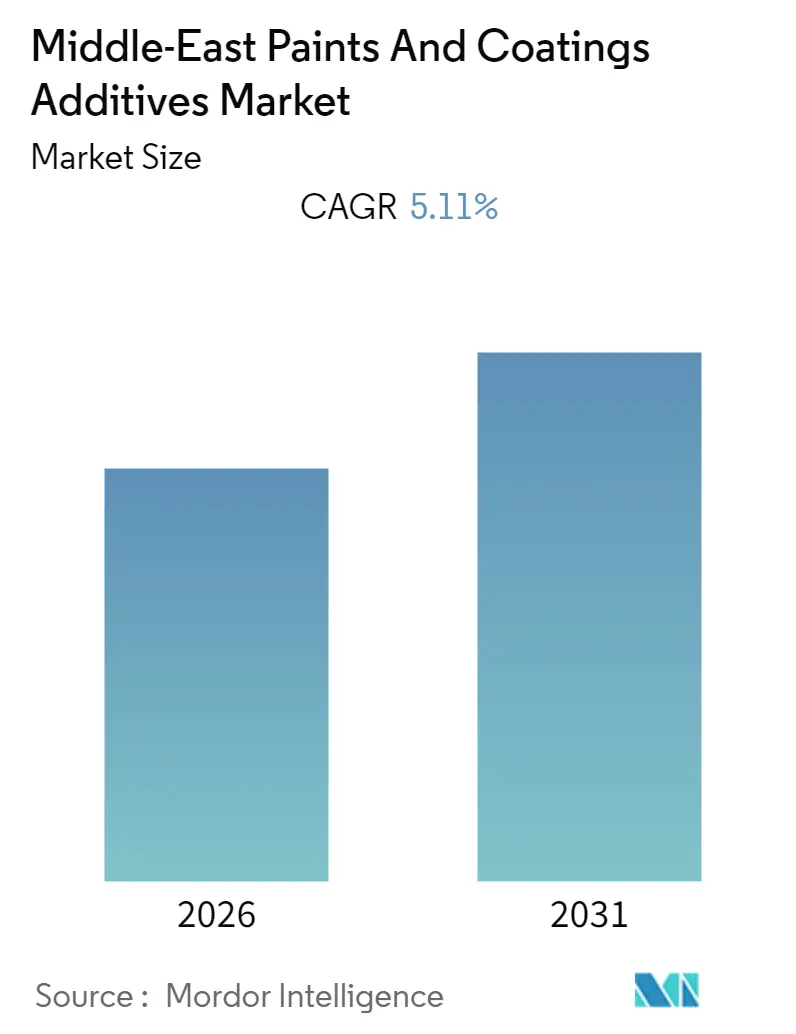
The Middle-East Paints and Coatings Additives Market size in 2026 is estimated at USD 1.38 billion, growing from 2025 value of USD 1.31 billion with 2031 projections showing USD 1.77 billion, growing at 5.11% CAGR over 2026-2031.
- Saudi Arabia dominated the market studied with a share of more than 45% of the total Middle-East paints and coatings additives market.
- By type, rheology modifiers had the largest share and occupied almost 25% of the Middle-East paints and coatings additives market, and is also the likely to expand at a fastest rate.
- The architectural segment accounted for the largest market share of more than 65%
Note: Market size and forecast figures in this report are generated using Mordor Intelligence’s proprietary estimation framework, updated with the latest available data and insights as of 2026.
Market Trends and Insights
Rheology Modifiers - A Huge Growth Potential
- Rheology modifiers are the largest type of additives by function, owing to many reasons, especially the ability to adjust the flow behavior of paints and coatings.
- They help in the reduction of spattering and dripping of paints while applying, and help in smooth and uniform applications, thus increasing the hiding power and shelf life of the paint.
- Additionally, during transportation and storage of paints and coatings, rheology modifiers help in preventing sedimentation of pigments.
- Rheology modifiers can be further classified into organic and inorganic rheology modifiers. These modifiers also act as thickeners.
- Inorganic modifiers help improve anti-settling, anti-spattering, and anti-sag properties of the coating. Organic modifiers help in stabilization against settling and low sagging.
- Thickeners are the commonly used rheology modifiers for water-borne coatings, and comprise of hydroxyethyl cellulose, hydroxypropyl cellulose, etc. Similarly, the commonly used rheology modifiers for solvent-borne coatings include organoclays, organic thixotropes, fumed silica, and over-based calcium sulfonate.
- Rheology modifiers are used primarily in architectural, industrial, automotive, and protective coatings.
- The commonly used rheology modifier types include WB synthetics, cellulosics, organoclays, fumed silicas, SB synthetics, and other inorganic types.
- Some of the manufacturers of rheology modifiers include Ashland, Cabot Corporation, Solvay, Elementis PLC, etc.

Saudi Arabia to Dominate the Market
- Saudi Arabia is aiming for the development of its paints and coatings sector, and is on the way to become the center for paints and coatings supply chain in the Middle-Eastern region, leveraging its easy access to key feedstock, production of basic molecules, and access to the regional market.
- Saudi Arabia has a persistent expedition in making some of the tallest, largest, and biggest structures. The paints and coatings industry in the country is expected to register steady growth in the coming years, as the construction industry is poised to witness sturdy growth in the forthcoming years, in turn, augmenting the demand for coating additives.
- The building activities in Saudi Arabia took place amid increased construction, especially in the industrial and commercial sectors in the local market, in keeping with the goals of the National Transformation Program 2020 and Saudi Vision 2030.
- In 2019, a new project worth USD 22 billion has been launched in Riyadh, by the King of the Saudi Arabia. The project focuses on the enhancement of infrastructure, amenities, and education in the region. The project includes 15 housing projects, Islamic museum, sports cities, seven medical cities and 16 educational projects.
- Additionally, the increasing foreign investments in various end-user industries, such as education, healthcare, hospitality, etc., are driving the growth of the Middle-East paints and coatings additives market in the region.

Geography Analysis
Saudi Arabia Paints and Coatings Additives Market
Saudi Arabia dominated the market studied with a share of more than 45.62% of the total Middle-East paints and coatings additives market in 2025.
Value Chain Analysis
The value chain begins with petrochemical and mineral feedstocks converted into base chemicals and functional intermediates used to produce coating additives, followed by specialty additive manufacturing, including rheology modifiers, dispersants and wetting agents, defoamers, surface modifiers, stabilizers, and biocides. Regional supply is supported by global producers and local or regional manufacturers.
Downstream demand is concentrated in architectural coatings, which is the largest end-user segment in the report, alongside industrial, protective, wood, and transportation coatings in Saudi Arabia, the UAE, Qatar, and the rest of the Middle East. Distribution is handled through a mix of direct sales by multinational suppliers and specialized distributors and blenders supporting paint makers, with logistics hubs such as Jebel Ali and industrial zones such as KEZAD supporting bulk chemical handling and time-to-market. Local capability for certain inputs and additives is present through regional manufacturers such as INDADD in Saudi Arabia, while regional distributors such as Raykem, Addisol, Safic-Alcan, and Chembridges support formulation support, sampling, and compliance documentation that becomes more central as Saudi product conformity and testing requirements tighten for coatings placed on the market.
Competitive Landscape
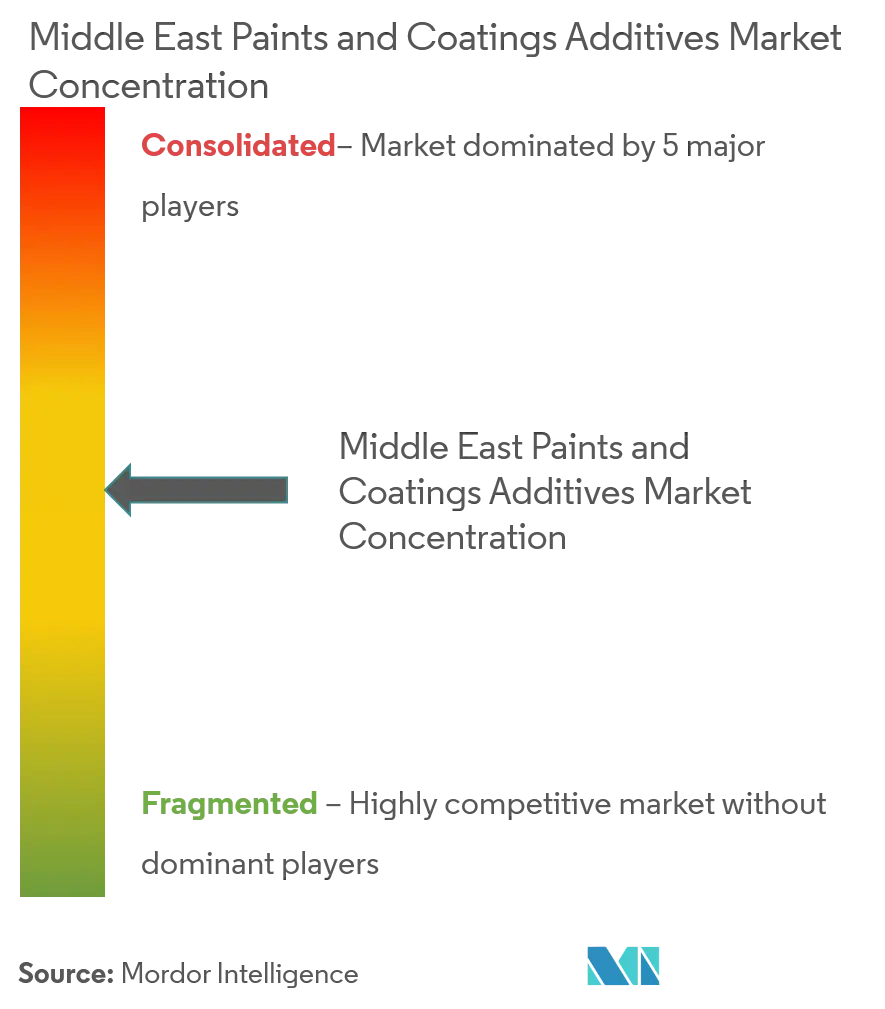
The Middle-Eastern coating additives market is partially concentrated, with the top five players accounting for around 40% of the market share. The region is primarily dominated by global players, and the local manufacturers are relatively low, when compared to global players. Major players in the market include Dow, Solvay, Altana Group (BYK), Ashland, and Elementis, among others.
Middle-East Paints And Coatings Additives Industry Leaders
-
Solvay
-
Altana Group (BYK)
-
Ashland
-
DOW
- *Disclaimer: Major Players sorted in no particular order
Middle-East Paints And Coatings Additives Market Companies Covered in this Report
- ALTANA
- Arkema Group
- Ashland
- BASF SE
- Cabot Corporation
- Daikin Industries Ltd
- Dow
- Elementis PLC
- Evonik Industries AG
- Nouryon
- Solvay
Read Analysis of Middle-East Paints And Coatings Additives Companies
Market Opportunities and Future Outlook
Regulatory-driven reformulation and documentation needs in Saudi Arabia create a specific entry space for additive suppliers that can help coating producers meet VOC and labeling requirements while maintaining performance in architectural and industrial applications. In May 2026, SASO issued Technical Regulation TR-IND-2026-04, revoking the VOC limit exemption for water-based industrial coatings and requiring compliance testing per SASO 2511:2024. This raises the value of low-VOC enabling packages such as wetting agents, defoamers, and rheology modifiers that help protect application properties while reducing solvent content.
A second opportunity is compliance-ready product stewardship and labeling support as Saudi Arabia moves environmental performance labeling for paints and varnishes from a voluntary phase (from April 2026) to mandatory implementation in October 2026 under its technical regulation framework. Suppliers with region-specific documentation, third-party conformity support, and consistent supply through GCC distribution networks can deepen relationships with large coating manufacturers, especially where specification-driven requirements elevate the need for additive selection and quality consistency in high-performance protective and infrastructure coatings.
Recent Industry Developments in Middle-East Paints And Coatings Additives Market
- April 2026: BYK (Altana Group) announced global price increases for additives of up to 18%, with certain product groups rising by up to 30%, effective May 1, 2026 (or as contracts allow). The update cited higher input and operating costs, and it feeds into additive procurement decisions and formulation cost management for paint and coatings manufacturers and distributors serving the Middle East.
- March 2026: Ashland implemented pricing actions across its Specialty Additives portfolio, citing market volatility, raw material costs, and logistics conditions linked to the Middle East conflict environment. The action influenced near-term sourcing and inventory strategies for coatings formulators that rely on imported specialty additives.
- August 2024: UAE environmental labeling program for paints and coatings began a formal pilot phase. The program accelerates conformity testing and documentation requirements for regional additive suppliers, and coatings manufacturers and distributors are aligning formulation strategies and supply-chain readiness to meet upcoming labeling standards and VOC reporting under the new framework.
Middle-East Paints And Coatings Additives Market Report Scope and Research Methodology
Market Definition and Coverage
This market covers chemical additives used in paint and coating formulations in the Middle East to improve processing, appearance, and performance, and it is measured in value terms at the point of sale to paint and coating manufacturers.
Scope exclusions: We exclude paint resins, pigments, solvents, and finished paint and coating products, even when they are sold through the same channels.
Segments Covered in This Report
- Type
- Biocides
- Dispersants & Wetting Agents
- Defoamers and Deaerators
- Rheology modifiers
- Surface Modifiers
- Stabilizers
- Flow and Leveling Additives
- Other Types
- End-user
- Architectural
- Wood
- Transportation
- Protective
- Other End-users
- Geography
- Saudi Arabia
- Qatar
- United Arab Emirates
- Rest of Middle-East
Data Sources, Market Sizing, and Validation
Desk Research
Desk research was used to set the core boundaries of the Middle East demand pool and to build starting assumptions for volumes and pricing. We referred to public sources such as national statistics portals for industrial output, customs authorities for trade flows of relevant chemical inputs, and standards bodies and regulators that shape VOC and labeling requirements.
To translate those signals into a usable model, we also reviewed trade association releases, peer-reviewed chemistry and coatings journals for formulation trends, company annual reports and investor presentations for regional exposure, and credible press coverage for plant expansions and construction cycles. Where needed, paid subscriptions focused on company financials and shipment-level import and export records were used to cross-check exposure, price direction, and supply routes. These examples are not exhaustive, and other public references were also used to collect, validate, and clarify data points.
Primary Interviews and Surveys
Primary work focused on validating how additives are bought and priced in the Middle East across architectural and protective coatings, and how mixes shift between water-borne and solvent-borne systems. We spoke with a spread of raw material suppliers, formulators, distributors, and downstream paint and coating buyers, so assumptions like average dosage rates, typical contract length, and pass-through timing could be adjusted when respondents described different purchasing cycles.
Coverage was balanced across the key Middle East markets and the rest of the region, and follow-up checks were done when desk signals and field feedback did not align on demand seasonality or pricing moves.
Distribution of primary research fieldwork respondents
| Company type | Respondent position |
|---|---|
| Top tier: 38% | CXOs: 12% |
| Mid tier: 43% | Functional/Unit leaders: 36% |
| Smaller Players: 19% | Managers: 52% |
Market-Sizing & Forecasting
Sizing starts with a top-down build that reconstructs regional paint and coatings activity, then applies additive intensity to that demand pool, which is filtered through the Middle East country mix. The intensity layer is driven by practical inputs such as construction and refurbishment activity, protective coatings demand linked to industrial maintenance, typical additive dosage rates by formulation, and the split between water-borne and solvent-borne systems.
After the first cut is produced, we check it using selective bottom-up approximations, such as rolling up a sample of supplier and distributor revenue exposure to the region, and validating implied average selling prices against interview feedback and recent import pricing direction. If a bottom-up view is incomplete for smaller channels, gaps are handled by using conservative penetration assumptions, then stress-testing totals against trade and production signals.
For forecasting, scenario analysis is used, with demand drivers like construction pipeline momentum, industrial project starts, raw material cost pressure, and regulatory tightening on VOC acting as the main levers. The final growth path is adjusted after reconciling what interviewees expect on mix shift, pricing pass-through lag, and substitution between additive chemistries.
Data Validation & Update Cycle
Validation is done by triangulating the modeled totals against independent signals, then running variance checks by country and by major end-use so outliers are easy to spot. When a number looks overstretched, we revisit assumptions and trigger targeted re-contacts to confirm whether the mismatch is coming from dosage, pricing, or a geography split issue.
Before sign-off, the model is reviewed in steps, first at the input layer and then at the output layer, so calculation errors and inconsistent units are caught early. Reports are refreshed annually, and interim updates are made when material events occur, such as sharp feedstock moves, major plant changes, or step-changes in construction spending. Right before delivery, a final analyst pass is completed to ensure clients receive the latest updated view.
Mordor Intelligence's Middle East Paint Additives Market Size Compared Against Other Published Estimates
Published market sizes for Middle East paint additives can look far apart because the region definition, the product boundary, and the year used for pricing are not always the same. Differences also show up when one estimate leans more on trade values while another relies more on downstream paint output assumptions.
The biggest gap drivers here are whether Africa is included with the Middle East, whether adjacent coating chemicals are counted as additives, and how average selling prices are moved from one year to the next during feedstock swings. Some studies also use an older base year and then apply a straight CAGR without re-checking mix shifts between architectural and protective coatings, which can change additive intensity.
Benchmark comparison
| Source | Market Size | Gaps in Research Methodology |
|---|---|---|
| Mordor Intelligence | USD 1.31 B (2025) | |
| Industry Databook A | USD 0.51 B (2022) | Uses a Middle East and Africa roll-up and anchors on a 2022 base, which can compress the Middle East-only view and smooth over the local mix shift that affects additive dosage and value. |
| Regional Consultancy B | USD 0.41 B (2024) | Starts from a narrower counted basket and applies a 2024 value base with limited visibility on how pricing is updated through contracts and distributor margins, which can pull the total down versus a manufacturer-facing market value. |
The spread is easiest to explain when geography and what gets counted are lined up, and then pricing timing is made explicit. A Middle East-only scope, checked against additive intensity and local formulation mix, is what keeps the value path consistent in our model, a choice applied by Mordor Intelligence.
Key Questions Answered in the Report
What is the current Middle-East Paints and Coatings Additives Market size?
The Middle-East Paints and Coatings Additives Market is projected to register a CAGR of 5.11% during the forecast period (2026-2031)
Who are the key players in Middle-East Paints and Coatings Additives Market?
Solvay, Altana Group (BYK), Ashland and DOW are the major companies operating in the Middle-East Paints and Coatings Additives Market.
What years does this Middle-East Paints and Coatings Additives Market cover?
The report covers the Middle-East Paints and Coatings Additives Market historical market size for years: 2020, 2021, 2022, 2023, 2024 and 2025. The report also forecasts the Middle-East Paints and Coatings Additives Market size for years: 2026, 2027, 2028, 2029, 2030 and 2031.