
Market Overview
| Study Period | 2020 - 2031 |
|---|---|
| Forecast Data Period | 2026 - 2031 |
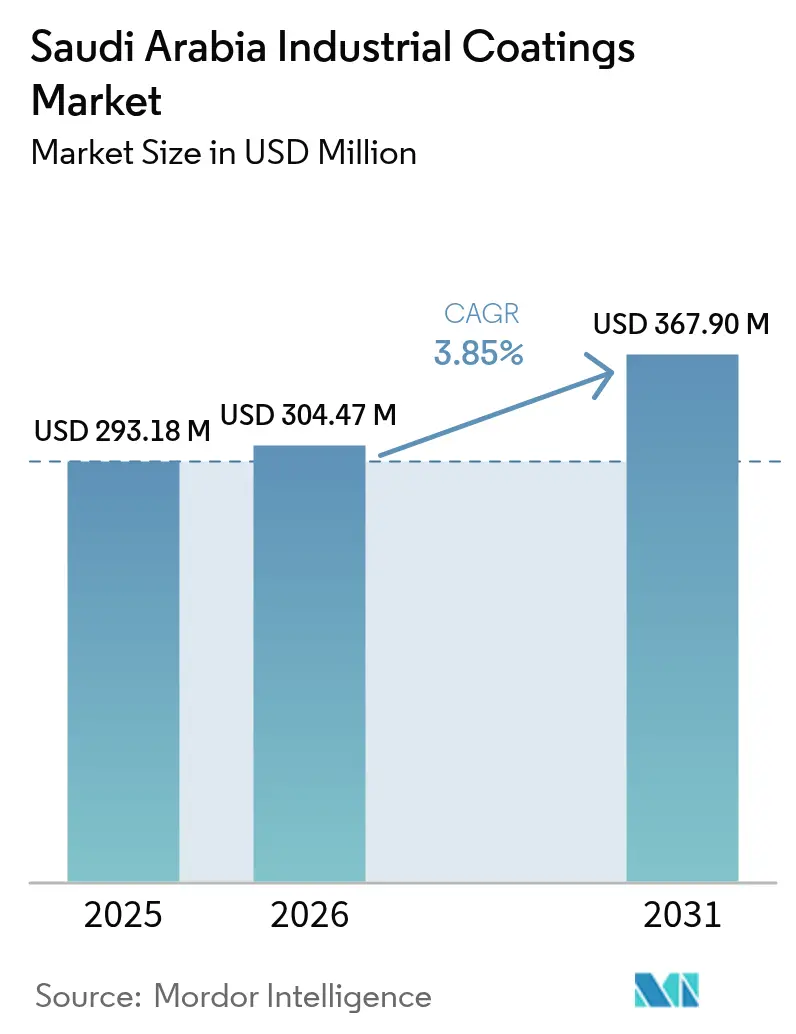
| Base Year Market Size (2025) | USD 293.18 Million |
| Market Size (2026) | USD 304.47 Million |
| Market Size (2031) | USD 367.9 Million |
| Growth Rate (2026 - 2031) | 3.85 % |
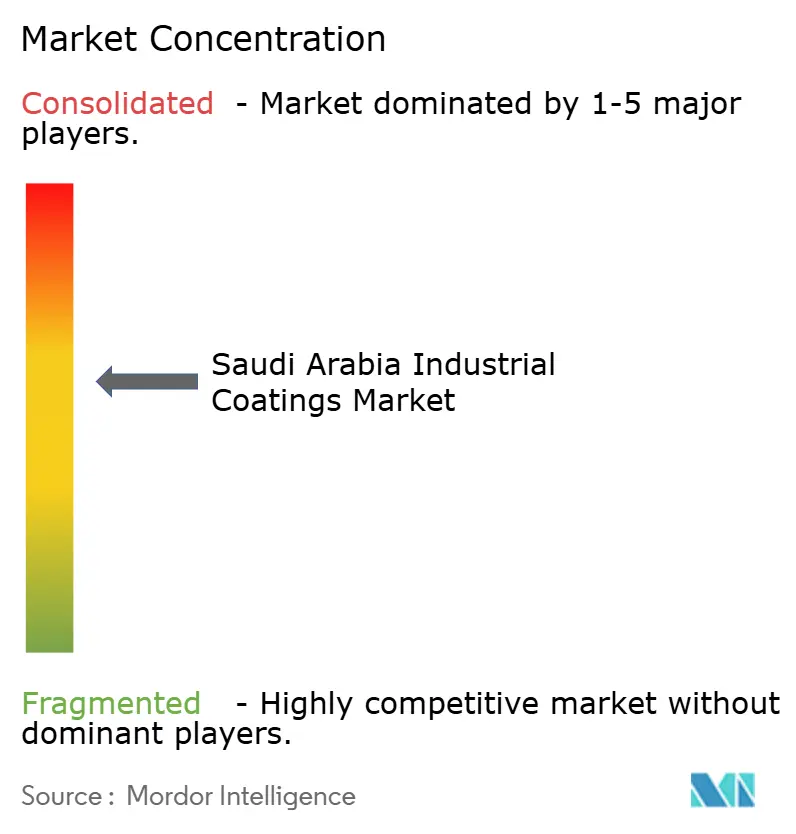
| Market Concentration | Medium |
Major Players *Disclaimer: Major Players sorted in no particular order Image © Mordor Intelligence. Reuse requires attribution under CC BY 4.0. | |
Saudi Arabia Industrial Coatings Market Analysis by Mordor Intelligence
The Saudi Arabia Industrial Coatings Market size is expected to grow from USD 293.18 million in 2025 to USD 304.47 million in 2026 and is forecast to reach USD 367.9 million by 2031 at 3.85% CAGR over 2026-2031. Continued industrial diversification under Vision 2030, a pipeline of giga-projects, and tightening SASO environmental norms have amplified demand for high-performance protective and specialty systems. Rapid downstream capacity additions, localization of automotive production in the King Salman Automotive Cluster, and widespread adoption of automated application methods further accelerate market expansion. International suppliers leverage global research and development to meet increasingly stringent specifications, while local producers scale up their capacity to provide cost-competitive supply. Raw-material price volatility and a shortage of certified applicators are the principal near-term challenges.
Key Report Takeaways
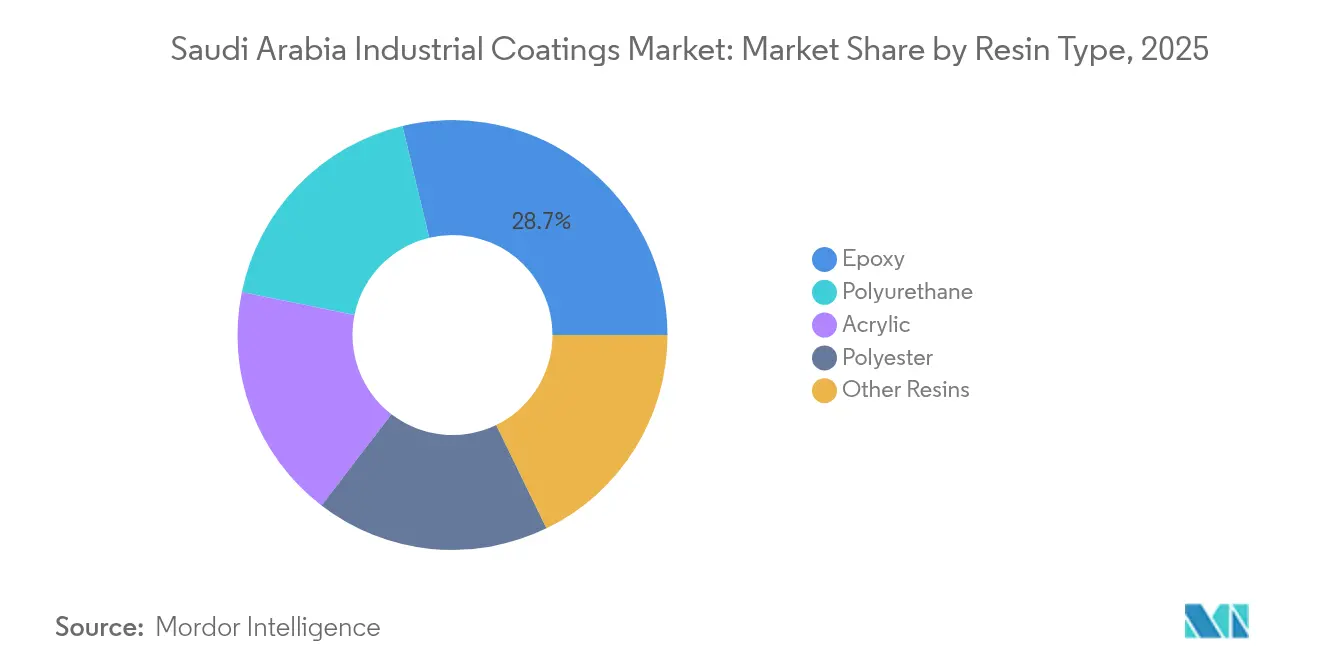
- By resin type, epoxy led the Saudi Arabia industrial coatings market with a 28.74% share in 2025, whereas polyurethane resins are forecast to grow at a 3.92% CAGR through 2031.
- By technology, solvent-borne products commanded 36.21% of the Saudi Arabian industrial coatings market share in 2025; water-borne systems are projected to expand at a 4.31% CAGR through 2031.
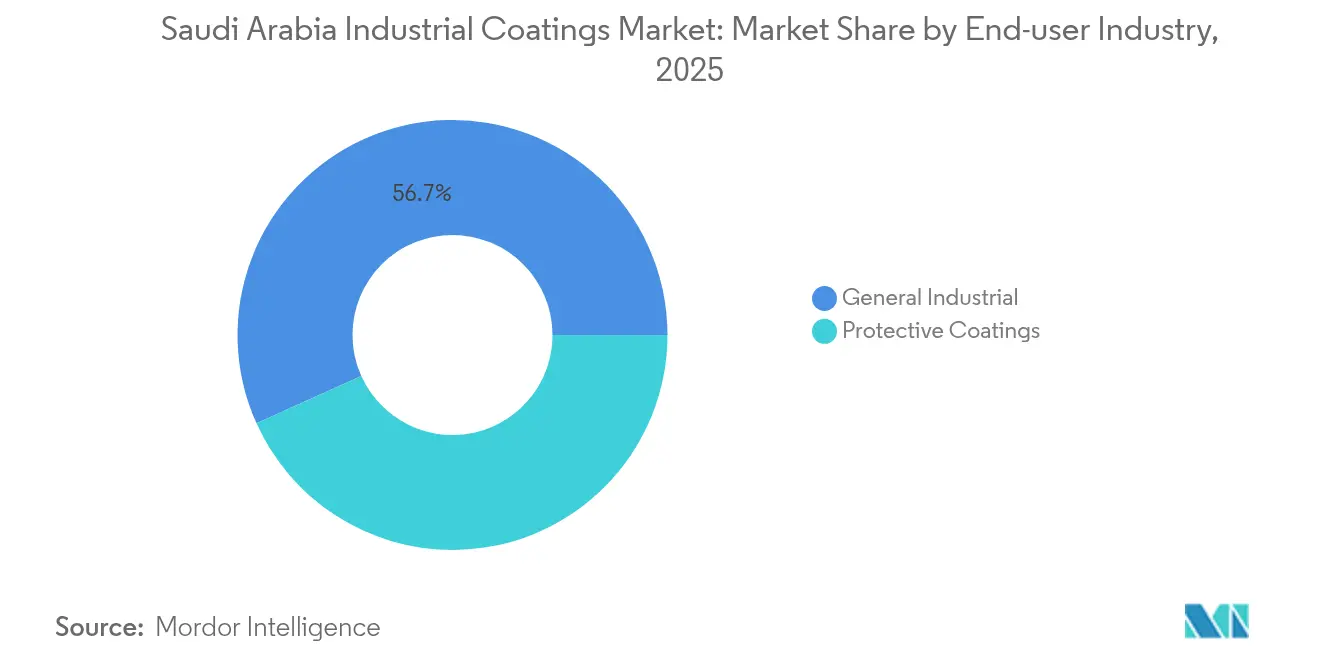
- By end-user industry, general industrial applications accounted for a 56.74% share of the Saudi Arabia industrial coatings market size in 2025 and are projected to advance at a 4.07% CAGR through 2031.
Note: Market size and forecast figures in this report are generated using Mordor Intelligence’s proprietary estimation framework, updated with the latest available data and insights as of 2026.
Saudi Arabia Industrial Coatings Market Trends and Insights
Drivers Impact Analysis*
| Drivers | (~) % Impact on CAGR Forecast | Geographic Relevance | Impact Timeline |
|---|---|---|---|
| Vision 2030 giga-projects pipeline | +1.2% | National, with early gains in NEOM, Red Sea, Qiddiya | Medium term (2-4 years) |
| Rapid expansion of oil-and-gas downstream maintenance cycles | +0.8% | Eastern Province core, spill-over to Jubail Industrial City | Short term (≤ 2 years) |
| Localization of automotive manufacturing and parts under NIDLP | +0.6% | Central Region focus, King Salman Automotive Cluster | Medium term (2-4 years) |
| Tightening SASO/SABER compliance favouring high-performance, low-VOC systems | +0.5% | National | Short term (≤ 2 years) |
| Surge in offshore wind / green-hydrogen assets needing specialty coatings | +0.4% | NEOM, Red Sea coastal areas | Long term (≥ 4 years) |
| Source: Mordor Intelligence | |||
Vision 2030 Giga-Projects Drive Unprecedented Coating Specifications
Landmark projects, including NEOM, The Red Sea Project, and Qiddiya, shape the Saudi Arabian industrial coatings market. NEOM’s masterplan needs coatings that withstand desert heat above 50 °C while delivering architectural aesthetics for The Line’s mirrored façades. Marine-grade, coral-safe systems are now mandatory at The Red Sea Project, while fire-resistant and anti-graffiti layers protect Qiddiya’s entertainment venues. Contractors have moved to robotic spray lines and automated film-thickness scanners to meet large-scale delivery schedules.
Oil and Gas Downstream Expansion Accelerates Protective Demand
Saudi Aramco’s gas program and SABIC integration have increased call-offs for protective coatings on new processing trains, storage tanks, and offshore pipelines. Aramco’s SAES standards specify epoxy and polyurethane systems with Level 1 and Level 2 inspection oversight, compelling suppliers to certify products for each service environment[1]. Hydrogen and offshore wind ventures at NEOM require coatings that resist hydrogen embrittlement and salt-spray corrosion for 25-year lifecycles.
NIDLP Automotive Localization Creates New Supply Chains
Lucid Motors plans to assemble vehicles, and the Ceer-Foxconn joint venture expands component lines in Riyadh. The shift necessitates OEM-grade primers, basecoats, and clearcoats formulated for Gulf Coast climates, plus battery-housing coatings that provide thermal and EMI shielding. Local content mandates encourage international paint majors to license technology or establish plants in partnership with Saudi companies.
SASO Compliance Drives High-Performance, Low-VOC Adoption
The 2024 Product Safety Law imposes fines and permits criminal liability for unsafe products. Manufacturers are rapidly reformulating to water-borne or high-solids chemistries that meet VOC caps while maintaining corrosion performance. Global players gain an edge through certified labs and traceable quality control, whereas smaller suppliers face costly upgrades[2].
Restraints Impact Analysis*
| Restraints | (~) % Impact on CAGR Forecast | Geographic Relevance | Impact Timeline |
|---|---|---|---|
| Heavy anti-dumping duties on TiO₂ and coated aluminium raising raw-material costs | -0.7% | National | Short term (≤ 2 years) |
| Acute shortage of certified applicators and inspectors for Aramco standards | -0.4% | Eastern Province, industrial clusters | Medium term (2-4 years) |
| Stricter New Product-Safety Law penalties elevating compliance costs | -0.3% | National | Short term (≤ 2 years) |
| Source: Mordor Intelligence | |||
Anti-Dumping Duties Escalate Raw-Material Costs
New trade remedies on imported titanium dioxide, coated aluminum, and PVC-coated fabrics inflate pigment and substrate expenses, as TiO₂ accounts for a significant portion of formulation cost. Domestic producer Tasnee explores backward integration to cushion volatility, yet near-term margins remain under pressure.
Certified Applicator Shortage Constrains Quality Assurance Capacity
Only a limited pool of Level 1 and Level 2 inspectors meets Aramco criteria, triggering project delays and rework. With the Kingdom projected to lack skilled workers by 2030, companies are investing in in-house vocational programs, such as Jazeera Paints Academy, although industry-wide uptake is slower than demand growth.
*Our forecasts treat driver/restraint impacts as directional, not additive. The impact forecasts reflect baseline growth, mix effects, and variable interactions.
Segment Analysis
By Resin Type: Epoxy Dominance Faces Polyurethane Challenge
Epoxy retained a 28.74% share of the Saudi Arabia industrial coatings market in 2025, underpinned by its widespread use on offshore rigs, storage spheres, and cross-country pipelines. The Saudi Arabia industrial coatings market size for epoxy systems is forecast to expand steadily as Aramco’s gas processing units are commission through 2031. Polyurethane registers the fastest 3.92% CAGR, propelled by demand for UV-resistant finishes on NEOM’s iconic landmarks and flexible weatherproof membranes on The Red Sea Project. Local formulators increasingly blend high-solids polyurethane hybrids to balance compliance and performance, while acrylics and polyesters maintain niche roles in coil and appliance lines.
The segment landscape mirrors Vision 2030 diversification. High-film-build epoxies protect corrosive petrochemical reactors, whereas elastomeric polyurethanes coat entertainment parks and lightweight bridge decks. International vendors differentiate themselves via amine-accelerated epoxies that cure at temperatures below 10 °C, ideal for winter shutdowns in Tabuk, while Saudi firms highlight low-temperature cure polyurethanes suited for modular onsite fabrication.

By Technology: Water-Borne Systems Gain Despite Solvent Leadership
Solvent-borne chemistries held a 36.21% share in the Saudi Arabia Industrial Coatings Market in 2025 due to their entrenched performance in abrasive offshore and refinery conditions. The Saudi Arabia industrial coatings market size for solvent-borne protective grades continues to grow alongside petrochemical debottlenecking, yet water-borne alternatives now log a 4.31% CAGR. SASO’s VOC thresholds and penalties under the Product Safety Law spur rapid switchovers in general industrial and OEM lines.
Powder coatings benefit from 0-VOC profiles and reclaim efficiency, finding traction in appliance shells and electric-vehicle chassis. UV-cure and high-solids systems target electronics, packaging, and 3-D-printed parts, though uptake remains niche due to capital outlays for curing units. Equipment suppliers report a rise in orders for robotic booths that can interchange between wet and powder lines in the same cell, reflecting hybrid production strategies at automotive tier suppliers.
By End-User Industry: General Industrial Applications Lead Growth
General industrial users accounted for 56.74% of demand in 2025 and are projected to rise at a 4.07% CAGR through 2031. Factory expansions across construction materials, consumer durables, and packaging sustain steady call-offs for primers, enamels, and maintenance topcoats. Protective oil-and-gas coatings follow mega-project cycles but remain the single largest high-value subsegment. Renewable power, including green hydrogen units at NEOM, necessitates specialized anti-hydrogen and anti-sparking layers.
Infrastructure projects, such as the Riyadh Metro, high-speed rail, and cross-kingdom bridges, prefer low-maintenance fluoropolymer-modified systems. Mining operations in the Northern Province spur abrasion-resistant linings for haul trucks and ore crushers. Together, these diversified outlets reduce reliance on upstream hydrocarbon spending and sustain a balanced volume base.
Geography Analysis
The Eastern Province contributed a significant portion of Saudi Arabia's industrial coatings market share in 2025, primarily driven by Jubail’s chemical plants. The region's growth rides on Aramco’s gas expansion, SABIC’s new polypropylene trains, and maritime yard upgrades along the Arabian Gulf. Tank farms, LNG terminals, and offshore jackets dominate protective demand, while maintenance repaint cycles align with five-year turnaround schedules.
Vision 2030 programs have earmarked significant value for mixed-use, transit, and manufacturing complexes, pushing volume for architectural primers, steelwork coatings, and OEM automotive finishes. The King Salman Automotive Cluster catalyzes new coil-coating lines for aluminum body panels and plastic parts requiring specialty primers compatible with EV batteries.
The Red Sea Project and NEOM’s coastal megastructures drive marine-grade and UV-stable coatings, while Jeddah’s logistics hub triggers demand for warehouse floor epoxies and container coatings. Northern and Southern provinces remain nascent, but mining concessions and border infrastructure provide future upside, particularly for abrasion-resistant and heat-reflective technologies in arid terrains.
Regulatory Landscape
Saudi Arabia regulates industrial coatings primarily through the Saudi Standards, Metrology and Quality Organization (SASO), which issues and enforces technical regulations for paints and varnishes and related conformity-assessment requirements. Market access for imported and domestically sold coatings is closely tied to compliance under SASO frameworks and the SABER platform, where certificates and test documentation are required as part of product registration and clearance workflows.
Environmental and product-safety compliance continues to tighten, pushing suppliers toward traceable quality systems and laboratory-verified performance. VOC requirements reference Gulf standards such as GSO 1914 as an anchor for limits used in paints and coatings oversight, with verification often depending on accredited chemical testing capabilities, including SASO-linked chemical products laboratory pathways. In parallel, industrial localization initiatives under the Ministry of Industry and Mineral Resources, aligned with Vision 2030 programs, reinforce in-Kingdom manufacturing and compliant supply for government-backed and megaproject procurement.
Value Chain Analysis
The value chain starts with upstream hydrocarbons and petrochemical intermediates supplying resins and solvents, with key feedstock flows tied to the Kingdom's large integrated complexes, particularly Jubail and Yanbu, and to national energy and petrochemical producers. Industrial coatings manufacturing then centers on in-Kingdom producers and blenders with local plants and technical service footprints, including SIPCO, Oasis Ameron, UCICOAT, and Zamil Industrial Coating, which formulate epoxy, polyurethane, and other systems for oil and gas, infrastructure, and general industrial applications.
Downstream, distribution is carried out through direct supply to EPC contractors, fabricators, and industrial maintenance providers, supported by specification approvals and testing routes governed by SASO and SABER. Bottlenecks include reliance on imported specialty pigments, such as titanium dioxide, and select epoxy intermediates, alongside execution constraints tied to the availability of certified applicators and inspectors for stringent project standards. Localization programs under the National Industrial Development and Logistics Program (NIDLP) reinforce investments in domestic manufacturing, quality control, and shorter lead-time supply to major industrial clusters, particularly in the Eastern Province.
Competitive Landscape
The Saudi Arabia Industrial Coatings Market is moderately consolidated. Global firms leverage research and development, as well as ISO-certified product lists compliant with SAES and SABER, to secure flagship contracts at NEOM and Aramco refineries. Each operates regional plants or toll blends in Dammam to satisfy Saudi content mandates. Product differentiation hinges on Gulf-climate durability, low-VOC formulations, and digital application aids. Leading firms are piloting drone-enabled surface inspection and AR-guided spraying to reduce labor bottlenecks. Niche disruptors develop graphene-enhanced barriers for hydrogen pipelines and single-coat polyurethanes with salt-fog resistance. Procurement teams at mega-projects weigh lifecycle cost, SAES prequalification, and local-content scorecards ahead of award decisions, giving agile domestic producers room to capture mid-tier packages while multinationals secure complex turnkey scopes.
Saudi Arabia Industrial Coatings Industry Leaders
-
Jotun
-
AkzoNobel N.V.
-
Al-Jazeera Paints
-
PPG Industries Inc.
-
The Sherwin-Williams Company
- *Disclaimer: Major Players sorted in no particular order
Market Opportunities and Future Outlook
Localization-driven capacity additions and partnerships create room for suppliers that can manufacture and qualify high-performance systems within Saudi Arabia. East Pipes Integrated Company for Industry provides an anchor point, with a SAR 78.5 million project in Dammam (Second Industrial City) aimed at adding a new external steel pipe coating line and expanding coating throughput, supported by demand from pipelines and energy infrastructure where protective specifications and delivery timelines are closely managed.
High-performance protective and specialty coatings for energy, marine, and megaproject assets also benefit from supplier actions that shorten lead times and help meet specification requirements. VIP Coatings' announcement of a strategic production partnership with CIC Construction Chemicals to manufacture high-performance coating and sealing solutions within Saudi Arabia points to increased interest in local manufacturing footprints beyond traditional paint majors. Alongside Vision 2030 localization mechanisms, including NIDLP and the local-content frameworks used across major industrial procurement, these developments support specific demand pockets in passive fire protection, corrosion protection, and specialty formulations designed for harsh coastal and desert operating conditions.
Recent Industry Developments
- June 2026: VIP Coatings announced a strategic production partnership with CIC Construction Chemicals to manufacture high-performance coating and sealing solutions within Saudi Arabia. The move increases local manufacturing availability for project-driven protective and specialty applications and supports faster supply and technical support for in-Kingdom customers.
- July 2025: Jotun Saudi Arabia announced plans to double production capacity through investments in its manufacturing facilities. Expanded local output supports large-volume industrial and protective demand tied to major infrastructure and energy projects and reduces reliance on imported finished coatings.
- April 2025: AkzoNobel started local manufacturing of Chartek ONE epoxy passive fire protection in Dammam, Saudi Arabia, serving customers across the EMEA region. Local production strengthens supply assurance for fire-protection specifications used in oil and gas and industrial infrastructure and improves responsiveness for complex project schedules.
Research Methodology Framework and Report Scope
Market Definition and Coverage
This market covers industrial coatings sold and applied in Saudi Arabia for protecting and finishing industrial assets and equipment, and it is measured in value terms at the point of sale to industrial users and applicators.
Scope exclusions: Decorative architectural paints for homes and offices and specialty consumer DIY coatings are excluded from this market sizing.
Segmentation Overview
- By Resin Type
- Epoxy
- Polyurethane
- Acrylic
- Polyester
- Other Resins (Alkyd, Fluoropolymer)
- By Technology
- Water-borne
- Solvent-borne
- Powder Coatings
- Other Technologies (UV-/EB-Cured and High Solids)
- By End-user Industry
- General Industrial
- Protective Coatings
- Oil and Gas
- Power Generation
- Infrastructure
- Mining
- Other Protective Coatings
Data Sources, Market Sizing, and Validation
Desk Research
Desk work starts with mapping the demand drivers that typically pull industrial coatings in Saudi Arabia, then aligning them to the product and end-use scope used in the model. Public sources, including Saudi General Authority for Statistics, Saudi Central Bank (SAMA) macro series, the Ministry of Industry and Mineral Resources, and public updates from Saudi Aramco and SEC, are used to ground industrial activity and project pipelines.
We also review customs and trade data where relevant, SASO references, environmental compliance references, and technical literature and patent databases to understand shifts in resin systems and technology adoption (for example, water-borne and powder moves). Company annual reports, investor presentations, and credible trade press help confirm capacity additions, plant utilization narratives, and end-market exposure. When needed, paid subscriptions are used for company financials and news, patent lookups, and shipment-level import and export checks for selected coating inputs and intermediates. These desk sources are illustrative and not exhaustive, and many other public references are consulted for cross-checking and clarification.
Primary Interviews and Surveys
Primary work is used to translate desk signals into usable sizing inputs, especially around mix by resin and technology, pricing direction, and the share of protective versus general industrial demand. We speak with manufacturers, distributors, contractors and applicators, and large end users across oil and gas, power, infrastructure, and general manufacturing in Saudi Arabia, and the feedback is used to validate assumptions and resolve gaps where public data is not specific enough.
Distribution of primary research fieldwork respondents
| Company type | Respondent position |
|---|---|
| Top tier: 31% | CXOs: 18% |
| Mid tier: 48% | Functional/Unit leaders: 25% |
| Smaller Players: 21% | Managers: 57% |
Market-Sizing & Forecasting
The sizing logic starts with a top-down build where industrial output and project activity are translated into coating demand pools, then filtered through coating intensity and typical maintenance cycles across key asset types. To keep the totals realistic, the outputs are corroborated using selective bottom-up approximations, such as sampled price per kilogram ranges multiplied by estimated volumes for major resin systems, and channel checks on distributor throughput, which are then used to adjust the final totals.
Inputs that matter for this market include industrial capex timing under Vision 2030, oil and gas and power maintenance spend patterns, new infrastructure and industrial zone build-outs, resin and solvent cost movements that influence selling prices, and adoption shifts between solvent-borne, water-borne, and powder technologies. Forecasting is run using scenario analysis supported by regression checks, where the independent variables are the most stable activity indicators and the scenario weights are reviewed with industry respondents. When bottom-up data is thin for a niche application, we bridge the gap by using neighboring application shares and pricing bands validated in interviews, then testing sensitivity before locking the number.
Data Validation & Update Cycle
Validation is done through a set of consistency checks, where the total market is compared against independent signals such as industrial production direction, import and export movements for key inputs, and the implied price progression year over year. Large variances trigger a re-check of assumptions and, when needed, a follow-up touchpoint with respondents to confirm whether the change is structural or mainly timing related.
Before sign-off, the model and outputs go through multi-step analyst review to ensure unit conversions, currency timing, and segment roll-ups remain consistent. The report is refreshed annually, and interim updates are made when major events occur, such as a sudden feedstock price swing or a large industrial project schedule change. Right before delivery, a final pass is completed to ensure the latest publicly available datapoints are reflected in the narrative and the numbers.
Mordor Intelligence's Saudi Arabia Industrial Coatings Market Size Versus Other Published Estimates
Different publishers can show different market sizes for Saudi Arabia industrial coatings because they do not always count the same coating scope, the same pricing point, or the same end-use boundary between industrial and adjacent paint categories. Another reason is timing, since some estimates are anchored to older base years and then extended using broad growth rates.
The biggest gaps usually come from whether the estimate blends industrial paints with wider paints and coatings, whether it includes architectural protective layers used on buildings, and how aggressive the price escalation is assumed during resin and solvent swings. The table points to that spread, where narrow industrial-only scope with resin and technology splits, and a 2025 base value of USD 293.18 M (2025) rather than a broader paints bucket, is the key reason the number differs for Mordor Intelligence.
Benchmark comparison
| Source | Market Size | Gaps in Research Methodology |
|---|---|---|
| Mordor Intelligence | USD 293.18 M (2025) | |
| Global Consultancy A | USD 928.10 M (2024) | Uses a different base year and a broader resin set that can capture wider industrial paint demand, and the revenue definition may reflect a higher pricing point and wider application scope than industrial-only coatings. |
| Research Publisher B | USD 480.00 M (2024) | Starts from a 2024 base and applies a high-growth trajectory to 2032, and the inclusion language suggests a wider industrial usage set that can blend adjacent coating applications and inflate the value versus a tighter industrial coatings definition. |
Overall, the spread is mostly explained by scope and base-year choices, followed by how pricing is trended through raw material cycles. By tying the model to clear industrial activity drivers and then pressure-testing totals with channel and pricing checks, the final number stays traceable and repeatable even when public data is not perfectly granular.
Key Questions Answered in the Report
How large is the Saudi Arabian industrial coatings market in 2026?
It is valued at USD 304.47 million and is projected to grow at a 3.85% CAGR to 2031.
Which resin type currently dominates demand?
Epoxy systems lead with 28.74% share due to extensive use in petrochemical protection.
What is driving the shift toward water-borne technologies?
SASO VOC limits and the 2024 Product Safety Law push manufacturers toward low-emission formulations.
Who are the key suppliers?
Jotun, AkzoNobel N.V., Al-Jazeera Paints, PPG Industries Inc., and The Sherwin-Williams Company are major players in the market.
What challenges threaten near-term growth?
TiO₂ anti-dumping duties raise raw-material costs, and a shortage of certified applicators delays project execution.