
Saudi Arabia Microwave Ovens Market Size and Share
Market Overview
| Study Period | 2020 - 2031 |
|---|---|
| Base Year For Estimation | 2025 |
| Forecast Data Period | 2026 - 2031 |
| Market Size (2026) | USD 156.56 Million |
| Market Size (2031) | USD 195.39 Million |
| Growth Rate (2026 - 2031) | 4.54 % CAGR |
| Market Concentration | Low |
Major Players *Disclaimer: Major Players sorted in no particular order. Image © Mordor Intelligence. Reuse requires attribution under CC BY 4.0. |

Saudi Arabia Microwave Ovens Market Analysis by Mordor Intelligence
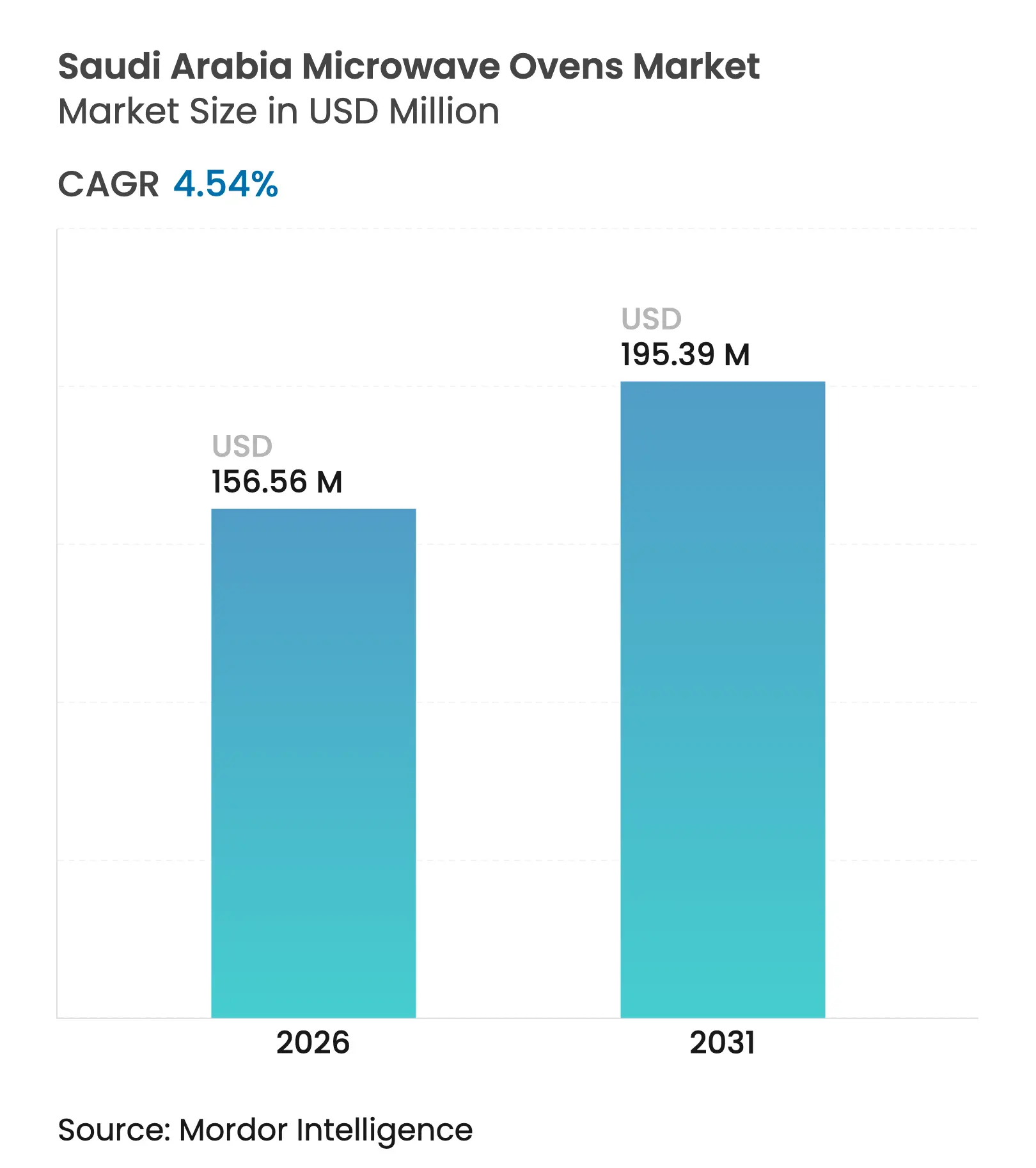
The Saudi Arabia microwave ovens market size was valued at USD 149.76 million in 2025 and estimated to grow from USD 156.56 million in 2026 to reach USD 195.39 million by 2031, at a CAGR of 4.54% during the forecast period (2026-2031). The market growth is expected from the Vision 2030 reforms that lift disposable incomes, accelerate residential building approvals, and incentivize digital payment adoption. Convection units lead product demand as households embrace appliances that blend traditional cooking with fast-paced lifestyles. Countertop formats remain dominant, yet built-in models gain momentum in premium housing developments where space optimization and aesthetics matter. Supply chain localization efforts such as the Public Investment Fund-backed Alat initiative may gradually curb import reliance and reshape pricing as local production scales.
Key Report Takeaways
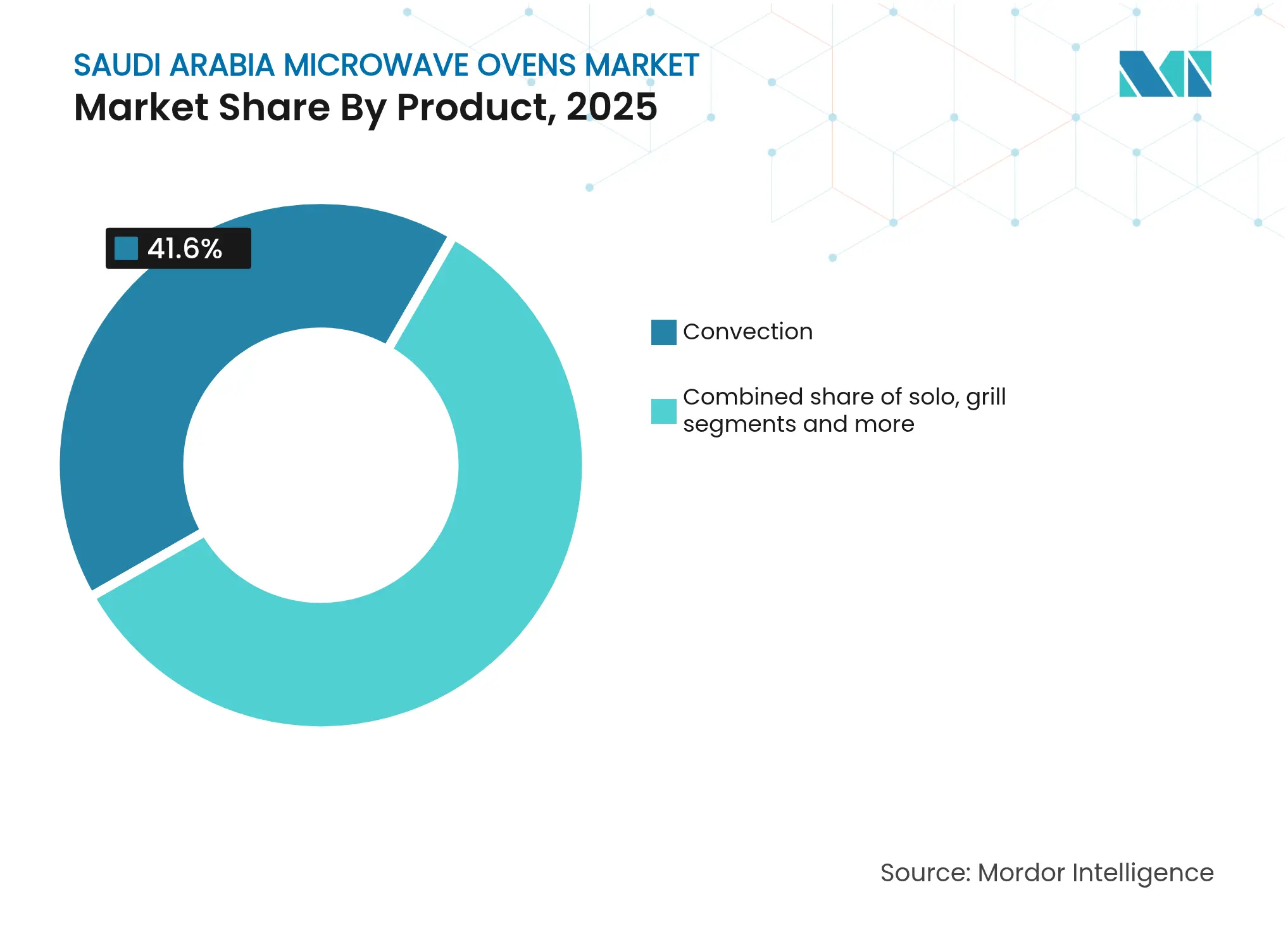
- By product, convection microwave ovens led with 41.60% revenue share in 2025, while grill variants recorded the fastest 4.83% CAGR through 2031.
- By structure, countertop units held 59.10% of the Saudi Arabia microwave ovens market share in 2025; built-in/wall units are projected to grow at 4.49% CAGR to 2031.
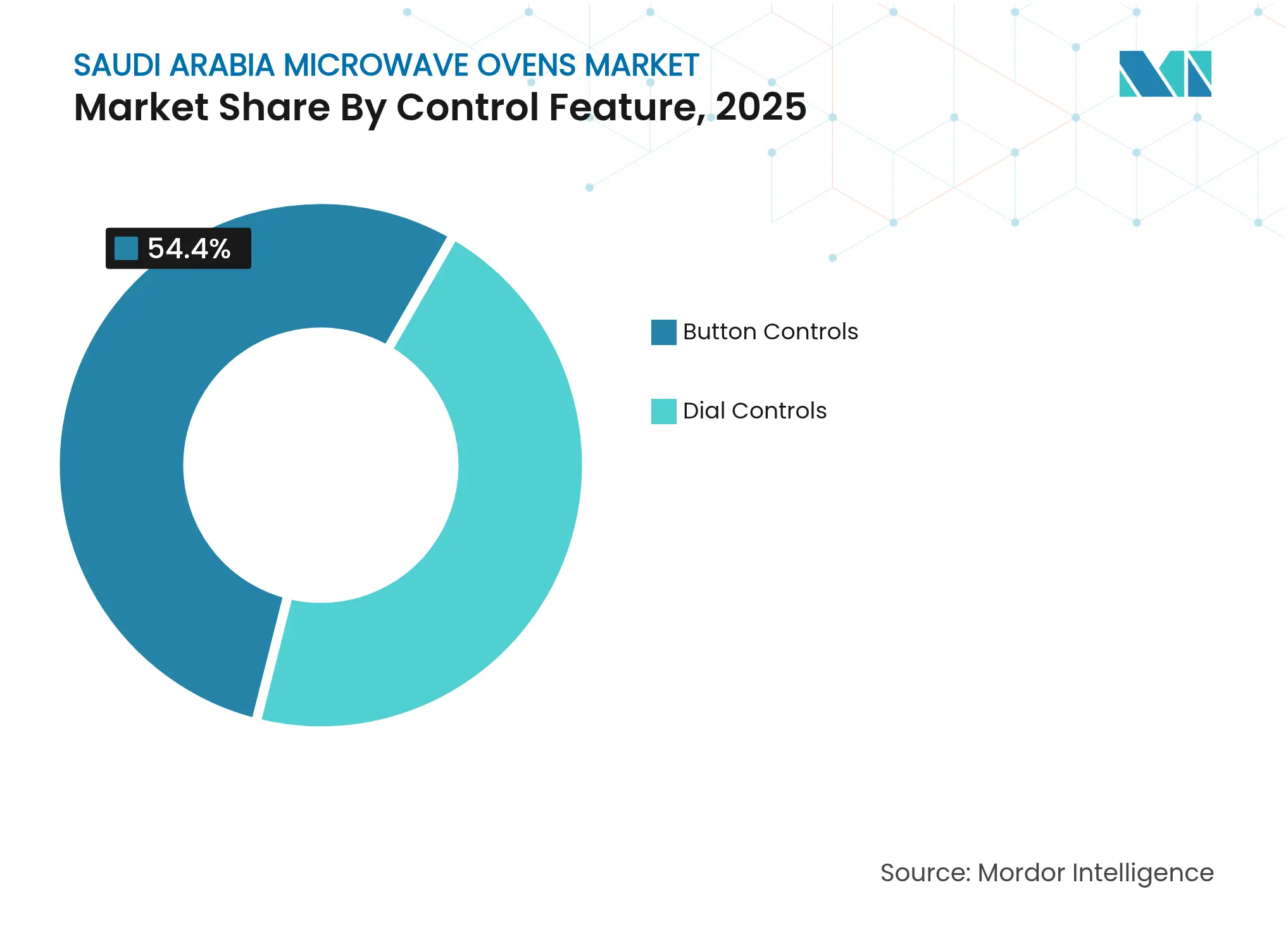
- By control feature, button interfaces accounted for 54.40% share of the Saudi Arabia microwave ovens market size in 2025, expanding at a 4.44% CAGR during the outlook period.
- By capacity, 20-24 liter models captured 39.30% of the Saudi Arabia microwave ovens market size in 2025, while ≥30 liter models advance at 4.73% CAGR to 2031.
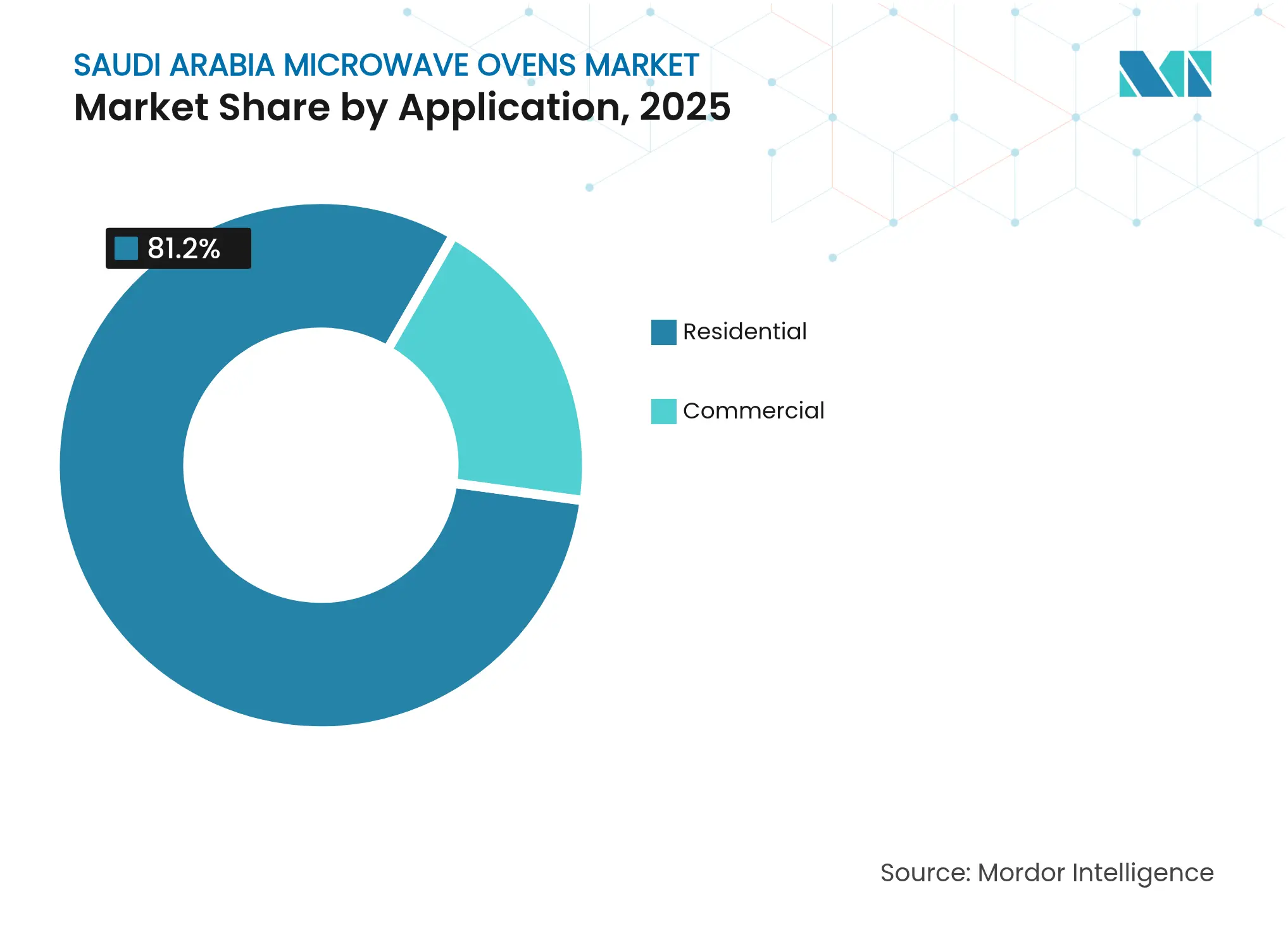
- By application, the commercial segment grows the quickest at 5.13% CAGR through 2031, whereas residential use dominates with 81.20% share in 2025.
- By distribution channel, multi-brand retail stores held 44.20% revenue share in 2025; online sales accelerate at a 5.62% CAGR to 2031.
- By geography, the Central region commanded 34.70% share in 2025; the Western region records a 4.34% CAGR through 2031.
Note: Market size and forecast figures in this report are generated using Mordor Intelligence's proprietary estimation framework, updated with the latest available data and insights as of 2026.
Saudi Arabia Microwave Ovens Market Trends and Insights
Drivers Impact Analysis
| Driver | (~) % Impact on CAGR Forecast | Geographic Relevance | Impact Timeline |
|---|---|---|---|
Rising dual-income nuclear households seeking convenience
cooking
|
+0.8%
|
National; highest in Central & Western regions
|
Medium term (2–4 years)
|
Government-backed housing initiatives under Vision 2030
| +0.7% | National; early gains in Riyadh, Jeddah, NEOM | Long term (≥ 4 years) |
Rapid expansion of QSR & cloud kitchens boosting
commercial demand
| +0.6% | Urban hubs, mainly Central & Western | Short term (≤ 2 years) |
Growing popularity of built-in kitchen concepts in premium
homes
| +0.5% | Central & Western high-income districts | Medium term (2–4 years) |
Innovation in energy-efficient inverter/air-fry models
| +0.4% | National; premium uptake in major cities | Medium term (2–4 years) |
Surge in e-commerce flash-sales events
| +0.3% | National; urban skew | Short term (≤ 2 years) |
| Source: Mordor Intelligence | |||
Rising Dual-Income Nuclear Households Seeking Convenience Cooking
Female labor participation gains under Vision 2030 shift household routines and elevate demand for quick-use appliances. These consumers prioritize energy-efficient models that align with Saudi Energy Efficiency Center guidelines cutting residential consumption by up to 70%.[1] Inverter platforms and air-fry functionality satisfy both healthy-eating goals and traditional recipe needs. Demand spreads fastest across Riyadh and Jeddah, where professional employment opportunities for women have risen sharply since 2024. Marketers underscore reliability and warranty coverage to attract families who seek durable solutions amid rising utility tariffs. As dual-income homes grow, repeat replacement cycles shorten, enlarging the Saudi Arabia microwave ovens market.
Government-Backed Housing Initiatives Under Vision 2030
Programs such as Wafi (off-plan sales) and Etmam (licensing streamlining) fast-track construction starts and feed appliance uptake at handover. Developers increasingly specify built-in kitchens, prompting consistent orders for integrated microwave ovens. The White Land program widens residential land supply, supporting appliance sales beyond premium neighborhoods. Policies that favor energy-efficient fittings dovetail with consumer interest in inverter technology, anchoring long-term growth for the Saudi Arabia microwave ovens market.
Rapid Expansion of QSR & Cloud Kitchens Boosting Commercial Demand
Quick service restaurant networks and cloud kitchens scale aggressively in major cities, propelling high-capacity ovens for rapid reheating. Payment ecosystems dominated by digital wallets and Buy Now Pay Later options streamline B2B procurement. Cloud operators favor compact yet powerful units that fit shared facilities while meeting volume surges tied to delivery platforms. Food-tech incumbents leverage IoT diagnostics to minimize downtime, reinforcing preference for globally recognized brands with established Saudi service partners. Commercial demand therefore adds momentum to the Saudi Arabia microwave ovens market through 2030.
Innovation in Energy-Efficient Inverter/Air-Fry Models
Lead brands cascade inverter engines across mid-range lines to trim power draw in a climate where cooling already dominates electricity bills. Samsung’s Bespoke AI range debuted deeper food-specific algorithms in 2025, promising precise heating cycles.[2]Air-fry features resonate with health-conscious millennials looking to cut oil yet retain familiar flavors. Multifunction adds value in smaller urban kitchens, encouraging replacement of older single-mode units. Sustained R&D investment by multinational OEMs ensures a steady rollout of energy-saving upgrades, reinforcing growth in the Saudi Arabia microwave ovens market.
Restraints Impact Analysis
| Restraint | (~) % Impact on CAGR Forecast | Geographic Relevance | Impact Timeline |
|---|---|---|---|
High import tariffs & SASO certification delays
|
-0.9%
|
Nationwide; price-sensitive tiers
|
Long term (≥ 4 years)
|
Volatility in global freight costs inflating retail prices
| -0.6% | Nationwide; import-heavy SKUs | Short term (≤ 2 years) |
Limited after-sales service network in tier-2 cities
| -0.4% | Tier-2 urban areas | Medium term (2–4 years) |
| Source: Mordor Intelligence | |||
High Import Tariffs & SASO Certification Delays
Microwave ovens shipped from outside the GCC attract 5% customs duty plus 15% VAT. Extra levies and port surcharges can lift shelf prices 20-25% above neighboring markets.[3] The SABER portal requires every model to secure a conformity certificate, adding lead times of up to six months and raising compliance costs. Periodic tariff revisions—some lines rose to 25% in 2024—tighten margins for midsize importers. Smaller foreign brands struggle to absorb these expenses, deterring new entrants and tempering competitive pressure in the Saudi Arabia microwave ovens market.
Volatility in Global Freight Costs Inflating Retail Prices
Container rates on Asia–Red Sea lanes swung 40-60% in 2024. Importers faced higher working capital and hedging needs as spot pricing spiked after Suez disruptions. UPS emphasizes landed-cost contracts to cushion variance, but not all distributors secure similar terms. Price-sensitive shoppers defer upgrades when sticker shock exceeds budgets, particularly in mid-range segments. Retailers run leaner inventories to mitigate risk, reducing the breadth of on-hand SKUs and constraining choice across the Saudi Arabia microwave ovens market.
Segment Analysis
By Product: Convection Models Drive Market Leadership
Convection units accounted for 41.60% of 2025 revenue, cementing them as the keystone of the Saudi Arabia microwave ovens market. Multifunction heating meets local culinary routines ranging from reheating kabsa to baking desserts. Grill models, encouraged by healthy-eating campaigns, register a 4.83% CAGR and erode solo oven share. Consumers assessing value increasingly weigh air-fry integration and inverter energy savings before purchasing. Manufacturers spread these features to solo lines to protect entry-level relevance. Meanwhile, Samsung’s AI-ready ecosystem points to rising appetite for connected cooking, suggesting future segmentation may shift toward software capability tiers within the Saudi Arabia microwave ovens market.
Note: Segment shares of all individual segments available upon report purchase
By Structure: Countertop Dominance Faces Built-In Challenge
Countertop appliances captured 59.10% of 2025 unit sales due to straightforward setup and competitive pricing. Rental households and students favor portability and low upfront costs. Built-in units claim a 4.49% CAGR through 2031 as upscale developers incorporate seamless cabinetry. The average kitchen size in new Riyadh villas is falling, prompting homeowners to hide appliances behind flush panels. Local carpenters install standardized niches that speed replacement cycles and normalize built-in sizes, improving part commonality. As a result, the Saudi Arabia microwave ovens market sees ASP lift despite flat raw-material cost trends.
By Control Feature: Button Controls Maintain User Preference
Button panels held 54.40% share in 2025, preferred for tactile clarity and ease of cleaning. Multi-generational households welcome large physical keys over glass touchpads susceptible to fingerprints. Dial variants endure among senior consumers, but OEMs gradually phase them from premium lines to allow OTA firmware updates on button-plus-display hybrids. Samsung’s 2025 launch of 7-inch AI Home touchscreens could catalyze a slow interface migration once prices decline, but today reliability and familiarity sustain button dominance within the Saudi Arabia microwave ovens market.
Note: Segment shares of all individual segments available upon report purchase
By Capacity: Mid-Range Sizes Dominate Consumer Choice
The 20-24 liter class seized 39.30% share in 2025 as it suits typical Saudi family portions while fitting standard counter depth. 30 litres & above models pace growth at 4.73% CAGR, fueled by cloud kitchens and big families in the Eastern region. Compact ≤ 19-liter units serve dormitories and offices yet suffer from limited dish clearance, curbing broad appeal. Mid-range sizes see feature proliferation—sensor defrost, steam add-ons—enhancing value and reinforcing their anchor status in the Saudi Arabia microwave ovens market.
By Application: Residential Dominance with Commercial Acceleration
Households represented 81.20% of 2025 value, underpinning steady baseline demand via replacement and new-home fit-outs. Commercial kitchens, however, expand at 5.13% CAGR as QSR chains localize menus and ramp ghost-kitchen footprints. Commercial buyers stipulate stainless shells and 1,000-hour duty cycles, pushing vendors toward rugged models with field-swappable magnetrons. The cross-pollination of specs elevates overall quality expectations across the Saudi Arabia microwave ovens market.
Note: Segment shares of all individual segments available upon report purchase
By Distribution Channel: Multi-Brand Stores Lead Amid Online Surge
Multi-brand electronics chains secured 44.20% of 2025 sales, offering in-person demos and same-day carryout convenience. Online marketplaces mount a 5.62% CAGR, boosted by frictionless checkout integrations and aggressive last-mile subsidies. Exclusive brand boutiques in luxury malls nurture high-margin lines and drive experiential marketing. Retailers now deploy click-and-collect points and AR product visualizers to merge channels, sustaining store footfalls while capturing the rising digital share of the Saudi Arabia microwave ovens market.
Geography Analysis
Central anchored 34.70% of the 2025 demand through concentrated dual-income households and government-backed mortgage programs. Jeddah and Mecca form the high-growth Western corridor at 4.34% CAGR, energized by tourism infrastructure. Western region buyers increasingly acquire commercial-grade units for hospitality suites serving religious tourists. Central households spend heavily on appliance upgrades, aided by mortgage rate incentives and mandatory building-code insulation that highlights energy-efficient microwave benefits. Eastern province consumers exhibit the highest average ticket due to expatriate demand for premium imported lines. In tier-2 Northern towns, outreach programs train local technicians, easing warranty concerns. Southern agricultural centers observe rising appliance ownership as farm families diversify income. Overall, regional convergence narrows but persists, requiring tailored channel strategies to maximize reach across the Saudi Arabia microwave ovens market.

Reports are available across multiple geographies.
Gain in-depth market insights across regions to support informed decisions.
Competitive Landscape
Market Concentration
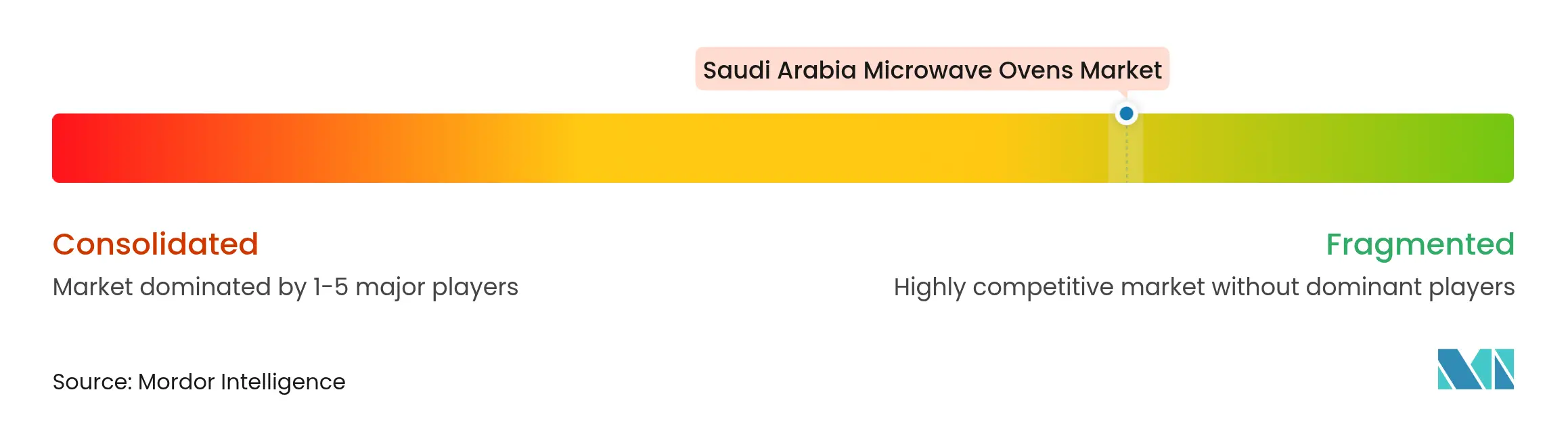
The Saudi Arabia microwave ovens market shows fragmentation. LG and Samsung leverage global R&D pipelines to introduce inverter technology ahead of rivals. Whirlpool and Midea emphasize cost-effective countertop models to secure price-sensitive households.
Players race to comply with SASO’s evolving efficiency thresholds, investing in local testing labs to shorten certification cycles. Partnerships with distributors like eXtra enable extended warranty packages and in-store digital kiosks demonstrating AI features. Samsung’s 2025 Bespoke showcase underscored a pivot toward connected cooking suites, presaging higher attach rates for SmartThings subscriptions.
Domestic manufacturing prospects improve following the launch of Alat, which plans multi-category appliance facilities. Brands assessing joint-venture assembly explore tariff mitigation and faster replenishment. Service network expansion in Hail and Tabuk becomes a differentiator, as consumers value reliable after-sales care almost as much as headline features in the Saudi Arabia microwave ovens market.
Saudi Arabia Microwave Ovens Industry Leaders

*Disclaimer: Major Players sorted in no particular order
Recent Industry Developments
- February 2025: Samsung Electronics showcased Bespoke AI appliances and new Dacor Induction Range at KBIS 2025, highlighting screens that integrate cooking guidance and smart-home connectivity.
- December 2024: Samsung Electronics unveiled refrigerators with AI Hybrid Cooling at CES 2025, signalling broader adoption of adaptive energy management across kitchen lines.
- July 2024: Sharp Corporation and Elaraby Group formed Horizon for Home Appliances Manufacturing Co. to build a refrigerator plant near Cairo, improving Middle East supply proximity.
Table of Contents for Saudi Arabia Microwave Ovens Industry Report
1. Introduction
- 1.1 Study Assumptions & Market Definition
- 1.2 Scope of the Study
2. Research Methodology
3. Executive Summary
4. Market Landscape
- 4.1 Market Overview
- 4.2 Market Drivers
- 4.2.1 Rising Dual-Income Nuclear Households Seeking Convenience Cooking
- 4.2.2 Government-Backed Housing Initiatives Under Vision 2030
- 4.2.3 Rapid Expansion Of QSR & Cloud Kitchens Boosting Commercial Demand
- 4.2.4 Growing Popularity Of Built-In Kitchen Concepts In Premium Homes
- 4.2.5 Innovation In Energy-Efficient Inverter / Air-Fry Models
- 4.2.6 Surge In E-Commerce Flash-Sales Events (White Friday, Hajj Season)
- 4.3 Market Restraints
- 4.3.1 High Import Tariffs & SASO Certification Delays
- 4.3.2 Volatility In Global Freight Costs Inflating Retail Prices
- 4.3.3 Limited After-Sales Service Network In Tier-2 Cities
- 4.4 Industry Value-Chain Analysis
- 4.5 Porter’s Five Forces Analysis
- 4.5.1 Threat of New Entrants
- 4.5.2 Bargaining Power of Suppliers
- 4.5.3 Bargaining Power of Buyers
- 4.5.4 Threat of Substitutes
- 4.5.5 Competitive Rivalry
- 4.6 Insights into the Latest Trends and Innovations
- 4.7 Insights on Recent Developments (Product Launches, M&A, Investments, Partnerships, JVs, Expansions)
5. Market Size & Growth Forecasts (Value)
- 5.1 By Product
- 5.1.1 Solo
- 5.1.2 Grill
- 5.1.3 Convection
- 5.1.4 Other Products
- 5.2 By Structure
- 5.2.1 Countertop
- 5.2.2 Built-in / Wall
- 5.2.3 Over-the-Range
- 5.3 By Control Feature
- 5.3.1 Button Controls
- 5.3.2 Dial Controls
- 5.4 By Capacity (Litres)
- 5.4.1 Up to 19 litres
- 5.4.2 20 to 24 litres
- 5.4.3 25 to 29 litres
- 5.4.4 30 litres & above
- 5.5 By Application
- 5.5.1 Residential
- 5.5.2 Commercial
- 5.6 By Distribution Channel
- 5.6.1 B2C / Retail
- 5.6.1.1 Multi-brand Stores
- 5.6.1.2 Exclusive Brand Outlets
- 5.6.1.3 Online
- 5.6.1.4 Other Distribution Channels
- 5.6.2 B2B / Direct from Manufacturers
- 5.7 By Geography
- 5.7.1 Western
- 5.7.2 Central
- 5.7.3 Northern
- 5.7.4 Eastern
- 5.7.5 Southern
6. Competitive Landscape
- 6.1 Market Concentration
- 6.2 Strategic Moves
- 6.3 Market Share Analysis
- 6.4 Company Profiles {(includes Global level Overview, Market level overview, Core Segments, Financials as available, Strategic Information, Market Rank/Share, Products & Services, Recent Developments)}
- 6.4.1 LG Electronics
- 6.4.2 Samsung Electronics
- 6.4.3 AB Electrolux (AEG, Zanussi)
- 6.4.4 Panasonic Corporation
- 6.4.5 Black + Decker (Spectrum Brands)
- 6.4.6 Whirlpool Corporation
- 6.4.7 Midea Group
- 6.4.8 Haier / GE Appliances
- 6.4.9 Sharp Electronics Corporation
- 6.4.10 BSH Home Appliances
- 6.4.11 Candy-Hoover Group
- 6.4.12 Daewoo Electronics
- 6.4.13 Hisense Group
- 6.4.14 Kenwood (De’Longhi)
- 6.4.15 Galanz / Weili Appliances
- 6.4.16 Geepas
- 6.4.17 Hommer
- 6.4.18 Nikai
- 6.4.19 White-Westinghouse
- 6.4.20 Haam (Almana Group)
7. Market Opportunities & Future Outlook
- 7.1 Rising Demand for Built-In and Premium Appliances in Modern Kitchens
- 7.2 Emerging Smart-Kitchen Ecosystem & IoT Integration
Scope and Methodology
The study offers a complete background analysis of the Saudi Arabia microwave oven market, including the analysis and forecast of market size, market share, industry trends, growth drivers, and vendors. It also includes insights into the market segmentation, by product type, by distribution channel, and by end-user. Additionally, the report features the qualitative and quantitative assessments, by analyzing the data gathered from the industry analysts and market participants across the key points in the industry's value chain.
| By Product | Solo | |
| Grill | ||
| Convection | ||
| Other Products | ||
| By Structure | Countertop | |
| Built-in / Wall | ||
| Over-the-Range | ||
| By Control Feature | Button Controls | |
| Dial Controls | ||
| By Capacity (Litres) | Up to 19 litres | |
| 20 to 24 litres | ||
| 25 to 29 litres | ||
| 30 litres & above | ||
| By Application | Residential | |
| Commercial | ||
| By Distribution Channel | B2C / Retail | Multi-brand Stores |
| Exclusive Brand Outlets | ||
| Online | ||
| Other Distribution Channels | ||
| B2B / Direct from Manufacturers | ||
| By Geography | Western | |
| Central | ||
| Northern | ||
| Eastern | ||
| Southern | ||
