
Market Overview
| Study Period | 2020 - 2031 |
|---|---|
| Forecast Data Period | 2026 - 2031 |
| Historical Data Period | 2020 - 2024 |
| Market Size (2026) | USD 231.12 Million |
| Market Size (2031) | USD 391.41 Million |
| Growth Rate (2026 - 2031) | 11.11 % |
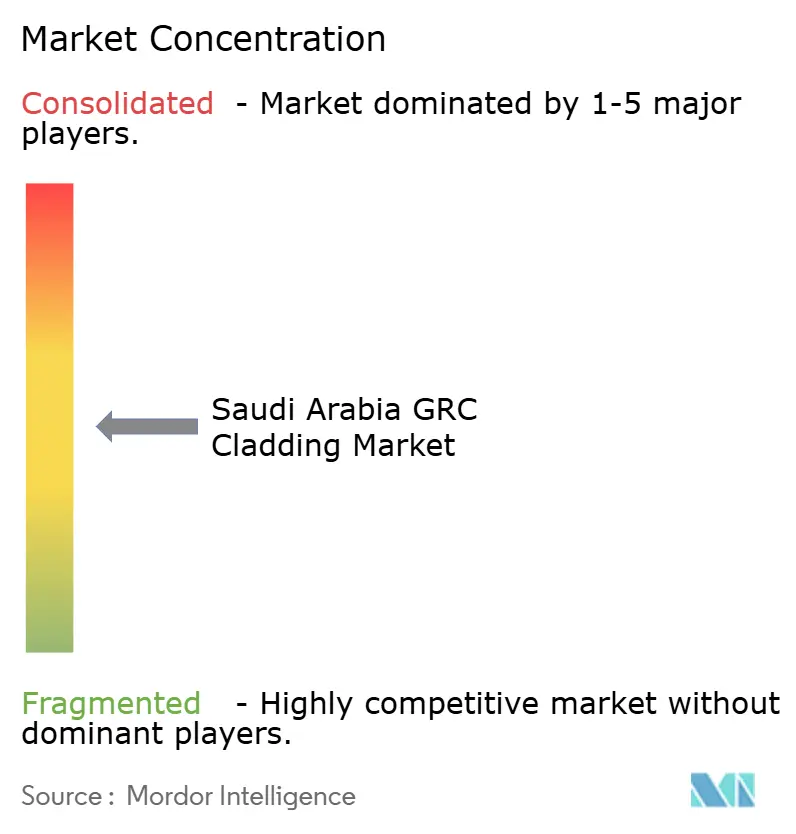
| Market Concentration | Medium |
Major Players *Disclaimer: Major Players sorted in no particular order Image © Mordor Intelligence. Reuse requires attribution under CC BY 4.0. | |
Saudi Arabia GRC Cladding Market Analysis by Mordor Intelligence
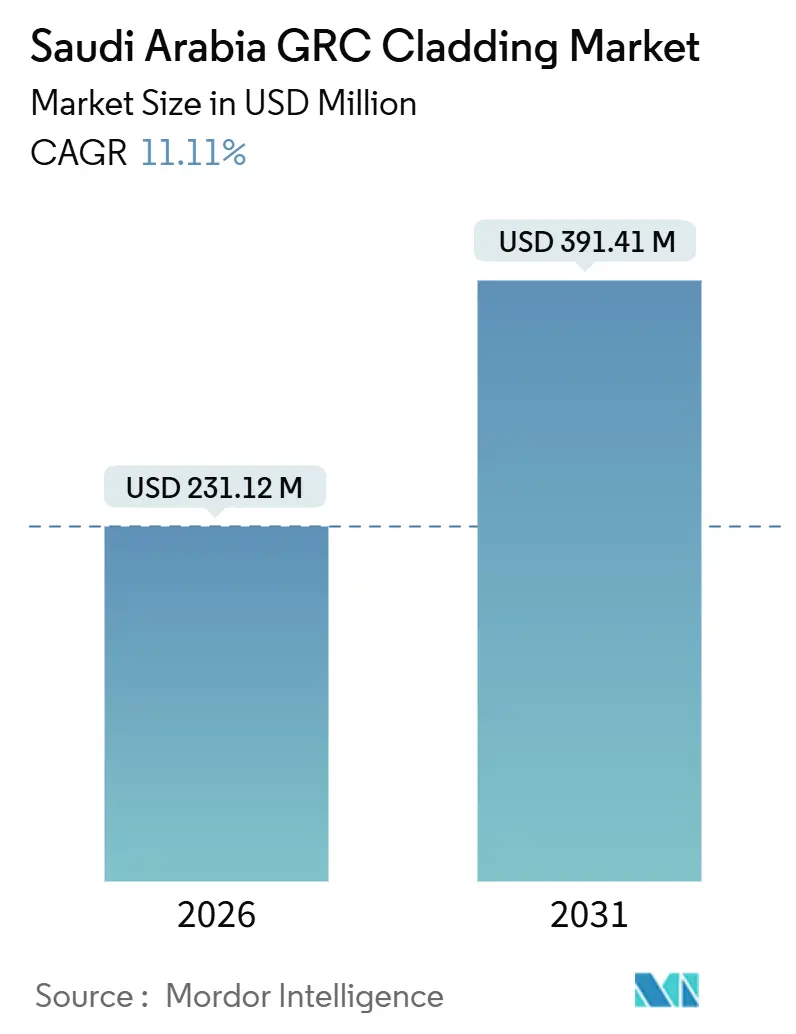
The Saudi Arabia GRC Cladding Market size is estimated at USD 231.12 million in 2026, and is expected to reach USD 391.41 million by 2031, at a CAGR of 11.11% during the forecast period (2026-2031). This acceleration reflects Vision 2030’s pivot from oil-centric spending toward mixed-use giga-projects, stricter façade fire-safety rules, and a nationwide push for passive-cooling retrofits in cities that routinely record summer temperatures above 45 °C[1]Vision 2030 Program, “Saudi Vision 2030,” Kingdom of Saudi Arabia, vision2030.gov.sa . Rainscreen systems benefit first from energy-efficiency mandates, while curtain walls gain traction in NEOM’s skyline-defining towers. Retrofit demand is also climbing as government landlords overlay new façades on pre-2010 structures to cut HVAC loads, and contractors with Saudi Building Code certifications win bids more readily. Despite rising import prices for alkali-resistant (AR) glass fiber, domestic capacity investments and 3D-printed moulding lines lower production costs, bolstering the Saudi Arabia GRC Cladding market expansion.
Key Report Takeaways
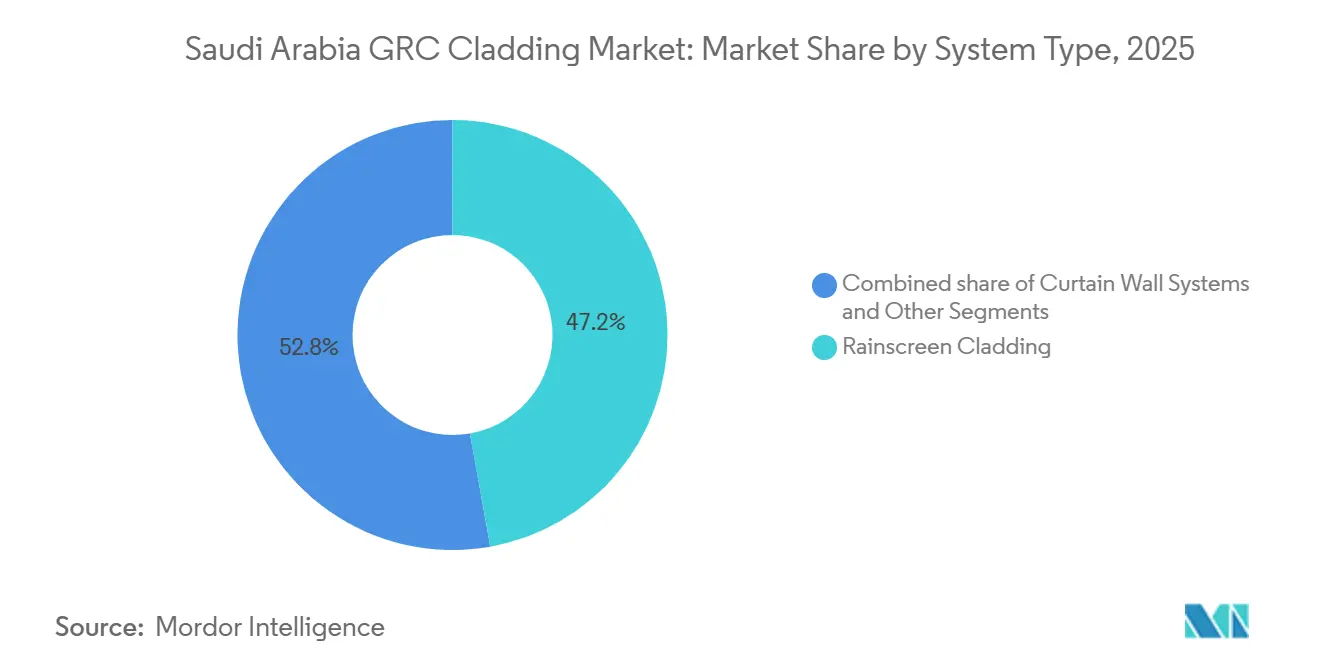
- By system type, rainscreen cladding led with 47.2% of revenue in 2025, while curtain wall assemblies are projected to expand at an 11.97% CAGR through 2031.
- By application, commercial projects accounted for 56.8% of revenue in 2025, whereas residential projects are set to grow at a 12.09% CAGR to 2031.
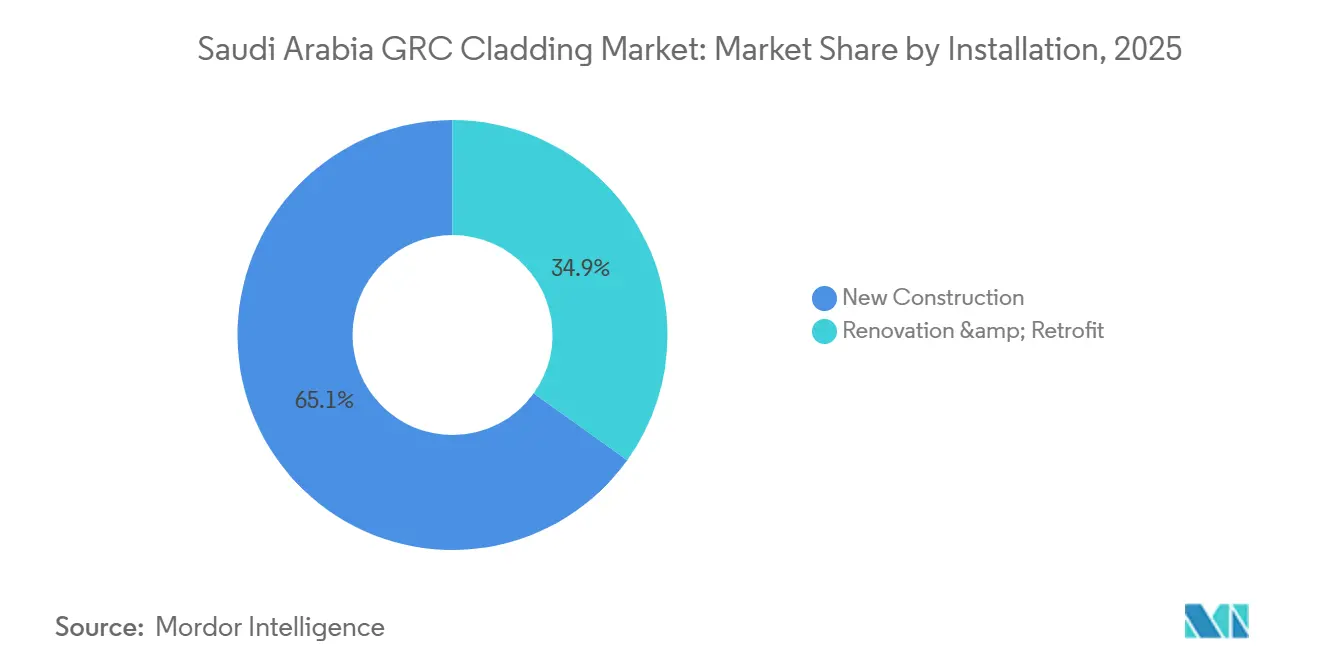
- By installation, new construction captured 65.1% of revenue in 2025, and renovation and retrofit activity is advancing at a 12.31% CAGR through 2031.
- By city, Riyadh commanded 44.8% demand in 2025, while the Dammam Metropolitan Area is forecast to expand at a 12.59% CAGR by 2031.
Note: Market size and forecast figures in this report are generated using Mordor Intelligence’s proprietary estimation framework, updated with the latest available data and insights as of January 2026.
Saudi Arabia GRC Cladding Market Trends and Insights
Drivers Impact Analysis*
| Drivers | (~) % IMPACT ON CAGR FORECAST | Geographic Relevance | Impact Timeline |
|---|---|---|---|
| Vision 2030 giga-projects needing iconic façades | +3.2% | Kingdom-wide, with clusters in NEOM, Qiddiya, Red Sea, Diriyah | Long term (≥ 4 years) |
| Harsh-climate performance requirements | +2.1% | Coastal Red Sea and interior deserts | Medium term (2–4 years) |
| Faster delivery via prefabricated, unitized panels | +2.0% | National mega-projects on tight schedules | Short term (≤ 2 years) |
| Design flexibility for Arabic and parametric geometries | +1.6% | Riyadh, Jeddah, NEOM | Medium term (2–4 years) |
| Durability and ESG focus over aluminum composite or plaster | +1.3% | Nationwide public and private portfolios | Long term (≥ 4 years) |
| Source: Mordor Intelligence | |||
Vision 2030 Giga-Projects Needing Iconic Façades at Scale
Massive mixed-use programs such as NEOM’s The Line, Qiddiya, Diriyah, and the Red Sea Project are bankrolling long pipeline visibility for the Saudi Arabia GRC Cladding market. These developments allocate 12%–18% of total construction budgets to façades, favoring lightweight panels that reduce crane hours and meet strict fire-rating codes. Approved local suppliers like Qanbar Dywidag leverage 6 million m² of annual capacity to ship panels inside eight-week windows, an advantage amplified by automated finishing lines that support integral colors and acid-etched textures. Stringent timelines and cultural-identity briefs ensure sustained double-digit growth in premium cladding packages.
Harsh-Climate Performance Requirements
Coastal sites battle salt-fog corrosion while inland deserts endure 50 °C peaks and sharp nighttime drops. GRC’s alkali-resistant glass fibers retain tensile strength after 5,000 hours of accelerated weathering, outlasting aluminum composite materials susceptible to delamination[2]Gulf Standardization Organization, “ASTM C1666 Adoption,” gso.org.sa. BFG Advanced Concrete Facades runs in-house salt-spray and UV-aging chambers to back twenty-year warranties, a proof point valued by Red Sea resort developers. SBC 801 mirrors the International Fire Code and mandates non-combustible façades on high-rise cores, pushing GRC further into the specification baseline for airports, petrochemical control rooms, and five-star hotels.
Design Flexibility for Arabic and Parametric Geometries
Thin-shell panels, typically 15–25 mm thick, allow deep reveals, mashrabiya patterns, and calligraphic relief at a fraction of stone’s weight. Diriyah’s Najdi-themed streetscapes rely on moldable GRC skins matched with mineral-wool cores to satisfy insulation targets. Roshn’s Sedra community showcases 12 façade typologies across 30,000 homes without escalating tooling fees, thanks to reusable molds and 3D-printed formworks. Iconic motifs embedded at the casting stage eliminate post-installation carving, trimming on-site labor by 40% compared with carved-stone alternatives.
Faster Delivery via Prefabricated, Unitized Panels
Factory-finished units cut installation cycles from twelve weeks to six and slash crane time by 60% when shipped as 3 × 4 m curtain-wall modules integrating glazing, mullions, and GRC spandrels. Qanbar Dywidag maintains 90-day finished-goods buffers, allowing just-in-time dispatch to The Line’s 170-km corridor. Technical and Vocational Training Corporation curricula cover panel handling, but field-competency gaps persist, making turnkey offsite fabrication a competitive edge through 2028[3]Technical and Vocational Training Corporation, “Graduate Statistics 2025,” tvtc.gov.sa.
Restraints Impact Analysis*
| Restraints | (~) % IMPACT ON CAGR FORECAST | Geographic Relevance | Impact Timeline |
|---|---|---|---|
| Higher upfront cost and structural support needs | -0.8% | Price-sensitive housing and industrial sheds | Short term (≤ 2 years) |
| Skilled fabrication and installation shortages | -0.6% | Jeddah, Dammam, secondary cities | Medium term (2–4 years) |
| Logistics and large-panel handling in extreme heat | -0.4% | Long desert corridors to NEOM and Riyadh | Medium term (2–4 years) |
| Source: Mordor Intelligence | |||
Higher Upfront Cost and Structural Support Needs
GRC panels weigh 40–70 kg/m², roughly triple the load of expanded-insulation finishes. That mass calls for thicker anchor plates and backup walls, inflating first costs by 20%–35%. Price-sensitive logistics parks in Dammam often default to metal sheets unless fire codes override budget limits. Until automated sprayers and fiber-dispersion controls trim labor content by 30%, the premium will confine GRC to projects where aesthetics, durability, or Class A fire resistance are non-negotiable.
Skilled Fabrication and Installation Shortages
Spray-up techniques, fiber dosing, and 28-day curing protocols restrict qualified labor to a small cohort concentrated in Riyadh. Smaller plants in Jeddah and Dammam poach certified technicians at 15%–25% wage uplifts, squeezing margins for retrofit jobs. Qanbar Dywidag trains 50 apprentices annually, but market demand outstrips supply by 30%, creating occasional schedule slippage on airport and petrochemical contracts.
*Our forecasts treat driver/restraint impacts as directional, not additive. The impact forecasts reflect baseline growth, mix effects, and variable interactions.
Segment Analysis
By System Type: Rainscreen Leadership with Curtain-Wall Upswing
Rainscreen assemblies captured 47.2% of 2025 revenue, confirming dominance in the Saudi Arabia GRC Cladding market share for their passive-cooling benefits and 30%–40% faster installation compared with render finishes. Qanbar Dywidag’s factory network delivers rainscreen panels to Riyadh and DMA job sites within eight weeks, cutting site manpower by 40%. The system also aligns with the Saudi Green Building Code target of 30% energy reduction, driving retrofit volume. Meanwhile, curtain walls are on track for an 11.97% CAGR to 2031, fueled by NEOM’s mirrored towers that blend floor-to-ceiling glass with GRC spandrels.
The wage premium for skilled curtain-wall installers currently sits 8% above rainscreen work, but automation and enhanced training will close this gap before 2029. Hybrid systems pairing GRC skins with foam cores find niche demand in industrial warehouses needing 180-minute fire ratings. Station Group’s lightweight hybrid panels supply King Salman Energy Park projects and weigh 40% less than solid alternatives. Over the forecast window, rainscreen stays volume leader, while curtain-wall value share rises in prestige towers, jointly sustaining the Saudi Arabia GRC Cladding market momentum.



By Application: Commercial Stronghold and Residential Surge
Commercial buildings held 56.8% revenue in 2025 as office towers, malls, and hotels in Riyadh and Jeddah mandated Class A façades under SBC 801. High-rise developers accept thicker 25-40 mm panels with acid-etched finishes that command price premiums. In contrast, residential cladding is advancing at a 12.09% CAGR to 2031, buoyed by Roshn’s goal to supply 400,000 homes and the National Housing Company’s 20,000-unit deal with CMEC in 2024. Villas and mid-rise apartments integrate 15-25 mm panels to hit cost targets yet still meet fire codes.
Commercial demand now shifts toward retrofit spending aimed at energy efficiency, which opens cross-selling prospects for rainscreen specialists. Residential developers employ 3D-printed moulds to accelerate bespoke façades, echoing Dar Al-Arkan’s modular homes that achieved 30% faster build cycles. As the population increases 2.4% annually, the Saudi Arabia GRC Cladding market sees residential volume outpace commercial, although premium commercial jobs preserve higher margins.
By Installation: New-Build Dominance and Retrofit Acceleration
New construction generated 65.1% of installation revenue in 2025, reflecting mega-project preference for greenfield sites that bypass integration issues with legacy structures. Retrofit activity grows at a 12.31% CAGR as landlords overlay ventilated façades to satisfy energy mandates. Engineering checks add 60–90 days to retrofit schedules, inflating consulting fees 12%–18%. Yet Station Group’s turnkey design-build model cuts overall timeline and secures repeat clients in Riyadh.
Retrofit scope widens as insurance premiums rise for non-compliant façades after SBC 801 enforcement. BFG incurred 8% margin compression by relocating crews, highlighting installer scarcity outside the capital. Over time, renovations will claim a larger share of Saudi Arabia GRC Cladding market size, but new-build giga-projects keep construction volumes high, ensuring balanced growth across segments.
Geography Analysis
Riyadh retained a 44.8% Saudi Arabia GRC Cladding market share in 2025, supported by active public spending on Diriyah, King Salman Park, and ongoing financial district towers that specify ASTM E84 Class A façades. Retrofit work has intensified because pre-2010 towers seek rainscreen overlays to achieve a mandated 30% energy reduction, a service niche captured by Station Group’s consulting arm. The city also benefits from the largest certified installer pool, cutting project lead times and reinforcing its production hub status.
The Dammam Metropolitan Area will grow at a 12.59% CAGR through 2031 as Aramco invests USD 500 billion in upstream, midstream, and petrochemical facilities that demand high-specification cladding. Qanbar Dywidag’s Jubail plant feeds this industrial belt with anchor-channel panels that cut site labor 30%, giving the supplier a logistical edge. Nevertheless, limited local installer certification drives cost premiums that some developers absorb to meet start-up timelines.
Jeddah balances heritage and modernity. Its UNESCO zone restricts modern façades, but citywide airport and waterfront schemes offset slower heritage approvals. NEOM in Tabuk, the Red Sea resorts, and Al-Ula cultural assets contribute to a growing Rest-of-Saudi segment, each specifying rainscreen or curtain-wall systems tailored to desert climates. The geographic spread of mega-projects ensures the Saudi Arabia GRC Cladding market gains resilience across distinct city profiles.
Regulatory Landscape
Saudi Arabia regulates external cladding through the Saudi Building Code (SBC) system and product-level compliance frameworks. SBC compliance is tied to municipalities issuing building permits and completion certificates, and energy-efficiency requirements (such as those set out under SBC 601) affect facade build-ups by pushing higher-performing insulation and controlled solar-heat-gain designs on new projects and major refurbishments.
On materials and safety, the Saudi Standards, Metrology and Quality Organization (SASO) enforces the Technical Regulation for Building Materials, Part 2 (Insulation and Building Cladding Materials). The Saudi Civil Defense Authority requires external facade cladding systems to be fire-tested as complete systems rather than as individual components. For public-sector demand, supplier eligibility and local content considerations increasingly intersect with procurement via platforms such as Etimad and oversight by the Local Content and Government Procurement Authority (LCGPA), which influences qualification, documentation, and sourcing choices for GRC cladding packages.
Value Chain Analysis
The value chain starts with raw materials (cement, sand, admixtures, coatings, and alkali-resistant glass fiber), then moves into facade design engineering, mold and formwork production, and GRC panel manufacturing (spray-up or premix), followed by curing, finishing (including integral color, acid-etched textures, and coatings), and QA testing aligned to ASTM/PCI/GRCA-type verification practices used by many specifiers. Downstream, the chain includes logistics to site (large-format panel handling and heat-sensitive scheduling), anchorage and subframe installation, panel erection, and the sealing and waterproofing interfaces, plus ongoing maintenance services for high-exposure coastal and desert environments.
In Saudi Arabia, many suppliers operate with vertical integration, pairing design support, production, and installation from facilities concentrated around major demand centers such as Riyadh and the Eastern Province. This reduces coordination risk on schedule-driven projects. Public procurement requirements add another layer: contractors and manufacturers often align documentation, compliance, and bidding processes to Etimad registrations and LCGPA local content rules, while major developments also use PPP/BOOT delivery models that can bundle facade scope into long-term concession structures.
Competitive Landscape
Competition is moderately fragmented, with the top five players collectively controlling a substantial share of installed capacity. Local champion Qanbar Dywidag supplies more than 6 million m² annually through plants in Jubail, Rabigh, and Qatar, leveraging Aramco, SABIC, and NEOM approvals to secure long-term contracts. Station Group commands the retrofit niche by bundling waterproofing and rainscreen consulting, creating recurring revenue streams. International firms such as BFG Advanced Concrete Facades and Fibrobeton differentiate with PCI and GRCA certificates that appeal to global architects, yet face price pressure from lower-cost Chinese and Indian fiber inputs.
Strategic moves focus on vertical integration and technology. Station Group installed robotic finishing units in 2025 to apply nano coatings that add 10% price premiums, while BFG cut certification time by adopting on-site fire-testing rigs that shorten schedules by five weeks. Local players seek cost certainty by signing multi-year AR-glass fiber deals with Asian suppliers to hedge volatility. Mid-tier entrants embrace 3D-printed moulding, proven in Roshn’s villa, to win bespoke façades without European design mark-ups.
Future rivalry will intensify around retrofit contracts in Riyadh and Jeddah where strict energy codes drive compulsory upgrades. Companies partnering with regional training centers can offset the installer shortage and unlock secondary-city growth. As fire-safety audits tighten and durability testing localizes, certified capacity will consolidate, providing opportunity for well-capitalized firms to raise Saudi Arabia GRC Cladding market share while smaller fabricators form joint ventures or exit.
Saudi Arabia GRC Cladding Industry Leaders
Petra GRC
Qanbar Dywidag Precast Co.
Station Group
BFG Advanced Concrete Facades
Classic GRC
- *Disclaimer: Major Players sorted in no particular order

Market Opportunities and Future Outlook
A near-term opportunity appears in projects procured through formal privatization and PPP pipelines, where facade packages are typically specified early and tied to compliance requirements. For example, the National Center for Privatisation and PPP (NCP) progressed with an EOI/RFQ/RFP process for a 50-year BOOT mixed-use project at Sikkah Al Hadid in Madinah, with a bid submission deadline of 23 June 2026. That schedule creates a defined window for qualified facade and cladding suppliers to position certified, system-tested GRC solutions.
White space also exists around system-level compliance and localized supply assurance. As SASO technical regulations for cladding materials, SBC energy-efficiency provisions, and Civil Defense system fire-testing expectations converge, contractors can differentiate through documented test assemblies, integrated rainscreen builds, and turnkey design-to-install delivery that reduces interface risk between GRC skins, insulation, and subframes. Local content screening (LCGPA) and Etimad-linked public tenders further reinforce opportunities for Saudi-based manufacturers and installers that can show compliant sourcing, rapid lead times, and standardized QA geared to giga-project schedules and retrofit programs.
Recent Industry Developments
- July 2026: Yamama Cement commenced commercial operations of its third production line at the new Al-Halal North site in Al-Kharj, with a clinker production capacity of approximately 12,500 tons per day. The expansion increases local cement supply capacity, supporting higher activity in construction and retrofit projects. The move strengthens downstream feasibility for GRC cladding suppliers in the Saudi market.
- November 2025: ACWA Power closed USD 8.2 billion in renewable projects, adding cladding demand for control buildings. The deal expands the renewable corridor and strengthens demand for cladding in utility scale facilities. The expansion broadens the pipeline for Saudi Arabia GRC cladding market and incentivizes suppliers to scale production.
- December 2024: NEOM opened Sindalah Island, the first destination to feature glass and GRC façades. The project signals momentum for GRC facade adoption in flagship developments. The development creates opportunities for premium façade applications tied to giga-projects.


Research Methodology Framework and Report Scope
Market Definition and Coverage
For this study, the market covers the value of glass fiber reinforced concrete (GRC) cladding supplied and installed in Saudi Arabia for building facades, including panels and related facade elements, measured in USD at the point of sale to the project.
Scope exclusions: We exclude non-GRC facade materials, structural precast concrete not used as cladding, and standalone interior GRC decorative items that are not part of the building envelope.
Segmentation Overview
- By System Type
- Rainscreen Cladding
- Curtain Wall Systems
- Others
- By Application
- Residential
- Commercial
- Others
- By Installation
- New Construction
- Renovation & Retrofit
- By City
- Riyadh
- Jeddah
- DMA (Dammam Metropolitan Area)
- Rest of Saudi Arabia
Data Sources, Market Sizing, and Validation
Desk Research
Desk work started by mapping where demand comes from, which is mainly new construction, major renovations, and public giga projects that specify facade upgrades. We referenced public construction pipelines and macro indicators from the Saudi General Authority for Statistics, the Ministry of Municipal and Rural Affairs and Housing, and official Vision 2030 program updates, which helped us anchor near term project momentum.
To keep assumptions realistic, we also reviewed building code and safety direction from Saudi Building Code materials, plus technical notes from standards bodies and peer reviewed civil materials journals on GRC durability, thickness norms, and typical installation practices in hot climates. Import and pricing signals were cross checked using customs style trade statistics where available, and we supplemented company-level context using annual reports, investor presentations, and reputable industry press. In a few steps, paid subscriptions for company financials and for shipment-level import and export data were used to validate supplier activity and material flow trends. This list is not exhaustive, and additional sources were used for data collection, cross-checks, and clarifying assumptions.
Primary Interviews and Surveys
Primary work was used to stress test the demand model against what is being specified on live projects, especially around specification shifts, lead times, and the share of facade area where GRC is chosen over other cladding types. We spoke with a balanced mix of manufacturers, fabricators, installers, facade consultants, and project-side teams, and coverage was kept across the main construction hubs in the country so pricing and adoption differences could be captured.
Distribution of primary research fieldwork respondents
| Company type | Respondent position |
|---|---|
| Top tier: 26% | CXOs: 14% |
| Mid tier: 56% | Functional/Unit leaders: 36% |
| Smaller Players: 18% | Managers: 50% |
Market-Sizing & Forecasting
Sizing followed a combined top-down and bottom-up flow so the final number stays practical and explainable. On the top-down side, the build began from Saudi construction activity and a facade demand pool, which was reconstructed using new build and retrofit project volumes and then translated into addressable facade area where GRC is typically specified. Those totals were then filtered using adoption rates by project type and city-level construction intensity, as validated in interviews.
To corroborate the result, selective bottom-up checks were added, including sampled project bill-of-quantity patterns, installed square-meter pricing, and supplier and installer throughput estimates for key clusters. Where a player did not disclose capacity or sales splits, we filled gaps using conservative utilization bands. Inputs that mattered most included active project pipeline timing, the share of GRC in rainscreen versus decorative facade elements, typical panel thickness and wastage factors, labor and installation cost movement, and imported AR glass fiber and cement-related price trends, which directly influence delivered cladding ASPs.
Forecasting was done using scenario analysis supported by simple trend fits on leading indicators, and then adjusted using primary feedback on bid activity, specification tightening, and schedule risk. Where large projects can swing yearly numbers, we treated them as explicit demand pulses rather than smoothing them away, and then normalized smaller residential and commercial demand using steady activity indicators.
Data Validation & Update Cycle
Validation was done in multiple passes, starting with internal consistency checks across project counts, facade area assumptions, and implied installed pricing by city. We compared model outputs against independent signals such as construction awards, visible import and material cost direction, and the revenue intensity that suppliers and installers described for recent quarters.
When variances were outside an expected range, we revisited the underlying drivers and re-contacted respondents to confirm whether the change came from mix shift, pricing, or project timing. Before sign-off, a separate analyst review was used to challenge adoption rates and year-to-year swings so outliers were not carried forward. The report is refreshed annually, with interim updates when material events occur, and a final pre-delivery pass is completed so clients receive the latest view.
Mordor Intelligence's Saudi Arabia Grc Cladding Market Size Measured Against Other Published Estimates
Published market values for Saudi Arabia GRC cladding can look different because the counted scope is not always the same, and because some models lean more on pricing assumptions than on project-driven demand. Differences also come from whether estimates treat installation value, imported panels, and custom facade elements as included items, and how they handle one-off mega projects that can distort a single year.
The main gap comes from whether facade work is counted as only GRC cladding delivered to Saudi projects or if the total facade envelope spend is blended in, and Mordor Intelligence treats the market as GRC cladding value tied to actual construction and renovation demand, with adoption rates and installed pricing checked through country-level project activity and interview validation.
Benchmark comparison
| Source | Market Size | Gaps in Research Methodology |
|---|---|---|
| Mordor Intelligence | USD 231.12 M (2026) | |
| Industry Association A | USD 205.00 M (2026) | Often tracks only locally manufactured GRC output and may exclude imported panels or outsourced installation packages, which can understate delivered project value in years with higher import dependence. |
| Regional Consultancy B | USD 275.00 M (2026) | Commonly rolls up broader facade and architectural concrete packages, and may apply aggressive installed ASP uplifts without separating decorative facade elements from true GRC cladding scope. |
Across the three figures, the spread is mainly explained by what gets counted as GRC cladding versus adjacent facade spend, and by how pricing and imports are treated. By tying demand to project activity and then checking adoption and installed prices with practitioners, the sizing steps remain traceable and can be repeated as new projects enter the pipeline.


Key Questions Answered in the Report
How large is the Saudi Arabia GRC Cladding market in 2026?
It is valued at USD 231.12 million in 2026 and is set to reach USD 391.41 million by 2031 at an 11.11% CAGR.
Which system type holds the largest share of cladding demand?
Rainscreen systems lead with a 47.2% share in 2025 due to passive-cooling and quick installation advantages.
What drives the fastest growth within system types?
Curtain walls are projected to grow at an 11.97% CAGR as NEOM and other towers favor full glass façades with GRC spandrels.
Why are retrofit projects gaining traction in Saudi Arabia?
Energy-efficiency mandates under the Green Building Code require older buildings to lower HVAC loads, making rainscreen retrofits attractive.
Which city is the fastest-growing market for GRC cladding?
The Dammam Metropolitan Area is forecast to grow at a 12.59% CAGR through 2031, driven by large petrochemical investments by Aramco.
How is technology changing Saudi GRC fabrication?
3D-printed moulding cuts tooling costs by 60% and shortens lead times to ten days, enabling bespoke façades at competitive prices.
Page last updated on:


 Your data is secure and never sold or shared.


