
Market Overview
| Study Period | 2020 - 2031 |
|---|---|
| Forecast Data Period | 2026 - 2031 |
| Base Year Market Size (2025) | 0.77 Million tonnes |
| Market Volume (2026) | 0.8 Million tonnes |
| Market Volume (2031) | 0.96 Million tonnes |
| Growth Rate (2026 - 2031) | 3.76 % |
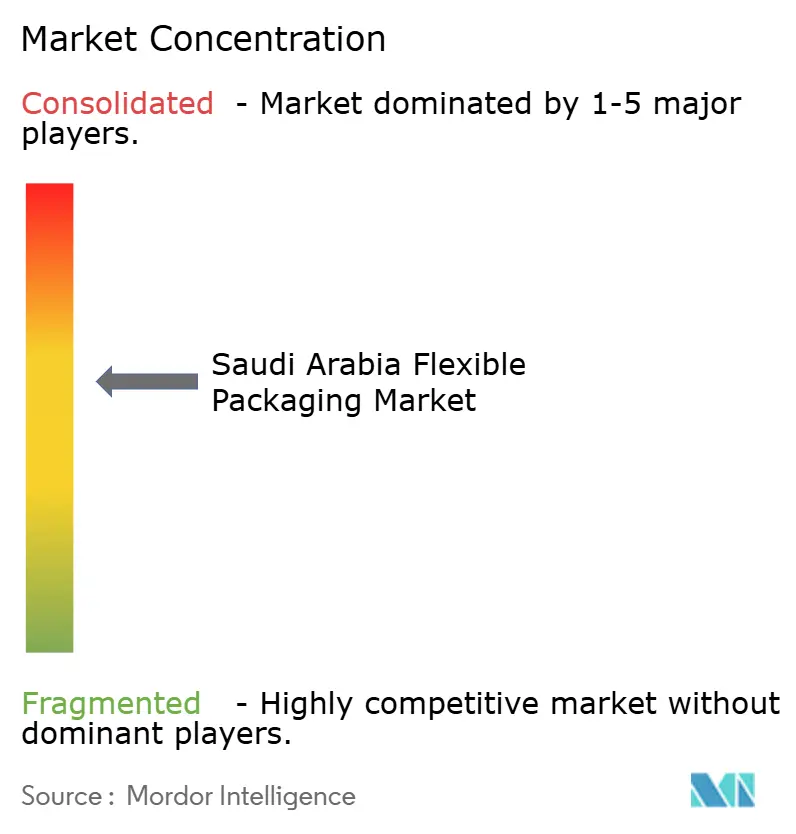
| Market Concentration | Medium |
Major Players *Disclaimer: Major Players sorted in no particular order Image © Mordor Intelligence. Reuse requires attribution under CC BY 4.0. | |
Saudi Arabia Flexible Packaging Market Analysis by Mordor Intelligence
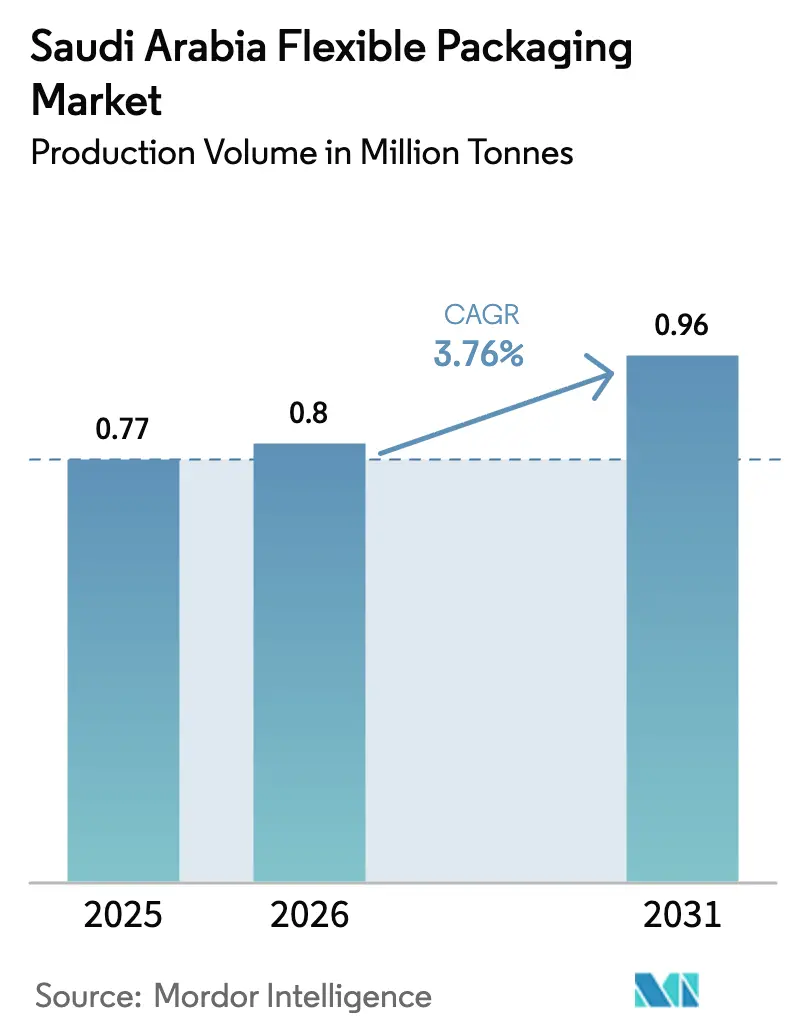
The Saudi Arabia flexible packaging market size is expected to grow from 0.77 million tonnes in 2025 to 0.8 million tonnes in 2026 and is forecast to reach 0.96 million tonnes by 2031 at 3.76% CAGR over 2026-2031. Rising investments in food-processing plants, pharmaceuticals, and e-commerce logistics hubs under Vision 2030 are the primary catalysts for growth. Rapid growth in Mada card transactions, the introduction of new petrochemical feedstocks, and municipal mandates for recycled content are reshaping material choices, technology adoption, and sustainability priorities. Competitive differentiation is moving toward circular polymers, high-barrier films, and short-run digital printing as brand owners demand lighter, smarter, and greener packaging solutions. While regulatory pressure around single-use plastics and energy tariffs poses cost headwinds, long-term infrastructure commitments in waste recovery and recycling are expected to mitigate these challenges and reinforce the growth trajectory of Saudi Arabia's flexible packaging market.
Key Report Takeaways
- By material, plastic led with 61.88% of the Saudi Arabia flexible packaging market share in 2025; bioplastics and compostable grades are projected to expand at a 4.95% CAGR through 2031.
- By product type, bags and pouches commanded 46.98% of the Saudi Arabia flexible packaging market size in 2025, while sachets and stick packs are forecast to grow at a 4.48% CAGR between 2026-2031.
- By end-user industry, food applications accounted for 32.11% of the Saudi Arabia flexible packaging market share in 2025; the personal care and cosmetics segment is the fastest-growing, with a 4.72% CAGR through 2031.
- By printing technology, flexography held a 44.93% revenue share in 2025, whereas digital printing is expected to advance at a 4.88% CAGR over 2026-2031.
Note: Market size and forecast figures in this report are generated using Mordor Intelligence’s proprietary estimation framework, updated with the latest available data and insights as of 2026.
Saudi Arabia Flexible Packaging Market Trends and Insights
Drivers Impact Analysis*
| Driver | (~) % Impact on CAGR Forecast | Geographic Relevance | Impact Timeline |
|---|---|---|---|
| Surge in food-processing capacity under Vision 2030 | +0.8% | National, concentrated in industrial clusters | Medium term (2-4 years) |
| Shift toward convenience foods and on-the-go formats | +0.6% | Urban centers, expanding to rural areas | Short term (≤ 2 years) |
| Expansion of local pharmaceutical manufacturing clusters | +0.5% | Riyadh, Dammam, emerging biotech zones | Long term (≥ 4 years) |
| Rapid e-commerce growth driving protective films/mailers | +0.7% | National, highest in Riyadh and Jeddah | Short term (≤ 2 years) |
| Competitive resin pricing from new petrochemical capacity | +0.5% | National, benefiting from SABIC expansions | Medium term (2-4 years) |
| Municipal recycled-content mandates in Riyadh pilot zones | +0.4% | Riyadh pilot zones, expanding nationally | Long term (≥ 4 years) |
| Source: Mordor Intelligence | |||
Surge in Food-Processing Capacity Under Vision 2030
State-backed investment is projected to reach USD 70 billion by 2030, up 59% from 2016.[1] The launch of the National Grains Supply Company, with 2.7 million tonnes of storage, is expanding downstream demand for bulk liners, wicket bags, and retail pouches. Seafood output is targeted to rise to 600,000 tonnes by 2030, intensifying cold-chain packaging needs for frozen and value-added fish products. Food-grade flexible formats deliver weight savings, oxygen-barrier performance, and cost advantages over rigid alternatives, making them indispensable for processors scaling up under Vision 2030. As new plants come on-stream, contract packagers are lining up long-term supply agreements, ensuring a steady pipeline of orders for polyethylene, polypropylene, and polyamide film converters.
Shift Toward Convenience Foods and On-the-Go Formats
Urbanization and 97% smartphone penetration have mainstreamed click-and-collect meal options, elevating demand for portion-controlled sachets, stick packs, and retort pouches. Farmers’ transition to compound feed-valued at USD 3.46 billion by 2027-illustrates parallel shifts toward smaller, moisture-resistant packs for livestock nutrition.[2] Brand owners are investing in easy-open zippers, laser perforation, and resealable spouts to secure premium shelf space with added consumer convenience. Flexible packaging’s ability to cut food waste by offering single-serve units aligns with national food security objectives, reinforcing volume growth.
Expansion of Local Pharmaceutical Manufacturing Clusters
The Public Investment Fund’s Lifera CDMO launch and the National Biotechnology Strategy aim for 30% drug localization by 2025. Sterile barrier pouches, high-barrier lamination, and child-resistant zippers are in higher demand as insulin, vaccine, and monoclonal antibody lines scale up. The Saudi Food and Drug Authority (SFDA) rules require traceable Arabic labeling, which is accelerating the adoption of digital printing for variable data compliance. Flexible films capable of withstand 121 °C autoclave cycles are commanding premium margins as pharma buyers shift from imports to local contract packagers.
Rapid E-Commerce Growth Driving Protective Films/Mailers
Mada transactions surged 25.82% YoY to SAR 197.42 billion (USD 52.64 billion) in 2024, with government targets of 70% online retail by 2030. Lightweight mailers, bubble films, and tamper-evident pouches mitigate last-mile damage and lower volumetric shipping costs. Large e-retailers like Jarir and Amazon.sa are standardizing pack formats and driving converters to scale output. Automated sortation centers favor film grades with high slip and puncture resistance, boosting polyethylene demand from local petrochemical suppliers.
Restraints Impact Analysis*
| Restraint | (~) % Impact on CAGR Forecast | Geographic Relevance | Impact Timeline |
|---|---|---|---|
| Plastic-use levies and single-use bans tightening in 2026 | -0.4% | National, pilot programs in Riyadh | Short term (≤ 2 years) |
| Weak domestic recycling infrastructure for PCR resins | -0.3% | National, acute in secondary cities | Medium term (2-4 years) |
| Rising electricity tariffs post-subsidy reforms | -0.2% | National, higher impact on energy-intensive operations | Short term (≤ 2 years) |
| Skilled-labour shortage in lamination and printing lines | -0.2% | Industrial clusters, technical job categories | Medium term (2-4 years) |
| Source: Mordor Intelligence | |||
Plastic-Use Levies and Single-Use Bans Tightening in 2026
Municipal mandates in Riyadh require certified recycled content, echoing the UAE’s blanket ban, effective 2026. SASO’s oxo-biodegradable film rule already covers 441 factories. Corporate pledges such as Zahid Group’s single-use phase-out intensify market momentum toward bio-based or compostable substitutes. Converters face retooling costs for barrier coatings and need chain-of-custody audits under ISCC Plus, raising capex while organic waste streams for compostables remain underdeveloped.
Weak Domestic Recycling Infrastructure for PCR Resins
Saudi recycling rates sit below 15%, and 85% of waste still goes to landfill. Five city master plans cover only 60% of national waste, leaving secondary regions underserved. Multilayer film contamination complicates PET recycling, restricting PCR feedstock supply for flexible formats. SABIC’s advanced-recycling TRUCIRCLE resins offer an interim option but carry cost premiums that price-sensitive converters resist, leading to a supply-demand imbalance.
*Our forecasts treat driver/restraint impacts as directional, not additive. The impact forecasts reflect baseline growth, mix effects, and variable interactions.
Segment Analysis
By Material: Plastic Dominance Faces Sustainability Transition
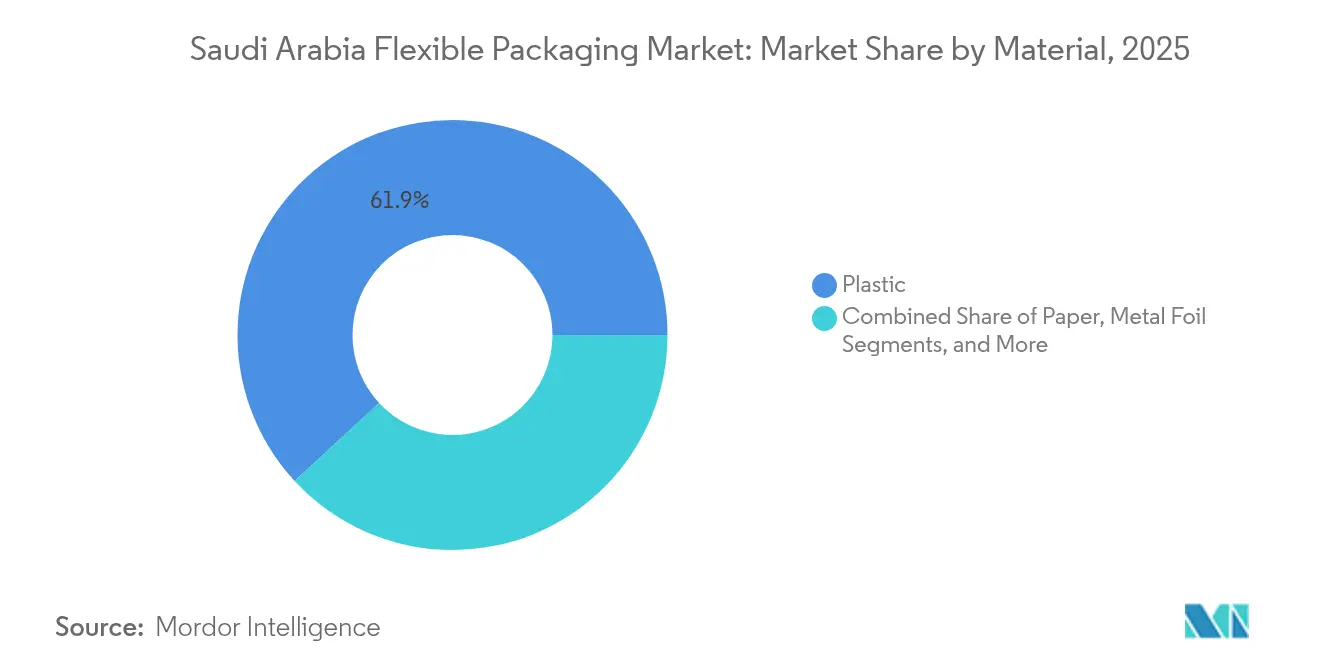
Plastic held 61.88% of the Saudi Arabia flexible packaging market share in 2025. Although commodity polyolefins remain cost-competitive, bio-based resins are gaining ground at a 4.95% CAGR as policymakers introduce recycled-content rules and brand owners pledge net-zero targets. The Saudi Arabia flexible packaging market size for bioplastics is forecast to widen by 2030, supported by SABIC’s TRUCIRCLE expansion, which delivers certified circular polymers. Ethylene capacity from the USD 6.4 billion Fujian complex promises plentiful feedstock, stabilizing virgin resin prices and safeguarding converter margins.
Paper and metal foil maintain specialized niches. Recyclable kraft laminates address new produce-pack rules, while aluminum foil remains essential for oxygen-sensitive nutraceuticals. However, life-cycle analysis favors monomaterial structures, prompting lamination downgrading initiatives that open opportunities for solvent-free adhesives and inline extrusion coating.

By Product Type: Convenience Formats Drive Innovation
Bags and pouches accounted for 46.98% of the Saudi Arabia flexible packaging market size in 2025. Growth stems from stand-up pouches replacing glass jars in condiments and gusseted sacks optimizing feed storage. Sachets and stick packs are on track for a 4.48% CAGR thanks to single-serve beverage powders and instant coffee. Retailers demand see-through windows, laser-score easy-tear features, and recyclable zippers, pressing converters to adopt inline inspection and digital pre-press workflows.
Films and wraps see accelerated orders from e-commerce fulfilment centers that require downgauged yet puncture-resistant polyethylene blends. Labels and sleeves, while smaller in tonnage, command high margins through tactile varnishes and smart-label integration that tracks temperature excursions during cold-chain logistics.
By End-user Industry: Food Sector Leads While Personal Care Accelerates
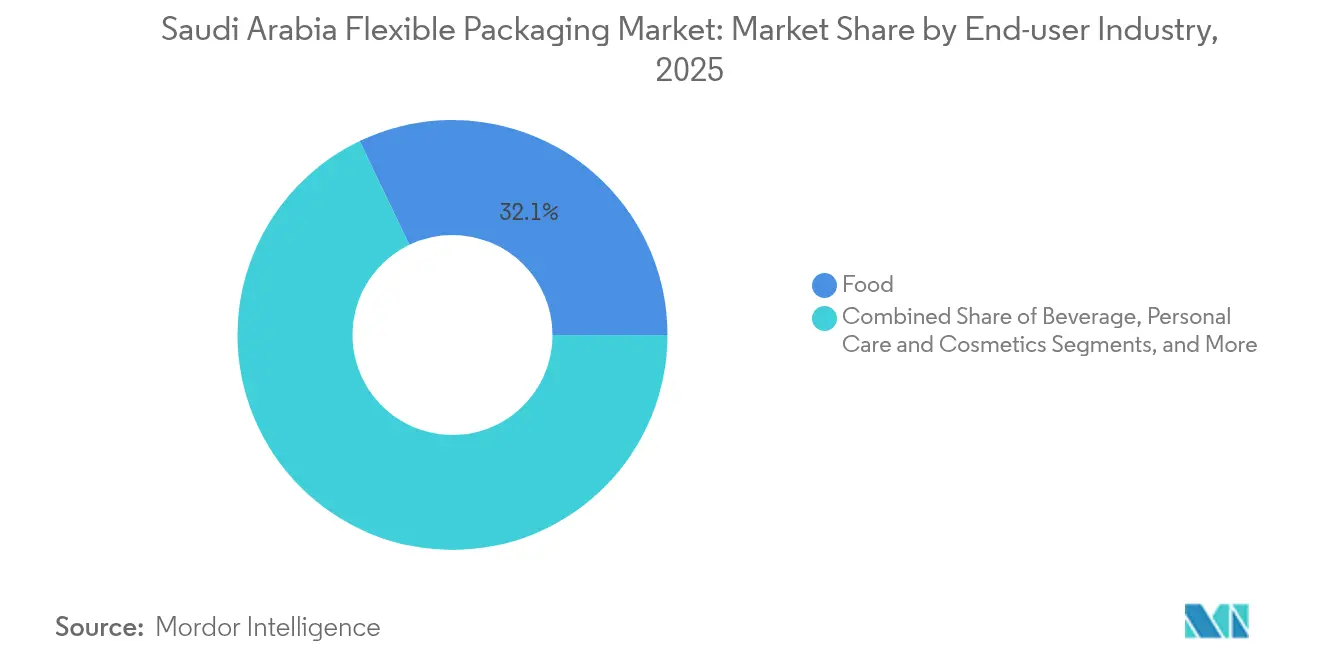
Food retained 32.11% market share in 2025, buoyed by Vision 2030’s drive for self-sufficiency. Shelf-stable snacks, ready-to-eat meals, and frozen seafood drive demand for barrier films. The personal care and cosmetics segment, forecast to rise at a 4.72% CAGR, benefits from domestic production of halal-certified beauty products that require high-opacity films and metallized pouches.
Beverages leverage flexible shrink bundles around PET bottles, complementing the SAR 3.5 billion bottled-water boom. Pharma and healthcare products fetch the highest unit prices, as the SFDA mandates tamper-evident, child-resistant seals and serialized pack-level codes, all of which favor digitally printed laminates that comply with Good Manufacturing Practices.
By Printing Technology: Digital Innovation Transforms Traditional Flexography
Flexography maintained a 44.93% revenue share in 2025 , but digital presses are projected to outpace overall market growth at a 4.88% CAGR. Inkjet systems enable batch-level Arabic labeling and rapid artwork changes without the need for plates, making them suitable for personalized beauty and nutraceutical brands. Hybrid flexo-digital lines are emerging in Dammam as converters retrofit existing assets to handle variable data.
Rotogravure remains a popular choice in premium snack and confectionery wraps, where high-resolution metallic inks justify the costs of cylinder printing. Meanwhile, AI-driven color-management software and closed-loop inspection systems reduce waste, aligning with circular economy targets and energy tariff pressures.
Geography Analysis
Riyadh generates 25.8 million tonnes of municipal waste, signaling high consumption and disposal volumes for flexible packs. Integrated waste-to-resource projects and the Riyadh recycled-content mandate favor early adopter converters located near the capital.
Eastern Province clusters around Dammam and Jubail host SABIC’s petrochemical complexes, providing feedstock security and export port access to GCC nations. Austrian, Chinese, and European converters have colocated extrusion lines in these zones to leverage low logistics costs and government incentives.
Western ports at Jeddah and Yanbu facilitate Red Sea exports to Africa, while multimodal corridors linked to the USD 267 billion national logistics strategy cut transit times to Levant markets. Pilot AI-enabled collection networks debut in Jeddah, giving tech-savvy recyclers first-mover advantage in PCR feedstock aggregation.
Regulatory Landscape
Saudi Arabia regulates packaging through the Saudi Standards, Metrology and Quality Organization (SASO) Technical Regulation for Packaging, which sets requirements for safety, labeling, and environmental compliance across materials used in flexible packs, including plastics and paper. For regulated end uses, the Saudi Food and Drug Authority (SFDA) requires food-contact packaging to comply with relevant Gulf standards, including GSO 839 (general requirements) and GSO 1863 (plastic packages), reinforcing controls on material suitability and labeling for consumer-facing packs.
For imports, conformity assessment runs through the SABER platform using SASO-notified certification bodies. This shapes supplier qualification, documentation, and time-to-market for films, laminates, and finished pouches entering the Kingdom. Alongside national technical requirements, municipal initiatives such as the recycled-content mandate piloted in Riyadh also affect converter material choices and audit readiness, increasing demand for certified recycled or circular polymers and clearer material identification to support recycling and compliance claims.
Value Chain Analysis
Upstream supply is anchored by Saudi Arabia's petrochemical base, which supports availability of polyolefins and other resins used in flexible films. Circular feedstocks remain constrained by low recycling penetration and limited PCR availability. Procurement typically spans virgin resin, additives, inks and coatings, and specialized substrates, including barrier layers, with sustainability requirements pushing converters toward certified circular polymers and improved traceability for recycled content.
Midstream activities include film extrusion, printing (flexographic, rotogravure, and digital), lamination and coating, and conversion into bags, pouches, sachets, and wraps. Integrated players such as Napco National and Obeikan Group participate across multiple steps, while Saudi Printing and Packaging Company (SPPC) adds converting depth through its packaging subsidiaries. Downstream demand concentrates in food, beverages, pharmaceuticals, personal care, and e-commerce logistics. Distribution and trade flows are supported by industrial clusters and logistics corridors linked to Dammam and Jubail and the Jeddah port system, but compliance gates, including SABER for imports and SFDA requirements for food contact, influence supplier selection, lead times, and documentation throughout the chain.
Competitive Landscape
Competition remains moderate, with top five suppliers controlling roughly 45% of tonnage, leaving ample room for mid-tier specialists. Amcor, Mondi, and Sealed Air utilize global R&D to introduce monomaterial retort pouches, whereas Napco National and Obeikan Flexible & Film capitalize on proximity to food processors for just-in-time delivery.
Vertical integration is a growing trend: SABIC’s collaboration with Lubrizol on soft-rigid compatibilizers aims to introduce recyclable PE/PP structures into markets previously served by PET-alu laminates. Sidel’s planned local F&B equipment hub will shorten lead times for bottle-to-pouch transitions.
Investment in digital presses surged after HP confirmed its first advanced-manufacturing site in Saudi Arabia, fostering a domestic ecosystem for inks, coatings, and spare parts. Converters racing to attain ISCC Plus and BRCGS certifications differentiate on export readiness as “Saudi Made” incentives reimburse up to 20% of international marketing costs.
Saudi Arabia Flexible Packaging Industry Leaders
-
Napco National CJSC
-
Saudi Printing & Packaging Company (SPPC)
-
Obeikan Flexible & Film Co. Ltd.
-
Gulf Packaging Industries Co.
-
Printopack Co. Ltd.
- *Disclaimer: Major Players sorted in no particular order
Market Opportunities and Future Outlook
Sustainability-led redesign is a primary whitespace area in flexible formats, especially where municipal recycled-content requirements, such as Riyadh pilot mandates, and SASO packaging rules increase the need for clear material identification and recycling-aligned structures. This creates opportunities for converters that can commercialize monomaterial, high-barrier solutions and provide chain-of-custody certification, for example ISCC Plus, alongside compliant labeling for regulated end uses. The market also has room for scaled local supply of certified circular polymers and fit-for-purpose PCR blends, given domestic recycling rates below 15% and high landfilling that limit consistent PCR availability for flexible applications.
Capacity scale and industrial integration offer another avenue, particularly for players with multi-site footprints and export-oriented operations. Napco National reports 20 industrial facilities in Saudi Arabia and sizable packaging capacities, including 242,000 MT per year of plastic packaging, while Obeikan Flexible and Film reports 20,000 metric tons per year and exports across 15 countries, providing a platform for faster qualification of new structures for food, pharma, and e-commerce. On the demand side, SFDA requirements for traceable Arabic labeling and variable data reinforce adoption of digital printing for shorter runs and compliance-driven SKUs. Vision 2030-linked investments in food processing and local manufacturing also pull through demand for high-performance pouches, sachets, and protective films designed for automated logistics and cold-chain handling.
Recent Industry Developments
- June 2026: ASG Plastic Factory Company signed an industrial land lease contract with Modon for a 100,377-square-metre plot in Sudair for a SAR 50 million expansion. The project boosts local flexible plastic production capacity in Saudi Arabia. Aligns with Vision 2030 industrial goals and improves domestic supply resilience in packaging.
- June 2026: Saudi Printing & Packaging Company (SPPC) board proposed capital reduction of 89% to restructure finances. This directly affects packaging market player capacity and financial dynamics. It refocuses the company on core Saudi operations, which may constrain near-term expansion and investment in new packaging capacity.
- February 2026: Saudi Printing & Packaging Company (SPPC) closure of UAE subsidiary City Pack Co. as part of strategic shift to core Saudi markets. The action consolidates the footprint closer to the Saudi market, affecting regional packaging supply chains. It streamlines the portfolio toward core market activities and reallocates debt and resourcing to higher growth segments.
Research Methodology Framework and Report Scope
Market Definition and Coverage
For this study, the market covers flexible packaging used in Saudi Arabia where the package is supplied as a film, pouch, bag, wrap, or other flexible format, and demand is measured by physical shipment volume across end use consumption.
Scope exclusions: It excludes rigid packaging formats, labels sold as standalone products, and packaging used only for industrial bulk handling outside typical consumer and healthcare pack types.
Segmentation Overview
- By Material
- Paper
- Plastic
- Metal Foil
- Bioplastics and Compostable Materials
- By Product Type
- Bags and Pouches
- Films and Wraps
- Sachets and Stick Packs
- Labels and Sleeves
- BY End-user Industry
- Food
- Baked Goods
- Snacks
- Meat, Poultry and Seafood
- Confectionery
- Pet Food
- Other Food Products
- Beverage
- Healthcare and Pharmaceutical
- Personal Care and Cosmetics
- Agriculture and Horticulture
- Other End-Use Industries
- Food
- By Printing Technology
- Flexography
- Rotogravure
- Digital Printing
- Other Printing Technologies
Data Sources, Market Sizing, and Validation
Desk Research
Desk work starts by building a clear demand map for packaged goods, since flexible packaging volume follows local consumption and trade activity. We use public sources such as Saudi General Authority for Statistics releases, Saudi Food and Drug Authority updates, UN Comtrade trade tables, and customs tariff schedules to understand what is produced locally and what is imported in packed form.
To connect packaging needs with real output, we also review sources such as industry association publications, peer reviewed papers on packaging materials and recyclability, and public corporate documents like annual reports and investor presentations. Where needed, paid subscriptions for company financials and intelligence, shipment level import export data, and patent databases are used to cross check capacity additions, material shifts (for example, PE and PP film trends), and technology adoption. The sources mentioned are illustrative, and many other public datasets and documents were also used for data collection, validation, and research clarification.
Primary Interviews and Surveys
Primary work focused on converters, film suppliers, packaging buyers, and channel participants who see ordering patterns across food, beverages, personal care, and pharma. Interviews and short surveys were used to pressure test film gauge trends, pouch mix changes, and how pricing moves when resin costs and freight rates shift.
Because this is a country market, discussions were kept Saudi specific, with follow ups used when there were gaps between trade signals, production claims, and observed consumption.
Distribution of primary research fieldwork respondents
| Company type | Respondent position |
|---|---|
| Top tier: 34% | CXOs: 19% |
| Mid tier: 45% | Functional/Unit leaders: 27% |
| Smaller Players: 21% | Managers: 54% |
Market-Sizing & Forecasting
Sizing is built using a top-down reconstruction of flexible packaging demand, linking packaged goods output, import flows of packed products, and format penetration assumptions. The resulting shipment demand is converted into tonnes using typical material weights and pack mix.
Totals are corroborated with selective bottom-up checks, such as sampled converter capacity utilization discussions, channel checks on film and pouch volumes, and price per kg sanity checks to ensure implied run rates remain realistic.
Key inputs used in the model include packaged food production growth, beverage filling activity, pharma and OTC pack volume signals, shifts between pouching and wrapped formats, and resin linked input cost movements that influence down gauging and material substitution. When direct volume points are missing for smaller end uses, the gaps are handled through proxy ratios based on similar pack types, then adjusted using interview feedback.
Forecasting uses scenario analysis supported by short trend lines on consumption growth and packaging intensity. Demand can shift with retail expansion, e-commerce shipping needs, and sustainability related specification changes. The forecasts are reviewed against expected investment timing and plant ramp ups, and then the forward path is locked.
Data Validation & Update Cycle
Outputs are checked in more than one way so the final numbers do not rely on a single assumption. Modeled tonnes are compared with independent signals, including trade direction, converter run rate commentary, and end market production indicators. Any large variance is investigated before sign off.
A second analyst review is completed for logic, unit consistency, and unusual year to year jumps. Targeted re contacts are done when a key input changes or when a mismatch persists. Reports are refreshed annually, with interim updates made when material events occur, such as major capacity additions, regulatory changes, or sharp resin price moves. Before delivery, the latest data is rechecked so clients receive an updated view.
Mordor Intelligence's Saudi Arabia Flexible Packaging Market Size Versus Other Published Estimates
Published market sizes for Saudi Arabia flexible packaging can vary, since some studies report revenue while others report tonnes, and the product boundary is not always the same. Differences also show up when older price decks are carried forward, when currency conversion timing is not aligned to the base year, and when film down gauging assumptions are not refreshed.
Recent resin and conversion cost movement is used to refresh implied ASP per kg, and the resulting bands are then rechecked through converter and buyer interviews. This reduces the risk of overstating value when gauges decline or mix shifts toward higher barrier films, which is how Mordor Intelligence keeps the series aligned to the base year.
Benchmark comparison
| Source | Market Size | Gaps in Research Methodology |
|---|---|---|
| Mordor Intelligence | USD 0.77 M (2025) | |
| Industry Publisher A | USD 4.89 B (2024) | Uses revenue sizing for a broader converted flexible packaging scope, and it likely includes value from printing and converting services that are not captured when the market is expressed as shipment tonnes. |
| Industry Publisher B | USD 3.73 B (2024) | Focuses on multilayer flexible packaging in revenue terms, which can inflate totals when single layer films and simpler structures are treated differently, and when the currency year and price basis are not clearly tied to the base year. |
The table shows that the spread is mainly explained by unit choice (tonnes versus USD) and by what gets counted inside the product boundary, especially around converted value and multilayer structures. By keeping demand anchored to physical shipments and by rechecking price and mix assumptions with industry feedback, the estimate remains traceable to clear inputs and repeatable steps.
Key Questions Answered in the Report
How large is the Saudi Arabia flexible packaging market today?
The sector processed 0.8 million tonnes in 2026 and is projected to reach 0.96 million tonnes by 2031.
What is the expected CAGR for flexible packaging demand in Saudi Arabia through 2031?
Mordor Intelligence forecasts a 3.76% CAGR for the period 2026-2031.
Which material segment is growing fastest?
Bioplastics and compostable films are set to rise at a 4.95% CAGR as sustainability mandates tighten.
Which end-use sector offers the highest growth potential?
Personal care and cosmetics are forecast to expand at 4.72% CAGR thanks to local brand manufacturing.
What impact will single-use plastic bans have on converters?
The 2026 levy will add compliance costs yet accelerate demand for recyclable and compostable alternatives.
Why are converters investing in digital printing?
Digital presses enable Arabic variable data, shorter runs, and faster artwork changes, critical for pharma and e-commerce packs.