
Market Overview
| Study Period | 2020 - 2031 |
|---|---|
| Forecast Data Period | 2026 - 2031 |
| Base Year Market Size (2025) | USD 559.32 Million |
| Market Size (2026) | USD 589.86 Million |
| Market Size (2031) | USD 769.54 Million |
| Growth Rate (2026 - 2031) | 5.46 % |
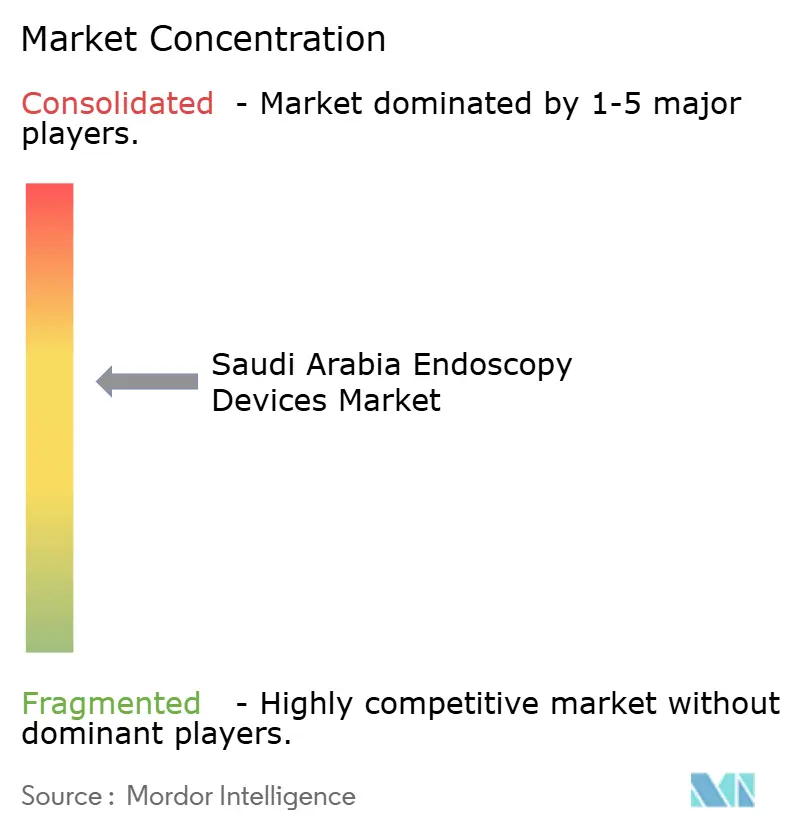
| Market Concentration | Medium |
Major Players *Disclaimer: Major Players sorted in no particular order Image © Mordor Intelligence. Reuse requires attribution under CC BY 4.0. | |
Saudi Arabia Endoscopy Devices Market Analysis by Mordor Intelligence
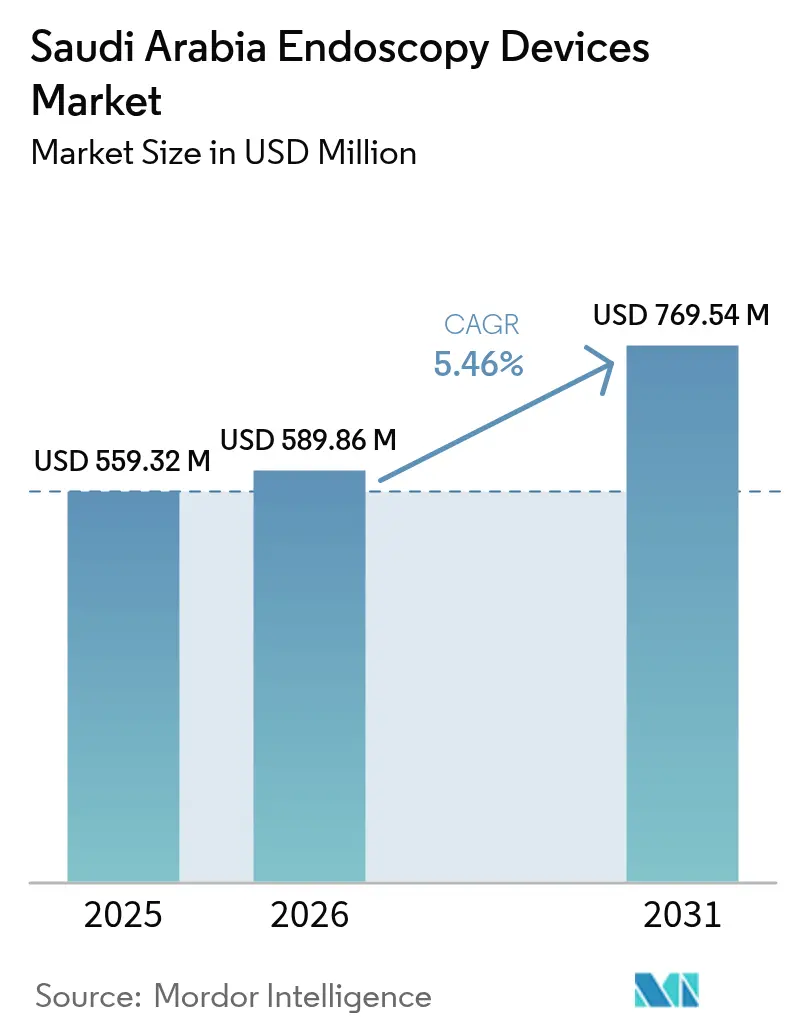
The Saudi Arabia endoscopy devices market size was valued at USD 559.32 million in 2025 and estimated to grow from USD 589.86 million in 2026 to reach USD 769.54 million by 2031, at a CAGR of 5.46% during the forecast period (2026-2031). The solid trajectory reflects Vision 2030-led healthcare modernization, large-scale procurement of minimally invasive technologies, and the country’s push to localize complex procedures. Demand spikes during Hajj and Umrah seasons, rising gastrointestinal (GI) disease incidence, and the rapid spread of AI-enabled visualization systems all reinforce growth. Hospital groups continue to centralize purchasing, yet private operators and ambulatory surgery centers are accelerating orders as reimbursement pathways improve. International vendors extend local training centers and technology-transfer deals to protect share, while emerging Saudi distributors target niche product gaps.
Key Report Takeaways
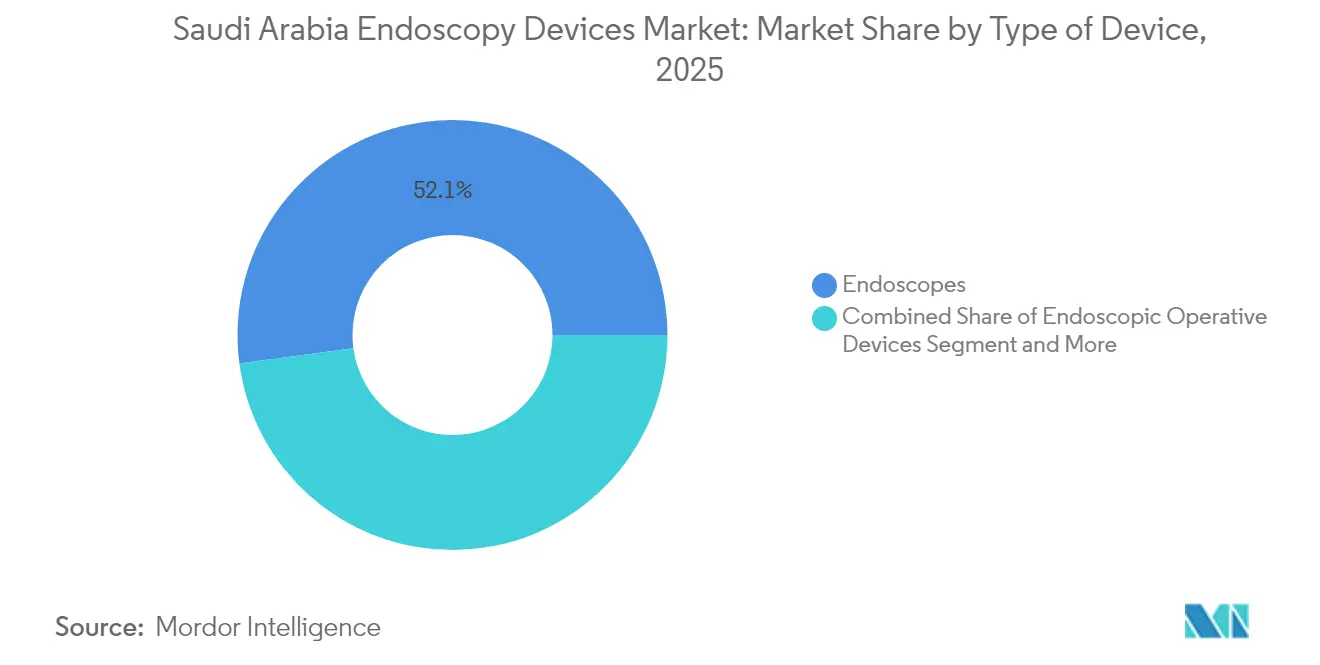
- By device type, endoscopes held 52.12% of the Saudi Arabia endoscopy devices market share in 2025, whereas visualization equipment is forecast to expand at a 9.78% CAGR through 2031.
- By application, gastroenterology accounted for 39.06% of the Saudi Arabia endoscopy devices market size in 2025 and neurology is projected to advance at an 11.24% CAGR to 2031.
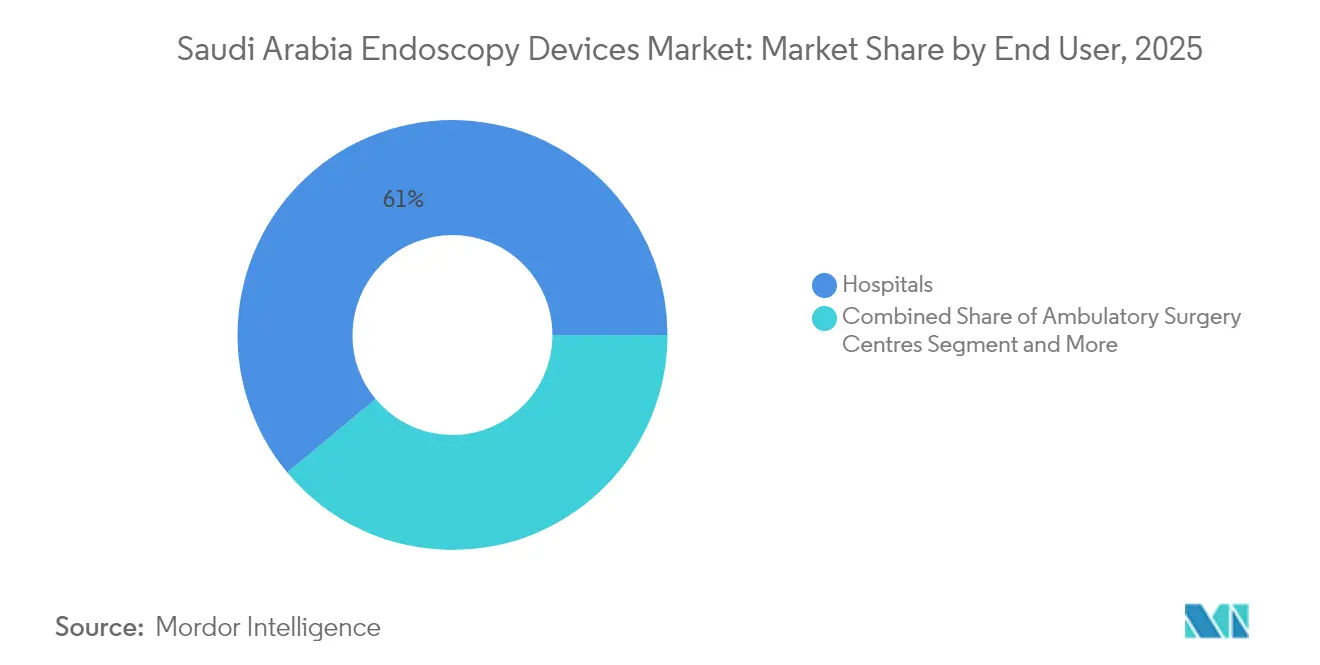
- By end user, hospitals commanded 61.05% of the Saudi Arabia endoscopy devices market size in 2025, while ambulatory surgery centers are set to record the fastest 11.63% CAGR during 2026-2031.
Note: Market size and forecast figures in this report are generated using Mordor Intelligence’s proprietary estimation framework, updated with the latest available data and insights as of 2026.
Saudi Arabia Endoscopy Devices Market Trends and Insights
Drivers Impact Analysis*
| Driver | (~) % Impact on CAGR Forecast | Geographic Relevance | Impact Timeline |
|---|---|---|---|
| Growing Preference for Minimally-Invasive Surgeries | +1.2% | Global, with early gains in Riyadh, Jeddah, Eastern Province | Medium term (2-4 years) |
| Rising Prevalence of GI Disorders in Saudi Arabia | +0.9% | National, concentrated in urban centers | Long term (≥ 4 years) |
| Expanding Healthcare Infrastructure & Private Hospital Investment | +1.5% | National, with priority in NEOM, Red Sea Project regions | Medium term (2-4 years) |
| Favourable Vision-2030 Healthcare Initiatives | +1.1% | National implementation with regional variations | Long term (≥ 4 years) |
| Pilgrimage-Related Surge in Emergency Endoscopy Demand | +0.4% | Mecca, Medina regions with spillover to Jeddah | Short term (≤ 2 years) |
| AI-Enabled Capsule Endoscopy Adoption by Tele-Health Start-Ups | +0.6% | Urban centers, expanding to remote regions | Medium term (2-4 years) |
| Source: Mordor Intelligence | |||
Growing Preference for Minimally-Invasive Surgeries
Hospitals and private centers in Riyadh and Jeddah increasingly favor minimally invasive procedures because they shorten intensive-care stays and lower total treatment costs. Robotic heart programs at King Faisal Specialist Hospital cut average ICU time from 26 days to four, which convinces administrators to redirect capital toward upgraded endoscopic suites[1]King Faisal Specialist Hospital & Research Centre, “KFSH&RC Leads the Global Healthcare Revolution with AI and Robotics,” kfshrc.edu.sa. The August 2025 installation of a da Vinci system at Johns Hopkins Aramco Healthcare signals broader regional adoption. Vendors must comply with Saudi FDA registration rules and ISO 13485 requirements before shipping systems. As clinical teams gain hands-on training at new vendor-run academies, procedure volumes for robotic and flexible endoscopy rise, anchoring steady equipment reorder cycles.
Rising Prevalence of GI Disorders in Saudi Arabia
Recent national studies document climbing rates of inflammatory bowel disease, colorectal cancer, and gastroesophageal reflux among Saudi adults, trends tied to dietary shifts and sedentary lifestyles[2]Saudi Ministry of Health, “National Colorectal Screening Initiative,” moh.gov.sa. These conditions drive earlier and more frequent screening using colonoscopes and capsule endoscopes. Vision 2030 preventive-care mandates push public hospitals to expand surveillance programs, raising annual procurement of flexible endoscopes and 4K visualization towers. Private gastroenterology clinics respond by adding same-day diagnostic services, intensifying demand for high-volume reprocessing equipment. Compliance with international colorectal screening guidelines and Saudi FDA software-as-a-medical device rules shape product selection for AI polyp-detection tools.
Expanding Healthcare Infrastructure & Private Hospital Investment
More than ten flagship private hospitals are under construction across NEOM and the Red Sea corridor, each budgeting for full endoscopy suites and integrated sterile reprocessing lines. Becton Dickinson’s simulation center in Riyadh, opened in May 2025, illustrates how global manufacturers co-locate training with new builds to accelerate uptake. The National Unified Procurement Company bundles large public orders, while private groups negotiate direct supply contracts with service-level guarantees. Contractors must meet Saudi Building Code standards that require negative-pressure endoscopy rooms and redundant water filtration, factors that boost accessory sales such as insufflators and suction pumps.
Favorable Vision 2030 Healthcare Initiatives
Government programs link clinical training, digital health, and local manufacturing incentives, forming a policy flywheel that benefits the Saudi Arabia endoscopy devices market. The Human Capability Development Program funds scholarships for GI fellows to train in AI-enabled colonoscopy. Sanabil Investments partnered with Redesign Health in January 2025 to create a venture studio expected to launch 20 new healthcare companies that could design single-use endoscopes or smart biopsy tools. Accelerated Saudi FDA review pathways shorten device-approval timelines to under six months for technologies already cleared by the U.S. FDA or CE marked. Intellectual-property reforms help multinationals justify local assembly operations, further easing supply bottlenecks.
Restraints Impact Analysis*
| Restraint | (~) % Impact on CAGR Forecast | Geographic Relevance | Impact Timeline |
|---|---|---|---|
| Infection & Cross-Contamination Risks | -0.8% | National, particularly in high-volume centers | Short term (≤ 2 years) |
| High Cost & Limited Reimbursement for Advanced Systems | -1.1% | National, affecting both public and private sectors | Medium term (2-4 years) |
| Shortage of Trained Female Endoscopists | -0.6% | National, with acute impact in conservative regions | Long term (≥ 4 years) |
| Import-Dependency & Geo-Political Supply Delays | -0.7% | National, with strategic buffer planning in major cities | Short term (≤ 2 years) |
| Source: Mordor Intelligence | |||
Infection & Cross-Contamination Risks
Reusable endoscope reprocessing remains complex, and several Saudi hospitals have reported sporadic contamination alerts that slowed elective case throughput. Administrators now weigh premium single-use scopes against higher consumable bills. Automated endoscope washers with real-time tracking sensors mitigate some risk but raise capital budgets and maintenance costs. The Ministry of Health audits sterilization workflows under updated infection-control guidelines modeled on WHO protocols. Vendors offering built-in leak testing, RFID-based scope tracking, and validated cleaning cycles gain preference, yet smaller centers struggle with staff certification and costs.
High Cost & Limited Reimbursement for Advanced Systems
AI-ready 4K towers, robotic flexible endoscopes, and smart biopsy forceps can triple upfront spending versus legacy units. Although Vision 2030 expands private insurance penetration, tariff schedules still lag behind actual equipment depreciation. Smaller private clinics defer purchases or lease devices, which elongates sales cycles. Currency fluctuations and a 5% customs duty add further pressure. Manufacturers must submit cost-effectiveness studies to the Saudi Health Technology Assessment Committee before premium systems enter public tenders, another barrier that slows unit growth in lower-volume facilities.
*Our forecasts treat driver/restraint impacts as directional, not additive. The impact forecasts reflect baseline growth, mix effects, and variable interactions.
Segment Analysis
By Type of Device: Advanced Visualization Drives Technology Adoption
Flexible endoscopes captured 52.12% of the Saudi Arabia endoscopy devices market share in 2025, underlining their indispensability for upper and lower GI procedures. The Saudi Arabia endoscopy devices market size for endoscopes is projected to climb alongside higher colorectal screening volumes and the uptake of capsule formats in remote monitoring programs. Hospitals increasingly bundle flexible scopes with automated reprocessors to meet new infection-control benchmarks, deepening vendor lock-in.
Visualization equipment enjoys the fastest 9.78% CAGR because 4K towers and AI polyp-detection software improve diagnostic accuracy and shorten procedure times. King Faisal Specialist Hospital adopted ultra-high-definition imaging in 2024 and reported an 18% rise in adenoma-detection rates, which spurred peer institutions to follow. Vendors highlight plug-and-play upgrades that retrofit existing towers, bridging budget gaps for public centers. Single-use visualization components, particularly in bronchoscopy, gain acceptance in ICUs that lack full reprocessing rooms.



By Application: Gastroenterology Leadership with Neurology Expansion
Gastroenterology held 39.06% of the Saudi Arabia endoscopy devices market size in 2025 through sustained colorectal cancer screening and routine upper-GI diagnostics. Vision 2030’s prevention focus increases colonoscopy subsidies, driving regular turnover of colonoscope fleets and accessory biopsy forceps. Capsule endoscopy supports rural outreach programs, transmitting images to urban reading centers through telehealth platforms.
Neurology shows the most rapid 11.24% CAGR as tertiary hospitals introduce ventricular neuroendoscopy for hydrocephalus and tumor excision. Robotic stereotactic systems combined with flexible neuro-endoscopes lower surgical morbidity, making them attractive for centers seeking international accreditation. ENT and urology maintain steady growth by adding office-based endoscopy that shifts low-complexity work from congested hospitals to outpatient suites.
By End User: Hospital Dominance with ASC Growth Trajectory
Hospitals controlled 61.05% of the Saudi Arabia endoscopy devices market share in 2025 because tertiary centers concentrate advanced imaging towers and high-throughput reprocessing rooms. National Unified Procurement Company negotiations lock in multiyear vendor contracts that cover maintenance, training, and consumables, reinforcing market leadership among established brands.
Ambulatory surgery centers post a 11.63% CAGR as Vision 2030 incentives encourage day-case surgery expansion. Private operators in Riyadh and Dammam deploy slim colonoscopes and portable towers aimed at rapid turnover. Office-based clinics adopt single-use gastroscopes for helicobacter screening, giving vendors entry to a previously under-equipped niche.
Geography Analysis
Central Region hospitals anchored by Riyadh account for the largest share of the Saudi Arabia endoscopy devices market due to dense tertiary infrastructure, policy makers, and distributor headquarters. King Faisal Specialist Hospital’s 1,127 robotic procedures in 2024 underscore the region’s appetite for cutting-edge platforms. Procurement frameworks here often serve as templates for other provinces.
Western Region hubs Jeddah, Mecca, and Medina collectively generate the second-largest portion of demand. Seasonal pilgrimage inflows require flexible capacity, prompting facilities to maintain portable endoscopy towers that can be redeployed after Hajj. Private hospitals in Jeddah cater to a growing expatriate population that expects international-standard GI screening.
Eastern Region posts the fastest 2026-2031 growth rate as NEOM and Red Sea resorts come online with integrated medical campuses. King Fahd University Hospital’s robotic orthopedic milestones in 2025 illustrate the region’s expanding skill set. Northern and Southern regions still trail but attract Vision 2030 funding for new general hospitals equipped with modular endoscopy rooms.
Regulatory Landscape
Endoscopy devices in Saudi Arabia are regulated by the Saudi Food and Drug Authority (SFDA) under the Law of Medical Devices and Supplies (Royal Decree No. M/54). Products must obtain Medical Device Marketing Authorization (MDMA) before being made available for distribution or use in the Kingdom, and risk-based classification rules apply to endoscope-related components and systems (including light-source and fiber-optic configurations).
On the supply side, establishments involved in importing and distribution require licensing under SFDA requirements (MDS-REQ 9, updated 2025), and shipments require clearance at ports of entry using SFDA-aligned processes supported by the GHAD and FASAH (Tabadul) platforms. For local manufacturing and partial localization (such as assembly, final packaging, and labeling), SFDA licensing and Quality Management System expectations aligned to ISO 13485:2016 shape compliance planning, while SFDA post-market oversight extends to monitoring healthcare facilities for adherence to technical regulations on medical devices and supplies.
Competitive Landscape
The Saudi Arabia endoscopy devices market is moderately fragmented. Olympus, Boston Scientific, Medtronic, and Karl Storz lead based on broad portfolios and long-standing distributor networks. They deepen presence through local training academies that shorten learning curves and reinforce loyalty. Becton Dickinson’s 2025 Riyadh center trains 1,000 clinicians annually on advanced visualization and sterility workflows[3]Becton Dickinson, “BD Simulation Center Riyadh Opens,” bd.com.
Local distributors such as ProMedEx and Almana leverage strong government ties to win regional tenders, often bundling consumables and service in price-competitive deals. Opportunities lie in AI-powered software, single-use scopes, and digitized reprocessing modules that align with Vision 2030 digitization targets. Hospitals give preference to vendors that prove measurable outcome gains—King Faisal Specialist Hospital achieved 98% survival in robotic cardiac cases, a benchmark that shapes procurement scoring models.
Market entrants must navigate Saudi FDA registration, cost-effectiveness dossiers, and post-market vigilance reporting. Manufacturers investing in partial local assembly could secure tariff exemptions and preferential tender scoring, providing a pathway to offset currency volatility and supply-chain disruptions.
Saudi Arabia Endoscopy Devices Industry Leaders
Fujifilm Holdings Corporation
Karl Storz SE & Co. KG
Olympus Corporation
Boston Scientific Corp.
Medtronic PLC
- *Disclaimer: Major Players sorted in no particular order

Market Opportunities and Future Outlook
White space is opening where clinical throughput and infection-control demands intersect with procurement standardization: high-volume centers and ASCs are prioritizing reprocessing automation (tracking, validated cycles, leak testing) and single-use scope pathways to reduce cross-contamination risk and procedure cancellations. The market already shows a technology pivot toward advanced visualization, with visualization equipment identified as the fastest-growing device category within the report scope, creating room for vendors that can retrofit installed bases with 4K/AI-ready upgrades while meeting Saudi FDA software and device compliance expectations.
Procurement and localization policies create a second opportunity track beyond pure device sales. Centralized government purchasing via the National Unified Procurement Company (NUPCO) and local content requirements administered through the Local Content and Government Procurement Authority (LCGPA) push suppliers toward Saudi-based service capability, training, and selective in-Kingdom manufacturing steps (assembly/packaging/labeling as permitted under SFDA guidance). The Law of Medical Devices and Supplies framework, Vision 2030 Health Sector Transformation initiatives, and localization programs tied to NIDLP and Made in Saudi (including the 40% added local value threshold for tender eligibility) support partnerships with licensed local distributors and industrial operators to compete more effectively in public tenders and sustain lifecycle revenues from maintenance, consumables, and clinical education.
Recent Industry Developments
- May 2026: Fujifilm launched the EB-710US balloon-less endobronchial ultrasound (EBUS) bronchoscope, targeting workflow efficiency and lower contamination points by removing the balloon step. The launch adds a newer option to bronchoscopy suites that are increasingly attentive to infection-control and turnaround time, and it expands the competitive set for advanced endoscopy in hospitals that bundle scopes with reprocessing and service contracts.
- April 2025: Becton Dickinson opened a training center in Riyadh to educate clinicians on advanced endoscopy and visualization technologies. Expanded local training capacity supports faster adoption of newer imaging and sterility workflows, strengthening vendor stickiness in a market where hospitals centralize purchasing and score suppliers on service and competency-building.
- February 2024: Waycen and MegaMind signed an AI-endoscopy supply agreement covering Middle East distribution, positioning Saudi facilities to access algorithm-enabled diagnostic support through regional channels. The agreement reinforced momentum for AI-assisted visualization selection criteria alongside Saudi FDA medical device and software compliance, influencing upgrade cycles for towers and compatible scopes.


Research Methodology Framework and Report Scope
Market Definition and Coverage
For this study, the market is defined as the value of endoscopy devices sold for use in Saudi Arabia across diagnostic and therapeutic endoscopic procedures in hospitals and outpatient settings, with revenues captured at the manufacturer or distributor selling price in USD.
Scope exclusions: We exclude endoscopy-related drugs, sterilization consumables, and broader operating room capital equipment that is not primarily used for endoscopy.
Segmentation Overview
- By Type of Device
- Endoscopes
- Rigid Endoscope
- Flexible Endoscope
- Capsule Endoscope
- Robot-assisted Endoscope
- Endoscopic Operative Devices
- Irrigation / Suction System
- Access Device
- Wound Protector
- Insufflation Device
- Operative Manual Instrument
- Visualization Equipment
- Endoscopes
- By Application
- Gastroenterology
- Orthopedic Surgery
- Cardiology
- ENT Surgery
- Gynecology
- Neurology
- Urology
- Others
- By End User
- Hospitals
- Ambulatory Surgery Centres
- Office-based / Out-patient Clinics
Data Sources, Market Sizing, and Validation
Desk Research
Desk research was used to build the foundational view on procedure demand, healthcare capacity, and device adoption in Saudi Arabia before any numbers were modeled. We referred to public health statistics and policy releases that indicate screening and surgical volumes, along with import and trade indicators that help explain device inflow patterns.
Sources typically reviewed include publications such as the Saudi Ministry of Health statistical yearbook and program updates, the General Authority for Statistics for population and health service indicators, World Health Organization databases for comparable disease burden context, World Bank health expenditure series, peer reviewed clinical journals for endoscopy utilization trends, and Saudi Food and Drug Authority notices for device and safety related signals. Company filings, investor presentations, hospital procurement announcements, and reputable press were also used. In addition, we applied selective checks from a paid database subscription focused on company financials and patent activity to sense product launches and pricing direction. These examples are not exhaustive, and many other public sources were used for data collection, validation, and clarification.
Primary Interviews and Surveys
Primary interviews and structured surveys were completed with stakeholders across the endoscopy device ecosystem, so assumptions from desk research could be corrected when local purchasing and utilization patterns differ. We spoke with a mix of suppliers, distributors, hospital procurement teams, clinicians, and service partners, covering demand patterns in major cities and referral driven volumes coming from secondary care facilities.
Inputs from these discussions were used to validate procedure mix changes, replacement cycles, and the practical split between capital equipment and recurring accessories, which then fed into final model checks.
Distribution of primary research fieldwork respondents
| Company type | Respondent position |
|---|---|
| Top tier: 28% | CXOs: 14% |
| Mid tier: 52% | Functional/Unit leaders: 28% |
| Smaller Players: 20% | Managers: 58% |
Market-Sizing & Forecasting
The sizing started with a top-down build where procedure demand and care capacity were used to reconstruct the addressable endoscopy device pool in Saudi Arabia, then converted into value using typical device mix and pricing ranges. To keep results grounded, we corroborated totals with selective bottom-up approximations such as sampled ASP times estimated unit volumes for core endoscope categories and accessories, supported by channel checks with distributors and hospital buyers.
Key inputs used in the model include indicators such as endoscopy procedure volumes by major clinical areas, hospital and day surgery capacity additions, replacement cycles for reusable endoscopes and towers, adoption of single use or disposable components where applicable, average selling price progression by product class, and the split of demand between public and private operators as purchasing models evolve. Where full product level volume was not consistently available, gaps were handled through conservative proxy ratios tied to procedure intensity and installed base refresh patterns, and then stress tested during interviews.
For forecasting, scenario analysis was used to translate expected changes in procedure growth, capacity rollouts, and pricing into yearly demand. Forecast results were then aligned to expert consensus on the pace of technology upgrades and procurement cycles. A few short scenarios were kept, so the resulting forecast remains explainable and repeatable using the same public indicators over time.
Data Validation & Update Cycle
Outputs were validated through multiple checks, starting with internal consistency tests across procedure driven demand, implied device utilization, and replacement timing. Variances were reviewed in analyst rounds, and any abnormal jumps were traced back to a specific driver such as one time procurement, pricing shifts, or a change in the assumed care setting mix.
We also compared the final totals with independent signals such as import intensity trends, hospital expansion announcements, and practical price bands shared by market participants. When a key assumption appeared weak, we re contacted respondents for clarification. Reports are refreshed annually, and interim updates are triggered when material events occur, such as policy changes, major tender cycles, or step change in procedure volumes. Before delivery, the numbers receive a final fresh pass so clients get the most current view available.
Mordor Intelligence's Saudi Arabia Endoscopy Devices Market Estimate Compared With Other Published Estimates
Published market sizes for Saudi Arabia endoscopy devices often differ because the underlying scope and the conversion logic from procedures to device value are not consistent across sources. Differences also come from how each publisher treats capital equipment versus accessories, the assumed replacement cycle, and the year of pricing used when currency and inflation conditions change.
In this study, the gap drivers that mattered most were whether single use components and recurring accessories were fully counted, how outpatient procedure growth was reflected (rather than only large hospitals), and whether base year pricing was updated using recent tender and distributor feedback. When these assumptions are not refreshed on time, the model can drift even if the headline growth rate looks reasonable.
Benchmark comparison
| Source | Market Size | Gaps in Research Methodology |
|---|---|---|
| Mordor Intelligence | USD 589.86 M (2026) | |
| Industry Publisher A | USD 497.50 M (2025) | Uses a different base year and a longer forecast horizon, and the scope and pricing logic are less clear on how recurring accessories and outpatient utilization are converted into value. |
| Industry Publisher B | USD 465.00 M (2024) | Relies on an earlier valuation year and a broader segment list, but the reconciliation between procedure demand, replacement cycles, and realized selling prices is not shown, which can compress the total. |
The comparison shows that timing and scope choices explain most of the spread, especially around whether accessory pull through and non hospital volumes are fully represented. By tying value to procedure intensity, replacement behavior, and refreshed price bands from local buyers, the estimate stays traceable to repeatable inputs, which is the key modeling choice applied by Mordor Intelligence.


Key Questions Answered in the Report
What is the current value of the Saudi Arabia endoscopy devices market?
The market is valued at USD 589.86 million in 2026.
Which device category shows the fastest growth through 2031?
Visualization equipment leads with a projected 9.78% CAGR.
How large is the hospital segment within national demand?
Hospitals account for 61.05% of total 2025 sales.
Why is neurology gaining share in the Saudi endoscopy space?
Tertiary centers are adopting neuroendoscopic techniques that offer minimally invasive brain surgery with quicker recovery times.
How do Vision 2030 policies influence endoscopy procurement?
Vision 2030 incentivizes local training, digital health integration, and private investment, all of which accelerate endoscopy suite expansion.
What regional market shows the highest future growth?
The Eastern Region is forecast to grow fastest due to new medical campuses tied to NEOM and Red Sea projects.
Page last updated on:


 Your data is secure and never sold or shared.


