
Market Overview
| Study Period | 2021 - 2031 |
|---|---|
| Forecast Data Period | 2026 - 2031 |
| Historical Data Period | 2021 - 2024 |
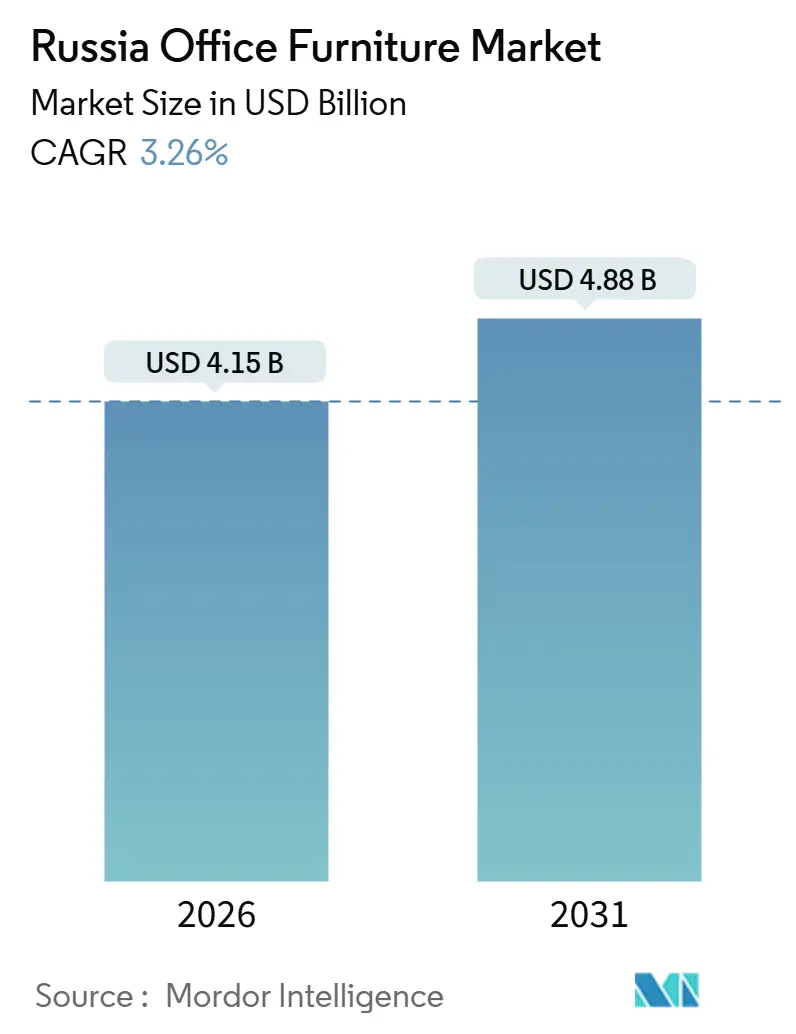
| Market Size (2026) | USD 4.15 Billion |
| Market Size (2031) | USD 4.88 Billion |
| Growth Rate (2026 - 2031) | 3.26 % |
| Market Concentration | Low |
Major Players *Disclaimer: Major Players sorted in no particular order Image © Mordor Intelligence. Reuse requires attribution under CC BY 4.0. | |
Russia Office Furniture Market Analysis by Mordor Intelligence
The Russia office furniture market size is USD 4.15 billion in 2026 and is projected to reach USD 4.88 billion by 2031, registering a 3.26% CAGR from 2026 to 2031. Growth conditions remain uneven as manufacturers navigate a 16% key rate that raises financing costs, increasing the emphasis on pre-leased projects and state tenders, which provide higher visibility and more predictable cash flows [1]Source: Bank of Russia, “The Bank of Russia’s Statement on Monetary Policy,” Bank of Russia, cbr.ru. Fit-out intensity remains supported by commissioning activity and longer pre-lease pipelines, which protect build-out schedules and direct orders to compliant vendors under localization rules. E-commerce platforms continue to open access to provincial buyers and SMEs, enabling online configuration, faster delivery, and transaction tools that expand assortment reach. Ergonomic mandates and workplace health guidance also influence both B2B refits and B2C home-office purchases, with specifications rooted in national labour guidelines and certification norms that push demand toward tested and documented products.
Key Report Takeaways
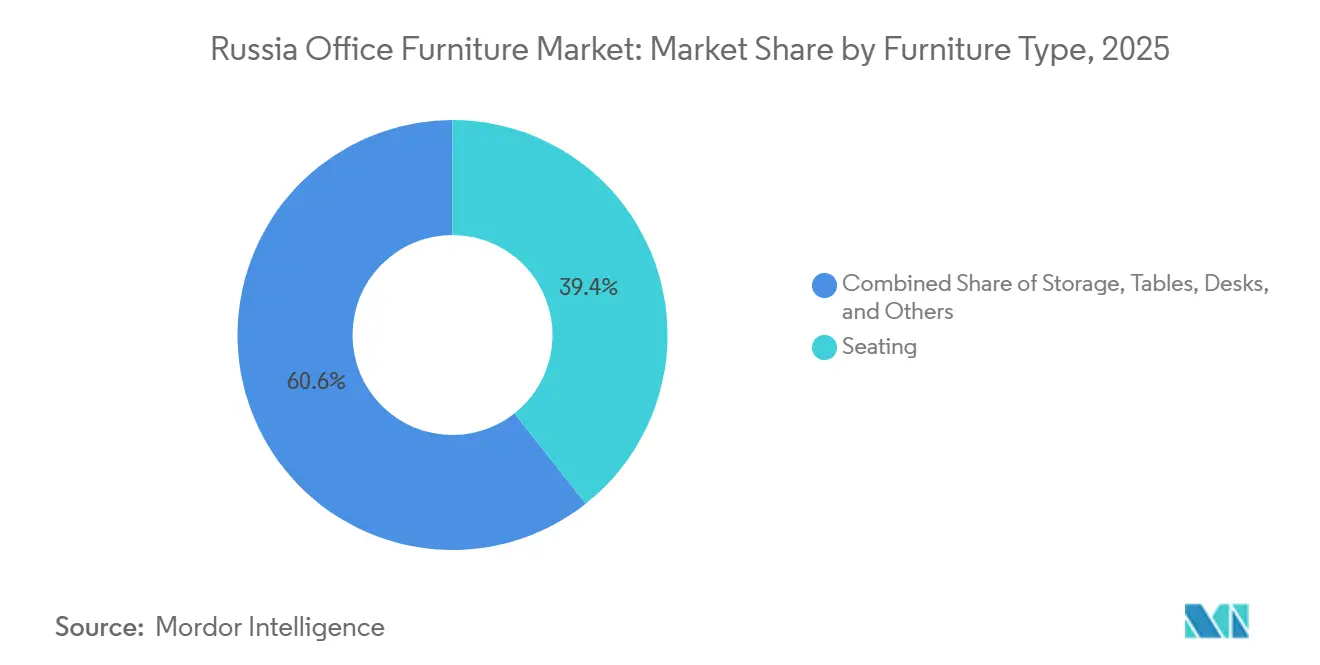
- By furniture type, Seating led with 39.37% of the Russia office furniture market share in 2025, while Desks are projected to expand at a 7.98% CAGR through 2031.
- By distribution channel, B2B held 54.87% of the Russia office furniture market share in 2025, while Retail is forecast to grow at an 8.87% CAGR to 2031.
- By geography, the Central Federal District accounted for 48.87% of the Russia office furniture market share in 2025 and is set to advance at a 5.24% CAGR through 2031.
Note: Market size and forecast figures in this report are generated using Mordor Intelligence’s proprietary estimation framework, updated with the latest available data and insights as of January 2026.
Russia Office Furniture Market Trends and Insights
Drivers Impact Analysis*
| Driver | (~) % Impact on CAGR Forecast | Geographic Relevance | Impact Timeline |
|---|---|---|---|
| Office real estate commissioning and pre-leased supply in Moscow | +1.8% | Central Federal District, spill-over to Northwestern Federal District | Medium term (2-4 years) |
| Procurement localization under PP 616/2013 | +1.5% | National, strongest in the Central Federal District | Long term (≥ 4 years) |
| E-commerce and marketplace penetration | +1.2% | National, early gains in Central, Volga, Ural, expanding to Siberian | Short term (≤ 2 years) |
| Hybrid or remote work and ergonomic demand | +0.9% | National, concentrated in major urban centres | Medium term (2-4 years) |
| Adoption of acoustic booths and partitions | +0.6% | Central and Northwestern Federal Districts | Short term (≤ 2 years) |
| Smart or height-adjustable desks and tech-integrated workstations | +0.4% | Central Federal District, early adopters in tech | Medium term (2-4 years) |
| Source: Mordor Intelligence | |||
Office Real Estate Commissioning and Pre-Leased Supply in Moscow Sustains Fit-Out Demand into the Late 2020s
Commissioning activity in Moscow remained strong into late 2025, which aligned turnkey furniture packages to pre-leased pipelines and sustained order flow into 2026 handovers. Pre-lease structures reduce developer risk and anchor specifications earlier in the cycle, which locks in compliant domestic vendors for integrated design, supply, and installation scopes under localization rules. The 16% policy rate raises the hurdle for speculative projects, so capital prioritizes pre-committed office space that is more likely to proceed to fit-out without scope cuts or schedule drift. Manufacturers aligned to major tenants and campus-scale projects reported stable pipelines and multi-year production plans, which offset volume headwinds in discretionary refurbishments. Vacancy stayed tight relative to an 8% equilibrium reference point, which helped landlords uphold rent increases that support capex for interior upgrades and related furnishings across higher-grade buildings.
Procurement Localization (PP 616/2013) Shifts Public-Sector and SOE Demand to Domestic Producers
The localization framework channels public-sector and state-affiliated orders to domestic and EAEU-origin suppliers, which creates a stable demand pool for compliant office furniture producers that can document origin and certification. Eligibility depends on registration and technical conformance, which raises barriers for import-heavy assemblers and rewards integrated manufacturers able to internalize key components and documentation. Large financial and energy groups cascade localization through contractor requirements, so indirect demand also tilts to domestic sources even outside formal tender procedures. Incumbents that invest in compliant processes, quality systems, and lab testing have a structural advantage in government-linked projects and multi-year frameworks. The VAT rate rise to 22% that starts from early 2026 creates cost-structure nuances across foreign and domestic supply chains, so working-capital and tax-treatment planning remain central to margin defense among local manufacturers.
E-Commerce And Marketplace Penetration Accelerate B2B And B2C Sales and Assortment Breadth
Marketplace features now include configuration tools, visual previews, and distributed fulfillment, which cut delivery times to short windows across major cities and extend reach across regional centers. These platforms have grown as procurement channels for SMEs and regional branches that seek transparent pricing, faster dispatch, and invoice-ready transactions. The Russia office furniture market benefits from demand aggregation on trusted portals, which narrows the historical advantage of local distributors that once depended on geographic exclusivity. Commission structures and co-marketing fees trade off with access to very large registered-user bases, which reshapes merchandising and accelerates product refresh cycles for responsive brands. As omnichannel execution becomes standard, logistics speed and SKU depth often outweigh traditional brand awareness in purchasing decisions across the Russia office furniture market.
Hybrid Or Remote Work Raises Demand for Ergonomic Seating and Home-Office Desks
Hybrid patterns continue to influence office reconfigurations and home-office setups, with ergonomic specifications embedded into procurement practices under labor guidance. Corporate facility teams are adopting mobility and adjustability as standard attributes to support hot-desking and activity-based zones, which increases the share of modular seating and benching systems in the Russia office furniture market. On the home side, consumers proceed with incremental upgrades targeted at health and posture rather than large-scale remodels, which supports mid-priced ergonomic lines from domestic suppliers. Installation options on marketplaces expand affordability for regional buyers, which brings remote and hybrid workers into the addressable base for performance-certified seating and desks. These shifts reinforce compliance and testing as differentiators, since public-sector and large private buyers increasingly specify conformance to ergonomics and safety standards in bid documents.
Restraints Impact Analysis*
| Restraint | (~) % Impact on CAGR Forecast | Geographic Relevance | Impact Timeline |
|---|---|---|---|
| High interest rates and softer corporate or residential demand | -1.4% | National, steeper outside the Central Federal District | Short term (≤ 2 years) |
| Input cost volatility and component import frictions | -0.9% | National, severe where customs is a primary entry point | Medium term (2-4 years) |
| Customs reclassification risk on fittings duties | -0.7% | National across major ports of entry | Short term (≤ 2 years) |
| Compliance burden for TR CU 025/2012 EAC or GOST | -0.3% | National across the EAEU supply chain | Long term (≥ 4 years) |
| Source: Mordor Intelligence | |||
High Interest Rates and Softer Corporate or Residential Demand Slow Large Refits
The 16% key rate raises the cost of inventory and project financing, which lowers the net present value of long-dated leases and dampens discretionary refits in the Russia office furniture market. Corporate buyers respond by extending replacement cycles, reducing average ticket values, and favoring standardized modular systems over bespoke collections. Financing conditions tightened at the supplier level as well, with shorter tenors and stricter covenants reinforcing the advantage of low-leverage manufacturers that can extend terms to key customers. Demand resilience skews toward the Central Federal District, where office pipelines and government contracting remain more stable, which keeps the Russia office furniture market more concentrated around the capital. Consumer-facing categories linked to home offices continue to sell through, but the mix shifts toward value tiers when real wages trail headline inflation pressure.
Input Cost Volatility and Component Import Frictions Lift End-Prices
Tariff exposure, customs classification shifts, and currency swings raise landed costs for metal hardware, actuators, and fittings that are integral to seating and desk systems in the Russia office furniture market. Domestic material inputs are also priced higher due to competing demand, which pushes producers toward backward integration strategies that internalize component manufacturing and stabilize bill-of-materials costs. Manufacturers have staggered price increases to protect share while covering cost inflation, which leaves margins sensitive to further shocks in transport and import fees. VAT treatment at 22% from early 2026 requires careful tax planning along multi-stage domestic production chains to avoid a cumulative burden relative to single-levy imports[2]Source: President of Russia, “Meeting on Support for Investment Projects in Domestic Industry,” Office of the President, kremlin.ru. Scale players hedge through multi-year supply contracts and currency tools, while sub-scale assemblers face spot markets and higher working-capital costs that can pressure continuity.
*Our forecasts treat driver/restraint impacts as directional, not additive. The impact forecasts reflect baseline growth, mix effects, and variable interactions.
Segment Analysis
By Furniture Type: Desks Surge on Hybrid-Work and Ergonomic Mandates
Seating accounted for 39.37% of revenue in 2025, while desks are the fastest-growing category with a 7.98% CAGR through 2031, which aligns with hybrid layouts and height-adjustability adoption within the Russia office furniture market. This mix supports modular benching, mobile task seating, and tech-ready workstations that compress fit-out schedules and simplify reconfiguration across projects in the capital and major regional centers. Ergonomics guidance drives standardization of adjustability and posture support features, so buyer specifications emphasize certified components and documented conformance. The Russia office furniture industry reflects this shift in product development roadmaps, with integrated producers calibrating value lines around mandated attributes and support services. As desk systems add height variability and power integration, lifecycle costs and service commitments become more important to procurement teams that assess durability and warranty as part of the total cost of ownership.
Within this category, acoustic dividers, collaborative tables, and lounge seating complement open-office layouts and video-call intensity, which extends demand to add-on components that raise functional performance without extensive partitioning. Certified solutions help public buyers enforce tender specifications that require conformance to ergonomic and safety standards, which favors incumbents with in-house compliance capabilities in the Russia office furniture market. The Russia office furniture market size for desks is aligned with adoption beyond technology firms, as financial and administrative tenants extend wellness policies to more facilities under standardized fit-out kits.


By Distribution Channel: B2C Retail Accelerates Amid E-Commerce Expansion and Home-Office Demand
B2B channels held 54.87% of shipments by value in 2025, and B2C retail is projected to post an 8.87% CAGR as marketplaces and home centers broaden reach and speed across regions in the Russia office furniture market. Online channels now serve both consumers and SME buyers with configuration, invoicing, and fast fulfillment, which changes the basis of competition from legacy distribution coverage to digital merchandising and logistics. As retail share expands, manufacturers optimize assortments and packaging for parcel networks and hub-and-spoke models, which raises the role of co-marketing and ratings in demand generation. Framework contracts and project scopes still define the largest single orders, so mixed-channel portfolios remain the dominant strategy for resilient revenue in the Russia office furniture market. Value growth in B2C home-office kits reinforces the link between labor guidance and retail assortment, as ergonomics becomes a baseline promise rather than a niche feature set.
Home centers and specialist showrooms continue to capture buyers who prefer coordinated purchases across lighting, cable management, and décor, which integrates furniture into one-stop projects across regional cities. Manufacturers leverage marketplaces to enter distant regions without physical stores, which helps balance capital discipline with nationwide exposure across the Russia office furniture market. The Russia office furniture market size associated with B2B frameworks remains anchored by tender-driven orders and pre-leased project kits, which sustains average order values well above consumer transactions. As B2C grows, retailers adopt B2B features such as bulk pricing and project management, while B2B vendors deploy digital catalogs and rapid-ship programs to protect their share. This convergence lifts standards for service and fulfillment, which ultimately raises the competitive bar across the Russia office furniture industry.
Geography Analysis
The Central Federal District led with a 48.87% share in 2025 and a forecast 5.24% CAGR to 2031, underpinned by concentrated commissioning, federal procurement, and headquarters demand centered in the capital in the Russia office furniture market. Pre-leased projects in Moscow anchor turnkey fit-outs and sustain supplier pipelines, which give integrated producers a consistent schedule of design, supply, and installation scopes. Tight vacancy relative to equilibrium allows rent pass-throughs that keep interior upgrades viable, which supports higher-value furniture programs in Grade A and B-plus buildings. Project delivery windows are compressed, which favors suppliers with proximity to the capital and the ability to staff installation teams at scale in the Russia office furniture market. The Russia office furniture market share earned by the district reflects this durability in institutional and corporate projects, which keeps the region structurally ahead of secondary markets on value capture.
The Northwestern Federal District contributes meaningful demand through St. Petersburg’s innovation and logistics roles, which support mid-tier ergonomic assortments and modular desk systems tuned to functional fit-outs. Office stock additions and R&D footprints maintain a steady cadence of projects, and procurement behavior emphasizes reliable delivery and standardized specifications across multi-site footprints in the Russia office furniture market. Logistics links to Baltic-facing trade and project contractors also influence supplier selection and service expectations, which pushes vendors to guarantee parts availability and after-sales support. Market growth in the district remains healthy yet below the Central District because corporate pipelines outside the city center are more cyclical and price sensitive. As acoustic, ergonomic, and modular categories gain traction, local manufacturers and distributors strengthen assortments that balance performance and affordability for the Russia office furniture market.
The Southern Federal District and the broader Rest of Russia pool together diverse demand across manufacturing, energy, services, and government, which produces steady but project-driven ordering patterns in the Russia office furniture market[3]Source: Expocentre, “MEBEL 2025: Relevant Issues of Furniture Retail,” Expocentre, meb-expo.ru. Regional hubs add office capacity at a smaller scale than Moscow, which sustains distributor networks and hybrid direct models that integrate showroom exposure with online selection. Logistics costs and distance from central production clusters require careful inventory planning, which can lengthen replenishment schedules unless suppliers dedicate regional stock or forward-deployed kits. As marketplaces reduce friction, buyers in these regions access standardized ergonomic ranges that meet national guidance, which helps narrow historical product gaps between the capital and regional cities. Through the forecast horizon, the Russia office furniture market size remains weighted to the Central Federal District on value, while volume expansion outside the capital continues in line with incremental office stock and SME formation.
Regulatory Landscape
Office furniture sold in Russia is regulated under the EAEU technical regulation TR CU 025/2012 (On Safety of Furniture Products). This framework requires conformity assessment (certification or declaration) and EAC marking for regulated products, with oversight aligned to state control functions, including Rospotrebnadzor for consumer protection and related supervision. In parallel, national standardization and compliance practices coordinated through Rosstandart and applicable GOST standards influence what buyers ask for in tenders and corporate specifications. As a result, test reports, labeling accuracy, and traceable documentation carry added weight.
Procurement and industrial policy also shape supplier eligibility. Government localization frameworks linked to confirmation of Russian industrial production status under Decree No. 719 (points-based criteria) continue to influence participation in state and state-affiliated procurement, benefiting manufacturers that can document origin and localize critical operations. In June 2026, the Government of the Russian Federation issued Decree No. 746 (15.06.2026), amending Decree No. 719 and updating compliance criteria used to confirm localized production status and tender eligibility. This increases the need for ongoing documentation and process alignment across factories and key component sourcing.
Value Chain Analysis
The value chain begins with raw materials and components (wood-based panels, metals, foams and textiles, adhesives and coatings, plus hardware such as fittings and mechanisms). It then runs through design and engineering, panel processing and metalworking, upholstery and assembly, finishing, packaging, and logistics and installation. Import dependence remains meaningful for selected fittings, chemicals, and production equipment. Component import frictions and customs reclassification risk can raise landed costs and elongate replenishment cycles, which pushes manufacturers toward dual sourcing, higher safety stocks for critical hardware, and selective backward integration for cost control.
Downstream, market routes split between project-led B2B and B2G channels (developers, corporate tenants, public procurement, and integrators offering turnkey fit-outs) and B2C retail, where marketplaces increasingly function as demand aggregators for SMEs and regional buyers through configuration and invoicing tools. Financing and logistics constraints also shape the chain. With a 16% key rate referenced in the market context, working-capital intensity rises for distributors and manufacturers holding inventory, while longer inter-regional delivery distances increase the value of hub-and-spoke fulfillment, standardized SKUs, and service networks for installation and warranty. Trade events and industry platforms further support diffusion of automation and production-efficiency solutions, which helps suppliers compete on lead times and compliance documentation.
Competitive Landscape
The Russia office furniture market remains fragmented, with no single player above 10% of national sales, which reflects the split between standardized categories with many rivals and specialized scopes with higher barriers and fewer credible bidders. Integrated manufacturers that combine certification speed, in-house component capability, and project execution tend to dominate government-linked and pre-leased pipelines under localization norms. FELIX and peers have invested in production planning and compliance processes that enable fast turn bid responses and consistent launch cycles, which is especially important when specifications finalize close to handover dates. Elevated policy rates reward firms with stronger balance sheets that can offer credit terms, which is difficult for smaller players that rely on factoring at higher costs. Omnichannel coverage has become a core differentiator that connects B2B frameworks, showrooms, and marketplaces into a single commercial system for the Russia office furniture market.
Retail-led disruptors have advanced through lower prices and rapid delivery, but installation, warranty servicing, and corporate financing often still favor established manufacturers and specialist B2B distributors. Marketplaces function as infrastructure rather than direct rivals for most producers, who trade commissions for reach and logistics that amplify assortment exposure in the Russia office furniture market. Private-label initiatives and vertical integration continue to appear on both retailer and distributor sides, which keeps value-chain boundaries fluid and rewards defensible assets like proprietary designs and sticky customer relationships. Company programs that align wellness data, IoT features, and ergonomic certifications position for premium segments where corporate buyers seek measurable outcomes and reported compliance. Certification and after-sales obligations limit the number of credible participants in specialized scopes, which moderates rivalry and sustains pricing discipline even as standardized lines see stronger price competition in the Russia office furniture market.
Exhibition platforms have assumed a larger role in technology diffusion and automation adoption, which helps suppliers offset labor constraints while raising throughput and consistency. MEBEL and WOODEX convenings report rising interest in robotics and high-efficiency manufacturing solutions across cutting, welding, painting, and upholstery, which supports investment in capacity with stronger unit economics in the Russia office furniture market. Company modernization programs reflect this trajectory and present new mid-price ergonomic lines that align with mainstream demand without compromising on conformance or serviceability. Producers increasingly bundle design support, site surveys, and maintenance into project proposals, which raises switching costs and improves lifecycle outcomes for customers. The Russia office furniture market will continue to favor suppliers that combine compliance readiness, execution speed, and multi-channel access over those relying on a single route to market or limited service scope.
Russia Office Furniture Industry Leaders
FELIX
Burokrat
Metta
Wildberries
Hoff
- *Disclaimer: Major Players sorted in no particular order


Market Opportunities and Future Outlook
Opportunities concentrate where compliance, localization, and fast delivery align with office project pipelines, especially in turnkey fit-outs for pre-leased office projects and in tender-led public and state-affiliated procurement. These channels require documented conformance and origin. The June 2026 amendment to the localized production confirmation framework, Government Decree No. 746 updating Decree No. 719 criteria, strengthens the position of manufacturers that can deepen local operations and sustain points-based compliance, particularly those offering integrated design, supply, and installation with traceable certification packs under TR CU 025/2012.
Capacity and capability upgrades are also turning into actionable supply-side evidence that can be leveraged into adjacent office furniture categories, including laminated casegoods, desk systems, and compliant components. In January 2026, Chair Group launched a new furniture production complex in Voskresensk (Moscow region) with a reported 500 million ruble investment and an 11,000 sq m facility. In June 2026, VLP Group reported completion of a one billion ruble lamination-line upgrade that increased output by 20%, supporting vertical integration and material availability for panel-based office products. On the demand and channel side, the continued penetration of marketplaces and digital configuration tools widens access for provincial SMEs and branch offices, supporting rapid-ship ergonomic assortments (seating and desks) that also meet documentation requirements and fit parcel and regional fulfillment.
Recent Industry Developments
- June 2026: The Government of the Russian Federation issued Decree No. 746 (15.06.2026) amending Decree No. 719, updating the criteria used to confirm Russian industrial production status. This directly affects tender eligibility and documentation requirements for office furniture suppliers selling into state and state-affiliated procurement. The change raises the premium on traceable local operations and compliance management systems across factories and key component sourcing.
- February 2026: FELIX expanded its assortment to include a broader range of chairs, strengthening its position as a more complete office furniture supplier beyond casegoods. The development supports bundling in turnkey fit-outs and improves competitiveness in projects where buyers consolidate seating and desks under fewer vendors. Broader seating coverage also increases the need for certified components and consistent quality systems aligned to buyer specifications.
- April 2025: FELIX completed construction of a new production building in Moscow designed for office, school, and home furniture with high-tech flow-line manufacturing capabilities. The added capacity and modernization help shorten lead times and improve consistency for large B2B orders and framework contracts. It also improves the company's ability to supply standardized, compliant ranges demanded in pre-leased project handovers and tender-driven purchases.


Research Methodology Framework and Report Scope
Market Definition and Coverage
For this study, the Russia office furniture market covers revenue earned from office-use furniture sold in Russia, across organized and unorganized channels, and counted at the point of sale into the country. It includes products purchased by businesses and institutions for workplaces, meeting areas, and administrative spaces.
Scope exclusions: We exclude office consumables and services such as interior design, installation-only contracts, office stationery, and general home furniture that is not bought for office-use settings.
Segmentation Overview
- By Furniture Type
- Seating
- Tables
- Storage
- Desks
- Other Furniture Type (Desk Divider, Office Sofas, Bookcases, Benches, Stools etc.)
- By Distribution Channel
- B2B/Directly from Manufacturer
- B2C/Retail
- Home Centers
- Specialty Furniture Stores
- Online
- Other Distribution Channel
- By Geography (Russia)
- Central Federal District
- Northwestern Federal District
- Southern Federal District
- North Caucasus Federal District
- Rest of Russia
Data Sources, Market Sizing, and Validation
Desk Research
Desk work starts by pinning down the supply and demand signals that can be checked repeatedly for Russia, since office furniture tracks construction cycles and corporate spending patterns. We reviewed public statistics and documentation such as Federal State Statistics Service releases (industrial output and sector activity), Federal Customs Service trade tables for relevant furniture categories, and Central Bank of Russia macro indicators that explain purchasing power and investment direction.
To keep assumptions grounded, we also used sources such as UN Comtrade for cross-checking import and export direction, trade association publications (for example, woodworking and furniture bodies), and peer-reviewed papers on materials and furniture production trends. Company annual reports, investor decks, and credible business press were used to understand pricing moves, capacity changes, and channel shifts. Paid databases were used selectively for company financials and for shipment-level trade checks where public customs tables were too aggregated. The specific desk research sources listed here are illustrative, and many other public documents and datasets were also referenced for collection, validation, and clarification.
Primary Interviews and Surveys
We use expert interviews and surveys with Russian furniture producers, distributors, procurement specialists, and workplace project advisers. Responses test secondary data, clarify realized prices and order timing, fill gaps in channel coverage, and triangulate the final analysis.
Distribution of primary research fieldwork respondents
| Company type | Respondent position |
|---|---|
| Top tier: 28% | CXOs: 14% |
| Mid tier: 47% | Functional/Unit leaders: 34% |
| Smaller Players: 25% | Managers: 52% |
Market-Sizing & Forecasting
Sizing is built using a top-down and bottom-up mix, where production and trade data are used to reconstruct the available office furniture supply into Russia, which is then aligned with what gets consumed through direct and retail channels. We then corroborated totals using selective bottom-up approximations, such as sampled brand and channel price points multiplied by implied unit movement ranges, and supplier and distributor roll-ups in the main federal districts.
A few market-specific inputs that were repeatedly used include office furniture production direction versus broader furniture output, import dependence and mix by furniture category, average selling price movement by material (wood, metal, and composite-heavy lines), commercial real estate and office space commissioning signals, and the share shift between direct B2B ordering and store-based retail. Where respondent feedback indicated gaps in public statistics, adjustments were applied using conservative ranges and then rechecked with trade and pricing logic.
For forecasting, we used scenario analysis supported by simple time series smoothing on the stable variables, then applied expert-agreed drivers such as office fit-out activity, refurbishment cycles, and channel growth. When signals moved in opposite directions, we kept the forecast anchored to the variables that could be verified most frequently and with the least ambiguity.
Data Validation & Update Cycle
Outputs are checked through triangulation across independent signals, including trade direction, production activity, and channel sentiment, before the final numbers are signed off. Outliers are flagged, assumptions are revisited, and follow-up calls are triggered when pricing, imports, or demand indicators shift beyond expected ranges.
Each report goes through multi-step analyst reviews, where calculation logic, unit consistency, and currency conversions are rechecked and documented. Reports are refreshed annually, and interim updates are made when material events occur that can change demand, supply, or pricing. Before delivery, we do a final pass to ensure the model reflects the latest available public releases and confirmed primary feedback.
Mordor Intelligence's Russia Office Furniture Market Estimate Compared With Other Published Estimates
Published market values for Russia office furniture often do not match because the market boundary is set differently, and because pricing and currency handling can be done in more than one way. In this category, the split between B2B direct buying and retail-led sales also changes the counted revenue point, which can move the total up or down.
By tracking trade-coded inflows, domestic output indicators, and channel-level ASP checks, Mordor Intelligence keeps the count limited to office-use furniture revenue sold inside Russia (such as seating, desks, storage, and tables) and avoids counting adjacent household furniture that is sometimes purchased for home-office use.
Benchmark comparison
| Source | Market Size | Gaps in Research Methodology |
|---|---|---|
| Mordor Intelligence | USD 4.15 B (2026) | |
| Regional Consultancy A | USD 2.80 B (2026) | This estimate appears to be built mainly from large corporate procurement and public tenders, which can miss retail purchases and smaller refurbishments that add up across regions. |
| Trade Journal B | USD 2.50 B (2025) | The published value is presented as an adjusted headline number linked to currency movements, and the method does not clearly show how product scope and price progression were applied consistently across years. |
Overall, the spread is mainly explained by what is included as office furniture, how retail and small-buyer demand is treated, and whether pricing is modeled as a stable series or as a one-off adjustment. Our checks keep the final total traceable to repeatable variables, which makes it easier for users to reconcile the number back to supply, demand, and price assumptions.


Key Questions Answered in the Report
What is the current size and projected growth for the Russia office furniture market by 2031?
The market size is USD 4.15 billion in 2026 and is set to reach USD 4.88 billion by 2031 at a 3.26% CAGR, reflecting steady expansion under localization policies, office commissioning, and online channel gains.
Which product category and channel leads growth within the Russia office furniture market?
Seating led revenue at 39.37% in 2025, while desks are the fastest-growing category at 7.98% CAGR, and B2B held 54.87% value share, with B2C retail forecast to grow at 8.87% CAGR.
How is localization shaping procurement in the Russia office furniture market?
Public-sector and SOE procurement rules prioritize domestic and EAEU-origin goods, which creates steadier tender pipelines for compliant suppliers while raising documentation and testing requirements.
How do high interest rates affect purchasing and projects in the Russia office furniture market?
The 16% key rate increases financing costs for inventory and fit-outs and encourages buyers to extend replacement cycles and shift toward standardized systems with lower upfront spend.
What role do marketplaces play in the Russia office furniture market?
Marketplaces provide configuration, fast fulfillment, and invoicing that open access to regional buyers and SMEs, which expands assortment reach and shortens shipping times.
Which region accounts for the largest share of the Russia office furniture market?
The Central Federal District led with 48.87% in 2025 and is projected to grow at 5.24% through 2031, supported by commissioning activity and tender concentration in the capital.
Page last updated on:


 Your data is secure and never sold or shared.


