
Rolled-Dried Starch Market Size and Share
Market Overview
| Study Period | 2021 - 2031 |
|---|---|
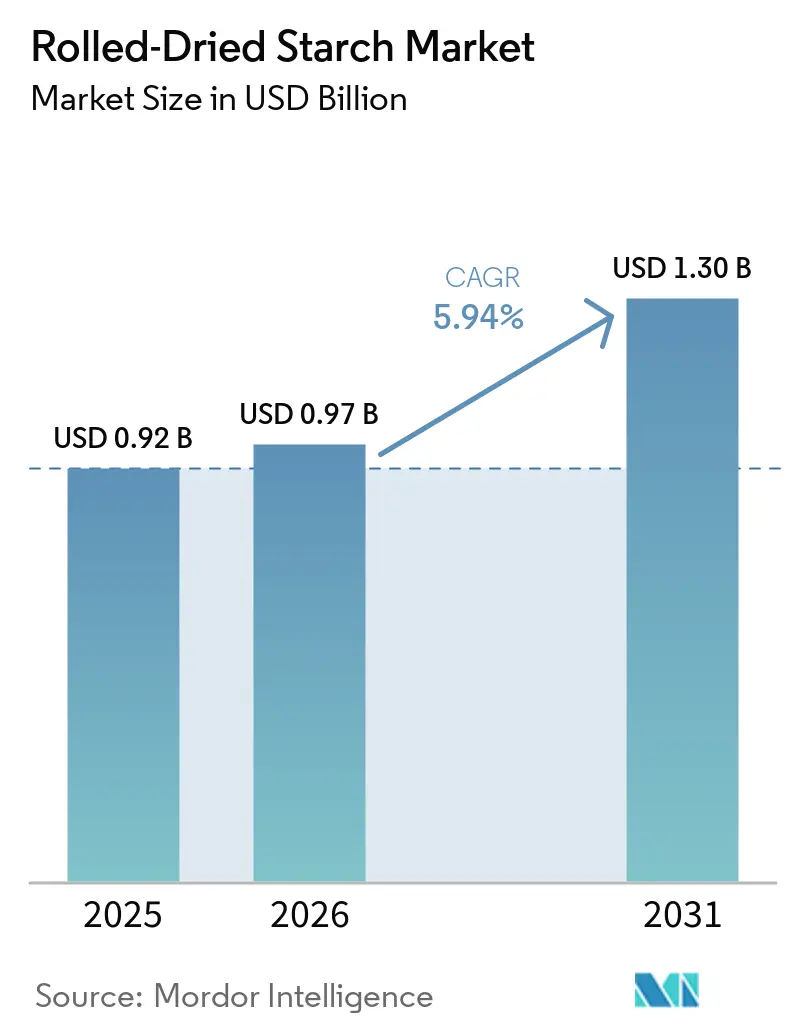
| Market Size (2026) | USD 0.97 Billion |
| Market Size (2031) | USD 1.30 Billion |
| Growth Rate (2026 - 2031) | 5.94 % |
| Fastest Growing Market | Asia-Pacific |
| Largest Market | Asia-Pacific |
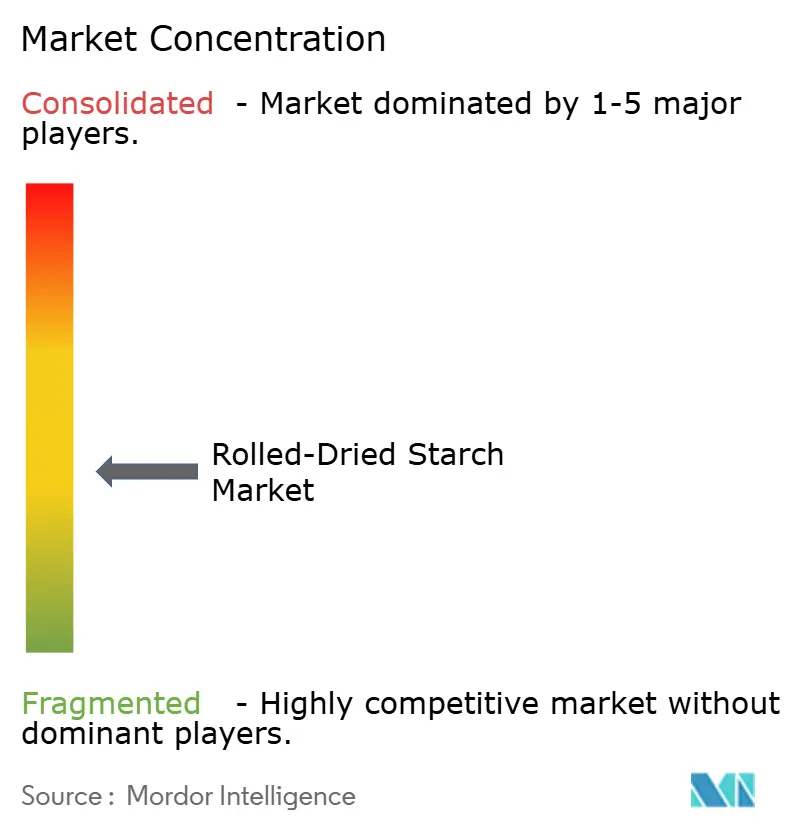
| Market Concentration | Medium |
Major Players
*Disclaimer: Major Players sorted in no particular order Image © Mordor Intelligence. Reuse requires attribution under CC BY 4.0. |
|
Rolled-Dried Starch Market Analysis by Mordor Intelligence
The rolled-dried starch market size is expected to grow from USD 0.92 billion in 2025 to USD 0.97 billion in 2026 and is forecast to reach USD 1.30 billion by 2031 at a 5.94% CAGR over 2026-2031. The global rolled-dried starch market is growing steadily, driven by increasing demand from food manufacturers for instant hydration, consistent texture, and functional performance without extensive chemical modification. Rolled-dried starch offers cold-water dispersibility and rapid viscosity development, making it suitable for a wide range of food and industrial applications. Additional demand comes from the expansion of convenience foods, clean-label formulation requirements, and growing use of starch-based ingredients in pharmaceutical applications. Manufacturers are also diversifying starch sources and developing specialized formulations to address changing consumer preferences and reduce dependence on individual raw materials.
Key Report Takeaways
- By source, potato starch held 39.14% of the Rolled-dried Starch market share in 2025 and is forecast to grow at a 6.85% CAGR during 2026–2031.
- By end-use industry, food industry held 57.16% of the 2025 Rolled-dried starch market share, while pharmaceutical industry is forecast to record a 7.13% CAGR during 2026-2031.
- By geography, Asia-Pacific accounted for 39.18% of the Rolled-dried Starch market in 2025 and is projected to register a 6.63% CAGR during 2026–2031.
Note: Market size and forecast figures in this report are generated using Mordor Intelligence’s proprietary estimation framework, updated with the latest available data and insights as of January 2026.
Global Rolled-Dried Starch Market Trends and Insights
Drivers Impact Analysis*
| Driver | (~) % Impact on CAGR Forecast | Geographic Relevance | Impact Timeline |
|---|---|---|---|
| Expansion of convenience and instant food formulations | +1.5% | Global, concentrated in Asia-Pacific and North America | Short term (≤ 2 years) |
| Rising demand for plant-based and alternative-protein foods | +1.2% | Global, accelerated in North America and urban Asia-Pacific | Medium term (2-4 years) |
| Growing adoption of clean-label and physically modified starch ingredients | +1.1% | North America and Europe core, expanding to Asia-Pacific | Medium term (2-4 years) |
| Increasing demand for low-temperature and heat-sensitive food processing | +0.9% | Global manufacturing hubs, spill-over to Middle East and Africa | Long term (≥ 4 years) |
| Growth of gluten-free and specialty bakery applications | +0.7% | North America, Europe, and urban Asia-Pacific | Medium term (2-4 years) |
| Increasing use of functional starches in sauces, dressings, and ready-to-eat foods | +0.6% | Global, strongest in North America and Europe | Short term (≤ 2 years) |
| Source: Mordor Intelligence | |||
Expansion of Convenience and Instant Food Formulations
The expansion of convenience and instant food formulations is driving demand for rolled-dried starch, as manufacturers increasingly require ingredients that provide rapid hydration, viscosity, and texture with minimal preparation. The International Food Information Council (IFIC) 2026 Food & Health Survey found that 61% of United States consumers considered convenience an important influence on food and beverage purchasing decisions, surpassing healthfulness for the first time in the survey's history[1]Source: International Food Information Council, "A Focus On Dietary Guidance & Processed Food", ific.org. In addition, the National Association for Convenience Stores (NACS) reported that prepared food accounted for 72.6% of convenience-store foodservice sales in 2024, highlighting the growing importance of ready-to-consume and easy-to-prepare food formats[2]Source: National Association for Convenience Stores, "C-Store Foodservice Delivered Exceptional Growth in 2024", convenience.org. Rolled-dried starch supports these applications by providing instant functionality in products such as instant soups, sauces, bakery mixes, and ready meals. Consequently, the continued shift toward time-saving food preparation is expected to strengthen its adoption across processed-food formulations.
Rising Demand for Plant-Based and Alternative-Protein Foods
The rising demand for plant-based and alternative-protein foods is supporting the adoption of rolled-dried starch, as manufacturers require functional ingredients that improve binding, moisture retention, texture, and structural stability in meat and dairy alternatives. According to the Good Food Institute (GFI), 60% of United States households purchased plant-based foods in 2025, consistent with 2024, while 75% of these households purchased plant-based foods more than once during the year[3]Source: Good Food Institute , "2026 State of the Industry report", gfi.org. This continued household participation indicates sustained demand for plant-based formulations and encourages manufacturers to improve the texture, consistency, and processing performance of these products. Rolled-dried starch can provide rapid hydration, thickening, and structural functionality, making it suitable for plant-based meats, dairy alternatives, sauces, and other alternative-protein formulations. As product developers continue refining the sensory and functional characteristics of these foods, demand for versatile starch ingredients is expected to increase.
Growing Adoption of Clean-Label and Physically Modified Starch Ingredients
The growing preference for clean-label food products is encouraging manufacturers to replace chemically modified starches with ingredients perceived as more natural, recognizable, and minimally processed. Physically modified starches offer a way to achieve targeted functional properties while avoiding conventional chemical modification, aligning with increasing attention to ingredient transparency and simpler labels. Processing techniques such as pre-gelatinization, drum drying, roll drying, starch blending, and hydrothermal treatment can alter starch functionality while retaining its clean-label positioning. Rolled-dried starch is particularly relevant because drum-based pre-gelatinization provides rapid hydration, thickening, and other functional characteristics without relying on chemical modification. As food manufacturers reformulate products to meet clean-label expectations while maintaining texture, stability, and processing performance, demand for physically modified starch ingredients is expected to increase.
Increasing Demand for Low-Temperature and Heat-Sensitive Food Processing
The increasing demand for low-temperature and heat-sensitive food processing is creating opportunities for rolled-dried starch, particularly in applications where excessive thermal exposure can affect product quality, functionality, or nutritional characteristics. Pre-gelatinized starch produced through drum drying can disperse readily in cold water, allowing manufacturers to achieve thickening and viscosity without requiring additional heating during final product preparation. This functionality is particularly relevant to heat-sensitive products such as cold desserts, salad dressings, bakery mixes, baby foods, and other formulations requiring gentle processing. Rolled-dried starch can therefore simplify processing while providing consistent hydration and texture at lower temperatures. As food manufacturers increasingly prioritize product quality and controlled thermal processing, demand for these readily dispersible starch ingredients is expected to strengthen.
Restraints Impact Analysis*
| Restraint | (~) % Impact on CAGR Forecast | Geographic Relevance | Impact Timeline |
|---|---|---|---|
| Agricultural raw-material price volatility | -0.4% | Europe and North America, spill-over to Asia-Pacific | Short term (≤ 2 years) |
| Processing complexity and quality-control requirements | -0.3% | Global, most acute in emerging Asia-Pacific and Middle East and Africa producers | Long term (≥ 4 years) |
| Availability of alternative starch modification technologies and hydrocolloids | -0.4% | Global, fastest substitution in Southeast Asia | Medium term (2-4 years) |
| Variability in functional performance across starch sources and compositions | -0.3% | Global manufacturing centers | Medium term (2-4 years) |
| Source: Mordor Intelligence | |||
Agricultural Raw-Material Price Volatility
Agricultural raw-material price volatility remains a restraint for the rolled-dried starch market because production depends heavily on crops such as potatoes, corn, cassava, rice, and other agricultural feedstocks whose availability and pricing are influenced by weather, yields, input costs, and competing demand. The United States Department of Agriculture (USDA) notes that weather can play a decisive role in determining potato yields, while fertilizer, fuel, labor, and other input costs can also influence prices paid to growers. These fluctuations can raise procurement costs for starch manufacturers and make production planning more difficult, particularly when poor harvests tighten raw-material availability. Since raw materials represent a significant component of starch processing costs, sustained price instability can pressure producer margins and may ultimately increase costs for downstream food manufacturers.
Processing Complexity and Quality-Control Requirements
Rolled-dried starch production involves a relatively narrow operating window in which small changes in drying conditions can alter the characteristics of the finished ingredient. Research on industrial drum drying shows that variables such as steam pressure, drum speed, and gelatinization-pool level can simultaneously affect moisture content, film thickness, and material output. Such sensitivity increases the need for close monitoring of the drying cycle and careful adjustment of feed and equipment settings. Variations can translate into differences in hydration behavior, viscosity, or reconstitution performance, making uniformity more difficult to maintain across production runs. The resulting technical demands can raise manufacturing costs and create additional barriers for smaller producers seeking to establish or expand rolled-dried starch capacity.
*Our forecasts treat driver/restraint impacts as directional, not additive. The impact forecasts reflect baseline growth, mix effects, and variable interactions.
Segment Analysis
By Source: Potato Dominance Meets Diversification Pressure
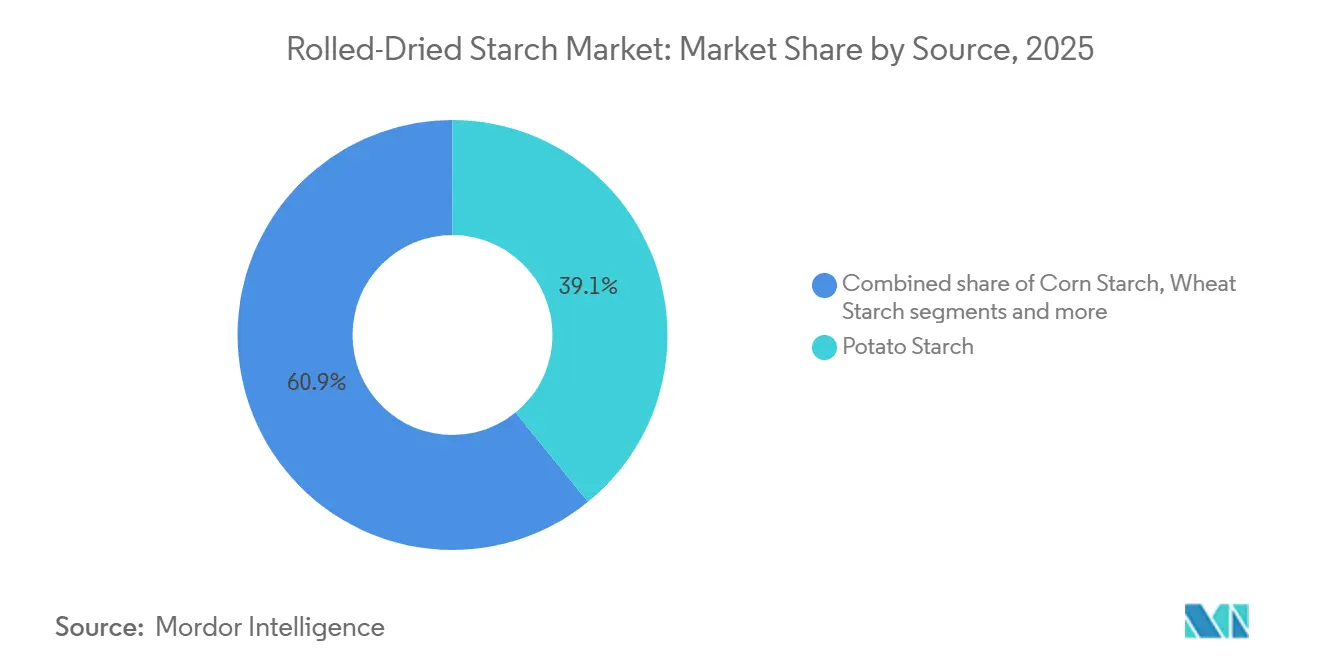
By source, potato starch accounted for 39.14% of the rolled-dried starch market in 2025 and is projected to register the fastest growth at a 6.85% CAGR from 2026 to 2031, making it both the largest and fastest-growing source segment. Its position is supported by strong gelatinization, water-binding capacity, and a neutral flavor profile, which make it suitable for sauces, bakery products, processed foods, and other formulations requiring consistent thickening and texture. The established availability of potato as a starch feedstock, particularly across major European producing regions, further supports its use in rolled-dried starch production. Its broad applicability across food and industrial formulations is expected to sustain demand growth.
The remaining source segments, comprising corn starch, wheat starch, and other sources, continue to serve established applications across food processing and industrial formulations. Corn starch benefits from broad availability and versatile thickening and binding properties, while wheat starch is widely used in bakery and processed food applications. Other sources, including cassava, pea, rice, and waxy varieties, provide differentiated functional properties for specialty formulations. Growing feedstock diversification and demand for starches with application-specific characteristics are expected to support these segments.



By End-Use Industry: Food Sector Anchors Value; Pharma Accelerates
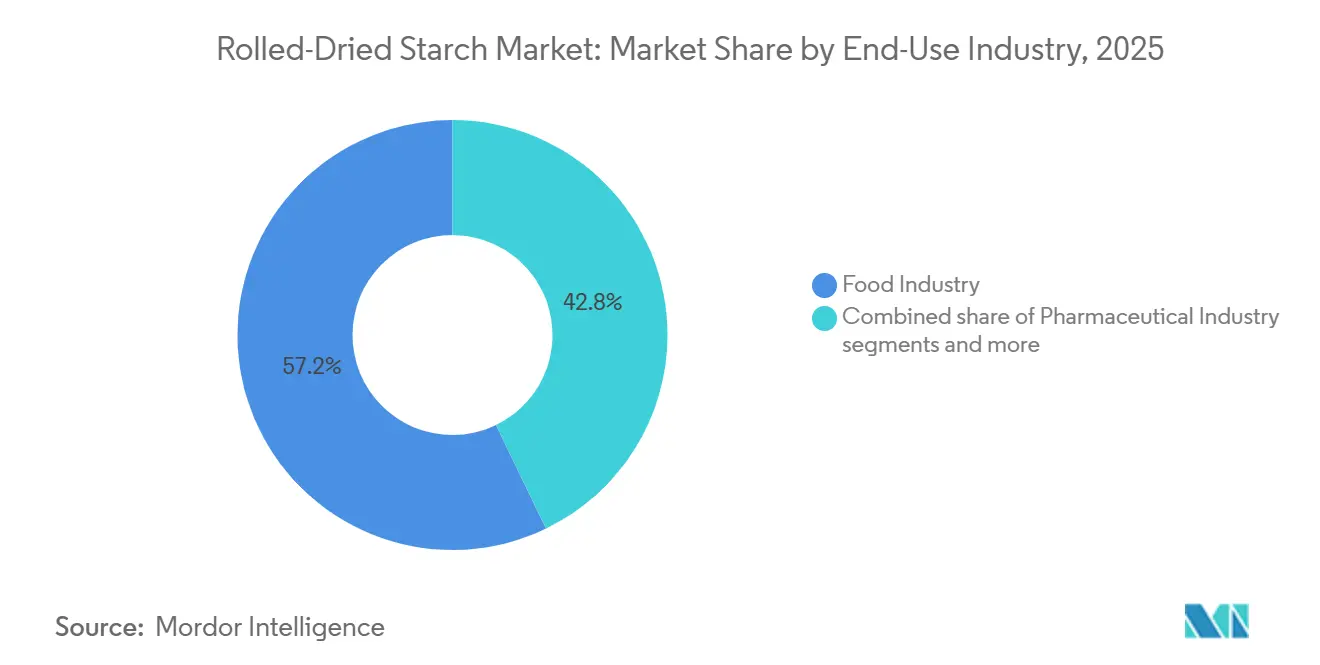
By end-use industry, the Food Industry accounted for 57.16% of the rolled-dried starch market in 2025, making it the largest application segment. Demand is supported by the widespread use of starch-based ingredients in convenience-oriented products such as instant soups, sauces, dry mixes, bakery products, baby foods, and ready-to-eat meals. Rolled-dried starch is particularly suitable for these applications because it can provide rapid hydration and viscosity without requiring extensive heating during preparation. Its ability to support texture and consistency also makes it relevant to reformulation efforts across reduced-fat and other specialty food products. The broad application base of starch in processed foods therefore provides a stable foundation for continued demand from the food industry.
The Pharmaceutical Industry is projected to record the fastest growth at a 7.13% CAGR from 2026 to 2031, supported by increasing use of starch-based excipients in tablets, capsules, and other dosage forms. Pregelatinized starch can function as a binder, filler, and disintegrant, making it useful in solid oral formulations where controlled processing and reliable tablet performance are required. Growing pharmaceutical manufacturing capacity, particularly in emerging markets, is creating additional opportunities for locally supplied excipient ingredients. At the same time, pharmaceutical applications require tighter quality specifications and regulatory compliance than many food applications, favoring suppliers with established manufacturing and quality-control capabilities. This combination of expanding pharmaceutical production and demand for multifunctional excipients is expected to support the segment's above-average growth.
Geography Analysis
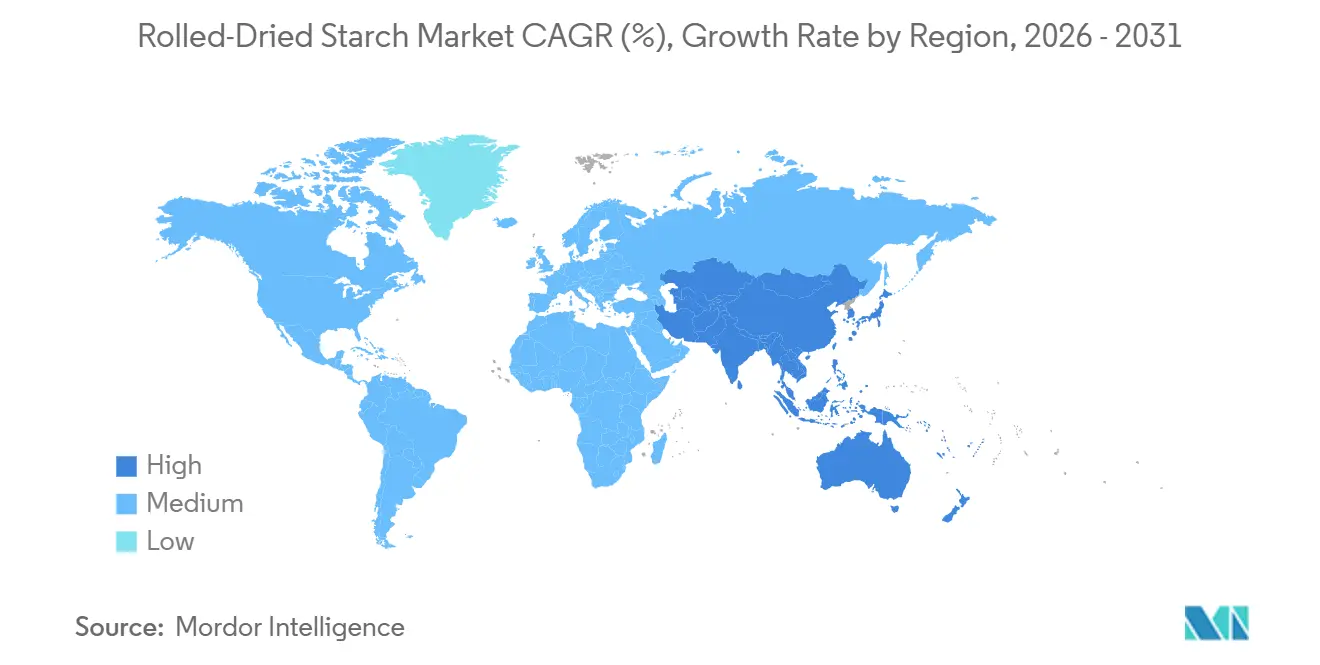
By geography, Asia-Pacific accounted for 39.18% of the global rolled-dried starch market in 2025 and is projected to grow at a 6.63% CAGR during 2026–2031, making it both the largest and fastest-growing regional market. Demand is driven by expanding food processing, pharmaceutical manufacturing, and convenience food production across China, India, and Southeast Asia. The region also benefits from established cassava and other starch-processing industries, particularly in Southeast Asia, where proximity to agricultural feedstocks supports cost-efficient production. In China, investment by global ingredient manufacturers in starch research and pilot-scale processing infrastructure is strengthening the region's capabilities in specialty starch development. India's expanding pharmaceutical and food-processing industries are also creating additional applications for pregelatinized and physically modified starch ingredients.
Europe represents an important market for rolled-dried starch, supported by its established starch-processing infrastructure and strong potato, wheat, and corn production base. France, Germany, the Netherlands, and other European countries have well-developed starch industries serving food, pharmaceutical, paper, and industrial applications. The region's focus on ingredient transparency and clean-label formulation is supporting demand for physically modified starches that provide targeted functionality without chemical modification. North America is characterized by a mature food-processing industry and continued product reformulation, with demand increasingly focused on specialty and functional starch applications rather than commodity ingredients. Investment by major starch producers in production and specialty-ingredient facilities is supporting the development of higher-value applications across food and industrial markets.
South America, led by Brazil and other major agricultural producers, benefits from the availability of corn and cassava feedstocks and an expanding processed food industry. These agricultural resources provide a favorable foundation for regional starch production while supporting applications in convenience foods and other processed products. The Middle East and Africa market remains comparatively smaller but offers opportunities as domestic food-processing capacity expands, particularly in Gulf countries pursuing broader industrial and food-security initiatives. Demand across these markets is supported by the need for functional starch ingredients in processed foods, while certification and regulatory requirements remain important considerations for international suppliers seeking to expand their presence.

Competitive Landscape
The rolled-dried starch market is moderately fragmented, with competition spanning globally diversified ingredient companies and specialized starch producers. Archer Daniels Midland Company, Cargill, Incorporated, Ingredion Incorporated, Tate & Lyle PLC, and Roquette Frères are the major players in this market, supported by broad starch portfolios, established processing capabilities, and extensive customer networks. Competition is primarily shaped by product breadth, application expertise, raw material access, manufacturing scale, and the ability to develop specialty starches for food, pharmaceutical, and industrial applications.
The competitive environment is also being influenced by consolidation among major ingredient suppliers. Ingredion's proposed acquisition of Tate & Lyle represents a significant strategic development, with Tate & Lyle shareholders approving the transaction in July 2026. The combination is expected to strengthen Ingredion's position across specialty ingredients by bringing together complementary capabilities in starches, texturizers, sweeteners, and formulation solutions. Meanwhile, Roquette continues to compete through specialty and plant-based starch solutions, while ADM and Cargill benefit from large-scale agricultural sourcing and global ingredient networks.
Beyond the major global suppliers, competition includes regional and specialized starch manufacturers that differentiate through feedstock proximity, application-specific products, and responsiveness to local customer requirements. European producers maintain established positions in potato and specialty starch applications, while Asian suppliers benefit from access to cassava and other locally available feedstocks. This creates a competitive structure in which multinational companies have advantages in scale, portfolio breadth, and international reach, whereas smaller and regional producers compete through specialized grades, localized sourcing, and targeted application expertise.
Rolled-Dried Starch Industry Leaders
-
Archer Daniels Midland Company
-
Cargill, Incorporated
-
Ingredion Incorporated
-
Tate & Lyle PLC
-
Roquette Frères S.A.
- *Disclaimer: Major Players sorted in no particular order

Recent Industry Developments
- July 2026: Emsland Group launched Emset® K 360, a new-generation starch ether for gypsum plaster, gypsum-lime plaster, tile adhesives, and cement dry-mortar applications. The product is described as a versatile starch ether designed to simplify formulations while providing performance across multiple construction applications.
- January 2026: Emsland Group launched Emjel® LC 15, a new functional starch for vegan and vegetarian jellies and gums. Emsland describes it as a cold-water-functional starch that enables atmospheric cooking and gelatin replacement.
- October 2025: AGRANA reported an increase in production capacity for drum-dried, non-food specialty starches at its Gmünd, Austria facility as part of its 2025/26 investment program.


Global Rolled-Dried Starch Market Report Scope
The rolled-dried starch market refers to the market for starch products processed through rolling and drying to achieve specific functional properties for use across various industrial applications. The rolled-dried starch market is segmented by source, including potato starch, corn starch, wheat starch, and other sources; by end-use industry, including food industry, pharmaceutical industry, paper and packaging industry, cosmetic and personal care industry, and other industries; and by geography, including North America, Europe, Asia-Pacific, South America, and Middle East and Africa. For each segment, the market sizing and forecasting have been done in value terms (USD million).
| Potato Starch |
| Corn Starch |
| Wheat Starch |
| Other Sources |
| Food Industry |
| Pharmaceutical Industry |
| Paper and Packaging Industry |
| Cosmetic and Personal Care Industry |
| Other Industries |
| North America | United States |
| Canada | |
| Mexico | |
| Rest of North America | |
| Europe | Germany |
| United Kingdom | |
| Italy | |
| France | |
| Spain | |
| Netherlands | |
| Poland | |
| Belgium | |
| Sweden | |
| Rest of Europe | |
| Asia-Pacific | China |
| India | |
| Japan | |
| Australia | |
| Indonesia | |
| South Korea | |
| Thailand | |
| Singapore | |
| Rest of Asia-Pacific | |
| South America | Brazil |
| Argentina | |
| Colombia | |
| Chile | |
| Peru | |
| Rest of South America | |
| Middle East and Africa | South Africa |
| Saudi Arabia | |
| United Arab Emirates | |
| Nigeria | |
| Egypt | |
| Morocco | |
| Turkey | |
| Rest of Middle East and Africa |
| By Source | Potato Starch | |
| Corn Starch | ||
| Wheat Starch | ||
| Other Sources | ||
| By End-Use Industry | Food Industry | |
| Pharmaceutical Industry | ||
| Paper and Packaging Industry | ||
| Cosmetic and Personal Care Industry | ||
| Other Industries | ||
| By Geography | North America | United States |
| Canada | ||
| Mexico | ||
| Rest of North America | ||
| Europe | Germany | |
| United Kingdom | ||
| Italy | ||
| France | ||
| Spain | ||
| Netherlands | ||
| Poland | ||
| Belgium | ||
| Sweden | ||
| Rest of Europe | ||
| Asia-Pacific | China | |
| India | ||
| Japan | ||
| Australia | ||
| Indonesia | ||
| South Korea | ||
| Thailand | ||
| Singapore | ||
| Rest of Asia-Pacific | ||
| South America | Brazil | |
| Argentina | ||
| Colombia | ||
| Chile | ||
| Peru | ||
| Rest of South America | ||
| Middle East and Africa | South Africa | |
| Saudi Arabia | ||
| United Arab Emirates | ||
| Nigeria | ||
| Egypt | ||
| Morocco | ||
| Turkey | ||
| Rest of Middle East and Africa | ||


Key Questions Answered in the Report
What is the expected value of rolled-dried starch by 2031?
The Rolled-dried starch market is forecast to reach USD 1.30 billion by 2031, from USD 0.97 billion in 2026.
Which starch source leads global demand?
Potato starch led with 39.14% share in 2025 and is forecast to grow at a 6.85% CAGR through 2031, making it the largest and fastest-growing source segment in the rolled-dried starch market.
Which end-use application is growing fastest?
Pharmaceutical industry is forecast to grow at a 7.13% CAGR during 2026-2031, supported by demand for certified starch excipients in the Rolled-dried starch market.
Which region held the largest share in 2025?
Asia-Pacific held 39.18% of global demand in 2025.
Page last updated on:


 Your data is secure and never sold or shared.


