
Wheat Starch Market Size and Share
Market Overview
| Study Period | 2021 - 2031 |
|---|---|
| Market Size (2026) | USD 4.65 Billion |
| Market Size (2031) | USD 5.76 Billion |
| Growth Rate (2026 - 2031) | 4.40 % |
| Fastest Growing Market | Asia-Pacific |
| Largest Market | Europe |
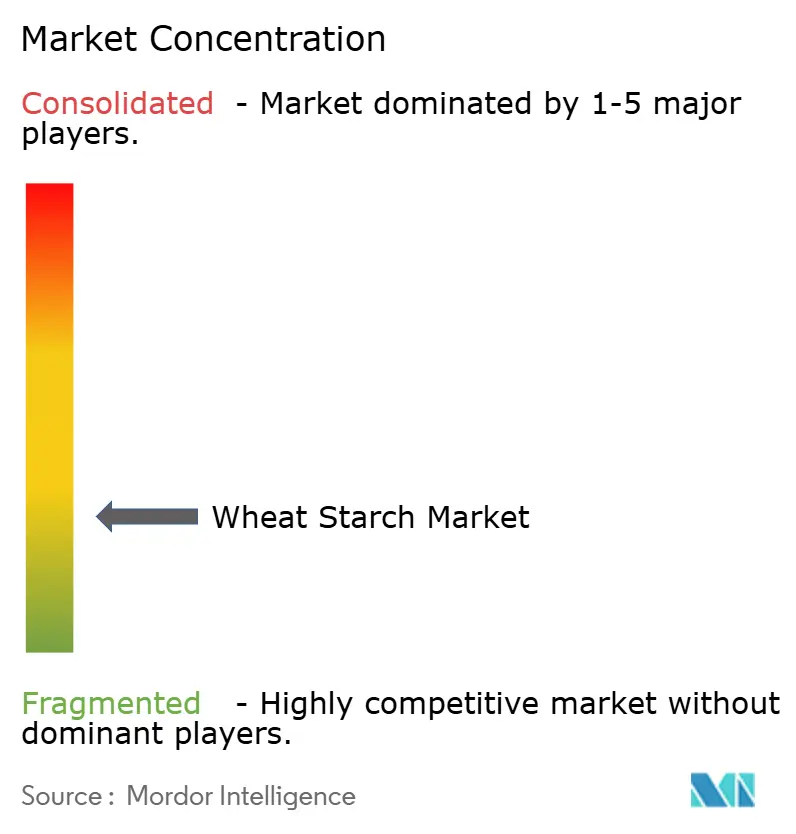
| Market Concentration | Low |
Major Players *Disclaimer: Major Players sorted in no particular order Image © Mordor Intelligence. Reuse requires attribution under CC BY 4.0. | |
Wheat Starch Market Analysis by Mordor Intelligence
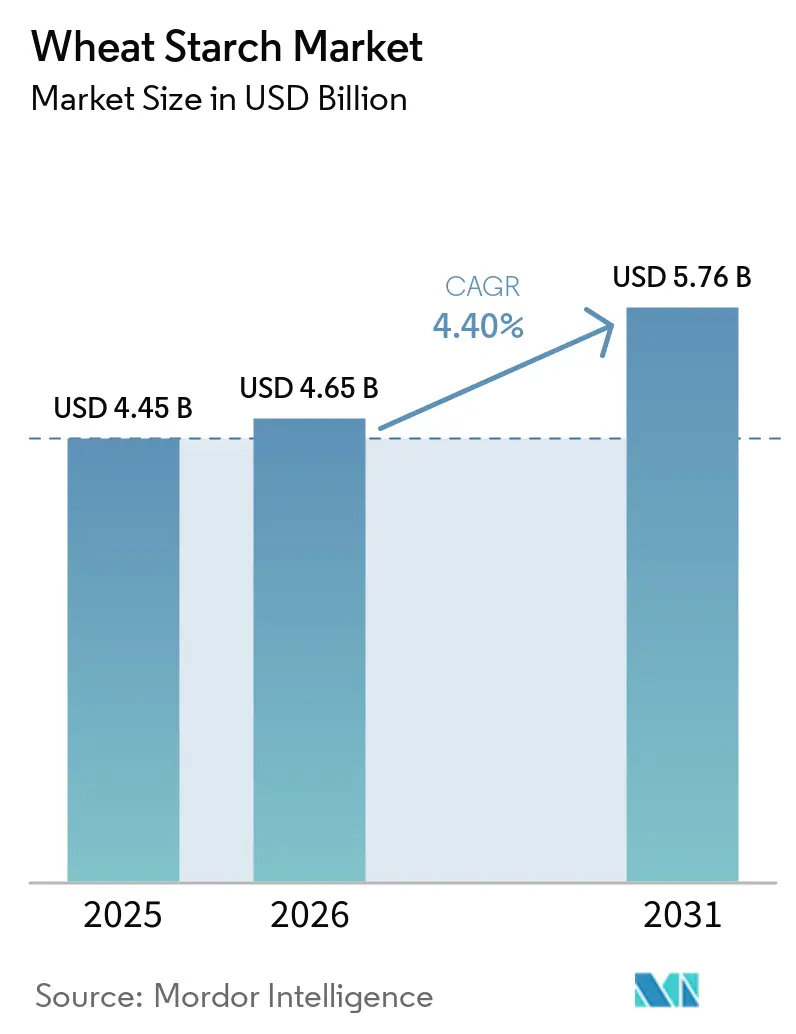
The wheat starch market size is expected to grow from USD 4.45 billion in 2025 to USD 4.65 billion in 2026 and is forecast to reach USD 5.76 billion by 2031 at a 4.40% CAGR over 2026-2031. The wheat starch market is experiencing steady growth, supported by the expansion of processed food manufacturing, increasing demand for pharmaceutical excipients, and the broader shift toward bio-based industrial inputs. Demand is gradually moving beyond conventional applications as manufacturers develop modified and specialty starches with enhanced functional properties and higher-value uses. Food and beverage applications remain a key demand base, while pharmaceutical, packaging, adhesive, and other industrial applications provide additional growth opportunities. The market is also benefiting from increasing convenience food consumption and greater adoption of starch-based ingredients across diverse end-use industries. At the same time, producers face pressure from raw material cost volatility and competition from alternative starch sources such as corn, potato, and tapioca. Overall, continued product development, application diversification, and the shift toward higher-value starch grades are expected to support market expansion.
Key Report Takeaways
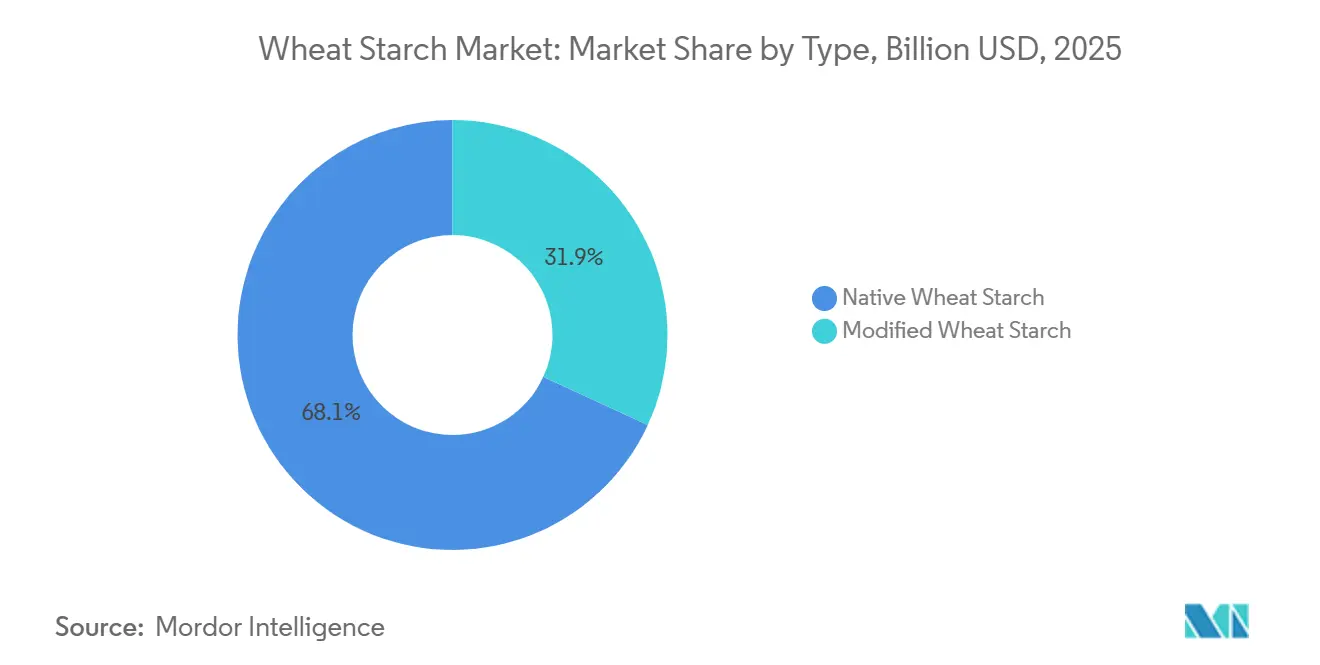
- By type, native wheat starch held 68.13% revenue share in 2025, while modified wheat starch is forecast to grow at a 4.76% CAGR during 2026-2031 across major processing regions.
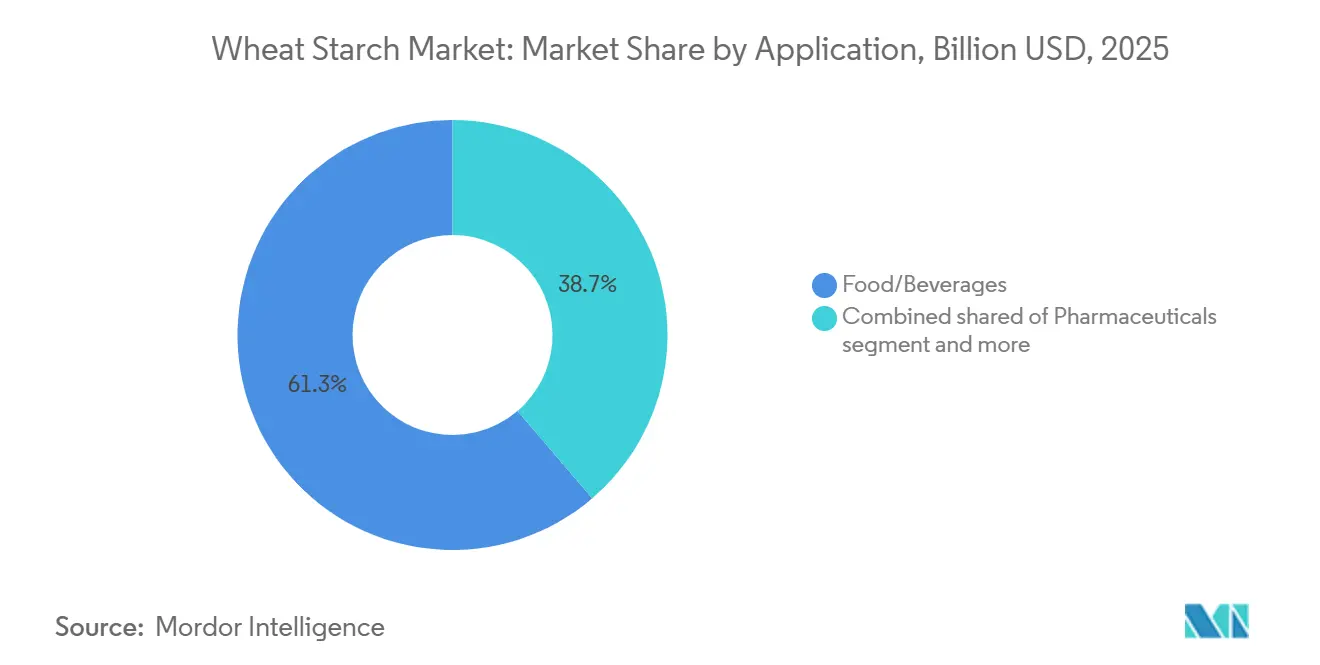
- By application, food and beverages accounted for 61.27% of the wheat starch market size in 2025, while pharmaceuticals is forecast to advance at a 5.14% CAGR during 2026-2031, supported by demand in North America, Europe, India, and China.
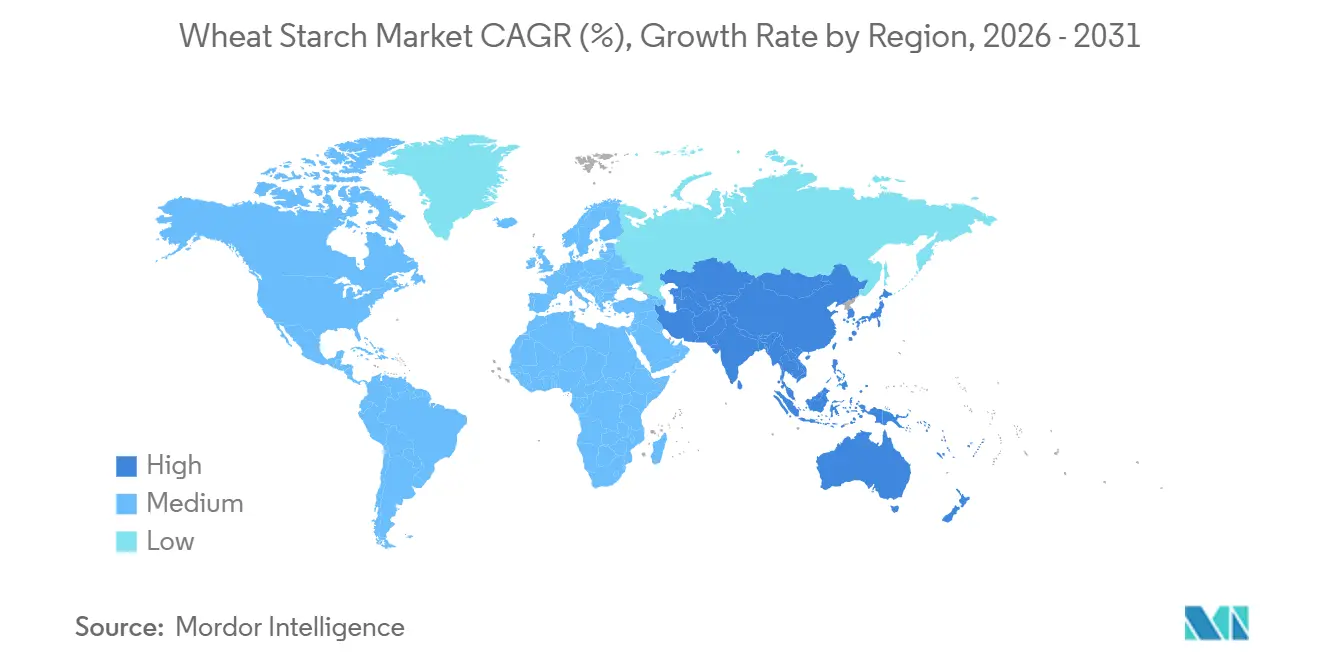
- By geography, within the wheat starch market, Europe held 43.68% revenue share in 2025, while Asia-Pacific is forecast to expand at a 5.57% CAGR during 2026-2031.
Note: Market size and forecast figures in this report are generated using Mordor Intelligence’s proprietary estimation framework, updated with the latest available data and insights as of January 2026.
Market Trends and Insights
Drivers Impact Analysis of Wheat Starch Market*
| Driver | (~) % Impact on CAGR Forecast | Geographic Relevance | Impact Timeline |
|---|---|---|---|
| Processed and convenience food adoption | +1.0% | Global; concentrated in Asia-Pacific and Middle East and Africa | Short term (≤ 2 years) |
| Expanding use of wheat starch in pharmaceutical excipients | +0.8% | Global; North America, Europe, and Asia-Pacific core | Medium term (2-4 years) |
| Growing adoption of starch-based adhesives and bio-based packaging | +0.6% | Europe dominant; spill-over to North America | Medium term (2-4 years) |
| Rising demand for clean-label and plant-based food formulations | +0.7% | North America and Europe primarily | Medium term (2-4 years) |
| Growth in bakery, sauces, dairy, and other starch-intensive food applications | +0.6% | Global; led by Europe and Asia-Pacific | Short term (≤ 2 years) |
| Advancements in modified and specialty wheat starch formulations | +0.5% | Global | Long term (≥ 4 years) |
| Source: Mordor Intelligence | |||
Processed and Convenience Food Adoption
The growing emphasis on convenience is supporting demand for processed foods and, in turn, functional ingredients such as wheat starch, which is used for thickening, binding, texture, and stability. The 2026 International Food Information Council (IFIC) Food & Health Survey found that convenience surpassed healthfulness as a food and beverage purchase consideration for the first time in the survey's history, with 61% of Americans identifying it as having a high impact on purchasing decisions[1]. This indicates that time-saving and easy-to-prepare food formats continue to influence consumer choices, supporting food manufacturers' need for functional starch ingredients. This is also reflected in the convenience foodservice channel, where the National Association of Convenience Stores (NACS) reported that prepared food accounted for 72.6% of foodservice sales in 2024[2]. As manufacturers expand their offerings of convenient prepared foods, bakery products, sauces, and other processed formulations, demand for wheat starch is expected to benefit from its functional and formulation properties.
Expanding Use of Wheat Starch in Pharmaceutical Excipients
The expanding use of wheat starch in pharmaceutical formulations is creating additional demand beyond its traditional food and industrial applications. Wheat starch is valued as an excipient because its swelling and water-absorption properties allow it to function as a disintegrant, filler, and binder in solid dosage formulations. It is used in applications including tablets, hard capsules, granules, and pellets, where consistent functionality supports formulation performance. Pharmaceutical-grade wheat starch is also available in products manufactured to comply with pharmaceutical requirements, demonstrating its established role within regulated formulations. As pharmaceutical manufacturers continue to develop solid oral dosage products, the established functionality and versatility of wheat starch are expected to support its continued use as a pharmaceutical excipient.
Growing Adoption of Starch-Based Adhesives and Bio-Based Packaging
The growing shift toward renewable and bio-based materials is supporting the adoption of starch-based adhesives across packaging and other industrial applications. Wheat starch offers useful bonding, viscosity, and film-forming properties, making it suitable for paper, corrugated board, labels, and related packaging applications. Its plant-based origin also provides an alternative to petroleum-derived adhesive materials, aligning with manufacturers’ efforts to reduce reliance on fossil-based inputs. Increasing demand for recyclable and environmentally preferable packaging is encouraging the use of starch-based formulations in packaging production. This broader transition toward bio-based materials is expected to create additional opportunities for wheat starch across adhesive and packaging applications.
Rising Demand for Clean-Label and Plant-Based Food Formulations
Growing consumer interest in simpler, recognizable, and plant-derived ingredients is encouraging food manufacturers to develop formulations aligned with clean-label and plant-based preferences. According to research cited by the Centre for the Promotion of Imports from developing countries (CBI), an agency of the Dutch Ministry of Foreign Affairs, clean-label products are projected to constitute over 70% of food and beverage portfolios in 2025 and 2026, increasing from 52% in 2021[3]. These preferences are encouraging manufacturers to incorporate familiar, plant-derived ingredients such as wheat starch while maintaining desired functionality in food products. As clean-label positioning and plant-based formulation practices continue to gain attention, wheat starch can benefit from its plant origin and established functionality across food applications.
Restraints Impact Analysis of Wheat Starch Market*
| Restraint | (~) % Impact on CAGR Forecast | Geographic Relevance | Impact Timeline |
|---|---|---|---|
| Volatility in wheat, fertilizer, and freight costs | -0.7% | Global; most acute in Europe and South America | Short term (≤ 2 years) |
| Competition from alternative starch sources | -0.6% | Global; strongest in Asia-Pacific and Middle East and Africa | Medium term (2-4 years) |
| Residual gluten and allergen-control compliance requirements | -0.4% | North America and Europe | Medium term (2-4 years) |
| High water, effluent-treatment, and drying-energy requirements | -0.5% | Global; most acute in water-stressed regions | Long term (≥ 4 years) |
| Source: Mordor Intelligence | |||
Volatility in Wheat, Fertilizer, and Freight Costs
Wheat starch producers remain exposed to volatility in key input and logistics costs, which can increase production expenses and create pressure on profit margins. Wheat is the primary raw material for starch production, making changes in grain availability, crop conditions, and agricultural input costs an important source of cost uncertainty. Fertilizer prices can also influence wheat cultivation costs and, indirectly, the pricing of wheat-based inputs. At the same time, fluctuations in fuel prices, shipping rates, and transportation availability can raise the cost of moving both raw wheat and finished starch across markets. These combined pressures can make procurement and production planning more difficult while limiting manufacturers’ ability to consistently pass higher costs on to customers.
Competition from Alternative Starch Sources
Wheat starch faces competition from alternative starch sources such as corn, potato, tapioca, and rice starch, which can serve similar functional roles across food and industrial applications. These alternatives offer different characteristics in areas such as viscosity, gel strength, clarity, moisture retention, and processing performance, allowing manufacturers to select the starch best suited to individual formulations. Potato and tapioca starch, for example, can provide advantages in specific applications where properties such as clarity, adhesive performance, or moisture retention are prioritized. The availability of multiple starch sources therefore gives food and industrial manufacturers greater flexibility in ingredient selection and can limit reliance on wheat starch. This competitive pressure may be particularly pronounced in applications where starches have comparable functionality and switching between sources requires limited reformulation.
*Our forecasts treat driver/restraint impacts as directional, not additive. The impact forecasts reflect baseline growth, mix effects, and variable interactions.
Wheat Starch Market Segment Analysis
By Type:
Modified Grades Drive Value as Native Starch Faces Margin HeadwindsNative wheat starch held the largest market share of 68.13% in 2025, reflecting its established use across food processing and industrial applications. Its natural functional properties, broad availability, and suitability for thickening, binding, and texturizing support its continued adoption in conventional formulations. Native grades are widely used where standard functionality and cost efficiency are prioritized. Their established position across food and non-food applications also provides a stable demand base for the segment. As a result, native wheat starch is expected to maintain its leading position over the forecast period.
Modified wheat starch is projected to be the fastest-growing type, registering a CAGR of 4.76% from 2026 to 2031. Growth is supported by demand for starches with enhanced functional properties, including improved stability, texture, binding, and resistance to processing conditions. Modified grades allow manufacturers to tailor starch performance to specific food, pharmaceutical, paper, adhesive, and other industrial applications. Their ability to provide functionality beyond conventional native starch is encouraging greater adoption in specialized formulations. This increasing focus on application-specific performance is expected to strengthen the position of modified wheat starch throughout the forecast period.
By Application:
Pharmaceuticals and Personal Care Gaining Ground as Food Remains the AnchorFood/beverages accounted for the largest share of 61.27% in 2025, supported by the extensive use of wheat starch across bakery products, sauces, dairy alternatives, processed foods, and other food formulations. Its thickening, binding, moisture-retention, and texturizing properties make it suitable for a wide range of food applications. The broad application base provides a stable source of demand across different product categories and processing formats. Increasing consumption of processed and convenience foods is also supporting the use of functional starch ingredients in food manufacturing. As a result, food and beverages are expected to retain their leading position throughout the forecast period.
Pharmaceuticals is projected to be the fastest-growing application, with a CAGR of 5.14% from 2026 to 2031. Growth is supported by the established use of wheat starch as a binder, disintegrant, and filler in tablets, capsules, and other solid dosage formulations. Pharmaceutical applications also place greater emphasis on consistent quality, functionality, and controlled formulation performance, supporting demand for suitable pharmaceutical-grade starches. Increasing pharmaceutical manufacturing and continued development of solid oral dosage products are creating additional opportunities for wheat starch suppliers. This combination of established functionality and expanding pharmaceutical applications is expected to drive faster growth in the segment.

Geography Analysis
Europe Wheat Starch Market
Europe accounted for the largest regional share of 43.68% in 2025, supported by its established wheat-processing infrastructure and well-developed food and industrial manufacturing base. The region benefits from integrated supply chains connecting wheat production, starch processing, and downstream industries. Strong demand from food processing, paper and corrugated board, adhesives, and other industrial applications provides a broad consumption base. Established manufacturing capabilities and a growing emphasis on traceability and bio-based materials further support wheat starch adoption. Europe is therefore expected to maintain its leading position throughout the forecast period.
APAC Wheat Starch Market
Asia-Pacific is projected to be the fastest-growing region, with a CAGR of 5.57% from 2026 to 2031, driven by expanding food processing activity, urbanization, and rising consumption of convenience foods. Increasing pharmaceutical manufacturing is also creating additional demand for wheat starch in excipient applications. Growing domestic food and ingredient-processing capabilities across the region are supporting greater consumption of functional starch ingredients. Rising demand for bakery products, processed foods, sauces, and other formulated products is further contributing to regional growth. These factors are expected to allow Asia-Pacific to gain market share at a faster pace than other regions.
The Americas and MEA Wheat Starch Market
North America represents a mature but innovation-oriented market, supported by established food processing and pharmaceutical industries and growing interest in functional and specialty starch applications. South America is developing gradually as food manufacturing and packaged-food consumption expand, although demand remains comparatively concentrated in major markets. The Middle East and Africa also present emerging opportunities as food-processing capacity, urbanization, and packaged-food consumption increase across several countries. Together, these regions offer additional avenues for wheat starch demand through food, pharmaceutical, packaging, and industrial applications, although their growth is expected to remain more moderate than that of Asia-Pacific.
Competitive Landscape
The wheat starch market is fragmented, with the five largest players, Cargill, Incorporated, Archer Daniels Midland Company, Roquette Frères, Tereos Group, and Manildra Group, accounting for a significant share of the market. Numerous regional and specialized producers serve the remaining demand. The largest companies benefit from broad starch portfolios, established processing capabilities, and extensive distribution networks, though competition remains active across both commodity and specialty grades.
Among the largest players, companies are increasingly focusing on specialty products, application development, and portfolio diversification. Roquette reported gaining market share in starch and starch derivatives in Europe during 2025, while continuing to emphasize specialty applications amid weak commodity demand. Tereos operates multiple wheat starch facilities and offers native and modified starches for food, pharmaceutical, and industrial applications. ADM continues to expand its portfolio of native, modified, and resistant starches derived from wheat and other crops, while maintaining broad technical and distribution capabilities.
Emerging and specialized players compete primarily through focused product portfolios, regional supply capabilities, and application-specific expertise rather than global scale. Manildra Group, for example, produces native and modified wheat starches for food, paper, packaging, mining, and construction applications, and continues to develop higher-value wheat-derived products. Other regional specialists such as Crespel & Deiters, Kröner-Stärke, Lantmännen Biorefineries, Sedamyl, and Interstarch add competitive pressure, particularly in European and specialized application markets. This broad base of smaller suppliers contributes to the market's fragmented structure and provides customers with alternatives to the largest multinational producers.
Wheat Starch Industry Leaders
-
Cargill, Incorporated
-
Archer Daniels Midland Company
-
Roquette Frères
-
Tereos Group
-
Manildra Group
- *Disclaimer: Major Players sorted in no particular order
Wheat Starch Market Companies Covered in this Report
- Cargill, Incorporated
- Archer Daniels Midland Company
- Roquette Frères
- Tereos Group
- Manildra Group
- AGRANA Beteiligungs-AG
- Aminola B.V.
- The Scoular Company
- Crespel & Deiters Group
- Lantmännen Biorefineries
- Sedamyl
- Jäckering Mühlen- und Nährmittelwerke GmbH
- MGP Ingredients, Inc.
- Sacchetto S.p.A.
- Interstarch GmbH
- Kröner-Stärke GmbH
- Meelunie B.V.
- Fidelinka Skrob
- MPF Benelux BV
- Nxinruigroup Co.,Ltd
Recent Industry Developments in Wheat Starch Market
- March 2026: Roquette Frères inaugurated a new starch and polyol pilot center at its Lianyungang plant in China. The more than 1,000-square-meter facility combines physicochemical analysis, laboratory research, and pilot-scale processing to accelerate the development and commercialization of plant-based ingredients.
- July 2025: Manildra Group launched GemMate, a natural clean-label preservative produced from fermented wheat starch. The ingredient is designed for applications including baked goods and smallgoods, providing an alternative to conventional artificial preservatives while supporting shelf-life extension. This represents a direct expansion of wheat starch into higher-value functional food ingredients.
- April 2024: Tereos and Futerro formed a partnership to develop a wheat-based bioplastics value chain in France. Under the agreement, Tereos committed to supplying Futerro with dextrose derived from wheat starch for conversion into lactic acid, lactide, and polylactic acid. The development expands the downstream use of wheat-derived starch into bio-based chemicals and packaging materials.
Global Wheat Starch Market Report Scope
The wheat starch market refers to the production and commercial use of starch extracted from wheat for food, pharmaceutical, personal care, animal feed, textile, paper, and other industrial applications. The wheat starch market is segmented by type into native wheat starch and modified wheat starch, by application into food and beverages, pharmaceuticals, personal care and cosmetics, animal feed, textile, paper and corrugating, and other industrial applications, and by geography into North America, Europe, Asia-Pacific, South America, and Middle East and Africa. The market forecasts are provided in terms of value in USD.
Segmentation Overview
| Native Wheat Starch |
| Modified Wheat Starch |
| Food/Beverages |
| Pharmaceuticals |
| Personal Care/Cosmetics |
| Animal Feed |
| Textile |
| Paper/Corrugating |
| Other Industrial Applications |
| North America | United States |
| Canada | |
| Mexico | |
| Rest of North America | |
| Europe | Germany |
| United Kingdom | |
| Italy | |
| France | |
| Spain | |
| Netherlands | |
| Poland | |
| Belgium | |
| Sweden | |
| Rest of Europe | |
| Asia-Pacific | China |
| India | |
| Japan | |
| Australia | |
| Indonesia | |
| South Korea | |
| Thailand | |
| Singapore | |
| Rest of Asia-Pacific | |
| South America | Brazil |
| Argentina | |
| Colombia | |
| Chile | |
| Peru | |
| Rest of South America | |
| Middle East and Africa | South Africa |
| Saudi Arabia | |
| United Arab Emirates | |
| Nigeria | |
| Egypt | |
| Morocco | |
| Turkey | |
| Rest of Middle East and Africa |
| By Type | Native Wheat Starch | |
| Modified Wheat Starch | ||
| By Application | Food/Beverages | |
| Pharmaceuticals | ||
| Personal Care/Cosmetics | ||
| Animal Feed | ||
| Textile | ||
| Paper/Corrugating | ||
| Other Industrial Applications | ||
| By Geography | North America | United States |
| Canada | ||
| Mexico | ||
| Rest of North America | ||
| Europe | Germany | |
| United Kingdom | ||
| Italy | ||
| France | ||
| Spain | ||
| Netherlands | ||
| Poland | ||
| Belgium | ||
| Sweden | ||
| Rest of Europe | ||
| Asia-Pacific | China | |
| India | ||
| Japan | ||
| Australia | ||
| Indonesia | ||
| South Korea | ||
| Thailand | ||
| Singapore | ||
| Rest of Asia-Pacific | ||
| South America | Brazil | |
| Argentina | ||
| Colombia | ||
| Chile | ||
| Peru | ||
| Rest of South America | ||
| Middle East and Africa | South Africa | |
| Saudi Arabia | ||
| United Arab Emirates | ||
| Nigeria | ||
| Egypt | ||
| Morocco | ||
| Turkey | ||
| Rest of Middle East and Africa | ||
Key Questions Answered in the Report
What is the projected size of the wheat starch sector by 2031?
The wheat starch market is forecast to reach USD 5.76 billion by 2031, from USD 4.65 billion in 2026, at a 4.40% CAGR.
Which wheat starch type has the largest share?
Native wheat starch led with 68.13% share in 2025, supported by use in food processing, paper converting, and textiles.
Which application is growing fastest for wheat starch?
For the wheat starch market, pharmaceuticals is forecast to grow at a 5.14% CAGR during 2026-2031 as demand rises for specialty excipients in tablet formulations.
Which region is growing fastest for wheat starch?
Asia-Pacific is forecast to grow at a 5.57% CAGR during 2026-2031, supported by processed food demand and pharmaceutical manufacturing.