
Radioligand Therapy (RLT) Market Size and Share
Market Overview
| Study Period | 2020 - 2031 |
|---|---|
| Market Size (2026) | USD 6.18 Billion |
| Market Size (2031) | USD 10.66 Billion |
| Growth Rate (2026 - 2031) | 11.52 % |
| Fastest Growing Market | Asia-Pacific |
| Largest Market | North America |
| Market Concentration | Medium |
Major Players *Disclaimer: Major Players sorted in no particular order Image © Mordor Intelligence. Reuse requires attribution under CC BY 4.0. | |
Radioligand Therapy (RLT) Market Analysis by Mordor Intelligence
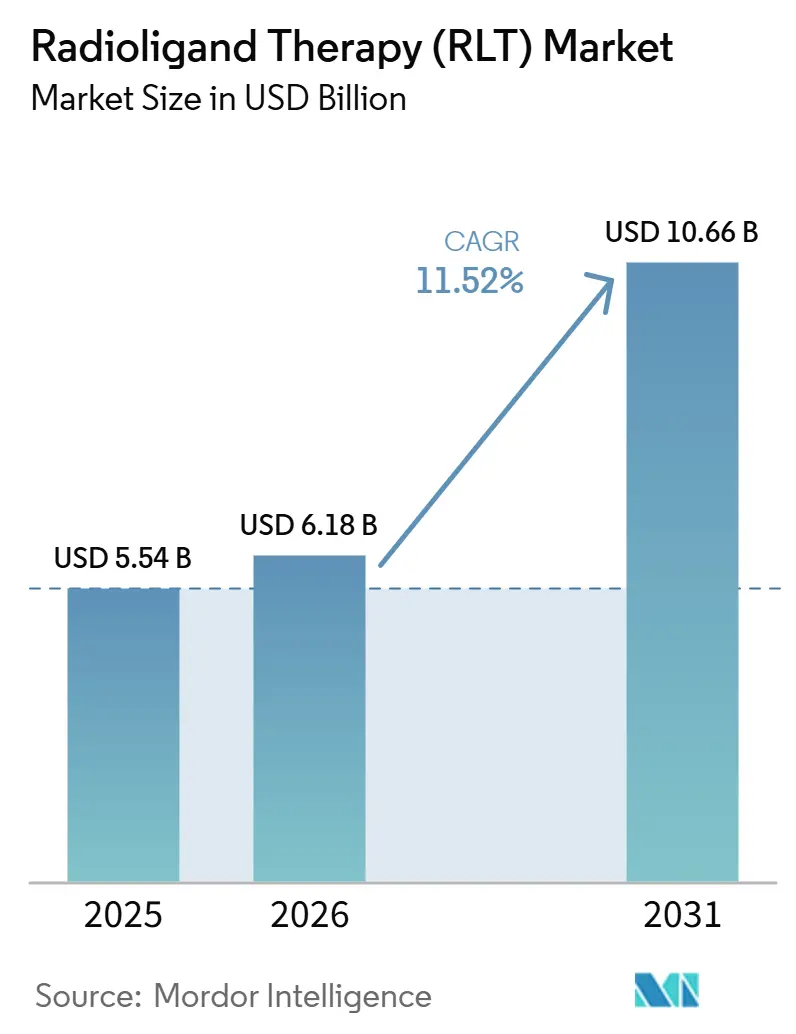
The Radioligand Therapy (RLT) Market size is expected to increase from USD 5.54 billion in 2025 to USD 6.18 billion in 2026 and reach USD 10.66 billion by 2031, growing at a CAGR of 11.52% over 2026-2031. The radioligand therapy market is moving toward precision radiopharmaceuticals because companion diagnostics can identify patients whose tumors express a relevant biological target. Demand is strong, but production capacity, isotope access, certified treatment sites, and local delivery networks remain more limiting than clinical interest. Pluvicto generated global net sales of USD 1.9 billion in 2025, while Lutathera generated USD 816 million, showing that receptor-guided treatments can support substantial revenue in defined patient populations. Manufacturers are securing isotope relationships and manufacturing assets through acquisitions and facility investments, which increases entry barriers in the radioligand therapy market and gives established operators greater control over supply continuity. Earlier treatment use, broader diagnostic adoption, and new tumor targets are expanding opportunities, while workforce shortages, short isotope half-lives, and complex delivery logistics continue to limit patient access.
Key Report Takeaways
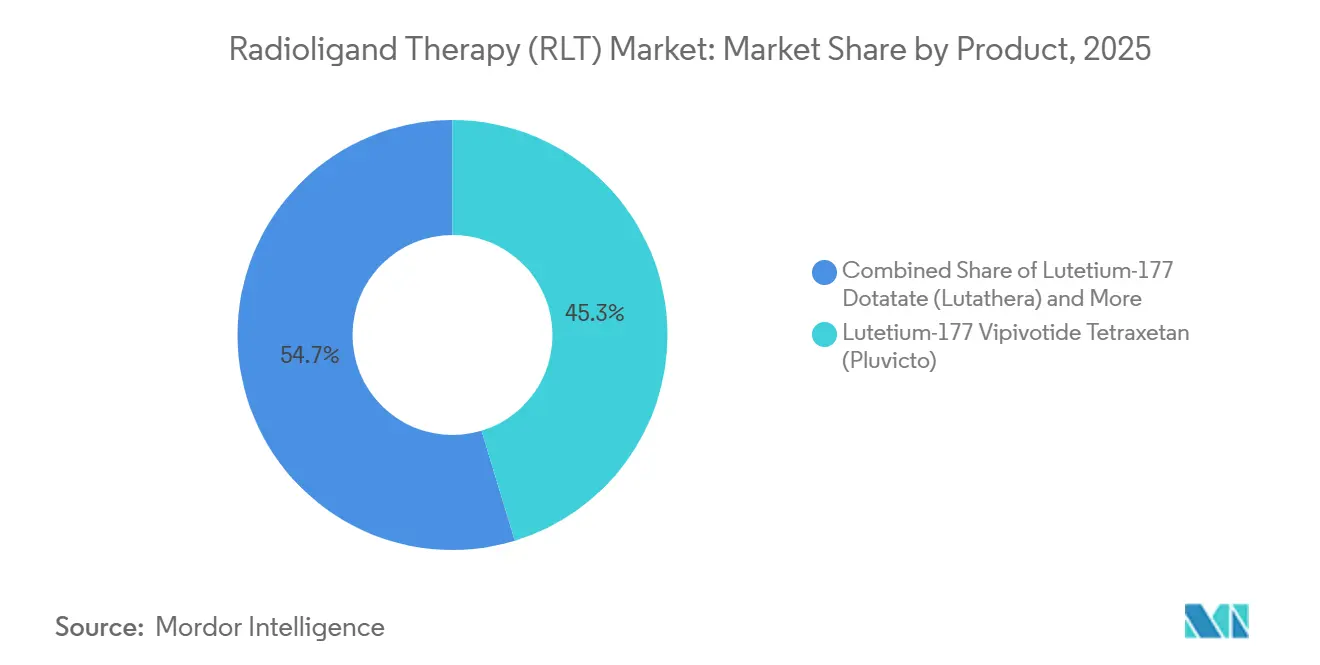
- By product, Lutetium-177 Vipivotide Tetraxetan (Pluvicto) led the product segment with 45.31% share in 2025, while Lutetium-177 Dotatate (Lutathera) is forecast to grow at a 15.58% CAGR through 2031.
- By target, Prostate-Specific Membrane Antigen accounted for 58.44% of the target segment in 2025 and is expected to have 16.52% CAGR through 2031.
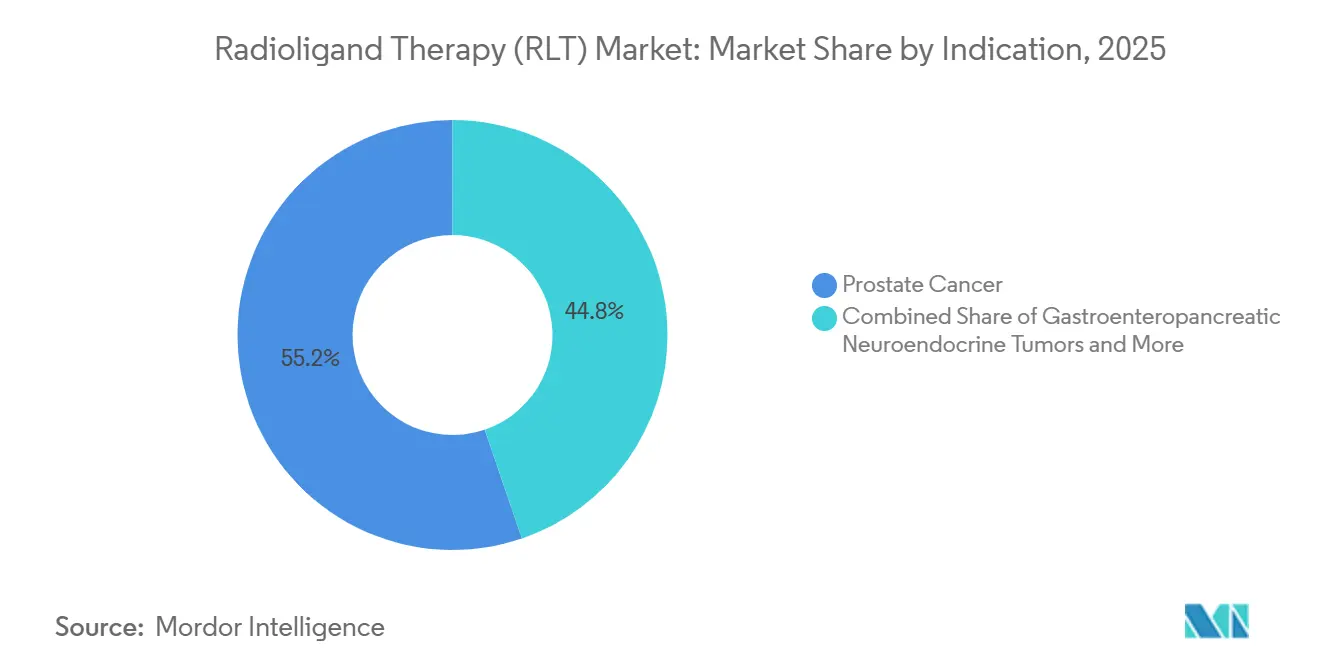
- By indication, prostate cancer held 55.24% of the indication segment in 2025, while GEP-NETs is forecast to expand at an 18.22% CAGR through 2031.
- By end user, tertiary care academic and comprehensive cancer centers held 58.14% share in 2025, while specialized nuclear medicine centers are projected to grow at a 14.22% CAGR through 2031.
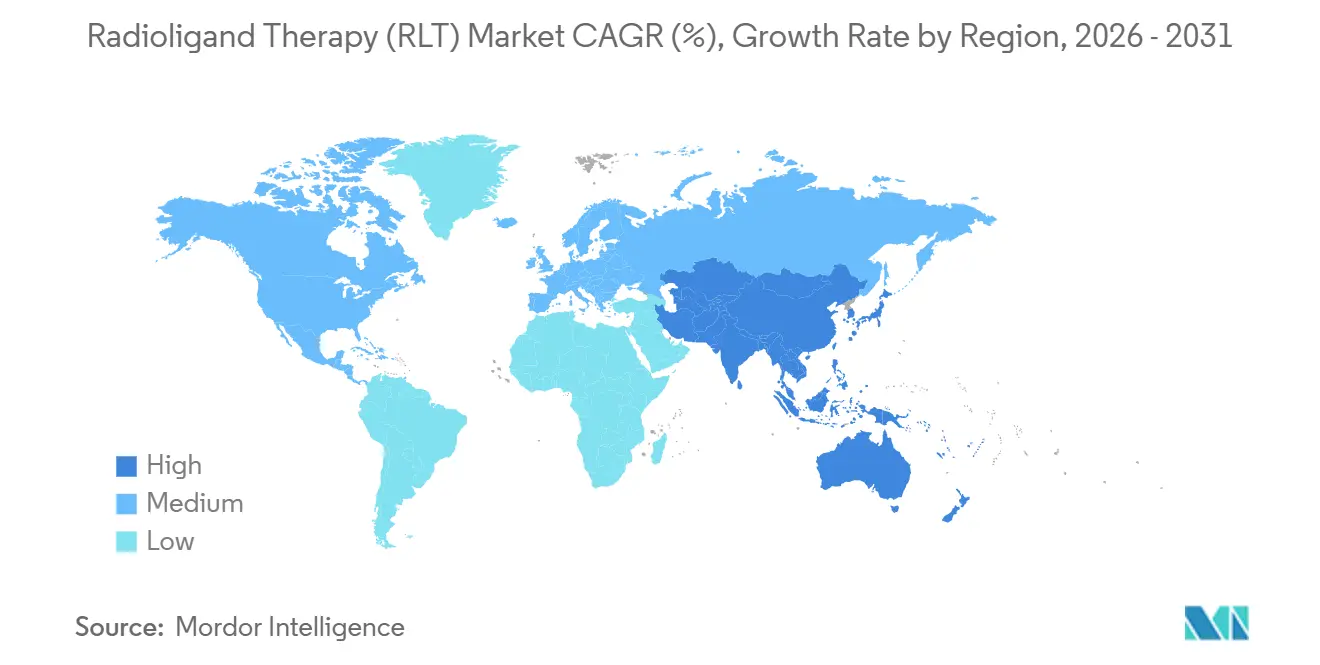
- By geography, North America held 80.61% of revenue in 2025, while Asia-Pacific is forecast to expand at a 15.85% CAGR through 2031.
Note: Market size and forecast figures in this report are generated using Mordor Intelligence’s proprietary estimation framework, updated with the latest available data and insights as of January 2026.
Market Trends and Insights
Drivers Impact Analysis of Radioligand Therapy (RLT) Market*
| Driver | (~) % Impact on CAGR Forecast | Geographic Relevance | Impact Timeline |
|---|---|---|---|
| Precision Oncology and Theranostic Adoption | +2.4% | Global, highest intensity in North America and Western Europe | Short term (≤ 2 years) |
| Earlier-Line Treatment Label Expansion | +2.1% | North America, primarily the United States, with spillover to the EU and Japan | Medium term (2-4 years) |
| Rising Cancer Burden and Aging Population | +1.8% | Global, especially APAC and South America | Long term (≥ 4 years) |
| Radioisotope and RLT Manufacturing Capacity | +1.7% | North America and the EU, with early gains in China and Canada | Medium term (2-4 years) |
| Dose Planning and Decentralized Delivery | +1.5% | North America and the EU, with early implementation in Australia and Japan | Long term (≥ 4 years) |
| Source: Mordor Intelligence | |||
Precision Oncology and Theranostic Adoption
The radioligand therapy market is supported by the closer use of companion diagnostics and targeted treatment, because both parts of care are planned around the same biological marker. A PSMA PET scan can identify eligible patients, show the distribution of disease, and help predict therapeutic response before treatment begins. This paired model shortens treatment selection, helps clinicians avoid treatment in unsuitable patients, and can reduce clinical attrition. FDA approvals for gallium-68 PSMA PET agents created a reimbursement precedent for related therapeutic use and lowered a practical access barrier. Radiology departments therefore have a larger role in treatment access and hospital procurement decisions, rather than serving only a diagnostic function. SSTR2 programs for neuroendocrine tumors and emerging FAP imaging programs show that this paired diagnostic and therapy approach extends beyond PSMA.
Label Expansion and Earlier-Line Treatment Use
Regulatory label extensions are expanding the treated population in the radioligand therapy market by moving approved therapies into earlier care settings. Each shift to an earlier treatment line can increase the eligible patient group by 2 to 3 times, which gives label decisions outsized commercial importance. The FDA approved Pluvicto in March 2025 for post-ARPI, pre-taxane mCRPC, opening a patient group 75% larger than the earlier post-taxane setting. Novartis anticipates a Q3 2026 FDA decision for Pluvicto in mHSPC based on the PSMAddition trial. Lutathera also gained from earlier-line use in approved GEP-NET settings in the United States and Japan during 2025, together with a pediatric indication. These repeat approval pathways let established products use the same chemistry, manufacturing base, and clinical network across more treatment settings.
Rising Cancer Burden and Aging Population
Cancer incidence is increasing the long-term treatment pool for the radioligand therapy market, particularly for tumor types with a strong relationship to older age. Cancer caused nearly 10 million deaths globally in 2024. Prostate cancer recorded 1.5 million new diagnoses in 2024 and was the most commonly diagnosed cancer among men in 118 of 185 countries. Global cancer incidence reached 19.5 million new cases in 2024 and is expected to reach 35 million annual cases by 2050 as populations age and urbanize. These patterns enlarge the eligible population for PSMA-targeted and somatostatin receptor-targeted therapies, which treat cancers linked to age-related incidence. GEP-NET detection is also rising as molecular imaging becomes more available, expanding diagnosed incidence beyond demographic growth alone.
Increasing Radioisotope and RLT Manufacturing Capacity
Manufacturing expansion is a near-term requirement for the radioligand therapy market because isotope supply must match tight production, transport, and treatment windows. Kinectrics commissioned 4 EMIS units in Toronto in September 2025, lifting annual Yb-176 production above 500 grams and enabling material for more than 150,000 patient treatments each year[1]Kinectrics and BWX Technologies, “Kinectrics Significantly Increases Isotope Production Capacity,” BWX Technologies Investor Relations, investors.bwxt.com. The company is also building a 26,000-square-foot facility to support further scale-up of precursor supply. Novartis is investing USD 23 billion in United States manufacturing over 5 years, including sites planned for Denton, Texas, in 2028 and Winter Park, Florida, in 2029. Its Zhejiang facility in China represents a USD 84.6 million investment and is targeted for commissioning by the end of 2026. These projects respond to the central operational challenge of preparing and delivering sufficient doses before isotope decay reduces their usability.
Restraints Impact Analysis of Radioligand Therapy (RLT) Market*
| Restraint | (~) % Impact on CAGR Forecast | Geographic Relevance | Impact Timeline |
|---|---|---|---|
| Therapeutic Radioisotope Supply Constraints | -1.8% | Global, most acute in APAC, the Middle East and Africa, and South America | Short term (≤ 2 years) |
| Specialized Workforce and Treatment-Center Capacity Shortages | -1.5% | Global, persistent in the EU and severe in low- and middle-income countries | Medium term (2-4 years) |
| Complex Radiation Logistics and Short Product Half-Lives | -1.0% | Global, most constraining in South America, the Middle East and Africa, and the rest of APAC | Medium term (2-4 years) |
| Source: Mordor Intelligence | |||
Therapeutic Radioisotope Supply Constraints
The radioligand therapy market faces a continuing mismatch between growing demand and the time needed to increase isotope output. Reactor-based lutetium-177 depends on a limited number of production facilities, so disruption at one site can affect supply chains across several markets. Laurentis Energy Partners plans to begin commercial lutetium-177 production at Ontario Power Generation’s Darlington Nuclear Generating Station in 2027. The facility is designed to supply 3 million doses, or treatment for 500,000 patients, annually. Actinium-225 availability is even more limited, which may restrict BMS-RayzeBio and AstraZeneca-Fusion programs despite favorable clinical results. Eden Radioisotopes submitted a 2026 NRC permit application for a United States lutetium-177 facility, but reactor projects require multiyear development and commissioning.
Specialized Workforce and Treatment-Center Capacity Shortages
Workforce limitations continue to constrain treatment capacity in the radioligand therapy market even where clinical demand and isotope supply are available. An EANM survey published in 2026 found open positions in more than 80% of European nuclear medicine departments, with shortages in technologists, radiographers, and physicians. The EANM reported 1 nuclear medicine physician per 50 RLT administrations and 1 medical physicist per 138 administrations, limiting rapid expansion without concurrent training[2]European Association of Nuclear Medicine, “Building Readiness for Nuclear Medicine: EU Policy Symposium Report,” European Association of Nuclear Medicine, eanm.org. A scientific review also found that qualified personnel remain insufficient for comprehensive theranostics operations, including in high-income countries. The shortage is more severe in low- and middle-income countries that represent future expansion areas. The EANM RLT Academy and the SNMMI center accreditation program address the gap, but training capacity has not matched demand.
*Our forecasts treat driver/restraint impacts as directional, not additive. The impact forecasts reflect baseline growth, mix effects, and variable interactions.
Radioligand Therapy (RLT) Market Segment Analysis
By Product:
Pluvicto Leads, but Generic Entry into Lutathera Reshapes the Revenue BasePluvicto held 45.31% of the product segment in 2025. Its expanding indication set and demand in United States pre-taxane mCRPC supported this position. Pluvicto sales reached USD 1,293 million in H1 2026, 57% above the prior-year period in constant currency. The March 2025 label expansion and growing access outside the United States supported sales. Lutathera is the fastest-growing product, with a 15.58% CAGR forecast from 2026 to 2031.
Lutathera generated USD 816 million in 2025, supported by pediatric approval and earlier-line use in the United States and Japan. Xofigo treats bone-metastatic CRPC through an alpha-emitting mechanism and does not require a companion diagnostic. Lantheus received FDA tentative approval for PNT2003, a radioequivalent of Lutathera, in March 2026. ITM-11 had an FDA PDUFA date of August 28, 2026, adding competitive pressure. Actinium-225 conjugates, lead-212 agents, and copper-64 theranostics will shape the commercial cycle beyond 2028.



By Target:
PSMA Dominates; FAP's Pan-Tumor Reach Opens a Long-Horizon OpportunityPSMA-targeted agents accounted for 58.44% of the target segment in 2025. Pluvicto’s commercial scale and established companion imaging infrastructure supported this position. SSTR remains central to GEP-NET treatment and lower per-cycle costs could increase treatment volumes. FAP is expressed in more than 90% of epithelial malignancies and has potential across multiple tumor types. Earlier FAPI therapeutics showed limited efficacy because tumor retention was short.
Cyclic peptide and albumin-binder modifications are improving dosimetry in active Phase 1 and Phase 2 studies. Eli Lilly’s Point Biopharma, Telix Pharmaceuticals, and Novartis with AAA614 are active FAP developers. GRPR can address early-stage prostate and breast cancer when PSMA expression is insufficient. Novartis’s AAA817, an actinium-225-PSMA-617 compound, targets post-lutetium-177 mCRPC. Sequential use of lutetium-177 and actinium-225 could extend treatment options and revenue per patient.
By Indication:
GEP-NETs Accelerate Fastest as the Perimeter Extends into New Tumor TypesProstate cancer held 55.24% of the indication segment in 2025. GEP-NETs has the highest forecast CAGR at 18.22% from 2026 to 2031. Improved SSTR PET detection, wider PRRT familiarity, and lower costs from generics support GEP-NET treatment growth. Prostate cancer remains the core revenue indication in the radioligand therapy market. The anticipated Q3 2026 FDA decision for Pluvicto in mHSPC could expand the treatable population by 75% against the current mCRPC setting.
Prostate cancer recorded 1.5 million new global cases in 2024. BMS-RayzeBio’s SSTR2-targeted RYZ101 is in Phase 3 for GEP-NETs and SCLC, with data anticipated in 2026[3]Bristol-Myers Squibb, “BMS JPM 2026 Investor Presentation,” Bristol-Myers Squibb Investor Relations, bms.com. SCLC and HCC remain active frontier indications, while breast cancer programs use GRPR and FAP strategies. Telix dosed the first patient in the Phase 3 LUTEON trial for clear cell renal cell carcinoma in July 2026. This program extends antigen-targeted RLT beyond established PSMA and SSTR applications.
By End User:
Academic Centers Anchor Revenue; Nuclear Medicine Centers Drive the Access CurveTertiary care academic and comprehensive cancer centers represented 58.14% of the end-user segment in 2025. Pluvicto’s REMS program required certified sites with multidisciplinary infrastructure. Academic settings were generally equipped to meet these operational requirements. Specialized nuclear medicine centers are the fastest-growing care setting at a 14.22% CAGR from 2026 to 2031. Standardized protocols and reimbursement for SNMMI-accredited facilities are broadening their treatment role.
Hospitals and specialized clinics offer a sizeable delivery base for the radioligand therapy market. Available trained staff, rather than capital investment, is the main constraint on their expansion. Distributed radiopharmacy networks can reduce dose preparation requirements at individual locations. These networks can support treatment growth after 2027 as local dose access improves. Standardized protocols, accredited centers, and training pipelines can support a wider treatment model.
Geography Analysis
North America Radioligand Therapy (RLT) Market
North America held 80.61% of the global market in 2025. Early commercial activity, established nuclear medicine infrastructure, and reimbursement pathways supported its position. The United States has FDA-approved commercial products and a mature PSMA PET network. Novartis is investing USD 23 billion in United States manufacturing over 5 years, including 5 domestic RLT facilities. Canada is developing domestic lutetium-177 capacity through the planned Darlington facility, which is expected to begin commercial operation in 2027.
Europe Radioligand Therapy (RLT) Market
Europe is the second established region for the radioligand therapy market. EMA approvals for Pluvicto and Lutathera support use across Germany, France, the United Kingdom, Italy, and Spain. Curium announced a EUR 32 million investment (USD 36.5 million), at its Saclay facility in June 2026 for a European lutetium-177 PSMA-I&T production line. Reimbursement differences across EU member states continue to limit wider use outside established academic programs.
APAC, MEA and South America Radioligand Therapy (RLT) Market
Asia-Pacific is the fastest-growing region, with a 15.85% CAGR forecast for 2026 to 2031. China approved Pluvicto in late 2025, its first licensed PSMA-targeted radioligand treatment. Novartis is constructing a Zhejiang facility at CNY 600 million (USD 84.6 million), for commissioning by the end of 2026. Japan is reviewing Telix’s Illuccix application after Phase 3 enrollment finished in July 2026. Australia has approved Pluvicto, while GCC and Brazilian academic investment could support access in the Middle East, Africa, and South America from 2028 to 2031.

Competitive Landscape
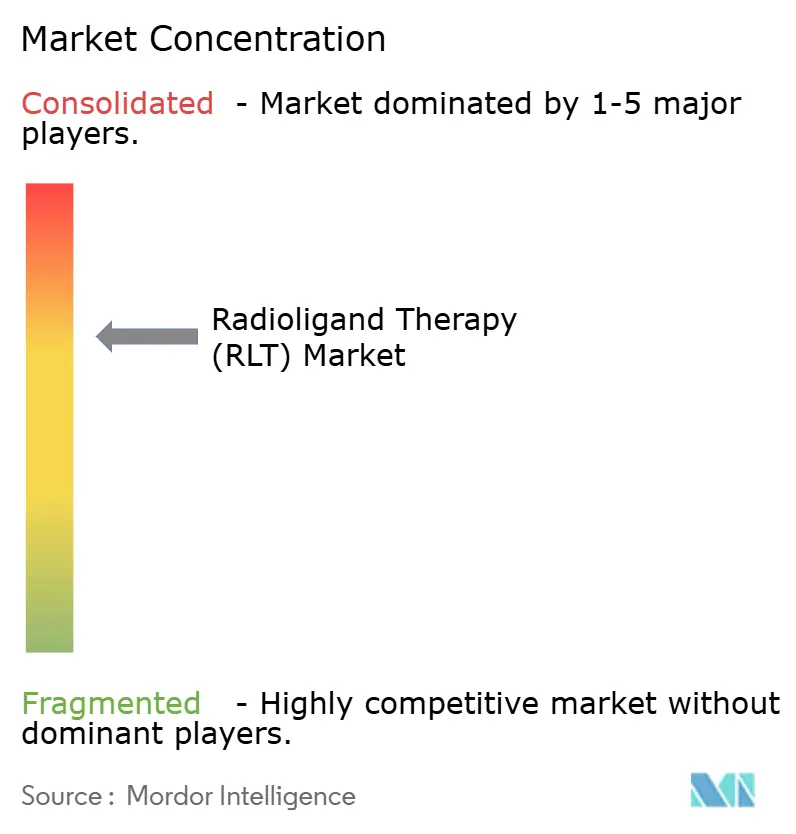
Novartis holds the leading commercial position in the radioligand therapy market through Pluvicto and Lutathera. Competition is increasing after acquisitions during 2024 and 2025. Bristol-Myers Squibb acquired RayzeBio for USD 4.1 billion, AstraZeneca acquired Fusion Pharmaceuticals for USD 2.4 billion, and Eli Lilly acquired Point Biopharma for USD 1.4 billion. These transactions secured pipeline assets, manufacturing capabilities, and isotope relationships that are difficult for new entrants to reproduce. Supply constraints for actinium-225 and lead-212 can limit alpha-emitter scale even when clinical results are favorable.
AstraZeneca’s February 2026 pipeline listed FPI-2265 in Phase 2 without a disclosed commercial actinium-225 supply arrangement at program scale. Patent positions in chelation chemistry can shape product differentiation alongside clinical performance. Telix generated USD 247 million in Q2 2026 revenue and has 3 concurrent Phase 3 programs. Its 2026 collaboration with Regeneron combined Telix manufacturing capabilities with Regeneron antibody discovery work. The agreement included an initial USD 40 million nonrefundable payment for development of antibody-radioconjugate hybrids.
ITM, SHINE Technologies, NorthStar Medical Radioisotopes, Curium, and Orano Med are important suppliers in the radioligand therapy market. Their role is growing because raw material access affects treatment availability. Curium’s June 2026 Saclay investment adds European capacity for lutetium-177 PSMA-I&T. Vertically integrated platforms can manage margins and supply disruption better than companies dependent on external manufacturing partners.
Radioligand Therapy (RLT) Industry Leaders
Novartis AG
Bayer AG
Eli Lilly and Company
Bristol-Myers Squibb Company
AstraZeneca plc
- *Disclaimer: Major Players sorted in no particular order
Radioligand Therapy (RLT) Market Companies Covered in this Report
- Actinium Pharmaceuticals, Inc.
- Ariceum Therapeutics GmbH
- AstraZeneca
- Bayer
- Bristol-Myers Squibb
- Clarity Pharmaceuticals Limited
- Convergent Therapeutics, Inc.
- Curium Pharma
- Eli Lilly and Company
- ITM Isotope Technologies Munich SE
- Lantheus Holdings, Inc.
- NorthStar Medical Radioisotopes, LLC
- Novartis
- Nusano, Inc.
- Orano Med
- Perspective Therapeutics, Inc.
- RadioMedix, Inc.
- Radiopharm Theranostics Limited
- SHINE Technologies, LLC
- Telix Pharmaceuticals Limited

Recent Industry Developments in Radioligand Therapy (RLT) Market
- July 2026: Telix Pharmaceuticals dosed the first patient in the Phase 3 LUTEON trial of TLX250-Tx (Lu-177 girentuximab tetraxetan) for relapsed or recurrent clear cell renal cell carcinoma, the first pivotal-stage RLT program in kidney cancer, extending the modality beyond prostate and neuroendocrine tumor indications.
- June 2026: Curium announced a EUR 32 million (USD 36.5 million) investment at its Saclay, France facility to establish a European production line for Lu-177 PSMA-I&T targeting mCRPC, creating 20 skilled positions and reducing European reliance on non-EU radioisotope sources.


Global Radioligand Therapy (RLT) Market Report Scope
As per the scope of the report, radioligand therapy is a targeted cancer treatment that involves using radioactive substances called radioligands. These radioligands are designed to specifically bind to certain molecules or receptors on cancer cells. Once bound, the radioactive component delivers targeted radiation directly to the cancer cells, helping to destroy or damage them while minimizing harm to surrounding healthy tissue.
The radioligand therapy (RLT) market is segmented by product into lutetium-177 vipivotide tetraxetan (Pluvicto), lutetium-177 dotatate (Lutathera), radium-223 dichloride (Xofigo), and other product types. By target, the market is segmented into prostate-specific membrane antigen, somatostatin receptor, fibroblast activation protein, gastrin-releasing peptide receptor, and other targets. By indication, the market is segmented into prostate cancer, gastroenteropancreatic neuroendocrine tumors, small cell lung cancer, hepatocellular carcinoma, breast cancer, and other indications. By end user, the market is segmented into tertiary care academic and comprehensive cancer centers, specialized nuclear medicine centers, hospitals, specialized clinics, and other end users. By geography, the market is segmented into North America, Europe, Asia-Pacific, the Middle East and Africa, and South America. The market report also covers the estimated market sizes and trends for 17 countries across major regions globally. For each segment, the market size and forecast are provided in terms of value (USD).
| Lutetium-177 Vipivotide Tetraxetan (Pluvicto) |
| Lutetium-177 Dotatate (Lutathera) |
| Radium-223 Dichloride (Xofigo) |
| Other Product Types |
| Prostate-Specific Membrane Antigen |
| Somatostatin Receptor |
| Fibroblast Activation Protein |
| Gastrin-Releasing Peptide Receptor |
| Other Targets |
| Prostate Cancer |
| Gastroenteropancreatic Neuroendocrine Tumors |
| Small Cell Lung Cancer |
| Hepatocellular Carcinoma |
| Breast Cancer |
| Other Indications |
| Tertiary Care Academic and Comprehensive Cancer Centers |
| Specialized Nuclear Medicine Centers |
| Hospitals |
| Specialized Clinics |
| Other End Users |
| North America | United States |
| Canada | |
| Mexico | |
| Europe | Germany |
| United Kingdom | |
| France | |
| Italy | |
| Spain | |
| Rest of Europe | |
| Asia-Pacific | China |
| Japan | |
| India | |
| Australia | |
| South Korea | |
| Rest of Asia-Pacific | |
| Middle East and Africa | GCC |
| South Africa | |
| Rest of Middle East and Africa | |
| South America | Brazil |
| Argentina | |
| Rest of South America |
| By Product | Lutetium-177 Vipivotide Tetraxetan (Pluvicto) | |
| Lutetium-177 Dotatate (Lutathera) | ||
| Radium-223 Dichloride (Xofigo) | ||
| Other Product Types | ||
| By Target | Prostate-Specific Membrane Antigen | |
| Somatostatin Receptor | ||
| Fibroblast Activation Protein | ||
| Gastrin-Releasing Peptide Receptor | ||
| Other Targets | ||
| By Indication | Prostate Cancer | |
| Gastroenteropancreatic Neuroendocrine Tumors | ||
| Small Cell Lung Cancer | ||
| Hepatocellular Carcinoma | ||
| Breast Cancer | ||
| Other Indications | ||
| By End User | Tertiary Care Academic and Comprehensive Cancer Centers | |
| Specialized Nuclear Medicine Centers | ||
| Hospitals | ||
| Specialized Clinics | ||
| Other End Users | ||
| By Geography | North America | United States |
| Canada | ||
| Mexico | ||
| Europe | Germany | |
| United Kingdom | ||
| France | ||
| Italy | ||
| Spain | ||
| Rest of Europe | ||
| Asia-Pacific | China | |
| Japan | ||
| India | ||
| Australia | ||
| South Korea | ||
| Rest of Asia-Pacific | ||
| Middle East and Africa | GCC | |
| South Africa | ||
| Rest of Middle East and Africa | ||
| South America | Brazil | |
| Argentina | ||
| Rest of South America | ||


Key Questions Answered in the Report
What is the projected value of radioligand therapy by 2031?
The radioligand therapy market size is forecast to reach USD 10.66 billion by 2031, growing from USD 6.18 billion in 2026 at an 11.52% CAGR. The forecast reflects broader use of targeted treatments and the need for more manufacturing capacity.
Which product currently leads radioligand therapy?
Pluvicto led the product segment with 45.31% share in 2025 and recorded USD 1,293 million in H1 2026 sales. It remains the leading commercial product in the radioligand therapy market.
Which indication is growing fastest for radioligand therapy?
GEP-NETs is the fastest-growing indication, with an 18.22% CAGR forecast for 2026 to 2031. Better detection, PRRT familiarity, and lower costs from generic entry support the radioligand therapy market in this indication.
Why is isotope supply important for radioligand therapy delivery?
Lutetium-177 has a short delivery window, and limited reactor capacity can restrict dose availability at treatment centers. Supply continuity is therefore essential to the radioligand therapy market and to timely patient treatment.
Which region has the highest projected growth?
Asia-Pacific is forecast to grow at a 15.85% CAGR from 2026 to 2031 as access expands across China, Japan, South Korea, Australia, and India. China's 2025 Pluvicto approval and local manufacturing plans support radioligand therapy market growth in the region.
What is limiting wider treatment access?
Radioisotope supply, skilled workforce availability, certified treatment-center capacity, and complex radiation logistics are the main constraints. These factors can slow radioligand therapy market expansion even when clinical demand remains strong.
Page last updated on:





