
Printing Toners Market Size and Share
Market Overview
| Study Period | 2022 - 2032 |
|---|---|
| Market Size (2027) | USD 5.75 Billion |
| Market Size (2032) | USD 7.74 Billion |
| Growth Rate (2027 - 2032) | 6.13 % |
| Fastest Growing Market | Asia-Pacific |
| Largest Market | Asia-Pacific |
| Market Concentration | Low |
Major Players
*Disclaimer: Major Players sorted in no particular order Image © Mordor Intelligence. Reuse requires attribution under CC BY 4.0. |
|
Printing Toners Market Analysis by Mordor Intelligence
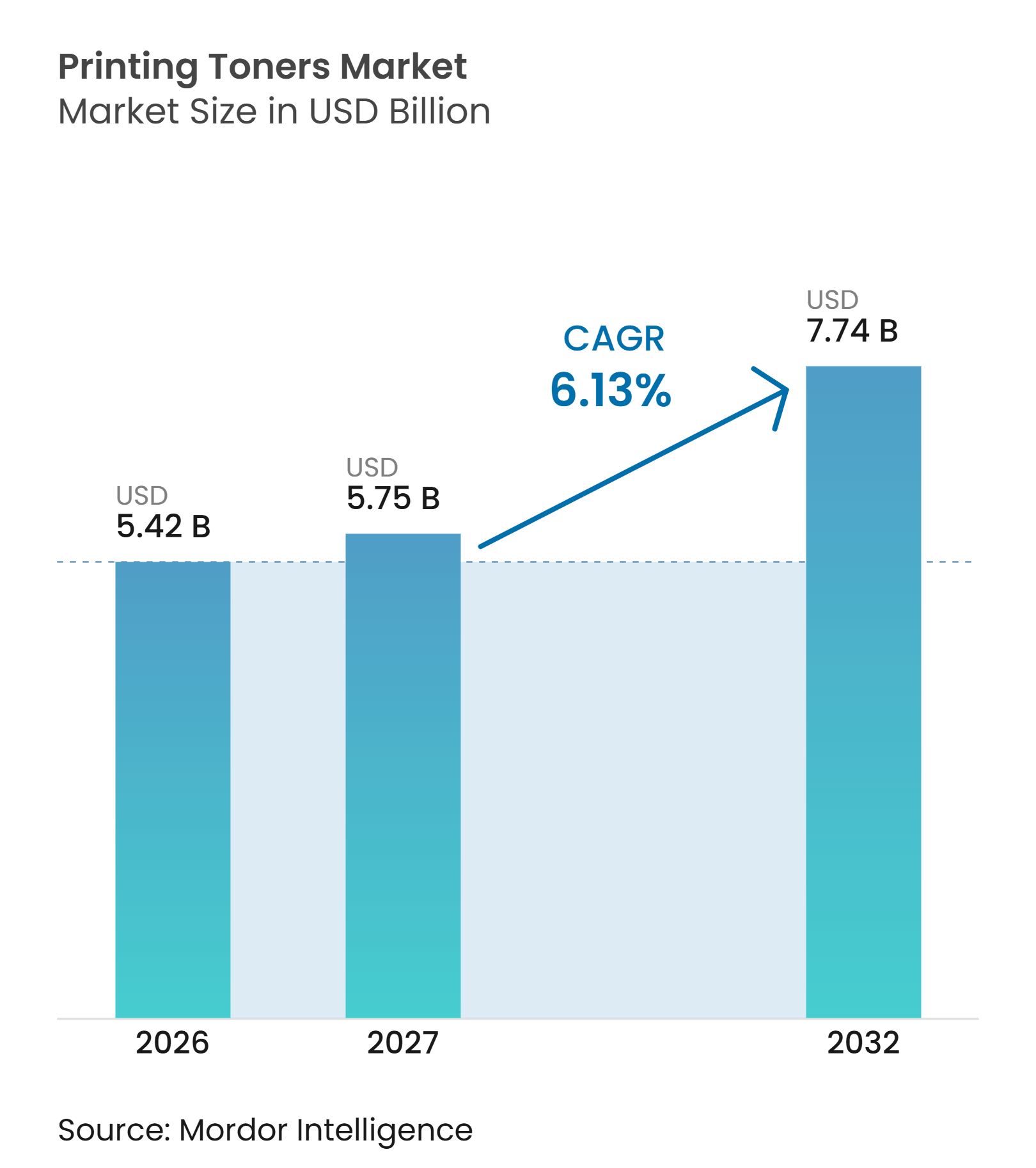
The printing toners market size was valued at USD 5.42 billion in 2026 and is estimated to grow from USD 5.75 billion in 2027 to USD 7.74 billion by 2032, at a CAGR of 6.13% during the forecast period (2027-2032). The printing toners market is expanding beyond office applications, with packaging, production printing, and commercial digital workflows representing a growing share of demand. Demand is increasingly driven by applications requiring color consistency, specialty effects, and dry-process printing to achieve differentiated output. This shift is driving supplier investments in toner chemistry, resin performance, and press-specific formulations. Product launches by Konica Minolta and FUJIFILM Business Innovation in 2025 indicate the role of specialty colors and production capabilities in competitive positioning. However, declining office page counts and the use of compatible cartridges present risks, particularly as paperless workflows reduce replenishment demand and third-party suppliers improve authentication compatibility.
Key Report Takeaways
- By type, Laser Toner held 57.13% of the printing toners market share in 2026, while Digital Copier Toner is forecast to grow at a CAGR of 6.89% through 2032.
- By technology, Conventional Toners accounted for 68.21% of the printing toners market size in 2026, while Chemical Toners are forecast to grow at a 7.11% CAGR through 2032.
- By raw material, Polyester held a 41.56% share in 2026, while Styrene-Acrylic Resin is forecast to expand at a 7.45% CAGR through 2032.
- By application, Monochrome Printing accounted for 37.12% of the printing toners market size in 2026, while Color Printing is forecast to grow at an 8.12% CAGR through 2032.
- By geography, Asia-Pacific held 43.66% of the printing toners market share in 2026 and is forecast to expand at an 8.04% CAGR through 2032.
Note: Market numbers in this report are based on Mordor Intelligence's proprietary estimation framework, which combines nine months of actuals with Q4 projections for base year 2026.
Market Trends and Insights
Drivers Impact Analysis of Printing Toners Market*
| Drivers | (~) % Impact on CAGR Forecast | Geographic Relevance | Impact Timeline |
|---|---|---|---|
| Expansion of Packaging and Label Printing | +1.8% | Global, with strongest pull in Asia-Pacific and Europe | Long term (≥ 4 years) |
| Growth of Commercial and Managed Printing | +1.2% | North America, Europe, Asia-Pacific | Medium term (2-4 years) |
| Demand for High-Yield and Low-Temperature-Fusing Toners | +0.9% | Global, with early adoption in Japan and Germany | Medium term (2-4 years) |
| Expansion of Digital and On-Demand Printing | +1.1% | North America, Europe, and core Asia-Pacific markets | Long term (≥ 4 years) |
| E-Commerce Discovery and Automated Replenishment | +0.7% | North America and Europe, spill-over to APAC | Short term (<2 years) |
| Source: Mordor Intelligence | |||
Expansion of Packaging and Label Printing
Packaging and label printing broadened the demand base for the printing toners market beyond conventional office printing. These applications require controlled particle distribution and consistent color output, which can support higher selling prices than standard office toner. By late 2025, Konica Minolta had installed more than 1,700 toner-based AccurioLabel presses across digital label applications. The company targeted 2,000 installations in North America during fiscal year 2025 and positioned toner-based output for pressure-sensitive substrates. Packaging converters also required short production runs and versioned artwork, strengthening the role of digital presses in label production. The printing toners market is supported when brand owners require frequent design changes without maintaining large inventories of preprinted materials.
Growth of Commercial and Managed Printing
Managed print services shift toner procurement from individual purchase orders to contract-based replenishment. This model supports regular supply flows because providers can monitor fleets and replenish cartridges before they run out. Lexmark was named a Leader in the 2025 IDC MarketScape for cloud-managed print services. The company connects its Global Internet of Things (IoT) System to fleet management and life-cycle control. In the printing toners market, commercial value depends on software and device compatibility as well as the cartridge. Original Equipment Manufacturers (OEMs) can use firmware, authentication, and automated fulfillment to connect supplies to contracted device fleets. Suppliers that do not participate in these platforms may have limited access to large commercial accounts.
Demand for High-Yield and Low-Temperature-Fusing Toners
High-yield and low-temperature-fusing toners address electricity consumption, cartridge life, and cost per page. Research published in the Journal of the Imaging Society of Japan indicates that crystalline polyester resins can provide wide fusing windows while limiting cold and hot offset. Konica Minolta states that its Simitri HD and HDE toners support lower fusing temperatures in its AccurioPress and AccurioLabel platforms. In June 2025, Kyocera introduced a restructured A4 toner lineup featuring lower carbon dioxide emissions and shipping savings throughout the toner life cycle. ISO/IEC 19752:2025 and ISO/IEC 19798:2025 provide updated methods for determining yields for monochrome and color toner cartridges, respectively. These standards provide procurement teams with a basis for comparing high-yield claims.
Expansion of Digital and On-Demand Printing
Digital and on-demand printing supports toner presses when customers require short runs, variable data, and rapid job changes. This trend supports the printing toners market because customized jobs require on-demand production rather than inventory-based printing. In 2025, FUJIFILM Business Innovation launched the Revoria Press PC2120, featuring Super EA-Eco toner and 2,400 dpi output for commercial printing[1]. Ricoh positions its Pro C5400 series for commercial and enterprise users seeking fast startup times and consistent output. These systems enable printers to shift suitable low- to mid-run jobs from offset workflows to digital production. Enhanced output capabilities can increase toner consumption per job, even when page counts do not rise at the same pace.
Restraints Impact Analysis of Printing Toners Market*
| Restraints | (~) % Impact on CAGR Forecast | Geographic Relevance | Impact Timeline |
|---|---|---|---|
| Paperless Workflows and Declining Office Page Volumes | -1.5% | Global, most acute in North America and Europe | Short term (≤ 2 years) |
| Inkjet Substitution in Selected Commercial Applications | -0.8% | North America, Europe, and emerging Asia-Pacific | Medium term (2-4 years) |
| Firmware Authentication and Chip-Lockout Friction | -0.3% | Global - regulatory influence in EU and North America | Short term (≤2 years) |
| Source: Mordor Intelligence | |||
Paperless Workflows and Declining Office Page Volumes
Paperless processes reduce office printing, which has historically supported toner replenishment. A 2025 peer-reviewed study of enterprise employees in Mumbai, Pune, and Nashik found that scan-to-cloud and e-signature deployments reduced monthly printing activity by 31%, while high-adoption users reduced printing by 40.4%[2]. A smaller installed base can reduce the frequency of cartridge replacements, even when customers do not switch brands. The impact varies by country because return-to-office policies, hybrid work arrangements, and the adoption of digital documentation differ across markets. Large enterprise offices can partly offset this trend where on-site work increases. Consequently, the printing toners market increasingly depends on specialized commercial applications where digital documentation cannot replace the need for physical output.
Inkjet Substitution in Selected Commercial Applications
Business inkjet platforms compete with toner in certain mid-output commercial applications. Ricoh continues to develop both high-speed inkjet and toner systems, enabling the company to retain customers with varying output requirements. Inkjet has gained relevance in direct mail and general commercial printing as image quality and color performance have improved. Toner is used for high-resolution monochrome printing, specialty-color applications, and dry-process output on non-absorbing media. These applications rely on toner chemistry rather than page cost alone. Therefore, the printing toners market remains relevant in applications where specialty effects and substrate flexibility are important to print buyers.
*Our forecasts treat driver/restraint impacts as directional, not additive. The impact forecasts reflect baseline growth, mix effects, and variable interactions.
Printing Toners Market Segment Analysis
By Type:
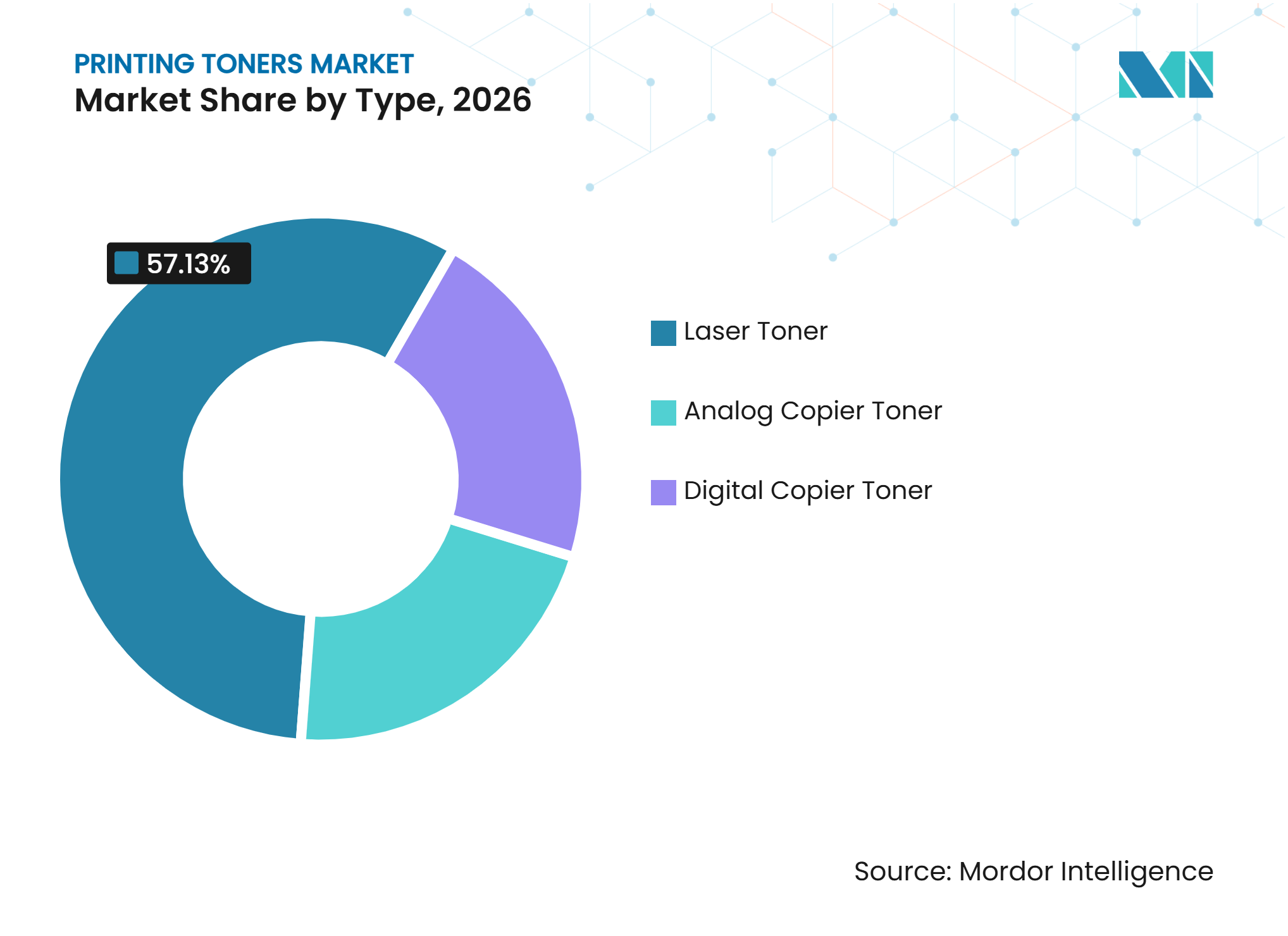
Laser Toner Anchors Revenue, Copier Toner AcceleratesLaser Toner holds a 57.13% share of the printing toners market in 2026. This position reflects the large installed base of electrophotographic printers across offices, commercial print facilities, government organizations, and production environments. The installed base includes compact small-office equipment, departmental devices, and high-speed presses, all of which require toner supplies throughout their operating lives. This broad hardware compatibility keeps Laser Toner relevant to the printing toners industry, even as demand for individual devices stabilizes or declines. Analog Copier Toner remains the smallest and most challenged type, as each replacement cycle removes additional legacy equipment from active use. The transition toward digital multifunction devices that combine copying, printing, scanning, and connected workflow features further affects its position.
Digital Copier Toner is projected to grow at a CAGR of 6.89% from 2027 to 2032. Commercial and government customers are upgrading medium- and large-format multifunction devices that support remote management, controlled access, and cloud-connected workflows. These systems provide remote firmware updates and standardized yield reporting, features that are increasingly relevant for centrally managed fleets. ISO/IEC 19752:2025 supports comparable measurements of monochrome cartridge yield in these purchasing processes. In October 2025, Brother refreshed its TN635 color laser cartridges for selected new printers and linked the product cycle to its Refresh EZ Print service model. This approach shows how suppliers link replenishment to hardware refresh cycles and managed services rather than relying solely on stand-alone consumable transactions.



By Technology:
Conventional Toners Dominate, but Chemical Toner Gains GroundConventional Toners account for 68.21% of the printing toners market in 2026. Lower manufacturing costs, established production methods, and the large installed base of presses designed for mechanically produced particles support their position. Manufacturers generally produce these toners by melt-blending and milling pigment and resin, a process that remains suitable for legacy equipment. Existing device settings, cartridge designs, and supply chains also support their use across mature printer fleets. Chemical Toners account for the remaining 31.79% share in 2026. Their narrower particle-size distribution, consistent charging behavior, and color performance support advanced commercial and production applications.
Chemical Toners are forecast to grow at a CAGR of 7.11% from 2027 to 2032. Suspension and emulsion-aggregation processes can support lower minimum fusion temperatures and more consistent particle properties, which are relevant to demanding color applications. In November 2025, Xerox presented its Continuous Emulsion Aggregation process and solvent-free resin emulsification work at a Society for Imaging Science and Technology (IS&T) conference. The work included specialty pigment approaches, including bio-based and low-volatile organic compound (VOC) options, without compromising the print-quality objectives stated in the research. Lower fusing temperatures can reduce electricity consumption in commercial printing facilities. Compliance requirements under the EU Ecodesign for Sustainable Products Regulation may further support formulations that improve environmental performance and product sustainability information.
By Raw Material:
Polyester Leads, Styrene-Acrylic Chases ColorPolyester accounts for 41.56% of the raw-material segment in 2026. The material has a lower glass-transition temperature and can support reliable fixing across a broad fusing range, which is important under varied production conditions. It is also compatible with dual-component developer systems used in production presses. Research on toner resins indicates that crystalline polyester can combine low-temperature melting with elastic recovery, helping prevent hot offset. This combination supports print performance without requiring the same formulation adjustments as some alternative systems. Consequently, polyester remains important in the printing toners market, where stable fusing performance and established production compatibility are required.
Styrene-acrylic resin is forecast to grow at a CAGR of 7.45% from 2027 to 2032. Its charging stability and dot-formation characteristics support color applications where resolution, sharp definition, and color gamut are important to print buyers. Specialty polymers, including hybrid resin blends and bio-sourced polyesters, remain smaller segments but continue to receive research investment from leading original equipment manufacturers (OEMs) seeking specialized performance. FUJIFILM uses Super EA-Eco Toner in its Revoria Press range and positions its fine particles for commercial printing applications. Resin selection is becoming more important as presses require consistent particle performance at demanding production speeds. These material requirements create opportunities for formulation-led differentiation among toner suppliers serving production and specialty-color applications.
By Application:
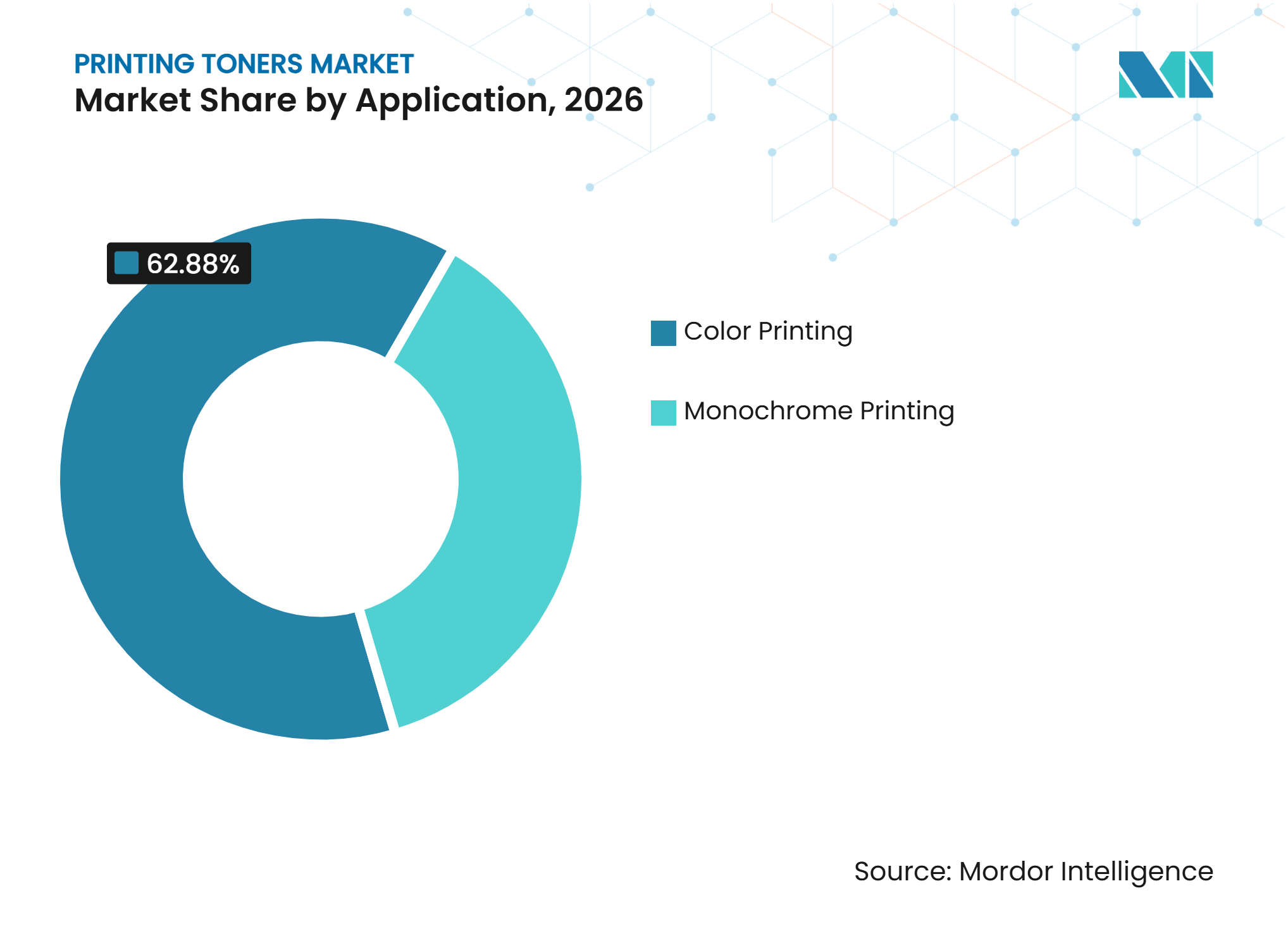
Monochrome Printing Accounts for the Largest Share, While Color Printing Records Higher GrowthMonochrome Printing accounts for 37.12% of the printing toners market in 2026. The segment benefits from the large installed base of monochrome laser devices in offices, government agencies, and educational settings. Black toner continues to support heavy-use printing applications in which customers prioritize predictable output, cartridge yield, and routine document production. ISO/IEC 19752:2025 provides a standardized basis for comparing monochrome cartridge yield. This standard remains relevant to procurement teams evaluating operating costs across large printer fleets and seeking consistency across purchasing programs. The installed base sustains toner supply requirements for monochrome printing, even as paperless processes constrain some office demand.
Color Printing is projected to expand at a CAGR of 8.12% from 2027 to 2032. Packaging converters, marketing firms, and commercial print shops are shifting more work to digital color presses, which can handle short runs and frequent design changes without the need for traditional plate preparation. In October 2025, Sharp presented the BP-1200S at Printing United Expo, featuring up to six colors, including gold, silver, white, and pink toner. Specialty colors can help print providers serve graphic-intensive jobs with differentiated output and higher-value print applications. This application creates demand for resins and particles that preserve color quality in shorter runs, making color printing a growth area in the printing toners market.

Geography Analysis
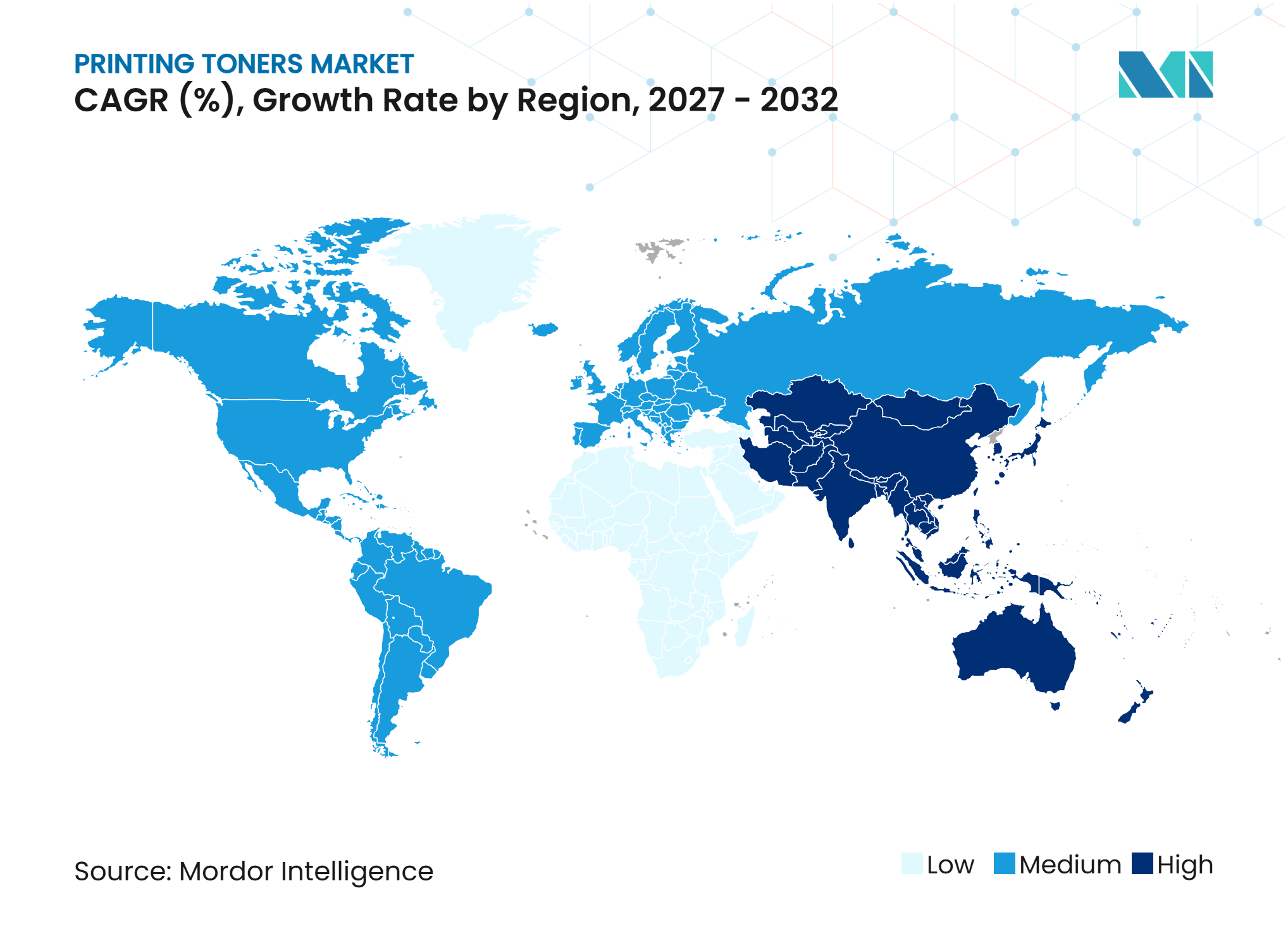
Asia-Pacific: The Market's Gravity Center
Asia-Pacific is estimated to hold a 43.66% share of the printing toners market in 2026 and is projected to grow at a CAGR of 8.04% from 2027 to 2032. China supports regional manufacturing through integrated operations spanning chip design and finished-cartridge assembly. These capabilities support cost control and rapid cartridge development for domestic and export customers. Ninestar and Pantum are among the companies involved in these integrated production activities.
India supports demand through localized manufacturing and public procurement preferences, making institutional buyers an important channel for suppliers that meet local production requirements. Pantum has identified local production in India as part of its strategy to serve government and institutional customers. Japan continues to generate demand for quality-focused production printing despite pressure from digital documentation. Its production-print base requires reliable output and tightly controlled toner quality. South Korea and ASEAN markets contribute demand through expanding small-business activity and packaging printing.
North America: Premium Segments Sustain a Mature Market
North America faces declining monochrome office print activity; however, toner and specialty segments continue to support demand for premium products. Managed print contracts account for a larger share of enterprise supply flows in the region, increasing the importance of device monitoring, compatibility, and automatic replenishment over one-time cartridge transactions. HP reported USD 16.70 billion in printing segment revenue in fiscal 2025, while supplies revenue declined by 3.4%. These trends reflect pressure on consumer and commercial installed bases.
Production printing supports demand, as commercial operators pay a premium for high-chroma and metallic toner, particularly for graphics, marketing materials, and other applications where standard CMYK is insufficient. Since 2025, Sharp, FUJIFILM, Konica Minolta, and Ricoh have introduced or advanced toner-based production systems for North American customers. The regional opportunity is concentrated in applications requiring differentiated output rather than standard office printing.
Europe and Emerging Regions: Sustainability Shapes the Agenda
Europe is placing greater emphasis on lower-emission and circular consumables, driven by regulatory requirements and buyer preferences. The EU Ecodesign for Sustainable Products Regulation provides a framework that may influence product design, sustainability disclosures, and supplier approaches to material use and circularity. HP states that its EvoCycle cartridge, available in France, Germany, and the United Kingdom, contains 76% recycled or reused content and has a 37% lower carbon footprint than a standard new HP toner cartridge.
Brother's certified remanufacturing program covers inkjet and toner consumables, with operations in Ruabon and expanded drum-unit remanufacturing in Slovakia in 2026. Germany, France, the United Kingdom, and Italy support organized commercial and production-print demand. Brazil benefits from e-commerce and retail logistics, which increase label-printing requirements. Gulf Cooperation Council markets and sub-Saharan African cities offer longer-term opportunities as office infrastructure and local distribution networks develop.
Competitive Landscape
Market Concentration
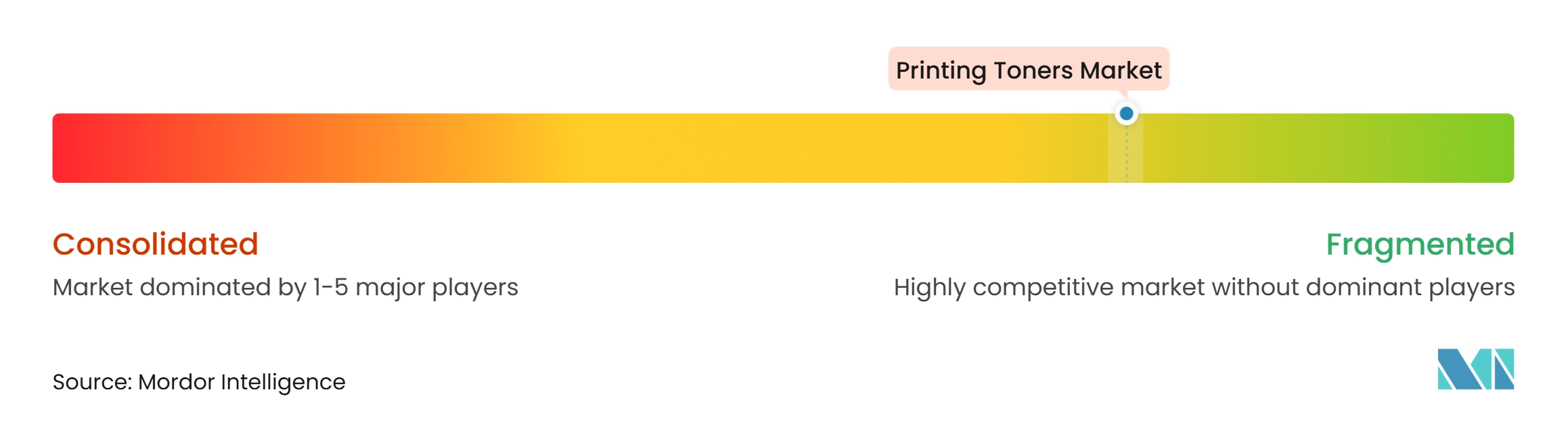
The printing toners market is moderately fragmented at the original equipment manufacturer (OEM) hardware level and highly competitive in the consumables aftermarket. Canon, KYOCERA Document Solutions, Ricoh, and Konica Minolta compete through vertically integrated toner and engine systems. Internal materials expertise and proprietary production methods support their formulations. Xerox completed its acquisition of Lexmark in 2025, combining its production-print capabilities with Lexmark's managed-print platform and fleet-management infrastructure. The acquisition expanded Xerox's ability to serve A3 and A4 enterprise accounts. Chinese suppliers also compete by introducing compatible cartridges and related authentication technologies, creating pressure on OEM supply margins and customer retention.
Circular-economy consumables represent a competitive area in the printing toners market. Xerox reported manufacturing 1.7 million toner cartridges using recovered units in 2024, with post-consumer materials achieving 90% reuse by weight. Smaller suppliers may face constraints in matching established collection networks and remanufacturing capabilities, as recovered products require collection, assessment, processing, and return to the supply chain at consistent quality levels. FUJIFILM Business Innovation Corp. and Konica Minolta established Global Procurement Partners Corp. in January 2025 to consolidate procurement and development activities. The arrangement pools resources for materials and production requirements, enabling the companies to share purchasing activities and development capabilities for specialized toner formulations. It indicates that mid-sized OEMs are pursuing scale in specialty toner development. Such alliances can strengthen purchasing leverage while supporting investments in formulation and hardware development.
Ricoh, Toshiba Tec, and OKI completed the ETRIA integration in October 2025. The venture combines printer and multifunction-device development activities across the participating companies. Shared development can streamline engine and cartridge supply chains by reducing duplication in hardware design and aligning technical requirements across previously separate product lines. It can also reduce the cost of maintaining separate hardware platforms. Konica Minolta and FUJIFILM continue to use specialty-color production systems to compete for commercial print customers. Suppliers with integrated capabilities across chemistry, devices, and services can address premium applications. Compatible cartridge specialists will continue to compete in segments where price and aftermarket access are primary purchase considerations.
Printing Toners Industry Leaders
-
HP Development Company, L.P.
-
Canon Inc.
-
Xerox Corporation
-
Ricoh
-
Konica Minolta
- *Disclaimer: Major Players sorted in no particular order
Printing Toners Market Companies Covered in this Report
- Brother Industries, Ltd.
- Canon Inc.
- FUJIFILM Group
- HP Development Company, L.P.
- Konica Minolta
- KYOCERA Document Solutions
- Lexmark International, Inc.
- Ninestar Corporation
- Panasonic Production Engineering Co., Ltd.
- Pantum International Limited
- Ricoh
- Seiko Epson Corporation
- Sharp Corporation
- Toshiba
- Xerox Corporation
Recent Industry Developments in Printing Toners Market
- October 2025: Ninestar Corporation’s G&G Image subsidiary launched the TN635 High-Chroma compatible printing toner cartridge series for Brother’s HL-L8430CDW, HL-L8570CDW, MFC-L8730CDW, and related color laser printers in North America. The formulation supports color printing applications among small and medium-sized businesses (SMBs) and commercial accounts.
- September 2025: Sharp Imaging and Information Company of America previewed an entry-level production printer and the Plockmatic Booklet Finisher for its BP-1200S at Printing United Expo 2025. The equipment supports 6-color digital printing with specialty printing toner options, including gold, silver, pink, white, and clear, for commercial print operators.
Global Printing Toners Market Report Scope
Printing toner is a fine, dry powder used in laser printers and photocopiers to create text and images on paper. The toner formulation typically contains pigment, polymer resin, charge-control agents, and other additives that support image development and transfer during the printing process.
The printing toners market is segmented by type, technology, raw material, application, and geography. By type, the market is segmented into laser toner, analog copier toner, and digital copier toner. By technology, the market is segmented into conventional toners and chemical toners. By raw material, the market is segmented into polyester, styrene-acrylic, and specialty polymers. By application, the market is segmented into monochrome printing and color printing. The report also covers market sizes and forecasts for printing toners across 15 countries in major regions. The market sizes and forecasts are provided in terms of value (USD).
Segmentation Overview
| Laser Toner |
| Analog Copier Toner |
| Digital Copier Toner |
| Conventional Toners |
| Chemical Toners |
| Polyester |
| Styrene-Acrylic |
| Specialty Polymers |
| Monochrome Printing |
| Color Printing |
| Asia-Pacific | China |
| India | |
| Japan | |
| South Korea | |
| ASEAN Countries | |
| Rest of Asia-Pacific | |
| North America | United States |
| Canada | |
| Mexico | |
| Europe | Germany |
| United Kingdom | |
| France | |
| Italy | |
| NORDIC Countries | |
| Rest of Europe | |
| South America | Brazil |
| Argentina | |
| Rest of South America | |
| Middle East and Africa | Saudi Arabia |
| South Africa | |
| Rest of Middle East and Africa |
| By Type | Laser Toner | |
| Analog Copier Toner | ||
| Digital Copier Toner | ||
| By Technology | Conventional Toners | |
| Chemical Toners | ||
| By Raw Material | Polyester | |
| Styrene-Acrylic | ||
| Specialty Polymers | ||
| By Application | Monochrome Printing | |
| Color Printing | ||
| By Geography | Asia-Pacific | China |
| India | ||
| Japan | ||
| South Korea | ||
| ASEAN Countries | ||
| Rest of Asia-Pacific | ||
| North America | United States | |
| Canada | ||
| Mexico | ||
| Europe | Germany | |
| United Kingdom | ||
| France | ||
| Italy | ||
| NORDIC Countries | ||
| Rest of Europe | ||
| South America | Brazil | |
| Argentina | ||
| Rest of South America | ||
| Middle East and Africa | Saudi Arabia | |
| South Africa | ||
| Rest of Middle East and Africa | ||
Key Questions Answered in the Report
What is current market size of Printing Toners Market?
The printing toners market size was valued at USD 5.42 billion in 2026 and is estimated to grow from USD 5.75 billion in 2027 to USD 7.74 billion by 2032, at a CAGR of 6.13% during the forecast period (2027-2032).
Which printing application is growing fastest?
Color Printing is expected to grow at an 8.12% CAGR through 2032 as commercial printers add digital color and specialty output.
Why are chemical toners gaining adoption?
Chemical Toners are forecast to grow at a 7.11% CAGR through 2032 because they can deliver consistent particles and lower fusing temperatures.
Which region drives demand for toner?
Asia-Pacific led with a 43.66% share in 2026 and is forecast to grow at an 8.04% CAGR through 2032.