
Positive Airway Pressure Market Size and Share
Market Overview
| Study Period | 2020 - 2031 |
|---|---|
| Forecast Data Period | 2026 - 2031 |
| Historical Data Period | 2020 - 2024 |
| Growth Rate | 4.54 % |
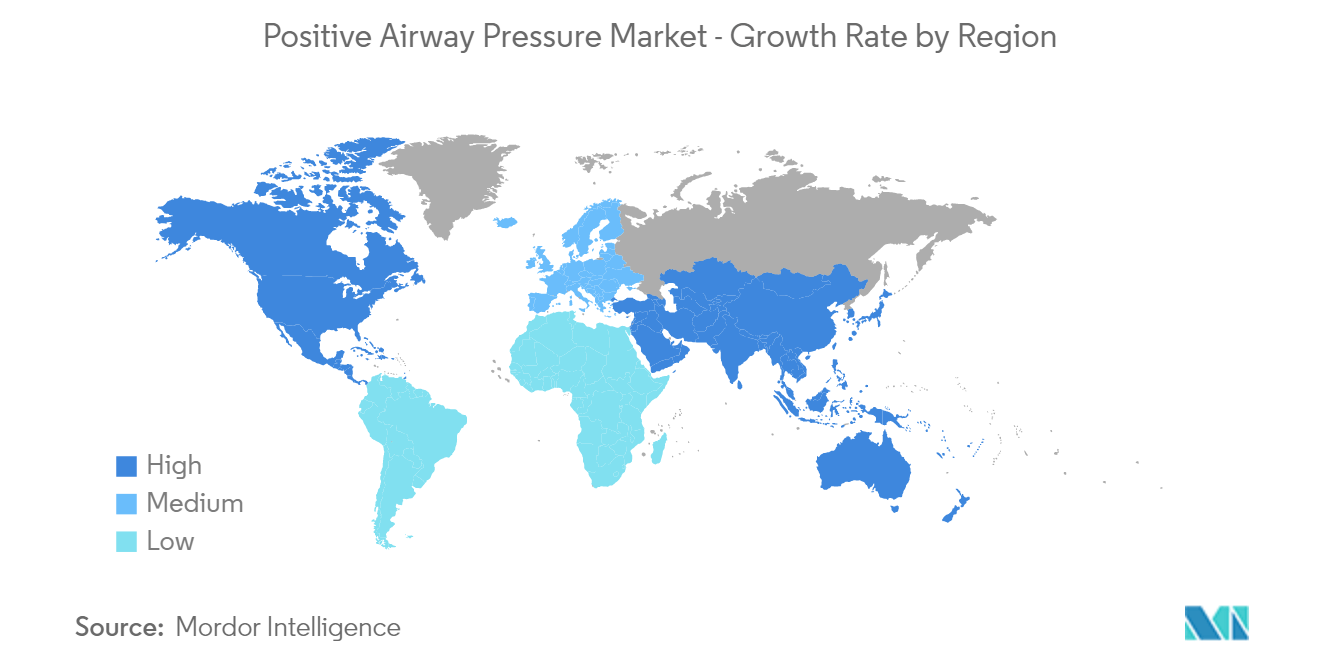
| Fastest Growing Market | Asia Pacific |
| Largest Market | North America |
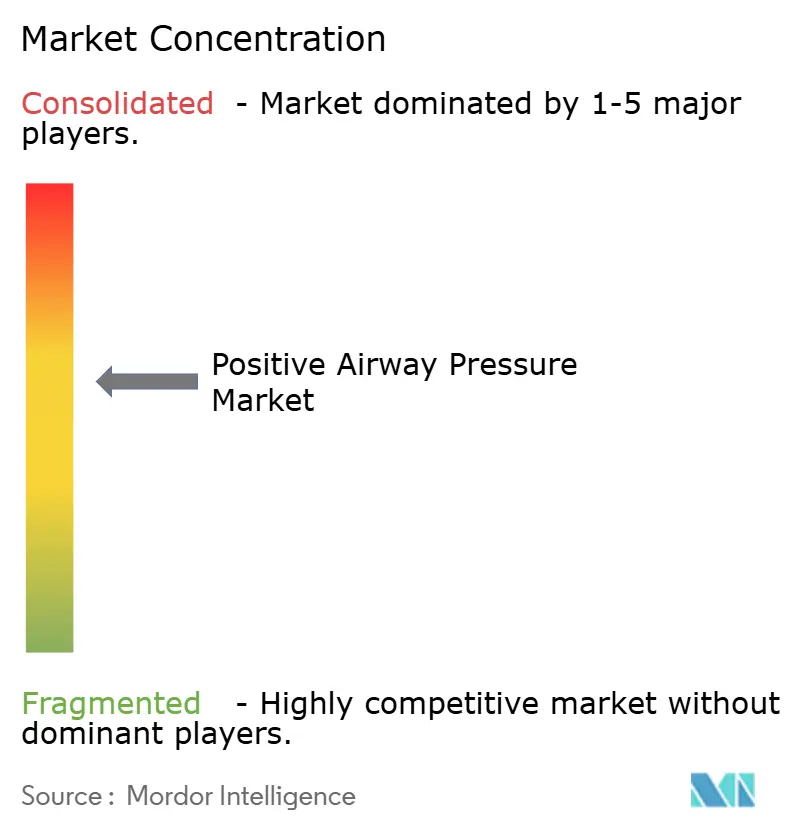
| Market Concentration | Medium |
Major Players *Disclaimer: Major Players sorted in no particular order Image © Mordor Intelligence. Reuse requires attribution under CC BY 4.0. | |
Positive Airway Pressure Market Analysis by Mordor Intelligence
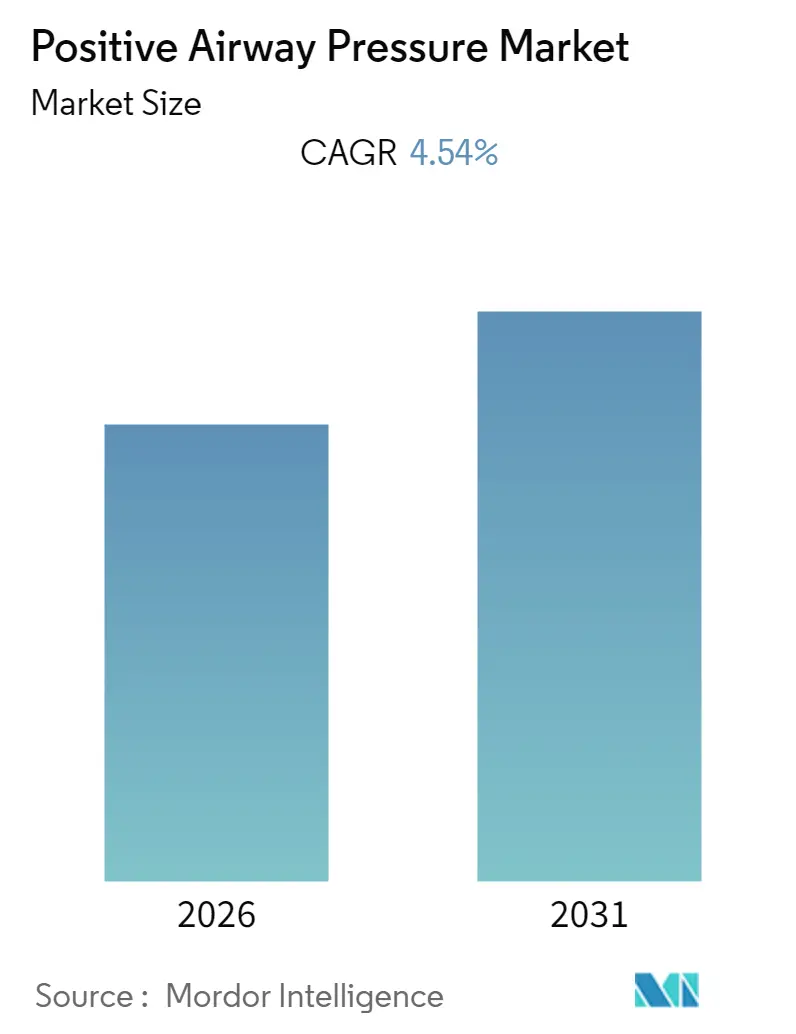
The Positive Airway Pressure Market size is expected to register a CAGR of 4.54% during the forecast period (2026-2031).
The COVID-19 pandemic turned the spotlight on continuous positive airway pressure. Since sleep apnea patients have an increasing demand for positive airway pressure (PAP), adherence to PAP significantly increased during the COVID-19 lockdown. According to the article published in the European Respiratory Journal 2020, a 4.48% increase in PAP adherence was observed during the first month of lockdown (15 March 2020 to 15 April 2020) compared to the same time in 2019.
The major factors attributing to the growth of the market are a rise in the global prevalence of sleep disorders such as sleep apnea due to the rise in the sedentary lifestyle, physical inactivity, and poor dietary habits resulting in increased obesity population, which was identified as the most common causative factor of sleep disorders. For instance, according to the World Health Organization report 2021, in 2020, more than 2 billion adults, 18 years and older, were overweight. Of these, over 650 million were obese, leading to a rise in sleep apnea.
The increasing global prevalence of sleep apnea is expected to boost the market over the forecast period. According to the article published in Lancet Respiratory Medicine 2020 by Adam V. Benjafield, globally, 936 million adults aged 30-69 had mild to severe obstructive sleep apnoea (OSA), and 425 million adults aged 30-69 had moderate to severe OSA. Similarly, it is believed that 50-60% of the obese population and patients with metabolic syndrome (MS) suffer from OSA. Thus, the growing prevalence of sleep apnea is expected to drive positive airway pressure market growth.
Also, increased awareness of sleep apnea and risk factors such as cardiovascular indications and high blood pressure are expected to fuel the PAP market throughout the forecast period.
Note: Market size and forecast figures in this report are generated using Mordor Intelligence’s proprietary estimation framework, updated with the latest available data and insights as of 2026.
Global Positive Airway Pressure Market Trends and Insights
Continuous Positive Airway Pressure Devices Expected to Hold the Largest Market Share in the Positive Airway Pressure Market
Continuous positive airway pressure (CPAP) is a type of positive airway pressure ventilation in which a steady pressure larger than atmospheric pressure is continuously applied to a person's upper respiratory tract. Continuous positive airway pressure (CPAP) devices contribute to the largest share in the market because they are used as a first-line PAP therapy to treat various sleep disorders.
According to the article published in The Lancet Respiratory Medicine 2020, "Time to wake the giant of obstructive sleep apnoea", around 8 million people aged 30-69 years are affected by obstructive sleep apnoea (OSA) in the United Kingdom alone each year. The massive demand for the CPAP devices is due to their proven efficiency in many sleep apnea patients in multiple cases, such as airway blockages, by controlling the air pressure with the help of a pump in the device to open up the blocked airways.
Many developments are taking place, including product launches and approvals, partnerships, collaborations, and mergers and acquisitions that can boost the positive airway pressure market. In March 2019, Resmed, a medical equipment firm based in the United States, announced the acquisition of HB Healthcare (HBH) for an undisclosed sum. With this agreement, Resmed hopes to reach out to Korean people with the support of HB Healthcare and its network of trusted distributor partners to provide CPAP and respiratory care to millions of South Koreans suffering from sleep apnea, COPD, and other respiratory disorders.
The patients' increased preference for CPAP devices due to various advantages such as increased energy levels, improved mood, mental alertness, and quality of sleep increase their demand, contributing to the rise in adoption of these systems and fueling the market growth.


North America Dominates the Market and Expected to do Same in the Forecast Period
North America is expected to dominate the global PAP market throughout the forecast period. The dominance is due to factors such as the rising prevalence of diabetes, high blood pressure, obesity, obstructive sleep apnea (OSA), and pulmonary disorders, such as dyspnea in the United States, which is to higher demand for the PAP devices. For instance, according to reports published by the National Institute of Medicine in 2020, in the United States, OSA prevalence was estimated to be as high as 14% of men and 5% of women. Hispanic, black, and Asian populations have higher rates, which drives the market growth in the forecast period.
According to the Centers for Disease Control and Prevention's Behavioral Risk Factors Surveillance System (BFRSS) 2019, the adult obesity percentage in the United States was 42.4%. This was the first time the national average surpassed 40%. The growing prevalence of obesity increases the demand for sleep apnea, thereby driving the market for positive airway pressure market.
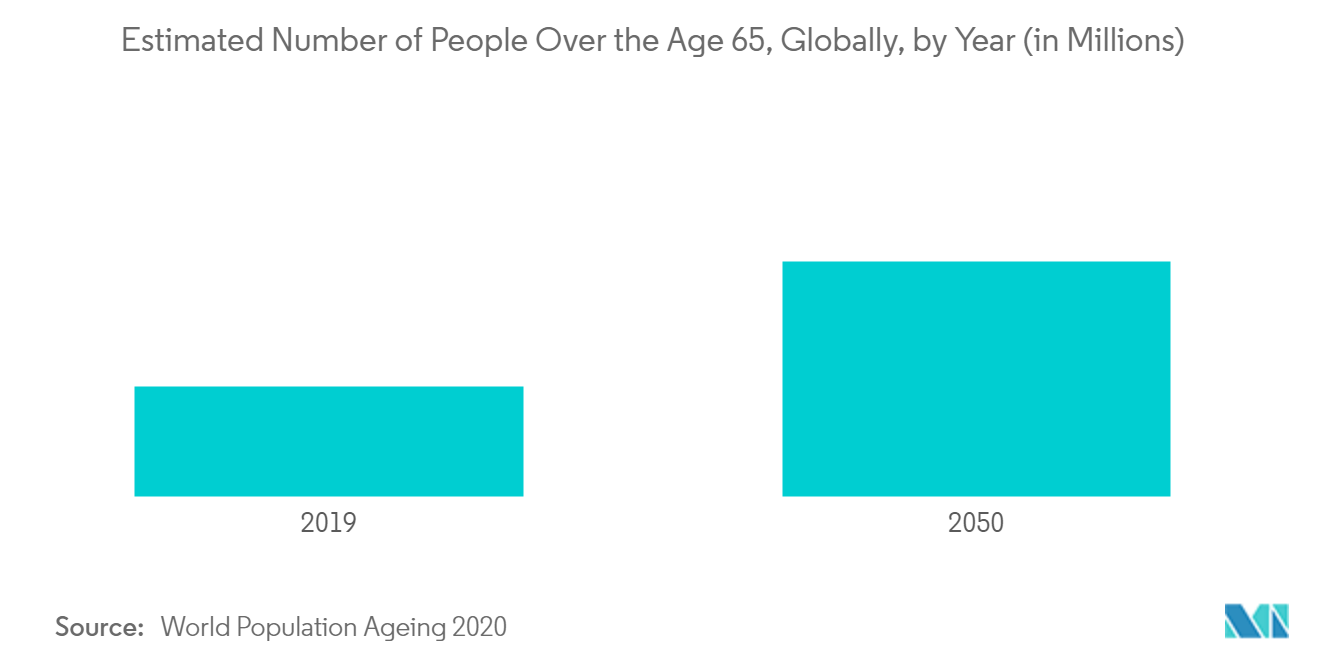
Also, increased affordability with a rise in disposable income, an aging population, a surge in high levels of air pollution, and technological advancements in the region contribute to its outstanding share in the global market revenue during the forecast period.

Competitive Landscape
The continuous positive airway pressure therapy market is moderately competitive and consists of several major players. In terms of market revenue, a few prominent players currently dominating the market are vigorously making acquisitions while others are launching new products. For example, in March 2019, ResMed consolidated its leading role in Korea's CPAP and respiratory care market by acquiring HB Healthcare (HBH) to help millions of South Koreans living with sleep apnea, chronic obstructive pulmonary disease (COPD), and other respiratory conditions. Some companies currently dominating the market include Koninklijke Philips NV, ResMed Inc., Smiths Group PLC, 3B Medical Inc., and Apex Medical Corp.
Positive Airway Pressure Industry Leaders
ResMed Inc
Smiths Group Plc
3B Medical Inc
Apex Medical Corp
Koninklijke Philips N.V.
- *Disclaimer: Major Players sorted in no particular order

Market Opportunities and Future Outlook
Opportunities in positive airway pressure (PAP) are increasingly tied to reducing diagnosis-to-therapy delays and improving long-term adherence, not only to device replacement demand. A workable focus is end-to-end digital coordination across referral, screening, and home sleep testing, supported by ResMed launching AirConnect Dx in the United Kingdom in May 2026 to support NHS sleep services with integrated pathways for suspected obstructive sleep apnea. Payer and policy mechanics continue to shape uptake in major markets; in the United States, Medicare coverage for PAP therapy is governed by Local Coverage Determination (LCD) L33718, including an initial 12-week trial and adherence documentation requirements, which keeps device connectivity, compliance reporting, and patient support workflows central to commercialization.
Product and software differentiation is also moving toward comfort and personalization to address mask intolerance and therapy discontinuation. ResMed received FDA 510(k) clearance in December 2025 for Smart Comfort, an AI-enabled feature to recommend personalized comfort settings, followed by the February 2026 US launch of a fabric full-face mask (AirTouch F30i Comfort). Against this backdrop, quality and safety actions in the installed base remain an adoption lever and a procurement filter, including Philips Respironics urgent recall activity affecting certain reworked DreamStation Auto CPAP and Auto BiPAP devices in June 2025, which keeps supplier reliability, remediation capacity, and post-market surveillance performance in focus for providers and home medical equipment channels.
Recent Industry Developments
- July 2026: ResMed entered into a definitive agreement to sell its MatrixCare business to Frazier Healthcare Partners. The transaction sharpened ResMed's focus on its core sleep and breathing health platforms and helped reallocate resources toward connected care offerings that support long-term therapy management.
- June 2026: ResMed completed the acquisition of Noctrix Health for USD 340 million, expanding beyond PAP into wearable therapeutic technology for sleep-related conditions such as restless legs syndrome. The deal broadened ResMed's clinical sleep health portfolio and added an adjacent modality that can be offered alongside traditional PAP pathways.
- June 2025: Philips Respironics issued an urgent recall for certain reworked DreamStation Auto CPAP and Auto BiPAP devices due to a programming error that could affect therapy delivery and device functions. The action increased scrutiny on device quality management and can influence provider and patient preference toward alternatives with stronger post-market assurance.


Research Methodology Framework and Report Scope
Market Definition and Coverage
For this study, the positive airway pressure (PAP) market includes revenues generated from PAP therapy devices used to deliver pressurized air for patients with sleep disordered breathing in home and clinical settings.
Scope exclusions: Excludes diagnostic testing, physician services, and non-PAP respiratory equipment that does not provide PAP therapy.
Segmentation Overview
- By Product
- Continuous Positive Airway Pressure (CPAP) Devices
- Automatic Positive Airway Pressure (APAP) Devices
- Bilevel Positive Airway Pressure (BiPAP) Devices
- Geography
- North America
- United States
- Canada
- Mexico
- Europe
- Germany
- United Kingdom
- France
- Italy
- Spain
- Rest of Europe
- Asia-Pacific
- China
- Japan
- India
- Australia
- South Korea
- Rest of Asia-Pacific
- Middle-East and Africa
- GCC
- South Africa
- Rest of Middle-East and Africa
- South America
- Brazil
- Argentina
- Rest of South America
- North America
Data Sources, Market Sizing, and Validation
Desk Research
Desk research started with building a clean fact base around the sleep apnea care pathway, device adoption, and reimbursement signals that shape demand. We referenced public sources such as the US CDC, the US FDA device and safety communications, NIH and National Library of Medicine for clinical context, the OECD for health spending indicators, and WHO data for risk-factor prevalence patterns.
To translate this into market math, we also reviewed company annual reports and investor presentations for revenue splits and geographic exposure, plus reputable press coverage for product launches and policy changes. For cross-checking company footprints and portfolio coverage, we used licensed datasets focused on company financials and intelligence, along with patent databases to confirm technology direction. The desk source list is illustrative, and other public and paid references were used to collect, validate, and clarify data points.
Primary Interviews and Surveys
Primary work was used to pressure-test assumptions that desk research cannot settle cleanly, for example, how therapy adherence affects replacement cycles and how device mix changes between fixed and auto-adjusting platforms. We spoke with a mix of manufacturers, distributors, sleep clinicians, and homecare stakeholders across APAC, EMEA, and the Americas, so model inputs could be adjusted for real-world pricing, channel margins, and demand constraints.
Distribution of primary research fieldwork respondents
| Company type | Respondent position | Region |
|---|---|---|
| Top tier: 37% | CXOs: 16% | APAC: 39% |
| Mid tier: 43% | Functional/Unit leaders: 39% | EMEA: 37% |
| Smaller Players: 20% | Managers: 45% | Americas: 24% |
Market-Sizing & Forecasting
Sizing is built using a top-down demand pool reconstructed from sleep apnea prevalence and diagnosis rates, then converted into treated patients using PAP therapy, followed by device attach and replacement behavior. Where the data got thin, we filled gaps with conservative proxy logic, such as using country-level diagnosed population ratios and aligning them with healthcare access indicators.
To keep totals realistic, results are then corroborated using selective bottom-up approximations, including sampled ASP by device type and channel, shipment and import-export signals where relevant, and a roll-up check against reported respiratory and sleep-related device revenue exposure from key suppliers. Inputs that matter most in this market include diagnosed OSA counts, therapy initiation rates, average device life, replacement frequency for masks and tubing assumptions where reported separately, payer coverage intensity, and pricing progression driven by algorithm upgrades and humidification bundling.
For forecasting, we applied scenario analysis supported by expert consensus, since diagnosis growth and reimbursement shifts can move faster in some countries than others. Scenarios were anchored around screening intensity, homecare penetration, and price mix shifts between CPAP, APAP, and BiPAP, then reconciled back to the historical run-rate so the forward curve stays believable.
Data Validation & Update Cycle
Outputs are checked against independent signals such as sleep clinic throughput trends, reimbursement and tender updates, and notable supply constraints that can temporarily distort shipments and pricing. When a variance looks too wide, we re-check the conversion steps, and then re-contact selected primary respondents to confirm whether the change is structural or short-term.
Before sign-off, the model and assumptions go through multiple analyst review passes, including consistency checks across regions and time series, plus currency and inflation sanity checks. Reports are refreshed annually, and interim adjustments are made when material events occur, after which a final pre-delivery sweep is done so clients receive the latest updated view.
Mordor Intelligence's Positive Airway Pressure Market Size Compared With Other Published Estimates
Published estimates for PAP devices often differ because each publisher chooses its own scope, base year, and pricing build-up, and those choices can change the final total more than most readers expect. Differences also come from how quickly assumptions are refreshed when reimbursement, homecare penetration, or device mix shifts.
Some external estimates appear to fold adjacent sleep apnea spending into the total, or extend the window to include longer-term adoption curves that assume faster diagnosis growth. In Mordor Intelligence modeling, the value is kept to PAP therapy devices within the defined period and geographies, and then validated against treated patient conversion steps, device replacement behavior, and price mix checks.
Benchmark comparison
| Source | Market Size | Gaps in Research Methodology |
|---|---|---|
| Mordor Intelligence | USD 0.00 B (2025) | |
| Industry Publisher A | USD 5.39 B (2025) | Uses a broader device family view and a longer forecast window, which can raise totals when faster diagnosis expansion and homecare uptake are assumed without country-level treated-patient conversion checks. |
| Industry Publisher B | USD 4.82 B (2025) | Typically emphasizes product revenue projections with fewer explicit checks on replacement cycles and channel pricing dispersion, which can shift the midpoint estimate depending on ASP escalation assumptions. |
Taken together, the spread is mainly explained by scope width and how pricing and demand conversion are handled. By tying the estimate to a treated patient demand build-up and then cross-checking it with supplier and pricing signals, the final number stays traceable to clear inputs and repeatable steps.


Key Questions Answered in the Report
What is the current Global Positive Airway Pressure Market size?
The Global Positive Airway Pressure Market is projected to register a CAGR of 4.54% during the forecast period (2026-2031)
Who are the key players in Global Positive Airway Pressure Market?
ResMed Inc, Smiths Group Plc, 3B Medical Inc, Apex Medical Corp and Koninklijke Philips N.V. are the major companies operating in the Global Positive Airway Pressure Market.
Which is the fastest growing region in Global Positive Airway Pressure Market?
Asia Pacific is estimated to grow at the highest CAGR over the forecast period (2026-2031).
Which region has the biggest share in Global Positive Airway Pressure Market?
In 2025, the North America accounts for the largest market share in Global Positive Airway Pressure Market.
What years does this Global Positive Airway Pressure Market cover?
The report covers the Global Positive Airway Pressure Market historical market size for years: 2019, 2020, 2021, 2022, 2023 and 2024. The report also forecasts the Global Positive Airway Pressure Market size for years: 2026, 2027, 2028, 2029, 2030 and 2031.
Page last updated on:





